

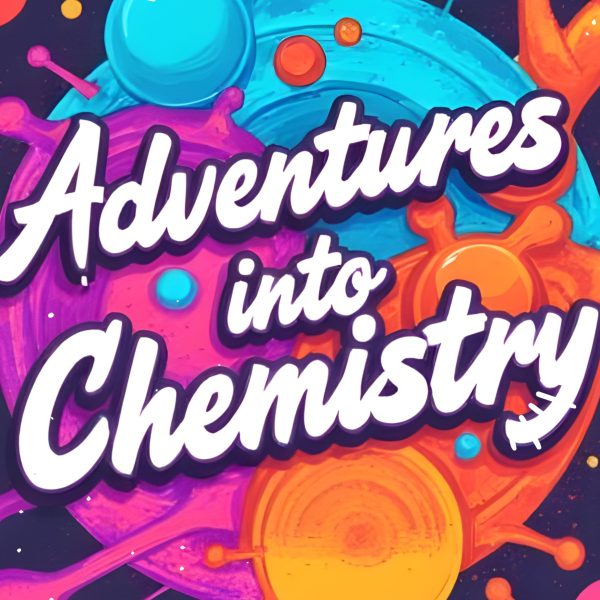
Adventures into Chemistry
- Episodios
- 36
- Se publica
- cada semana
- Último episodio
- 21 Nov 2026
Sobre el podcast
Adventures into Chemistry is a podcast for anyone who’s ever wondered what’s really going on inside the stuff around us. Chemistry is the reason your phone battery works, why onions make you cry, how a tiny tweak to a molecule can turn a poison into a lifesaving drug. It’s strange, powerful, and sometimes a little chaotic. This show dives into the quirky, mind-bending corners of advanced chemistry, Reactions that were discovered by accident. Molecules that glow, explode, heal, stain, or refuse to react at all.
Episodios 36
Why Monster Volcanoes Might Be Coming Back to Life
Unlike traditional volcanoes that slowly build pressure and ooze lava over weeks or months, kimberlite eruptions detonate with supersonic force from 150 kilometers beneath the Earth's mantle, leaving behind …
Notas del episodio
Unlike traditional volcanoes that slowly build pressure and ooze lava over weeks or months, kimberlite eruptions detonate with supersonic force from 150 kilometers beneath the Earth's mantle, leaving behind deep, vertical pipes.
In this episode, we explore the violent mechanics of kimberlite volcanoes—Earth's hidden, long-extinct fury—and how they act as nature's diamond elevators, catastrophically carrying precious gems from deep cratonic roots to the surface.
We trace the historical peak of these explosive events and the mystery of their apparent disappearance.
Finally, we examine recent geological discoveries, such as the 10,000-year-old eruption in Tanzania's Igwisi Hills and seismic scans revealing deep mantle disturbances, which suggest these sleeping giants might not be gone forever.
Meet LUCA: The Last Universal Common Ancestor
Before humans, dinosaurs, or even the first fully formed cells existed, a single microscopic progenitor known as LUCA—the Last Universal Common Ancestor—ignited an unbroken lineage that connects every living …
Notas del episodio
Before humans, dinosaurs, or even the first fully formed cells existed, a single microscopic progenitor known as LUCA—the Last Universal Common Ancestor—ignited an unbroken lineage that connects every living thing on Earth.
In this episode, we explore the deep origins of life, tracing how Carl Woese’s revolutionary 1970s discovery of ribosomal RNA restructured the Tree of Life into three distinct domains: Bacteria, Archaea, and Eukaryotes.
We examine the hostile, asteroid-battered environment of early Earth 4.2 billion years ago, where recent geologic findings and studies suggest life emerged with surprising speed near hydrothermal vents or terrestrial hot springs.
Finally, we dive into the pre-cellular worlds of the RNA era and modern phylogenomic research revealing that LUCA was far from a simple half-baked life form, possessing a robust genome of over 2,000 genes and early antiviral defenses.
Will Fusion Arrive in Time to Fix Climate Change
For decades, nuclear fusion has been dismissed as a "30-year mirage," a distant dream of harnessing the power of the Sun to provide limitless, clean energy. In this episode, we explore the long and winding …
Notas del episodio
For decades, nuclear fusion has been dismissed as a "30-year mirage," a distant dream of harnessing the power of the Sun to provide limitless, clean energy.
In this episode, we explore the long and winding quest for controlled fusion, tracing its historical roots from Sir Arthur Eddington's 1920 insights to the monumental December 2022 breakthrough at the Lawrence Livermore National Laboratory, where researchers used 192 laser beams to finally achieve net energy gain.
We examine the intense engineering challenges of containing searing plasma hotter than the stellar core using tokamaks, stellarators, and inertial confinement, while weighing the technical hurdles of tritium breeding and material degradation.
Finally, we look at the modern global race—from public institutions like ITER to private startups like Helion and Commonwealth Fusion Systems—and evaluate how fusion’s role as a reliable baseload power source can complement renewables to secure a sustainable energy future.
Black and Hot, Universe's Most Common Ice
While heat typically turns solids into liquids and gases, extreme planetary pressures can force water to freeze into a rigid, highly ordered crystal even at temperatures hotter than a blast furnace. In this …
Notas del episodio
While heat typically turns solids into liquids and gases, extreme planetary pressures can force water to freeze into a rigid, highly ordered crystal even at temperatures hotter than a blast furnace.
In this episode, we explore the discovery of superionic ice—a bizarre state of water where heavy oxygen atoms lock into a solid lattice while hydrogen protons flow freely like a liquid.
We trace how researchers at the Laboratory for Laser Energetics used diamond anvils and the powerful OMEGA laser to recreate the extreme conditions found deep inside planetary interiors, capturing direct evidence of a material that computer simulations first predicted over three decades prior.
Finally, we examine why this opaque, dark "black ice" is actually the most common form of water in the universe, shaping the complex magnetic fields and internal dynamics of ice giants like Uranus and Neptune.
Why and When Will Sun Stop Burning
While the vast majority of our atmosphere is made of nitrogen and oxygen—gases that are completely transparent to Earth's outgoing infrared heat—a tiny fraction of trace gases manages to regulate the planet's …
Notas del episodio
While the vast majority of our atmosphere is made of nitrogen and oxygen—gases that are completely transparent to Earth's outgoing infrared heat—a tiny fraction of trace gases manages to regulate the planet's temperature, presenting a central conundrum of climate science.
In this episode, we explore the quantum mechanics behind global warming, tracing how the Earth’s energy balance is maintained and why a handful of molecules can warm an entire world.
We examine the historical roadblocks of early 20th-century climate science, including Knut Ångström's flawed "saturation argument," and reveal how physicist Gilbert Plass revolutionized our understanding in the 1950s by using quantum theory to prove that absorption spectra act more like a "picket fence with gaps" than a solid wall.
Finally, we dive into the microscopic rules of energy levels and electrical imbalances, uncovering how molecules function as quantum tuning forks to trap heat, while setting up a striking paradox regarding the symmetrical structure of carbon dioxide.
How Planetary Systems Have Molecular Origins
Before a planetary system takes shape with rocky worlds and gas giants, it begins as a cold, turbulent cloud of gas and dust where complex chemistry lays the structural foundation for future worlds. In this …
Notas del episodio
Before a planetary system takes shape with rocky worlds and gas giants, it begins as a cold, turbulent cloud of gas and dust where complex chemistry lays the structural foundation for future worlds.
In this episode, we explore the molecular origins of planetary systems, tracing how microscopic dust and ices evolve into the building blocks of planets.
We examine how advanced observatories like the James Webb Space Telescope use infrared transmission spectroscopy to read molecular barcodes in stellar nurseries and exoplanet atmospheres, revealing the vital chemical clues hidden within starlight.
We trace the journey of icy dust grains acting as miniature chemical laboratories in deep freeze, where cascade hydrogenation reactions synthesize complex organic molecules before stellar ignition.
Finally, we reveal how thermal gradients carve protoplanetary disks into distinct chemical zones separated by snow lines, and how the inward drift of icy pebbles and water vapor supplies the raw materials necessary to assemble terrestrial worlds and gas giants alike.
Why Atomic Weights Still Keep Changing
A century and a half after Dmitri Mendeleev organized the building blocks of matter, the absolute weight of our world remains in a fascinating state of constant flux. In this episode, we investigate the hidden …
Notas del episodio
A century and a half after Dmitri Mendeleev organized the building blocks of matter, the absolute weight of our world remains in a fascinating state of constant flux.
In this episode, we investigate the hidden instability within the periodic table’s foundational atomic masses.
We travel back to the mid-nineteenth century, a time when chemistry was paralyzed by a chaotic lack of standard terms, leaving scientists violently divided over something as simple as the chemical formula for water.
This structural crisis triggered the historic 1807 Karlsruhe Congress—the first international scientific conference in history, where a circulated paper by Stanislao Cannizzaro revived Avogadro's hypothesis to permanently establish a logical, unified framework for atomic weights.
We follow the decades-long "wet chemistry" quest for fractional measurement precision into the radioactive discoveries of the early twentieth century.
We track how chemist Frederick Soddy resolved a structural bottleneck in the periodic table by coining the term "isotopes", proving that atoms can be chemically identical yet possess different weights.
Finally, we profile Francis Aston’s invention of the mass spectrograph, revealing how his magnetic "smearing" of neon and chlorine ions cracked open the secret of atomic averages.
We look at how this variable standard continues to dictate industrial megaton scales and why the International Union of Pure and Applied Chemistry (IUPAC) must meticulously track these isotopic shifts to anchor global metrics like the redefinition of the kilogram.
Science Behind Witchcraft
For centuries, courts across Europe and British America prosecuted nearly 100,000 individuals for witchcraft, but modern toxicology and neuroscience reveal that what communities called "black magic" was often a …
Notas del episodio
For centuries, courts across Europe and British America prosecuted nearly 100,000 individuals for witchcraft, but modern toxicology and neuroscience reveal that what communities called "black magic" was often a potent mix of plant chemistry, psychological suggestion, and real-world experimentation.
In this episode, we step inside the volatile world of early modern folklore to look at the spells, potions, and rituals that sent tens of thousands of people to their deaths.
Far from being a product of mere mass hysteria or uneducated delusions, history shows a lively, unregulated culture of experimentation with powerful natural substances.
By looking at the old world of magic through advanced modern lenses like residue analysis, neuroimaging, and gas chromatography-mass spectrometry, we uncover the physical realities hidden behind centuries of folklore.
We trace the deep chemistry that made magic believable, mapping how plants developed nitrogen-containing secondary metabolites, specifically tropane alkaloids like atropine, hyoscyamine, and scopolamine, to violently disrupt the mammalian nervous system and permanently warp body awareness.
We profile the village cunning women and midwives who served as the absolute front lines of medical defense, examining how they transformed everyday remedies into memorable, trusted theatrical spells.
Finally, we put an authentic 1582 English witchcraft trial under the microscope, revealing how a bizarre ritual involving stabbing knives and herbal ale triggered the brain's descending pain modulatory system to provide real, biological relief.
Science of Ice Cream
Most people don’t expect anything special when they open a pint of ice cream, but to a physical chemist, the soft, sweet dessert is one of the most carefully engineered foods we eat. In this episode, we look at …
Notas del episodio
Most people don’t expect anything special when they open a pint of ice cream, but to a physical chemist, the soft, sweet dessert is one of the most carefully engineered foods we eat.
In this episode, we look at the complex physical chemistry behind the perfect scoop.
The long-running ice cream technology course at the University of Guelph teaches that ice cream is a highly contradictory multiphase material consisting of an emulsion, a foam, ice crystals, and a syrup.
Left alone, these elements would naturally separate into a dense layer of butterfat, a puddle of sugary water, and an impenetrable hockey puck of solid ice.
We map out how aggressive churning, trapped atmospheric air, and strategic sugar concentrations actively depress freezing points to glue this architecture together into a scoopable, syrupy paste.
We step inside the microscopic world of the dessert, examining how "partial coalescence" creates protective fat fences around 30-micrometer air bubbles, and how keeping ice crystals under the 50-micrometer threshold tricks the human tongue into perceiving absolute smoothness.
Finally, we explore the mechanical violence of the scraped-surface freezer and break down why replacing sugar with soluble corn fiber in "healthier" recipes completely sabotages the freezing point and the foundational stability of the dessert.
Science of Creating New Chemistry with Light
For centuries, chemistry has relied on heat, pressure, or catalysts to drive reactions, hoping that molecules would blindly collide with enough energy to form new bonds, but a new era of quantum control is …
Notas del episodio
For centuries, chemistry has relied on heat, pressure, or catalysts to drive reactions, hoping that molecules would blindly collide with enough energy to form new bonds, but a new era of quantum control is turning chemistry into a programmable science.
In this episode, we step inside a different kind of chemistry lab: a laser-filled control room where scientists shape focused beams of light lasting only a quadrillionth of a second.
We explore how these ultrafast femtosecond pulses can bypass traditional activation energy barriers.
Instead of heating a flask, which shakes the molecular landscape randomly and creates unwanted byproducts, tailored light waveforms interact directly with a molecule's electrons, temporarily smoothing out obstacles to create a precise path toward a desired product.
We trace the evolution of this optical revolution, from its early constraints in the 1960s to a major 1990s breakthrough led by Herschel Rabitz, who treated pulse-shaping like playing a highly complex piano with over a hundred keys.
We demystify the mechanics of spreading out laser frequencies, tuning their timing, and aligning their mathematical phases to give electrons a perfectly synchronized push.
Finally, we reveal how modern "tracking control" algorithms allow physicists to work entirely backward from a desired result, and explore how this temporary, switchable tool is being used to manipulate solid electronic structures, offering the holy grail of perfect chemical selectivity.
Mysterious Origins of Gold
In this episode, we step inside "The Alchemy of Catastrophe" to unravel one of astrophysics' greatest detective stories: the origin of the heaviest elements on the periodic table. For decades, the stellar math …
Notas del episodio
In this episode, we step inside "The Alchemy of Catastrophe" to unravel one of astrophysics' greatest detective stories: the origin of the heaviest elements on the periodic table. For decades, the stellar math behind the universe's slow-burning nuclear engines could not account for the gold in our safes or the platinum in our laboratories. …Forever Chemicals: A New Hidden Crisis
We are told that life is a simple, unidirectional journey, a steep climb up to a glorious summit in our twenties followed by a long, depressing slide down the other side, but modern biology proves this old map …
Notas del episodio
We are told that life is a simple, unidirectional journey, a steep climb up to a glorious summit in our twenties followed by a long, depressing slide down the other side, but modern biology proves this old map is an absolute joke. In this episode, we dismantle the bleak evolutionary myths surrounding the human timeline to reveal that our development is a vast, shifting topography rather than a single mountain. …Chirality: World’s Most Lethal Bioweapon
There is a crisis brewing in biochemistry that has nothing to do with viruses or AI, but rather with a fundamental property of matter called chirality, or "handedness." Just as your left and right hands are …
Notas del episodio
There is a crisis brewing in biochemistry that has nothing to do with viruses or AI, but rather with a fundamental property of matter called chirality, or "handedness." Just as your left and right hands are mirror reflections that can never be perfectly superimposed, the molecules of life—like DNA and amino acids—exist in two mirrored versions. On Earth, biology has a strict preference: all living things use "left-handed" amino acids and "right-handed" sugars. …Chemistry of Glass
Glass is a scientific paradox—a "frozen liquid" that behaves like a solid while maintaining the chaotic, disordered atomic structure of a fluid. Unlike most solids that snap into neat, crystalline patterns as …
Notas del episodio
Glass is a scientific paradox—a "frozen liquid" that behaves like a solid while maintaining the chaotic, disordered atomic structure of a fluid. Unlike most solids that snap into neat, crystalline patterns as they cool, glass is an amorphous solid that becomes increasingly viscous until its atoms are locked in a jumbled state. …Chemistry of Concrete
Concrete is not a material that simply "dries"; it is a product of complex chemistry that is "born from water". The process begins with cement—limestone and clay cooked at 1,450°C to forge new chemical bonds …
Notas del episodio
Concrete is not a material that simply "dries"; it is a product of complex chemistry that is "born from water". The process begins with cement—limestone and clay cooked at 1,450°C to forge new chemical bonds known as calcium silicates. When water is added, it awakens these compounds, creating a gel where microscopic, crystal-like fibrils of calcium silicate hydrate grow and mesh together like a skeleton. …Strange Forms of Bonding
While we often imagine chemical bonds as rigid sticks connecting atoms, reality is a "fuzzy" glue that even modern AI is still learning to predict. Linus Pauling’s classic 1931 taxonomy remains the foundation …
Notas del episodio
While we often imagine chemical bonds as rigid sticks connecting atoms, reality is a "fuzzy" glue that even modern AI is still learning to predict. Linus Pauling’s classic 1931 taxonomy remains the foundation of chemistry. However, 2025 breakthroughs at the European XFEL, which filmed atoms bonding in real-time, prove that these categories are actually parts of a shifting spectrum. …Chemistry of Paper
Paper is a silent, ubiquitous companion that defines the fabric of daily life, appearing in everything from morning coffee filters to the cereal boxes on our kitchen tables. While it appears to be a smooth …
Notas del episodio
Paper is a silent, ubiquitous companion that defines the fabric of daily life, appearing in everything from morning coffee filters to the cereal boxes on our kitchen tables. While it appears to be a smooth, solid plane, paper is actually a deceptive engineering marvel—a microscopic forest composed of a dense, tangled mesh of interlocking cellulose fibers. …Not So Vanilla: How To Protect Favourite Flavor From Extinction
Vanilla is often used as shorthand for "bland" or "basic," but the reality of the world’s favorite flavor is a high-stakes biological and economic drama. As the second most expensive spice after saffron …
Notas del episodio
Vanilla is often used as shorthand for "bland" or "basic," but the reality of the world’s favorite flavor is a high-stakes biological and economic drama. As the second most expensive spice after saffron, vanilla suffers from extreme market volatility; in 2018, prices spiked to $600 per kilogram—briefly costing more than silver by weight—after a cyclone devastated crops in Madagascar. …Chemistry of Steel
The 1969 Murchison meteorite landing in Australia revealed that the universe is a prolific cook, packed with at least 86 different types of amino acids. Yet, despite this extraterrestrial abundance, every …
Notas del episodio
The 1969 Murchison meteorite landing in Australia revealed that the universe is a prolific cook, packed with at least 86 different types of amino acids. Yet, despite this extraterrestrial abundance, every living cell on Earth relies on a strikingly specific subset of just 20 building blocks. …Why Life is Made of Just 20 Amino Acids
The origins of life are often viewed through the lens of a "prolific and messy" cosmic cook. When the Murchison meteorite struck Australia in 1969, it revealed that the universe is packed with at least …
Notas del episodio
The origins of life are often viewed through the lens of a "prolific and messy" cosmic cook. When the Murchison meteorite struck Australia in 1969, it revealed that the universe is packed with at least eighty-six different types of amino acids, ranging from long chains to complex rings. Yet, despite this extraterrestrial abundance, all life on Earth relies on a strikingly small and specific subset: just twenty building blocks. …Chemistry of Plastics
The story of plastic began not in a high-tech lab, but in a 19th-century quest to replace ivory billiard balls. In the 1860s, a printer named John Wesley Hyatt sought a $10,000 prize by experimenting with …
Notas del episodio
The story of plastic began not in a high-tech lab, but in a 19th-century quest to replace ivory billiard balls. In the 1860s, a printer named John Wesley Hyatt sought a $10,000 prize by experimenting with nitrocellulose—an unstable explosive known as "gun cotton." While his early prototypes were dangerously flammable, they marked the birth of celluloid and the dawn of a new era of "imaginative" materials. …Mechanical Side of Bonding
For over two centuries, chemistry was defined as a story of electronic attraction—the covalent and ionic bonds that act as the rigid "glue" of the universe. However, in the 1960s, a radical new concept emerged …
Notas del episodio
For over two centuries, chemistry was defined as a story of electronic attraction—the covalent and ionic bonds that act as the rigid "glue" of the universe. However, in the 1960s, a radical new concept emerged: the mechanical bond. Unlike traditional bonds where atoms share or steal electrons to stay locked in place, the mechanical bond is a story of entrapment and empty space. …Chemistry of Chocolate
The experience of eating a piece of dark chocolate is a masterclass in "atomic architecture." The satisfying snap and smooth melt-in-your-mouth sensation are not accidents; they are governed by the specific …
Notas del episodio
The experience of eating a piece of dark chocolate is a masterclass in "atomic architecture." The satisfying snap and smooth melt-in-your-mouth sensation are not accidents; they are governed by the specific arrangement of cocoa butter triglycerides. These fat molecules can stack in six different crystalline forms, but only "Form V" provides the glossy finish and precise melting point—just below human body temperature—that defines premium chocolate. …Why Mercury is the Weirdest Metal
The 2025 Nobel Prize in Chemistry celebrates an architectural triumph on a scale invisible to the human eye: the creation of Metal-Organic Frameworks, or MOFs. These materials act as sophisticated …
Notas del episodio
The 2025 Nobel Prize in Chemistry celebrates an architectural triumph on a scale invisible to the human eye: the creation of Metal-Organic Frameworks, or MOFs. These materials act as sophisticated, molecular-sized buildings, engineered with specific "rooms," "channels," and "doors" designed to interact with target molecules. By using metal atoms as cornerstones and rigid, carbon-based molecules as beams, chemists can now construct vast networks of repeating spaces. …Chemistry of Curry
For many, the secret to a great curry lies in a "laundry list" of spices that can seem overwhelming to the uninitiated. However, culinary science reveals that Indian cooking is a precise mosaic where each …
Notas del episodio
For many, the secret to a great curry lies in a "laundry list" of spices that can seem overwhelming to the uninitiated. However, culinary science reveals that Indian cooking is a precise mosaic where each ingredient contributes a unique volatile aroma compound. Unlike Western cuisines, which often pair ingredients that share similar flavor profiles, traditional Indian recipes thrive on "flavor pairing" where ingredients with clashing chemical compounds are brought together to create a…How to Summit Everest in 3 Days
Mountaineering has traditionally been a months-long battle of physiological endurance, where climbers spend weeks trekking and waiting for their bodies to acclimatize to the "death zone" above 8,000 meters …
Notas del episodio
Mountaineering has traditionally been a months-long battle of physiological endurance, where climbers spend weeks trekking and waiting for their bodies to acclimatize to the "death zone" above 8,000 meters. This established rhythm was recently shattered by a British team that completed a round trip from London to the summit of Mount Everest in under seven days. …Chemistry of Red Wine
For nearly one in five wine lovers, a single glass of red wine initiates a painful countdown toward a pulsing headache. This phenomenon has baffled drinkers and scientists alike for centuries, often leaving …
Notas del episodio
For nearly one in five wine lovers, a single glass of red wine initiates a painful countdown toward a pulsing headache. This phenomenon has baffled drinkers and scientists alike for centuries, often leaving silkier, high-end Cabernets to trigger migraines while cheaper spirits leave the same drinkers unscathed. While theories have long pointed to sulfites or histamines, recent scientific breakthroughs have spotlighted a new culprit: a flavonol called quercetin. …What It Takes to Discover a New Element
The periodic table is one of the most powerful predictive tools in science, a masterfully crafted map that has evolved from Mendeleev’s early sketches into a guide for unlocking the secrets of matter. While the …
Notas del episodio
The periodic table is one of the most powerful predictive tools in science, a masterfully crafted map that has evolved from Mendeleev’s early sketches into a guide for unlocking the secrets of matter. While the table has expanded over two centuries, we now stand at a daunting frontier: the search for super-heavy elements that do not exist in nature. …You’re Surrounded by Organic Chemistry
Your morning routine is a chemistry experiment—you just don’t know it yet. From the molecules in your morning coffee to the chemistry of flavors, smells, and materials, this episode explores the surprising ways …
Notas del episodio
Your morning routine is a chemistry experiment—you just don’t know it yet. From the molecules in your morning coffee to the chemistry of flavors, smells, and materials, this episode explores the surprising ways organic chemistry shapes our everyday lives. Why does fresh bread smell so good? What makes a perfume last? And how do colors in food, fabric, and even sunsets come down to molecular tricks? …Analytical Techniques of Chemistry: How to See Molecules You Can’t See ?
How do we study molecules that are too small to see? This episode dives into the high-tech world of spectroscopy—the ultimate detective toolkit for chemists. We uncover how scientists use infrared light …
Notas del episodio
How do we study molecules that are too small to see? This episode dives into the high-tech world of spectroscopy—the ultimate detective toolkit for chemists. We uncover how scientists use infrared light, nuclear magnetism, and mass spectrometry to identify unknown substances, catch drug cheats, and even analyze ancient artifacts. How do forensic scientists track poison in crime investigations? What can chemistry reveal about lost civilizations? …
Podcasts similares
Más podcasts de Ciencias




¿Es tu podcast?
Confírmalo con una entrada en tu feed: aquí recibes un código, lo añades como podcast:txt en el canal de tu feed y nosotros lo comprobamos. Después tu podcast aparecerá como «verificado» en SoundNode.