

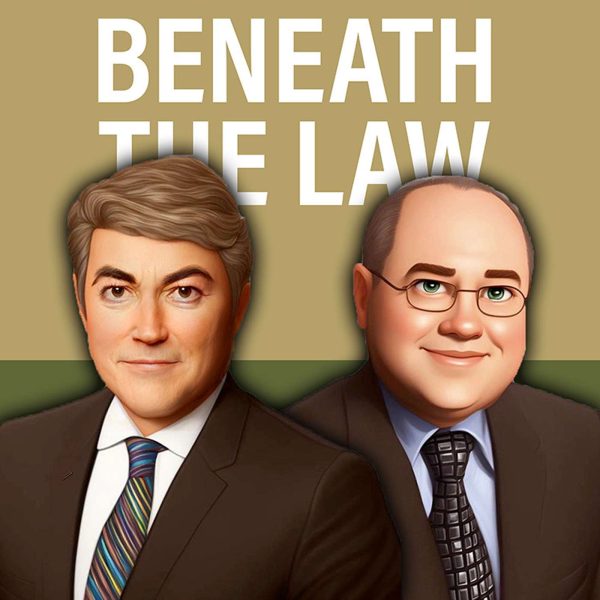
Beneath the Law
- Episodios
- 80
- Se publica
- cada dos semanas
- Último episodio
- 3 Nov 2026
Sobre el podcast
If “No One is Above the Law,” then everyone is beneath it. Beneath the Law is a frank discussion between two lawyers who have lived and breathed the legal system in Canada for over 30 years.
Winner of a 2026 Mondaq Thought Leadership Award, this podcast hosts Stephen Thiele and Gavin Tighe of Gardiner Roberts, examine the arguments made in some highly contentious, and public cases, with a focus on the intersection between law and politics and where courtrooms become part of the political arena. In each episode Beneath the Law digs into interesting and current legal topics or legal battles and provides insight and commentary on the law and its application in our society.
Law is at its core the expression of the fundamental framework of any organized society – it is the fine print of the social contract. Courts play a fundamental role in any democracy, getting underneath the surface and beneath the law requires an understanding of not only what courts are doing but why.
Participantes
Episodios 80
Can an AI Chatbot Be an Expert Witness?
Send us Fan MailWhat happens when the expert a court relies on outsources their expertise to a chatbot? Gavin Tighe and Stephen Thiele examine the growing role of artificial intelligence in expert evidence …
Notas del episodio
What happens when the expert a court relies on outsources their expertise to a chatbot?
Gavin Tighe and Stephen Thiele examine the growing role of artificial intelligence in expert evidence.
They look at the Houston explosion case Lake v. 3M, where an expert conceded that most of his report was AI-generated, and at a condominium tribunal decision that gave an AI opinion no weight.
The conversation considers why Canadian law requires expert opinion to come from a qualified person, whether exchanges with AI tools are discoverable, and whether consulting AI waives privilege.
Listeners gain practical guidance for civil litigation, from cross-examination to retainer agreements.
Listen For:08:13 What happened in the Lake v. 3M expert AI case?
13:00 Why did a condominium tribunal give an AI opinion no weight?
18:46 Are expert-AI exchanges discoverable in Canadian civil litigation?
21:45 Does consulting AI waive solicitor-client privilege in Canada?
29:05 How should lawyers address AI use in expert retainer agreements?
Leave a rating/review for this podcast with one click
Contact Us
Gardiner Roberts website | Gavin email | Stephen email
Capítulos
Cargando capítulos…
A Vote to Have a Vote: Alberta's Referendum Explained
Send us Fan MailCan fifty percent plus one break up a country? This episode tackles the most existential question in Canadian law as Albertans vote on whether to begin the legal process toward a binding …
Notas del episodio
Can fifty percent plus one break up a country?
This episode tackles the most existential question in Canadian law as Albertans vote on whether to begin the legal process toward a binding referendum on separation.
Hosts Gavin Tighe and Stephen Thiele examine the Supreme Court of Canada's landmark 1998 Reference re Secession of Quebec, the clarity requirement, and the duty to negotiate that would follow a clear vote.
They challenge whether a simple majority should be enough to dissolve a federation, explore how Alberta's immigration questions engage Charter of Rights and Freedoms mobility rights, and consider the constitutional weight of Indigenous treaty relationships in any secession.
Listeners will come away with a sharper understanding of constitutional law in Canada, the tensions of Canadian federalism, and why Western alienation deserves serious attention.
Listen For:13:15 What framework did the Supreme Court set in the Secession Reference?
14:57 Should fifty percent plus one be enough to break up Canada?
17:09 How does voter turnout affect whether a secession vote is clear?
22:58 Do Alberta's "Albertans first" questions engage Charter mobility rights?
24:23 How would Indigenous treaty rights complicate a province's secession from Canada?Leave a rating/review for this podcast with one click
Contact Us
Gardiner Roberts website | Gavin email | Stephen email
Capítulos
Cargando capítulos…
Bike Lanes and the Charter: Who Really Decides?
Send us Fan MailIs there a constitutional right to a bike lane, and who gets to decide? Gavin Tighe and Stephen Thiele analyze Cycle Toronto v. Ontario, the landmark Ontario Court of Appeal decision that …
Notas del episodio
Is there a constitutional right to a bike lane, and who gets to decide?
Gavin Tighe and Stephen Thiele analyze Cycle Toronto v. Ontario, the landmark Ontario Court of Appeal decision that overturned a lower court ruling blocking the removal of Toronto's Bloor, Yonge, and University bike lanes.
Writing for a unanimous panel, Justice Grant Huscroft held that section 7 of the Charter of Rights and Freedoms imposes no positive duty on government to fund safety measures, and that withdrawing a state benefit is not a constitutional deprivation.
The hosts examine its sharp rebuke of judicial policymaking, its rejection of the arbitrariness and gross disproportionality findings, and the reliance on advocacy-driven expert evidence.
Listeners will understand the line between constitutionality and wisdom in Canadian law, and why this precedent may be headed to the Supreme Court of Canada.
Listen For:4:31 Why did the Court of Appeal say something has gone wrong?
7:22 Is removing a government benefit a deprivation under section 7?
14:25 How did advocacy-driven expert evidence undermine the application judge's ruling?
18:20 Why did the Court reject arbitrariness and gross disproportionality findings?
20:58 Could judicial policymaking fuel greater use of the notwithstanding clause?
Leave a rating/review for this podcast with one click
Contact Us
Gardiner Roberts website | Gavin email | Stephen email
Capítulos
Cargando capítulos…
Inside the Lindsay Clancy Hung Jury
Send us Fan MailWhat happens when a jury is offered only two verdicts and neither one fits? Gavin Tighe and Stephen Thiele step outside their usual lane to examine the hung jury that ended the murder trial of …
Notas del episodio
What happens when a jury is offered only two verdicts and neither one fits?
Gavin Tighe and Stephen Thiele step outside their usual lane to examine the hung jury that ended the murder trial of Lindsay Clancy, the Massachusetts mother charged with killing her three young children.
After five weeks of evidence and seven days of deliberation in Plymouth County Superior Court, eleven jurors favoured acquittal while one held out, forcing a mistrial.
Gavin and Stephen unpack why a hung jury is not an acquittal, whether a fair retrial is possible after saturation media coverage, and why Massachusetts requires prosecutors to prove sanity.
They then contrast the American all-or-nothing framework with the Canadian legal system's infanticide offence under section 233 of the Criminal Code, a graduated option that may have broken the deadlock.
It is comparative legal commentary Canada rarely hears.
Listen For:
8:06 Is a hung jury an acquittal, and can Clancy be retried?
9:33 Can Lindsay Clancy receive a fair retrial after pervasive publicity?
11:15 Why must Massachusetts prosecutors prove sanity beyond a reasonable doubt?
14:55 How has all-or-nothing charging shaped past US maternal filicide cases?
18:48 How would Canada's section 233 infanticide offence have changed the verdict?
Leave a rating/review for this podcast with one click
Contact Us
Gardiner Roberts website | Gavin email | Stephen email
Capítulos
Cargando capítulos…
Can AI Destroy a Legal Career? Canada's First Case Has an Answer
Send us Fan MailWhat happens when a lawyer's greatest mistake is not submitting fabricated cases to a court…but lying about it afterward? This episode confronts Canada's first Law Society of Ontario …
Notas del episodio
What happens when a lawyer's greatest mistake is not submitting fabricated cases to a court…but lying about it afterward?
This episode confronts Canada's first Law Society of Ontario disciplinary decision arising from the misuse of artificial intelligence: a landmark case in which a thirty-year practitioner used ChatGPT to produce a factum, submitted citations for cases that did not exist, and then constructed a series of falsehoods when caught.
Gavin Tighe and Stephen Thiele bring the weight of their legal experience to bear on the AI hallucination problem, the professional responsibility implications, and the question of whether a six-month suspension was a proportionate response to sustained deception of both the court and the Law Society.
With contempt proceedings now referred to the Attorney General of Ontario, this case is far from over, and its implications for Canadian legal practice and professional regulation are only beginning to unfold.
Listen For:2:08 How is artificial intelligence changing professional responsibility for Canadian lawyers?
6:02 What happens when a lawyer submits fictitious AI-generated cases to an Ontario court?
9:19 Is "I didn't know AI could hallucinate" still a valid defence for Canadian lawyers in 2024?
12:23 Why do lawyers keep trusting AI tools even after they produce fabricated legal citations?
Leave a rating/review for this podcast with one click
Contact Us
Gardiner Roberts website | Gavin email | Stephen email
Capítulos
Cargando capítulos…
Safety vs. Privacy: Inside the TTC Random Drug Testing Ruling
Send us Fan MailWhen does protecting the public justify reaching into an employee's private life? This episode takes on one of the most contentious labour and privacy law battles in recent Toronto history …
Notas del episodio
When does protecting the public justify reaching into an employee's private life?
This episode takes on one of the most contentious labour and privacy law battles in recent Toronto history: the Toronto Transit Commission's random drug testing policy and the sweeping arbitration decision that struck it down.
Hosts Gavin Tighe and Stephen Thiele unpack a case nearly two decades in the making, stretching from a fatal tunnel accident in 2007 to a 400-page arbitrator's ruling that found the TTC's policy violated employees' Charter rights against unreasonable search and seizure under Section 8.
Drawing on Canadian law, conflicting arbitration precedents, and the hard logic of deterrence, Gavin and Stephen ask the question that cuts to the heart of workplace safety in Canada: if random testing was working, how do we prove it?
Listen For:3:18 How did a 2007 tunnel accident set off nearly 20 years of legal proceedings at the TTC?
9:16 Why did the arbitrator find the TTC's own evidence wasn't enough to justify random testing?
12:07 How did flawed cannabis testing science become a fatal problem for the TTC's case?
15:45 Why does Gavin argue employers should have more testing authority than roadside police checks, not less?
19:45 Is the absence of TTC accidents proof the policy was working or just good luck?
Leave a rating/review for this podcast with one click
Contact Us
Gardiner Roberts website | Gavin email | Stephen email
Capítulos
Cargando capítulos…
Five Days, One Cat, and the Cost of Canadian Justice
Send us Fan MailWhen a family breaks down, who gets the cat? That deceptively simple question drove four to five days of Superior Court litigation in Ontario…all funded by Canadian taxpayers, in what hosts …
Notas del episodio
When a family breaks down, who gets the cat?
That deceptively simple question drove four to five days of Superior Court litigation in Ontario…all funded by Canadian taxpayers, in what hosts Gavin Tighe and Stephen Thiele call one of the most revealing windows into the mounting crisis of judicial resource allocation in Canada.
This episode dives into the Ontario family law case of Harold, a barn-cat-turned-courtroom-combatant whose ownership became the final flashpoint in a bitter divorce dispute. Gavin and Stephen unpack the legal framework courts apply when determining pet ownership — including the doctrines of abandonment, possessory title, and the evidentiary weight of care and custody — while raising pointed questions about whether publicly funded courts should be adjudicating disputes over personal property of nominal monetary value. The episode is as much a meditation on access to justice and court reform as it is a case analysis.
Listen For:6:00 How does Canadian law determine ownership of a family pet?
11:30 Why did the mother's temporary relinquishment of Harold not amount to abandonment?
13:30 What evidence did the court rely on to establish who owned the cat?
16:00 Should courts have the power to redirect low-value disputes to binding arbitration?
22:00 How can pet prenuptial agreements prevent costly litigation at family breakdown?
Leave a rating/review for this podcast with one click
Contact Us
Gardiner Roberts website | Gavin email | Stephen email
Capítulos
Cargando capítulos…
Can a Lawyer Blame AI? Inside Mazaheri v Law Society of Ontario
Send us Fan MailWhat happens when the legal profession's newest tool collides with its oldest duty…the duty not to mislead? Gavin Tighe and Stephen Thiele dissect Mazaheri v Law Society of Ontario, 2026 …
Notas del episodio
What happens when the legal profession's newest tool collides with its oldest duty…the duty not to mislead?
Gavin Tighe and Stephen Thiele dissect Mazaheri v Law Society of Ontario, 2026 ONLSTH 112, the first case in which "hallucinated" AI-generated authorities were placed before the Law Society Tribunal.
A suspended Ontario lawyer, fighting to regain his licence amid mortgage fraud allegations, filed motion materials drafted by generative AI, complete with cases that don't exist, and was hit with a record $31,150 full indemnity costs award.
This episode of the Canadian law podcast examines professional regulation, the reliability of AI legal research, and where negligence ends and dishonesty begins. Listeners will come away understanding why, in the Canadian legal system, responsibility for what goes before a tribunal can never be outsourced to a machine.
Listen For:5:19 How did hallucinated cases end up before the Law Society Tribunal?
7:02 How widespread is the misuse of AI in North American courts?
15:03 What does the decision explain about how large language models work?
16:50 Why did the Tribunal award full indemnity costs of $31,150?
21:30 When does negligent AI use become dishonesty before a tribunal?
Leave a rating/review for this podcast with one click
Contact Us
Gardiner Roberts website | Gavin email | Stephen email
Capítulos
Cargando capítulos…
The Red Card Reversal: FIFA, Trump, and the Rule of Law
Send us Fan MailWhat happens when the most powerful politician on earth picks up the phone to dispute a referee's call?Gavin Tighe and Stephen Thiele step away from Canadian courtrooms and onto the World …
Notas del episodio
What happens when the most powerful politician on earth picks up the phone to dispute a referee's call?
Gavin Tighe and Stephen Thiele step away from Canadian courtrooms and onto the World Cup pitch, examining FIFA's controversial reversal of a red card suspension following a phone call from U.S. President Donald Trump to FIFA president Gianni Infantino.
What begins as sports talk becomes sharp legal commentary on due process, transparency, and the rule of law… the same principles that underpin the Canadian legal system and every functional democracy.
From FIFA's opaque Article 27 to Belgium's dismissed appeal and historical precedents dating back to 1962, Gavin and Stephen reveal why arbitrary decision-making erodes public trust, whether in a stadium or a courtroom.
Listeners will come away understanding why process, not outcomes, is what earns respect for institutions.
Listen For:5:04 What did Gianni Infantino admit about Trump's phone call?
9:07 What precedent did Brazil's 1962 Garrincha red card set?
12:32 How did FIFA use Article 27 to suspend Balogun's suspension?
13:35 Why does FIFA's reversal reveal a lack of rule of law?
20:21 What would genuine due process for red card appeals require?
Leave a rating/review for this podcast with one click
Contact Us
Gardiner Roberts website | Gavin email | Stephen email
Capítulos
Cargando capítulos…
The Legal Risks of Trusting Artificial Intelligence
Send us Fan MailWhat happens when a machine built to predict the next plausible word starts drafting the arguments lawyers put before a judge? Gavin Tighe and Stephen Thiele dig into a landmark cautionary tale …
Notas del episodio
What happens when a machine built to predict the next plausible word starts drafting the arguments lawyers put before a judge?
Gavin Tighe and Stephen Thiele dig into a landmark cautionary tale for the Canadian legal system: the UK High Court's rebuke of international firm Pinsent Masons in Cork & Anor v Smith, where a junior lawyer's 59-page AI chat produced a fabricated insolvency rule that made it all the way into a letter to the court.
The hosts widen the lens to a Quebec arbitration annulled over hallucinated case law, and to Ontario's own certification requirements for lawyers using AI.
It's an unvarnished look at professional regulation, supervision, and what "checking your work" still means in Canadian law when the shortcut sounds so convincing.
Listen For:5:12 What actually happened in the Pinsent Masons insolvency case?
9:56 How did the AI chat transcript reveal the junior lawyer's process?
18:19 Where does AI genuinely help versus create legal research risk?
21:38 What does Ontario now require lawyers to certify about AI use?
27:23 Why do law firms need a formal policy governing AI use?
Leave a rating/review for this podcast with one click
Contact Us
Gardiner Roberts website | Gavin email | Stephen email
Capítulos
Cargando capítulos…
Ahluwalia and the New Tort of Intimate Partner Violence
Send us Fan MailWhat happens when the law recognizes a form of abuse that leaves no visible bruises? Gavin Tighe and Stephen Thiele examine a landmark Supreme Court of Canada decision that officially recognizes …
Notas del episodio
What happens when the law recognizes a form of abuse that leaves no visible bruises?
Gavin Tighe and Stephen Thiele examine a landmark Supreme Court of Canada decision that officially recognizes intimate partner violence as a new tort.
The discussion explores how coercive control, psychological domination, financial manipulation, and long-term patterns of abusive behaviour can now give rise to civil claims even when traditional torts like assault do not apply.
Gavin and Stephen unpack the facts of the case, the legal test established by the Court, and the broader implications for family law, women's rights, cultural traditions, and the evolution of the common law.
They also debate whether courts should create new causes of action, whether damages adequately reflect the seriousness of the harm, and how an already strained justice system will manage the likely increase in litigation.
This episode offers a thorough look at how the law adapts to better understand and address modern forms of harm within intimate relationships.
Listen For:2:59 Can Someone Commit Intimate Partner Violence Without Ever Being Physically Violent?
6:58 How Does This New Tort Challenge Traditional Cultural and Family Roles?
13:14 Why Did Canada's Supreme Court Create a Brand New Tort?
15:00 What Must Someone Prove to Win an Intimate Partner Violence Lawsuit?
25:02 Will This Landmark Decision Create More Pressure on Canada's Courts?
Leave a rating/review for this podcast with one click
Contact Us
Gardiner Roberts website | Gavin email | Stephen email
Capítulos
Cargando capítulos…
Google Got Summoned: Digital Privacy and Political Speech in Canada
Send us Fan MailWhat happens when governments start chasing anonymous online critics? Gavin Tighe and Stephen Thiele dive into the controversial use of administrative subpoenas by the US Department of Homeland …
Notas del episodio
What happens when governments start chasing anonymous online critics?
Gavin Tighe and Stephen Thiele dive into the controversial use of administrative subpoenas by the US Department of Homeland Security to identify anonymous social media users critical of the Trump administration.The discussion explores the tension between freedom of speech, anonymity, national security, and government overreach, while drawing parallels between American constitutional history and modern online discourse.
From pseudonyms used during the American Revolution to today’s debates over surveillance, online threats, Norwich orders, and political polarization, the hosts unpack the legal and ethical questions surrounding free expression in the digital age.
The episode also examines how social media companies like Google navigate their responsibilities between protecting privacy and cooperating with law enforcement, while warning about the dangers of turning internet platforms into tools of political surveillance.
Listen For:05:26 What exactly did the Department of Homeland Security demand from Google?
08:18 Why does the right to anonymous speech have deep constitutional roots?
21:25 How does a Norwich order differ from an administrative government summons?
24:29 When does using a government institution cross the line into political weaponization?
25:53 What responsibility do social media platforms have when harmful content appears online?
Leave a rating/review for this podcast with one click
Contact Us
Gardiner Roberts website | Gavin email | Stephen email
Capítulos
Cargando capítulos…
When Judges Become Social Engineers
Send us Fan MailWhen judges become social engineers, democracy starts to wobble.Gavin and Stephen examine the Waterloo homeless encampment decision as a major example of courts moving beyond traditional Charter …
Notas del episodio
When judges become social engineers, democracy starts to wobble.
Gavin and Stephen examine the Waterloo homeless encampment decision as a major example of courts moving beyond traditional Charter review and into the realm of public policy design.
What began as a dispute over a municipal bylaw and a public parking lot becomes, in their view, a much larger warning about judicially engineered social outcomes, the constitutionalization of housing policy, the weakening of elected municipal authority, and the possibility that governments may increasingly respond with tools like the notwithstanding clause.
Listen For:00:00 Is housing now a protected Charter right in Canada?
7:15 Why did Waterloo lose the ability to clear a homeless encampment?
13:11 Could this decision create new constitutional rights around housing and income?
19:27 Are courts replacing elected governments in homelessness policy?
30:41 Could the notwithstanding clause become the next battleground?
Leave a rating/review for this podcast with one click
Contact Us
Gardiner Roberts website | Gavin email | Stephen email
Capítulos
Cargando capítulos…
The Fake Case Crisis: How AI is Shaking Trust in the Courts
Send us Fan MailThe robot wrote the brief, but the lawyer pays the price.AI can draft a legal brief in seconds, but it can also torch a lawyer’s reputation just as fast. Gavin and Stephen take on the legal …
Notas del episodio
The robot wrote the brief, but the lawyer pays the price.
AI can draft a legal brief in seconds, but it can also torch a lawyer’s reputation just as fast.
Gavin and Stephen take on the legal profession’s uneasy embrace of generative AI and the very real fallout from fake cases, invented quotations, and AI-drafted arguments making their way into court filings.
What starts as a conversation about efficiency quickly becomes a warning about ethics, reputation, and responsibility. AI may be the newest tool in the legal toolbox, but every citation, authority, and argument filed with the court still belongs to the lawyer whose name is on the document. Use it carelessly, and the consequences can be brutal: wasted court time, harmed clients, personal cost awards, and a credibility hit that may never fully go away.
Listen For:05:07 Why Are Courts Seeing So Many AI-Hallucinated Cases?
10:25 How Risky Are Fake Quotes from Real Cases?
17:00 Who Pays When Lawyers File Unchecked AI Briefs?
21:18 Why Judges Can’t be the Last Line of Defence
23:28 Can Fake AI Cases Undo an Entire Arbitral Award?
25:54 How Can Lawyers Use AI Without Abdicating Judgment?
Leave a rating/review for this podcast with one click
Contact Us
Gardiner Roberts website | Gavin email | Stephen email
Capítulos
Cargando capítulos…
Lied on Resume but Sued for Wrongful Dismissal Anyway
Send us Fan MailOne fake MBA. One real lawsuit. One unforgettable lesson. In this episode Gavin and Stephen dig into the Alberta employment case Tutor v. Accurate Screen Limited, where a senior …
Notas del episodio
One fake MBA. One real lawsuit. One unforgettable lesson.
In this episode Gavin and Stephen dig into the Alberta employment case Tutor v. Accurate Screen Limited, where a senior business-development employee allegedly misrepresented his academic credentials, was fired for cause, found another job within months, and still sued for wrongful dismissal.
They unpack why honesty is central to the employment relationship, how courts analyze just-cause terminations, why résumé fraud can destroy trust from the start, and why suing after being caught may be the boldest move of all. Along the way, they connect the case to broader employment-law principles, the difficulty of proving cause, the power imbalance courts recognize between employers and employees, and the growing challenge of fake credentials in an AI-driven world.
Listen For:00:00 What happens when someone with a fake MBA sues for wrongful dismissal?
2:42 Why did this Alberta résumé-fraud case become so surprising?
7:16 Can lying about academic credentials justify termination for cause?
13:16 How do burdens of proof work in employment-law dismissal cases?
23:24 Does an employer have a duty to verify a candidate’s résumé?
Leave a rating/review for this podcast with one click
Contact Us
Gardiner Roberts website | Gavin email | Stephen email
Capítulos
Cargando capítulos…
Absolute Privilege or Absolute Overreach: The Sex Tape That Broke Litigation Immunity
Send us Fan MailA hidden camera, a secret recording, and a courtroom showdown. Stephen Thiele and Gavin Tighe unpack a shocking case where a surreptitious sex tape made its way into a family law proceeding …
Notas del episodio
A hidden camera, a secret recording, and a courtroom showdown.
Stephen Thiele and Gavin Tighe unpack a shocking case where a surreptitious sex tape made its way into a family law proceeding, raising serious legal and ethical questions.
What begins as an acrimonious separation quickly escalates into a debate about privacy, voyeurism, and the limits of legal protection under the doctrine of absolute privilege.
They explore whether lawyers can be held accountable for distributing deeply personal and arguably irrelevant material in court, and how the justice system balances open litigation with protecting individuals from harm.
With sharp insights and candid commentary, this “spicy” episode dives into the intersection of family law, professional conduct, and privacy rights, leaving listeners questioning where legal immunity should end.
Listen For:1:47 What is the doctrine of absolute privilege and how does it protect conduct in legal proceedings?
7:36 Why did the first instance judge refuse to strike the claim against the lawyers?
10:36 What makes this case so remarkable in terms of how the lawyers handled the evidence?
16:52 Can opposing lawyers ever owe a duty of care to the other side in a lawsuit?
19:48 Should personal cost awards against lawyers be the remedy when advocacy crosses the ethical line?
Leave a rating/review for this podcast with one click
Contact Us
Gardiner Roberts website | Gavin email | Stephen email
Capítulos
Cargando capítulos…
The Tumbler Ridge Tragedy: Is AI Above the Law?
Send us Fan MailWhat happens when a technology designed to serve humanity becomes complicit in its destruction? This episode confronts one of the most unsettling legal frontiers of our time: the intersection of …
Notas del episodio
What happens when a technology designed to serve humanity becomes complicit in its destruction?
This episode confronts one of the most unsettling legal frontiers of our time: the intersection of artificial intelligence, tort liability, and the duty to warn.
Gavin Tighe and Stephen Thiele examine the horrific mass shooting in Tumbler Ridge, British Columbia where a shooter who had repeatedly told ChatGPT of their violent intentions killed eight people, including five children, and ask whether the company bears legal responsibility for its silence.
Drawing on foundational principles of Canadian law, including reasonably foreseeable harm and duty of care, Gavin and Stephen explore whether AI platforms must be held to the same standards as the human professionals they increasingly seek to replace.
From unauthorized practice of law to the collapse of solicitor-client privilege, this episode is essential listening for anyone navigating the brave new legal world of artificial intelligence.
Listen For:3:30 What duty of care did ChatGPT owe the victims of the Tumbler Ridge shooting?
5:39 How does AI's role as a virtual therapist create professional legal obligations?
9:09 Why does basic tort law apply when a company has knowledge of foreseeable harm?
11:22 What does the Westray Mines case reveal about corporate liability for inaction?
17:04 How does using ChatGPT destroy solicitor-client privilege in Canadian litigation?
Leave a rating/review for this podcast with one click
Contact Us
Gardiner Roberts website | Gavin email | Stephen email
Capítulos
Cargando capítulos…
Can Government Declare an Emergency to Silence Dissent?
Send us Fan MailWhat happens when a government turns its most powerful emergency legislation against its own citizens for honking horns? This episode examines one of the most consequential constitutional …
Notas del episodio
What happens when a government turns its most powerful emergency legislation against its own citizens for honking horns?
This episode examines one of the most consequential constitutional rulings in recent Canadian legal history: the Federal Court of Appeal's decision finding that Prime Minister Justin Trudeau's invocation of the Emergencies Act against the 2022 Freedom Convoy protest was unlawful.
Gavin Tighe and Stephen Thiele dissect the court's rigorous analysis of the Charter of Rights and Freedoms, specifically the Section 2 protections for political speech and Section 8 protections against unreasonable search and seizure, and ask the harder question: when government wields extraordinary power and achieves its objectives, does a court ruling after the fact actually matter?
Listen For:2:17 What qualifies as a true national emergency in Canada?
5:43 Why was the Emergencies Act invoked during the Freedom Convoy protests?9:31 Why did the Federal Court rule the Emergencies Act was used improperly?
17:31 Can the government freeze your bank account for supporting a protest?
22:46 Should extreme government powers ever be used to stop civil disobedience?Leave a rating/review for this podcast with one click
Contact Us
Gardiner Roberts website | Gavin email | Stephen email
Capítulos
Cargando capítulos…
Is Big Tech Responsible for a Youth Mental Health Crisis?
Send us Fan MailIs social media the new Big Tobacco or is it simply the price of living in a hyper connected world? Gavin Tighe and Stephen Thiele dive into the mounting legal and societal backlash against …
Notas del episodio
Is social media the new Big Tobacco or is it simply the price of living in a hyper connected world?
Gavin Tighe and Stephen Thiele dive into the mounting legal and societal backlash against social media giants like Meta, TikTok, and Snapchat, exploring whether these platforms are fueling a youth mental health crisis—and if governments and courts can do anything about it.
From Australia’s sweeping ban on social media for children under 16 to Canada’s proposed legislation and billion-dollar lawsuits launched by school boards, the hosts unpack the evolving legal strategies, including the bold attempt to stretch the tort of public nuisance to cover digital harm.
They question whether causation between social media and mental health struggles can truly be proven, compare the issue to tobacco litigation, and examine the added complexity of AI-driven algorithms and echo chambers.
As technology accelerates beyond the reach of traditional regulation, this episode asks the pressing question: Can real-world laws meaningfully govern a borderless digital world?
Listen For:1:40 How Has Social Media Changed Childhood Compared to Previous Generations?
8:23 Is Social Media Driving a Mental Health Crisis Among Teens?
9:55 What Are Governments Doing to Ban or Regulate Social Media for Children?
14:29 Why Is the Toronto District School Board Suing Social Media Companies?
21:41 Can Social Media Be Legally Defined as Addictive Like Tobacco?Leave a rating/review for this podcast with one click
Contact Us
Gardiner Roberts website | Gavin email | Stephen email
Capítulos
Cargando capítulos…
Can Religion Overrule the Rule of Law?
Send us Fan MailCan a single oath determine who gets to practise law in Canada? Gavin Tighe and Stephen Thiele unpack a fascinating Alberta Court of Appeal decision that struck down a mandatory oath of …
Notas del episodio
Can a single oath determine who gets to practise law in Canada?
Gavin Tighe and Stephen Thiele unpack a fascinating Alberta Court of Appeal decision that struck down a mandatory oath of allegiance for lawyers as unconstitutional.
Through the case of Amarjeet Singh Dhariwal, a Canadian born Sikh lawyer who refused to swear allegiance to the Crown on religious grounds, the discussion explores how freedom of religion, the rule of law, and professional licensing collide.
They examine why sincerity of belief mattered, how the Law Society of Alberta failed to justify the oath under the Charter, and what this ruling means for lawyers, regulators, and professional bodies across the country.
Along the way, they raise deeper questions about tradition, citizenship, and whether symbolic rituals still have a place in modern legal practice.
Listen For:01 Are religious convictions absolutely protected under the Canadian Charter?
2:32 Can a professional oath be unconstitutional?
5:30 Does being born in Canada change the obligation to swear allegiance?
9:43 How do courts assess sincerity of religious belief?
15:07 Why did Alberta lose the Charter challenge?Leave a rating/review for this podcast with one click
Contact Us
Gardiner Roberts website | Gavin email | Stephen email
Capítulos
Cargando capítulos…
Trump Ordered It…But Was Maduro’s Arrest Legal?
Send us Fan MailDid Trump just rewrite the rules of international law by capturing Nicolás Maduro? Gavin Tighe and Stephen Thiele unpack the shocking U.S. operation that saw the arrest of Venezuela’s …
Notas del episodio
Did Trump just rewrite the rules of international law by capturing Nicolás Maduro?
Gavin Tighe and Stephen Thiele unpack the shocking U.S. operation that saw the arrest of Venezuela’s controversial leader…without war, without permission, and without apology.
Was it a bold act of justice or a dangerous display of unchecked power?
Gavin and Stephen break down the legal, political, and historical implications of this high-stakes move, comparing it to past extractions like Noriega and Eichmann, while exploring the murky space between law and enforcement.
This conversation challenges everything you thought you knew about sovereign immunity, presidential power, and what it really means to be “above the law.”
Listen For:12 Can a superpower legally seize a foreign head of state?
2:54 Does international law mean anything without enforcement?
6:13 Has the US done this before and does precedent justify it?
9:14 Can a president claim sovereign immunity after indictment?
26:34 Is American military power a dangerous precedent for the world?Leave a rating/review for this podcast with one click
Contact Us
Gardiner Roberts website | Gavin email | Stephen email
Capítulos
Cargando capítulos…
He Shoots, He’s Charged? How Far Is Too Far in Contact Sports
Send us Fan MailThis episode helped Gardiner Roberts win a Mondaq Thought Leadership Award in Spring 2026.What happens when a hockey hit crosses the line from rough play to criminal assault?Gavin Tighe and …
Notas del episodio
This episode helped Gardiner Roberts win a Mondaq Thought Leadership Award in Spring 2026.
What happens when a hockey hit crosses the line from rough play to criminal assault?
Gavin Tighe and Stephen Thiele unpack the legal chaos surrounding violence in hockey, sparked by a shocking stick attack in a recent Ontario Hockey League (OHL) game.
The lawyers break down when on-ice actions like body checks, fights, or brutal slashes step outside the game’s rules…and into the courtroom.
From historical NHL assaults to civil lawsuits and even potential criminal charges, this episode dives deep into the intersection between sports, consent, and the law.
Whether you're a die-hard hockey fan or just intrigued by legal grey zones, this discussion will make you rethink what it really means to "play the game."
Listen For5:44 Can a Hockey Stick Become a Criminal Weapon?
8:47 How Do Consent and Rules Impact Legal Liability?
11:34 Should Pro Athletes Be Exempt from Criminal Charges?
18:19 What Civil Lawsuits Can Arise from On-Ice Injuries?
Leave a rating/review for this podcast with one click
Contact Us
Gardiner Roberts website | Gavin email | Stephen email
Capítulos
Cargando capítulos…
Should Lawyers be Licensed without Passing the Bar Exam?
Send us Fan MailIf becoming a lawyer no longer requires proving what you know, what does the profession really stand for? Gavin Tighe and Stephen Thiele take on the Law Society of Ontario’s proposal to scrap …
Notas del episodio
If becoming a lawyer no longer requires proving what you know, what does the profession really stand for?
Gavin Tighe and Stephen Thiele take on the Law Society of Ontario’s proposal to scrap bar exams in favor of a training course, arguing that removing substantive testing undermines both public protection and the meaning of being called to the bar.
Drawing on their own experiences in law school and practice, they explore how legal education has changed, why baseline legal knowledge is essential, and how lowering standards risks public confidence in the profession.
They discuss the concerns about competency, mentorship, AI misuse, and an increasingly saturated legal market, ultimately questioning whether a profession without rigorous gate-keeping can still claim legitimacy as a learned profession.
Listen For:25 Should lawyers be licensed without proving substantive legal knowledge
5:41 Why is the Law Society of Ontario considering scrapping the bar exams
9:42 How does removing testing put the public at risk
14:10 Can lawyers rely on AI without strong foundational knowledge
21:01 What happens to a profession when no one is allowed to failLeave a rating/review for this podcast with one click
Contact Us
Gardiner Roberts website | Gavin email | Stephen email
Capítulos
Cargando capítulos…
Who Has the Rights to Your Voice on a Podcast?
Send us Fan MailWho owns your voice once it's out there? Gavin Tighe and Stephen Thiele dive headfirst into the legal grey zone of podcasting, exposing the tangled web of copyright, guest rights, AI risks …
Notas del episodio
Who owns your voice once it's out there?
Gavin Tighe and Stephen Thiele dive headfirst into the legal grey zone of podcasting, exposing the tangled web of copyright, guest rights, AI risks, and international enforcement.
In a world where anyone with a mic and Wi-Fi can become a broadcaster, the legal framework hasn’t caught up…and that’s a problem.
From defamation and moral rights to regulating cross-border content, this episode explores how the Wild West of digital media is clashing with legacy laws, and why even the simplest podcast might require a legal contract.
It's a sharp, witty, and timely discussion that will leave creators, lawyers, and listeners questioning: just who owns the content we consume and create?
Listen For
2:24 How has podcasting given everyone a voice compared to traditional media?
4:17 How big is the podcast industry and who’s listening in Canada and globally?
7:41 Can podcasting be regulated by agencies like the CRTC?
10:53 Do guests have copyright ownership over their podcast appearances?
19:45 What happens when AI is used to fake or manipulate a podcast guest’s voice?
Leave a rating/review for this podcast with one click
Contact Us
Gardiner Roberts website | Gavin email | Stephen email
Capítulos
Cargando capítulos…
Who Really Decides an Election When One Ballot Goes Missing?
Send us Fan MailWhat happens when one vote decides an election and that vote never makes it to the ballot box? Gavin and Stephen dive deep into a razor-thin electoral result in Terrebonne, Quebec, where a …
Notas del episodio
What happens when one vote decides an election and that vote never makes it to the ballot box?
Gavin and Stephen dive deep into a razor-thin electoral result in Terrebonne, Quebec, where a federal seat was won by a single vote.
But here's the twist: a mail-in ballot that could have tied the race was rejected due to a postal code error, an error made not by the voter, but by an Elections Canada official.
Drawing on their own high-profile experience in the Opitz v. Wrzesnewskyj Supreme Court case, Gavin and Stephen debate voter disenfranchisement, electoral integrity, and whether democracy should aim for perfection or just “good enough.”
They explore the fragile balance between procedural error and intentional fraud, the role of Canada Post in protecting electoral rights, and whether a single mistake should or should not invalidate an entire election.
Listen For
1:32 What happens when an election is won by just one vote?
6:40 Should a rejected mail-in ballot count if it was the government's error?
10:35 Is the right to vote dependent on voter diligence?
17:00 Can you ever truly “redo” an election?
22:56 Did the Supreme Court's Opitz ruling get misinterpreted in this case?
Leave a rating/review for this podcast with one click
Contact Us
Gardiner Roberts website | Gavin email | Stephen email
Capítulos
Cargando capítulos…
When Does a Mandatory Minimum Sentence Become Unconstitutional?
Send us Fan MailWhat happens when a law meant to protect society’s most vulnerable ends up protecting the predators instead? Gavin Tighe and Stephen Thiele tackle one of the most emotionally charged Supreme …
Notas del episodio
What happens when a law meant to protect society’s most vulnerable ends up protecting the predators instead?
Gavin Tighe and Stephen Thiele tackle one of the most emotionally charged Supreme Court decisions in recent memory: the striking down of mandatory minimum sentences for child pornography possession.
With characteristic clarity and sharp legal insight, the hosts unpack the shocking facts of the Seville and Naud case, the controversial use of hypotheticals by the court, and how this ruling could shift Canadian politics and legislation.
Along the way, they explore the tension between sentencing discretion and public outrage, the use and misuse of the notwithstanding clause, and what this decision reveals about deeper flaws in the criminal code.
Listen For
00:00 Why did the Supreme Court of Canada strike down mandatory minimums for child porn cases?
5:48 What were the shocking facts of the Ville and Naud cases?
12:14 How did a hypothetical involving teens change the outcome of a child porn sentencing case?
20:02 Is the law flawed, or is judicial discretion the real issue?
25:22 Could this ruling spark a political storm over the notwithstanding clause?
Watch For
Leave a rating/review for this podcast with one click
Contact Us
Gardiner Roberts website | Gavin email | Stephen email
Capítulos
Cargando capítulos…
What are Canada's NOTWITHSTANDING Clause Limitations?
Send us Fan MailWho gets the last word in Canada’s democracy: judges or elected lawmakers? Gavin Tighe and Stephen Thiele unpack the politics and law of the notwithstanding clause, tracing its 1982 origins as a …
Notas del episodio
Who gets the last word in Canada’s democracy: judges or elected lawmakers?
Gavin Tighe and Stephen Thiele unpack the politics and law of the notwithstanding clause, tracing its 1982 origins as a grand bargain that paired constitutional rights with parliamentary supremacy and a five year sunset.
Using Quebec’s secularism law as a live test case, they explain why some rights like voting cannot be overridden and how current fights over bike lanes and speed cameras pull courts into policy making.
They debate proposed “guardrails” such as supermajority requirements, argue that any real limits would need a formal constitutional amendment, and warn that frequent use could normalize section 33 and water down the Charter.
The result is a sharp, timely primer on how law, politics, and accountability collide when governments invoke the clause.
Listen For
1:20 Who gets the last word in Canada’s democracy, courts or parliament?
3:50 Why can’t the notwithstanding clause override voting rights under section 3?
6:01 Could bike lanes or speed camera rollbacks trigger Charter challenges on safety?
7:26 Why was section 33 created and how does the five year sunset tie to elections?
14:16 Should Canada add guardrails like a supermajority to use the notwithstanding clause?
Capítulos
Cargando capítulos…
How a Fence Won 3,600 Square Feet from the City of Toronto
Send us Fan MailCan someone really steal land just by building a fence around it? Gavin Tighe and Stephen Thiele dissect a controversial Supreme Court of Canada decision in Koki v. City of Toronto, where a …
Notas del episodio
Can someone really steal land just by building a fence around it?
Gavin Tighe and Stephen Thiele dissect a controversial Supreme Court of Canada decision in Koki v. City of Toronto, where a private homeowner gained legal ownership of 3,600 square feet of municipal parkland through adverse possession.
They break down the complexities of Ontario’s real property laws, from the nuances of the land title system versus registry, to the doctrine of “squatter’s rights,” and how legal tactics and statutory interpretation shaped the surprising outcome.
With implications for public land use, municipal oversight, and homeowners who unknowingly benefit from historical quirks, this episode is a must-listen for anyone curious about how property law works… and sometimes doesn’t.
Listen For
1:27 What started the squatter’s rights case?
8:00 Why can’t you claim land under Land Titles?
13:16 How do squatter claims still happen?
17:03 Do cities need to watch all parkland?
22:09 Will this lead to more squatter cases?Leave a rating/review for this podcast with one click
Contact Us
Gardiner Roberts website | Gavin email | Stephen email
Capítulos
Cargando capítulos…
Freedom or Fraud? The Real Cost of Speed Cameras
Send us Fan MailWhat if your next speeding ticket came from a machine you can’t question, can’t confront, and can’t appeal?Gavin Tighe and Stephen Thiele take aim at Toronto's controversial speed camera …
Notas del episodio
What if your next speeding ticket came from a machine you can’t question, can’t confront, and can’t appeal?
Gavin Tighe and Stephen Thiele take aim at Toronto's controversial speed camera program, dissecting its implications for justice, privacy, and public policy.
From discussing the opaque review process to sharing personal anecdotes of fines issued without due process, the duo explores how what began as a public safety initiative has morphed into what they argue is a taxpayer-funded surveillance scheme and revenue grab.
Touching on comparisons, legal rights, and political consequences, this episode offers a passionate and provocative critique of automated enforcement and raises pressing questions about the erosion of democratic protections under the guise of road safety.
Listen For
2:48 Machine Justice: The Speed Camera Deep Dive
5:18 The Illusion of Safety and the Real Agenda
8:22 Toronto’s $7 Million Speed Trap
15:04 No Appeal, No Problem: The Kafkaesque Review Process
30:33 What Did the Camera Ever Do?
Leave a rating/review for this podcast with one click
Contact Us
Gardiner Roberts website | Gavin email | Stephen email
Capítulos
Cargando capítulos…
Who is Legally Responsible for Charlie Kirk’s Death?
Send us Fan MailWhat happens when debate dies and violence takes its place? In this episode of Beneath the Law, Gavin Tighe and Stephen Thiele examine the shocking assassination of Charlie Kirk in Utah …
Notas del episodio
What happens when debate dies and violence takes its place?
In this episode of Beneath the Law, Gavin Tighe and Stephen Thiele examine the shocking assassination of Charlie Kirk in Utah, unpacking its chilling implications for free speech, civil discourse, and the rule of law.
They examine the reaction to Kirk's death, from public celebrations to university professors facing consequences for online comments and explore everything from potential civil liability to the dangers of ad hominem attacks in public dialogue.
Drawing parallels to the attempted Trump assassination and historic figures like Martin Luther King Jr., they raise urgent questions about whether we’re entering a new era where disagreeing isn't just controversial, it's life-threatening.
Listen For
:47 The Shocking Celebration of Death Online
2:47 The Death of Debate and Rise of Violence
13:09 Can the University Be Sued? Tort Law and the Shooting
25:22 Free Speech or Firing Offense? The Professor Controversy
32:56 Why Even the Guilty Deserve a Lawyer
Leave a rating/review for this podcast with one click
Contact Us
Gardiner Roberts website | Gavin email | Stephen email
Capítulos
Cargando capítulos…
Aquí están los 40 episodios más recientes de 80. Los anteriores están en el feed del podcast.
Podcasts similares
Más podcasts de Noticias







¿Es tu podcast?
Confírmalo con una entrada en tu feed: aquí recibes un código, lo añades como podcast:txt en el canal de tu feed y nosotros lo comprobamos. Después tu podcast aparecerá como «verificado» en SoundNode.