

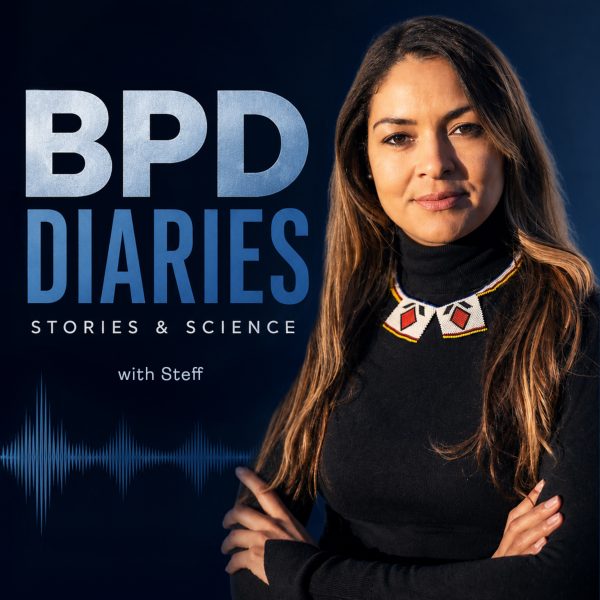
BPD Diaries: Stories and Science with Steff
- Episodios
- 59
- Se publica
- cada dos semanas
- Último episodio
- 23 Oct 2026
Sobre el podcast
I'm Steff, psychologist & BPD Warrior. Join me for unfiltered stories, the latest research, & practical strategies that actually work. It’s real, raw, & honest talk about BPD, with just enough humor to make the hard stuff easier to hear. Whether you're navigating your own diagnosis, supporting someone who is, or just trying to understand, you're welcome here. Brought to you with love by Stephanie Schildknecht Note: Earlier episodes feature my wonderful co-host, Kerry Fisher. Her warmth & laughter remain part of this podcast's story, & I'm so grateful for the foundation we built together.
Episodios 59
What We Wish People Knew About BPD (in under 10 Minutes)
What do people with borderline personality disorder wish everyone else understood? I asked around, and here are the answers I got.In this short episode, we see that BPD is more than its symptoms. Behind the …
Notas del episodio
What do people with borderline personality disorder wish everyone else understood? I asked around, and here are the answers I got.
In this short episode, we see that BPD is more than its symptoms. Behind the reactions are human beings trying to make sense of their experiences, build meaningful relationships, and find their way forward.
Whether you live with BPD, love someone who does, or simply want to understand it better, this episode is for you.
🌱 Have questions, stories, or something you’d like us to cover? We’d love to hear from you. Email us at [email protected] and let’s keep the conversation going.
If you’d like more support in your journey toward BPD recovery, Steff offers 1:1 sessions using evidence-based tools from DBT, Schema Therapy, and Mindfulness to help you heal. Email for a free 30-Minute Consultation:
📩 [email protected] or check out the website: www.bpdsupport.org
What Are Psychiatric Drugs Actually Doing to Your Brain? And Do They Help BPD? | Psychiatrist Dr Joanna Moncrieff
Is Medication the Best Solution for BPD? In this episode, I sit down with Professor Joanna Moncrieff, Professor of Critical and Social Psychiatry at University College London and practising consultant …
Notas del episodio
Is Medication the Best Solution for BPD?
In this episode, I sit down with Professor Joanna Moncrieff, Professor of Critical and Social Psychiatry at University College London and practising consultant psychiatrist, for a conversation that challenges some of the assumptions about mental health, psychiatric diagnosis and medication.
Joanna's work has challenged the idea that psychiatric drugs work by correcting an underlying “chemical imbalance” in the brain. So what does that mean for people with BPD?
Content note: This episode discusses psychiatric medication, depression, suicide, trauma and mental health diagnoses.
⚠️ This episode is for education and discussion, not medical advice. Please don't stop or change any medication without talking to your prescriber. Some medications can cause withdrawal effects if stopped suddenly.
🌱 Have questions, stories, or something you’d like us to cover? We’d love to hear from you. Email us at [email protected] and let’s keep the conversation going.
If you’d like more support in your journey toward BPD recovery, Steff offers 1:1 sessions using evidence-based tools from DBT, Schema Therapy, and Mindfulness to help you heal. Email for a free 30-Minute Consultation:
📩 [email protected] or check out the website: www.bpdsupport.org
References
Moncrieff, J. (2025). Chemically imbalanced: The making and unmaking of the serotonin myth. The History Press.
Moncrieff, J., Cooper, R. E., Stockmann, T., Amendola, S., Hengartner, M. P., & Horowitz, M. A. (2023). The serotonin theory of depression: A systematic umbrella review of the evidence. Molecular Psychiatry, 28(8), 3243–3256. https://doi.org/10.1038/s41380-022-01661-0
Moncrieff, J., Cooper, R. E., Stockmann, T., Amendola, S., Hengartner, M. P., & Horowitz, M. A. (2024). Difficult lives explain depression better than broken brains. Molecular Psychiatry, 29(1), 206–209. https://doi.org/10.1038/s41380-024-02462-3
Stoffers-Winterling, J. M., Storebø, O. J., Pereira Ribeiro, J., Kongerslev, M. T., Völlm, B. A., Mattivi, J. T., Faltinsen, E., Todorovac, A., Jørgensen, M. S., Callesen, H. E., Sales, C. P., Schaug, J. P., Simonsen, E., & Lieb, K. (2022). Pharmacological interventions for people with borderline personality disorder. Cochrane Database of Systematic Reviews, 2022(11), Article CD012956. https://doi.org/10.1002/14651858.CD012956.pub2
Streit, F., Awasthi, S., Hall, A. S. M., Braun, A., Niarchou, M., Marouli, E., Babajide, O., Frank, J., Zillich, L., Callies, C. M., Avetyan, D., Zillich, E., Naamanka, J., Gonzalez, J., Harder, A., Lu, Y., Aherrahrou, Z., Ahmad, Z.-U.-A., Ask, H., ... Witt, S. H. (2026). Genome-wide association analyses of borderline personality disorder identify 11 loci and highlight shared risk with mental and somatic disorders. Nature Genetics, 58(8), 1831–1844. https://doi.org/10.1038/s41588-026-02654-3
Stronger Than BPD: What Recovery Really Looks Like, And Should You Trust AI With Your Mental Health? | BPD Warrior Debbie Corso
I Was Hospitalised Again and Again. Then I Discovered DBTWhat does recovery from BPD actually look like?In this deeply honest conversation, Debbie DeMarco Bennett, better known as Debbie Corso, author of …
Notas del episodio
I Was Hospitalised Again and Again. Then I Discovered DBT
What does recovery from BPD actually look like?
In this deeply honest conversation, Debbie DeMarco Bennett, better known as Debbie Corso, author of Stronger Than BPD and founder of DBT Path, takes us back to the years when her life was dominated by intense emotions, chaotic relationships, suicidal thoughts and repeated psychiatric hospitalizations.
Debbie talks openly about being misunderstood and misdiagnosed, the stigma surrounding BPD, her eventual diagnosis, and the moment DBT began to change the course of her life.
Debbie also talks about her concerns about the potential risks of the growing reliance on AI for emotional support and why she wants to be part of shaping how we use it safely.
This is a conversation about BPD, DBT, recovery, hope, lived experience, stigma, relationships, AI and what it means to build a life worth living.
Resources & Links
DBT Path
The DBT program offers a 9-month DBT skills class and is designed to make DBT accessible to people worldwide .Website with Blog: https://emotionallysensitive.com/
Debbie's books (written under her pen name, Debbie Corso):
- Stronger Than BPD: The Girl's Guide to Taking Control of Intense Emotions, Drama, and Chaos Using DBT
- The Stronger Than BPD Journal: DBT Activities to Help You Manage Emotions, Heal from Borderline Personality Disorder, and Discover the Wise Woman Within (co-written with Kathryn C. Holt, LCSW
Other Books Mentioned:
- Self-Compassion Workbook for BPD: Dialectical Behavior Therapy Skills to Find Self-Forgiveness, Healing, and Self-Love with Borderline Personality Disorder by Amanda Smith
- The Deepest Well: Healing the Long-Term Effects of Childhood Adversity by Dr. Nadine Burke Harris, MD
🌱 Have questions, stories, or something you’d like us to cover? We’d love to hear from you. Email us at [email protected] and let’s keep the conversation going.
If you’d like more support in your journey toward BPD recovery, Steff offers 1:1 sessions using evidence-based tools from DBT, Schema Therapy, and Mindfulness to help you heal. Email for a free 30-Minute Consultation:
📩 [email protected] or check out the website: www.bpdsupport.org
Why You Keep Spending When You Know You Shouldn’t | BPD & Impulsive Spending
Why can spending money feel like emotional relief when you have BPD?You feel empty, lonely, rejected, angry or overwhelmed. Then you see something you want. And that little voice says, "Buy it!"In this episode …
Notas del episodio
Why can spending money feel like emotional relief when you have BPD?
You feel empty, lonely, rejected, angry or overwhelmed. Then you see something you want. And that little voice says, "Buy it!"
In this episode, I explore the complicated relationship between BPD, impulsive spending, emotional regulation and shame.
I look at why spending can become a way of escaping emotional pain, filling chronic emptiness, extending a good mood or even trying to buy a different version of yourself.
This episode is about understanding why the spending happens and what we can actually do about it.
🌱 Have questions, stories, or something you’d like us to cover? We’d love to hear from you. Email us at [email protected] and let’s keep the conversation going.
🎧 Looking for meditations made for emotional regulation, BPD, and more? Check out Empowered Heroes Meditations on Spotify.
If you’d like more support in your journey toward BPD recovery, Steff offers 1:1 sessions using evidence-based tools from DBT, Schema Therapy, and Mindfulness to help you heal. Email for a free 30-Minute Consultation:
📩 [email protected] or check out the website: www.bpdsupport.org
Free financial support resources:
UK: StepChange Debt Charity - https://www.stepchange.org | National Debtline - nationaldebtline.org
Ireland: MABS (Money Advice and Budgeting Service) - mabs.ie
Australia: National Debt Helpline - ndh.org.au | 1800 007 007
US: National Foundation for Credit Counseling - nfcc.org | CFPB- consumerfinance.gov
📚 Referenced Research Includes:
American Psychiatric Association. (2022). Diagnostic and statistical manual of mental disorders (5th ed., text rev.). https://doi.org/10.1176/appi.books.9780890425787
Carpenter, R. W., & Trull, T. J. (2013). Components of emotion dysregulation in borderline personality disorder: A review. Current psychiatry reports, 15(1), 335. https://doi.org/10.1007/s11920-012-0335-2
Glenn, C. R., & Klonsky, E. D. (2009). Emotion dysregulation as a core feature of borderline personality disorder. Journal of personality disorders, 23(1), 20-28. https://doi.org/10.1521/pedi.2009.23.1.20
Kujovic, M., Bahr, C., Riesbeck, M., Benz, D., Deiß, M., Margittai, Z., ... & Meisenzahl, E. (2025). Effects on impulsivity and delay discounting of intermittent theta burst stimulation add-on to dialectical behavioral therapy in borderline personality disorder: a randomized, sham-controlled pilot trial. Borderline Personality Disorder and Emotion Dysregulation, 12(1), 2. https://doi.org/10.1186/s40479-025-00278-3
Lieberman, M., Eisenberger, N. I., & Crockett, M. J. (2007). Putting feelings into words: affect labeling disrupts amygdala activity in response to affective stimuli. PsycholSci18 (5): 421–428. https://doi.org/10.1111/j.1467-9280.2007.01916.x
Ott, C. A., Voce, A., Grinband, J., Lopez-Castro, T., Fertuck, E. A., Stanley, D. A., & Lempert, K. M. (2025). The borderline personality disorder feature of identity instability predicts temporal discounting in a community sample: An exploratory study. Personality Science, 6, 27000710251374485. https://doi.org/10.1177/27000710251374485
Sansone, R. A., & Wiederman, M. W. (2012). Spending too much: Relationships with borderline personality symptomatology. International journal of psychiatry in clinical practice, 16(4), 316-318. https://doi.org/10.3109/13651501.2012.693186
Starcevic, V., & Khazaal, Y. (2017). Relationships between behavioural addictions and psychiatric disorders: What is known and what is yet to be learned?. Frontiers in psychiatry, 8, 53. https://doi.org/10.3389/fpsyt.2017.00053
Zac, A., Huang, Y. C., Von Moltke, A., Decker, C., & Ezrachi, A. (2025). Dark patterns and consumer vulnerability. Behavioural Public Policy, 1-50. DOI: https://doi.org/10.1017/bpp.2024.49
What Happens When You Diagnose A 14-Year-Old With BPD? | Teenage BPD Expert Professor Joost Hutsebaut
What if the label everyone's afraid to give a teenager is the one thing that could save their future?Professor Joost Hutsebaut has spent a career working with young people on the edge of a diagnosis most …
Notas del episodio
What if the label everyone's afraid to give a teenager is the one thing that could save their future?
Professor Joost Hutsebaut has spent a career working with young people on the edge of a diagnosis most clinicians won't touch: borderline personality disorder (BPD).
In this episode, Joost explains why he wrote a paper called The Diagnosis That Should Speak Its Name, arguing it's ethically right to diagnose personality disorders in teens. We dig into where a "difficult personality" ends and a disorder begins, the real risks of stigma versus the risks of staying silent, and how his own philosophy - "make therapy simple again" - reshaped the way he practices. He also honestly answers some of the internet's most asked questions.
Whether you're a clinician, a parent, or someone who's ever been told to "wait and see," this conversation reframes early diagnosis as an act of hope, not a life sentence.
🌱 Have questions, stories, or something you’d like us to cover? We’d love to hear from you. Email us at [email protected] and let’s keep the conversation going.
🎧 Looking for meditations made for emotional regulation, BPD, and more? Check out Empowered Heroes Meditations on Spotify.
If you’d like more support in your journey toward BPD recovery, Steff offers 1:1 sessions using evidence-based tools from DBT, Schema Therapy, and Mindfulness to help you heal. Email for a free 30-Minute Consultation:
📩 [email protected] or check out the website: www.bpdsupport.org
📚 Referenced Research Includes:
Bomhof, C., Löffler, J. P., Brugman, S., Lodder, P., van den End, A., van Dijk, M. K., ... & Hutsebaut, J. (2025). The effectiveness of generalist (GIT-PD) versus specialist treatment (MBT/ST) for severe personality disorders (Personality Disorders Access to Effective Treatment, P-DAET): study protocol of a pragmatic randomised controlled non-inferiority multicentre trial. BMC psychiatry, 25(1), 1107. https://doi.org/10.1186/s12888-025-07550-4
Clarke, S. L., Soons, N., Videler, A. C., van Alphen, S. P., Van, H., Dil, L., ... & Hutsebaut, J. (2025). The progress in the field of clinical staging for mental disorders within the last decade: an updated systematic review. Frontiers in psychiatry, 15, 1473051.https://doi.org/10.3389/fpsyt.2024.1473051
Hutsebaut, J. (2020). Make therapy simple again. Tijdschrift voor Psychotherapie, 46(2), 96-106.
Hutsebaut, J., Clarke, S. L., & Chanen, A. M. (2023). The diagnosis that should speak its name: why it is ethically right to diagnose and treat personality disorder during adolescence. Frontiers in Psychiatry, 14, 1130417. https://doi.org/10.3389/fpsyt.2023.1130417
Hutsebaut, J., Willemsen, E., Bachrach, N., & Van, R. (2020). Improving access to and effectiveness of mental health care for personality disorders: the guideline-informed treatment for personality disorders (GIT-PD) initiative in the Netherlands. Borderline Personality Disorder and Emotion Dysregulation, 7(1), 16. https://doi.org/10.1186/s40479-020-00133-7
Remeeus, M. G., Clarke, S. L., Feenstra, D. J., Van Eeren, H., Smits, M. L., Debruyne, S., ... & Hutsebaut, J. (2024). The (cost-) effectiveness of early intervention (MBT-early) versus standard protocolized treatment (CBT) for emerging borderline personality disorder in adolescents (the EARLY study): a study protocol for a randomized controlled trial. Trials, 25(1), 261.https://doi.org/10.1186/s13063-024-08095-9
Renneberg, B., Hutsebaut, J., Berens, A., De Panfilis, C., Bertsch, K., Kaera, A., ... & 30 experts with lived experience–clients, relatives, significant others-from 10 European countries. (2024). Towards an informed research agenda for the field of personality disorders by experts with lived and living experience and researchers. Borderline personality disorder and emotion dysregulation, 11(1), 14. https://doi.org/10.1186/s40479-024-00257-0
Should You Tell People You Have BPD? The Honest Answer.
Whether you've just been diagnosed with BPD or have been living with the diagnosis for years, deciding whether to disclose it can feel overwhelming. Should you tell your partner? Your family? Friends? Your …
Notas del episodio
Whether you've just been diagnosed with BPD or have been living with the diagnosis for years, deciding whether to disclose it can feel overwhelming. Should you tell your partner? Your family? Friends? Your employer? Or is it safer to keep it private?
In this episode, I explore one of the most common and emotionally difficult questions people with BPD ask.
🌱 Have questions, stories, or something you’d like us to cover? We’d love to hear from you. Email us at [email protected] and let’s keep the conversation going.
🎧 Looking for meditations made for emotional regulation, BPD, and more? Check out Empowered Heroes Meditations on Spotify.
If you’d like more support in your journey toward BPD recovery, Steff offers 1:1 sessions using evidence-based tools from DBT, Schema Therapy, and Mindfulness to help you heal. Email for a free 30-Minute Consultation:
📩 [email protected] or check out the website: www.bpdsupport.org
📚 Referenced Research Includes:
Brohan, E., Henderson, C., Wheat, K., Malcolm, E., Clement, S., Barley, E. A., ... & Thornicroft, G. (2012). Systematic review of beliefs, behaviours and influencing factors associated with disclosure of a mental health problem in the workplace. BMC psychiatry, 12(1), https://doi.org/10.1186/1471-244X-12-11
De Picker, L. (2021). To diagnose or not to diagnose your BPD patient. European Psychiatry, 64(S1), S55-S55.
Ma, R., & Else-Quest, N. M. (2025). Destigmatizing borderline personality disorder with social justice and intersectional cultural humility: How researchers can construct and deconstruct stigma. Feminism & Psychology, 35(1), 3-21. https://doi.org/10.1177/09593535241278213
Masland, S. R., Victor, S. E., Peters, J. R., Fitzpatrick, S., Dixon-Gordon, K. L., Bettis, A. H., ... & Rizvi, S. L. (2023). Destigmatizing borderline personality disorder: A call to action for psychological science. Perspectives on Psychological Science, 18(2), 445-460. https://doi.org/10.1177/17456916221100464
Nault, E. (2025). The Moderating Effects of Disclosure on Bpd Personality Pathology Severity and Workplace Interpersonal Mistreatment (Doctoral dissertation).
Navarre, K. M. (2025). “You sure she's not making this up?”: A qualitative investigation of stigma toward adults with borderline personality disorder in physical healthcare settings. Personality and Mental Health, 19(1), e1646. https://doi.org/10.1002/pmh.1646
Stricker, J., Jakob, L., & Pietrowsky, R. (2024). Associations of continuum beliefs with personality disorder stigma: Correlational and experimental evidence. Social psychiatry and psychiatric epidemiology, 59(9), 1629-1637. https://doi.org/10.1007/s00127-023-02543-8
van Schie, C. C., Lewis, K., Barr, K. R., Jewell, M., Malcolmson, N., Townsend, M. L., & Grenyer, B. F. (2024). Borderline personality disorder and stigma: Lived experience perspectives on helpful and hurtful language. Personality and mental health, 18(3), 216-226. https://doi.org/10.1002/pmh.1609
Villet, L., Madjlessi, A., Revah-Levy, A., Speranza, M., Younes, N., & Sibéoni, J. (2024). The lived experience of French parents concerning the diagnosis of their children with borderline personality disorder. Borderline Personality Disorder and Emotion Dysregulation, 11(1), 13. https://doi.org/10.1186/s40479-024-00258-z
Volkov, I., Sheppard, D. M., Kirk-Brown, A., & Van Dijk, P. (2025). Workplace outcomes after mental health disclosure: the critical influence of supervisor reactions. Journal of Occupational Rehabilitation, 1-12. https://doi.org/10.1007/s10926-025-10352-w
Watts, J. (2024). The epistemic injustice of borderline personality disorder. BJPsych International, 21(4), 78-82. doi:10.1192/bji.2024.16
business.com/articles/disclosing-mental-health-at-work
pursuit.unimelb.edu.au — source for BPD stigma exceeding schizophrenia in healthcare settings.
Is It Ever Too Late To Heal From BPD? | Late Life BPD Expert Professor Arjan Videler
Helping young people with BPD is 'sexy.' Helping older adults? Not so much. That's the ageism we need to talk about.In this episode, I'm joined by Professor Arjan Videler - Professor of Psychotherapy in Older …
Notas del episodio
Helping young people with BPD is 'sexy.' Helping older adults? Not so much. That's the ageism we need to talk about.
In this episode, I'm joined by Professor Arjan Videler - Professor of Psychotherapy in Older Adults at Tilburg University, senior researcher at PersonaCura in the Netherlands, and one of the world's leading voices on BPD across the lifespan.
We cover:
• The 19-year life expectancy gap for people with BPD
• What BPD actually looks like at 70
• The advantage older adults have for recovery
• The ageism in mental health
• How schema therapy and STEPPS are being adapted for older adults
• What 'positive schemas' are and why they matterAnd somewhere in the middle, there's a story about a glass of expensive wine in Central Park, a psychologist named Theodore Millen, and how the DSM ended up categorical instead of dimensional.
This is a quiet, profound episode about a population that has been largely invisible in BPD research and public conversation.
If you're 40 or 70, it doesn't really make a difference. It's never too late to heal.
🌱 Have questions, stories, or something you’d like us to cover? We’d love to hear from you. Email us at [email protected] and let’s keep the conversation going.
🎧 Looking for meditations made for emotional regulation, BPD, and more? Check out Empowered Heroes Meditations on Spotify.
If you’d like more support in your journey toward BPD recovery, Steff offers 1:1 sessions using evidence-based tools from DBT, Schema Therapy, and Mindfulness to help you heal. Email for a free 30-Minute Consultation:
📩 [email protected] or check out the website: www.bpdsupport.org
📚 Referenced Research Includes:
Conjaerts, J. A., Videler, A. C., Schepman, R., Elfeddali, I., Rosowsky, E., & van Alphen, S. P. (2025). Clinical staging for personality disorders in older adults. Journal of Geriatric Psychiatry and Neurology, 38(1), 32-43. https://doi.org/10.1177/08919887241254467
Ekiz, E., van Alphen, S. P., Ouwens, M. A., Van de Paar, J., & Videler, A. C. (2023). Systems Training for Emotional Predictability and Problem Solving for borderline personality disorder: A systematic review. Personality and Mental Health, 17(1), 20-39.
https://doi.org/10.1002/pmh.1558
Khasho, D. A., Van Alphen, S. P. J., Heijnen-Kohl, S. M. J., Ouwens, M. A., Arntz, A., & Videler, A. C. (2019). The effectiveness of individual schema therapy in older adults with borderline personality disorder: Protocol of a multiple-baseline study. Contemporary clinical trials communications, 14, 100330. https://doi.org/10.1016/j.conctc.2019.100330
van Donzel, L., Ouwens, M. A., van Alphen, S. P., Bouwmeester, S., Bachrach, N., & Videler, A. C. (2025). Integrating positive schemas in schema therapy for Cluster C personality disorders in older adults: A multiple baseline study. Clinical Psychology & Psychotherapy, 32(4), e70121.
https://doi.org/10.1002/cpp.70121
Videler, A. C., Hutsebaut, J., Schulkens, J. E., Sobczak, S., & Van Alphen, S. P. (2019). A life span perspective on borderline personality disorder. Current psychiatry reports, 21(7), 51. https://doi.org/10.1007/s11920-019-1040-1
Videler, A. A., van Royen, R. R., & van Alphen, S. B. (2012). Schema therapy with older adults: call for evidence. International Psychogeriatrics, 24(7), 1186-1187. Doi:10.1017/S1041610211002638
PersonaCura: https://ggzbreburg.nl/over-ggz-breburg/voorloper-in-de-ggz/topklinische-ggz/personacura
Make Therapy Simple Again Article: https://www.researchgate.net/publication/340081785_Make_therapy_simple_again
Stoicism for the BPD Brain | 10 Principles That Actually Work
What if the most effective framework for BPD recovery was written by a former slave and a Roman emperor over 2,000 years ago?This episode is about Stoicism. Not the pop culture version that means suppressing …
Notas del episodio
What if the most effective framework for BPD recovery was written by a former slave and a Roman emperor over 2,000 years ago?
This episode is about Stoicism. Not the pop culture version that means suppressing your feelings and pretending nothing hurts, but the real thing. A practical, rigorous system of thought that maps onto what people with BPD struggle with most.
The impulsivity. The fear of abandonment. The catastrophic interpretations. The feeling of being a slave to your emotions.
I go through ten Stoic principles, each one mapped directly to the BPD experience, grounded in neuroscience. Because this isn't just philosophy. CBT was directly influenced by Stoic thought. DBT was built on CBT. Which means there's a direct line from Epictetus in the first century AD to the skills your therapist may have walked you through last week.
🌱 Have questions, stories, or something you’d like us to cover? We’d love to hear from you. Email us at [email protected] and let’s keep the conversation going.
🎧 Looking for meditations made for emotional regulation, BPD, and more? Check out Empowered Heroes Meditations on Spotify.
If you’d like more support in your journey toward BPD recovery, Steff offers 1:1 sessions using evidence-based tools from DBT, Schema Therapy, and Mindfulness to help you heal. Email for a free 30-Minute Consultation:
📩 [email protected] or check out the website: www.bpdsupport.org
📚 Referenced Research Includes:
Aziz, A. (2025). The Application of Stoic Philosophy to Modern Emotional Regulation.
Denny, B. T., Lopez, R. B., Wu-Chung, E. L., Dicker, E. E., Goodson, P. N., Fan, J., ... & Koenigsberg, H. W. (2024). Training in cognitive reappraisal normalizes whole-brain indices of emotion regulation in borderline personality disorder. Biological Psychiatry: Cognitive Neuroscience and Neuroimaging, 9(8), 819-826. https://doi.org/10.1016/j.bpsc.2024.03.007
Zetsche, U., Bürkner, P. C., Bohländer, J., Renneberg, B., Roepke, S., & Schulze, L. (2024). Daily emotion regulation in major depression and borderline personality disorder. Clinical Psychological Science, 12(1), 161-170. https://doi.org/10.1177/2167702623116070
Stoic Primary Texts (all public domain)
Epictetus. The Enchiridion.
Marcus Aurelius. Meditations.
Seneca. Letters from a Stoic.
Further Reading
Robertson, D. How to Think Like a Roman Emperor: The Stoic Philosophy of Marcus Aurelius.
Robertson, D. Stoicism and the Art of Happiness.
Holiday, R. The Obstacle is the Way.
Waltman, S. The Stoicism Workbook.
Psych Wards: A Lifeline or a Trap? | The Brutal Truth Nobody Tells You Before You Go In
If you have BPD, there's a good chance you've either been to a psychiatric hospital, or been told you should go.Maybe it helped. Maybe it made things worse. Maybe you left feeling more broken than when you …
Notas del episodio
If you have BPD, there's a good chance you've either been to a psychiatric hospital, or been told you should go.
Maybe it helped. Maybe it made things worse. Maybe you left feeling more broken than when you arrived.
In this episode, I want to give the full picture:
• When is hospitalization genuinely helpful?
• When is it actively harmful?
• What does the research say?
• What are your rights on the ward?
• What are the alternatives?
And I offer practical guidance: how to make the most of a hospital stay, what to ask for, and what to do when you're discharged.
If you're in crisis, links to crisis resources are below.
🌱 Have questions, stories, or something you’d like us to cover? We’d love to hear from you. Email us at [email protected] and let’s keep the conversation going.
🎧 Looking for meditations made for emotional regulation, BPD, and more? Check out Empowered Heroes Meditations on Spotify.
If you’d like more support in your journey toward BPD recovery, Steff offers 1:1 sessions using evidence-based tools from DBT, Schema Therapy, and Mindfulness to help you heal. Email for a free 30-Minute Consultation:
📩 [email protected] or check out the website: www.bpdsupport.org
Crisis Resources:
UK: Samaritans - 116 123 | Crisis text line: text SHOUT to 85258
Ireland: Samaritans - 116 123 | Pieta House - 116 123
Australia: Lifeline - 13 11 14 | Beyond Blue - 1300 22 4636
US: 988 Suicide & Crisis Lifeline - call or text 988
International: findahelpline.com
📚 Referenced Research Includes:
Bateman, A., & Fonagy, P. (1999). Effectiveness of partial hospitalization in the treatment of borderline personality disorder: a randomized controlled trial. American journal of Psychiatry, 156(10), 1563-1569. https://doi.org/10.1176/ajp.156.10.1563
Bloom, J. M., Woodward, E. N., Susmaras, T., & Pantalone, D. W. (2012). Use of dialectical behavior therapy in inpatient treatment of borderline personality disorder: a systematic review. Psychiatric Services, 63(9), 881-888. https://doi.org/10.1176/appi.ps.201100311
Bodner, E., Cohen-Fridel, S., Mashiah, M., Segal, M., Grinshpoon, A., Fischel, T., & Iancu, I. (2015). The attitudes of psychiatric hospital staff toward hospitalization and treatment of patients with borderline personality disorder. BMC psychiatry, 15(1), 2. https://doi.org/10.1176/ajp.156.10.1563
Broadbear, J. H., Dwyer, J., Bugeja, L., & Rao, S. (2020). Coroners’ investigations of suicide in Australia: The hidden toll of borderline personality disorder. Journal of psychiatric research, 129, 241-249. 10.1016/j.jpsychires.2020.07.007
Katsakou, C., Marougka, S., Barnicot, K., Savill, M., White, H., Lockwood, K., & Priebe, S. (2012). Recovery in borderline personality disorder (BPD): a qualitative study of service users' perspectives. PloS one, 7(5), e36517. https://doi.org/10.1371/journal.pone.0036517
Knaak, S., Szeto, A. C., Fitch, K., Modgill, G., & Patten, S. (2015). Stigma towards borderline personality disorder: effectiveness and generalizability of an anti-stigma program for healthcare providers using a pre-post randomized design. Borderline personality disorder and emotion dysregulation, 2(1), 9. https://doi.org/10.1186/s40479-015-0030-0
Paris, J. (2004). Is hospitalization useful for suicidal patients with borderline personality disorder?. Journal of personality disorders, 18(3: Special issue), 240-247. https://doi.org/10.1521/pedi.18.3.240.35443
Stanley, B., & Brown, G. K. (2012). Safety planning intervention: a brief intervention to mitigate suicide risk. Cognitive and behavioral practice, 19(2), 256-264. 10.1016/j.cbpra.2011.01.001
Zanarini, M. C., Frankenburg, F. R., Hennen, J., Reich, D. B., & Silk, K. R. (2006). Prediction of the 10-year course of borderline personality disorder. American Journal of Psychiatry, 163(5), 827-832. https://doi.org/10.1176/ajp.2006.163.5.827
99% Sought Help. Most Didn't Get It In Time | BPD Expert Dr Jillian Broadbear on Men with BPD, Suicide & What Needs to Change
99% of people with BPD who die by suicide sought help in the year before their death. 88% in the last six weeks.They were going to the right places - emergency departments, GPs, crisis services. The system …
Notas del episodio
99% of people with BPD who die by suicide sought help in the year before their death. 88% in the last six weeks.
They were going to the right places - emergency departments, GPs, crisis services. The system failed them.
In this episode, I sit down with Dr. Jillian Broadbear, researcher at Spectrum, Australia's leading personality disorder service, to ask the hard questions.
She talks about why men are being left behind, what the suicide data actually says, and why self-compassion might be the unexpected key to recovery.
Plus, Dr. Broadbear shares an exclusive: Spectrum's new trial using MDMA-assisted therapy for people with BPD and complex trauma - a world-first that could change everything.
For anyone who's ever felt invisible, misunderstood, or like giving up. This one's for you.
"There are a lot of people who care. Don't give up. You are worth it." - Dr. Jillian Broadbear
🌱 Have questions, stories, or something you’d like us to cover? We’d love to hear from you. Email us at [email protected] and let’s keep the conversation going.
🎧 Looking for meditations made for emotional regulation, BPD, and more? Check out Empowered Heroes Meditations on Spotify.
If you’d like more support in your journey toward BPD recovery, Steff offers 1:1 sessions using evidence-based tools from DBT, Schema Therapy, and Mindfulness to help you heal. Email for a free 30-Minute Consultation:
📩 [email protected] or check out the website: www.bpdsupport.org
📚 Referenced Research Includes:
Broadbear, J. H., Bhagwandas, M. G., Crowley, S., Cheney, L., & Rao, S. (2025). Exploring the pathways to diagnosis for men with borderline personality disorder: A qualitative study. International Journal of Mental Health Nursing, 34(1), e13413. https://doi.org/10.1111/inm.13413Digital Object Identifier (DOI)
Broadbear, J. H., Dwyer, J., Bugeja, L., & Rao, S. (2020). Coroners’ investigations of suicide in Australia: The hidden toll of borderline personality disorder. Journal of psychiatric research, 129, 241-249.10.1016/j.jpsychires.2020.07.007
Donald, F., Lawrence, K. A., Broadbear, J. H., & Rao, S. (2019). An exploration of self-compassion and self-criticism in the context of personal recovery from borderline personality disorder. Australasian Psychiatry, 27(1), 56-59.
🔗 Links:
Spectrum Personality Disorder Service: spectrumbpd.com.au
Spectrum Annual Research Forum - November 6th, free and virtual
You Love Someone With BPD. Now What? | Honest Answers to What Loved Ones of People With BPD Ask Most
You love someone with BPD. But some nights, you lie awake wondering:• Do they actually love me?• Am I codependent or just a caring person?• Is this BPD or emotional abuse?• Should I stay or should I leave?• Why …
Notas del episodio
You love someone with BPD. But some nights, you lie awake wondering:
• Do they actually love me?
• Am I codependent or just a caring person?
• Is this BPD or emotional abuse?
• Should I stay or should I leave?
• Why do they threaten suicide when I try to leave, and what do I actually do?These are some the questions partners, parents, and friends of people with BPD ask. Often with guilt. Often with exhaustion. Often without anyone giving them a straight answer.
This episode answers some of the most common questions from loved ones. Not with easy answers, but with honesty and compassion for both sides.
If you've ever felt like you're losing yourself while loving someone with BPD, this one is for you.
[This is the second episode in my BPD Awareness Month series. You don't need to have heard Episode 1 to understand this one.]
Family Connections: https://sashbear.org/family-connections/
🌱 Have questions, stories, or something you’d like us to cover? We’d love to hear from you. Email us at [email protected] and let’s keep the conversation going.
🎧 Looking for meditations made for emotional regulation, BPD, and more? Check out Empowered Heroes Meditations on Spotify.
If you’d like more support in your journey toward BPD recovery, Steff offers 1:1 sessions using evidence-based tools from DBT, Schema Therapy, and Mindfulness to help you heal. Email for a free 30-Minute Consultation:
📩 [email protected] or check out the website: www.bpdsupport.org
The Internet's Most Asked BPD Questions, Answered | People with BPD Edition
It's BPD Awareness Month. So I am doing something different.I keep seeing the same questions. Asked at 2am. Asked through tears. Asked by people who are exhausted, confused, and just want an honest answer.This …
Notas del episodio
It's BPD Awareness Month. So I am doing something different.
I keep seeing the same questions. Asked at 2am. Asked through tears. Asked by people who are exhausted, confused, and just want an honest answer.
This episode answers 10 of the most common questions people with BPD actually ask, including:
• Is it BPD or bipolar?
• Why do I react so intensely even when I know better?
• Am I a bad person because of what I've done during episodes?• Are people with BPD manipulative?
• Why do I lie even about small things?
• Why do I feel empty even when things are going okay?
• What is a 'favorite person' and why does it hurt so much?
• Why do I keep splitting on people I love and how do I stop?
• Can I ever have a normal relationship?
• Can I recover without DBT?
I'm not just answering them. I'm showing you how to ask them better, because the way you ask a question changes what you can find.
And at the end: a bonus question that almost no one is asking. The one that might matter more than all the others.
This is for anyone with BPD who is tired of feeling like a problem to be solved and is ready to start building something worth living for.
🌱 Have questions, stories, or something you’d like us to cover? We’d love to hear from you. Email us at [email protected] and let’s keep the conversation going.
🎧 Looking for meditations made for emotional regulation, BPD, and more? Check out Empowered Heroes Meditations on Spotify.
If you’d like more support in your journey toward BPD recovery, Steff offers 1:1 sessions using evidence-based tools from DBT, Schema Therapy, and Mindfulness to help you heal. Email for a free 30-Minute Consultation:
📩 [email protected] or check out the website: www.bpdsupport.org
Too Old for a BPD Diagnosis? | Late-Life BPD Diagnosis (And Why It's Never Too Late to Heal)
In this episode, we explore what it means to receive a BPD diagnosis later in life. Why it happens so often, what the latest research tells us about BPD across the lifespan, and why healing is never too …
Notas del episodio
In this episode, we explore what it means to receive a BPD diagnosis later in life. Why it happens so often, what the latest research tells us about BPD across the lifespan, and why healing is never too late.
Whether you're newly diagnosed, still searching for answers, or supporting someone you love, this one's for you.
It's never too late to be understood.
🌱 Have questions, stories, or something you’d like us to cover? We’d love to hear from you. Email us at [email protected] and let’s keep the conversation going.
🎧 Looking for meditations made for emotional regulation, BPD, and more? Check out Empowered Heroes Meditations on Spotify.
If you’d like more support in your journey toward BPD recovery, Steff offers 1:1 sessions using evidence-based tools from DBT, Schema Therapy, and Mindfulness to help you heal. Email for a free 30-Minute Consultation:
📩 [email protected] or check out the website: www.bpdsupport.org
📚 Referenced Research Includes:
Broadbear, J. H., Bhagwandas, M. G., Crowley, S., Cheney, L., & Rao, S. (2025). Exploring the Pathways to Diagnosis for Men With Borderline Personality Disorder: A Qualitative Study. International Journal of Mental Health Nursing, 34(1). https://doi.org/10.1111/inm.13413
Ekiz, E., van Alphen, S. P., Ouwens, M. A., & Videler, A. C. (2026). Managing Emotional Intensity Difficulties in Older Adults With Personality Disorders: A Proof-of-Concept Study. Journal of Clinical Psychology. https://doi.org/10.1002/jclp.70090
Hill, R. (2005). End-of-life care for the patient with borderline personality disorder. Journal of Hospice & Palliative Nursing, 7(3), 150–161.
Jo, R., Broadbear, J. H., Hope, J., & Rao, S. (2023). Late manifestation of borderline personality disorder: Characterization of an under-recognized phenomenon. Personality and Mental Health, 17(2), 165–175. https://doi.org/10.1002/pmh.1571
Khasho, D. A., Van Alphen, S. P. J., Heijnen-Kohl, S. M. J., Ouwens, M. A., Arntz, A., & Videler, A. C. (2019). The effectiveness of individual schema therapy in older adults with borderline personality disorder: Protocol of a multiple-baseline study. Contemporary Clinical Trials Communications, 14, 100330. https://doi.org/10.1016/j.conctc.2019.100330
Kjaer, J. N., Biskin, R., Vestergaard, C. H., & Munk-Jorgensen, P. (2015). A nationwide study of mortality in patients with borderline personality disorder. European Psychiatry, 30(S1), 1–1. doi:10.1016/S0924-9338(15)30162-0
Lynch, T. R., et al. (2007). Dialectical behavior therapy for depressed older adults: A randomized pilot study. American Journal of Geriatric Psychiatry, 15(5), 383–393.
Rexand-Galais, F., Pithon, L., & Le Goff, J. (2021). Assessment of borderline personality disorder in geriatric institutions. Frontiers in Psychology, 12, 629571. https://doi.org/10.3389/fpsyg.2021.629571
Stiles, C., Batchelor, R., Gumley, A., & Gajwani, R. (2023). Experiences of stigma and discrimination in borderline personality disorder: A systematic review and qualitative meta-synthesis. Journal of Personality Disorders, 37(2), 177–194. https://doi.org/10.1521/pedi.2023.37.2.177
Videler, A. C., et al. (2020). Schema therapy for personality disorders in older adults. Aging & Mental Health, 24(1), 119–126.
Zanarini, M. C., Frankenburg, F. R., Hennen, J., Reich, D. B., & Silk, K. R. (2005). The McLean Study of Adult Development (MSAD): Overview and implications of the first six years of prospective follow-up. Journal of Personality Disorders, 19(5), 505–523. https://doi.org/10.1521/pedi.2005.19.5.505
C0MCs5181rD1oysF4PfM
Quiet BPD | The One Who Always Has It Together (And Is Quietly Falling Apart)
What if your emotional pain was invisible , even to the people closest to you?In this episode, we explore Quiet BPD: the presentation of Borderline Personality Disorder where the storm rages entirely on the …
Notas del episodio
What if your emotional pain was invisible , even to the people closest to you?
In this episode, we explore Quiet BPD: the presentation of Borderline Personality Disorder where the storm rages entirely on the inside. No outbursts. No visible chaos. Just a carefully maintained exterior while everything underneath is burning.
We cover what Quiet BPD actually is (and what the research says), why it's so often misdiagnosed as depression, anxiety, or even autism, and what daily life looks like for people who've learned to turn their pain inward rather than outward.
If you've ever felt like you were performing "fine" while privately falling apart, this episode was made for you.
Topics covered: internalizing vs. externalizing BPD, shame & self-blame, misdiagnosis, treatment options including DBT & IFS, advice for loved ones
Your struggle is valid , whether it's loud or quiet.
🌱 Have questions, stories, or something you’d like us to cover? We’d love to hear from you. Email us at [email protected] and let’s keep the conversation going.
🎧 Looking for meditations made for emotional regulation, BPD, and more? Check out Empowered Heroes Meditations on Spotify.
If you’d like more support in your journey toward BPD recovery, Steff offers 1:1 sessions using evidence-based tools from DBT, Schema Therapy, and Mindfulness to help you heal. Email for a free 30-Minute Consultation:
📩 [email protected] or check out the website: www.bpdsupport.org
📚 Referenced Research Includes:
Book:The Complete Guide to Quiet BPD by Paul Fabunni Meredith
Centres for Health and Healing Ontario. (2025). Living with Quiet BPD: Signs, Triggers, and Coping Strategies. Retrieved from: https://cfhh.ca/blog/living-with-quiet-bpd-signs-triggers-coping-strategies/
Higgins, H. M. (2025). The Quiet Borderline Personality Disorder: Understanding and Thriving with Internalized EUPD/BPD.
Lenzenweger, M. F., Lane, M. C., Loranger, A. W., & Kessler, R. C. (2007). DSM-IV personality disorders in the National Comorbidity Survey Replication. Biological psychiatry, 62(6), 553-564. https://doi.org/10.1016/j.biopsych.2006.09.019
Lo, I. (2021). The struggles of quiet BPD. Retrieved from: https://www.psychologytoday.com/us/blog/living-emotional-intensity/202107/the-struggles-quiet-bpd
Millon, T. (2011). Disorders of personality: Introducing a DSM/ICD spectrum from normal to abnormal. John Wiley & Sons.
Stoffers-Winterling, J. M., Storebø, O. J., Kongerslev, M. T., Faltinsen, E., Todorovac, A., Jørgensen, M. S., ... & Simonsen, E. (2022). Psychotherapies for borderline personality disorder: a focused systematic review and meta-analysis. The British Journal of Psychiatry, 221(3), 538-552. doi:10.1192/bjp.2021.204
Wolf, K., Scharoba, J., Noack, R., Keller, A., & Weidner, K. (2023). Subtypes of borderline personality disorder in a day-clinic setting—Clinical and therapeutic differences. Personality Disorders: Theory, Research, and Treatment, 14(5), 555.
When Food Becomes a Coping Mechanism | BPD & Eating Disorders
Nearly 1 in 3 people with Borderline Personality Disorder (BPD) will also experience an eating disorder at some point in their lives. But this connection goes far deeper than food, weight, or appearance.In this …
Notas del episodio
Nearly 1 in 3 people with Borderline Personality Disorder (BPD) will also experience an eating disorder at some point in their lives. But this connection goes far deeper than food, weight, or appearance.
In this episode, we explore the powerful and often misunderstood relationship between BPD and eating disorders, including anorexia, bulimia, and binge eating disorder.
Why do these conditions so often occur together? What role do emotion dysregulation, impulsivity, identity disturbance, and chronic emptiness play in disordered eating? And what does current research say about the most effective ways to support recovery?
🌱 Have questions, stories, or something you’d like us to cover? We’d love to hear from you. Email us at [email protected] and let’s keep the conversation going.
🎧 Looking for meditations made for emotional regulation, BPD, and more? Check out Empowered Heroes Meditations on Spotify.
If you’d like more support in your journey toward BPD recovery, Steff offers 1:1 sessions using evidence-based tools from DBT, Schema Therapy, and Mindfulness to help you heal. Email for a free 30-Minute Consultation:
📩 [email protected] or check out the website: www.bpdsupport.org
📚 Referenced Research Includes:
Cassioli, E., Rossi, E., D'Anna, G., Martelli, M., Hazzard, V. M., Crosby, R. D., ... & Castellini, G. (2022). A 1‐year follow‐up study of the longitudinal interplay between emotion dysregulation and childhood trauma in the treatment of anorexia nervosa. International Journal of Eating Disorders, 55(1), 98-107. https://doi.org/10.1002/eat.23647
Chen, E. Y., Brown, M. Z., Harned, M. S., & Linehan, M. M. (2009). A comparison of borderline personality disorder with and without eating disorders. Psychiatry research, 170(1), 86-90. https://doi.org/10.1016/j.psychres.2009.03.006
Fairburn, C. G. (2008). Cognitive behavior therapy and eating disorders. Guilford Press.
Federici, A., & Wisniewski, L. (2013). An intensive DBT program for patients with multidiagnostic eating disorder presentations: A case series analysis. International Journal of Eating Disorders, 46(4), 322-331. https://doi.org/10.1002/eat.22112Digital Object Identifier (DOI)
Khosravi, M. (2020). Eating disorders among patients with borderline personality disorder: understanding the prevalence and psychopathology. Journal of Eating Disorders, 8(1), 38. https://doi.org/10.1186/s40337-020-00314-3
Racine, S. E., & Wildes, J. E. (2015). Emotion dysregulation and anorexia nervosa: An exploration of the role of childhood abuse. International Journal of Eating Disorders, 48(1), 55-58. https://doi.org/10.1002/eat.22364Digital Object Identifier (DOI)
Sansone, R. A., & Sansone, L. A. (2010). Borderline personality and eating disorders: A chaotic crossroads. In Treatment of eating disorders (pp. 217-232). Academic Press. https://doi.org/10.1016/B978-0-12-375668-8.10013-0
Crisis & Support Resources:
- National Eating Disorders Association (NEDA) Helpline: 1-800-931-2237
- Crisis Text Line: Text HOME to 741741
The Most Effective Free Skill You're Not Using for BPD | Sleep and BPD
For many people with Borderline Personality Disorder, night isn’t peaceful.It’s when the abandonment dreams start.When shame replays.When the nervous system refuses to power down.Sleep isn’t just rest, it’s …
Notas del episodio
For many people with Borderline Personality Disorder, night isn’t peaceful.
It’s when the abandonment dreams start.
When shame replays.
When the nervous system refuses to power down.Sleep isn’t just rest, it’s emotional regulation, impulse control, and survival.
In this episode, we talk about sleep and BPD, from vivid nightmares and insomnia to the emotional hangover that lingers the next day, and how to be better at sleep.
🌱 Have questions, stories, or something you’d like us to cover? We’d love to hear from you. Email us at [email protected] and let’s keep the conversation going.
🎧 Looking for meditations made for emotional regulation, BPD, and more? Check out Empowered Heroes Meditations on Spotify.
If you’d like more support in your journey toward BPD recovery, Steff offers 1:1 sessions using evidence-based tools from DBT, Schema Therapy, and Mindfulness to help you heal. Email for a free 30-Minute Consultation:
📩 [email protected] or check out the website: www.bpdsupport.org
📚 Referenced Research Includes:
George, K. C., Kebejian, L., Ruth, L. J., Miller, C. W., & Himelhoch, S. (2016). Meta-analysis of the efficacy and safety of prazosin versus placebo for the treatment of nightmares and sleep disturbances in adults with posttraumatic stress disorder. Journal of Trauma & Dissociation, 17(4), 494-510. https://doi.org/10.1080/15299732.2016.1141150
Gieselmann, A., Ait Aoudia, M., Carr, M., Germain, A., Gorzka, R., Holzinger, B., ... & Pietrowsky, R. (2019). Aetiology and treatment of nightmare disorder: State of the art and future perspectives. Journal of sleep research, 28(4), e12820. https://doi.org/10.1111/jsr.12820
Selby, E. A. (2013). Chronic sleep disturbances and borderline personality disorder symptoms. Journal of consulting and clinical psychology, 81(5), 941.
van Trigt, S., van der Zweerde, T., van Someren, E. J., van Straten, A., & van Marle, H. J. (2025). A theoretical perspective on the role of sleep in borderline personality disorder: From causative factor to treatment target. Sleep Medicine Reviews, 81, 102089. 10.1016/j.smrv.2025.102089 https://doi.org/10.1037/a0033201
Walker, M. (2017). Why we sleep: Unlocking the power of sleep and dreams. Simon and Schuster.
Winsper, C., Lereya, S. T., Marwaha, S., Thompson, A., Eyden, J., & Singh, S. P. (2016). The aetiological and psychopathological validity of borderline personality disorder in youth: A systematic review and meta-analysis. Clinical psychology review, 44, 13-24. https://doi.org/10.1016/j.cpr.2015.12.001
Is Recovery From BPD Possible?
What does recovery from Borderline Personality Disorder actually look like?For years, Borderline Personality Disorder was considered chronic and untreatable.And if you've ever searched for "BPD recovery," …
Notas del episodio
What does recovery from Borderline Personality Disorder actually look like?
For years, Borderline Personality Disorder was considered chronic and untreatable.
And if you've ever searched for "BPD recovery," you've probably seen two extreme narratives: the hopeless one that says you'll never change, and the oversimplified one that says DBT will fix everything overnight. Neither tells the full storyIn this episode, we dive into the messy, non-linear, and deeply human reality of recovery. We explore what the research actually says, and what recovery feels like from the inside.
🌱 Have questions, stories, or something you’d like us to cover? We’d love to hear from you. Email us at [email protected] and let’s keep the conversation going.
🎧 Looking for meditations made for emotional regulation, BPD, and more? Check out Empowered Heroes Meditations on Spotify.
If you’d like more support in your journey toward BPD recovery, Steff offers 1:1 sessions using evidence-based tools from DBT, Schema Therapy, and Mindfulness to help you heal. Email for a free 30-Minute Consultation:
📩 [email protected] or check out the website: www.bpdsupport.org
📚 Referenced Research Includes:
Bateman, A., & Fonagy, P. (2009). Randomized controlled trial of outpatient mentalization-based treatment versus structured clinical management for borderline personality disorder. American journal of Psychiatry, 166(12), 1355-1364.https://doi.org/10.1176/appi.ajp.2009.0904053
Davidson, R. J., & McEwen, B. S. (2012). Social influences on neuroplasticity: stress and interventions to promote well-being. Nature neuroscience, 15(5), 689-695. https://doi.org/10.1038/nn.3093
Gunderson, J. G., Stout, R. L., McGlashan, T. H., Shea, M. T., Morey, L. C., Grilo, C. M., ... & Skodol, A. E. (2011). Ten-year course of borderline personality disorder: psychopathology and function from the Collaborative Longitudinal Personality Disorders study. Archives of general psychiatry, 68(8), 827-837. doi:10.1001/archgenpsychiatry.2011.37
Linehan, M. (1993). Cognitive-behavioral treatment of borderline personality disorder. Guilford press.
Linehan, M. M., Comtois, K. A., Murray, A. M., Brown, M. Z., Gallop, R. J., Heard, H. L., ... & Lindenboim, N. (2006). Two-year randomized controlled trial and follow-up of dialectical behavior therapy vs therapy by experts for suicidal behaviors and borderline personality disorder. Archives of general psychiatry, 63(7), 757-766. doi:10.1001/archpsyc.63.7.757
Ng, F. Y., Bourke, M. E., & Grenyer, B. F. (2016). Recovery from borderline personality disorder: A systematic review of the perspectives of consumers, clinicians, family and carers. PloS one, 11(8), e0160515. https://doi.org/10.1371/journal.pone.0160515
Zanarini, M. C., Frankenburg, F. R., Reich, D. B., & Fitzmaurice, G. (2010). The 10‐year course of psychosocial functioning among patients with borderline personality disorder and axis II comparison subjects. Acta Psychiatrica Scandinavica, 122(2), 103-109. https://doi.org/10.1111/j.1600-0447.2010.01543.x
The Midlife BPD Crisis Nobody Talks About | BPD, Perimenopause and Menopause
Have you spent years stabilizing your BPD, only to feel like you're unraveling again in your 40s or 50s? What if it's not your therapy failing, it's your hormones? In a medical blind spot affecting so many …
Notas del episodio
Have you spent years stabilizing your BPD, only to feel like you're unraveling again in your 40s or 50s? What if it's not your therapy failing, it's your hormones? In a medical blind spot affecting so many, perimenopause and menopause can dramatically amplify BPD symptoms, yet almost no one is talking about it.
In this episode, we look into one of the most critical and overlooked intersections in women's mental health: Borderline Personality Disorder through perimenopause and menopause. This isn't about hot flashes, this is about your brain chemistry undergoing its most significant shift since adolescence, colliding with the emotional dysregulation at the heart of BPD.
🌱 Have questions, stories, or something you’d like us to cover? We’d love to hear from you. Email us at [email protected] and let’s keep the conversation going.
🎧 Looking for meditations made for emotional regulation, BPD, and more? Check out Empowered Heroes Meditations on Spotify.
If you’d like more support in your journey toward BPD recovery, Steff offers 1:1 sessions using evidence-based tools from DBT and Mindfulness to help you heal. Email for a free 30-Minute Consultation:
📩 [email protected] or check out the website: www.bpdsupport.org
📚 Referenced Research Includes:
Barth, C., Villringer, A., & Sacher, J. (2015). Sex hormones affect neurotransmitters and shape the adult female brain during hormonal transition periods. Frontiers in neuroscience, 9, 37. https://doi.org/10.3389/fnins.2015.00037
Behrman, S., & Crockett, C. (2024). Severe mental illness and the perimenopause. BJPsych Bulletin, 48(6), 364–370. doi:10.1192/bjb.2023.89
Cohen, L. S., Soares, C. N., Vitonis, A. F., Otto, M. W., & Harlow, B. L. (2006). Risk for new onset of depression during the menopausal transition: the Harvard study of moods and cycles. Archives of general psychiatry, 63(4), 385-390. doi:10.1001/archpsyc.63.4.385
Crowell, S. E., Beauchaine, T. P., & Linehan, M. M. (2009). A biosocial developmental model of borderline personality: Elaborating and extending Linehan’s theory. Psychological bulletin, 135(3), 495. https://doi.org/10.1037/a0015616
Gordon, J. L., Rubinow, D. R., Eisenlohr-Moul, T. A., Xia, K., Schmidt, P. J., & Girdler, S. S. (2018). Efficacy of transdermal estradiol and micronized progesterone in the prevention of depressive symptoms in the menopause transition: a randomized clinical trial. JAMA psychiatry, 75(2), 149-157.
Gunter, J. (2021). The menopause manifesto: own your health with facts and feminism.
Linehan, M. (1993). Cognitive-behavioral treatment of borderline personality disorder. Guilford press.
Maki, P. M., Kornstein, S. G., Joffe, H., Bromberger, J. T., Freeman, E. W., Athappilly, G., ... & Soares, C. N. (2018). Guidelines for the evaluation and treatment of perimenopausal depression: summary and recommendations. Menopause, 25(10), 1069-1085.DOI: 10.1097/GME.0000000000001174
Toffoletto, S., Lanzenberger, R., Gingnell, M., Sundström-Poromaa, I., & Comasco, E. (2014). Emotional and cognitive functional imaging of estrogen and progesterone effects in the female human brain: a systematic review. Psychoneuroendocrinology, 50, 28-52. https://doi.org/10.1016/j.psyneuen.2014.07.025
Resources:
The North American Menopause Society (NAMS): www.menopause.org
The International Menopause Society: www.imsociety.org
Menopause Mastery: https://mlrb.net/menopause-bpd/Hell Week | BPD & Your Menstrual Cycle
Why does everything feel so much harder the week before your period? For many people with Borderline Personality Disorder, the days before menstruation feel brutal. But this isn’t “just PMS.”If your BPD …
Notas del episodio
Why does everything feel so much harder the week before your period?
For many people with Borderline Personality Disorder, the days before menstruation feel brutal. But this isn’t “just PMS.”
If your BPD symptoms seem to sync perfectly with your menstrual cycle, you're not imagining it. This is real, it's biological, and it has a name.
In this episode, we explore the often-overlooked connection between BPD, the menstrual cycle, PMS, and Premenstrual Exacerbation (PME). We unpack the science and share personal stories.
🌱 Have questions, stories, or something you’d like us to cover? We’d love to hear from you. Email us at [email protected] and let’s keep the conversation going.
🎧 Looking for meditations made for emotional regulation, BPD, and more? Check out Empowered Heroes Meditations on Spotify.
If you’d like more support in your journey toward BPD recovery, Steff offers 1:1 sessions using evidence-based tools from DBT and Mindfulness to help you heal. Email for a free 30-Minute Consultation:
📩 [email protected] or check out the website: www.bpdsupport.org
📚 Referenced Research Includes:
Dubey, N., Hoffman, J. F., Schuebel, K., Yuan, Q., Martinez, P. E., Nieman, L. K., ... & Goldman, D. (2017). The ESC/E (Z) complex, an effector of response to ovarian steroids, manifests an intrinsic difference in cells from women with premenstrual dysphoric disorder. Molecular psychiatry, 22(8), 1172-1184. https://doi.org/10.1038/mp.2016.229
Eisenlohr-Moul, T. A., Schmalenberger, K. M., Owens, S. A., Peters, J. R., Dawson, D. N., & Girdler, S. S. (2018). Perimenstrual exacerbation of symptoms in borderline personality disorder: evidence from multilevel models and the Carolina Premenstrual Assessment Scoring System. Psychological Medicine, 48(12), 2085-2095. doi:10.1017/S0033291718001253
Hantsoo, L., & Epperson, C. N. (2015). Premenstrual dysphoric disorder: epidemiology and treatment. Current psychiatry reports, 17(11), 87. https://doi.org/10.1007/s11920-015-0628-3
Linehan, M. M. (2025). DBT skills training manual. Guilford Publications.
Marjoribanks, J., Brown, J., O'Brien, P. M. S., & Wyatt, K. (2013). Selective serotonin reuptake inhibitors for premenstrual syndrome. Cochrane Database of Systematic Reviews, (6). https://doi.org/10.1002/14651858.CD001396.pub3
Yen, J. Y., Wang, P. W., Su, C. H., Liu, T. L., Long, C. Y., & Ko, C. H. (2018). Estrogen levels, emotion regulation, and emotional symptoms of women with premenstrual dysphoric disorder: The moderating effect of estrogen receptor 1α polymorphism. Progress in Neuro-Psychopharmacology and Biological Psychiatry, 82, 216-223. https://doi.org/10.1016/j.pnpbp.2017.11.013
Yonkers, K. A., & White, K. (1992). Premenstrual exacerbation of depression: one process or two?. The Journal of clinical psychiatry, 53(8), 289-292. PMID: 1500406.
The International Association for Premenstrual Disorders (IAPMD) : https://www.iapmd.org/pmdd?gad_source=1&gad_campaignid=23263234694&gbraid=0AAAAADiCO_rEBChLKw_ciQ6FWaXXP7Hsk&gclid=Cj0KCQiAm9fLBhCQARIsAJoNOcsYFvNRS7luuwgBOogkT-se_5N3LA8F6xjAFeyhJ4A-nSf-xv-AXBIaAqy0EALw_wcB
Ghosting, Blocking & Dopamine | When Likes Feel Like Love | Social Media and BPD
Feeling empty, disconnected, or raw? You open Instagram, post something carefully crafted, and for a moment, the likes make you feel seen. Then, the algorithm shifts. An ex appears. A friend's post feels like a …
Notas del episodio
Feeling empty, disconnected, or raw? You open Instagram, post something carefully crafted, and for a moment, the likes make you feel seen. Then, the algorithm shifts. An ex appears. A friend's post feels like a dig. Or worse: silence. Your post gets three likes. That piece of yourself vanishes into the digital void.
What happens next? The chest tightness. The spiral. The urge to delete everything or post something even more raw to force a connection.
If this cycle is your reality, you're not being "too sensitive." You're navigating a world not built for the BPD brain.
In this episode, we break down why social media often feels like psychological warfare. We explore:
The Digital Dopamine Trap: Why our brains are uniquely wired for this struggle and how platforms become our "interpersonal regulation machines."
Research Deep Dives: How a single ignored message can trigger self-harm urges, and why we post/delete/edit in a cycle of emotional survival.
The Specific Minefields: The agony of asynchronous texts, the catastrophic impact of ghosting, and the "block/unblock" spiral.
Actionable Strategies: How to conduct a "digital symptom audit," engineer your environment, build "analog anchors," and create a crisis plan for online triggers.
This isn't about deleting your apps. It’s about understanding the hooks and learning to build a digital life that serves you, not your symptoms.
🌱 Have questions, stories, or something you’d like us to cover? We’d love to hear from you. Email us at [email protected] and let’s keep the conversation going.
🎧 Looking for meditations made for emotional regulation, BPD, and more? Check out Empowered Heroes Meditations on Spotify.
If you’d like more support in your journey toward BPD recovery, Steff offers 1:1 sessions using evidence-based tools from DBT and Mindfulness to help you heal. Email for a free 30-Minute Consultation:
📩 [email protected] or check out the website: www.bpdsupport.org
📚 Referenced Research Includes:
Howard, K. P., & Cheavens, J. S. (2023). Interpersonal emotion regulation in the context of social networks: A focus on borderline personality disorder. Personality Disorders: Theory, Research, and Treatment, 14(2), 182.
Ooi, J., Michael, J., Lemola, S., Butterfill, S., Siew, C. S., & Walasek, L. (2020). Interpersonal functioning in borderline personality disorder traits: a social media perspective. Scientific reports, 10(1), 1068. https://doi.org/10.1038/s41598-020-58001-x
Goreis, A., Chang, D., Klinger, D., Zesch, H. E., Pfeffer, B., Oehlke, S. M., ... & Kothgassner, O. D. (2025). Impact of social media on triggering nonsuicidal self-injury in adolescents: a comparative ambulatory assessment study. Borderline Personality Disorder and Emotion Dysregulation, 12(1), 4. https://doi.org/10.1186/s40479-025-00280-9
Hu, A., Yuan, R., Chen, R., & Liu, M. J. (2024). A glamorous but highly stressful job: The role of social media-afforded status in micro-celebrity stress coping. Technological Forecasting and Social Change, 209, 123791. https://doi.org/10.1016/j.techfore.2024.123791
The Center for Humane Technology (humanetech.com) for understanding app design.
Navigating Work, Career, and BPD | Burnout, Triggers, and Finding Sustainable Careers
Work can be a lifeline or a psychological minefield when you live with Borderline Personality Disorder.In this episode, we discuss what it’s really like to navigate career, ambition, burnout, and identity with …
Notas del episodio
Work can be a lifeline or a psychological minefield when you live with Borderline Personality Disorder.
In this episode, we discuss what it’s really like to navigate career, ambition, burnout, and identity with BPD. We talk about why so many of us become high achievers at constant risk of implosion - overworking to outrun shame, masking emotional pain behind professionalism, and collapsing the moment we’re off the clock.
🌱 Have questions, stories, or something you’d like us to cover? We’d love to hear from you. Email us at [email protected] and let’s keep the conversation going.
🎧 Looking for meditations made for emotional regulation, BPD, and more? Check out Empowered Heroes Meditations on Spotify.
If you’d like more support in your journey toward BPD recovery, Steff offers 1:1 sessions using evidence-based tools from DBT and Mindfulness to help you heal. Email for a free 30-Minute Consultation:
📩 [email protected] or check out the website: www.bpdsupport.org
📚 Referenced Research Includes:
Comtois, K. A., Kerbrat, A. H., Atkins, D. C., Harned, M. S., & Elwood, L. (2010). Recovery from disability for individuals with borderline personality disorder: a feasibility trial of DBT-ACES. Psychiatric Services, 61(11), 1106-1111. doi: 10.1176/ps.2010.61.11.1106.
Skodol, A. E., Gunderson, J. G., McGlashan, T. H., Dyck, I. R., Stout, R. L., Bender, D. S., ... & Oldham, J. M. (2002). Functional impairment in patients with schizotypal, borderline, avoidant, or obsessive-compulsive personality disorder. American journal of psychiatry, 159(2), 276-283.
BPD vs Antisocial Personality Disorder (ASPD)
Are people with Borderline Personality Disorder (BPD) "antisocial"? In this episode, we dive deep into the complex, often misunderstood relationship between BPD and Antisocial Personality Disorder (ASPD).We go …
Notas del episodio
Are people with Borderline Personality Disorder (BPD) "antisocial"? In this episode, we dive deep into the complex, often misunderstood relationship between BPD and Antisocial Personality Disorder (ASPD).
We go beyond the online stereotypes and fear-mongering to explore the science, the diagnostic lines, and the sobering overlaps. We break down the crucial differences and the emotional experience. We also tackle why these disorders are so frequently confused, the dangerous dynamics of BPD/ASPD relationships, and the painful reality of trauma bonding.
This isn't about creating villains or victims. It's about compassion, critical thinking, and understanding the spectrum of human struggle. Whether you're challenging stigma, grappling with a difficult diagnosis, or simply seeking clarity, this episode provides the nuanced conversation this topic desperately needs.
🌱 Have questions, stories, or something you’d like us to cover? We’d love to hear from you. Email us at [email protected] and let’s keep the conversation going.
🎧 Looking for meditations made for emotional regulation, BPD, and more? Check out Empowered Heroes Meditations on Spotify.
If you’d like more support in your journey toward BPD recovery, Steff offers 1:1 sessions using evidence-based tools from DBT and Mindfulness to help you heal. Email for a free 30-Minute Consultation:
📩 [email protected] or check out the website: www.bpdsupport.org
📚 Referenced Research Includes:
American Psychiatric Association. (2022). Diagnostic and statistical manual of mental disorders (5th ed., text rev.). https://doi.org/10.1176/appi.books.9780890425787
Buchheim, A., Roth, G., Schiepek, G., Pogarell, O., & Karch, S. (2013). Neurobiology of borderline personality disorder (BPD) and antisocial personality disorder (APD). Swiss Archives of Neurology and Psychiatry, 164(4), 115-122.
Chow, R. T. S., Yu, R., Geddes, J. R., & Fazel, S. (2025). Personality disorders, violence and antisocial behaviour: updated systematic review and meta-regression analysis. The British Journal of Psychiatry, 227(1), 481–491. doi:10.1192/bjp.2024.226
Chun, S., Harris, A., Carrion, M., Rojas, E., Stark, S., Lejuez, C., Lechner, W. V., & Bornovalova, M. A. (2017). A psychometric investigation of gender differences and common processes across borderline and antisocial personality disorders. Journal of Abnormal Psychology, 126(1), 76–88.Lieb, K., Zanarini, M. C., Schmahl, C., Linehan, M. M., & Bohus, M. (2004). Borderline personality disorder. The lancet, 364(9432), 453-461.
Özel, B., Karakaya, E., Köksal, F. et al. Gender bias of antisocial and borderline personality disorders among psychiatrists. Arch Womens Ment Health 28, 563–571 (2025). https://doi.org/10.1007/s00737-024-01519-0
Raine, A. (2018). Antisocial personality as a neurodevelopmental disorder. Annual review of clinical psychology, 14(1), 259-289. https://doi.org/10.1146/annurev-clinpsy-050817-084819
Stoffers-Winterling, J. M., Storebø, O. J., Kongerslev, M. T., Faltinsen, E., Todorovac, A., Jørgensen, M. S., ... & Simonsen, E. (2022). Psychotherapies for borderline personality disorder: a focused systematic review and meta-analysis. The British Journal of Psychiatry, 221(3), 538-552. doi:10.1192/bjp.2021.204
https://www.england.nhs.uk/commissioning/wp-content/uploads/sites/12/2015/10/work-offndrs-persnlty-disorder-oct15.pdf
https://assets.publishing.service.gov.uk/media/619e6dbb8fa8f5037e8ccb2c/6.5151_HMPPS_Working_with_Offenders_with_Personality_Disorder_accessible_version_.pdf
https://www.ebsco.com/research-starters/law/borderline-personality-disorder-and-crime#research-starter-titleA Christmas Message to Our BPD Diaries Family
To all the beautiful, complex hearts tuning in:Wherever you are, whatever this day looks like for you, we are so grateful to have you as part of the BPD Diaries family. Your presence, your courage, and your …
Notas del episodio
To all the beautiful, complex hearts tuning in:
Wherever you are, whatever this day looks like for you, we are so grateful to have you as part of the BPD Diaries family. Your presence, your courage, and your stories mean the world to us. Thank you for allowing us to be a small part of your journey.We’re thinking of you, and we’re sending you so much warmth.
From our hearts to yours, Merry Christmas. Be incredibly kind to yourselves today.
🌱 Have questions, stories, or something you’d like us to cover? We’d love to hear from you. Email us at [email protected] and let’s keep the conversation going.
🎧 Looking for meditations made for emotional regulation, BPD, and more? Check out Empowered Heroes Meditations on Spotify.
If you’d like more support in your journey toward BPD recovery, Steff offers 1:1 sessions using evidence-based tools from DBT and Mindfulness to help you heal. Email for a free 30-Minute Consultation:
📩 [email protected] or check out the website: www.bpdsupport.org
Music credit:We Wish You a Merry Christmas by Twin Musicom is licensed under a Creative Commons Attribution 4.0 license. https://creativecommons.org/licenses/by/4.0/
Artist: http://www.twinmusicom.org/
BPD, Histrionic Personality Disorder & The ‘Hysterical’ Myth | What’s Really Going On?
Have you ever been called “too dramatic,” “too emotional,” or “attention-seeking”? These labels are hurtful, oversimplified, and often point to a deeper, misunderstood struggle. In this episode, we explore the …
Notas del episodio
Have you ever been called “too dramatic,” “too emotional,” or “attention-seeking”? These labels are hurtful, oversimplified, and often point to a deeper, misunderstood struggle. In this episode, we explore the complex and often confused relationship between Borderline Personality Disorder (BPD) and Histrionic Personality Disorder (HPD).
We go beyond the stereotypes to unpack the science and the stories. What’s the real difference between a core fear of abandonment and a desperate need to be seen? Is "histrionic" just a gendered, modern version of "hysteria"? How can two disorders look so similar on the outside yet feel so different on the inside?
🌱 Have questions, stories, or something you’d like us to cover? We’d love to hear from you. Email us at [email protected] and let’s keep the conversation going.
🎧 Looking for meditations made for emotional regulation, BPD, and more? Check out Empowered Heroes Meditations on Spotify.
If you’d like more support in your journey toward BPD recovery, Steff offers 1:1 sessions using evidence-based tools from DBT and Mindfulness to help you heal. Email for a free 30-Minute Consultation:
📩 [email protected] or check out the website: www.bpdsupport.org
📚 Referenced Research Includes:
DELİGÖZ, A., & KARAAZİZ, M. (2025). A Review of Common Therapeutic Approaches in the Clinical Intervention of Histrionic Personality Disorder. ISPEC International Journal of Social Sciences & Humanities, 9(2), 140–156. https://doi.org/10.5281/zenodo.15773941
Hujing, C.L., Yalch, M.M. (2024). Histrionic Personality Disorder. In: Shackelford, T.K. (eds) Encyclopedia of Sexual Psychology and Behavior. Springer, Cham. https://doi.org/10.1007/978-3-031-08956-5_2502-1
Liu, Y., Chen, C., Zhou, Y., Zhang, N., & Liu, S. (2024). Twenty years of research on borderline personality disorder: a scientometric analysis of hotspots, bursts, and research trends. Frontiers in Psychiatry, 15. https://doi.org/10.3389/fpsyt.2024.1361535
Novais, F., Araújo, A., & Godinho, P. (2015). Historical roots of histrionic personality disorder. Frontiers in psychology, 6, 1463.https://doi.org/10.3389/fpsyg.2015.01463
Why Christmas Hurts & How to Get Through It | The BPD Holiday Survival Guide
"Tis the season to be... triggered? If the "most wonderful time of the year" feels more like an emotional pressure cooker, you are not alone. In this episode, we break down exactly why the holidays are so …
Notas del episodio
"Tis the season to be... triggered?
If the "most wonderful time of the year" feels more like an emotional pressure cooker, you are not alone. In this episode, we break down exactly why the holidays are so dysregulating for those with BPD, from attachment activation to sensory overload, and arm you with a practical toolkit to not just survive, but find small moments of peace.
You're not alone this Christmas. ❤️
🌱 Have questions, stories, or something you’d like us to cover? We’d love to hear from you. Email us at [email protected] and let’s keep the conversation going.
🎧 Looking for meditations made for emotional regulation, BPD, and more? Check out Empowered Heroes Meditations on Spotify.
If you’d like more support in your journey toward BPD recovery, Steff offers 1:1 sessions using evidence-based tools from DBT and Mindfulness to help you heal. Email for a free 30-Minute Consultation:
📩 [email protected] or check out the website: www.bpdsupport.org
Bipolar or BPD? How to Tell the Difference and Get the Right Treatment
Have you ever wondered, "Do I have BPD or Bipolar Disorder?" You're not alone. This is one of the most common and consequential mix-ups in mental health, leading to years of wrong treatments and unnecessary …
Notas del episodio
Have you ever wondered, "Do I have BPD or Bipolar Disorder?" You're not alone. This is one of the most common and consequential mix-ups in mental health, leading to years of wrong treatments and unnecessary suffering. In this episode, we're cutting through the confusion.
We break down the science and the stories behind Borderline Personality Disorder and Bipolar Disorder, explaining why they look so similar but are fundamentally different.
Quick note: we had some technical difficulties while recording, so a few parts of the audio aren’t as clear as usual. Thanks for your patience and understanding 🙏
🌱 Have questions, stories, or something you’d like us to cover? We’d love to hear from you. Email us at [email protected] and let’s keep the conversation going.
🎧 Looking for meditations made for emotional regulation, BPD, and more? Check out Empowered Heroes Meditations on Spotify.
If you’d like more support in your journey toward BPD recovery, Steff offers 1:1 sessions using evidence-based tools from DBT and Mindfulness to help you heal. Email for a free 30-Minute Consultation:
📩 [email protected] or check out the website: www.bpdsupport.org
📚 Referenced Research Includes:
Baratta, L.G., Maibach, H. (eds) The Misdiagnosis Casebook in Clinical Medicine. Springer, Cham. https://doi.org/10.1007/978-3-031-28296-6_62 https://eprints.worc.ac.uk/12476/
Paris, J., & Black, D. W. (2015). Borderline personality disorder and bipolar disorder: what is the difference and why does it matter?. The Journal of nervous and mental disease, 203(1), 3-7. DOI: 10.1097/NMD.0000000000000225
Parker, G., Bayes, A., McClure, G., del Moral, Y. R. R., & Stevenson, J. (2016). Clinical status of comorbid bipolar disorder and borderline personality disorder. British Journal of Psychiatry, 209(3), 209–215. doi:10.1192/bjp.bp.115.177998
Phillips, M. L., & Kupfer, D. J. (2013). Bipolar disorder diagnosis: challenges and future directions. The Lancet, 381(9878), 1663-1671.
Ruggero, C. J., Zimmerman, M., Chelminski, I., & Young, D. (2010). Borderline personality disorder and the misdiagnosis of bipolar disorder. Journal of psychiatric research, 44(6), 405-408. https://doi.org/10.1016/j.jpsychires.2009.09.011
Skodol, A. E., Gunderson, J. G., Shea, M. T., McGlashan, T. H., Morey, L. C., Sanislow, C. A., ... & Stout, R. L. (2005). The collaborative longitudinal personality disorders study (CLPS): Overview and implications. Journal of personality disorders, 19(5), 487-504. https://doi.org/10.1521/pedi.2005.19.5.487
Tickle, E.V. (2022) Borderline personality disorder among individuals with bipolar disorder: Prevalence, correlates, and experiences of the comorbid diagnosis. PhD thesis, University of Worcester. https://www.psychiatrictimes.com/view/borderpolar-patients-borderline-personality-disorder-and-bipolar-disorder
Zimmerman, M., & Morgan, T. A. (2013). The relationship between borderline personality disorder and bipolar disorder. Dialogues in clinical neuroscience, 15(2), 155-169. https://doi.org/10.31887/DCNS.2013.15.2/mzimmerman
Zimmerman, M.D. (2019). Borderpolar: Patients with Borderline Personality Disorder and Bipolar Disorder. Psychiatric Times, [online] 36(12). Available at: https://www.psychiatrictimes.com/view/borderpolar-patients-borderline-personality-disorder-and-bipolar-disorder.https://www.cambridge.org/core/journals/the-british-journal-of-psychiatry/article/clinical-status-of-comorbid-bipolar-disorder-and-borderline-personality-disorder/B338C67D84E514C87949AEA6885E546E
Am I the Narcissist? | BPD vs Narcissism | Victim or Perpetrator
On social media, ‘narcissist’ has become a slur for anyone who hurts us. But what happens when this label gets weaponized against people with Borderline Personality Disorder (BPD), a condition often defined by …
Notas del episodio
On social media, ‘narcissist’ has become a slur for anyone who hurts us. But what happens when this label gets weaponized against people with Borderline Personality Disorder (BPD), a condition often defined by deep empathy, self-criticism, and a fear of abandonment?
In this episode we dive into one of the most painful and misunderstood dynamics: the relationship between BPD and narcissism. We explore how someone can be both a victim of profound psychological abuse and be accused of being the perpetrator.
🌱 Have questions, stories, or something you’d like us to cover? We’d love to hear from you. Email us at [email protected] and let’s keep the conversation going.
🎧 Looking for meditations made for emotional regulation, BPD, and more? Check out Empowered Heroes Meditations on Spotify.
If you’d like more support in your journey toward BPD recovery, Steff offers 1:1 sessions using evidence-based tools from DBT and Mindfulness to help you heal. Email for a free 30-Minute Consultation:
📩 [email protected] or check out the website: www.bpdsupport.org
📚 Referenced Research Includes:
American Psychiatric Association. (2013). Diagnostic and Statistical Manual of Mental Disorders (5th ed., text rev.).
Carnes, P. (2019). The betrayal bond: Breaking free of exploitive relationships. Health Communications Incorporated
Caligor, E., Levy, K. N., & Yeomans, F. E. (2015). Narcissistic personality disorder: Diagnostic and clinical challenges. American Journal of Psychiatry, 172(5), 415-422. https://doi.org/10.1176/appi.ajp.2014.1406072
Lis, S., & Bohus, M. (2013). Social interaction in borderline personality disorder. Current psychiatry reports, 15(2), 338. https://doi.org/10.1007/s11920-012-0338-z
Ronningstam, E. (2016). Pathological narcissism and narcissistic personality disorder: Recent research and clinical implications. Current Behavioral Neuroscience Reports, 3(1), 34-42. https://doi.org/10.1007/s40473-016-0060-y
When Your BPD Doesn't Look "White" Enough to Be Diagnosed
When we talk about Borderline Personality Disorder, we talk about a checklist. But what happens when that checklist was written with a very specific person in mind? What happens when your culture teaches you to …
Notas del episodio
When we talk about Borderline Personality Disorder, we talk about a checklist. But what happens when that checklist was written with a very specific person in mind? What happens when your culture teaches you to express pain in a way that medicine doesn't recognize?
In this episode, we pull back the curtain on how BPD is shaped and perceived across different cultures.
Whether you’re a clinician, someone living with BPD, or someone who loves them, this episode will challenge how you think about diagnosis, identity, and emotional suffering.
Trigger Warning: This episode mentions sensitive topics. Listener discretion is advised.
🌱 Have questions, stories, or something you’d like us to cover? We’d love to hear from you. Email us at [email protected] and let’s keep the conversation going.
🎧 Looking for meditations made for emotional regulation, BPD, and more? Check out Empowered Heroes Meditations on Spotify.
If you’d like more support in your journey toward BPD recovery, Steff offers 1:1 sessions using evidence-based tools from DBT and Mindfulness to help you heal. Email for a free 30-Minute Consultation:
📩 [email protected] or check out the website: www.bpdsupport.org
📚 Referenced Research Includes:
Munson, K. A., Janney, C. A., Goodwin, K., & Nagalla, M. (2022). Cultural representations of borderline personality disorder. Frontiers in Sociology, 7, 832497. https://doi.org/10.3389/fsoc.2022.832497
Venta, A., et al. (2024). Racial and ethnic differences in borderline personality disorder features in a high-risk sample of justice-involved young adults. Law and Human Behavior. https://doi.org/10.1037/lhb0000557
https://www.verywellmind.com/narcissistic-personality-disorder-425426
https://paloaltou.edu/resources/business-of-practice-blog/cross-cultural-manifestations-of-borderline-personality-disorder
Can I Be a Good Parent if I Have BPD?
Is it possible to be a good parent when you have Borderline Personality Disorder? Parenthood is hard enough, but what happens when you add Borderline Personality Disorder into the mix?We unpack what the …
Notas del episodio
Is it possible to be a good parent when you have Borderline Personality Disorder?
Parenthood is hard enough, but what happens when you add Borderline Personality Disorder into the mix?
We unpack what the research really says about parenting with BPD, from emotional dysregulation, shame, and attachment challenges, to the incredible empathy, protectiveness, and determination many parents with BPD bring to their families.
Trigger Warning: This episode contains a frank discussion of addiction, substance abuse, and other sensitive topics. Listener discretion is advised.
🌱 Have questions, stories, or something you’d like us to cover? We’d love to hear from you. Email us at [email protected] and let’s keep the conversation going.
🎧 Looking for meditations made for emotional regulation, BPD, and more? Check out Empowered Heroes Meditations on Spotify.
If you’d like more support in your journey toward BPD recovery, Steff offers 1:1 sessions using evidence-based tools from DBT and Mindfulness to help you heal. Email for a free 30-Minute Consultation:
📩 [email protected] or check out the website: www.bpdsupport.org
📚 Referenced Research Includes:
Barnow, S., Spitzer, C., Grabe, H. J., Kessler, C., & Freyberger, H. J. (2006). Individual characteristics, familial experience, and psychopathology in children of mothers with borderline personality disorder. Journal of the American Academy of Child & Adolescent Psychiatry, 45(8), 965-972. https://doi.org/10.1097/01.chi.0000222790.41853.b9
Eyden, J., Winsper, C., Wolke, D., Broome, M. R., & MacCallum, F. (2016). A systematic review of the parenting and outcomes experienced by offspring of mothers with borderline personality pathology: Potential mechanisms and clinical implications. Clinical psychology review, 47, 85-105. https://doi.org/10.1016/j.cpr.2016.04.002
Fonagy, P., Luyten, P., & Strathearn, L. (2011). Borderline personality disorder, mentalization, and the neurobiology of attachment. Infant mental health journal, 32(1), 47-69. https://doi.org/10.1002/imhj.20283
Kasiviswanathan, K., Lee, J., Rao, S. et al. (2025). Navigating parenthood in people living with borderline personality disorder: a meta-ethnography. bord personal disord emot dysregul 12, 22 https://doi.org/10.1186/s40479-025-00291-6
Lumsden, V., Kerr, S., & Feigenbaum, J. (2018). ‘It makes me not worthy to be a father from time to time’: the experiences of fathers with a diagnosis of borderline personality disorder. Journal of Family Studies, 24(2), 109-125.https://doi.org/10.1080/13229400.2015.1108859
Newman, L. K., Stevenson, C. S., Bergman, L. R., & Boyce, P. (2007). Borderline personality disorder, mother–infant interaction and parenting perceptions: preliminary findings. Australian & New Zealand Journal of Psychiatry, 41(7), 598-605. https://doi.org/10.1080/00048670701392833
Nijssens, L., Luyten, P., & Bales, D. L. (2013). Mentalization-based treatment for parents (MBT-P) with borderline personality disorder and their infants. In Minding the child (pp. 79-97). Routledge.
Petfield, L., Startup, H., Droscher, H., & Cartwright-Hatton, S. (2015). Parenting in mothers with borderline personality disorder and impact on child outcomes. BMJ Ment Health, 18(3), 67-75. https://doi.org/10.1136/eb-2015-102163
Stepp, S. D., Whalen, D. J., Pilkonis, P. A., Hipwell, A. E., & Levine, M. D. (2012). Children of mothers with borderline personality disorder: identifying parenting behaviors as potential targets for intervention. Personality Disorders: Theory, Research, and Treatment, 3(1), 76. doi:10.1037/a0023081.
https://www.oneeducation.co.uk/wp-content/uploads/2024/09/Chapter-2.3-Attachment-and-trauma-aware-approaches.pdf
Why Do So Many People With BPD Struggle With Substance Use?
Your Addiction is a Solution (And That's the Problem)It’s not about partying, it’s about survival. For someone with BPD, substance use isn't the primary problem, it's a maladaptive solution to the problem of …
Notas del episodio
Your Addiction is a Solution (And That's the Problem)
It’s not about partying, it’s about survival. For someone with BPD, substance use isn't the primary problem, it's a maladaptive solution to the problem of unbearable emotional pain. In this episode, we get real about the powerful link between BPD and addiction/substance use.
If you've ever felt shame about your substance use, this episode offers a path to radical self-forgiveness and explains the integrated treatments (like DBT-SUD) that can help you build a life worth living, sober.
Trigger Warning: This episode contains a frank discussion of addiction, substance abuse, and other sensitive topics. Listener discretion is advised.
🌱 Have questions, stories, or something you’d like us to cover? We’d love to hear from you. Email us at [email protected] and let’s keep the conversation going.
🎧 Looking for meditations made for emotional regulation, BPD, and more? Check out Empowered Heroes Meditations on Spotify.
If you’d like more support in your journey toward BPD recovery, Steff offers 1:1 sessions using evidence-based tools from DBT and Mindfulness to help you heal. Email for a free 30-Minute Consultation:
📩 [email protected] or check out the website: www.bpdsupport.org
📚 Referenced Research Includes:
Bornovalova, M. A., Lejuez, C. W., Daughters, S. B., Rosenthal, M. Z., & Lynch, T. R. (2005). Impulsivity as a common process across borderline personality and substance use disorders. Clinical psychology review, 25(6), 790-812. https://doi.org/10.1016/j.cpr.2005.05.005
Kienast, T., Stoffers, J., Bermpohl, F., & Lieb, K. (2014). Borderline personality disorder and comorbid addiction: epidemiology and treatment. Deutsches Ärzteblatt International, 111(16), 280. doi: 10.3238/arztebl.2014.0280
Linehan, M. M., Schmidt, H., Dimeff, L. A., Craft, J. C., Kanter, J., & Comtois, K. A. (1999). Dialectical behavior therapy for patients with borderline personality disorder and drug-dependence. American Journal on Addictions, 8(4), 279-292. https://doi.org/10.1080/105504999305686
Mattingley, S., Youssef, G. J., Graeme, L., Sloan, E., Manning, V., & Hall, K. (2024). Negative urgency, distress tolerance, and symptoms of substance use, eating, and borderline personality disorders in treatment‐seeking young people. Journal of Clinical Psychology, 80(2), 261-278. https://doi.org/10.1002/jclp.23579
Nabel, J., Bertele, S., Stapel, B., Scharn, N., & Kahl, K. G. (2025). Unseen dualities: underdiagnosis of substance use disorders in borderline personality disorder. Frontiers in Psychiatry, 16, 1539611. https://doi.org/10.3389/fpsyt.2025.1539611
Trull, T. J., Freeman, L. K., Vebares, T. J., Choate, A. M., Helle, A. C., & Wycoff, A. M. (2018). Borderline personality disorder and substance use disorders: an updated review. Borderline personality disorder and emotion dysregulation, 5(1), 15. https://doi.org/10.1186/s40479-018-0093-9
Zanarini, M. C., Frankenbur, F. R., Weingeroff, J. L., Reich, D. B., Fitzmaurice, G. M., & Weiss, R. D. (2011). The course of substance use disorders in patients with borderline personality disorder and Axis II comparison subjects: A 10‐year follow‐up study. Addiction, 106(2), 342-348. https://doi.org/10.1111/j.1360-
Aquí están los 40 episodios más recientes de 59. Los anteriores están en el feed del podcast.
Podcasts similares
Más podcasts de Educación



¿Es tu podcast?
Confírmalo con una entrada en tu feed: aquí recibes un código, lo añades como podcast:txt en el canal de tu feed y nosotros lo comprobamos. Después tu podcast aparecerá como «verificado» en SoundNode.