

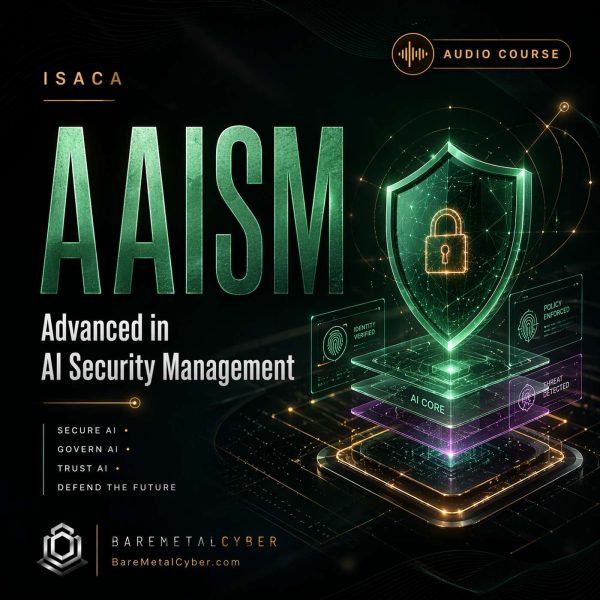
Certified: The ISACA AAISM Audio Course
- Episodios
- 91
- Formato
- Serie: escúchala desde el principio
- Último episodio
- 15 Feb 2026
Sobre el podcast
Welcome to Certified: The ISACA AAISM Audio Course. If you’re responsible for security, risk, assurance, or governance and AI is now part of your environment, you’re in the right place. This course is designed to help you prepare for the ISACA AAISM certification with clear explanations and practical framing, so the topics feel manageable instead of abstract. Each episode stays focused on the concepts the exam tests, while still connecting them to real situations you might face when reviewing AI use cases, third-party AI services, or internal model development. Expect straightforward definitions, exam-style thinking, and guidance on how to separate what matters from what’s noise. To get the most out of this course, listen in order at first, even if you’re tempted to jump to the topics that feel urgent. The early episodes build a shared vocabulary for AI systems, risk, and assurance, and that foundation makes later material click faster. As you go, pause when you hear a term you’d want to explain to a stakeholder, then try saying it back in your own words before you continue. That simple habit builds recall for test day and clarity for your day job. Follow or subscribe so new episodes show up automatically, and keep a steady pace—you’ll be surprised how quickly this becomes familiar.
Episodios 91
Welcome to the ISACA AAISM Audio Course
Certified: The ISACA AAISM Audio Course is built for security managers, team leads, auditors, and practitioners who are stepping into AI risk and security oversight and need a clear path to exam readiness. If …
Notas del episodio
Certified: The ISACA AAISM Audio Course is built for security managers, team leads, auditors, and practitioners who are stepping into AI risk and security oversight and need a clear path to exam readiness. If you already understand core cybersecurity and governance basics but feel unsure about AI systems, model risk, and how assurance expectations change, this course meets you where you are. It also works well for busy professionals who want a structured, certification-aligned way to learn without getting lost in research papers or vendor hype. You’ll learn how to think like an assessor and like a responsible program owner, so you can explain AI security decisions to technical teams, executives, and auditors using shared language and defensible reasoning.
Across this course, you’ll build a working mental model of how AI systems are designed, deployed, monitored, and governed, then map that reality to what the exam expects you to know. You’ll cover AI life cycle concepts, data and model risks, security and privacy controls, evaluation and testing practices, and the operational requirements that keep AI trustworthy over time. The teaching approach is audio-first and designed for real schedules: short, focused lessons that explain terms in plain language, connect ideas with practical examples, and reinforce what matters most for exam questions. You can learn while commuting, walking, or doing routine tasks, and still feel like you’re progressing with purpose.
What makes this course different is that it treats assurance as a skill, not a checklist, and it keeps the focus on decisions you can defend. You won’t just memorize definitions; you’ll practice recognizing what “good” looks like in policies, controls, evidence, and monitoring, including where AI introduces new failure modes and blind spots. You’ll also learn how to spot common traps, like confusing model performance with safety, or assuming governance exists because a document exists. Success here means you can read an AI-related scenario, identify the risk and control gaps quickly, and choose the best next step with confidence for both the exam and the workplace.
Episode 90 — Finish strong: lock in governance, risk, and controls for AAISM (Tasks 1–22)
This final episode ties the full AAISM body of knowledge together so you leave with a single coherent mental model: governance sets ownership and rules, risk management prioritizes what matters, and controls …
Notas del episodio
This final episode ties the full AAISM body of knowledge together so you leave with a single coherent mental model: governance sets ownership and rules, risk management prioritizes what matters, and controls plus operations deliver measurable protection over the AI life cycle. You will reinforce how to connect artifacts and evidence, such as charters, policies, inventories, assessments, monitoring outputs, and incident records, into an auditable story that explains what you did, why you did it, and how you know it works. We use a closing scenario that forces trade-offs between speed and safety to practice choosing actions that align to tasks, roles, and evidence expectations. Produced by BareMetalCyber.com, where you’ll find more cyber audio courses, books, and information to strengthen your educational path. Also, if you want to stay up to date with the latest news, visit DailyCyber.News for a newsletter you can use, and a daily podcast you can commute with.
Episode 89 — Exam-day tactics: calm pacing, best-answer logic, and time discipline (Tasks 1–22)
This episode focuses on exam-day tactics that improve accuracy without rushing, emphasizing calm pacing, best-answer logic, and time discipline as skills you can apply to every AAISM question. You will learn …
Notas del episodio
This episode focuses on exam-day tactics that improve accuracy without rushing, emphasizing calm pacing, best-answer logic, and time discipline as skills you can apply to every AAISM question. You will learn how to quickly identify what the question is truly asking, spot qualifiers that limit scope, and eliminate answers that do not satisfy the task’s intent even if they sound plausible. We cover practical time management behaviors, such as when to mark and move on, how to avoid overthinking rare edge cases, and how to prioritize defensible governance and evidence when multiple options appear “secure.” Troubleshooting focuses on common exam errors like answering from personal tool preference, misreading who owns the decision, and missing the difference between prevention, detection, and response in the scenario’s timeline. Produced by BareMetalCyber.com, where you’ll find more cyber audio courses, books, and information to strengthen your educational path. Also, if you want to stay up to date with the latest news, visit DailyCyber.News for a newsletter you can use, and a daily podcast you can commute with.
Episode 88 — Final rapid recap: remember the three domains and all 22 tasks (Tasks 1–22)
This episode delivers a rapid, structured recap that reinforces how the three AAISM domains connect and how all 22 tasks fit into a single end-to-end AI security operating model. You will revisit the purpose of …
Notas del episodio
This episode delivers a rapid, structured recap that reinforces how the three AAISM domains connect and how all 22 tasks fit into a single end-to-end AI security operating model. You will revisit the purpose of governance and policy, the logic of risk identification through treatment and reassessment, and the operational controls that secure architecture, data, monitoring, and incident response. The focus is memory clarity under pressure, helping you quickly map a question to the correct domain, then to the specific task and the kind of evidence or action it requires. Troubleshooting emphasizes preventing last-minute confusion between similar-sounding activities, such as monitoring versus testing or vendor review versus vendor assurance, so you can answer consistently and defensibly. Produced by BareMetalCyber.com, where you’ll find more cyber audio courses, books, and information to strengthen your educational path. Also, if you want to stay up to date with the latest news, visit DailyCyber.News for a newsletter you can use, and a daily podcast you can commute with.
Episode 87 — Cross-domain practice: choose the right task in realistic scenarios (Tasks 1–22)
This episode provides cross-domain practice by training you to identify the correct AAISM task under realistic scenarios, because the exam often rewards task recognition more than memorizing isolated facts. You …
Notas del episodio
This episode provides cross-domain practice by training you to identify the correct AAISM task under realistic scenarios, because the exam often rewards task recognition more than memorizing isolated facts. You will practice listening for signals that indicate governance work versus risk assessment versus technical control operations, such as keywords tied to ownership, evidence, monitoring, vendor boundaries, lifecycle phases, and incident actions. We use blended scenarios like a vendor model update causing new risks, or a policy requirement conflicting with operational reality, to show how the best answer changes when you correctly identify the task being tested. Troubleshooting focuses on common misreads, including selecting a technical fix when the question is asking for governance evidence, or selecting a policy update when the scenario needs immediate containment and escalation. Produced by BareMetalCyber.com, where you’ll find more cyber audio courses, books, and information to strengthen your educational path. Also, if you want to stay up to date with the latest news, visit DailyCyber.News for a newsletter you can use, and a daily podcast you can commute with.
Episode 86 — Connect monitoring to incident response so alerts lead to action (Task 16)
This episode teaches how to connect monitoring to incident response so alerts reliably trigger triage, containment, and recovery actions, which AAISM tests by asking what makes monitoring operationally …
Notas del episodio
This episode teaches how to connect monitoring to incident response so alerts reliably trigger triage, containment, and recovery actions, which AAISM tests by asking what makes monitoring operationally meaningful. You will learn how to define what constitutes an incident signal versus a performance issue, how to route alerts to the right owners, and how to use runbooks that specify evidence collection, immediate containment levers, and escalation thresholds. We walk through scenarios like suspected data exfiltration through prompts, abnormal endpoint usage suggesting abuse, and integrity signals from a pipeline to show how monitoring should drive concrete steps rather than debate. Troubleshooting focuses on missing runbooks, unclear ownership, and alerts that are not validated against real behavior, creating either false confidence or alert fatigue that delays real containment. Produced by BareMetalCyber.com, where you’ll find more cyber audio courses, books, and information to strengthen your educational path. Also, if you want to stay up to date with the latest news, visit DailyCyber.News for a newsletter you can use, and a daily podcast you can commute with.
Episode 85 — Build continuous monitoring for AI systems, controls, and security signals (Task 12)
This episode explains how to build continuous monitoring for AI systems so you can detect control breakdowns, misuse, and emerging risk early, which AAISM tests through operational control effectiveness …
Notas del episodio
This episode explains how to build continuous monitoring for AI systems so you can detect control breakdowns, misuse, and emerging risk early, which AAISM tests through operational control effectiveness scenarios. You will learn what to monitor across model endpoints, data pipelines, access paths, guardrails, and control outcomes, and how to turn monitoring into actionable signals with clear thresholds and ownership. We use examples like tracking unusual prompt patterns, access anomalies, drift indicators that correlate to security exposure, and changes to critical configurations that should never happen silently. Troubleshooting focuses on monitoring that produces noise without decisions, missing telemetry that prevents investigation, and unclear responsibilities that cause alerts to be ignored, all of which undermine both security and audit defensibility. Produced by BareMetalCyber.com, where you’ll find more cyber audio courses, books, and information to strengthen your educational path. Also, if you want to stay up to date with the latest news, visit DailyCyber.News for a newsletter you can use, and a daily podcast you can commute with.
Episode 84 — Test robustness and respond when models behave unpredictably (Task 20)
This episode teaches how to test robustness and respond when models behave unpredictably, because AAISM expects you to treat unpredictable behavior as a risk that must be measured, monitored, and managed with …
Notas del episodio
This episode teaches how to test robustness and respond when models behave unpredictably, because AAISM expects you to treat unpredictable behavior as a risk that must be measured, monitored, and managed with defined actions. You will learn how to design robustness tests that include edge cases, adversarial inputs, environmental changes, and integration failures that can shift outputs in harmful ways. We walk through scenarios like a model reacting poorly to novel prompt patterns or a pipeline change causing unexpected output drift, showing how to capture evidence, set thresholds, and decide when to restrict functionality, roll back versions, or require human review. Troubleshooting focuses on the common mistake of treating unpredictable behavior as “just AI,” instead of identifying contributing causes like data quality, configuration changes, weak guardrails, or missing monitoring signals. Produced by BareMetalCyber.com, where you’ll find more cyber audio courses, books, and information to strengthen your educational path. Also, if you want to stay up to date with the latest news, visit DailyCyber.News for a newsletter you can use, and a daily podcast you can commute with.
Episode 83 — Improve explainability so decisions are defensible to leaders and auditors (Task 20)
This episode explains how to improve explainability so AI-driven decisions are defensible to leaders and auditors, which AAISM tests through scenarios that require clear rationale, limits, and evidence rather …
Notas del episodio
This episode explains how to improve explainability so AI-driven decisions are defensible to leaders and auditors, which AAISM tests through scenarios that require clear rationale, limits, and evidence rather than vague claims of “the model decided.” You will learn what explainability means in practical terms, including describing inputs, constraints, confidence signals, decision boundaries, and human oversight steps, and how to document these elements so stakeholders understand risk and accountability. We use examples like credit-like decisions, prioritization recommendations, or automated approvals to show how to communicate what the model can and cannot reliably do, and where human judgment remains required. Troubleshooting focuses on overpromising certainty, relying on explanations that are not stable across versions, and failing to connect explainability to monitoring and change control that keeps claims accurate over time. Produced by BareMetalCyber.com, where you’ll find more cyber audio courses, books, and information to strengthen your educational path. Also, if you want to stay up to date with the latest news, visit DailyCyber.News for a newsletter you can use, and a daily podcast you can commute with.
Episode 82 — Review AI outputs for trust and safety without slowing the business (Task 20)
This episode teaches how to review AI outputs for trust and safety in ways that scale, because AAISM questions often ask what control best reduces harm while still enabling delivery speed. You will learn …
Notas del episodio
This episode teaches how to review AI outputs for trust and safety in ways that scale, because AAISM questions often ask what control best reduces harm while still enabling delivery speed. You will learn practical output review patterns such as sampling, risk-tiered review, high-impact approval gates, automated pre-filters paired with human escalation, and clear “stop” conditions when unsafe behavior appears. We walk through scenarios like an assistant drafting customer messages or generating policy guidance to show how to define unacceptable output categories and how to route questionable outputs for review without blocking routine use. Troubleshooting focuses on review programs that create bottlenecks, lack reviewer standards, or produce inconsistent decisions, and how to build evidence that review is happening and improving outcomes. Produced by BareMetalCyber.com, where you’ll find more cyber audio courses, books, and information to strengthen your educational path. Also, if you want to stay up to date with the latest news, visit DailyCyber.News for a newsletter you can use, and a daily podcast you can commute with.
Episode 81 — Design risk-based human oversight so AI stays safe and useful (Task 20)
This episode explains how to design risk-based human oversight so AI systems remain safe and useful without turning every decision into manual work, a balance the AAISM exam tests through scenario questions …
Notas del episodio
This episode explains how to design risk-based human oversight so AI systems remain safe and useful without turning every decision into manual work, a balance the AAISM exam tests through scenario questions about review thresholds and accountability. You will learn how to decide where humans must approve, where humans must monitor, and where automation is acceptable, based on impact, data sensitivity, user reach, and the reversibility of outcomes. We use examples like customer-facing recommendations and internal decision support to show how to set escalation triggers, define reviewer authority, and document why a particular oversight level is appropriate. Troubleshooting focuses on oversight that is either too weak to prevent harm or so heavy that teams bypass it, and how to choose exam answers that create enforceable, measurable oversight. Produced by BareMetalCyber.com, where you’ll find more cyber audio courses, books, and information to strengthen your educational path. Also, if you want to stay up to date with the latest news, visit DailyCyber.News for a newsletter you can use, and a daily podcast you can commute with.
Episode 80 — Build ethical guardrails that reduce harm while meeting business goals (Task 3)
This episode teaches how to build ethical guardrails that reduce harm while still meeting business goals, because AAISM tests whether you can operationalize ethics as measurable requirements rather than …
Notas del episodio
This episode teaches how to build ethical guardrails that reduce harm while still meeting business goals, because AAISM tests whether you can operationalize ethics as measurable requirements rather than statements of intent. You will learn to define guardrails in terms of prohibited outcomes, required human review thresholds, transparency expectations, and monitoring triggers that detect harmful patterns early. We use examples like limiting sensitive recommendations, preventing discriminatory outcomes, and handling unsafe user requests to show how guardrails can be implemented through policy, workflow constraints, and technical controls that teams can test and audit. Troubleshooting focuses on guardrails that are too vague, not enforced in production, or not aligned to business objectives, which creates either uncontrolled harm or unnecessary friction that teams will bypass. Produced by BareMetalCyber.com, where you’ll find more cyber audio courses, books, and information to strengthen your educational path. Also, if you want to stay up to date with the latest news, visit DailyCyber.News for a newsletter you can use, and a daily podcast you can commute with.
Episode 79 — Manage privacy requirements across AI inputs, outputs, and user access (Task 3)
This episode explains how to manage privacy requirements across AI inputs, outputs, and user access, with an exam focus on turning privacy expectations into enforceable controls and provable evidence. You will …
Notas del episodio
This episode explains how to manage privacy requirements across AI inputs, outputs, and user access, with an exam focus on turning privacy expectations into enforceable controls and provable evidence. You will learn how privacy risk shows up through training data selection, user-provided prompts, inference logs, and generated outputs that may reveal sensitive information or infer protected details. We use scenarios like an internal assistant accessing regulated data and a customer-facing model handling user submissions to show how consent, minimization, purpose limitation, retention, and access controls must align across the full flow. Troubleshooting focuses on privacy failures such as logging too much, retaining too long, allowing broad user access without role-based constraints, and making transparency claims that are not supported by system behavior or evidence. Produced by BareMetalCyber.com, where you’ll find more cyber audio courses, books, and information to strengthen your educational path. Also, if you want to stay up to date with the latest news, visit DailyCyber.News for a newsletter you can use, and a daily podcast you can commute with.
Episode 78 — Protect embeddings, prompts, and inference logs as sensitive AI assets (Task 14)
This episode teaches why embeddings, prompts, and inference logs must be treated as sensitive assets, because AAISM scenarios often test whether you recognize non-obvious data that can reveal secrets, personal …
Notas del episodio
This episode teaches why embeddings, prompts, and inference logs must be treated as sensitive assets, because AAISM scenarios often test whether you recognize non-obvious data that can reveal secrets, personal data, or proprietary information. You will learn how embeddings can encode sensitive context, how prompts can contain confidential instructions or data pasted by users, and how logs can create long-lived exposure if retention and access are not controlled. We walk through practical protections such as classification, least-privilege access, encryption, retention limits, and monitoring for abnormal access patterns, along with how to document evidence that these controls are working. Troubleshooting focuses on overlooked exposures like debug logging, shared prompt libraries without ownership, and uncontrolled access to vector stores that become easy targets for theft or misuse. Produced by BareMetalCyber.com, where you’ll find more cyber audio courses, books, and information to strengthen your educational path. Also, if you want to stay up to date with the latest news, visit DailyCyber.News for a newsletter you can use, and a daily podcast you can commute with.
Episode 77 — Control data pipelines with lineage, access control, and secure storage (Task 14)
This episode explains how to control data pipelines using lineage, access control, and secure storage, which AAISM tests because data pipelines are where integrity and confidentiality failures often begin. You …
Notas del episodio
This episode explains how to control data pipelines using lineage, access control, and secure storage, which AAISM tests because data pipelines are where integrity and confidentiality failures often begin. You will learn how lineage clarifies where data came from, how it changed, and which model versions used it, while access control limits who can introduce or modify data and secure storage prevents leaks and unauthorized access. We use scenarios like a feature pipeline that silently changes and causes unexpected model behavior to show how lineage and controlled ingestion accelerate investigation and reduce ambiguity. Troubleshooting focuses on common pipeline risks such as uncontrolled copies, missing audit logs, broad permissions, and storage misconfigurations that expose training or evaluation datasets. Produced by BareMetalCyber.com, where you’ll find more cyber audio courses, books, and information to strengthen your educational path. Also, if you want to stay up to date with the latest news, visit DailyCyber.News for a newsletter you can use, and a daily podcast you can commute with.
Episode 76 — Review and tune AI security controls as models, data, and threats change (Task 12)
This episode teaches how to review and tune AI security controls over time, because AAISM questions often assume that controls must evolve as models, data sources, vendor features, and attacker methods change …
Notas del episodio
This episode teaches how to review and tune AI security controls over time, because AAISM questions often assume that controls must evolve as models, data sources, vendor features, and attacker methods change. You will learn to build a review routine that uses monitoring signals, incident lessons learned, and reassessment triggers to decide what to tune, what to retire, and what to strengthen. We use examples like tightening prompt filtering after new abuse patterns, updating access scope when a use case expands, and retesting guardrails after a model update to show how tuning protects both safety and business outcomes. Troubleshooting focuses on control drift, including thresholds that become meaningless, policies that no longer match reality, and controls that were never revalidated after pipeline or vendor changes. Produced by BareMetalCyber.com, where you’ll find more cyber audio courses, books, and information to strengthen your educational path. Also, if you want to stay up to date with the latest news, visit DailyCyber.News for a newsletter you can use, and a daily podcast you can commute with.
Episode 75 — Assign control owners and evidence so controls survive real operations (Task 12)
This episode explains how to assign control owners and evidence requirements so AI security controls remain effective after the initial rollout, which AAISM treats as a governance-and-operations problem as much …
Notas del episodio
This episode explains how to assign control owners and evidence requirements so AI security controls remain effective after the initial rollout, which AAISM treats as a governance-and-operations problem as much as a technical one. You will learn how to define ownership for controls spanning data, pipelines, endpoints, monitoring, and incident response, and how to specify evidence that proves the control is operating, such as logs, approval records, test results, and periodic attestations. We use scenarios like a guardrail configuration being changed during an urgent release to show why ownership and evidence must be explicit, or controls quietly erode under schedule pressure. Troubleshooting focuses on common breakdowns: “shared ownership” that creates no accountability, evidence that is not retained or trustworthy, and controls that cannot be verified because success criteria were never defined. Produced by BareMetalCyber.com, where you’ll find more cyber audio courses, books, and information to strengthen your educational path. Also, if you want to stay up to date with the latest news, visit DailyCyber.News for a newsletter you can use, and a daily podcast you can commute with.
Episode 74 — Apply security controls across the AI life cycle to treat risk (Task 12)
This episode teaches how to apply security controls across the AI life cycle so controls actually treat risk at the points where harm can occur, which AAISM tests through “where should the control be placed” …
Notas del episodio
This episode teaches how to apply security controls across the AI life cycle so controls actually treat risk at the points where harm can occur, which AAISM tests through “where should the control be placed” and “what control reduces this risk most” questions. You will learn to map risks to stages, such as access controls and provenance at data intake, integrity controls during training, validation gates before deployment, and monitoring plus incident response readiness in production. We use examples like preventing poisoning at ingestion, limiting leakage through logging, and controlling model changes through approvals and rollback to show how controls work together as a system. Troubleshooting focuses on misapplied controls, such as deploying a monitoring tool but skipping release gates, or writing policies without implementing technical and procedural enforcement. Produced by BareMetalCyber.com, where you’ll find more cyber audio courses, books, and information to strengthen your educational path. Also, if you want to stay up to date with the latest news, visit DailyCyber.News for a newsletter you can use, and a daily podcast you can commute with.
Episode 73 — Validate models for safety, accuracy, and security failure modes (Task 22)
This episode explains how to validate models in a way that addresses safety, accuracy, and security failure modes, because AAISM questions often ask what validation should prove before deployment approval. You …
Notas del episodio
This episode explains how to validate models in a way that addresses safety, accuracy, and security failure modes, because AAISM questions often ask what validation should prove before deployment approval. You will learn to define validation goals that include expected performance, unacceptable behaviors, and adversarial misuse patterns, then document test design so results can be trusted and repeated. We walk through scenarios like a model that performs well on benchmarks but leaks sensitive information through specific prompt patterns, showing why validation must include realistic inputs, edge cases, and guardrail testing. Troubleshooting focuses on validation shortcuts, such as testing only average-case accuracy, failing to retest after data changes, and treating guardrails as optional rather than required evidence for safe operation. Produced by BareMetalCyber.com, where you’ll find more cyber audio courses, books, and information to strengthen your educational path. Also, if you want to stay up to date with the latest news, visit DailyCyber.News for a newsletter you can use, and a daily podcast you can commute with.
Episode 72 — Secure build, train, and deploy pipelines for repeatable safe releases (Task 22)
This episode teaches how to secure build, training, and deployment pipelines so releases are repeatable, controlled, and auditable, which AAISM commonly tests through scenarios involving rapid iteration and …
Notas del episodio
This episode teaches how to secure build, training, and deployment pipelines so releases are repeatable, controlled, and auditable, which AAISM commonly tests through scenarios involving rapid iteration and hidden production changes. You will learn how to treat pipelines as critical security assets by enforcing least privilege for service accounts, strong secret management, approvals for stage transitions, and logging that preserves who changed what and when. We use examples like a training job pulling data from multiple sources and a deployment pushing a new model version to an endpoint to show how pipeline controls prevent accidental exposure and intentional tampering. Troubleshooting focuses on weak points such as shared credentials, unmanaged pipeline steps, missing artifact integrity checks, and “temporary” bypasses that become permanent risk. Produced by BareMetalCyber.com, where you’ll find more cyber audio courses, books, and information to strengthen your educational path. Also, if you want to stay up to date with the latest news, visit DailyCyber.News for a newsletter you can use, and a daily podcast you can commute with.
Episode 71 — Understand the AI development life cycle from idea to retirement (Task 22)
This episode explains the AI development life cycle as the AAISM exam expects you to reason about it: a sequence of accountable decisions and controlled transitions from idea intake to retirement. You will …
Notas del episodio
This episode explains the AI development life cycle as the AAISM exam expects you to reason about it: a sequence of accountable decisions and controlled transitions from idea intake to retirement. You will define practical phases such as use-case selection, data sourcing, model development, evaluation, deployment, monitoring, and decommissioning, then connect each phase to the evidence and controls that prove the system is being managed safely. We use scenarios like expanding an internal assistant into a customer-facing product to show how scope changes create new risks and new control obligations. Troubleshooting focuses on life cycle gaps that cause exam-style failures, such as skipping retirement planning, losing version traceability, and deploying models without clear rollback and ownership. Produced by BareMetalCyber.com, where you’ll find more cyber audio courses, books, and information to strengthen your educational path. Also, if you want to stay up to date with the latest news, visit DailyCyber.News for a newsletter you can use, and a daily podcast you can commute with.
Episode 70 — Document architecture decisions so governance and audit stay aligned (Task 11)
This episode explains how to document AI architecture decisions so governance and audit stay aligned, which AAISM tests by asking what evidence proves controls were intentionally designed, approved, and …
Notas del episodio
This episode explains how to document AI architecture decisions so governance and audit stay aligned, which AAISM tests by asking what evidence proves controls were intentionally designed, approved, and maintained. You will learn what to capture in an architecture decision record, including the problem statement, assumptions, trade-offs, chosen controls, residual risks, and the approvals that authorize the design. We walk through examples like selecting a vendor model platform, enabling a new integration, or changing a data flow, showing how documentation creates traceability that supports audits and speeds incident investigation. Troubleshooting focuses on documentation that is too vague to verify, missing version history, and decisions that are made informally and later become impossible to defend when something goes wrong. Produced by BareMetalCyber.com, where you’ll find more cyber audio courses, books, and information to strengthen your educational path. Also, if you want to stay up to date with the latest news, visit DailyCyber.News for a newsletter you can use, and a daily podcast you can commute with.
Episode 69 — Align AI architecture with enterprise identity, network, and data standards (Task 11)
This episode teaches how to align AI architecture with enterprise identity, network, and data standards, because AAISM expects you to treat AI as part of the environment, not a separate universe with custom …
Notas del episodio
This episode teaches how to align AI architecture with enterprise identity, network, and data standards, because AAISM expects you to treat AI as part of the environment, not a separate universe with custom rules. You will learn how to enforce identity standards like centralized authentication and role-based access, apply network standards like segmentation and controlled egress, and adopt data standards like classification-driven access and retention. We use examples such as controlling which data sources retrieval can access, ensuring inference logs follow retention rules, and routing telemetry into existing monitoring platforms. Troubleshooting focuses on drift between “approved architecture” and what actually runs in production, including undocumented exceptions, vendor features enabled without review, and data pathways that bypass normal controls and governance oversight. Produced by BareMetalCyber.com, where you’ll find more cyber audio courses, books, and information to strengthen your educational path. Also, if you want to stay up to date with the latest news, visit DailyCyber.News for a newsletter you can use, and a daily podcast you can commute with.
Episode 68 — Integrate AI architecture into enterprise architecture without shadow systems (Task 11)
This episode explains how to integrate AI architecture into enterprise architecture so AI systems inherit proven controls instead of becoming shadow systems, which AAISM tests through scenarios involving …
Notas del episodio
This episode explains how to integrate AI architecture into enterprise architecture so AI systems inherit proven controls instead of becoming shadow systems, which AAISM tests through scenarios involving inconsistent standards and unmanaged deployments. You will learn how to align AI components with approved platforms, identity patterns, network segmentation, logging pipelines, and change management so governance remains enforceable. We use a scenario where a team builds an AI workflow outside normal enterprise patterns to move faster, then show how that choice creates blind spots in monitoring, incident response, and audit evidence. Troubleshooting focuses on practical integration issues such as mismatched tooling, unclear ownership between architecture and engineering teams, and exceptions that accumulate until AI security becomes unmanageable. Produced by BareMetalCyber.com, where you’ll find more cyber audio courses, books, and information to strengthen your educational path. Also, if you want to stay up to date with the latest news, visit DailyCyber.News for a newsletter you can use, and a daily podcast you can commute with.
Episode 67 — Implement AI architecture protections for identity, secrets, and isolation (Task 10)
This episode teaches how to implement core architecture protections around identity, secrets, and isolation, because AAISM scenarios frequently test whether you can prevent compromise paths that start with …
Notas del episodio
This episode teaches how to implement core architecture protections around identity, secrets, and isolation, because AAISM scenarios frequently test whether you can prevent compromise paths that start with credentials and end with data exposure or model misuse. You will learn how to apply least privilege to service accounts and users, how to manage keys and tokens with rotation and scoped permissions, and how to isolate environments and workloads so a failure in one area does not spill into others. We walk through examples like separating training from inference, limiting lateral movement from an AI endpoint, and ensuring secrets never live in code or prompts. Troubleshooting focuses on the most common causes of AI security failure: shared credentials, uncontrolled key distribution, and weak isolation that turns a small mistake into a broad incident. Produced by BareMetalCyber.com, where you’ll find more cyber audio courses, books, and information to strengthen your educational path. Also, if you want to stay up to date with the latest news, visit DailyCyber.News for a newsletter you can use, and a daily podcast you can commute with.
Episode 66 — Reduce AI attack surface through smart deployment and integration choices (Task 10)
This episode explains how to reduce AI attack surface by making smart deployment and integration choices, which AAISM tests by asking what design decision most effectively lowers exposure without relying on a …
Notas del episodio
This episode explains how to reduce AI attack surface by making smart deployment and integration choices, which AAISM tests by asking what design decision most effectively lowers exposure without relying on a single tool. You will learn to minimize public endpoints, restrict plugin and connector capabilities, limit data access by default, and avoid unnecessary features that expand what an attacker can influence through prompts or API calls. We use examples like disabling high-risk integrations, separating environments, and scoping retrieval sources to show how small architectural decisions can prevent entire classes of incidents. Troubleshooting emphasizes recognizing hidden attack surface, such as overly permissive service accounts, broad network reachability, and “temporary” debug logging that leaks sensitive prompts or outputs. Produced by BareMetalCyber.com, where you’ll find more cyber audio courses, books, and information to strengthen your educational path. Also, if you want to stay up to date with the latest news, visit DailyCyber.News for a newsletter you can use, and a daily podcast you can commute with.
Episode 65 — Design AI security architecture with clear trust boundaries and data flows (Task 10)
This episode teaches how to design AI security architecture by clearly defining trust boundaries and data flows, because AAISM questions often hinge on whether you can place controls based on how information …
Notas del episodio
This episode teaches how to design AI security architecture by clearly defining trust boundaries and data flows, because AAISM questions often hinge on whether you can place controls based on how information and authority actually move through the system. You will learn to map where data is collected, transformed, stored, and used for training or inference, and where identities, keys, and permissions enable actions across components. We walk through a scenario where an AI service connects to internal data sources and external vendor APIs, showing how trust boundaries identify where to enforce authentication, authorization, validation, and logging. Troubleshooting focuses on architecture diagrams that hide critical flows, boundary assumptions that are not true in production, and designs that cannot support investigation because telemetry and version history are not captured. Produced by BareMetalCyber.com, where you’ll find more cyber audio courses, books, and information to strengthen your educational path. Also, if you want to stay up to date with the latest news, visit DailyCyber.News for a newsletter you can use, and a daily podcast you can commute with.
Episode 64 — Domain 3 overview: secure AI technologies using architecture and controls (Task 10)
This episode introduces Domain 3 as the “how you actually secure it” domain, focusing on architecture and control implementation that makes AI systems defensible in real operations, which AAISM tests through …
Notas del episodio
This episode introduces Domain 3 as the “how you actually secure it” domain, focusing on architecture and control implementation that makes AI systems defensible in real operations, which AAISM tests through deployment, integration, and control design scenarios. You will learn how to think in trust boundaries, data flows, identity paths, and dependency chains so you can place controls where they reduce risk rather than where they are easiest to deploy. We use examples like an internal assistant with enterprise data access and a customer-facing model endpoint to show how architecture choices determine attack surface, monitoring feasibility, and incident containment speed. Troubleshooting focuses on the most common Domain 3 pitfall: treating AI as a special island that bypasses enterprise identity, network, logging, and change management standards. Produced by BareMetalCyber.com, where you’ll find more cyber audio courses, books, and information to strengthen your educational path. Also, if you want to stay up to date with the latest news, visit DailyCyber.News for a newsletter you can use, and a daily podcast you can commute with.
Episode 63 — Domain 2 quick review: risk lifecycle, threats, testing, and vendors (Tasks 4–9)
This episode reinforces Domain 2 by connecting the risk lifecycle, threat assessment, reassessment triggers, security testing, vulnerability management, and vendor oversight into a single continuous loop, which …
Notas del episodio
This episode reinforces Domain 2 by connecting the risk lifecycle, threat assessment, reassessment triggers, security testing, vulnerability management, and vendor oversight into a single continuous loop, which is how AAISM expects you to reason under exam pressure. You will review how intake and scope drive threat relevance, how likelihood and impact shape prioritization, and how treatments must be documented with owners, timelines, and residual risk decisions. We also tie testing and vulnerability management back into monitoring, showing how findings become remediation work and how retesting proves closure. Vendor oversight is framed as part of risk continuity, emphasizing that vendor updates and incidents can rapidly change exposure and must feed reassessment and governance decisions. Produced by BareMetalCyber.com, where you’ll find more cyber audio courses, books, and information to strengthen your educational path. Also, if you want to stay up to date with the latest news, visit DailyCyber.News for a newsletter you can use, and a daily podcast you can commute with.
Episode 62 — Verify vendor AI security through audits, tests, and contract enforcement (Task 9)
This episode explains how to verify vendor AI security using audits, targeted tests, and enforceable contract terms, which AAISM tests by asking what creates real assurance when visibility ends at the provider …
Notas del episodio
This episode explains how to verify vendor AI security using audits, targeted tests, and enforceable contract terms, which AAISM tests by asking what creates real assurance when visibility ends at the provider boundary. You will learn how to distinguish paper evidence from operational proof, and how to request and evaluate artifacts like audit reports, control mappings, penetration testing summaries, incident response procedures, and data handling documentation. We use scenarios such as a managed LLM provider and a SaaS product with embedded AI to show how verification must address shared responsibility, logging access, retention and deletion, and incident timelines. Troubleshooting emphasizes avoiding performative vendor reviews, ensuring contracts require evidence delivery and notification, and selecting exam answers that prioritize enforceable rights over informal assurances. Produced by BareMetalCyber.com, where you’ll find more cyber audio courses, books, and information to strengthen your educational path. Also, if you want to stay up to date with the latest news, visit DailyCyber.News for a newsletter you can use, and a daily podcast you can commute with.
Aquí están los 60 episodios más recientes de 91. Los anteriores están en el feed del podcast.
Recomendado por Certified: The ISACA AAISM Audio Course



Podcasts similares
Más podcasts de Educación







¿Es tu podcast?
Confírmalo con una entrada en tu feed: aquí recibes un código, lo añades como podcast:txt en el canal de tu feed y nosotros lo comprobamos. Después tu podcast aparecerá como «verificado» en SoundNode.