

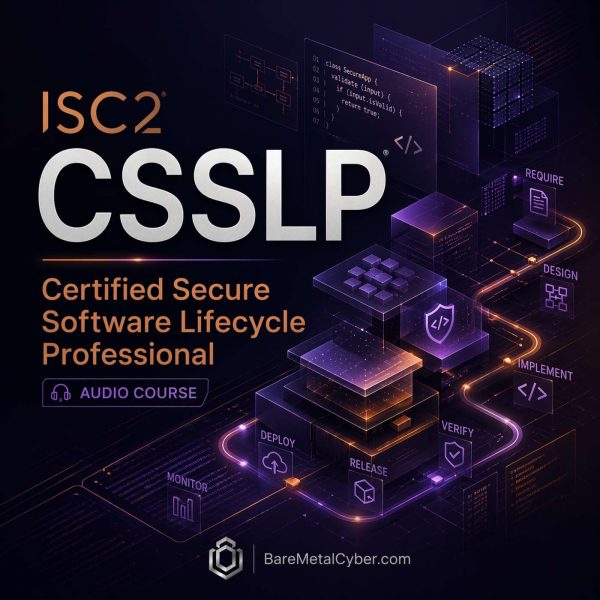
Certified: The ISC2 CSSLP Audio Course
- Episodios
- 71
- Formato
- Serie: escúchala desde el principio
- Último episodio
- 30 Nov 2025
Sobre el podcast
This audio-only CSSLP prep course is built for busy security professionals who want to study anywhere, without a screen. Across 70 tightly focused episodes, you’ll walk the full Certified Secure Software Lifecycle Professional exam blueprint, from requirements and architecture to implementation, testing, operations, and supply chain risk. Each episode is structured as a guided journey: clear concepts, concrete examples, pitfalls to avoid, and quick mental rehearsals you can follow along with in real time. You’ll hear practical takes on exam strategy, secure design principles, SDLC integration, threat modeling, metrics, documentation, incident response, and more, all in plain language. Recap checkpoints, glossary episodes, and acronym refreshers reinforce what you’ve learned so it sticks when you sit for the exam. Whether you’re commuting, at the gym, or in between meetings, this podcast turns small pockets of time into steady progress toward your CSSLP.
Episodios 71
Episode 70 — Essential Terms: Plain-Language Glossary for Fast Review
Key terms and principles appear throughout the CSSLP exam, and being able to recall them quickly in plain language is essential for reading questions correctly and evaluating answer options. This episode …
Notas del episodio
Key terms and principles appear throughout the CSSLP exam, and being able to recall them quickly in plain language is essential for reading questions correctly and evaluating answer options. This episode presents a concentrated glossary of high-yield concepts such as least privilege, defense in depth, separation of duties, threat modeling, risk treatment, secure defaults, nonrepudiation, idempotency, provenance, attestation, and compensating controls. Each term is defined in concise, everyday wording and then tied to specific kinds of decisions, such as how access is granted, how failures are contained, or how system state is proven. The goal is to turn dense textbook phrasing into mental shortcuts you can say aloud, so that the meaning is immediately available when you see the term embedded in a scenario.
To deepen retention, the episode uses short examples that show each term in action rather than leaving it as an abstract definition. Scenarios demonstrate, for instance, how least privilege shapes role design, how nonrepudiation depends on both identity binding and tamper-evident logs, how idempotency affects API behavior under retries, and how compensating controls allow risk treatment when primary controls are not feasible. You also practice grouping related terms into families—for example, those dealing with access control, those tied to reliability, and those focused on assurance—so that recalling one term naturally triggers others. This structured review gives you a final, audio-friendly sweep of the vocabulary that underpins exam questions, making it easier to parse long stems and spot subtle distinctions between answer choices. Produced by BareMetalCyber.com, where you’ll find more cyber audio courses, books, and information to strengthen your educational path. Also, if you want to stay up to date with the latest news, visit DailyCyber.News for a newsletter you can use, and a daily podcast you can commute with.
Episode 69 — Crush Exam Day With Calm, Repeatable Tactics
Exam day performance depends as much on process as on knowledge, and CSSLP candidates who manage time, stress, and attention methodically have a clear advantage. In this episode, you walk through the logistics …
Notas del episodio
Exam day performance depends as much on process as on knowledge, and CSSLP candidates who manage time, stress, and attention methodically have a clear advantage. In this episode, you walk through the logistics and mindset that support a predictable exam experience, starting with arrival planning, check-in steps, and familiarity with testing center rules so that administrative details do not create unnecessary anxiety. The conversation explains how to set an initial pacing plan, translating total questions and allotted time into per-question targets and buffer periods. You also examine how to read questions efficiently by focusing on the stem, identifying verbs and constraints, and separating core requirements from background context that is present only to distract.
Converting that preparation into performance requires disciplined tactics in the exam interface itself. Examples illustrate how to apply a two-pass approach, answering straightforward questions in the first sweep, flagging ambiguous ones, and returning later with a clearer sense of remaining time. Scenarios show how to systematically eliminate distractor options that are too absolute, conflict with known principles, or solve the wrong problem, and how to choose the best answer when several appear plausible by aligning with risk, governance, and lifecycle thinking emphasized throughout the blueprint. You also explore micro-techniques for resetting attention, such as brief pauses and controlled breathing, and for resisting unproductive behavior like repeatedly changing answers based on anxiety rather than new insight. These habits support a calm, repeatable pattern you can rehearse in practice exams and then apply consistently on the real day. Produced by BareMetalCyber.com, where you’ll find more cyber audio courses, books, and information to strengthen your educational path. Also, if you want to stay up to date with the latest news, visit DailyCyber.News for a newsletter you can use, and a daily podcast you can commute with.
Episode 68 — Recap Checkpoint: Domains Seven and Eight Mastery
Later CSSLP domains extend security thinking into supply chain, operations, and broader governance, and a focused recap helps integrate these topics into a cohesive mental model. This episode revisits core …
Notas del episodio
Later CSSLP domains extend security thinking into supply chain, operations, and broader governance, and a focused recap helps integrate these topics into a cohesive mental model. This episode revisits core themes such as supplier onboarding and lifecycle oversight, contractual guardrails, provenance and SBOM usage, runtime protection, and continuous monitoring of production systems. You review how runtime controls, telemetry, incident response processes, patching practices, vulnerability management, continuity planning, and SLA alignment form a dense network of interlocking safeguards. Emphasis is placed on seeing how decisions about dependency selection, pipeline hardening, and component verification echo earlier principles around least privilege, defense in depth, and trusted baselines, but now applied across organizational and supply chain boundaries.
To strengthen retention, the discussion uses multi-domain scenarios that mirror exam complexity. You consider cases where a supplier incident intersects with runtime defenses, monitoring signals, and contractual notification obligations, and where vulnerability disclosures in a third-party component trigger provenance checks, patch management workflows, and updated risk analysis. Examples highlight common failure patterns, such as relying solely on contracts without technical validation, treating production as static, or neglecting continuity implications of supplier concentration. You also hear how to turn these patterns into simple mental cues, so that when a question mentions vendors, pipelines, or production telemetry, you automatically recall the relevant controls and governance mechanisms. This integrated checkpoint prepares you to handle questions that span procurement, development, deployment, and operations while still demonstrating structured, exam-ready reasoning. Produced by BareMetalCyber.com, where you’ll find more cyber audio courses, books, and information to strengthen your educational path. Also, if you want to stay up to date with the latest news, visit DailyCyber.News for a newsletter you can use, and a daily podcast you can commute with.
Episode 67 — Support Contracts, Intellectual Property, and Software Escrow
Contracts define how legal, operational, and security responsibilities are shared, and the CSSLP exam often expects you to interpret these agreements from a security and risk perspective. In this episode, you …
Notas del episodio
Contracts define how legal, operational, and security responsibilities are shared, and the CSSLP exam often expects you to interpret these agreements from a security and risk perspective. In this episode, you look at how intellectual property ownership, license terms, and confidentiality clauses shape what can be done with software, documentation, and data. The discussion explains how to express data rights clearly, including permitted processing purposes, retention limits, deletion obligations, and restrictions on onward sharing. You will also see how security representations and warranties, such as commitments to maintain specific controls or meet certain standards, become part of the assurance story that must be supported with evidence. Notification timelines for incidents and vulnerabilities are examined in the context of regulatory requirements, customer expectations, and realistic detection and response capabilities.
The episode then turns to software escrow and related mechanisms that help preserve continuity when critical third-party components are involved. Examples describe when escrow is appropriate, how to define objective release conditions, and why periodic verification of deposits—build instructions, dependencies, and test data—is crucial if escrow is to be more than a symbolic safeguard. Scenarios discuss how contracts can address indemnification for intellectual property infringement, data loss, and regulatory penalties, and how those provisions influence risk assessments and insurance decisions. You also explore termination assistance, transition support, and knowledge transfer clauses that reduce lock-in and speed recovery if a vendor fails or risk becomes unacceptable. Exam items in this area tend to favor answers that integrate legal constructs, technical realities, and operational processes, rather than treating contract language as disconnected from how systems are designed and run. Produced by BareMetalCyber.com, where you’ll find more cyber audio courses, books, and information to strengthen your educational path. Also, if you want to stay up to date with the latest news, visit DailyCyber.News for a newsletter you can use, and a daily podcast you can commute with.
Episode 66 — Enforce Supplier Security Requirements Through Lifecycle Oversight
Supplier security cannot be assured at contract signing alone; it has to be monitored and enforced throughout the full relationship, which is a recurring theme in CSSLP scenarios. In this episode, you examine …
Notas del episodio
Supplier security cannot be assured at contract signing alone; it has to be monitored and enforced throughout the full relationship, which is a recurring theme in CSSLP scenarios. In this episode, you examine how to translate internal security expectations and regulatory obligations into concrete entry criteria for vendors, including minimum control baselines, attestations, and evidence requirements that are practical to verify. The discussion walks through mapping supplier activities to the data they handle, the environments they operate in, and the privileges they receive, so that requirements around identity, access, logging, vulnerability handling, and incident notification are appropriately scoped. You also hear why onboarding checkpoints, such as verifying segregated environments and confirming tested secure development practices, are essential to prevent high-risk arrangements from becoming embedded before security is evaluated.
Sustaining that assurance over time depends on structured lifecycle oversight, not one-off due diligence. Examples show how to schedule periodic reassessments, review security reports and audit findings, and track remediation commitments with clear ownership and deadlines. Scenarios illustrate how to manage changes such as new subcontractors, data center moves, or architecture shifts, and why robust change notification clauses support timely risk re-evaluation. You explore how performance scorecards, incentives, and renewal decisions can be tied to security conformance, and how termination playbooks ensure clean data return or destruction and revocation of access when relationships end. Exam-style questions in this area favor responses that embed supplier security into ongoing monitoring, governance, and contractual levers, instead of assuming a single initial questionnaire is enough. Produced by BareMetalCyber.com, where you’ll find more cyber audio courses, books, and information to strengthen your educational path. Also, if you want to stay up to date with the latest news, visit DailyCyber.News for a newsletter you can use, and a daily podcast you can commute with.
Episode 65 — Verify Component Pedigree and Provenance to Reduce Risk
Component pedigree and provenance determine whether you can trust the origins and integrity of the software building blocks in your systems, and the CSSLP blueprint highlights this as a critical element of …
Notas del episodio
Component pedigree and provenance determine whether you can trust the origins and integrity of the software building blocks in your systems, and the CSSLP blueprint highlights this as a critical element of modern assurance. This episode explains what pedigree and provenance mean in practice: verifying who developed a component, how it has been maintained, and whether the artifacts you consume match the sources you trust. You will hear how signed commits, tags, and releases, along with checksums and secure distribution channels, help you detect tampering or substitution. The conversation introduces software bills of materials and provenance attestations as structured ways to record which components are included in a build, where they came from, and under what conditions they were produced.
Ensuring that only trustworthy components enter your environment requires both policy and enforcement. Examples explore how to implement admission controls that block unsigned or unverified artifacts, require minimum levels of provenance detail, and enforce version pinning with scheduled review points for updates. Scenarios discuss monitoring upstream repositories for hijacks, maintainer changes, and suspicious activity, and how to respond when a dependency’s trustworthiness is called into question, including quarantining artifacts and consulting community or vendor advisories. You also consider how provenance data supports incident investigations and customer or auditor inquiries by enabling you to answer precisely which versions and components were present at a given time. Exam scenarios in this area reward answers that embed provenance checks into build and deployment pipelines and maintain auditable evidence trails, rather than those that rely on ad hoc manual verification or unverified downloads. Produced by BareMetalCyber.com, where you’ll find more cyber audio courses, books, and information to strengthen your educational path. Also, if you want to stay up to date with the latest news, visit DailyCyber.News for a newsletter you can use, and a daily podcast you can commute with.
Episode 64 — Analyze Third-Party Software Security Before Adoption
Choosing a new third-party product or service is effectively choosing to share risk with another organization, and CSSLP questions often examine how thoughtfully that decision is made. This episode outlines the …
Notas del episodio
Choosing a new third-party product or service is effectively choosing to share risk with another organization, and CSSLP questions often examine how thoughtfully that decision is made. This episode outlines the key elements of pre-adoption security analysis, starting with understanding the software’s architecture, data flows, privilege requirements, and external communication paths. You will hear how to evaluate authentication and authorization mechanisms, default configurations, logging capabilities, and encryption practices, using both documentation and demonstrations. The discussion also covers the importance of update processes, patch channels, and secure distribution mechanisms, because the way software changes over time is as important as how it looks on day one.
Translating this analysis into clear go, no-go, or conditional decisions requires structured evaluation criteria. Examples walk through requesting and interpreting security test summaries, secure development lifecycle evidence, and third-party audit reports, and then mapping those artifacts back to your own control requirements and risk appetite. Scenarios illustrate how to identify gaps such as weak segregation in multi-tenant environments, limited configuration hardening options, or inadequate support for audit logging, and how to define compensating controls or contractual conditions if you proceed. You will also see how to capture exit criteria and transition plans in case future assessments reveal unacceptable risk, ensuring you are not locked into an unsafe dependency. Exam-relevant answers consistently favor approaches that combine architectural understanding, evidence gathering, and explicit conditions for adoption, rather than relying solely on brand reputation or feature lists. Produced by BareMetalCyber.com, where you’ll find more cyber audio courses, books, and information to strengthen your educational path. Also, if you want to stay up to date with the latest news, visit DailyCyber.News for a newsletter you can use, and a daily podcast you can commute with.
Episode 63 — Implement Comprehensive Supply Chain Risk Management Practices
Software today depends on a layered supply chain of cloud platforms, third-party services, open-source components, and commercial products, and the CSSLP exam expects you to treat this web of dependencies as a …
Notas del episodio
Software today depends on a layered supply chain of cloud platforms, third-party services, open-source components, and commercial products, and the CSSLP exam expects you to treat this web of dependencies as a primary risk focus. This episode introduces the core steps of supply chain risk management: inventorying suppliers and components, assessing criticality, understanding where they are hosted, and determining how failure or compromise would affect your systems. You will hear how to gather security attestations, control mappings, and audit results from suppliers, and how to place them in the context of your own requirements and obligations. The conversation also explains how regulatory expectations and industry guidance are increasingly explicit about managing vendor risks, making this topic essential for exam success.
Comprehensive practice means integrating supply chain thinking into design, procurement, operations, and retirement decisions rather than treating it as a one-time checklist. Examples describe how to require software bills of materials, signature verification, and provenance attestations as conditions of use, and how to monitor vulnerability advisories and incident reports affecting your dependencies. Scenarios examine onboarding processes that gate new suppliers on security reviews, recurring assessments that revisit controls and performance, and termination procedures that ensure data return or destruction and revocation of access. You also see how tabletop exercises can model supplier outages or major vulnerabilities, driving preparation for substitution, failover, or compensating controls. Exam items in this area reward answers that demonstrate continuous, evidence-based oversight of suppliers and components, rather than blind trust or purely contractual assurances. Produced by BareMetalCyber.com, where you’ll find more cyber audio courses, books, and information to strengthen your educational path. Also, if you want to stay up to date with the latest news, visit DailyCyber.News for a newsletter you can use, and a daily podcast you can commute with.
Episode 62 — Align Service Levels and SLAs With Security Outcomes
Service levels and formal SLAs influence how software and supporting services are designed, monitored, and improved, and CSSLP items increasingly connect these agreements to security expectations. This episode …
Notas del episodio
Service levels and formal SLAs influence how software and supporting services are designed, monitored, and improved, and CSSLP items increasingly connect these agreements to security expectations. This episode explains how to define service level indicators and objectives that capture not only uptime, but also detection and response times, data protection guarantees, and acceptable error rates. You will hear how to relate these indicators to confidentiality, integrity, and availability requirements, ensuring that commitments to customers and stakeholders reflect real risk posture rather than marketing claims. The discussion distinguishes between SLIs and SLOs you manage internally and SLAs you negotiate with customers or suppliers, emphasizing that all three must be coherent if you are to keep promises reliably.
Maintaining alignment between these measures and security outcomes means treating them as part of your control framework, not just contractual language. Examples show how error budgets can include security incidents and maintenance windows, encouraging preventive hardening and controlled changes instead of reactive firefighting. Scenarios examine how to embed measurable thresholds into SLAs with cloud providers or security vendors, including notification times, evidence delivery, and remediation expectations, and how to respond when actual performance diverges from agreed levels. You will also explore how dashboards, periodic reviews, and incentive structures can reinforce the right behaviors, such as investing in resilience or incident readiness rather than simply maximizing apparent uptime. Exam questions in this area typically favor answers that connect service levels to risk-informed design, monitoring, and governance, rather than treating SLAs as boilerplate text with no operational consequence. Produced by BareMetalCyber.com, where you’ll find more cyber audio courses, books, and information to strengthen your educational path. Also, if you want to stay up to date with the latest news, visit DailyCyber.News for a newsletter you can use, and a daily podcast you can commute with.
Episode 61 — Support Business Continuity and Disaster Recovery Objectives
Business continuity and disaster recovery planning connect directly to the CSSLP focus on availability, resiliency, and risk treatment across the software lifecycle. This episode explains how to identify …
Notas del episodio
Business continuity and disaster recovery planning connect directly to the CSSLP focus on availability, resiliency, and risk treatment across the software lifecycle. This episode explains how to identify critical business services, map them to specific applications and data stores, and understand how interruptions would affect customers, regulators, and internal operations. You will hear how to define recovery time and recovery point objectives in language that aligns with business expectations, not just infrastructure capabilities, and how these objectives drive design decisions about redundancy, replication, and failover patterns. The discussion also clarifies the roles of continuity plans, disaster recovery runbooks, and supporting inventories, showing how each document provides a different lens on the same underlying risk.
Putting continuity and recovery objectives into practice requires a combination of architecture, process, and regular testing. Examples walk through designing restoration sequences that prioritize identity, networking, and core data platforms ahead of less critical services, and show how to ensure backups are not only present but encrypted, isolated, and regularly validated through full restore exercises. Scenarios explore handling loss of a primary data center, region-wide cloud outages, and supplier failures, emphasizing how communication plans and manual workarounds complement technical recovery actions. You also see how post-exercise reviews feed into updated RTOs, RPOs, and design improvements, which is precisely the feedback loop the exam expects you to recognize in scenario questions. Produced by BareMetalCyber.com, where you’ll find more cyber audio courses, books, and information to strengthen your educational path. Also, if you want to stay up to date with the latest news, visit DailyCyber.News for a newsletter you can use, and a daily podcast you can commute with.
Episode 60 — Integrate Runtime Protection Controls for Live Defenses
Runtime protection adds an active defensive layer while applications are serving real users, and CSSLP questions increasingly probe how these controls fit with design, testing, and operations. Core capabilities …
Notas del episodio
Runtime protection adds an active defensive layer while applications are serving real users, and CSSLP questions increasingly probe how these controls fit with design, testing, and operations. Core capabilities discussed here include web application firewalls and API gateways that enforce schemas, rate limits, and authentication requirements at the edge, along with runtime self-protection mechanisms embedded in applications. You learn how memory protections, container or workload sandboxes, and egress controls limit what an exploit can do even if a vulnerability is present. The episode also explains how behavior analytics across identities, sessions, and endpoints can highlight privilege misuse or lateral movement that static controls alone might miss.
Successfully integrating these defenses requires careful tuning and alignment with existing incident and monitoring processes. Examples cover deploying protections in stages, starting with monitor-only modes to understand traffic, then gradually moving to blocking configurations as confidence grows, all while watching key reliability metrics. Scenarios illustrate how deception points such as honey tokens or trap endpoints reveal attacker presence early without confusing normal operations, and how admission controls that validate signatures and provenance prevent untrusted code from entering the environment. You see how runtime protections should feed alerts into incident response runbooks, support dwell-time reduction metrics, and be adjusted when new threats or false positives appear. Exam-relevant options consistently favor approaches that treat runtime controls as part of a layered strategy tied to telemetry, testing, and governance, rather than as isolated appliances turned on without context or review. Produced by BareMetalCyber.com, where you’ll find more cyber audio courses, books, and information to strengthen your educational path. Also, if you want to stay up to date with the latest news, visit DailyCyber.News for a newsletter you can use, and a daily podcast you can commute with.
Episode 59 — Operate a Measurable Vulnerability Management Program Continually
Vulnerability management goes beyond running scanners; it is a continual process of discovering, assessing, and closing real weaknesses, and the CSSLP exam examines whether that process is balanced and …
Notas del episodio
Vulnerability management goes beyond running scanners; it is a continual process of discovering, assessing, and closing real weaknesses, and the CSSLP exam examines whether that process is balanced and evidence-driven. Emphasis is placed on maintaining inventories that relate assets to business functions and data sensitivity, so finding severity can be interpreted in context. You learn how to aggregate information from multiple sources—automated scans, penetration tests, bug bounty reports, threat intelligence, and vendor advisories—and then de-duplicate and group findings by root cause or affected component. The discussion clarifies how to evaluate exploitability by considering network exposure, authentication requirements, compensating controls, and current attacker interest, rather than relying solely on generic scores.
Continuous operation of this program depends on structured workflows and meaningful metrics. Examples describe assigning owners and timelines to remediation tasks, linking them to risk registers, and defining acceptance evidence such as rescans or configuration proofs. Scenarios show how to track backlog health, identify aging high-risk issues, and escalate stalled remediation through governance channels. You also see how trend metrics, including reduction in critical vulnerabilities over time or improved remediation times, provide more insight than raw counts of findings. Exam-style questions frequently contrast superficial programs that “scan and forget” with mature ones that close the loop through validation, reporting, and systemic fixes like hardened baselines and better coding practices. Recognizing that full loop positions you to choose answers that reflect continuous, measurable vulnerability reduction instead of one-off cleanup efforts. Produced by BareMetalCyber.com, where you’ll find more cyber audio courses, books, and information to strengthen your educational path. Also, if you want to stay up to date with the latest news, visit DailyCyber.News for a newsletter you can use, and a daily podcast you can commute with.
Episode 58 — Run Patch Management Effectively Without Business Disruption
Patch management connects vulnerability knowledge to operational change, and the CSSLP exam focuses on whether this connection is timely, prioritized, and controlled. The process begins with accurate asset …
Notas del episodio
Patch management connects vulnerability knowledge to operational change, and the CSSLP exam focuses on whether this connection is timely, prioritized, and controlled. The process begins with accurate asset inventories that record software versions, ownership, business criticality, and maintenance windows, so you know where patches apply and who must be involved. You learn how to evaluate advisories and vendor bulletins by considering exploit availability, exposure of affected services, and potential impact of compromise, rather than reacting to every update with equal urgency. The episode also explains why standardized build and test stages, including compatibility checks and smoke tests, are essential to avoid shipping patches that break functionality or degrade performance.
Executing patching with minimal disruption requires disciplined scheduling, automation, and clear expectations. Examples show how to design rollout waves that start with canary systems, monitor key indicators, and only then extend to wider fleets when results are stable, reducing the risk of large-scale outages. Scenarios explore documenting exceptions for patches that cannot be applied immediately, defining compensating controls such as additional monitoring or access restrictions, and setting expiry dates and review points for those exceptions. Metrics like time-to-patch, coverage percentages, and rollback rates help you evaluate program effectiveness and are often referenced indirectly in exam questions that ask which approach best strengthens operations over time. The exam-relevant pattern consistently favors structured, prioritized, and observable patch processes over ad hoc updates triggered solely by user complaints or unplanned maintenance windows. Produced by BareMetalCyber.com, where you’ll find more cyber audio courses, books, and information to strengthen your educational path. Also, if you want to stay up to date with the latest news, visit DailyCyber.News for a newsletter you can use, and a daily podcast you can commute with.
Episode 57 — Execute the Incident Response Plan With Confidence
Incident response is where plans and controls are tested under stress, and CSSLP scenarios often examine whether organizations can move from detection to containment and recovery in a structured way. Core …
Notas del episodio
Incident response is where plans and controls are tested under stress, and CSSLP scenarios often examine whether organizations can move from detection to containment and recovery in a structured way. Core concepts in this episode include defining what constitutes an incident versus a minor event, classifying severity levels, and assigning roles such as incident commander, technical leads, communications owner, and liaison to business stakeholders. You learn how clear criteria for escalation, decision authority, and documentation responsibilities prevent confusion when time is limited. The importance of preserving evidence—through log snapshots, system images, and careful recording of actions—is emphasized as a foundation for understanding root causes and meeting legal or regulatory obligations.
Reliable execution depends on rehearsed workflows rather than improvisation. Example situations walk through declaring an incident, isolating affected systems without unnecessarily impacting unrelated services, rotating credentials, and blocking malicious access paths while maintaining an accurate timeline of actions. Scenarios also cover coordination with third parties such as cloud providers, key suppliers, regulators, and customers, and highlight how mismanaged communication can increase damage even when technical containment is successful. You see how post-incident reviews convert lessons learned into updates for playbooks, controls, and training, closing the loop that exam questions often reference when they ask what to do after an incident is “resolved.” The strongest answers consistently favor structured, evidence-based, and repeatable incident response behaviors over ad hoc heroics or purely technical fixes with no follow-through. Produced by BareMetalCyber.com, where you’ll find more cyber audio courses, books, and information to strengthen your educational path. Also, if you want to stay up to date with the latest news, visit DailyCyber.News for a newsletter you can use, and a daily podcast you can commute with.
Episode 56 — Monitor Security Using Meaningful, Observable Telemetry
Security telemetry turns raw events into insight about how systems behave, which threats are active, and whether controls are working as intended, and the CSSLP exam expects you to recognize effective …
Notas del episodio
Security telemetry turns raw events into insight about how systems behave, which threats are active, and whether controls are working as intended, and the CSSLP exam expects you to recognize effective monitoring designs. The starting point is defining clear questions that telemetry must answer, such as how authentication is being used, where sensitive data is accessed, and which configuration changes affect risk. From there, you establish normalized event formats, consistent timestamps, and correlation identifiers so that logs from different components can be stitched together into coherent stories. Attention is given to centralizing collection in repositories that enforce integrity, retention policies, and strict access controls, because logs themselves often contain sensitive information. Telemetry is framed not as an afterthought, but as a first-class design concern that supports detection, forensics, and continuous assurance across the software lifecycle.
Making telemetry truly useful requires choosing signals that align with risk, not just capturing everything available. Examples highlight how to prioritize events tied to policy violations, suspicious login attempts, privilege changes, and access to high-value data, and how to build baselines so that anomalies stand out. Scenarios explore tuning alerts to balance false positives and false negatives, enriching events with context from asset inventories and vulnerability data, and creating runbooks that spell out exactly what should happen when certain patterns appear. You also see how these practices support exam-relevant activities like incident response, metrics reporting, and audit evidence, enabling you to distinguish strong answer choices that emphasize actionable, observable telemetry from weak ones that rely on vague “logging enabled” statements. Produced by BareMetalCyber.com, where you’ll find more cyber audio courses, books, and information to strengthen your educational path. Also, if you want to stay up to date with the latest news, visit DailyCyber.News for a newsletter you can use, and a daily podcast you can commute with.
Episode 55 — Obtain Authority to Operate Through Evidence and Assurance
Authority to operate represents formal acceptance of risk and confirmation that required controls are in place, and the CSSLP exam views it as the culmination of many lifecycle activities. This episode …
Notas del episodio
Authority to operate represents formal acceptance of risk and confirmation that required controls are in place, and the CSSLP exam views it as the culmination of many lifecycle activities. This episode describes how to define the scope of a system seeking authorization, including boundaries, interfaces, inherited controls, and dependencies. You will hear how to build an evidence plan that maps control requirements to concrete artifacts such as policies, test reports, configuration snapshots, logs, and approvals, along with the owners responsible for producing and maintaining them. The relationship between readiness assessments, independent evaluations, and documented risk acceptances is explained so you understand how all contribute to an overall assurance posture.
Preparing for authorization in a disciplined way involves closing gaps, organizing documentation, and supporting assessors with transparent responses. Examples walk through assembling authorization packages that include executive summaries, control matrices, risk registers, and clear references to underlying evidence repositories. Scenarios highlight how to handle findings by implementing remediation, defining compensating controls, or documenting residual risks with time-bound acceptance and explicit triggers for re-evaluation. You will also explore how continuous monitoring—through metrics, alerts, and periodic reviews—feeds back into the authority to operate by ensuring it remains valid as systems and environments change. Exam questions in this area favor answers that show a traceable line from requirements to controls, evidence, and formal risk decisions, rather than ad hoc sign-offs based on informal impressions. Produced by BareMetalCyber.com, where you’ll find more cyber audio courses, books, and information to strengthen your educational path. Also, if you want to stay up to date with the latest news, visit DailyCyber.News for a newsletter you can use, and a daily podcast you can commute with.
Episode 54 — Ensure Secure Installation and Deployment Procedures Consistently
Installation and deployment procedures are moments of high risk, when new systems, configurations, and paths are created, and the CSSLP exam frequently examines whether those moments are controlled. This …
Notas del episodio
Installation and deployment procedures are moments of high risk, when new systems, configurations, and paths are created, and the CSSLP exam frequently examines whether those moments are controlled. This episode explains how to design installation processes that verify prerequisites, validate package signatures and checksums, and use non-privileged service accounts with only the rights required for operation. You will hear how to incorporate baseline hardening steps into installers, such as disabling default accounts, removing sample content, and configuring secure logging and monitoring from the very beginning. The role of structured preflight checklists is highlighted as a way to confirm that network, identity, and storage conditions are ready before proceeding, reducing improvisation under time pressure.
Consistent deployments depend on scripting, documentation, and rehearsed rollback options rather than manual, one-off actions. Examples show how to separate binaries from data, set permissions correctly on directories and files, and register services with health checks and observability systems at first start. Scenarios examine how to secure network exposure by limiting listeners, defining explicit allowed origins, and controlling outbound connectivity, particularly in cloud and containerized environments. You will also learn how to capture installation metadata such as versions, owners, timestamps, and environment fingerprints in a way that supports auditing and incident investigation. Exam-style questions often contrast rushed, informal deployments that skip validation and hardening with procedures that embed security into the standard installation path and provide repeatable, verifiable outcomes. Produced by BareMetalCyber.com, where you’ll find more cyber audio courses, books, and information to strengthen your educational path. Also, if you want to stay up to date with the latest news, visit DailyCyber.News for a newsletter you can use, and a daily podcast you can commute with.
Episode 53 — Manage Secrets, Keys, and Sensitive Configurations Securely
Secrets management sits at the center of many high-impact breaches, and the CSSLP exam expects a disciplined approach across the entire secret lifecycle. This episode clarifies what counts as a secret …
Notas del episodio
Secrets management sits at the center of many high-impact breaches, and the CSSLP exam expects a disciplined approach across the entire secret lifecycle. This episode clarifies what counts as a secret, including passwords, API keys, certificates, private keys, tokens, and sensitive configuration values such as database connection strings. You will hear why storing these items in source code, configuration files, or ticketing systems is dangerous, and how dedicated secret vaults, hardware-backed stores, and just-in-time retrieval mechanisms reduce exposure. The discussion also covers key lifecycle concepts such as generation, distribution, rotation, revocation, and recovery, along with the need for strong separation of duties between roles that can read, write, or administratively manage secrets.
Applying these principles in real systems requires careful design of access paths, monitoring, and response procedures. Examples walk through replacing long-lived credentials with short-lived tokens tied to specific identities and scopes, and show how automation can rotate secrets without causing outages. Scenarios examine how to detect leaks by scanning repositories, images, and logs, and how to respond when a secret is suspected to be compromised, including revoking it, issuing replacements, and updating dependent services. You will also explore how to model secrets for non-human actors such as services and workloads, ensuring they use identity-based or hardware-bound mechanisms rather than static files. Exam scenarios often differentiate between answers that mention encryption in general terms and those that describe concrete vaulting, rotation, access control, and auditing behaviors, and recognizing that distinction helps you choose responses aligned with mature secrets management. Produced by BareMetalCyber.com, where you’ll find more cyber audio courses, books, and information to strengthen your educational path. Also, if you want to stay up to date with the latest news, visit DailyCyber.News for a newsletter you can use, and a daily podcast you can commute with.
Episode 52 — Release Software Safely Through a Hardened CI/CD
Continuous integration and continuous delivery pipelines determine how changes reach production, and the CSSLP exam increasingly reflects the need to secure those paths end-to-end. This episode outlines the …
Notas del episodio
Continuous integration and continuous delivery pipelines determine how changes reach production, and the CSSLP exam increasingly reflects the need to secure those paths end-to-end. This episode outlines the structure of a typical CI/CD setup, including source control, build stages, artifact repositories, and deployment mechanisms, and explains how each stage can either preserve or weaken trust. You will hear why practices such as signed commits, protected branches, mandatory reviews, and policy checks before builds are essential to preventing unauthorized or low-quality changes from progressing. The importance of isolating runners, limiting network access, and ensuring that build environments do not double as development workspaces is emphasized as a defense against pipeline compromise.
Building safety into releases involves more than passing tests; it means controlling how and when changes roll out and how quickly you can recover if something goes wrong. Examples explore deploying with blue-green, rolling, or canary strategies that limit blast radius while still supporting rapid delivery, and show how to connect these strategies to health checks, error budgets, and rollback criteria. Scenarios highlight how to enforce that only signed, vetted artifacts from trusted repositories can be deployed, preventing ad hoc builds or manual file copies from bypassing controls. You will also learn how to log and attest to who approved a release, what changed, when it went out, and which evidence supported the decision. Exam items in this area tend to favor answers that embed security checks directly into the automated path and provide clear observability around releases, rather than relying on after-the-fact reviews or informal approvals. Produced by BareMetalCyber.com, where you’ll find more cyber audio courses, books, and information to strengthen your educational path. Also, if you want to stay up to date with the latest news, visit DailyCyber.News for a newsletter you can use, and a daily podcast you can commute with.
Episode 51 — Enforce Secure Configuration Baselines Across Environments
Secure configuration baselines define the minimum hardening level every system must meet, and the CSSLP exam treats them as fundamental controls rather than optional refinements. This episode explains how …
Notas del episodio
Secure configuration baselines define the minimum hardening level every system must meet, and the CSSLP exam treats them as fundamental controls rather than optional refinements. This episode explains how baselines are derived from sources such as vendor guidance, regulatory expectations, industry benchmarks, and internal risk assessments, then tailored to specific platforms like operating systems, databases, application servers, and cloud services. You will hear how parameterizing baselines for development, test, and production environments still preserves nonnegotiable safeguards such as logging, time synchronization, strong cryptography, and restricted administrative access. The role of “configuration as code” is highlighted as a way to keep baselines versioned, reviewable, and repeatable, instead of relying on manual checklists that drift over time.
Maintaining these baselines in live environments requires automation, monitoring, and clear governance. Examples describe how to use configuration management tools, policy-as-code engines, and continuous compliance scanners to detect and remediate deviations before they become incidents or audit findings. Scenarios explore problems such as leftover default accounts, unnecessary services, weak cipher suites, or inconsistent firewall rules between regions, and show how a disciplined baseline program reveals and corrects these issues. You will also see how to protect the baseline definitions themselves, limiting who can change them, requiring approvals, and establishing exception workflows with expiry dates. Exam questions often contrast organizations that treat configuration hardening as a one-time activity with those that run ongoing drift detection and remediation, and understanding this difference helps you recognize answer choices that represent sustainable, defensible practices. Produced by BareMetalCyber.com, where you’ll find more cyber audio courses, books, and information to strengthen your educational path. Also, if you want to stay up to date with the latest news, visit DailyCyber.News for a newsletter you can use, and a daily podcast you can commute with.
Episode 50 — Perform Operational Risk Analysis to Guide Controls
Operational risk analysis connects live system behavior to the choice and tuning of security controls, and the CSSLP exam frequently evaluates whether that connection is clear. The process begins with …
Notas del episodio
Operational risk analysis connects live system behavior to the choice and tuning of security controls, and the CSSLP exam frequently evaluates whether that connection is clear. The process begins with inventorying services, dependencies, privileges, and customer-facing transactions, then identifying plausible failure modes, abuse scenarios, and threat activity that could affect them. You will hear how to apply calibrated likelihood and impact scales that incorporate real telemetry, such as incident history, monitoring trends, and change frequency. The analysis is framed around understanding what could realistically disrupt confidentiality, integrity, or availability in the operating environment, rather than abstract possibilities that ignore current architecture and usage.
Guiding control decisions from this analysis means mapping each significant risk to preventive, detective, and responsive measures with named owners and expected outcomes. Examples describe how to translate a risk of credential stuffing into specific controls like strong authentication, anomaly detection on login patterns, and runbooks for rapid account protection. Other scenarios explore operational hazards such as patch delays, configuration drift, supplier outages, and capacity constraints, showing how these factors shape hardening, monitoring, and continuity plans. You will also see how exercises, simulations, and post-incident reviews help validate whether selected controls genuinely reduce risk or simply create a sense of security. Exam items in this area often distinguish between answers that list tools and those that demonstrate a reasoning chain from observed risk to selected control and evidence of effectiveness, and aligning your thinking with that chain increases your chances of choosing correctly. Produced by BareMetalCyber.com, where you’ll find more cyber audio courses, books, and information to strengthen your educational path. Also, if you want to stay up to date with the latest news, visit DailyCyber.News for a newsletter you can use, and a daily podcast you can commute with.
Episode 49 — Recap Checkpoint: Implementation and Testing Essentials
Implementation and testing domains contain a dense set of practices that influence almost every other part of the CSSLP blueprint, and pausing for a structured recap helps solidify those connections. The …
Notas del episodio
Implementation and testing domains contain a dense set of practices that influence almost every other part of the CSSLP blueprint, and pausing for a structured recap helps solidify those connections. The emphasis at this checkpoint is on revisiting secure coding fundamentals, input validation, error handling, and control implementation patterns that have appeared across preceding episodes. You will hear how these practices support defense in depth, least privilege, and secure defaults, forming a consistent thread through code, configuration, and runtime controls. Testing concepts such as risk-based strategy, attack surface test case design, automated scanning, penetration testing, and fuzzing are reviewed in a way that links them back to the goals of proving behavior and uncovering gaps.
Consolidating this material involves comparing decision patterns rather than memorizing lists. Illustrations examine how secure coding habits feed into cleaner static analysis results, how thoughtful integration design enables more targeted attack surface testing, and how strong documentation and traceability simplify defect triage and retesting. Scenarios bring together multiple elements, such as identifying a flawed build pipeline control, designing a test to expose it, analyzing the resulting defect, and tracking remediation through closure. By seeing how implementation and testing disciplines reinforce each other, you build a mental model that helps when exam questions span several domains at once. The most reliable answers in this area are those that acknowledge the need for coherent practices from coding through operations, backed by evidence and verification at each step. Produced by BareMetalCyber.com, where you’ll find more cyber audio courses, books, and information to strengthen your educational path. Also, if you want to stay up to date with the latest news, visit DailyCyber.News for a newsletter you can use, and a daily podcast you can commute with.
Episode 48 — Perform Independent Verification and Validation for Assurance
Independent verification and validation provide a higher level of assurance that systems meet their stated requirements and security objectives, and the CSSLP exam expects you to recognize what true …
Notas del episodio
Independent verification and validation provide a higher level of assurance that systems meet their stated requirements and security objectives, and the CSSLP exam expects you to recognize what true independence entails. The focus here is on separating responsibilities so that the group performing verification does not have a direct stake in the implementation outcomes being judged. You will hear how independent teams evaluate coverage of requirements, examine whether acceptance criteria are meaningful, and confirm that tests address both normal operation and stressed or degraded conditions. The relationship between verification (checking that the product is built correctly) and validation (checking that the right product is being built for the stated purpose) is explained in language aligned with software security lifecycles.
Assurance grows when independent activities are rooted in evidence, reproducibility, and clear reporting. Examples explore how separate reviewers might recreate security tests, confirm environment parity, and challenge assumptions made in threat models or risk assessments. Scenarios discuss evaluating third-party attestations, certifications, and inherited controls, especially when those claims form part of an organization’s own assurance story. You will also examine how IV&V findings should be documented with severities, rationale, and concrete recommendations, and how follow-up work is tracked to closure before updated assurance statements are issued. Exam questions often contrast superficial sign-offs with genuine independent review that samples configurations, inspects documentation, and verifies that controls function as described, and understanding that distinction helps you select answers that reflect credible, defensible assurance activities. Produced by BareMetalCyber.com, where you’ll find more cyber audio courses, books, and information to strengthen your educational path. Also, if you want to stay up to date with the latest news, visit DailyCyber.News for a newsletter you can use, and a daily podcast you can commute with.
Episode 47 — Protect and Govern Security Test Data End-to-End
Security test data presents a unique challenge because it must be rich enough to exercise realistic conditions while still respecting confidentiality, privacy, and regulatory constraints. The starting point in …
Notas del episodio
Security test data presents a unique challenge because it must be rich enough to exercise realistic conditions while still respecting confidentiality, privacy, and regulatory constraints. The starting point in this episode is understanding how to classify test data according to sensitivity, origin, and legal obligations, recognizing that copies of production records are not automatically safe to use. You will hear how to define when synthetic, masked, or subsetted data is appropriate, and what it means for a synthetic dataset to be representative of real usage patterns. The discussion also clarifies how retention requirements, lawful bases for processing, and contractual clauses apply to test data just as much as to production data, even when environments are labeled “non-production.”
Maintaining control over this data across its lifecycle requires technical safeguards and governance practices that work together. Practical examples describe how to design generation pipelines with controlled seeds, track lineage as datasets move through tools and environments, and enforce least privilege on accounts that can read or export security test data. Scenarios highlight the risks of storing raw attack payloads, credentials, or personal identifiers in logs and screenshots, and show how tokenization, redaction, and encryption can mitigate those issues. You will also examine procedures for disposal and verifiable destruction, along with oversight of third parties that receive test data for outsourced testing. The exam frequently presents situations where test environments are treated casually compared with production, and the strongest answers are those that apply consistent classification, access controls, and monitoring across all locations where sensitive information appears. Produced by BareMetalCyber.com, where you’ll find more cyber audio courses, books, and information to strengthen your educational path. Also, if you want to stay up to date with the latest news, visit DailyCyber.News for a newsletter you can use, and a daily podcast you can commute with.
Episode 46 — Analyze Test Results and Track Defects Rigorously
Security testing only creates exam-relevant value when the results are analyzed systematically and defects are tracked from first observation through final closure. In this episode, the focus is on …
Notas del episodio
Security testing only creates exam-relevant value when the results are analyzed systematically and defects are tracked from first observation through final closure. In this episode, the focus is on consolidating outputs from multiple sources such as static analysis tools, dynamic testing, penetration efforts, and manual reviews into a unified view of system health. You will hear how to normalize severities using clear criteria that consider exploitability, impact, and exposure, rather than relying on tool-assigned labels alone. The importance of documenting reproducible steps, affected environments, and expected versus actual behavior is emphasized, because those details drive the quality of fixes and retesting. The session also explores how to link findings back to requirements, controls, and architectural elements so risks are understood in context, not just as isolated bugs.
Effective defect handling demands discipline in ownership, prioritization, and verification. Examples illustrate how to create remediation tickets that include risk rationale, dependency notes, and acceptance conditions, making it clear what “done” looks like from a security standpoint. Scenarios show how to handle duplicates, correlate multiple symptoms to a single root cause, and recognize patterns that indicate deeper systemic issues such as recurring misconfigurations or repeated coding mistakes. You will see how metrics like reopen rates, escape defects, and mean time to remediate help you evaluate whether the defect management process is improving or simply processing a queue. Exam questions in this area often distinguish between teams that close issues based on assumption and those that require evidence from retests and updated artifacts, and understanding that difference positions you to choose the more rigorous, defensible answer. Produced by BareMetalCyber.com, where you’ll find more cyber audio courses, books, and information to strengthen your educational path. Also, if you want to stay up to date with the latest news, visit DailyCyber.News for a newsletter you can use, and a daily podcast you can commute with.
Episode 45 — Verify Documentation and Uncover Undocumented System Behavior
Documentation is often treated as a static description of a system, yet the CSSLP exam expects you to recognize that written artifacts must be validated against reality. This episode focuses on comparing …
Notas del episodio
Documentation is often treated as a static description of a system, yet the CSSLP exam expects you to recognize that written artifacts must be validated against reality. This episode focuses on comparing policies, standards, procedures, and runbooks with what systems actually do, especially around data flows, interfaces, and security controls. You will hear how to design verification activities that walk through documented steps, check configuration states, and confirm that logging, encryption, and access rules match what is described. The discussion emphasizes the importance of tracing a sample transaction from entry point through processing to storage or output, noting where behavior deviates from the documented design.
Exposure of undocumented behavior is a key outcome of this verification, as hidden endpoints, legacy features, and debug pathways often present significant risk. Examples show how to use telemetry, configuration inspection, and exploratory testing to discover functionality that was never fully documented or has drifted over time. Scenarios explore what to do when discrepancies are found, including opening defects, updating documentation, assigning owners, and establishing regular drift detection mechanisms. You will also examine how these activities support audits and incident investigations by ensuring that diagrams, inventories, and procedures can be trusted as working maps rather than outdated sketches. Exam questions in this area frequently distinguish between responses that simply update documents and those that actively reconcile behavior and documentation while setting up ongoing review. Produced by BareMetalCyber.com, where you’ll find more cyber audio courses, books, and information to strengthen your educational path. Also, if you want to stay up to date with the latest news, visit DailyCyber.News for a newsletter you can use, and a daily podcast you can commute with.
Episode 44 — Conduct Penetration and Fuzz Testing With Purpose
Penetration testing and fuzzing provide deep, focused insight into how systems behave under hostile conditions, and the CSSLP exam emphasizes the need for clear objectives and disciplined execution. This …
Notas del episodio
Penetration testing and fuzzing provide deep, focused insight into how systems behave under hostile conditions, and the CSSLP exam emphasizes the need for clear objectives and disciplined execution. This episode explains how to define rules of engagement for penetration tests, including in-scope systems, allowed techniques, safety boundaries, and success criteria that mirror realistic attacker goals. You will hear how to choose between black-box, gray-box, and white-box approaches depending on what you want to learn, and how to supply testers with architecture and threat context that increases the value of their work. Fuzz testing is introduced as a complementary technique that sends large volumes of malformed or random inputs to expose crashes, hangs, and subtle state corruption.
Translating findings from these activities into meaningful improvements requires careful prioritization and repeatable validation. Examples cover how to document chained vulnerabilities that demonstrate impactful attack paths, and how to separate proof-of-concept material from reusable exploit code that could create additional risk if mishandled. Scenarios show how to design follow-up test runs after fixes, reuse fuzzing seeds from earlier campaigns, and use code coverage feedback to improve the reach of fuzzers. You will also consider how penetration and fuzz test results inform threat models, secure coding standards, and runtime protections, creating a feedback loop rather than isolated reports. Exam-style reasoning highlights answers that frame these tests as targeted, evidence-generating engagements with clear remediation plans, as opposed to vague exercises done solely to “check a box” or impress stakeholders. Produced by BareMetalCyber.com, where you’ll find more cyber audio courses, books, and information to strengthen your educational path. Also, if you want to stay up to date with the latest news, visit DailyCyber.News for a newsletter you can use, and a daily podcast you can commute with.
Episode 43 — Automate DAST and IAST for Continuous Coverage
Dynamic application security testing and interactive application security testing are powerful when configured and integrated correctly, and CSSLP questions often explore whether they are being used …
Notas del episodio
Dynamic application security testing and interactive application security testing are powerful when configured and integrated correctly, and CSSLP questions often explore whether they are being used thoughtfully rather than just switched on. This episode describes how DAST exercises running applications from the outside while IAST instruments code paths from within, and why combining both offers a richer view of vulnerabilities. You will hear how to select tools that align with your technology stack, authentication patterns, and deployment models, and how to set up environments where scanners can safely explore without disrupting production. Emphasis is placed on configuring authenticated sessions, constraining crawlers, and seeding tools with knowledge of application paths so tests are realistic and coverage is maximized.
Operationalizing these tools means treating them as part of a continuous assurance loop rather than a one-off scan before release. Examples illustrate how to schedule scans in pipelines and nightly jobs, feed findings into defect tracking systems with appropriate ownership, and tune rules to reduce false positives without suppressing important signals. Scenarios highlight how to correlate DAST findings like suspicious responses or open redirects with IAST insights about underlying code and data flows, improving triage quality and remediation guidance. You will also explore how to track coverage, mean time to remediate, and recurrence rates, using these metrics to refine configurations and justify investments. Exam-style options are contrasted between approaches that simply run tools and ignore output, and strategies that integrate automation, human review, and governance into a coherent testing program. Produced by BareMetalCyber.com, where you’ll find more cyber audio courses, books, and information to strengthen your educational path. Also, if you want to stay up to date with the latest news, visit DailyCyber.News for a newsletter you can use, and a daily podcast you can commute with.
Episode 42 — Design Targeted Attack Surface Test Cases Clearly
Attack surface testing delivers the most value when each test case has a crisp hypothesis about how an exposed element might fail, and the CSSLP exam reflects this focus on precision. This episode explores how …
Notas del episodio
Attack surface testing delivers the most value when each test case has a crisp hypothesis about how an exposed element might fail, and the CSSLP exam reflects this focus on precision. This episode explores how to move from a high-level inventory of endpoints, protocols, and entry points to specific test ideas that target authentication gaps, input handling flaws, misconfigurations, and privilege escalation paths. You will hear how to write test descriptions that spell out preconditions, triggers, payloads, and expected outcomes so that different testers can execute them consistently. The discussion stresses the importance of covering unauthenticated, authenticated, and role-based scenarios, along with negative tests that push limits or attempt actions that should be blocked.
Applying these ideas in realistic situations requires attention to observability and maintainability. Examples show how to incorporate logging expectations, correlation identifiers, and telemetry checks into each test case so that failures are easy to interpret and trace across systems. Scenarios examine tests for rate limiting, forced browsing, parameter pollution, and error handling under malformed input, highlighting how small details in responses can reveal larger weaknesses. You will also see how to group related tests into families that can be driven from data sets, allowing expansion without rewriting the structure each time. Exam-style reasoning is reinforced by contrasting vague test plans, which simply “scan the app,” with targeted sets of cases that align clearly to threats, requirements, and acceptance criteria. Produced by BareMetalCyber.com, where you’ll find more cyber audio courses, books, and information to strengthen your educational path. Also, if you want to stay up to date with the latest news, visit DailyCyber.News for a newsletter you can use, and a daily podcast you can commute with.
Episode 41 — Plan a Cohesive Security Testing Strategy Upfront
Security testing is most effective when it grows out of a deliberate strategy rather than a scattered collection of tools and ad hoc activities, and the CSSLP exam tests your ability to recognize that …
Notas del episodio
Security testing is most effective when it grows out of a deliberate strategy rather than a scattered collection of tools and ad hoc activities, and the CSSLP exam tests your ability to recognize that structure. This episode explains how to define the scope of a security testing strategy by listing in-scope systems, interfaces, environments, and data flows, and then mapping them to the main categories of tests. You will hear how risk analysis, regulatory requirements, and architectural threats inform which layers to emphasize, from unit and integration through system, acceptance, and production validation. The conversation links these choices back to entry and exit criteria so that testing concludes based on evidence of coverage and control effectiveness, not just schedule pressure.
Turning strategy into practice involves sequencing activities so they fit naturally into the lifecycle and provide reliable, repeatable feedback. Examples walk through aligning static analysis, secure code review, and unit-level tests early in development, while reserving dynamic testing, abuse-case exercises, and independence checks for later stages where behavior can be observed. Scenarios highlight how to define defect severity levels, assign ownership for recurring tests, and ensure that findings are fed into backlogs with traceability to requirements and risks. You will also hear how to coordinate testing with release trains and change windows, building a rhythm where security tests become part of standard delivery rather than special exceptions. Produced by BareMetalCyber.com, where you’ll find more cyber audio courses, books, and information to strengthen your educational path. Also, if you want to stay up to date with the latest news, visit DailyCyber.News for a newsletter you can use, and a daily podcast you can commute with.
Aquí están los 60 episodios más recientes de 71. Los anteriores están en el feed del podcast.
Recomendado por Certified: The ISC2 CSSLP Audio Course



Podcasts similares
Más podcasts de Educación







¿Es tu podcast?
Confírmalo con una entrada en tu feed: aquí recibes un código, lo añades como podcast:txt en el canal de tu feed y nosotros lo comprobamos. Después tu podcast aparecerá como «verificado» en SoundNode.