

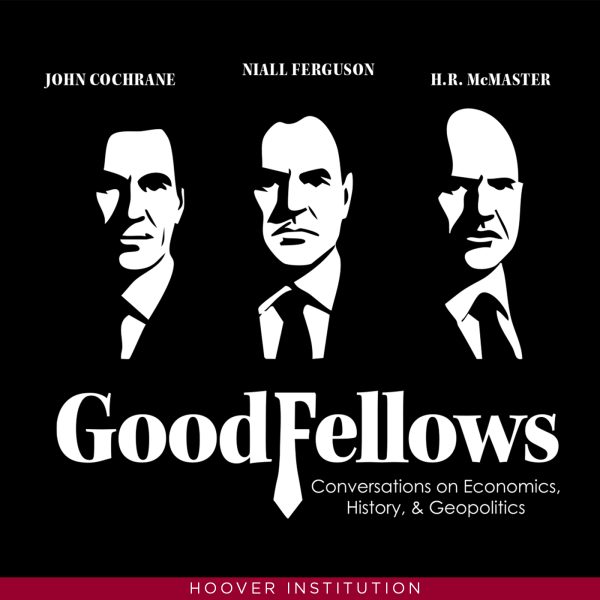
GoodFellows: Conversations on Economics, History & Geopolitics
- Episodios
- 100
- Se publica
- cada dos semanas
- Último episodio
- 7 Nov 2026
Sobre el podcast
GoodFellows: Conversations on Economics, History, & Geopolitics is a flagship videocast from the Hoover Institution where senior fellows John Cochrane, Niall Ferguson, and H.R. McMaster cut through the noise, challenge conventional wisdom, and explain what’s driving markets, power, and public policy. Drawing on rigorous economic analysis, deep historical perspective, and national security leadership at the highest levels, these leading thinkers deliver clear, trusted insight into the challenges facing the United States while debating the forces shaping the modern world.
Episodios 100
“Extinction Level Event”: Jonah Goldberg on the Midterm Elections | GoodFellows
How bad was Election Night in America for Donald Trump and his party? Aside from the brutal math (arguably the GOP’s worst midterm meltdown since 1974’s Watergate backlash), the question arises as to what's …
Notas del episodio
How bad was Election Night in America for Donald Trump and his party? Aside from the brutal math (arguably the GOP’s worst midterm meltdown since 1974’s Watergate backlash), the question arises as to what's next for s chastised President and rival Democrats with unanticipated majorities in Congress. Jonah Goldberg, editor-in-chief of The Dispatch and a veteran observer of American politics, joins GoodFellows regulars Sir Niall Ferguson and John Cochrane (and moderator Bill Whalen) to parse what was behind the anti-Trump referendum (affordability, corruption, and Israel?) and the path forward in Washington – i.e., will policy (economics, ethics reform) or payback (investigations, impeachments) carry the day in 2027? Afterward, in the “Lightning Round”, the fellows make sense of election intrigue in Israel and Brazil, the emergence of data centers as NIMBY villains à la nuclear power a generation ago, whether canines should be bred for combat, Elon Musk’s SpaceX stock-share, plus American expats regretting their newfound European existence (turns out an America in which air conditioners and washing machines aren’t a luxury ain’t so bad after all). Finally, Sir Niall explains why he sports a red poppy every November and the significance of the UK’s Remembrance Day.
Subscribe to GoodFellows for clarity on today’s biggest social, economic, and geostrategic shifts — only on GoodFellows.
Boomers, Burners, and Flying Cars with Cal Newport | GoodFellows
While the public clamors for some semblance of government regulation of the burgeoning artificial intelligence sector, the question remains: how to prevent doom scenarios without compromising the industry’s …
Notas del episodio
While the public clamors for some semblance of government regulation of the burgeoning artificial intelligence sector, the question remains: how to prevent doom scenarios without compromising the industry’s innovative spirit. Cal Newport, a Georgetown University computer scientist and frequent writer on AI matters, discusses questions he wants Congress to ask and suggests ways to keep AI from undermining secondary and college learning processes (are Georgetown’s phone-free “cognition cloisters” the answer?). After that, the fellows discuss what’s fueling the fiery riots across Western Europe (is it time that European nations paid attention to Javier Milei’s reforms in Argentina?) and what compelled President Trump to threaten Ukraine with blocked access to the Starlink satellite internet service (is it what comes from too many conversations with Vladimir Putin?). Finally, in the “Lightning Round”: thoughts on Hoover economist Bob Hall receiving a Nobel Prize, what America’s midterm elections might bring, and the likelihood of any of the three academics buying Elon Musk’s “flying” roadster (the answer, it seems: when pigs fly!).
Subscribe to GoodFellows for clarity on today’s biggest social, economic, and geostrategic shifts — only on GoodFellows.
National Treasures, October Surprises, and Silly Walks with Michael Auslin
Much like the fragile parchment on which a new republic’s principles and grievances were outlined, America’s Declaration of Independence endures to this day – quite the accomplishment given a Continental …
Notas del episodio
Much like the fragile parchment on which a new republic’s principles and grievances were outlined, America’s Declaration of Independence endures to this day – quite the accomplishment given a Continental Congress struggling to help George Washington wage war and a few Founding Fathers who’d rather not have been in Philadelphia that summer (beginning with Thomas Jefferson). Michael Auslin, a Hoover Institution distinguished research fellow and author of National Treasure: How the Declaration of Independence Made America, discusses whether the “spirit of ‘76” is alive and well in 2026.
After that: the fellows address the possibility of a disruptive “October Surprise” in advance of America’s November election – if such a shock comes in the form of a terrorist event (would it make political sense for Iran to try to embarrass an already-struggling President Trump?) or a financial crisis (October historically a time of market panics and crashes)? Finally, in the “Lightning Round”: the Chicago-born Pope employs a little divine intervention to boost the White Sox’s playoff chances; are a few comforting words by industry leaders the beginning of a more optimist AI “vibe shift”?; U.S. War Secretary Pete Hegseth’s criteria for joining America’s fighting forces (“beardos” and “weirdos” need not apply); Tucker Carlson’s curious take on Germany’s invasion of Poland; on the 57th anniversary of the first televised episode of Monty Python’s Flying Circus, the question of what happened to the longstanding tradition of British satire and comedy (our resident Boomers recalling a few of their favorite Python skits that most Gen-Zers probably won’t understand or appreciate).
Subscribe to GoodFellows for clarity on today’s biggest social, economic, and geostrategic shifts — only on GoodFellows.
Taiwan’s Slow Squeeze, Ukraine’s Long War
America’s complicated relationship with China doesn’t lack for subplots – tariffs, territorial designs, human rights and espionage. But does the superpowers’ Cold War-like competition over artificial …
Notas del episodio
America’s complicated relationship with China doesn’t lack for subplots – tariffs, territorial designs, human rights and espionage. But does the superpowers’ Cold War-like competition over artificial intelligence supersede all other U.S.-Sino concerns? On the eve of the year’s second Trump-Xi summit, Hoover fellow Eyck Freymann discusses the state of the superpowers’ rivalry and the possibility of a Chinese move on Taiwan in the near future (Freymann being the author of 2026’s Defending Taiwan: A Strategy to Prevent War with China, envisions an “all-domain pressure campaign” that slowly strangles the island nation). After that: Sir Niall recounts his recent visit to Kyiv (his fifth time in Ukraine since Russia’s invasion) and the odds of Vladimir Putin finding an “off-ramp” after a 55-month war of attrition (or, with his back to the wall, will Russia’s leader opt instead for a modern-day “Ludendorff Offensive”?). Finally, the fellows weigh in on the Fed’s recent rate increase, President Trump stepping up America’s strategic footprints in Greenland and Poland, plus what the 1619 Project’s Nikole Hanna-Jones’ mea culpa for purposely placing her daughter in a low-performing public school – the daughter now struggling with high-school academics – says about the state of education in America (and showcasing one’s offspring in the pages of The New York Times).
Subscribe to GoodFellows for clarity on today’s biggest social, economic, and geostrategic shifts — only on GoodFellows.
California’s War on Wealth—and America’s War on Terror
The rubber meets the road in California this fall when a proposed one-time 5% tax on the state’s billionaire class – wealth taxes being a longtime progressive hobby horse – faces a public vote in the form of …
Notas del episodio
The rubber meets the road in California this fall when a proposed one-time 5% tax on the state’s billionaire class – wealth taxes being a longtime progressive hobby horse – faces a public vote in the form of Proposition 40. Joshua Rauh, the Hoover Institution’s George P. Shultz Senior Fellow in economics and author of a data analysis of Prop 40’s fiscal and economic impacts, explains why the measure would be a “disaster” if enacted and whether the policy battle marks the beginning of more public engagement on the part of the wealthiest Californians or instead will speed up their exodus from the Golden State. After that: the fellows reflect on the 25th anniversary of the 9/11 attacks on America – where they were that fateful day and 9/11’s legacy as it pertains to the war on terror, social divides and global alliances (if a similar attack happened today, would Vladimir Putin still be the first world leader to offer assistance to the American president?). Finally, in the “Lightning Round”: the pros and cons of an ascendant world senior population; the merits of “financial engineering” as governments spend and borrow more; disorder in the ranks as more of America’s military leaders part ways with the Pentagon; young conservatives’ “Nixonmaxxing” (and revising presidential history).
Subscribe to GoodFellows for clarity on today’s biggest social, economic, and geostrategic shifts — only on GoodFellows.
Endless Summer: Iran, Woke Two?, and the George Costanza Theory of War
On the latest GoodFellows: Is economic strangulation the key to achieving Iranian cooperation, or another misstep in the Persian Gulf? Is a sequel to “Woke 1” in the works? And does playing the race card in the …
Notas del episodio
On the latest GoodFellows: Is economic strangulation the key to achieving Iranian cooperation, or another misstep in the Persian Gulf? Is a sequel to “Woke 1” in the works? And does playing the race card in the aftermath of a former Cambridge University professor's suicide make his death even more tragic – and distract from another tragedy: declining academic tragedy?
Subscribe to GoodFellows for clarity on today’s biggest social, economic, and geostrategic shifts — only on GoodFellows.
Complicated Legacy: Jay Bhattacharya on Fauci, RFK, and Vaccines
Jay Bhattacharya returns to GoodFellows—now as NIH director and acting CDC director—for a candid conversation on what COVID got wrong, why science needs a replication revolution, and how to restore public …
Notas del episodio
Jay Bhattacharya returns to GoodFellows—now as NIH director and acting CDC director—for a candid conversation on what COVID got wrong, why science needs a replication revolution, and how to restore public trust. Jay takes on the legacy of lockdowns, school closures, Fauci, gain-of-function research, China, AI-enabled biosecurity risks, vaccine questions, and the fight to make scientific dissent possible again.
Then: Iran, the Strait of Hormuz, AI guardrails, democratic socialism, and what Homer can still teach us about war.
Subscribe to GoodFellows for clarity on today’s biggest social, economic, and geostrategic shifts — only on GoodFellows.
Trump Slump, Capitalism vs. Communism, and Old Man Yells at Claude
After a productive first 100 days after returning to office, President Trump has since hit a rough patch – stubborn inflation (despite an otherwise powerhouse economy), an unpopular war with Iran, setbacks at …
Notas del episodio
After a productive first 100 days after returning to office, President Trump has since hit a rough patch – stubborn inflation (despite an otherwise powerhouse economy), an unpopular war with Iran, setbacks at the Supreme Court, plus growing dissent among congressional Republicans as his party faces the distinct possibility of losing one or both chambers of Congress in November. Has the ever-impulsive, risk-taking Trump lost his political Midas touch, or is he simply yet another president befuddled by a second-term jinx (not to mention a disgruntled electorate)? If Trump is sorely in need of a “win”, will it come on the domestic front or abroad (spoiler alert: look to Cuba)? After that, the fellows discuss whether it was fair play for the American president to intervene in World Cup officiating and the International Olympic Committee to allow Russian athlete to compete for Mother Russia in the 2028 Games, if the war in Ukraine is anywhere close to a tipping point, whether futbol is in fact an expression of socialist convictions (or so New York City Mayor Zohran Mamdani believes), and the policy smarts (or a lack thereof) of Vermont Sen. Bernie Sanders’ call for a sovereign wealth on AI companies’ stock and how those firms should be addressing the industry’s image problem (the fellows playfully disagreeing on using AI to cheat on schoolwork).
Subscribe to GoodFellows for clarity on today’s biggest social, economic, and geostrategic shifts — only on GoodFellows.
The Empire Strikes Out: Rick Atkinson on 1776, Is Britain Broken?, and Socialists in New York
On paper, it was a mismatch: a fledgling republic seeking freedom from the world’s mightiest empire. And yet the American Revolution ended with the upstart colonists’ victory over the mighty British military …
Notas del episodio
On paper, it was a mismatch: a fledgling republic seeking freedom from the world’s mightiest empire. And yet the American Revolution ended with the upstart colonists’ victory over the mighty British military. Rick Atkinson, a military historian and author of a “Revolutionary Trilogy” on the fight for America’s independence, discusses the military tactics, geopolitical shifts, and economic conditions that factored into the war’s outcome. After that, the fellows discuss why serving as the British prime minister has become a game of musical chairs and how Labour lost its way, as well as the rise of “democratic socialism” and the appeal of class warfare and expansive government in the US – most notably, a California ballot initiative that imposes a “wealth tax” on the state’s billionaires. Finally, in the “lighting round”, John's thoughts on the passing of former Federal Reserve chair Alan Greenspan; H.R.’s take on the Pentagon putting its generals out to pasture; and Niall reflecting on European World Cup fans descending upon the US, only to discover a land of abundance (i.e., plenty of ranch dressing even if there’s not enough beer to go around).
Subscribe to GoodFellows for clarity on today’s biggest social, economic, and geostrategic shifts — only on GoodFellows.
Trump’s 14 Points: Epic Fury or Epic Fail?
As the US and Iran prepare to sign a memorandum of understanding halting hostilities in the Middle East, will the agreement hold up for long given fundamental differences over Iran’s nuclear ambitions (another …
Notas del episodio
As the US and Iran prepare to sign a memorandum of understanding halting hostilities in the Middle East, will the agreement hold up for long given fundamental differences over Iran’s nuclear ambitions (another 60 days of negotiating), its funding of terrorist proxies across the region, plus Israel’s actions in Lebanon? If he succeeds in putting Iran in the rear-view window, does President Trump turn his attention to brokering a peace deal between Russia and Ukraine (that war now approaching four years and four months of fighting) as well as ending Cuba’s communist dictatorship? Finally, speaking of invasions, GoodFellows’ resident Scotsman explains the joy of his countrymen’s “Tartan Army” coming to Boston – thousands of kilt-wearing lads and lasses singing, marching and pub-crawling their way through Beantown whilst rooting on a Scottish national team making its first World Cup appearance in this century.
Subscribe to GoodFellows for clarity on today’s biggest social, economic, and geostrategic shifts — only on GoodFellows.
From Arsenal to Zelenskyy: The GoodFellows Answer Viewer Mail
In a special “mailbag” episode, Hoover senior fellows Sir Niall Ferguson, John Cochrane, and H.R. McMaster answer audience questions. Among the topics (after a brief opening segment devoted to the latest in the …
Notas del episodio
In a special “mailbag” episode, Hoover senior fellows Sir Niall Ferguson, John Cochrane, and H.R. McMaster answer audience questions. Among the topics (after a brief opening segment devoted to the latest in the Iran-US impasse – aka, “Schrödinger’s ceasefire”): who are today’s great leaders; is “the American experiment” doomed, as some intellectuals posit; China’s move to gold from dollar-denominated securities; the futures of the European Union and the UK’s Reform movement; North Korea’s relative silence; the cooled-down rhetoric of climate change; whether our PhD-wielding historians bother with televised historical dramas; thoughts on gentlemen-scholars’ sartorial style (“buy [clothes] when you’re a graduate student and wear them until they fall apart”); plus managerial lessons to be drawn from the recent successes of Sir Niall’s beloved Arsenal football club.
Subscribe to GoodFellows for clarity on today’s biggest social, economic, and geostrategic shifts — only on GoodFellows.
“Deciders”, “Honey Badgers”, and “Lonely Liberals”: Sarah Isgur on a Divided Supreme Court
Is it time to rethink the configuration of the US Supreme Court – not nine justices divided along lockstep ideological lines, but three groups of three justices, each clique with a different approach to …
Notas del episodio
Is it time to rethink the configuration of the US Supreme Court – not nine justices divided along lockstep ideological lines, but three groups of three justices, each clique with a different approach to jurisprudence? So argues court watcher and legal analyst Sarah Isgur, who discusses her new book, Last Branch Standing: A Potentially Surprising, Occasionally Witty Journey Inside Today's Supreme Court, and explains where the justices stand on a series of contentious issues (“birthright citizenship”, the administrative state, abortion, the court’s relationship with an antagonistic president on matters like tariffs and executive authority, plus maintaining a semblance of impartiality in a polarized Washington). After that: the three fellows discuss what’s next in Iran with peace negotiations seemingly at an impasse, what to expect from this week’s US-China summit in Beijing, plus what challenges lie ahead for Hoover fellow Kevin Warsh as he takes over as the Federal Reserve’s new chair.
Subscribe to GoodFellows for clarity on today’s biggest social, economic, and geostrategic shifts — only on GoodFellows.
GoodFellows LIVE: The US Constitution and A Republic - If You Can Keep It | Hoover Institution
As part of the Hoover Institution’s ongoing USA@250 celebration of the founding of the American republic, a live GoodFellows episode recorded on the campus of Stanford University focusing on the US Constitution …
Notas del episodio
As part of the Hoover Institution’s ongoing USA@250 celebration of the founding of the American republic, a live GoodFellows episode recorded on the campus of Stanford University focusing on the US Constitution – in tech terms, America’s “operating system”. Goodfellows regulars Sir Niall Ferguson, John Cochrane and Lt. Gen. H.R. McMaster discuss the root causes of the American Revolution (taxation without representation, though the Scottish-born panelist contends the colonists in fact had a “fantastic deal”), the Constitution’s underlying principles (recognizing but not granting rights), why a document that’s more “machinery” than “visionary” in its design has stood the test of time, plus whether several provisions within the original framework and its 27 amendments (presidential eligibility, gun rights, “birthright citizenship”) need updating a world the Founding Fathers couldn’t imagine.
Subscribe to GoodFellows for clarity on today’s biggest social, economic, and geostrategic shifts — only on GoodFellows.
Who’s Actually Running Iran? with Abbas Milani | Hoover Institution
Hoover Institution research fellow and Iran scholar Abbas Milani joins the GoodFellows to discuss life within the beleaguered theocracy: who’s in charge, and will added economic pressure in the form of a …
Notas del episodio
Hoover Institution research fellow and Iran scholar Abbas Milani joins the GoodFellows to discuss life within the beleaguered theocracy: who’s in charge, and will added economic pressure in the form of a blockade of the Strait of Hormuz, and a halt on Iran’s oil trade bring about an end to the regime. After that: the fellows’ thoughts on Hungary’s election, Iran war “winners and losers”, America’s woeful tax code, and the Artemis II space mission.
Subscribe to GoodFellows for clarity on today’s biggest social, economic, and geostrategic shifts — only on GoodFellows.
Locusts and Pirates: What’s Your Favorite Recession? with Tyler Goodspeed | Hoover Institution
If unexpected wars and oil shocks have been big features of recent history, so too are economic recessions – another downturn perhaps ahead in 2026. Tyler Goodspeed, a former Hoover Institution fellow and …
Notas del episodio
If unexpected wars and oil shocks have been big features of recent history, so too are economic recessions – another downturn perhaps ahead in 2026. Tyler Goodspeed, a former Hoover Institution fellow and author of the forthcoming book, Recession: The Real Reasons Economies Shrink and What To Do About It, joins GoodFellows regulars Sir Niall Ferguson, John Cochrane, and Lt. Gen. H.R. McMaster for a tutorial on economic conditions and lessons past and present. After that: The three fellows discuss the latest in the Iran conflict including the feasibility of a peace agreement by week’s end as demanded by President Trump, the odds of land forces entering the equation in the near future, plus possible economic hardship ahead should the fighting linger. Finally, in the “lightning round”: why the late Stanford biologist Paul Erlich was so amiss in predicting a doomed planet (not unlike climate alarmists) and H.R.’s favorite Chuck Norris jokes in honor of the recent passing of the famed Hollywood tough guy.
Subscribe to GoodFellows for clarity on today’s biggest social, economic, and geostrategic shifts — only on GoodFellows.
Dire Straits: Condoleezza Rice on The War with Iran | Hoover Institution
Does the current conflict in the Middle East suggest that America has learned from its recent past wars? Hoover Institution Director and former US Secretary of State Condoleezza Rice joins GoodFellows regulars …
Notas del episodio
Does the current conflict in the Middle East suggest that America has learned from its recent past wars? Hoover Institution Director and former US Secretary of State Condoleezza Rice joins GoodFellows regulars Sir Niall Ferguson, John Cochrane and Lt. Gen. H.R. McMaster to discuss the prospects of an oil “shock” prompted by a prolonged closure of the Strait of Hormuz as well as a political “shock” back in the US when voters go to the polls in November, China and Russia’s losses in terms of stature and friendly regimes, plus what the Anthropic-Pentagon legal kerfuffle suggests about the role of emerging technology in history’s first AI-enabled war and the problems in being portrayed as a societal menace. Afterwards: the fellows reflect on the 250th anniversary of Adam Smith’s The Wealth of Nations, billionaires in the crosshairs of the “affordability” debate, and why they won’t be watching the upcoming Academy Awards.
Subscribe to GoodFellows for clarity on today’s biggest social, economic, and geostrategic shifts — only on GoodFellows.
Gulf War III Or Cold War II: Iran Truth And Consequences | Hoover Institution
A week into US and Israeli military operations against Iran, where does the conflict stand? GoodFellows regulars Niall Ferguson, John Cochrane and H.R. McMaster discuss the odds of hostilities expanding, what …
Notas del episodio
A week into US and Israeli military operations against Iran, where does the conflict stand? GoodFellows regulars Niall Ferguson, John Cochrane and H.R. McMaster discuss the odds of hostilities expanding, what the aftermath of “regime alteration” might resemble, a possible economic backlash should energy prices spike, plus a geopolitical shock felt in Beijing and Moscow.
Subscribe to GoodFellows for clarity on today’s biggest social, economic, and geostrategic shifts — only on GoodFellows.
Iran, Tariffs, Epstein | GoodFellows | Hoover Institution
As his self-proclaimed 10-day window for dealing with Iran approaches its end, what are President Trump’s options? GoodFellows regulars Niall Ferguson, John Cochrane, and H.R. McMaster weigh the merits of a US …
Notas del episodio
As his self-proclaimed 10-day window for dealing with Iran approaches its end, what are President Trump’s options? GoodFellows regulars Niall Ferguson, John Cochrane, and H.R. McMaster weigh the merits of a US military strike versus an interim diplomatic solution. They also probe the Epstein scandal’s impact on the British landscape and the Supreme Court’s ruling against the Trump administration’s use of emergency powers for tariff implementation. Later, in the “lightning round”: why US Secretary of State Marco Rubio was warmly received at the Munich Security Conference; the Pentagon’s desire to sever academic ties with Harvard University; Barack Obama’s suggesting that aliens exist; plus H.R.’s remembrance of film great Robert Duvall, aka Apocalypse Now’s Lt. Col. Bill “I Love the Smell of Napalm in the Morning” Kilgore.
Subscribe to GoodFellows for clarity on today’s biggest social, economic, and geostrategic shifts — only on GoodFellows.
The Origins of Modern China; Is Trump “Lost”? America, Home of the . . . Squatters? | GoodFellows | Hoover Institution
Unlike the romanticized tale the Chinese Communist Party tells of itself—long marches and a long game of outlasting and outwitting its foes—the early years of the CCP were ones of unrepentant violence and a …
Notas del episodio
Unlike the romanticized tale the Chinese Communist Party tells of itself—long marches and a long game of outlasting and outwitting its foes—the early years of the CCP were ones of unrepentant violence and a rise to power made possible only with external help. Frank Dikötter, the Hoover Institution’s Milias Senior Fellow and author of the forthcoming book, Red Dawn over China: How Communism Conquered a Quarter of Humanity, joins GoodFellows regulars Niall Ferguson, John Cochrane and H.R. McMaster to discuss what shaped the CCP from the years 1921–1949, plus parallels between Xi Jinping and Mao Zedong in terms of amassing power, purging rivals, and practicing economics and geopolitics. After that: the fellows debate the assertion by a New York Times columnist that Donald Trump has “lost the country,” as well as how much faith to put in economic indicators, plus songstress Billie Eilish’s belief that “no one is illegal on stolen land.”
Subscribe to GoodFellows for clarity on today’s biggest social, economic, and geostrategic shifts — only on GoodFellows.
The Right Side of History with Tyler Cowen | GoodFellows | Hoover Institution
Donald Trump’s drop-in at the World Economic Forum and the ensuing kerfuffle between the American president and the attending globalist elites raises the question: Who is winning on the world stage, Trump or …
Notas del episodio
Donald Trump’s drop-in at the World Economic Forum and the ensuing kerfuffle between the American president and the attending globalist elites raises the question: Who is winning on the world stage, Trump or his foes—or do they have more in common than is commonly recognized? Tyler Cowen, an economist, blogger, and Free Press columnist, joins GoodFellows regulars Niall Ferguson, John Cochrane, and H.R. McMaster to discuss Trump’s third presidential visit to the Davos, Switzerland, lion’s den, plus the rise of “democratic socialism” and “affordability politics” embodied in the ethos of New York Mayor Zohran Mamdani. After that: the three fellows discuss lessons from Minneapolis in the aftermath of two protestors shot to death by federal immigration agents; the odds of American military strikes against Iran; the significance of China’s latest military purge; plus whether the show’s resident historians are comfortable with the (over)use of phrase “the right side of history.”
Subscribe to GoodFellows for clarity on today’s biggest social, economic, and geostrategic shifts — only on GoodFellows.
The World According to Trump | GoodFellows | Hoover Institution
As Iran’s theocracy teeters on the brink, the question turns to what the Trump administration’s abiding interest in other bad regimes (Venezuela, Cuba, Colombia) and its appetite for land acquisitions …
Notas del episodio
As Iran’s theocracy teeters on the brink, the question turns to what the Trump administration’s abiding interest in other bad regimes (Venezuela, Cuba, Colombia) and its appetite for land acquisitions (greenbacks for Greenland?) say about the American president’s worldview. GoodFellows regulars Niall Ferguson, John Cochrane, and H.R. McMaster discuss policy options for Iran now that protests have turned tragic; the relative silence from the same campus leftists who fervently protested the war in Gaza; Nixonian echoes in Trump’s foreign policy; plus Secretary of State Marco Rubio’s emergence as a geopolitical jack-of-all-trades. In the second segment, John weighs in on the significance of the Justice Department’s criminal investigation into Federal Reserve chair Jerome Powell; H.R. contends America’s designs on Greenland are no laughing matter; and Sir Niall previews what to expect from Trump’s appearance at the upcoming World Economic Forum in Davos. Finally, GoodFellows’ resident “Deadhead” bids a fond farewell to the late Bob Weir, guitarist and cofounder of the Grateful Dead.
Subscribe to GoodFellows for clarity on today’s biggest social, economic, and geostrategic shifts — only on GoodFellows.
Coercive Diplomacy: Venezuela, Iran, and . . . Greenland? | GoodFellows | Hoover Institution
American special forces capture Venezuela’s president and his wife in a daring nighttime operation, returning the deposed first couple to the US to stand trial for alleged narcoterrorism. Meanwhile, protests in …
Notas del episodio
American special forces capture Venezuela’s president and his wife in a daring nighttime operation, returning the deposed first couple to the US to stand trial for alleged narcoterrorism. Meanwhile, protests in Iran over worsening living conditions, coupled with a cratered economy, threaten that theocracy’s future. GoodFellows regulars Niall Ferguson, John Cochrane, and H.R. McMaster kick off 2026 by discussing both the precedent and the consequences of the move on Maduro, whether other nations (i.e. China) will invoke their own “Monroe Doctrines” to justify regional power grabs, plus the chances of similar fates awaiting Greenland, Colombia, or Cuba. After that: the panel’s thoughts on whether Iran’s regime is in its dying days as conditions on the ground deteriorate; and the chances of political transformation spreading worldwide in 2026—a là the end of the first Cold War—potential signposts of freedom as America celebrates 250 years of individual liberty. Finally, the fellows send their best wishes to a pair of GoodFellows guests—former Nebraska Senator Ben Sasse and Hoover’s Victor Davis Hanson—as the two gentlemen do battle with cancer.
Subscribe to GoodFellows for clarity on today’s biggest social, economic, and geostrategic shifts — only on GoodFellows.
Are We Doing This Again? Andrew Ross Sorkin on “1929” and the GoodFellows on 2025 | GoodFellows | Hoover Institution
Nearly a century ago, after years of investors on a champagne high and warning signs ignored, a stock market crash led to a descent into a global depression. Andrew Ross Sorkin, a New York Times financial …
Notas del episodio
Nearly a century ago, after years of investors on a champagne high and warning signs ignored, a stock market crash led to a descent into a global depression. Andrew Ross Sorkin, a New York Times financial journalist and author of the bestseller 1929: Inside the Greatest Crash in Wall Street History—and How It Shattered a Nation, joins GoodFellows regulars Niall Ferguson, John Cochrane, and H.R. McMaster to discuss how the events of 1929 resonate to this day, what’s misunderstood about the fabled crash, whether Herbert Hoover (only seven months into his presidency when disaster struck) gets a fair shake, plus what the future holds for Federal Reserve independence, the bidding war for Warner Bros. Discovery, and Wall Street’s relationship with Washington. After that: The three fellows look back on 2025 with their choices for individual of the year, the most significant or ignored stories, what they learned in 2025, plus predictions and resolutions for the new year. Finally, a surprise visit by Hoover Institution visiting fellow Kris Kringle, who asks the panel for its holiday wishes (oddly enough, H.R. is never around when jolly old St. Nick shows up).
Subscribe to GoodFellows for clarity on today’s biggest social, economic, and geostrategic shifts — only on GoodFellows.
Tiny Cars and 70’s Problems with Ben Sasse | GoodFellows | Hoover Institution
Two institutional sectors are in both steady and rapid decline in terms of public trust: Congress and academia. Ben Sasse, former US senator from Nebraska and president of two universities, joins GoodFellows …
Notas del episodio
Two institutional sectors are in both steady and rapid decline in terms of public trust: Congress and academia. Ben Sasse, former US senator from Nebraska and president of two universities, joins GoodFellows regulars Niall Ferguson, John Cochrane, and H.R. McMaster to discuss what ails Congress and how to fix it (based on his eight years in the Senate), plus how America’s educational system has set a low bar for readying students for higher learning and life after college.
Next the three fellows weigh the merits of the Trump administration’s new National Security Strategy and what strategy there is (or isn’t) regarding Venezuela and drug trafficking; the shortcomings of fuel-efficiency standards; whether they’d buy an American-made “tiny car” (no way, says our resident former tank driver); and, with the World Cup coming to America in 2026, how to clear up the confusion between US-brand “football” and the international “beautiful game” that goes by the same name (Sir Niall’s solution: Change US football to “armored rugby”).
Subscribe to GoodFellows for clarity on today’s biggest social, economic, and geostrategic shifts — only on GoodFellows.
Viewer Mail: War & Peace, Reading & Writing, Why Babies Are Good, and Thanksgiving Memories | GoodFellows | Hoover Institution
Is the bitter war in Ukraine soon to wind down now that a peace settlement is being negotiated (think a Panmunjom-style compromise, not Munich-style appeasement), and how should America prepare for economic and …
Notas del episodio
Is the bitter war in Ukraine soon to wind down now that a peace settlement is being negotiated (think a Panmunjom-style compromise, not Munich-style appeasement), and how should America prepare for economic and military parity with China? In an episode devoted solely to viewers’ questions, Hoover senior fellows Sir Niall Ferguson, John Cochrane and H.R. McMaster delve into matters ranging from those somber (allaying twenty-somethings’ climate alarmism, “ideal” interest rates, the future of tank warfare as well as AI’s redesign of future workforces) to those more lighthearted (H.R.’s service nickname, the artist behind John’s wall hangings, and how the fellows would ride out a future pandemic). Finally, on the eve of America’s Thanksgiving holiday, the fellows count their blessings – especially “Papa” Ferguson, who recently joined John (aka, “Blah-Blah” to his grandchildren) and H.R. (likewise, his grandkids’ “Papa”) as a first-time grandfather.
Subscribe to GoodFellows for clarity on today’s biggest social, economic, and geostrategic shifts — only on GoodFellows.
Cyber Rattling & Socialism: Anne Neuberger on Future Wars, Mayor Mamdani, and a Big Deal at the BBC | GoodFellows | Hoover Institution
Will future wars be decided by who controls space—cyber and outer—and which superpower has better paired geostrategic thinking with emerging technologies? Anne Neuberger, the Hoover Institution’s William C …
Notas del episodio
Will future wars be decided by who controls space—cyber and outer—and which superpower has better paired geostrategic thinking with emerging technologies? Anne Neuberger, the Hoover Institution’s William C. Edwards Distinguished Visiting Fellow and a former White House and Pentagon cyber policy advisor, joins GoodFellows regulars Sir Niall Ferguson, John H. Cochrane, and Lt. Gen. H.R. McMaster to discuss what she sees as a “cyber gap” between China and America, the need for the US to rethink traditional weapons platforms (hello, drones), plus how Dwight Eisenhower’s warning of a “military industry complex” is being redefined by the tech sector’s growing role in present-day and future warfare. After that: the three fellows weigh the significance of a utopian socialist recently elected mayor of a very capitalist New York City, a new “algocracy” (algorithms running the government) in Albania, the UK’s fabled BBC in hot water over alleged editorial bias, plus whether the “war of the tomorrow” may be in . . . Venezuela?
Subscribe to GoodFellows for clarity on today’s biggest social, economic, and geostrategic shifts — only on GoodFellows.
Trick or Treat? A Fight Between Good and Evil with Michael McFaul | GoodFellows | Hoover Institution
At a time of “hot wars” across the globe, there’s also an ideological “cold war” featuring two foes: those who embrace freedom and those who oppress it. Michael McFaul, the Hoover Institution’s Peter and Helen …
Notas del episodio
At a time of “hot wars” across the globe, there’s also an ideological “cold war” featuring two foes: those who embrace freedom and those who oppress it. Michael McFaul, the Hoover Institution’s Peter and Helen Bing Senior Fellow and author of the newly released Autocrats vs. Democrats: China, America, Russia and the New Global Disorder, joins GoodFellows regulars John Cochrane and Lt. Gen. H.R. McMaster to discuss where he departs from the Trump administration on its approach to Russia and China (one autocracy economically dwarfing the other), his suggestions for course change, and why he holds “guarded” optimism for America’s future. After that: John and H.R. go “trick-or-treating”—weighing the pros (“treats”) and cons (“tricks”) of a new White House ballroom, a Chinese military purge, the latest inflation numbers and gold prices that no longer glitter, a CEO’s tariff worries, New York City on a non-hallowed eve of “democratic socialism,” plus a new and tougher American citizenship test (could Sir Niall Ferguson pass it?). Finally, as Halloween approaches, John and H.R. give us their go-to candies.
Subscribe to GoodFellows for clarity on today’s biggest social, economic, and geostrategic shifts — only on GoodFellows.It’s The Economy, Israel and Tariffs, Stupid | GoodFellows | Hoover Institution
A hostage return and the signing of a cease-fire agreement signal a new chapter in the long-running dream of peace in the Middle East. Did it matter that the key negotiators, on the US side, were financiers and …
Notas del episodio
A hostage return and the signing of a cease-fire agreement signal a new chapter in the long-running dream of peace in the Middle East. Did it matter that the key negotiators, on the US side, were financiers and real-estate developers rather than scions of America’s diplomatic corps?
Russell Berman, a Hoover Institution senior fellow and codirector of Hoover’s Working Group on the Middle East and the Islamic World, joins GoodFellows regulars Niall Ferguson and John Cochrane to discuss the sturdiness of the Trump White House’s 20-point peace plan, the futures of Hamas and the Abraham Accords, the likelihood of Israeli Prime Minister Benjamin Netanyahu’s reliving Winston Churchill’s fate (a successful wartime leader rejected by a war-weary electorate), plus whether the “real estate-ism” approach to diplomacy is applicable to President Trump’s upcoming meetings with his Russian and Chinese counterparts.
After that, Niall and John reflect on the likelihood of a market crash (it is October, after all), the chances of a full-fledged tariff war with China, the merits of a US-Argentina currency swap, plus an ominous warning from the International Monetary Fund regarding global debt. Finally, the fellows salute the legendary economist Thomas Sowell, the subject of a Hoover Institution tribute later this month.
Subscribe to GoodFellows for clarity on today’s biggest social, economic, and geostrategic shifts — only on GoodFellows.
Who’s Going To Win The Future? Dan Wang on China’s Engineers vs. America’s Lawyers | GoodFellows | Hoover Institution
One great power (China) has a relentless thirst to build that comes with a terrible human cost, while its main rival (America) is a more lawyerly and free society that’s prone to stifling ideas both good and …
Notas del episodio
One great power (China) has a relentless thirst to build that comes with a terrible human cost, while its main rival (America) is a more lawyerly and free society that’s prone to stifling ideas both good and bad. On the 76th anniversary of the founding of the People’s Republic of China, Dan Wang, a Hoover Institution research fellow and author of the bestseller Breakneck: China’s Quest to Engineer the Future, joins GoodFellows regulars Niall Ferguson and H.R. McMaster to discuss what the future holds for the two Cold War 2 rivals, plus Wang’s firsthand experiences witnessing China’s engineering boom and enduring its draconian pandemic policies. After that, the fellows weigh in on President Trump’s recent United Nations address and the state of that institution, the likelihood of Trump’s Gaza peace plan coming to fruition, the provision of long-range Tomahawk missiles to Ukraine, plus the merits of a US military strike inside Venezuela to counter narco-terrorism. In the lightning round: why America’s military brass gathered at Quantico; National Guard troops head to Portland, Oregon; Scotland’s frustration with illegal immigration; and the feasibility of the US regaining Afghanistan’s Bagram Air Base.
Subscribe to GoodFellows for clarity on today’s biggest social, economic, and geostrategic shifts — only on GoodFellows.
Turning Points: Kyiv, Kirk, Kimmel, and the Sundance Kid | GoodFellows | Hoover Institution
As a seemingly interminable conflict in Ukraine concludes its 43rd month of ground combat, aerial drone strikes, and stalemate, America’s culture war enters a new phase with the assassination of conservative …
Notas del episodio
As a seemingly interminable conflict in Ukraine concludes its 43rd month of ground combat, aerial drone strikes, and stalemate, America’s culture war enters a new phase with the assassination of conservative activist and Turning Point USA founder Charlie Kirk, followed by the suspension of late-night television host Jimmy Kimmel for an on-air comment made in the aftermath of Kirk’s murder. GoodFellows regulars Niall Ferguson, John Cochrane, and H.R. McMaster discuss the current state of affairs in Ukraine (Sir Niall fresh off a visit to Kyiv), Kirk’s murder as a watershed moment in a potential new cycle of political violence, plus whether America has reached a tipping point regarding free speech and government meddling for partisan benefit (our resident “grumpy economist” calling for the elimination of the Federal Communications Commission). Finally, a little sunshine (as in the Sundance Kid): the three fellows offering their favorite Robert Redford movies in honor of the recently deceased (and Scottish?) screen legend.
Subscribe to GoodFellows for clarity on today’s biggest social, economic, and geostrategic shifts — only on GoodFellows.
Aquí están los 40 episodios más recientes de 100. Los anteriores están en el feed del podcast.
Podcasts similares
Más podcasts de Noticias

¿Es tu podcast?
Confírmalo con una entrada en tu feed: aquí recibes un código, lo añades como podcast:txt en el canal de tu feed y nosotros lo comprobamos. Después tu podcast aparecerá como «verificado» en SoundNode.