

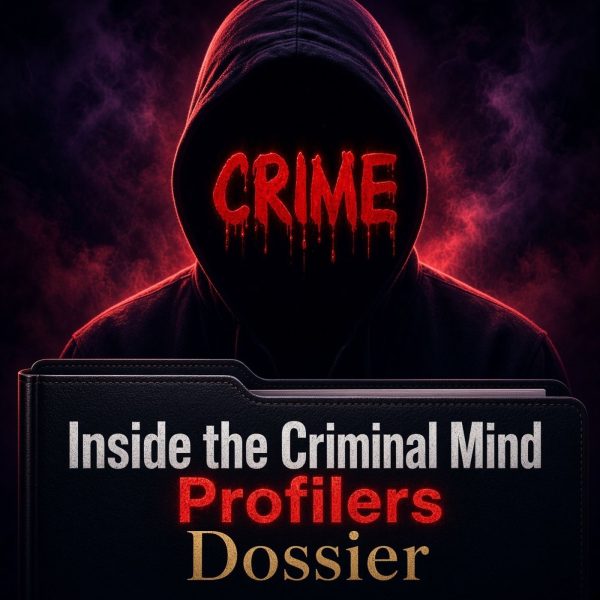
Inside the Criminal Mind- Profiler’s Dossier
- Episodios
- 82
- Se publica
- a diario
- Último episodio
- 10 Nov 2026
Sobre el podcast
What can a crime tell us about the person who committed it?
Inside the Criminal Mind: The Profiler explores the psychology and behavior behind some of the world’s most disturbing crimes. Each episode examines a case through the lens of criminal psychology, behavioral analysis, and investigative profiling—looking beyond what happened to ask why an offender behaved the way they did.
From serial offenders and predatory criminals to kidnappers, stalkers, con artists, and killers, we examine behavioral patterns, victim selection, crime-scene decisions, escalation, deception, and the mistakes that ultimately expose offenders.
Along the way, the podcast separates the reality of criminal profiling from the mythology created by movies and television. Profiling isn’t mind reading, and behavior rarely provides a perfect psychological fingerprint. Instead, investigators assemble patterns, probabilities, evidence, and human behavior to gradually narrow the possibilities.
Every crime leaves evidence.
Sometimes, it also leaves behind a glimpse of the mind responsible for it.
Inside the Criminal Mind: The Profiler — where psychology meets investigation.
Episodios 82
Ted Bundy: How Charm Became an Instrument of Predation
Ted Bundy is often remembered as a charming, intelligent serial killer who concealed his violence behind an ordinary appearance. But his ability to manipulate social expectations may be more important to …
Notas del episodio
Ted Bundy is often remembered as a charming, intelligent serial killer who concealed his violence behind an ordinary appearance. But his ability to manipulate social expectations may be more important to understanding his crimes than his personality alone. This episode examines how Bundy exploited trust, used deception to approach victims, and demonstrated why behavioral profilers must look beyond an offender’s public persona to understand the methods behind predatory violence.The Archivist of Chew Avenue: Inside the Olney House of Horrors
In mid-2026, federal and Philadelphia investigators converged on 417 West Chew Avenue in Olney, uncovering a clandestine compound tied to at least seven missing women. Inside, detectives seized over a million …
Notas del episodio
In mid-2026, federal and Philadelphia investigators converged on 417 West Chew Avenue in Olney, uncovering a clandestine compound tied to at least seven missing women. Inside, detectives seized over a million digital videos and photographs alongside industrial chemicals and modified plumbing suggesting sophisticated "wet cremation" body disposal. The primary suspect, the late filmmaker and convicted felon Raymond "R.C." Horsch, ran a calculated operation centered on predatory control, trophy documentation, and total physical erasure. Using the FBI’s Behavioral Analysis Unit lens, this case dissects the rare psychology of an organized serial predator whose extensive digital catalog outlived him.The Evolution of Fantasy: From Prowler to Predator
Serial violent offenders rarely manifest overnight; their crimes are almost always preceded by a trail of overlooked boundary violations like voyeurism, fetish burglaries, and nocturnal prowling. To the …
Notas del episodio
Serial violent offenders rarely manifest overnight; their crimes are almost always preceded by a trail of overlooked boundary violations like voyeurism, fetish burglaries, and nocturnal prowling. To the untrained eye, a prowler in a backyard appears to be an annoying neighborhood nuisance or a petty trespasser rather than an imminent threat. For FBI behavioral analysts, however, these early infractions represent the proving ground where an internal, violent sexual fantasy rehearses its logistical execution. By examining the fragile boundary between covert observation and physical invasion, this episode reveals the critical tipping points profilers track before an offender’s fantasy outgrows its non-violent container.Edmund Kemper: The Serial Killer Who Learned to Fool Psychiatrists
Edmund Kemper was unusually intelligent, articulate, and seemingly capable of understanding the psychological forces behind his violent behavior. After killing his grandparents as a teenager, he convinced …
Notas del episodio
Edmund Kemper was unusually intelligent, articulate, and seemingly capable of understanding the psychological forces behind his violent behavior. After killing his grandparents as a teenager, he convinced psychiatric evaluators that he had made sufficient progress to return to society, only to later murder eight more people. This episode of Inside the Criminal Mind: FBI Profiler examines how intellectual insight can be mistaken for genuine remorse, why cooperation and psychological sophistication do not necessarily indicate rehabilitation, and what Kemper’s case reveals about the limitations of forensic risk assessment.The Blueprint and the Need: Deconstructing Modus Operandi and Signature
In behavioral crime scene analysis, separating an offender's functional mechanics from their underlying psychological compulsion is the cornerstone of behavioral linkage analysis. While a Modus Operandi …
Notas del episodio
In behavioral crime scene analysis, separating an offender's functional mechanics from their underlying psychological compulsion is the cornerstone of behavioral linkage analysis. While a Modus Operandi reflects dynamic, learned behaviors deployed to complete the crime and evade detection, the Signature represents static, non-functional acts executed solely to fulfill emotional fantasy. Understanding where tradecraft ends and ritual begins allows analysts to link disparate cases and anticipate escalations. This retrospective examines the diagnostic criteria, common analytical pitfalls, and practical limits of reading human intent off the forensic floor.The Ghost in the Data: Israel Keyes and the Geometry of Anti-Forensics
In modern criminal profiling, geographical profiling and victimology rely on the presumption that predators operate within discernible comfort zones and exploit familiar environmental routines. Israel Keyes …
Notas del episodio
In modern criminal profiling, geographical profiling and victimology rely on the presumption that predators operate within discernible comfort zones and exploit familiar environmental routines. Israel Keyes systematically weaponized those assumptions against behavioral analysts, flying thousands of miles, renting vehicles, and deploying buried kill caches years before selecting completely randomized targets. His hyper-disciplined operational security dismantled the foundational heuristics used to link serial offenses across state lines. This retrospective deconstructs the forensic breakdown of anchor points, the mechanics of pre-staged logistics, and the investigative blind spots created by an offender determined to generate zero behavioral noise.The Boston Strangler: Profiling the Invisible Anchor Point
In early 1960s Boston, thirteen women were found strangled behind locked apartment doors with no signs of forced entry. While the public envisioned a shapeshifting phantom stalking the streets, early behavioral …
Notas del episodio
In early 1960s Boston, thirteen women were found strangled behind locked apartment doors with no signs of forced entry. While the public envisioned a shapeshifting phantom stalking the streets, early behavioral analysts faced a complex geographic puzzle: where does a serial predator actually anchor himself when his crime scenes cross jurisdictional lines? By analyzing commuter patterns, boundary hopping, and routine activity, investigators began piecing together whether they were tracking a nomadic outsider or someone whose daily employment gave him seamless, legitimate access to every victim’s threshold. This episode examines the breakthrough transition from hunting a mythical monster to mapping the deliberate physical movements.Inside the Mind of John D. Miller: The Killer Who Taunted a City
For thirty years, the person responsible for April Tinsley's murder remained unidentified while threatening messages intensified fear throughout the Fort Wayne community. What can an offender's written …
Notas del episodio
For thirty years, the person responsible for April Tinsley's murder remained unidentified while threatening messages intensified fear throughout the Fort Wayne community. What can an offender's written communications reveal about their thinking, motivations, and relationship with investigators? This episode approaches the case through the methods of behavioral analysis, examining intimidation, possible fantasies of control, and the risks of interpreting criminal behavior too confidently. Discover how the killer's own actions ultimately contributed to the evidence that exposed him.The Mind of the Serial Arsonist: John Leonard Orr and the Hero Complex
Most arson investigations focus on financial greed, vandalism, or personal revenge, but serial arsonists operate under a far more dangerous psychological script: an insatiable craving for control and …
Notas del episodio
Most arson investigations focus on financial greed, vandalism, or personal revenge, but serial arsonists operate under a far more dangerous psychological script: an insatiable craving for control and validation. When catastrophic fires broke out across Southern California in the 1980s, the physical evidence revealed an offender using sophisticated delay incendiary devices with a masterclass understanding of burn patterns. For the FBI’s Behavioral Analysis Unit, the signature was not the destruction of property, but the offender’s desperate need to insert himself into the emergency response. This episode explores the behavioral anatomy of the "hero syndrome," unpacking how profilers exposed Glendale Fire Captain John Leonard Orr as the very predator he was assigned to hunt.Inside the Trafficker's Mind: How Predators Build Psychological Control
How do some traffickers transform romantic relationships into systems of exploitation? This episode examines grooming, manipulation, intermittent reinforcement, and the behavioral patterns investigators may …
Notas del episodio
How do some traffickers transform romantic relationships into systems of exploitation? This episode examines grooming, manipulation, intermittent reinforcement, and the behavioral patterns investigators may encounter in trafficking cases. We explore how analysts can develop investigative hypotheses about an offender's methods without claiming to read minds or diagnose someone from behavior alone. The episode also considers how changes in an offender's control tactics may help investigators understand escalation and risk.Billy the Kid: An FBI-Style Behavioral Profile of America's Most Famous Young Outlaw
Was Billy the Kid a calculating psychopath, a traumatized young man seeking belonging, or a violent offender shaped by the lawlessness of the American frontier? In this episode of Profiler's Dossier, we examine …
Notas del episodio
Was Billy the Kid a calculating psychopath, a traumatized young man seeking belonging, or a violent offender shaped by the lawlessness of the American frontier? In this episode of Profiler's Dossier, we examine Henry McCarty through the methods of modern FBI-style behavioral analysis. By investigating his childhood, criminal motivations, victim selection, interpersonal relationships, and patterns of aggression, we attempt to answer a fascinating question. Was Billy the Kid inherently dangerous, or did the Lincoln County War help transform a troubled teenager into a legendary killer?The Making of a Cartel Recruit: Profiling Vulnerability, Coercion, and Criminal Identity
What psychological characteristics make an adolescent vulnerable to recruitment by a violent criminal organization? In this episode of Profiler’s Dossier, we examine how investigators distinguish opportunistic …
Notas del episodio
What psychological characteristics make an adolescent vulnerable to recruitment by a violent criminal organization? In this episode of Profiler’s Dossier, we examine how investigators distinguish opportunistic offenders, coerced participants, and increasingly committed cartel members. Through the lenses of developmental psychology, behavioral conditioning, moral disengagement, and criminal investigative analysis, we explore how recruitment relationships develop and why some individuals escalate toward serious violence while others attempt to escape. The episode also examines the limits of criminal profiling and why no single personality characteristic can reliably predict cartel involvement.The Crew Cut Killer: Behavioral Patterns of a Suspected Serial Murderer
Three murders in Northern California raised disturbing questions about a possible serial offender. Investigators connected the crimes to Taylor Morris Teaford, a violent fugitive with a history of serious …
Notas del episodio
Three murders in Northern California raised disturbing questions about a possible serial offender. Investigators connected the crimes to Taylor Morris Teaford, a violent fugitive with a history of serious offenses. This episode examines victim selection, behavioral consistency, escalation, and the limitations of criminal profiling when investigators attempt to link separate homicides. The identification of Joanne Burdick nearly six decades later provides a new opportunity to examine what the evidence can and cannot reveal about a suspected killer.The Interview Room: Can Investigators Recognize Psychopathic Traits?
Criminal investigators sometimes encounter suspects who appear charming, cooperative, or emotionally detached. This episode examines how interviewers evaluate statements, inconsistencies, and behavior without …
Notas del episodio
Criminal investigators sometimes encounter suspects who appear charming, cooperative, or emotionally detached. This episode examines how interviewers evaluate statements, inconsistencies, and behavior without relying on popular myths about psychopathy. Discover why corroborating evidence and structured investigative techniques matter more than intuition.Organized vs. Disorganized Killers: Does the FBI Distinction Still Hold Up?
For decades, criminal profiling has taught investigators and students to distinguish between organized and disorganized killers based on what offenders leave behind at crime scenes. An organized offender …
Notas del episodio
For decades, criminal profiling has taught investigators and students to distinguish between organized and disorganized killers based on what offenders leave behind at crime scenes. An organized offender supposedly plans carefully, controls the victim, conceals evidence, and appears socially competent, while a disorganized offender acts impulsively and leaves behind a chaotic scene. The distinction became one of the most recognizable ideas associated with early FBI behavioral profiling and was popularized through books, documentaries, and fictional portrayals of profilers. But later research challenged whether real offenders actually divide neatly into these two categories. In this episode, we examine where the organized-disorganized model came from, what it can still contribute to an investigation, and why modern behavioral analysis requires considerably more caution.How Does a Profiler Read a Crime Scene? Behavior Versus Physical Evidence
crime scene contains more than fingerprints, DNA, and physical objects—it may also preserve traces of human decision-making. Profilers examine patterns of behavior to develop cautious hypotheses about an …
Notas del episodio
crime scene contains more than fingerprints, DNA, and physical objects—it may also preserve traces of human decision-making. Profilers examine patterns of behavior to develop cautious hypotheses about an offender’s choices, priorities, and relationship to the victim. But behavioral evidence is fundamentally different from physical evidence, and understanding that distinction is essential to understanding what profiling can—and cannot—do.Why Serial Killers Choose Certain Places: The Geography of Predatory Crime
Serial predators rarely choose locations completely at random. Where they hunt, encounter victims, commit crimes, and dispose of bodies can reflect familiarity, opportunity, transportation routes, victim …
Notas del episodio
Serial predators rarely choose locations completely at random. Where they hunt, encounter victims, commit crimes, and dispose of bodies can reflect familiarity, opportunity, transportation routes, victim availability, and the offender’s desire to avoid detection. This episode explores geographic profiling and how investigators use patterns across multiple crime scenes to better understand an offender’s activity area.Twenty-Eight Fires and One Map: Finding an Arsonist’s Neighborhood
For months, someone was setting fires at occupied homes in Burnaby, British Columbia, leaving investigators with dozens of incidents but no identified suspect. With conventional investigative methods failing to …
Notas del episodio
For months, someone was setting fires at occupied homes in Burnaby, British Columbia, leaving investigators with dozens of incidents but no identified suspect. With conventional investigative methods failing to produce a breakthrough, police turned to behavioral and geographic profiling to narrow the search. A map eventually pointed investigators toward a particular area, but the decisive lead came from someone in the community who recognized what investigators were describing. The case demonstrates an important lesson in criminal profiling: a profile rarely solves a crime by itself—it helps detectives decide where, and sometimes at whom, to look more closely.The Railway Killer: What Could a Psychologist See That Detectives Needed?
In 1980s Britain, investigators faced a disturbing series of sexual assaults and murders associated with railway stations across London and southeast England. Instead of asking only who the offender might be …
Notas del episodio
In 1980s Britain, investigators faced a disturbing series of sexual assaults and murders associated with railway stations across London and southeast England. Instead of asking only who the offender might be, psychological analysis introduced another question: What can the locations, sequence, and behavior of the crimes tell us about how this offender lives? The investigation of John Duffy became an important early demonstration of how behavioral and geographical analysis could support police decision-making without replacing traditional detective work.When the Crime Scene Is Empty: What Behavior Reveals When Evidence Vanishes
In June 1973, seven-year-old Susan Jaeger vanished from her family’s tent at a Montana campground, leaving investigators with remarkably little physical evidence and no obvious suspect. The case became an …
Notas del episodio
In June 1973, seven-year-old Susan Jaeger vanished from her family’s tent at a Montana campground, leaving investigators with remarkably little physical evidence and no obvious suspect. The case became an important episode in the FBI’s emerging use of behavioral analysis, associated with early Behavioral Science Unit figures Howard Teten and Patrick Mullany. This episode asks a deceptively difficult question: What can behavior tell investigators when the crime scene tells them almost nothing?The Mask on Evelyn Street
Between 2014 and 2024 a masked man hunted women in a tight pocket of Tucker, Georgia—first in a garage on Christmas Eve, then at an apartment a mile away, then in a bound drive from machine to machine. The …
Notas del episodio
Between 2014 and 2024 a masked man hunted women in a tight pocket of Tucker, Georgia—first in a garage on Christmas Eve, then at an apartment a mile away, then in a bound drive from machine to machine. The attacks sat in separate files until a July homicide arrest put a name on the DNA. The geography never wandered. The face never appeared. That combination is the whole case.There Is No Job Called “FBI Profiler.” There Is a Long Queue Behind That Door.
You do not apply to the Behavioral Analysis Unit out of college. You become an FBI special agent, survive Quantico, work real cases for years, then compete for a small desk at NCAVC. The steps are public. The …
Notas del episodio
You do not apply to the Behavioral Analysis Unit out of college. You become an FBI special agent, survive Quantico, work real cases for years, then compete for a small desk at NCAVC. The steps are public. The odds are not. Television skipped the decade in the middle.Inside the Basement: How the FBI Learned to Listen to Monsters
Long before behavioral profiling was a fixture of crime fiction, two FBI agents began slipping tape recorders into maximum-security interview rooms to study violent repeat offenders. By listening closely to the …
Notas del episodio
Long before behavioral profiling was a fixture of crime fiction, two FBI agents began slipping tape recorders into maximum-security interview rooms to study violent repeat offenders. By listening closely to the recurring fantasies and rituals behind unsolved horrors, they mapped out how violence begins long before a physical crime takes place. Here is how John Douglas and Robert Ressler helped build modern behavioral analysis—and where popular dramatizations like Mindhunter meet gritty reality.Profiling Is Not Mind Reading. Jana Monroe Spent 850 Cases Proving It.
Jana Monroe was the first female FBI agent in the Behavioral Science Unit and consulted on roughly 850 homicides, including work connected to Jeffrey Dahmer and the Rogers family murders. In Hearts of Darkness …
Notas del episodio
Jana Monroe was the first female FBI agent in the Behavioral Science Unit and consulted on roughly 850 homicides, including work connected to Jeffrey Dahmer and the Rogers family murders. In Hearts of Darkness and recent interviews, she describes profiling as crime-scene analysis and victimology used to shrink a suspect pool—not as psychic access to a killer’s inner life. That distinction still matters, because television trained the public to expect the wrong kind of certainty.He Agreed to Talk to the BAU. That Is Not the Same Thing as Understanding Him.
On April 8, 2026, Rex Heuermann pleaded guilty to strangling eight women whose remains were tied to the Gilgo Beach investigation and admitted an eighth killing he had not even been charged with. As part of the …
Notas del episodio
On April 8, 2026, Rex Heuermann pleaded guilty to strangling eight women whose remains were tied to the Gilgo Beach investigation and admitted an eighth killing he had not even been charged with. As part of the deal he agreed to sit with the FBI’s Behavioral Analysis Unit. That is a rare ending for a serial case, and it is also a trap if you treat the interview as the explanation.Vigilante Justice What Really Drives People to Take the Law Into Their Own Hands
a look at vigilantism, Carlos and retired FBI profiler Andrew Bringuel dig into what actually motivates someone to bypass the justice system and act on their own. Using the PEPS model — personal, economic …
Notas del episodio
a look at vigilantism, Carlos and retired FBI profiler Andrew Bringuel dig into what actually motivates someone to bypass the justice system and act on their own. Using the PEPS model — personal, economic, power/political, and social motives — they break down real cases, including the Bernhard Goetz shooting, to separate the myth of the vigilante from the psychology behind it. The conversation also turns practical, weighing what "good" versus destructive vigilante behavior looks like when communities feel the system has failed them.
Aquí están los 40 episodios más recientes de 82. Los anteriores están en el feed del podcast.
Podcasts similares
Más podcasts de Crímenes reales





¿Es tu podcast?
Confírmalo con una entrada en tu feed: aquí recibes un código, lo añades como podcast:txt en el canal de tu feed y nosotros lo comprobamos. Después tu podcast aparecerá como «verificado» en SoundNode.