

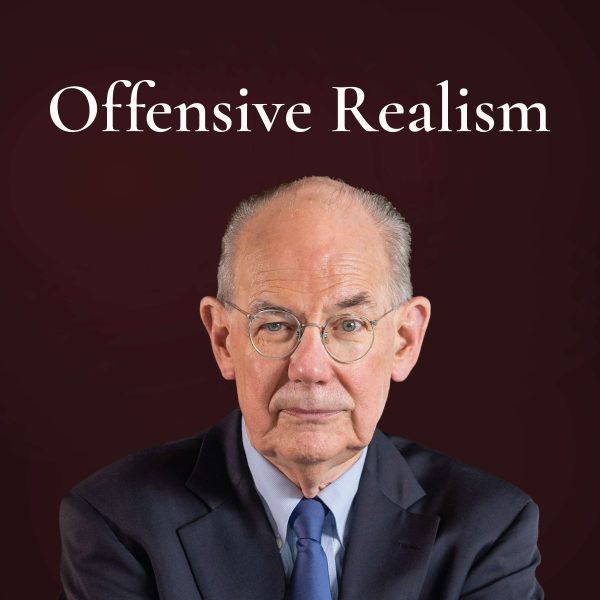
John Mearsheimer – Offensive Realism
- Episodios
- 29
- Se publica
- varias veces por semana
- Último episodio
- 11 Nov 2026
Sobre el podcast
The official podcast of Prof. John Mearsheimer
Episodios 29
No Guarantees, No Peace for Ukraine | Episode 15
Become a member to submit questions for future videos. Click Join: https://www.youtube.com/@johnmearsheimer/join————————————————————PODCASTSSpotify: https://open.spotify.com/show/0Ahf67i2DOoXDmi2HA6VcjApple …
Notas del episodio
Become a member to submit questions for future videos.
Click Join: https://www.youtube.com/@johnmearsheimer/join
————————————————————
PODCASTS
Spotify: https://open.spotify.com/show/0Ahf67i2DOoXDmi2HA6Vcj
Apple: https://podcasts.apple.com/podcast/id6810828298
————————————————————
DESCRIPTION
Delegations from Russia, Ukraine, and the United States are now meeting in Abu Dhabi in hopes of reaching an agreement on the all-important issue of security guarantees, which would represent a major step toward ending the Ukraine war. These negotiations are almost certain to fail, however, mainly because it is virtually impossible to devise a formula for security guarantees that satisfies both Russia and Ukraine. Moreover, the Europeans, who have been excluded from the negotiations at Russia’s insistence, are important players who will side with Ukraine against Russia.
————————————————————
CHAPTERS
0:00 Intro
0:32 The Abu Dhabi Negotiations
1:08 Previous Talks in Abu Dhabi and Geneva
2:02 Trump's Optimism vs. Ukraine's Pessimism
2:53 Why These Talks Will Fail
4:14 The Real Issue: Security Guarantees
5:10 No Ceasefire on the Table
6:13 What Ukraine Wants
7:20 What Russia Wants
8:37 Who's at the Table
9:00 Why Europe Is Left Out
12:20 Problem 1: The U.S. Is Not a Mediator
14:44 Problem 2: The Europeans
16:49 Indivisible Security
18:39 The Security Dilemma
21:38 Applying It to Ukraine and Russia
23:28 Russia Demands a Veto
24:25 You Cannot Square This Circle
26:10 The War Will Be Settled on the Battlefield
26:43 A Frozen Conflict
28:07 Conclusion
————————————————————
MUSIC
"The Ice Giants" Kevin MacLeod (incompetech.com)
Licensed under Creative Commons: By Attribution 4.0 License
http://creativecommons.org/licenses/by/4.0/
Music modified (edited/remixed) from the original.Have “Antisemitic” and “Communist” Lost Their Meaning? | Ask the Professor
YouTube Channel member @GSM1 asks: When politicians use terms like communist and socialist, or countries call themselves people’s republics, what do these words actually mean to their audiences today? Have …
Notas del episodio
YouTube Channel member @GSM1 asks: When politicians use terms like communist and socialist, or countries call themselves people’s republics, what do these words actually mean to their audiences today? Have these labels, much like the term anti-Semitism, evolved so far from their original meanings that they’ve become largely meaningless political rhetoric?
I don’t think these labels are meaningless. I think they serve two purposes. First, leaders use them to motivate their public. The United States is separated from its adversaries by two oceans, so elites have to work to get Americans to back costly wars. That is why Saddam Hussein became Hitler, why Iran’s leaders are compared to the Nazis, and why every standoff becomes Munich in 1938. Second, sometimes the labels reflect real ideological differences that fuel conflict, as on the Eastern Front in World War II and in the Cold War.
When ideology and geopolitics point in the same direction, they reinforce each other. When they conflict, the realist logic wins. The United States and Britain allied with the Soviet Union against Nazi Germany, and Washington cleaned up Stalin’s image to do it.The Danger of a Nuclear Middle East | Ask the Professor
YouTube Channel member @Seniorquasimodo asks: if Iran builds a nuclear deterrent, will Saudi Arabia, Turkey and the UAE follow, creating a stable balance of nuclear powers in the region? Would Israel and the …
Notas del episodio
YouTube Channel member @Seniorquasimodo asks: if Iran builds a nuclear deterrent, will Saudi Arabia, Turkey and the UAE follow, creating a stable balance of nuclear powers in the region? Would Israel and the United States allow it, and what is the future of nuclear proliferation in the Middle East?
In this Ask the Professor, I make three points. First, the 2025 12-day war and the ongoing war that began on February 28 have given Iran powerful incentives to go nuclear, and Saudi Arabia, Egypt, Iraq and Turkey would likely follow. Second, the Saudis have incentives to acquire a deterrent even if Iran doesn’t, because the United States can no longer protect them. Third, a region where every state has a survivable deterrent would be stable, but the proliferation process itself is extremely dangerous, since Israel and the United States have enormous incentives to strike before the capability is complete, and small arsenals may be vulnerable.Trump’s Post-Midterm Iran Plan Is a Loser | Episode 14
DESCRIPTIONThe Trump administration is desperately searching for a way to end the Iran war on favorable terms. President Trump has indicated that he would take steps after the mid-term elections to bring the …
Notas del episodio
DESCRIPTION
The Trump administration is desperately searching for a way to end the Iran war on favorable terms. President Trump has indicated that he would take steps after the mid-term elections to bring the war to a victorious conclusion. That is not going to happen, however. The United States has no way of winning its war against Iran.
————————————————————
CHAPTERS
0:00 Intro
0:27 Trump's Post-Midterm Iran Plan
1:59 What's Happened Since February 28th
2:37 The Four U.S. and Israeli War Goals
4:47 What the War Has Cost So Far
6:09 Iran's Demands
9:53 Iran's Slow Walk on the Nuclear Issue
12:56 The Strategies the U.S. Has Tried
19:09 Trump's Four Options
20:58 Option 1: A Three-Day Bombing Campaign
25:25 Option 2: The Blockade and Bessent Strategy
27:51 Option 3: Diplomacy
29:56 Desperation in Washington and Israel
31:27 Option 4: A Nuke on Pickaxe Mountain
34:09 How a Nuclear Strike Would Work
36:55 Would It End the War?
38:20 The Wider Costs of Going Nuclear
40:43 Where That Leaves Us
————————————————————
MUSIC
"The Ice Giants" Kevin MacLeod (incompetech.com)
Licensed under Creative Commons: By Attribution 4.0 License
http://creativecommons.org/licenses/by/4.0/
Music modified (edited/remixed) from the original.International Law Only Binds the Weak | Ask the Professor
YouTube channel member @KamranRazvan asks: What does the Nuclear Nonproliferation Treaty actually offer a non-nuclear state if international law has no real enforcement?My answer starts with a distinction …
Notas del episodio
YouTube channel member @KamranRazvan asks: What does the Nuclear Nonproliferation Treaty actually offer a non-nuclear state if international law has no real enforcement?
My answer starts with a distinction between great powers and minor powers. Great powers create international institutions, write the rules to serve their own interests, and break those rules when they conflict with their national interest. No higher authority can punish them. The UN Security Council veto is the clearest example. Minor powers don’t write the rules, and they almost always have to obey them, because the great powers that built the institutions have the economic and military might to enforce them.
The NPT, created in 1968 by the United States and the Soviet Union, shows the pattern. Washington, Moscow, and today Beijing all have an interest in keeping non-nuclear states from getting the bomb. They enforce the treaty, not the institution itself. North Korea is the glaring exception.Was It a Mistake for Britain to Fight World War II? | Ask the Professor
In this episode I answer a question from channel member @hassanakram8328 , who asks whether it was worth it for Britain to fight World War I and World War II, and whether Britain should be helping Ukraine …
Notas del episodio
In this episode I answer a question from channel member @hassanakram8328 , who asks whether it was worth it for Britain to fight World War I and World War II, and whether Britain should be helping Ukraine against Russia today. My answer is that Britain had no choice. Both wars were extremely costly, but staying out would have cost more. In 1914 and 1939, Britain had to choose between two bad options, and fighting was the less bad one. I explain why Britain, an island, repeatedly abandoned its policy of “splendid isolation” whenever a potential hegemon threatened to dominate Europe, from Napoleonic France to Imperial Germany to Nazi Germany. I also explain why the same logic led the United States into both world wars. I close with Ukraine. Russia is not Napoleonic France, Imperial Germany, or Nazi Germany, so the logic that brought Britain into the world wars doesn’t apply.
Does Israel Win If the Gulf Burns? | Ask the Professor
YouTube channel member @BrianPerry-f7b asks: Does Israel benefit if the Gulf states are devastated? Iran has threatened to hit Gulf civilian infrastructure if its own sites are struck, and it has the …
Notas del episodio
YouTube channel member @BrianPerry-f7b asks: Does Israel benefit if the Gulf states are devastated? Iran has threatened to hit Gulf civilian infrastructure if its own sites are struck, and it has the capability: oil and gas facilities, desalination plants, and the seven undersea internet cables running beneath the Persian Gulf.
To answer it, I lay out Israel’s five strategic goals and show where Iran blocks two of them: weak neighbors and no nuclear proliferation. Israel would love to see Iran badly hurt, but a war that wrecks the whole Gulf is a different matter. Israel has valuable relationships with the UAE and Saudi Arabia, a global economic collapse would hit it too, and Iran has made clear Israel is high on its target list.Israel’s Lobby vs US Democracy | A Special Roundtable
BUY THE BOOKS:Israel's Lobby: America in the Grip of a Foreign Power by Eli Clifton and Ian Lustick: https://amzn.to/4gMNJeyThe Israel Lobby and U.S. Foreign Policy by John Mearsheimer & Steve Walt …
Notas del episodio
BUY THE BOOKS:
Israel's Lobby: America in the Grip of a Foreign Power by Eli Clifton and Ian Lustick: https://amzn.to/4gMNJey
The Israel Lobby and U.S. Foreign Policy by John Mearsheimer & Steve Walt: https://amzn.to/3SL2M0o
————————————————————
DESCRIPTION
Why has American opinion on Israel shifted so sharply while U.S. policy has barely moved? The authors of the two major books on the Israel lobby take it on.
In this special collaboration between the Quincy Institute for Responsible Statecraft and my YouTube channel, I join Stephen Walt (Harvard Kennedy School), Eli Clifton (Quincy Institute co-founder), and Ian Lustick (University of Pennsylvania) for a roundtable discussion on our book The Israel Lobby and U.S. Foreign Policy (2007) and their new book Israel's Lobby: America in the Grip of a Foreign Power. Rashid Khalidi, professor emeritus of history at Columbia University, moderates.
We cover the military-industrial complex and oil lobbies, why the Palestinian issue is where the lobby dominates, the gap between public opinion and policy, campaign money after Citizens United, the antisemitism charge and the use of state power against campuses, why Israel's defenders struggle to argue the facts, and when policy might change.
————————————————————
CHAPTERS
00:00 Introduction:
00:09 Offensive Realism & the Quincy Institute
02:20 Rashid Khalidi opens the roundtable
04:03 Is the military-industrial complex part of the lobby?
06:46 When defense & oil interests clash with the lobby
09:53 Strategic interests vs. the lobby: Kissinger, Eisenhower, the JCPOA
11:43 Ian Lustick: process tracing & the Chomsky argument
14:41 Startup Nation Central & the NDAA push to fuse U.S.–Israeli defense
18:43 The Palestinians: always left by the wayside
21:38 Why presidents' Palestine initiatives keep failing
23:38 The post-Cold War puzzle: weaker case, deeper relationship
25:14 Public opinion has shifted, but policy hasn't
26:39 The lobby lost the discourse, not the policy
29:20 Citizens United & $200M in pro-Israel super PAC money
32:39 "Smash-mouth politics"
33:06 The domestic fallout: universities, speech & state power
36:01 Rising antisemitism & the "collective Jew" argument
38:00 American Jews are not a monolith
41:12 Why the lobby can no longer defend Israel's policies
44:42 Israel as a "crazy state" & the civilizational-war narrative
48:06 New historians, scholars & the internet
49:48 Smears losing force & the alliance with culture warriors
53:13 The facts on the ground: Gaza & social media
55:42 The NRA parallel: why policy lags opinion
58:09 Washington's Farewell Address & the danger of faction
1:00:35 The bandwidth cost of the special relationship
1:03:18 Israel's new military doctrine & "Sparta among nations"
1:09:04 When will public opinion finally change policy?
1:12:09 Predictions: the Democrats, 2028 & the Iran war
1:18:50 Generational change
1:22:03 A grim note: "cooked" antisemitism statistics
1:26:14 The danger of a backlash & the dual-loyalty trope
1:28:51 Mearsheimer: antisemitism on campus before 2024
1:30:46 Closing remarks
————————————————————
MUSIC
"The Ice Giants" Kevin MacLeod (incompetech.com)
Licensed under Creative Commons: By Attribution 4.0 License
http://creativecommons.org/licenses/by/4.0/
Music modified (edited/remixed) from the original.Are Aircraft Carriers Obsolete? | Ask The Professor
Become a member to submit questions for future videos. Click Join: https://www.youtube.com/@johnmearsheimer/joinYouTube channel member @JerryMcLaughlin-r8w asked whether drones, cruise missiles and ballistic …
Notas del episodio
Become a member to submit questions for future videos. Click Join: https://www.youtube.com/@johnmearsheimer/join
YouTube channel member @JerryMcLaughlin-r8w asked whether drones, cruise missiles and ballistic missiles have made U.S. aircraft carriers obsolete, and whether the Navy saw it coming. Carriers have always been vulnerable near large landmasses, which is why we didn’t use them against Nazi Germany or plan to in a Cold War fight in Europe. The threat is now far greater, and the cost exchange favors cheap missiles and drones over a carrier and its battlegroup. In a fight with China over Taiwan or the South China Sea, I think carriers are basically useless. Against Iran they’d have to operate even farther out as Iranian weapons improve. The Navy knows all this, but carriers are bound up with its identity, so reducing our reliance on them will be hard. Looking at it purely strategically, I think we’d be better off spending much less on carriers and much more on submarines. ————————————————————
CHAPTERS 0:00 Intro 0:04 The Question: Are Aircraft Carriers Obsolete? 1:02 Carriers Have Always Been Vulnerable Near Land 2:21 Lessons from the Ukraine and Iran Wars 3:22 Carriers in a War with China 5:06 Carriers in the Middle East 6:47 Does the Navy Know? 7:22 Why the Navy Won't Let Go of Carriers 9:10 The Strategic Case for Fewer Carriers
Trump's Three-War Trap | Episode 13
Become a member to submit questions for future videos. Click Join: https://www.youtube.com/@johnmearsheimer/join————————————————————PODCASTSSpotify: https://open.spotify.com/show/0Ahf67i2DOoXDmi2HA6VcjApple …
Notas del episodio
Become a member to submit questions for future videos.
Click Join: https://www.youtube.com/@johnmearsheimer/join
————————————————————
PODCASTS
Spotify: https://open.spotify.com/show/0Ahf67i2DOoXDmi2HA6Vcj
Apple: https://podcasts.apple.com/podcast/id6810828298
————————————————————
DESCRIPTION
President Trump bears responsibility for three ongoing wars: 1) the Ukraine war, which he inherited from Joe Biden but now owns; 2) the Iran war, which he launched together with Israel on 28 February 2026; and 3) the war between the Houthis and Saudi Arabia, which he encouraged the Saudis to initiate on 13 July 2026. Each of these wars carries a significant risk of dangerous escalation, and together they threaten to inflict serious damage on the international economy. To make matters worse, Trump has no strategy for ending these wars on terms favorable to the United States, much less achieving lasting peace. Even after the fighting stops, all three wars may well turn into frozen conflicts.
————————————————————
CHAPTERS
0:00 Intro
0:29 Trump and his wars
1:57 Year one: Ukraine, the 12-day war and Venezuela
4:50 Why Ukraine is now Trump's war
6:30 Wars two and three: Iran and the Saudi–Houthi war
8:48 Why these wars are disasters
13:19 The great-power backdrop
15:29 The Iran war: where we are now
21:31 Iran: the danger of escalation
27:10 Iran: the economic damage
29:09 Iran: no way to win
31:21 Iran: a frozen conflict and the nuclear question
35:07 Iran: Russia and China
36:39 The Saudi–Houthi war: how it started
40:08 Saudi–Houthi: horizontal and vertical escalation
42:48 Saudi–Houthi: the economic stakes
45:09 Saudi–Houthi: the Saudis can't win
46:24 Saudi–Houthi: a frozen conflict
49:45 Will Saudi Arabia go nuclear?
51:22 The Ukraine war: where we are now
54:17 Ukraine: escalation in the air war
59:02 The Karaganov argument
1:04:48 Ukraine: the international economy
1:06:45 Ukraine: no winning strategy
1:07:52 Ukraine: the frozen conflict
1:10:54 Great-power politics across all three wars
1:16:23 Summing up: three losing wars
1:19:25 An LBJ/Nixon fate for Trump?
1:20:29 Why Gaza isn't on the list
————————————————————
MUSIC
"The Ice Giants" Kevin MacLeod (incompetech.com)
Licensed under Creative Commons: By Attribution 4.0 License
http://creativecommons.org/licenses/by/4.0/
Music modified (edited/remixed) from the original.Did Russia Manipulate Mearsheimer? | Ask The Professor
In this Ask the Professor, YouTube channel member @boresow asks how I separate real insight from propaganda after my visit to Russia, and whether I’m being used to amplify Moscow’s narrative.I make two points …
Notas del episodio
In this Ask the Professor, YouTube channel member @boresow asks how I separate real insight from propaganda after my visit to Russia, and whether I’m being used to amplify Moscow’s narrative.
I make two points. First, a scholar should talk to people he disagrees with, whether that’s Viktor Orbán, Sergei Lavrov, or Vladimir Putin. Second, my view that NATO expansion caused the Ukraine war came from studying the evidence, not from talking to the Russians. It happens to match their view, but I didn’t adopt it to win their favor.
Why Can’t America Contain China? | Ask The Professor
YouTube channel member @GuanWang-n2g asks: why did Washington never devote the resources needed to carry out the pivot to Asia that the Obama administration announced in 2011? My answer is that pivoting to …
Notas del episodio
YouTube channel member @GuanWang-n2g asks: why did Washington never devote the resources needed to carry out the pivot to Asia that the Obama administration announced in 2011? My answer is that pivoting to Asia means containing China, and in 2011 we were still pursuing engagement, helping China get rich. The pivot only really began in 2017, when China had become a great power and Trump adopted containment. Since then, the wars in Ukraine and Iran have pulled forces out of East Asia. The pivot to Asia has turned into a pivot away from Asia, which is a huge mistake.
We Can't Help Saudi Arabia | Ask the Professor
YouTube channel member @sambaker7691 asks: how do you explain the shortcomings in U.S. efforts to give Saudi Arabia the air defenses it needs against Houthi missile and drone attacks, despite the close …
Notas del episodio
YouTube channel member @sambaker7691 asks: how do you explain the shortcomings in U.S. efforts to give Saudi Arabia the air defenses it needs against Houthi missile and drone attacks, despite the close strategic partnership between the two countries? My answer is that this isn’t about the relationship. The Saudis are rich, and we’ve sold them almost all the weaponry they want. The problem is that today, offense beats defense. Even with heavy American help, Israel couldn’t stop Iranian missiles and drones in the 12-Day War or in the 40-day bombing campaign that started the current war. Ukraine has run out of Patriots. Offensive missiles are cheaper than interceptors and can overwhelm them. The United States can’t protect Saudi Arabia, and it won’t be able to defend any bases it might rebuild in the Persian Gulf either.
Why Hamas Really Attacked Israel on Oct. 7 | Episode 12
October 7, 2026, marked the third anniversary of Hamas’s deadly attack on Israel. Considerable attention was devoted to commemorating that event in Israel and throughout the West. The focus was mainly on three …
Notas del episodio
October 7, 2026, marked the third anniversary of Hamas’s deadly attack on Israel. Considerable attention was devoted to commemorating that event in Israel and throughout the West. The focus was mainly on three questions: 1) What happened that day? 2) Why was Israel caught by surprise? 3) What have been the consequences of that momentous day?
Much less attention was paid to a fundamental question: Why did Hamas launch the attack in the first place? Indeed, this relative neglect of the attack’s root causes has characterized much of the public discussion of October 7 from the beginning.
Israel and its supporters, however, have a straightforward explanation. According to Prime Minister Netanyahu, Hamas and its allies are “the new Nazis,” and October 7 was an unprovoked attack that Israeli leaders and much of the Israeli public have repeatedly compared to the Holocaust. In other words, the attack is understood primarily as an expression of genocidal antisemitism.
In this episode, I examine that explanation and argue that it is fundamentally mistaken. The historical record and a careful examination of Hamas’s motives point toward a very different story, which I believe is why Israel and its supporters have paid little attention to discussing the political and strategic calculations that led Hamas to attack Israel on October 7, 2023.
————————————————————
CHAPTERS
0:00 Intro
0:26 The question nobody asks: why did Hamas attack?
2:01 The Israeli story: Hamas as "the new Nazis"
5:08 The old story: "a land without people"
8:28 The new historians rewrite the record
9:53 The real Zionist goal: a Greater Israel
11:00 The numbers: a land full of Palestinians
13:57 "They're going to have to steal the land"
15:34 Palestinian resistance, from 1936 to Gaza
17:56 Jabotinsky and Ben-Gurion: "We have stolen their country"
20:45 A Palestinian population that never went away
24:21 Option 1: the Iron Wall
26:00 Option 2: ethnic cleansing
28:54 Option 3: Bantustans and ghettos
30:38 The myth of the two-state solution
32:45 Gaza: occupation, settlers and Sharon's pullout
36:30 The blockade: Gaza on a diet
38:34 Assassinating Gaza's leaders
40:22 "Mowing the lawn": Cast Lead and Protective Edge
44:25 October 7th: the inmates break out
46:22 Hamas wants its land back
49:46 Read the history
51:11 Was the attack legal under international law?
————————————————————
MUSIC
"The Ice Giants" Kevin MacLeod (incompetech.com)
Licensed under Creative Commons: By Attribution 4.0 License
http://creativecommons.org/licenses/by/4.0/
Music modified (edited/remixed) from the original.We’ll Never Beat the Houthis
DESCRIPTIONYouTube Channel member @edhodapp6465 asks: should we go to war against the Houthis, and is damaging Iran's proxies a worthwhile strategy? My answer is no. We're at war with Iran, but …
Notas del episodio
DESCRIPTION
YouTube Channel member @edhodapp6465 asks: should we go to war against the Houthis, and is damaging Iran's proxies a worthwhile strategy? My answer is no. We're at war with Iran, but we're not fighting the Houthis. They're fighting Saudi Arabia. We already failed to beat them in 2025, and after the war with Iran, we have even fewer munitions now. The Houthis can hit Saudi oil infrastructure and control the Bab el-Mandeb strait. And if we started winning, I believe Iran would step in. The U.S. has no winning strategy in the Gulf.
————————————————————
CHAPTERS
0:00 Intro
0:04 Should we go to war against the Houthis?
0:47 Two separate wars: US vs. Iran, Houthis vs. Saudi Arabia
2:07 Trump's failed 2025 campaign against the Houthis
3:13 Should the US join Saudi Arabia against the Houthis?
3:41 Why the Houthis are a real threat (Bab el-Mandeb)
4:25 Why the answer is no: we can't win, and we're short on munitions
6:29 Houthi retaliation and Saudi oil infrastructure
8:03 What if the US were winning? Iran would step in
9:08 Conclusion: no winning strategy in the Middle East
————————————————————The Korean War: America vs China | Ask The Professor
YouTube Channel member @spacecometrue asked me to share my analysis of the causes and course of the Korean War. North Korea invaded the South on June 25, 1950, and nearly won before the U.S. stepped in …
Notas del episodio
YouTube Channel member @spacecometrue asked me to share my analysis of the causes and course of the Korean War. North Korea invaded the South on June 25, 1950, and nearly won before the U.S. stepped in. MacArthur's Inchon landing pushed the North Koreans back to the 38th parallel. When we crossed it and headed for the Yalu River, China entered the war in October 1950, and from that point it was really a war between the U.S. and China. It ended in an armistice in July 1953, not a peace agreement. I also explain why each side fought. North Korea wanted to unify the peninsula. The U.S. came in after Dean Acheson's blunder, because a Soviet ally controlling Korea threatened Japan and Northeast Asia. China found U.S. troops on its border unacceptable, much as Russia saw Ukraine in NATO. I also cover how the war militarized the Cold War, and why I think the Korean Peninsula is stable today despite North Korea's nuclear weapons. ————————————————————
CHAPTERS 0:00 Intro: 0:04 A member's question on Korea 0:41 How the Korean War unfolded 1:36 The U.S. enters and the Inchon landing 2:08 Crossing the 38th parallel 3:15 China enters the war 4:31 Really a U.S.–China war, and the 1953 armistice 5:28 How Korea militarized the Cold War 6:55 Why North Korea invaded 8:27 Why the U.S. came in: Acheson's blunder 10:24 Why China came in 11:16 The Ukraine–NATO parallel 12:41 The Korean Peninsula today 14:01 Why North Korea's nukes are defensive 15:24 Verdict: another war is unlikely ————————————————————
Trump Can’t Bluff Iran into Surrender | Episode 11
DESCRIPTIONIt seems clear that the Trump administration and its allies are working overtime to create the false impression that the United States is well on its way to defeating Iran and that Tehran should …
Notas del episodio
DESCRIPTION
It seems clear that the Trump administration and its allies are working overtime to create the false impression that the United States is well on its way to defeating Iran and that Tehran should therefore submit to American demands sooner rather than later. If it does not, so the argument goes, not only will the economic punishment inflicted on Iran reach crushing levels, but President Trump will launch a devastating military attack that might even include putting U.S. ground forces into Iran. I will argue in this episode that this is largely a propaganda campaign—and that it is unlikely to work because Iran, not the Trump administration, is in the driver’s seat.
————————————————————
CHAPTERS
0:00 Intro
0:42 The Administration's Propaganda Campaign
3:41 A Two-Pronged Approach
4:12 The Economic Argument: Blockade & Bessent's Strategy
6:21 The Military Argument: More Troops & Carriers
8:48 Why the Story Is Deeply Flawed
9:16 Why a New Air Campaign Won't Work
10:51 The "Three Carriers" Myth
14:28 Striking Oil Infrastructure & Iran's Second Strike
15:35 The Ground Invasion: How Many Combat Troops?
20:23 What Can You Do With 7,500 Troops?
23:05 Body Bags & Getting the Marines Ashore
25:19 Will Economic Pain Make Iran Surrender?
26:28 Lesson of History: Blockades Alone Don't Win Wars
28:38 Facing an Existential Threat
29:23 Iran's Doomsday Option
31:14 Is the West Really Doing Well?
32:01 New Strait Attacks & the Houthi Threat to Saudi Oil
34:30 Oil Is Flowing, but Economies Are Still Hurting
36:01 Bottom Line
————————————————————
MUSIC
"The Ice Giants" Kevin MacLeod (incompetech.com)
Licensed under Creative Commons: By Attribution 4.0 License
http://creativecommons.org/licenses/by/4.0/
Music modified (edited/remixed) from the original.Forget Vietnam, You Get Iran And Iraq | Ask The Professor
I'll explain how the Vietnam War shaped my thinking about international relations, and the lessons it holds for today.
Will China Attack Taiwan? | Ask The Professor
I'll explain why I believe a Chinese invasion of Taiwan in the next decade is unlikely, and the one scenario that could change that.
The Inescapable US-China Rivalry | Episode 10
President Trump and President Xi Jinping just concluded a three-day summit in Washington, DC, that was noteworthy for its lofty rhetoric and almost complete lack of progress in dealing with a host of truly …
Notas del episodio
President Trump and President Xi Jinping just concluded a three-day summit in Washington, DC, that was noteworthy for its lofty rhetoric and almost complete lack of progress in dealing with a host of truly important issues: AI, Iran, Taiwan, trade, and Ukraine. The Economist maintains that the two leaders “squandered a chance to tackle the world’s gravest threats,” which it argues “amounts to a dereliction of duty, and leaves the rest of humanity as the losers.” I disagree. I will review what happened at the summit regarding each of these issues and explain why, with the possible exception of trade, the underlying conflicts of interest between China and the United States leave little room for meaningful agreement.
Is Ukraine Committing National Suicide? | Episode 9
Iuliia Mendel, who served as President Zelensky’s press secretary from 2019 to 2021, published an article in The Spectator on September 15, 2026, titled “Zelensky’s Strategy Is National Suicide.” In essence …
Notas del episodio
Iuliia Mendel, who served as President Zelensky’s press secretary from 2019 to 2021, published an article in The Spectator on September 15, 2026, titled “Zelensky’s Strategy Is National Suicide.” In essence, she makes a compelling case that Ukraine is not simply losing its war with Russia but is being so thoroughly wrecked in the process that it is effectively committing national suicide.
Mendel made much the same case the following day, September 16, in a virtual address to an event at the European Parliament. She had intended to deliver the speech in person but was denied entry to the Parliament building and therefore had to appear virtually. Mendel attributes that decision to the sanctions President Zelensky had imposed on her three days earlier, although the European Parliament has not said why she was barred.
Mendel’s article and speech have generated substantial controversy, which is hardly surprising given the severity of her indictment and the fact that she served as Zelensky’s press secretary. My aim in this episode is to examine the arguments she makes in both her article and her European Parliament speech and explain why I think her description of what is happening to Ukraine is fundamentally correct.The Russia I Saw | Episode 8
I recently spent 8 days in Russia – September 5-12, 2026 – mainly in Moscow and St. Petersburg. I gave a series of talks and interviews and spoke with numerous people in the Russian security community …
Notas del episodio
I recently spent 8 days in Russia – September 5-12, 2026 – mainly in Moscow and St. Petersburg. I gave a series of talks and interviews and spoke with numerous people in the Russian security community, including senior figures like Foreign Minister Sergey Lavrov. In this episode, I describe what I learned during my trip.
A Must Read Book on the Israel Lobby | Episode 7
Eli Clifton and Ian Lustick have just published a terrific new book called Israel’s Lobby: America in the Grip of a Foreign Power. It appears twenty years after Steve Walt and I published “The Israel Lobby” in …
Notas del episodio
Eli Clifton and Ian Lustick have just published a terrific new book called Israel’s Lobby: America in the Grip of a Foreign Power. It appears twenty years after Steve Walt and I published “The Israel Lobby” in The London Review of Books (March 2006), which we turned into a book a year later. Much has happened regarding Israel, the Israel lobby, and the US-Israeli relationship in the two decades since Steve and I first addressed those subjects. Clifton and Lustick do a great job explaining those fundamental changes. In this episode, I will discuss their new book and explain how it differs from what Steve and I wrote in our article and book on the lobby.
————————————————————
BUY THE BOOKS
1. Israel's Lobby: America in the Grip of a Foreign Power
by Eli Clifton and Ian Lustick
Purchase Here: https://amzn.to/4gMNJey
2. The Israel Lobby and U.S. Foreign Policy
by John J. Mearsheimer and Stephen M. Walt
Purchase Here: https://amzn.to/3SL2M0o
(As an Amazon Associate I earn from qualifying purchases.)
————————————————————
CHAPTERS
0:00 Intro
0:28 The book: Israel's Lobby by Eli Clifton and Ian Lustick
2:38 The core arguments
5:15 The conceptual framework: discourse vs. policy
7:29 Where the new book breaks from Mearsheimer & Walt
8:01 How the discourse changed: dual loyalty and "Israel Firsters"
12:42 The internet and the collapse of media gatekeeping
15:08 Israeli behavior after October 7th
17:45 Israel as a "crazy state"
22:11 Israeli identity: "a nation that dwells alone"
27:51 Why Americans turned on Israel
29:29 The lobby fights back: redefining antisemitism
32:54 Government crackdowns on campus protests
35:40 Plutocrats, Citizens United, and policy capture
39:11 The bottom line and the big question ahead
41:14 Closing thoughts
————————————————————
MUSIC
"The Ice Giants" Kevin MacLeod (incompetech.com)
Licensed under Creative Commons: By Attribution 4.0 License
http://creativecommons.org/licenses/by/4.0/
Music modified (edited/remixed) from the original.Why Ukraine Is Doomed | Episode 6
In recent months, Western news coverage of the Ukraine war tells us that Russia is suffering huge casualties on the battlefield while making hardly any progress capturing Ukrainian territory. At the same time …
Notas del episodio
In recent months, Western news coverage of the Ukraine war tells us that Russia is suffering huge casualties on the battlefield while making hardly any progress capturing Ukrainian territory. At the same time, Ukraine’s long-range drone attacks on the Russian homeland are wreaking havoc, which will improve Ukraine’s position at the bargaining table. In short, Russia is in deep trouble and Ukraine’s situation is hardly dire. This episode explains why this perspective is wrong. Russia is winning on the battlefield – albeit slowly – and its ramped-up bombing campaign is doing egregious damage to Ukraine’s economy, which is essential for Kyiv to sustain the war on the front lines. This situation is unsurprising, as this is a war of attrition in which the side with an advantage in manpower and weaponry invariably wins. In that regard, the Russians have an overwhelming advantage. Indeed, were it not for the effect that drones have had on the battlefield, the Ukrainians would have lost a long time ago.
————————————————————
Chapters
0:00 Intro
0:34 What This Episode Covers
0:50 The Story the Western Media Is Telling
3:25 The Battlefield: A War of Attrition
4:20 The Balance of Manpower
6:41 Force-to-Space Ratio: Gaps in the Line
8:13 The Balance of Firepower: Artillery
10:51 Drones: What's Keeping Ukraine in the Fight
12:02 Russian Casualties: The Numbers Don't Add Up
15:01 Ukrainian Casualties: 30,000 a Month
18:18 Why Russia Takes Territory So Slowly
20:11 The Air War: Russia's Inventory
28:45 Why Punishment Campaigns Don't Work
29:35 Russia Changes Strategy
33:49 Warehouses and the Energy Grid
36:11 Ukraine's Drone Campaign Can't Win the War
37:40 Outside Support for Ukraine
38:12 Trump and the Shifting Burden
42:29 Inside Ukraine: War Weariness
43:51 Zelensky's Political Troubles
45:31 Where the War Stands Today
47:48 The Cost of Rebuilding
49:16 The Best Ukraine Can Hope For
50:34 Conclusion
————————————————————
Music
"The Ice Giants" Kevin MacLeod (incompetech.com)
Licensed under Creative Commons: By Attribution 4.0 License
http://creativecommons.org/licenses/by/4.0/
Music modified (edited/remixed) from the original.The False Promise of Tactical Nuclear Weapons | Episode 5
There is considerable evidence that the US is interested in “expanding its options” for using its nuclear arsenal. In particular, it appears that the Pentagon would like to increase its reliance on tactical …
Notas del episodio
There is considerable evidence that the US is interested in “expanding its options” for using its nuclear arsenal. In particular, it appears that the Pentagon would like to increase its reliance on tactical nuclear weapons for both deterrence and warfighting should deterrence fail.
I will argue that fighting a war with tactical nuclear weapons is unlikely to produce a meaningful military victory and is likely to have catastrophic consequences. In fact, the US and NATO embraced this very option in the 1950s in the context of a war in Europe, only to realize that they had to find a different way to deter the Soviet Union and fight it should deterrence break down. The same basic logic that applied then still applies today. Simply put, tactical nuclear weapons are not war-winning weapons.
————————————————————
CHAPTERS
00:00 Introduction
00:31 Why tactical nuclear weapons, why now
01:52 From massive retaliation to flexible options
03:04 The real driver: weakened conventional forces
04:46 Ukraine, Iran, and depleted munitions
05:07 Balancing conventional and nuclear deterrence
06:24 The appeal of tactical nukes on the battlefield
07:04 Why that thinking is misguided
07:55 Defending Europe in the 1950s
10:26 NATO's nuclear answer — and why the US never adopted "no first use"
11:54 Carte Blanche: the June 1955 war game
14:41 Destroying Germany to save Germany
15:38 The escalation problem
16:47 Command and control in a nuclear war
18:50 MC 14/2: NATO doubles down in 1957
20:20 Shift one: rebuilding conventional deterrence
23:03 Shift two: nuclear weapons as coercion, not warfighting
25:19 A handful of weapons and the slippery slope
28:00 MC 14/2 vs. MC 14/3
29:30 Recap: how NATO moved away from warfighting
31:30 What this means for the US today
33:49 Conclusion
————————————————————
MUSIC
"The Ice Giants" Kevin MacLeod (incompetech.com)
Licensed under Creative Commons: By Attribution 4.0 License
http://creativecommons.org/licenses/by/4.0/
Music modified (edited/remixed) from the original.The MOU Is Dead! Can a Blockade Save Us? | Episode 4
The June 17, 2026, Memorandum of Understanding (MOU) expired today – August 17, 2026. The US has not achieved any of its initial objectives. It is now mainly concerned with opening the Strait of Hormuz without …
Notas del episodio
The June 17, 2026, Memorandum of Understanding (MOU) expired today – August 17, 2026. The US has not achieved any of its initial objectives. It is now mainly concerned with opening the Strait of Hormuz without having to accept Iran’s far-reaching demands for ending its blockade of the Strait.
The Trump administration is trying to achieve that goal with a naval blockade, a strategy it employed earlier in the war, and which failed. I will argue that the strategic situation facing the US in the Gulf is much worse now and there is virtually no chance that this second blockade will work. Moreover, that deteriorating strategic situation makes escalation even less attractive.
————————————————————
CHAPTERS
0:00 Introduction
0:29 The MOU expires today
1:23 Why the US is now relying on a naval blockade
2:49 America's four original war aims — and why all four failed
3:40 What America wants now: open the strait, get a nuclear deal
4:58 Iran's goals and its list of demands
7:22 How we got here: the phases of the war
7:38 Phase one — the 40-day air campaign
8:06 Phase two — the first blockade and the surrender document
9:13 Phase three — the tit-for-tat campaign
10:49 Phase four — the second blockade, where we are today
11:24 Bessent's promise of "unprecedented economic hurt"
12:53 Can the second blockade actually work?
14:39 Problem one: the state of the US Navy
17:05 Problem two: stripping East Asia to cover the Gulf
19:17 Problem three: oil, the Red Sea, and drained reserves
21:50 Problem four: Iranian hardliners take control
23:50 Is there an escalation option? Three reasons why not
25:34 The July 6th attack — and what the US isn't doing now
28:15 Iran now holds the escalation card
29:59 Conclusion: the US has no strategy left
————————————————————
MUSIC
"The Ice Giants" Kevin MacLeod (incompetech.com)
Licensed under Creative Commons: By Attribution 4.0 License
http://creativecommons.org/licenses/by/4.0/
Music modified (edited/remixed) from the original.Iran Has Trump Over A Barrel | Episode 3
The aim of this video is to compare the terms of the new deal to end the Iran war, which key Iranian spokesmen have just described, with those of the June 17, 2026, Memorandum of Understanding (MOU) between …
Notas del episodio
The aim of this video is to compare the terms of the new deal to end the Iran war, which key Iranian spokesmen have just described, with those of the June 17, 2026, Memorandum of Understanding (MOU) between Tehran and Washington.
I will explain why President Trump should have embraced the original MOU instead of walking away. The US has since lost significant bargaining leverage, and is now facing Iranian demands that far exceed those in the original MOU.
It is difficult to see how Trump can accept Iran’s demands, as that would represent a humiliating defeat for the US. At the same time, it is hard to see how he can reject them, as he has to open the Strait of Hormuz sooner rather than later and he has hardly any coercive leverage over Iran.
————————————————————
CHAPTERS
0:00 Introduction
0:32 The state of US–Iran negotiations
1:37 Background: Obama and the 2015 JCPOA
2:09 Trump tears up the JCPOA (2018)
3:03 Biden fails; Trump returns (2025)
3:57 The June 2025 "12-Day War"
4:33 The February 28th war
5:53 The 40-day bombing and the April 8th ceasefire
6:33 Failed talks and the June 17th Memorandum of Understanding
8:43 The 11 issues on the table
9:19 Issue 1: Opening the Strait of Hormuz
9:56 Issue 2: Lifting oil sanctions
10:23 Issues 3 & 4: The ceasefires
11:33 Issue 5: Who controls the Strait
11:44 Issue 6: Tolls and fees
12:07 Issue 7: US military presence
12:40 Issues 8–10: The big three economic issues
14:11 Issue 11: The nuclear question
15:30 MOU - June 17th
20:36 The July tit-for-tat and the collapse of US leverage
21:38 Iran's Proposal - August 8th
27:11 What can Trump do?
29:36 Conclusion
————————————————————
MUSIC
"The Ice Giants" Kevin MacLeod (incompetech.com)
Licensed under Creative Commons: By Attribution 4.0 License
http://creativecommons.org/licenses/by/4.0/
Music modified (edited/remixed) from the original.Trump Must Admit Defeat In Iran | Episode 2
In today’s video I’ll explain why I believe a US victory is not possible and why the longer Trump waits to cut a deal with Iran, the worse the outcome for the US. I’ll argue that Trump would have been wise to …
Notas del episodio
In today’s video I’ll explain why I believe a US victory is not possible and why the longer Trump waits to cut a deal with Iran, the worse the outcome for the US.
I’ll argue that Trump would have been wise to settle the war months ago, after the initial bombing campaign failed. Instead, he kept looking for some way to win the war or at least find an off ramp that would allow him to make the case that the US achieved some of its goals and did not walk away from the fight empty-handed. But that search is a futile enterprise. There is no war-winning strategy available to him.
————————————————————
CHAPTERS
0:00 Introduction
0:33 The Current Situation in Iran
0:44 Overview of the Episode
2:47 The Four Goals of the US
6:17 The June 17 Memorandum of Understanding: A Surrender Document
9:18 Why Did our Strategies Fail?
9:51 The Five Possible Military Strategies
10:30 Strategy 1: The Discriminate Air Campaign
11:51 Strategy 2: The Indiscriminate Air Campaign
12:35 Strategy 3: Tit-for-Tat
13:07 Strategy 4: The Naval Blockade
13:26 Strategy 5: The Land Option
13:57 What the US Actually Did: The Timeline
18:35 Signing the MoU, Then Violating It
22:46 Why the Three Strategies Failed
36:20 Where We Are: America Has Lost
38:46 What Trump Must Do Now
40:31 The Iranians Hold the Cards
41:13 Summary & Conclusions
————————————————————
MUSIC
"The Ice Giants" Kevin MacLeod (incompetech.com)
Licensed under Creative Commons: By Attribution 4.0 License
http://creativecommons.org/licenses/by/4.0/
Music modified (edited/remixed) from the original.Origins of the War In Ukraine | Episode 1
In today’s episode I’ll explain why I believe a US victory is not possible and why the longer Trump waits to cut a deal with Iran, the worse the outcome for the US. I’ll argue that Trump would have been wise to …
Notas del episodio
In today’s episode I’ll explain why I believe a US victory is not possible and why the longer Trump waits to cut a deal with Iran, the worse the outcome for the US.
I’ll argue that Trump would have been wise to settle the war months ago, after the initial bombing campaign failed. Instead, he kept looking for some way to win the war or at least find an off ramp that would allow him to make the case that the US achieved some of its goals and did not walk away from the fight empty-handed. But that search is a futile enterprise. There is no war-winning strategy available to him.
————————————————————
CHAPTERS
0:00 Introduction
0:33 The Current Situation in Iran
0:44 Overview of the Episode
2:47 The Four Goals of the US
6:17 The June 17 Memorandum of Understanding: A Surrender Document
9:18 Why Did our Strategies Fail?
9:51 The Five Possible Military Strategies
10:30 Strategy 1: The Discriminate Air Campaign
11:51 Strategy 2: The Indiscriminate Air Campaign
12:35 Strategy 3: Tit-for-Tat
13:07 Strategy 4: The Naval Blockade
13:26 Strategy 5: The Land Option
13:57 What the US Actually Did: The Timeline
18:35 Signing the MoU, Then Violating It
22:46 Why the Three Strategies Failed
36:20 Where We Are: America Has Lost
38:46 What Trump Must Do Now
40:31 The Iranians Hold the Cards
41:13 Summary & Conclusions
————————————————————
MUSIC
"The Ice Giants" Kevin MacLeod (incompetech.com)
Licensed under Creative Commons: By Attribution 4.0 License
http://creativecommons.org/licenses/by/4.0/
Music modified (edited/remixed) from the original.
Podcasts similares
Más podcasts de Noticias





¿Es tu podcast?
Confírmalo con una entrada en tu feed: aquí recibes un código, lo añades como podcast:txt en el canal de tu feed y nosotros lo comprobamos. Después tu podcast aparecerá como «verificado» en SoundNode.