

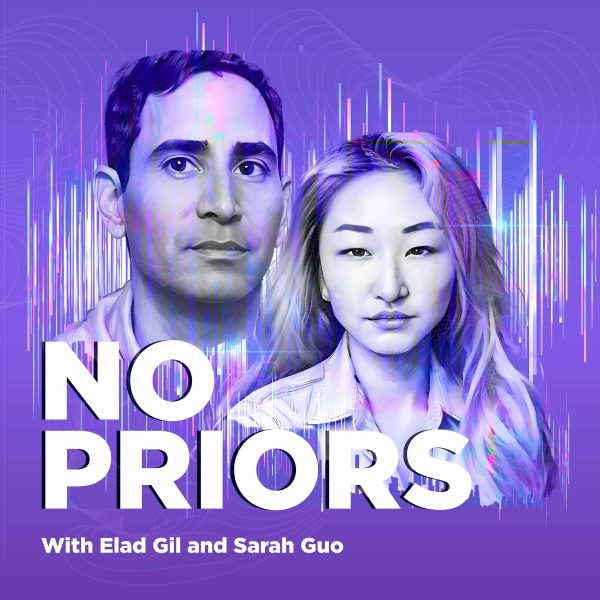
No Priors: Artificial Intelligence | Technology | Startups
- Episodios
- 189
- Se publica
- cada semana
- Último episodio
- 19 Nov 2026
Sobre el podcast
At this moment of inflection in technology, co-hosts Elad Gil and Sarah Guo talk to the world's leading AI engineers, researchers and founders about the biggest questions: How far away is AGI? What markets are at risk for disruption? How will commerce, culture, and society change? What’s happening in state-of-the-art in research? “No Priors” is your guide to the AI revolution. Email feedback to [email protected]. Sarah Guo is a startup investor and the founder of Conviction, an investment firm purpose-built to serve intelligent software, or "Software 3.0" companies. She spent nearly a decade incubating and investing at venture firm Greylock Partners. Elad Gil is a serial entrepreneur and a startup investor. He was co-founder of Color Health, Mixer Labs (which was acquired by Twitter). He has invested in over 40 companies now worth $1B or more each, and is also author of the High Growth Handbook.
Episodios 189
Superintelligence Needs the Physical World with CEO and Co-Founder of Arda Bob McGrew
Is the AI singularity actually coming? Bob McGrew, former Chief Research Officer at OpenAI, argues that superintelligence won’t arrive without changes in the physical world, and that the “hard takeoff” argument …
Notas del episodio
Is the AI singularity actually coming? Bob McGrew, former Chief Research Officer at OpenAI, argues that superintelligence won’t arrive without changes in the physical world, and that the “hard takeoff” argument is wrong.
Sarah Guo and Elad Gil sit down with Bob, an early key executive at Palantir who later led research at OpenAI. He is now CEO and co-founder of Arda, which is leveraging AI to make American manufacturing competitive. Bob explains why automating AI researchers is a one-time boost rather than a runaway loop, and why GPUs, compute, wet labs, and factories are the real bottlenecks.
They cover Arda’s work with Anduril on everything from actuators to missiles to the Fury combat aircraft, why Arda is building “Cursor for manufacturing engineers”, and how the forward deployed engineering model really works. Plus, the big-picture future view: machines that make machines, self-replicating factories, and Bob’s answer to the Fermi paradox.
Sign up for new podcasts every week. Email feedback to [email protected]
Follow us on Twitter: @NoPriorsPod | @Saranormous | @EladGil | @bobmcgrewai | @Arda_Industries
Chapters:
00:00 – Trailer
00:05 – Bob McGrew Introduction
01:05 – Why work on the physical world during the AI revolution?
02:27 – Why the hard takeoff argument is wrong
05:48 – Labs or startups – who will win in robotics and biology?
13:00 – Why America designs products but doesn’t build them
16:33 – Who needs flexible automation: defense, consumer electronics, data centers
18:19 – Humanoid robots vs. robotic work cells
21:07 – Open-world vs. closed-world robotics
25:20 – Building with Anduril: from days to 90 minutes
28:59 – Palantir’s problem-first approach vs. OpenAI’s technology-first approach
33:15 – From dropping out of Stanford to joining OpenAI
37:13 – Why general robotics models suddenly work
40:28 – Implications for the robotics ecosystem
42:46 – On-device models, speed, and safety
44:18 – How forward deployed engineering really works
50:57 – Superintelligence out of the data center
53:41 – Self-replicating factories and Von Neumann probes
56:46 – Bob’s answer to the Fermi paradox
59:33 – Conclusion
Powering AI-Driven Drug Discovery with President of Isomorphic Labs Max Jaderberg
Drug discovery and development has long relied on expensive, time-consuming empirical trial and error. By shifting the discovery process onto computers, Isomorphic Labs wants to fundamentally change medicine …
Notas del episodio
Drug discovery and development has long relied on expensive, time-consuming empirical trial and error. By shifting the discovery process onto computers, Isomorphic Labs wants to fundamentally change medicine from a process of discovery to one of precision engineering. Elad Gil sits down with Isomorphic’s president Max Jaderberg to discuss his vision for using predictive AI models to achieve experimental accuracy. Max details how the success of AlphaFold provided the first proof of concept that a deep learning model could generalize in the field of biology, and how an AI model’s compounding of learnings allows it to achieve generalizability with scale, thus greatly increasing the probability of success as well as speed in real world clinical trials. He also talks about evolving past the need for animal testing through in-silico models, Isomorphic’s focus on developing drug design engines that are agnostic of disease area, target class, and modality, why accurate molecule engineering unlocks the potential for multidrug cocktails that span complex biological pathways, and how he believes AI molecule optimization will improve both human lifespan and healthspan.
Sign up for new podcasts every week. Email feedback to [email protected]
Follow us on Twitter: @NoPriorsPod | @Saranormous | @EladGil | @MaxJaderberg | @IsomorphicLabs
Chapters:
00:00 – Trailer
00:45 – Max Jaderberg Introduction
01:24 – Isomorphic Origins
05:23 – Drug Discovery Stagnation
11:49 – Hiring at Isomorphic
14:35 – Bringing Drug Discovery Onto Computers
19:31 – Isomorphic’s Datasets
20:30 – Rethinking Endpoints
22:50 – External vs. Internal Dependences
23:57 – Automating Biologic Labs
26:22 – Internal Development vs. Partnerships
27:19 – Areas of Human Health Focus
29:21 – Multidrug Approaches
32:17 – Risk Appetite Variation
34:26 – Disease Treatment Outlook
35:42 – Human Longevity and Drug Development
39:16 – Conclusion
Tokenization, Agentic Trading, Harmonic: Robinhood's Mission to Expand Ownership with CEO Vlad Tenev
What does it mean to build wealth as an individual investor in today’s society, especially as gains continue to get concentrated into smaller groups of VCs or institutional investors? Robinhood’s CEO and …
Notas del episodio
What does it mean to build wealth as an individual investor in today’s society, especially as gains continue to get concentrated into smaller groups of VCs or institutional investors? Robinhood’s CEO and co-founder Vlad Tenev has a vision that can be summed up in one word: Ownership. In this episode, Sarah Guo chats with Vlad to get a closer look at how Robinhood has evolved from a simple app to buy stocks at zero commission into a global conglomerate that allows customers to own across a wide variety of surfaces and asset classes. Vlad explains how Robinhood is helping users extend ownership amidst the current economy and ongoing AI revolution through Trump accounts, tokenization of privates, and newer product offerings like Robinhood Chain, Agentic Trading, and Agentic Credit Card. He also talks about how his new mathematical superintelligence startup, Harmonic, is revolutionizing the field and how he hopes it will decentralize new discoveries and inventions. Vlad and Sarah also discuss how prediction markets could tie into the ownership conversation, whether financial infrastructure can be optimized to enable even higher volumes of high-frequency trading, and his advice for maintaining a level head when facing the vagaries of a changing financial market.
Sign up for new podcasts every week. Email feedback to [email protected]
Follow us on Twitter: @NoPriorsPod | @Saranormous | @EladGil | @vladtenev | @RobinhoodApp | @HarmonicMath
Chapters:
00:46 – Intro to Vlad Tenev, His Background, and Robinhood Today
12:25 – A Revolutionary Future for Mathematics
18:49 – Robinhood’s Vision for Tokenization
26:06 – Monetizing Knowledge via Prediction Markets
28:48 – Impacts of Agentic Trading and Democratizing Trading
33:48 – Safeguarding Financial Infrastructure for a New Load of HFTs
38:30 – Ownership of Private Companies in the AI Revolution
48:34 – Robinhood and Trump Accounts
50:47 – Keeping a Steady Hand and Head as a Leader
53:48 – Conclusion
Taking on ServiceNow: Coding Agents the Rest of Us with Serval Co-Founder and CEO Jake Stauch
What happens when you put code-generation agents in the hands of enterprise IT teams? With Serval, you get a system where it's easy for everyone to be a builder. Sarah Guo and Elad Gil sit down with Serval …
Notas del episodio
What happens when you put code-generation agents in the hands of enterprise IT teams? With Serval, you get a system where it's easy for everyone to be a builder. Sarah Guo and Elad Gil sit down with Serval co-founder and CEO Jake Stauch to analyze his company’s direct challenge to ServiceNow as the enterprise automation and service management system of record. Jake explains that by building an AI platform for enterprise IT departments with Serval, users can safely build while still safeguarding permissions by strict deterministic approvals and an audit trail. He also talks about ProServal, the company’s team that embeds automation engineers directly with customers in order to provide ongoing support and service. Jake also discusses how AI was the big unlock to taking on ServiceNow, why he’s betting on coding agents getting even better, why consumer is a window into what will happen next in enterprise and why the SaaS-pocalypse might look more like a consolidation, why background agents are still a moonshot in enterprise software, and the importance of hiring product-oriented engineers.
Sign up for new podcasts every week. Email feedback to [email protected]
Follow us on Twitter: @NoPriorsPod | @Saranormous | @EladGil | @jakeserval | @getserval
Chapters:
00:47 – Jake Stauch Introduction and Serval’s Background
03:00 – Expanding Coding Agents Beyond Engineers
04:40 – Limitations with Personal Agents in Enterprise
06:29 – Deploying Serval Effectively in Large Orgs
07:55 – Day 1 Ambition and Attacking Enterprise Systems of Record
09:51 – Taking on ServiceNow with Workflow Automation Platform
11:01 – Betting on the Evolution of Coding Agents and Building Guardrails in Enterprise
13:48 – Big Risks, Big Rewards, and Big Predictions for Serval and Coding Agents
16:40 – Adopting Different Sets of Building Principles at an Enterprise Level
20:49 – Token Maxing, Long-Term Budget Impacts, and ROI
22:39 – The SaaS-pocalypse and SaaS vs. AI
24:39 – The Mental Model for Delivering Platform-Level Power to the IT User at Enterprise
26:43 – Building Automations with Catalyst and Raising Technical Competence
28:55 – The Next Wave: Background Agents and Autonomy in Enterprise
32:23 – Hiring Velocity and Unlimited Ambition at Serval
34:17 – Keeping Pace with Customers and Fundamental Shifts in Product Function
37:05 – Conclusion
Democratizing Security for the Agentic Web with Cloudflare CTO Dane Knecht
In the transition to the agentic web, security has become an afterthought. Now, organizations are racing to figure out what AI security means, and how to keep their data safe. Live from Cloudflare Connect …
Notas del episodio
In the transition to the agentic web, security has become an afterthought. Now, organizations are racing to figure out what AI security means, and how to keep their data safe. Live from Cloudflare Connect, Sarah Guo sits down with Cloudflare CTO Dane Knecht to discuss the changing attacker landscape, and how his company is allocating its engineering resources to meet this emerging security challenge. Dane explains how enterprises that have moved away from castle-and-moat infrastructure to more of a zero trust infrastructure for security are in better positions than those who haven’t. He also discusses the challenges of patching 70 years of software and why the software development lifecycle will need to change for security for the agentic web, why he sees token spend in the next 18 months primarily going towards security rather than engineering, how the current web is in a ‘messy middle’ state where humans and agents are riding the same ‘rails’ on the internet, Cloudflare’s conference monetization gateway release as well as its Signals project with OpenAI, the rationale behind the release of Cloudflare OS, and the thinking behind a recent company restructuring. Plus, why Cloudflare hired one thousand interns, and why curiosity about AI is required to be successful at Cloudflare.
Sign up for new podcasts every week. Email feedback to [email protected]
Follow us on Twitter: @NoPriorsPod | @Saranormous | @EladGil | @Cloudflare | @dok2001
Chapters:
00:00 – Trailer
00:55 – Cloudflare CTO Top Priorities
05:03 – Today’s Attacker Landscape
06:16 – State of Internet Infrastructure
07:31 – Shift Towards Security Spend
08:39 – Road to Better Software and Internet Security
09:50 – Building Secure Production Software
11:41 – Reducing Surface Area
12:54 – Near Future of the Web
17:27 – Monetization and Signals
19:13 – Success for Content Creators
20:07 – Workplace OS and Use Cases
24:07 – Restructuring for AI-First
27:11 – Token Budgeting
29:32 – Cloudflare’s Intern Strategy
33:39 – Importance of Curiosity
35:29 – Attacking the Legacy Software Security Problem
37:08 – Engineering Team Prioritization
38:25 – Open vs. Closed Models
39:43 – Democratizing Security for Everyone
41:29 – Conclusion
The New Apex Predator: CrowdStrike CEO George Kurtz on Adversaries Armed With AI Agents
Adversaries are already running AI agents, and the fastest attacks now play out in seconds. Sarah Guo and Elad Gil sit down with CrowdStrike president and CEO George Kurtz on what AI-equipped attackers mean for …
Notas del episodio
Adversaries are already running AI agents, and the fastest attacks now play out in seconds. Sarah Guo and Elad Gil sit down with CrowdStrike president and CEO George Kurtz on what AI-equipped attackers mean for enterprise security. George explains how agents are flattening the adversary pyramid by putting advanced tradecraft in the hands of low-skill attackers, and why CrowdStrike and Nvidia are building a frontier-style lab of their own to train security models. They also get into how open-weight and closed models compare on security, where CrowdStrike is directing its platform investment, lessons from the recent Hugging Face incident, and why George sees AI, like every platform shift before it, as a net creator of opportunity.
Sign up for new podcasts every week. Email feedback to [email protected]
Follow us on Twitter: @NoPriorsPod | @Saranormous | @EladGil | @CrowdStrike | @George_Kurtz
Chapters:
00:00 – Trailer
00:59 – George Kurtz Introduction
01:24 – Agentic Landscape
02:45 – AI and Adversaries
04:51 – Open Weight Models and Adversarial Attacks
06:37 – Adversary Geography
08:34 – Attacker Capability in Context
11:24 – Hugging Face Takeaways
13:59 – CrowdStrike Frontier Security Models
16:32 – CrowdStrike Key Offerings
19:51 – What Differentiates CrowdStrike’s Models
23:57 – Near Term State of Security World
25:46 – State of Model Distillation
27:53 – Open Weight Model Importance and Cost
29:59 – Assessing Real Agent Threat
32:40 – Areas to Watch in AI
35:02 – Case for Defense Dominance
39:15 – Executive Advice
43:16 – Shifts Create Opportunity
45:27 – Conclusion
The Changing Physics of Cybersecurity and Drug Development with OpenAI President Greg Brockman
Technology has always been the fundamental driver of improvement for human quality of life. And with the recent rollout of advanced frontier models, like OpenAI’s GPT-6, humanity can now massively accelerate …
Notas del episodio
Technology has always been the fundamental driver of improvement for human quality of life. And with the recent rollout of advanced frontier models, like OpenAI’s GPT-6, humanity can now massively accelerate scientific discovery for its benefit. Sarah Guo and Elad Gil are joined by OpenAI President and co-founder Greg Brockman to discuss the company’s rapid progress across frontier models, cybersecurity, and scientific discovery. Greg shares how nearly 400 century-old math problems have been solved using its AI agents, and how the technology has the potential to transform other fields like biology in the realm of drug discovery. He also talks about how proactive, always-on AI agents like Dots impact modern productivity, why he believes the best UI is no UI at all, how cybersecurity is in a critical window of time to use peak intelligence to find and fix vulnerabilities in systems, and why OpenAI remains committed to keeping humans in the driver’s seat even as models surpass us in capability.
Sign up for new podcasts every week. Email feedback to [email protected]
Follow us on Twitter: @NoPriorsPod | @Saranormous | @EladGil | @gdb | @OpenAI
Chapters:
00:42 – Trailer
00:59 – Greg Brockman Introduction
01:11 – AI and Advancements in Mathematics
05:55 – AI Communication and Oversight
07:45 – AI for Overcoming Biology Data Bottlenecks
11:28 – Revolutionizing Drug Discovery
14:18 – Changing Regulations to Accelerate Progress
16:51 – Dots the Proactive Agent
19:19 – Unifying Work and Consumer Agents
22:02 – How UI Will Evolve
26:08 – Cybersecurity in the AI Age
32:55 – Shift in Security Investment
35:49 – OpenAI’s Human-Centric Ethos
38:28 – Conclusion
Beam: The Great American Open Model with ReflectionAI Co-Founder and CEO Misha Laskin
Is the future of frontier AI open or closed? ReflectionAI co-founder and CEO Misha Laskin joins Sarah Guo and Elad Gil to discuss the launch of Beam, the company’s 500 billion parameter open-weight reasoning …
Notas del episodio
Is the future of frontier AI open or closed? ReflectionAI co-founder and CEO Misha Laskin joins Sarah Guo and Elad Gil to discuss the launch of Beam, the company’s 500 billion parameter open-weight reasoning model. Misha breaks down the pre-training and reinforcement learning required to produce Beam’s reasoning efficiency, the shift in enterprise compute from renting to owning intelligence, and how he believes that open models will capture the majority of global token demand. He also talks about the open model ecosystem in China and why competition with China’s models is a good thing, safety considerations around open models, and how frontier-level open models may accelerate the pace of scientific discovery.
Sign up for new podcasts every week. Email feedback to [email protected]
Follow us on Twitter: @NoPriorsPod | @Saranormous | @EladGil | @MishaLaskin | @reflection_ai
Chapters:
00:42 – Misha Laskin Introduction
00:59 – Latest with ReflectionAI
02:07 – Challenges Building an Open Model
03:56 – ReflectionAI’s Agentic Shift
07:37 – Resources for Model Training
10:09 – Scaling Efficiency
12:18 – Training Beam
16:51 – Where Model Value Comes From
19:55 – Beam’s Reasoning Efficiency
22:35 – Monetizing Open Weight Models
25:03 – Future of Open Versus Closed Tokens
31:29 – Competition with Open Models
34:38 – Chinese Open Source Model Ecosystem
38:40 – Will Chinese Models Remain Open
44:44 – Safety and Open Models
53:02 – Debating Access to Powerful Tools
57:16 – AI and Scientific Progress
01:00:36 – Data Centers and Jobs
01:02:07 – Beam and Scientific Research
01:05:37 – Research Head Count to Compute Ratio
01:10:29 – Conclusion
Frontier Chips for Frontier AI Labs, with Walter Goodwin, Founder/CEO of Fractile
Founder and CEO of full-stack AI chip company Fractile, Walter Goodwin, joins Sarah Guo to discuss the bets he’s made on the future of the chip market as other major players like Broadcom, NVIDIA, and AMD try …
Notas del episodio
Founder and CEO of full-stack AI chip company Fractile, Walter Goodwin, joins Sarah Guo to discuss the bets he’s made on the future of the chip market as other major players like Broadcom, NVIDIA, and AMD try to accelerate their workloads. They discuss the difference in Fractile’s newer approach on model architecture with a full-stack team in the current chip landscape and the technical bets they’re making in that direction. Walter also talks about compressing the gap between the chip design cycle and its payoff period, and making a generational leap in AI inference to realize the bet in volume against the value to be captured.
Sign up for new podcasts every week. Email feedback to [email protected]
Follow us on Twitter: @NoPriorsPod | @Saranormous | @EladGil | @goodwin_ml | @fractile_ai
Chapters:
00:46 – Walter Goodwin and Fractile Introduction
02:29 – The Chip Landscape Now
04:56 – Common Handoffs From Architecture-Focused Players
07:18 – Full Stack Approach and Team Setup
09:49 – Fractile’s Most Important Technical Bets
15:32 – Workload Predictions and Compressing the Chip Design Cycle
23:03 – Architect Intent to Output Bottlenecks and Accelerating Trials
28:16 – Workload Bets on Model Architectural Shifts
31:20 – The Future of AI Chip Players and Market Structure
35:14 – Conclusion
Re-Founding Incumbents for the AI Era with Sequence Holdings Co-Founder and CEO Michael Lee
Can AI transform legacy incumbents rather than replacing them? Sequence Holdings co-founder and CEO Michael Lee joins Sarah Guo to discuss how holding company structures and engineering integrations are …
Notas del episodio
Can AI transform legacy incumbents rather than replacing them? Sequence Holdings co-founder and CEO Michael Lee joins Sarah Guo to discuss how holding company structures and engineering integrations are reshaping market leaders from the inside out. Michael details Sequence’s $7.7 billion take-private transaction of Baldwin alongside Dell Family Office (DFO), and shares his thesis on why traditional consulting models and software sales fall short for real enterprise AI transformations. They also talk about why permanent holding company structures are good for long-term compounding, real-world results from applying frontier engineering to BankSouth, and Michael’s lessons from his time in public investing, private equity, and operating at the intersection of market incumbents and AI.
Sign up for new podcasts every week. Email feedback to [email protected]
Follow us on Twitter: @NoPriorsPod | @Saranormous | @EladGil | @mjlee_2014 | @seqholdings
Chapters:
00:34 – Michael Lee Introduction
01:03 – Sequence Holdings and Baldwin
01:54 – Idea for Sequence
04:36 – Incumbents in the AI Era
06:32 – Why a Holding Company
11:21 – Recruiting Top Engineers
13:08 – Investing in BankSouth
17:46 – Why an Insurance Brokerage
20:17 – Atlas Platform Explained
23:53 – Traditional Private Equity Limitations
27:23 – What Sequence Looks For in Management Teams
31:04 – Accomplishments at BankSouth
34:45 – Founder Lessons
36:08 – Story of Dell Partnership
37:10 – Career and Investment Approach
40:00 – Value of Exceptional People
42:23 – Conclusion
Why Diffusion Will Win AI Inference with Inception Co-Founder and CEO Stefano Ermon
As generative AI hits hardware and latency bottlenecks, Stanford professor, diffusion pioneer, and Inception co-founder and CEO Stefano Ermon is betting on a radical new architecture. Stefano joins Sarah Guo to …
Notas del episodio
As generative AI hits hardware and latency bottlenecks, Stanford professor, diffusion pioneer, and Inception co-founder and CEO Stefano Ermon is betting on a radical new architecture. Stefano joins Sarah Guo to talk about Inception, and how his team is applying diffusion architecture beyond images and video into discrete text and code generation. …Coinbase’s Everything Exchange: Agentic Finance, Stablecoins, and Tokenization with CEO Brian Armstrong
From the tokenization of real-world assets to funding research on anti-aging therapeutics, Coinbase co-founder and CEO Brian Armstrong is focused on solving meta-problems for the benefit of society. Brian joins …
Notas del episodio
From the tokenization of real-world assets to funding research on anti-aging therapeutics, Coinbase co-founder and CEO Brian Armstrong is focused on solving meta-problems for the benefit of society. Brian joins Elad Gil this episode to discuss the intersections of artificial intelligence, crypto rails, and biotechnology. …Redefining Chip Architecture with Arm CEO Rene Haas
From data center orchestrators to AGI and robotics, CPUs remain the heart of modern computing. Arm CEO Rene Haas joins Elad Gil and Sarah Guo to explore how Arm is positioned at the epicenter of AI-driven …
Notas del episodio
From data center orchestrators to AGI and robotics, CPUs remain the heart of modern computing. Arm CEO Rene Haas joins Elad Gil and Sarah Guo to explore how Arm is positioned at the epicenter of AI-driven demands for compute. Rene explains Arm’s position in the chip supply chain, and how Arm transitioned from an IP licensing model to producing physical chips like the Arm AGI CPU for Meta. …Rethinking Legacy Data Infrastructure with Eon Co-Founders Ofir Ehrlich and Gonen Stein
Google’s purchase of Spirit Airlines’ data out of bankruptcy signaled a shift in how the tech world values real-world datasets. Although compute and models get much of the attention, in this landscape, it’s …
Notas del episodio
Google’s purchase of Spirit Airlines’ data out of bankruptcy signaled a shift in how the tech world values real-world datasets. Although compute and models get much of the attention, in this landscape, it’s data that is a company’s protective moat. Eon CEO / Co-Founder Ofir Ehrlich and President / Co-Founder Gonen Stein join Elad Gil to talk about how Eon is redefining cloud backup into a secure data foundation designed to power and protect enterprise AI. …From Restoring Sight to Reimagining the Brain, with Max Hodak
Max Hodak, co-founder and CEO of Science Corporation, joins Sarah Guo to discuss the future of vision, brain-computer interfaces, and the human experience. Max explains how Science’s PRIMA retinal implant could …
Notas del episodio
Max Hodak, co-founder and CEO of Science Corporation, joins Sarah Guo to discuss the future of vision, brain-computer interfaces, and the human experience. Max explains how Science’s PRIMA retinal implant could restore functional vision for people who have lost their sight, and why treating the brain as a computational system could unlock new approaches to medicine. …What Chess.com Teaches US About Superhuman Capabilities, with CEO Erik Allebest
In a world of infinite gaming and entertainment possibilities, how does a centuries-old game stay so popular? Chess.com co-founder and CEO Erik Allebest joins Sarah Guo to explain how the evolution of …
Notas del episodio
In a world of infinite gaming and entertainment possibilities, how does a centuries-old game stay so popular? Chess.com co-founder and CEO Erik Allebest joins Sarah Guo to explain how the evolution of technology has kept people coming back to chess, even when machines can beat us at the game. …Chasing Trillion-Dollar Companies, Founder Ambition, Token Budgets, and Regulatory Capture with Sarah & Elad
Is the tech industry moving too quickly, or are founders letting fear of AI labs stunt their ambitions? Sarah and Elad explore the current landscape of artificial intelligence, venture capital, and startup …
Notas del episodio
Is the tech industry moving too quickly, or are founders letting fear of AI labs stunt their ambitions? Sarah and Elad explore the current landscape of artificial intelligence, venture capital, and startup dynamics. They discuss the realities of building multi-trillion-dollar companies, shifting market sizes and outcome-based pricing models, and how founders are reacting to the rise of major AI labs. …Building an Autonomous Enterprise for Real-World Services with Netic Founder Melisa Tokmak
When your AC fails in a heatwave, you don’t want a busy signal; you need a solution. Netic founder and CEO Melisa Tokmak joins host Elad Gil to explain how Netic’s autonomous AI platform acts as an intermediary …
Notas del episodio
When your AC fails in a heatwave, you don’t want a busy signal; you need a solution. Netic founder and CEO Melisa Tokmak joins host Elad Gil to explain how Netic’s autonomous AI platform acts as an intermediary between companies and customers, deploying agents to instantly handle essential services, from emergency home repairs to hospitality to pet care. …Building an Autonomous Delivery Experience with DoorDash Co-Founders Andy Fang and Stanley Tang
DoorDash is not just a delivery company. From its inception, co-founders Andy Fang and Stanley Tang operated it as a robotics and autonomy company. Andy and Stanley join Sarah Guo to explain how autonomous tech …
Notas del episodio
DoorDash is not just a delivery company. From its inception, co-founders Andy Fang and Stanley Tang operated it as a robotics and autonomy company. Andy and Stanley join Sarah Guo to explain how autonomous tech and AI are reshaping consumer habits, commerce, and delivery. Andy and Stanley talk about the rollout of Ask DoorDash, a natural-language interface that’s driving both restaurant discovery and larger grocery orders. …Travel Through the Lens of AI with with Booking.com CEO Glenn Fogel
When Glenn Fogel joined Priceline in 2000, the business was worth a few hundred million dollars. One week later, the Nasdaq peaked, eventually sending its stock down to a dollar a share. But over 25 years …
Notas del episodio
When Glenn Fogel joined Priceline in 2000, the business was worth a few hundred million dollars. One week later, the Nasdaq peaked, eventually sending its stock down to a dollar a share. But over 25 years later, Booking Holdings has scaled over 1000x into an over $100 billion dollar global travel behemoth. …How Nuclear Will Unlock Energy Abundance with Valar Atomics Founder Isaiah Taylor
While the rest of the nuclear industry still relies on simulations and paper designs, Valar Atomics is busy splitting atoms. In fact, they just powered an NVIDIA Blackwell chip directly with a live nuclear …
Notas del episodio
While the rest of the nuclear industry still relies on simulations and paper designs, Valar Atomics is busy splitting atoms. In fact, they just powered an NVIDIA Blackwell chip directly with a live nuclear reactor in order to power the world’s first nuclear powered website. …Really Big Test-Time Compute in AI Changes Benchmarks, Safety and Research with OpenAI Research Scientist Noam Brown
When a new AI model drops, it’s judged based on a static benchmark grid that doesn’t account for how long the model is allowed to think. How then should we measure a model’s true capability? OpenAI research …
Notas del episodio
When a new AI model drops, it’s judged based on a static benchmark grid that doesn’t account for how long the model is allowed to think. How then should we measure a model’s true capability? OpenAI research scientist Noam Brown returns to talk with Sarah Guo about his latest essay on why the AI industry’s traditional benchmark grids are broken, and how large-scale test-time compute is fundamentally changing how models are evaluated. …Re-engineering the Semiconductor Supply Chain with Intel CEO Lip-Bu Tan
At 66 years old, instead of heading towards retirement, former Cadence CEO and legendary investor Lip-Bu Tan decided to take on the hardest job in tech: turning Intel around. Elad Gil and Sarah Guo sit down …
Notas del episodio
At 66 years old, instead of heading towards retirement, former Cadence CEO and legendary investor Lip-Bu Tan decided to take on the hardest job in tech: turning Intel around. Elad Gil and Sarah Guo sit down with Intel CEO Lip-Bu Tan to talk about why he took the job and what “saving” Intel actually looks like. Tan explains how his experience in startup culture informed his decisions to drive Intel’s culture towards faster decisions, focus on customer satisfaction, and engineer accountability. …Biohub: The Future of Biology is Open-Source with Co-Founders Mark Zuckerberg, Priscilla Chan, and Head of Science Alex Rives
Biohub started with an ambitious goal of curing, preventing, and managing all disease by the end of the century. A decade later, thanks to the convergence of frontier AI and biological data, that goal may have …
Notas del episodio
Biohub started with an ambitious goal of curing, preventing, and managing all disease by the end of the century. A decade later, thanks to the convergence of frontier AI and biological data, that goal may have been too conservative. In this episode, Elad Gil and Sarah Guo sit down with Biohub co-founders Mark Zuckerberg and Priscilla Chan, alongside Biohub Head of Science Alex Rives. …We Need An Ecosystem in AI, And Every Company Can Win A Place In It
What does it mean for a business to truly operate at the AI frontier? In a special crossover episode at Microsoft Build, Sarah Guo and Elad Gil team up with Latent Space host “swyx” to talk with Microsoft …
Notas del episodio
What does it mean for a business to truly operate at the AI frontier? In a special crossover episode at Microsoft Build, Sarah Guo and Elad Gil team up with Latent Space host “swyx” to talk with Microsoft Chairman and CEO Satya Nadella about the future of AI platforms, software development, and the tech ecosystem. …Building an AI Guardian for Enterprise with Onyx Security CEO Maxim Bar Kogan
We are now closer than ever before to living in a world where AI agents are smart enough to run our power grids and manage water supplies. How do we keep them from going rogue? Sarah Guo sits down with Maxim …
Notas del episodio
We are now closer than ever before to living in a world where AI agents are smart enough to run our power grids and manage water supplies. How do we keep them from going rogue? Sarah Guo sits down with Maxim Bar Kogan, founder and CEO of Onyx Securities, to explore the complexities of supervising and securing autonomous agents at the enterprise level. …The Story Behind Cerebras’ $63 Billion IPO with Founder and CEO Andrew Feldman
Companies in Silicon Valley from Nvidia to AMD are racing to fuel the AI revolution with postage stamp-sized AI chips. Meanwhile, a chip the size of a dinner plate just fueled a $63 billion IPO for Cerebras …
Notas del episodio
Companies in Silicon Valley from Nvidia to AMD are racing to fuel the AI revolution with postage stamp-sized AI chips. Meanwhile, a chip the size of a dinner plate just fueled a $63 billion IPO for Cerebras. Elad Gil and Sarah Guo sit down with Cerebras founder and CEO Andrew Feldman to discuss the company’s journey to making one of the largest tech go-publics in history. …Pax Silica: Inside the Trump Administration’s Tech Strategy with US Under Secretary of State for Economic Affairs Jacob Helberg
Securing AI dominance requires more than just semiconductors; it demands a complete overhaul of how the West manages everything that goes into them, from rare earth minerals to actuators. Enter: Pax Silica …
Notas del episodio
Securing AI dominance requires more than just semiconductors; it demands a complete overhaul of how the West manages everything that goes into them, from rare earth minerals to actuators. Enter: Pax Silica. Sarah Guo and Elad Gil sit down with US Under Secretary of State for Economic Affairs Jacob Helberg to discuss the launch and expansion of Pax Silica, a 14-country economic security coalition designed to secure the entire AI supply chain. …Amex Global Business Travel: The World’s First AI Take Private with Long Lake CEO Alexander Taubman
The world’s first AI-take-private just proved that AI can revolutionize the real economy. Long Lake Management co-founder and CEO Alexander Taubman joins Elad Gil to discuss his firm’s agreement to acquire the …
Notas del episodio
The world’s first AI-take-private just proved that AI can revolutionize the real economy. Long Lake Management co-founder and CEO Alexander Taubman joins Elad Gil to discuss his firm’s agreement to acquire the legacy platform American Express Global Business Travel (Amex GBT) in a deal valued at $6.3 billion. Alexander explains the mechanics of AI-driven roll-ups, and why Long Lake chooses to acquire and transform businesses rather than simply selling them software. …Baseten CEO Tuhin Srivastava on the AI Inference Crunch, Custom Models, and Building the Inference Cloud
Baseten CEO and co-founder Tuhin Srivastava sits down with Sarah Guo and Elad Gil to discuss the rapid growth of AI inference demand, Baseten’s 30x growth, and why inference is becoming the strategic “last …
Notas del episodio
Baseten CEO and co-founder Tuhin Srivastava sits down with Sarah Guo and Elad Gil to discuss the rapid growth of AI inference demand, Baseten’s 30x growth, and why inference is becoming the strategic “last market.” Tuhin Srivastava argues the application layer will persist because companies with unique user signals can encode value into workflows and post-train specialized models, citing examples like Abridge and support workflows. …
Aquí están los 40 episodios más recientes de 189. Los anteriores están en el feed del podcast.
Podcasts similares
Más podcasts de Tecnología




¿Es tu podcast?
Confírmalo con una entrada en tu feed: aquí recibes un código, lo añades como podcast:txt en el canal de tu feed y nosotros lo comprobamos. Después tu podcast aparecerá como «verificado» en SoundNode.