

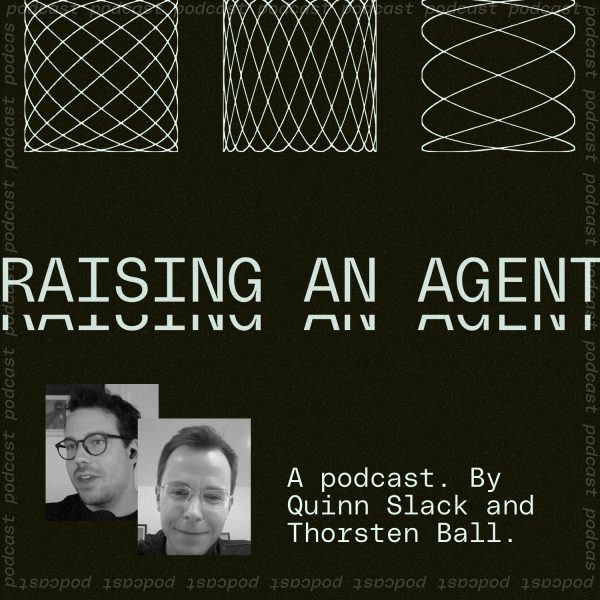
Raising An Agent
- Episodios
- 17
- Se publica
- cada mes
- Último episodio
- 30 Oct 2026
Sobre el podcast
A "diary of excitement" documenting the journey of building Amp.
Episodios 17
Culture Stops Slop
Quinn and Thorsten answer the responses to The Company of the Future. Some teams stopped doing pull requests; others said their security team would never allow it, and asked Amp to meet people where they are …
Notas del episodio
Quinn and Thorsten answer the responses to The Company of the Future. Some teams stopped doing pull requests; others said their security team would never allow it, and asked Amp to meet people where they are. They explain why, in 2026, meeting people where they are means falling behind, and how a team of 21 makes big architectural changes without RFCs: self-hosted Orbs, worked out in one Slack thread and a customer visit, and macOS Satellites, which launched an hour before they recorded. They also cover how culture keeps slop off main, adopting customers instead of filing tickets, why they don't hire their way out of priorities, removing features, why Thorsten no longer looks at unit tests, the unseen cost of code review, and why you've got to get the tokens.
The Company of the Future
Quinn and Thorsten sit down together in San Francisco to answer the question they get asked most: how does the Amp team work? They walk through a week at Amp, from Thorsten's Sunday post and the single Monday …
Notas del episodio
Quinn and Thorsten sit down together in San Francisco to answer the question they get asked most: how does the Amp team work? They walk through a week at Amp, from Thorsten's Sunday post and the single Monday meeting to writing down goals in silence. They explain why Amp has no quarterly goals, no departments and no territory, and how feature flags and the work in progress, orb good and orb bad channels keep a team of 21 in sync. They also cover reviewing changes with agents, pushing to main without mandatory code review, and why they think more companies will soon work like this.
Stop Boxing In Your Agent
Quinn and Thorsten record a late-night Hot Take Thursday. They start with a company that capped each engineer at €50 of tokens a week, then talk about why cheap models end up costing more and why some people …
Notas del episodio
Quinn and Thorsten record a late-night Hot Take Thursday. They start with a company that capped each engineer at €50 of tokens a week, then talk about why cheap models end up costing more and why some people will be priced out of frontier models. They explain how agents now ship, monitor and fix production, not just write code, and why code review and other old processes get in the way. They also cover not waiting on your agents, simple evals in Orbs, why Amp has runners, and the hot takes Thorsten left out of his post.
What Is the Computer For Now?
Quinn and Thorsten discuss what they can hand off to agents now, from coordinating work across projects to following up with users after a fix ships. They explain how they test agent behavior and use production …
Notas del episodio
Quinn and Thorsten discuss what they can hand off to agents now, from coordinating work across projects to following up with users after a fix ships. They explain how they test agent behavior and use production data to improve performance, then talk about Amp's recent outages and the work to improve reliability. With more of their work happening in Orbs, they ask what the personal computer is still for, and why changing how you work matters as much as changing models.
When Tokens Flow Like Electricity
Quinn and Thorsten predict that intelligence will get cheap and tokens will be everywhere, then ask what that does to software. They debate build versus buy in the age of agents, why Orbs are worth paying for …
Notas del episodio
Quinn and Thorsten predict that intelligence will get cheap and tokens will be everywhere, then ask what that does to software. They debate build versus buy in the age of agents, why Orbs are worth paying for while Thorsten one-shot a bug tracker, and why developers should do X instead of building software to do X. They also explain the two Amps, why building Amp feels like owning a house instead of renting, and how they plan to bring the Amp way to more teams.
Orbs and Jellyware
This episode was recorded in person in Munich, where the whole Amp team had gathered for a week of building. Quinn and Thorsten discuss why isolated Orbs make it easier to run agents in parallel, how the team …
Notas del episodio
This episode was recorded in person in Munich, where the whole Amp team had gathered for a week of building.
Quinn and Thorsten discuss why isolated Orbs make it easier to run agents in parallel, how the team asks agents for exhaustive verification, and how production itself can become a feedback loop.
They also introduce jellyware: high-quality software that is designed to change quickly. When agents make software more malleable, teams can fix bugs faster and raise the quality bar instead of lowering it.
Local Dev Doesn't Matter on the Frontier
In the first episode of season 2, Quinn and Thorsten discuss why the Amp team went heads-down the last few months to rebuild Amp around remote-controllable, parallel agents, running locally or in orbs. They …
Notas del episodio
In the first episode of season 2, Quinn and Thorsten discuss why the Amp team went heads-down the last few months to rebuild Amp around remote-controllable, parallel agents, running locally or in orbs. They also talk about how this shift changed our development workflows and what that means for the future of local development.
Episode 10
Quinn and Thorsten announce that they will kill the Amp editor extension. It will self-destruct soon, because the time of the sidebar is over.
Episode 9
Quinn and Thorsten are back! It's been a while since they published a Raising An Agent episode and in this this episode, they discuss how everything seems to have changed again with Gemini 3 and Opus 4.5 and …
Notas del episodio
Quinn and Thorsten are back! It's been a while since they published a Raising An Agent episode and in this this episode, they discuss how everything seems to have changed again with Gemini 3 and Opus 4.5 and what comes after — the assistant is dead, long live the factory.
Episode 8
In this episode of Raising an Agent, Beyang and Camden dive into how the Amp team evaluates models for agentic coding. They break down why tool calling is the key differentiator, what went wrong with Gemini …
Notas del episodio
In this episode of Raising an Agent, Beyang and Camden dive into how the Amp team evaluates models for agentic coding. They break down why tool calling is the key differentiator, what went wrong with Gemini Pro, and why open models like K2 and Qwen are promising but not ready as main drivers. They share first impressions of GPT-5, explore the idea of alloying models, and explain why qualitative "vibe checks" often matter more than benchmarks. If you want to understand how Amp thinks about model selection, subagents, and the future of coding with agents, this episode has you covered.
Episode 7
In this episode, Beyang and Thorsten discuss strategies for effective agentic coding, including the 101 of how it's different from coding with chat LLMs, the key constraint of the context window, how and where …
Notas del episodio
In this episode, Beyang and Thorsten discuss strategies for effective agentic coding, including the 101 of how it's different from coding with chat LLMs, the key constraint of the context window, how and where subagents can help, and the new oracle subagent which combines multiple LLMs.
00:53 Intros 03:35 How coding with agents is very different from coding with prior AI tools that use chat LLMs 10:46 Example of an agentic coding run to fix a simple issue 14:28 Example of debugging an issue with an MCP server 22:05 Example of unifying two build scripts that share logic 25:24 How context window size has emerged as a key constraint on agentic automation 31:16 Why it's best to focus on one thing at a time per agentic thread 33:24 Subagents and how they help extend the effective context window 34:04 The Amp codebase search subagent 38:48 General-purpose subagents 44:20 When to use subagents 47:04 The oracle subagent and o3 51:47 Multi-model agents and using the best model for each job
Episode 6
In this episode, Quinn and Thorsten discuss Claude 4, sub-agents, background agents, and they share "hot tips" for agentic coding.
Episode 5
In this episode, Beyang interviews Thorsten and Quinn to unpack what has happened in the world of Amp in the last five weeks: how predictions played out, how working with agents shaped how they write code, how …
Notas del episodio
In this episode, Beyang interviews Thorsten and Quinn to unpack what has happened in the world of Amp in the last five weeks: how predictions played out, how working with agents shaped how they write code, how agents are and will influence model development, and, of course, all the things that have been shipped in Amp.
Episode 4
Thorsten and Quinn talk about the future of programming and whether code will still be as valuable in the future, how maybe the GitHub contribution graph is already worthless, how LLMs can free us from the …
Notas del episodio
Thorsten and Quinn talk about the future of programming and whether code will still be as valuable in the future, how maybe the GitHub contribution graph is already worthless, how LLMs can free us from the tyranny of input boxes, and how conversations with an agent might be a better record of how a code change came to be than git commit tools. They also share where it works and simply doesn't work.
Episode 3
Quinn and Thorsten start by sharing how reviews are still very much needed when using AI to code and how it changes the overall flow you're in when coding with an agent. They also talk about a very important …
Notas del episodio
Quinn and Thorsten start by sharing how reviews are still very much needed when using AI to code and how it changes the overall flow you're in when coding with an agent. They also talk about a very important question they face: how important is code search, in its current form, in the age of AI agents?
Episode 2
Thorsten and Quinn talk about how different agentic programming is from normal programming and how the mindset has to adapt to it. One thing they discuss is that having a higher-level architectural …
Notas del episodio
Thorsten and Quinn talk about how different agentic programming is from normal programming and how the mindset has to adapt to it. One thing they discuss is that having a higher-level architectural understanding is still very important, so that the agent can fill in the blanks. They also talk about how, surprisingly, the models are really, really good when they have inputs that a human would normally get. Most importantly, they share the realization that subscription-based pricing might make bad agentic products.
Episode 1
In the first episode of Raising an Agent, Quinn and Thorsten kick things off by sharing a lot of wow-moments they experienced after getting the agent at the heart of Amp into a working state. They talk about …
Notas del episodio
In the first episode of Raising an Agent, Quinn and Thorsten kick things off by sharing a lot of wow-moments they experienced after getting the agent at the heart of Amp into a working state. They talk about how little is actually needed to create an agent and how magical the results are when you give a model the right tools, unlimited tokens, and feedback. That might be the biggest surprise: how many previous assumptions feel outdated when you see an agent explore a codebase on its own.
Podcasts similares
Más podcasts de Tecnología






¿Es tu podcast?
Confírmalo con una entrada en tu feed: aquí recibes un código, lo añades como podcast:txt en el canal de tu feed y nosotros lo comprobamos. Después tu podcast aparecerá como «verificado» en SoundNode.