

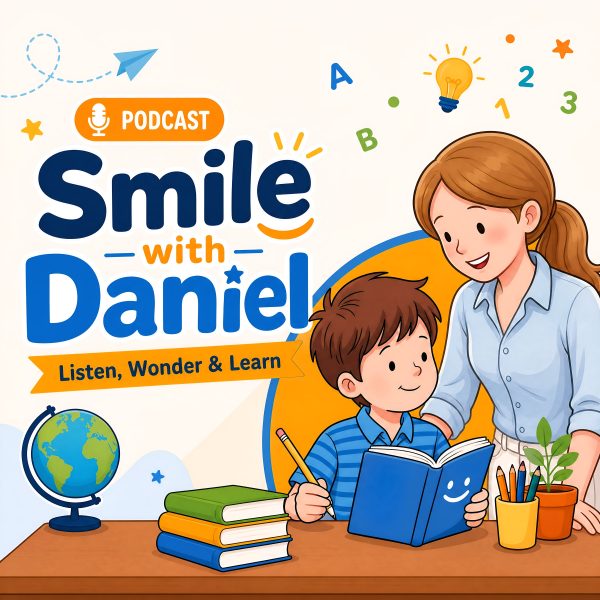
Smile with Daniel
- Episodios
- 93
- Se publica
- varias veces por semana
- Último episodio
- 21 Sep 2026
Sobre el podcast
Every night, Daniel asks his mom a question.
Why do we call money "bucks"? Why do we get dizzy when we spin? Why do we knock on wood?
The answers are always surprising, and a lot more interesting than you'd expect.
Smile with Daniel is a short podcast for curious kids and the adults who love them.
Real questions. Real answers. No dumbing it down.
New episodes every week.
Find us @smilewithDaniel everywhere.
Licencia: Smile with Daniel
Episodios 93
Why Is Everyone Racing to Mars?
Download the free "Why Is Everyone Racing to Mars?" worksheet for fun questions, listening challenges, and activities inspired by this episode.Mars has rivers. Or it did. Ancient ones, carved into rock that is …
Notas del episodio
Download the free "Why Is Everyone Racing to Mars?" worksheet for fun questions, listening challenges, and activities inspired by this episode.
Mars has rivers. Or it did. Ancient ones, carved into rock that is now bone dry.
Scientists believe Mars was once warmer and wetter, possibly with conditions that could have supported life. Now it is a red desert with no breathable air — and the attention of every major space agency on Earth.
Download the free Episode 91 worksheet at your website URL.
Mars has an unusual combination of advantages. Its day is only about 37 minutes longer than Earth's. It has water ice and evidence of ancient rivers and lakes. Its surface may preserve clues about whether another planet was once habitable. That makes it one of the most compelling destinations beyond the Moon.
Getting there is hard. The journey takes six to nine months. Radiation during the trip is a serious unsolved problem. Launch windows only open every 26 months when Earth and Mars align. And once you are committed to the journey, there is no quick emergency return. A radio signal takes about twenty minutes to travel one way.
The motivations for going are not simple. Scientists want to understand Mars's history and whether it ever supported life. Some, including Elon Musk, have framed a Mars colony as an existential backup for humanity. Governments have strategic and geopolitical reasons. None of these point in exactly the same direction.
As of 2026, the plans keep shifting. NASA's Mars Sample Return plan ran into major cost and schedule problems. There is currently no confirmed launch date or approved mission architecture for retrieving Perseverance's samples — which are sitting on Mars right now. SpaceX shifted its near-term priority toward the Moon in February 2026. And China is pressing ahead with Tianwen-3, targeting launch around 2028 and sample return around 2031.
There is also a question nobody talks about enough. If Mars once had life — even ancient microbial life — sending humans there before we fully understand that could contaminate or destroy the very evidence we are looking for.
Whether getting there fast is the same as getting there right is one of the genuine tensions in Mars exploration.
What you will find in this episode:
- Why Mars specifically and what makes it compelling beyond the Moon
- The real constraints: radiation, launch windows, and no emergency return
- The different reasons different people and countries want to go
- What happened to NASA's sample return plan and where Perseverance's samples are now
- The planetary protection question that rarely makes headlines
- Daniel's closing line about ancient rivers, possible ancient life, and the 26-month bus schedule
Short, current, and the kind of episode that makes every Mars headline make more sense.
Listen, wonder, and learn.
How Did a Volcano Help Invent the Bicycle?
Download the free "How Did a Volcano Help Invent the Bicycle?" worksheet for fun questions, listening challenges, and activities inspired by this episode.In April 1815 a volcano in Indonesia erupted so …
Notas del episodio
Download the free "How Did a Volcano Help Invent the Bicycle?" worksheet for fun questions, listening challenges, and activities inspired by this episode.
In April 1815 a volcano in Indonesia erupted so violently that people heard the explosion two thousand kilometers away.
The following summer, it snowed in New England in June. Harvests failed across Europe and North America. Food prices soared.
And somehow, all of that may have helped lead to the bicycle.
The volcano was Mount Tambora. Its eruption was one of the most powerful in recorded history. Volcanic gases formed tiny particles high in the atmosphere that reflected sunlight and cooled the climate. 1816 became known as the Year Without a Summer.
The harvest crisis put enormous pressure on people who depended on horses for transportation. Horses ate oats. Oats were scarce. Historians have proposed a connection between that crisis and what happened next.
In 1817, in the German state of Baden, an inventor named Karl von Drais demonstrated something new: a steerable two-wheeled machine that needed no horse at all. No pedals. You sat on a wooden frame and pushed yourself along the ground with your feet. He called it the Laufmaschine. Some historians connect its appearance to the food and horse crisis that followed Tambora, though the link is compelling rather than proven.
Pedals were added in the 1860s. The modern bicycle design with equal wheels and a chain drive came in the 1880s. The lineage traces back to Drais and his two-wheeled machine from 1817.
And that same strange summer of 1816 produced another piece of history. Mary Shelley was staying near Lake Geneva, where the wet miserable weather kept her group indoors. They began reading ghost stories. Lord Byron suggested each of them write one. She began the story that became Frankenstein.
One eruption. One strange summer. And two pieces of history connected to its aftermath.
What you will find in this episode:
- What Mount Tambora did to the climate and why 1816 was the Year Without a Summer
- The horse and harvest crisis and why historians connect it to the bicycle
- What Karl von Drais actually built in 1817 and how it worked
- How the bicycle got from the Laufmaschine to the modern design over sixty years
- The Mary Shelley and Frankenstein connection
- Daniel's closing line about Tambora's legacy
Short, surprising, and the kind of episode that makes every bicycle ride feel like a piece of unexpected history.
Listen, wonder, and learn.
[topic:history]
Why Is Tesla Named After Nikola Tesla?
In January 1943 a man died alone in a New York hotel room with almost nothing. At that exact moment, electrical systems built partly on his inventions were powering cities across the world.His name was Nikola …
Notas del episodio
In January 1943 a man died alone in a New York hotel room with almost nothing. At that exact moment, electrical systems built partly on his inventions were powering cities across the world.
His name was Nikola Tesla. And his story explains why one of the world's most famous electric car companies carries his name.
Tesla did not invent electricity or alternating current. What he did was help solve some of the big engineering problems that made AC practical on a huge scale. His polyphase system and induction motor were central to that work. AC electricity can have its voltage stepped up or down using transformers, which means it can be transmitted over long distances with far less loss. That capability is what made large-scale electrical grids possible.
In the late 1880s, the AC system backed by George Westinghouse using Tesla's patents competed with the DC system championed by Thomas Edison. The War of Currents played out across the decade. In 1893 Tesla and Westinghouse lit the Chicago World's Fair with AC power. In 1896 the Niagara Falls power station began transmitting electricity to Buffalo. AC became the basis of modern electrical grids.
Tesla's technical contributions were central to that outcome. His personal financial story was very different. His finances deteriorated in later years. Several ambitious projects never produced the results he hoped for. He died in January 1943 with very little.
Tesla Motors was founded in 2003 by Martin Eberhard and Marc Tarpenning, who deliberately named it after Nikola Tesla as a tribute to his pioneering work on AC induction motors — technology closely connected to the kind of electric motor the company's first car would use. Elon Musk joined as an investor in 2004 and became CEO in 2008.
What you will find in this episode:
- What Tesla actually contributed and what he did not invent
- The War of Currents and how AC became the basis of modern grids
- Why Tesla's technical importance and personal success went in different directions
- Who actually founded Tesla Motors and why they chose the name
- The cold open that sets the whole episode up in three sentences
- Daniel's closing line about whether this story is poetic or deeply annoying
Short, surprising, and the kind of episode that makes the name on every charging cable feel completely different.
Listen, wonder, and learn.
[topic:history]
Why Do We Have Different Time Zones?
Daniel opens with a joke about time zones and the future looking bright.Then he asks the real question.For most of human history, every town kept its own local time based on when the sun was overhead. If you …
Notas del episodio
Daniel opens with a joke about time zones and the future looking bright.
Then he asks the real question.
For most of human history, every town kept its own local time based on when the sun was overhead. If you were traveling by foot or horseback, the gradual difference between towns barely mattered. Trains changed everything. A railway needed a published schedule. But if every town kept its own solar time, a timetable became impossibly complicated. In the United States alone, railroad companies were using at least 75 different time standards.
One of the most famous people who pushed for a worldwide solution was a Canadian engineer named Sandford Fleming, who wrote that he missed a train in Ireland in 1876 because a timetable showed p.m. when it should have shown a.m. But he was not the only person working on the problem.
On November 18, 1883, American and Canadian railroads replaced their patchwork of local times with standardized railway time zones. Some locations experienced noon twice that day as clocks were reset. It became known as the Day of Two Noons.
Then in 1884, delegates from 25 nations met in Washington for the International Meridian Conference. They recommended Greenwich in England as the world's prime meridian. The conference did not create today's time zones, but it provided an international reference that helped make global timekeeping more coordinated.
Today's time zones do not follow pure geography. They bend around political borders and national preferences. China spans roughly the same east-west distance as the continental United States but uses a single time zone. Nepal runs fifteen minutes ahead of India by deliberate choice.
What you will find in this episode:
- Why local solar time worked until railways made it a problem
- The Day of Two Noons and what actually happened on November 18, 1883
- What the 1884 International Meridian Conference did and did not do
- Why China uses one time zone for the entire country
- Why Nepal is fifteen minutes ahead of India
- The closing exchange about Sandford Fleming and jet lag
Short, surprising, and the kind of episode that makes every clock feel like a political document.
Listen, wonder, and learn.
[topic:history]
What Does Social Media Do to a Kid's Brain?
Daniel wants to know if social media is actually bad for you — or if that is just something adults say.The answer turns out to be more interesting and more complicated than most headlines suggest.Many social …
Notas del episodio
Daniel wants to know if social media is actually bad for you — or if that is just something adults say.
The answer turns out to be more interesting and more complicated than most headlines suggest.
Many social media apps are designed to keep you engaged and coming back. Notifications pull you back. Infinite scroll removes a natural stopping point. And unpredictable social feedback — sometimes a post gets lots of likes, sometimes nothing — can make checking especially compelling. Psychologists have studied similar patterns of intermittent reward in many kinds of behavior, including gambling. The comparison does not mean scrolling and gambling are identical. But both involve uncertainty about when the next rewarding thing will appear.
Brain-imaging studies have found that social feedback such as receiving likes can engage reward-related regions of the brain. And adolescent brains are particularly sensitive to social rewards, making peer approval and social feedback especially important during those years.
Researchers have found correlations between heavy social media use and higher rates of anxiety, depression, and sleep problems in adolescents. But correlation is not causation. And researchers increasingly ask different questions: which kinds of social media use, for which kids, under what circumstances, and what is that time replacing?
Sleep is one area researchers pay particular attention to — especially when social media use pushes bedtime later or replaces sleep with scrolling. An hour of scrolling that replaces an hour of sleep, exercise, or time with other people matters differently from an hour of scrolling that replaces nothing.
Social media does not affect every person the same way. Talking to a close friend is a different experience from spending an hour comparing yourself with strangers. Creating something with friends is different from consuming upsetting content alone. Both count as an hour on a screen. They are not the same experience.
What you will find in this episode:
- Why many social media apps are designed to keep you engaged and coming back
- The slot machine comparison — what it means and what it does not mean
- Why the honest answer to "is social media bad?" depends on which kids, which use, and what it replaces
- Why sleep is one of the most consistently studied effects
- Why screen time alone cannot tell you whether someone's use is helping or harming them
- The closing exchange about who actually decided to open the app
Honest, careful, and the kind of episode that gives children a framework for thinking about social media that will serve them long after this one conversation.
Listen, wonder, and learn.
[topic:health]
How Do Movies Trick Your Brain?
Daniel knows movies are shown on a screen. He wants to know how his brain sees movement when he is really watching still pictures.The answer is stranger than most people realize.A film is a sequence of still …
Notas del episodio
Daniel knows movies are shown on a screen. He wants to know how his brain sees movement when he is really watching still pictures.
The answer is stranger than most people realize.
A film is a sequence of still photographs, typically around 24 per second for cinema. When they are shown fast enough, the brain does not see individual images flickering. It perceives continuous motion. But the motion itself does not exist on the screen. It is constructed by the visual system.
The traditional explanation is called persistence of vision. The idea is that an afterimage lingers briefly after a frame disappears, which has been offered as one reason the gaps between frames are not jarring. Researchers have questioned how much that explanation fully accounts for, particularly when it comes to perceiving motion itself.
Another concept researchers study is called the phi phenomenon. When the visual system sees two alternating images in quick succession, it can perceive apparent motion between them even when nothing actually moved. The brain appears to be actively filling in motion rather than passively receiving it.
There is no single frame rate where the brain suddenly switches from seeing still images to perceiving motion. It depends on what is being shown and how. Twenty-four frames per second became the standard for cinema, but it is not a magic number built into human vision. Films shot at 48 frames per second have struck many viewers as looking unusually real or unsettling, because audiences are accustomed to the look of standard cinema, and when something looks noticeably different, it can feel off.
The full explanation for how movies work is still being worked out by vision scientists. But the motion we experience watching a film is constructed by our visual system, not displayed on the screen.
What you will find in this episode:
- What a film actually is and why the motion in it does not exist on screen
- What persistence of vision explains and what it does not
- The phi phenomenon and what it suggests about how the visual system works
- Why 24 fps is a convention rather than a neurological threshold
- What happens when filmmakers use 48 frames per second
- The closing line about what a brain and 24 still images can produce together
Short, mind-bending, and the kind of episode that makes every film you watch feel completely different.
Listen, wonder, and learn.
Why Are There 12 Months in a Year?
Daniel notices something. September, October, November, and December sound like they mean seven, eight, nine, and ten. But they are the ninth, tenth, eleventh, and twelfth months.He wants to know why.The names …
Notas del episodio
Daniel notices something. September, October, November, and December sound like they mean seven, eight, nine, and ten. But they are the ninth, tenth, eleventh, and twelfth months.
He wants to know why.
The names are a fossil. The Roman year once started in March. September was the seventh month. October the eighth. When the calendar changed, the names stayed.
The reason there are twelve months comes from the Moon. There are a little more than twelve lunar cycles in one solar year, so calendars built around lunar cycles naturally tend toward about twelve months. But twelve lunar months do not make a full solar year. That mismatch between the Moon and the Sun is one reason calendars have needed adjustments for thousands of years.
Julius Caesar addressed the problem in 46 BC, apparently with help from the Alexandrian astronomer Sosigenes. He replaced the old system with a 365-day solar calendar with a leap day every four years. Getting the seasons back into alignment required stretching 46 BC by adding extra months. It is sometimes called the year of confusion.
The Julian calendar was still about eleven minutes too long per year. By the 1500s that had accumulated to ten days. Pope Gregory XIII ordered a correction in 1582. In countries adopting the reform, October 4th was followed immediately by October 15th. He also adjusted the leap year rule so the calendar would drift much more slowly. Century years like 1700 and 1800 would only be leap years if divisible by 400. That is why 2000 was a leap year and 1900 was not.
Britain did not adopt the Gregorian calendar until 1752. There is a famous story that crowds demanded their eleven days back. The phrase even appears in a painting by William Hogarth. Historians debate whether the riots described in popular accounts really happened the way people imagine them.
What you will find in this episode:
- Why September through December have the wrong numbers in their names
- Why twelve months made sense in the first place
- What Julius Caesar actually did to the calendar and why 46 BC was extraordinary
- How eleven minutes per year became a ten-day problem over centuries
- The Gregorian correction and the leap year rule that fixed the drift
- The closing line about September
Short, surprising, and the kind of episode that makes every month feel like a piece of unfinished history.
Listen, wonder, and learn.
[topic:history]
Why Did Everyone Used to Wear a Hat?
Daniel is looking at old photographs and notices that everyone is wearing a hat. On the street, at the beach, at baseball games. Everyone.He wants to know when that stopped and why.The hat was doing several …
Notas del episodio
Daniel is looking at old photographs and notices that everyone is wearing a hat. On the street, at the beach, at baseball games. Everyone.
He wants to know when that stopped and why.
The hat was doing several jobs at once. It offered protection from the weather. It signaled social position, occupation, and how formally you were dressed. And for a long time it was simply what a respectable person wore in public. Different hats belonged in different social worlds, and what sat on your head could introduce you before you said a word.
The decline happened gradually across the 1950s and 1960s and had no single cause. Enclosed cars meant people spent less time exposed to the elements. Elaborate hairstyles became increasingly important, and hats did not work well on top of them. Clothing became more casual across the board, and the old etiquette rules that had made hats feel obligatory began to weaken.
One thing that did not cause the decline: John F. Kennedy. He wore a silk top hat to his 1961 inauguration. He removed it for the oath and his speech, which created the famous hatless images. But men's hats were already declining well before he became president.
Nobody announced the change. Nobody passed a law. A hat simply went from something people were expected to wear to something they could choose to wear. And once it became optional, most people chose not to.
What you will find in this episode:
- What a hat actually communicated in the nineteenth and early twentieth centuries
- Why cars and hairstyles both contributed to the decline
- How the social expectation itself disappeared, and why that mattered most
- The JFK myth corrected
- Why women's hat wearing declined separately but for connected reasons
- The closing line about every hat in every old photograph
Short, surprising, and the kind of episode that makes every old photograph feel like a social history lesson.
Listen, wonder, and learn.
[topic:history]
Why Do Crickets Chirp All Night?
Daniel is lying awake listening to crickets and wants to know why they never stop.The short answer is that they are trying to find a mate. But the longer answer is more interesting.Crickets do not make their …
Notas del episodio
Daniel is lying awake listening to crickets and wants to know why they never stop.
The short answer is that they are trying to find a mate. But the longer answer is more interesting.
Crickets do not make their sound by rubbing their legs together. They rub their wings together in a process called stridulation. One wing has a ridged edge called a file. The other has a scraper. Each pass produces a chirp. And in the species we usually hear singing, only males produce those songs.
A male cricket does not just make one sound. Researchers have identified distinct songs for different purposes: a loud calling song to attract distant females, a quieter courtship song when a female is nearby, and an aggressive song for rival males. What sounds like background noise is a structured communication system.
Because crickets are ectothermic, temperature affects how quickly they chirp. As temperature rises, their chirp rate generally rises too. Consistently enough that in 1897 an American physicist named Amos Dolbear published a paper called The Cricket as a Thermometer. Today a shortcut based on Dolbear's Law lets you estimate the outdoor temperature by counting chirps for about fourteen seconds and adding forty. The snowy tree cricket, sometimes called the thermometer cricket, is the species for which the relationship works most reliably.
But Dolbear was not the first. In 1881 a woman named Margarette W. Brooks published experiments on the same relationship in Popular Science Monthly. And Brooks herself referred to an even earlier observation by someone identified only as W.G.B. Dolbear published the mathematical formula. The observation had been circulating before him.
What you will find in this episode:
- How crickets actually make their sound, and why legs have nothing to do with it
- Why males produce several different songs for different purposes
- Why many crickets are most active at night, and why the pattern is not universal
- How temperature affects chirp rate and what Dolbear's Law actually says
- The more complicated history behind the formula's famous name
- The closing line that sends Daniel back to where the episode began
Short, surprising, and the kind of episode that makes every summer night feel completely different.
Listen, wonder, and learn.
[topic:nature]
Why Are Police Cars Mostly Black and White?
Daniel assumes police cars have always been black and white everywhere.They have not. And the origin of the ones that are is murkier than most people expect.Black was common on early American cars because it …
Notas del episodio
Daniel assumes police cars have always been black and white everywhere.
They have not. And the origin of the ones that are is murkier than most people expect.
Black was common on early American cars because it was an inexpensive factory finish. As police departments grew, the problem became recognition -- a dark patrol car blended in with civilian traffic. Departments began experimenting with contrast. Black and white police cars were appearing in California by around the early 1930s, though nobody seems to know exactly which department started it. There was never a national rule requiring it.
What spread the image was television. Dragnet put LAPD black and white patrol cars in front of millions of Americans from the 1950s. Adam-12 did the same through the late 1960s and 1970s. Television did not invent the black and white police car. It helped invent the picture of a police car in people's heads.
Police forces around the world use entirely different colors. The UK uses blue and yellow Battenburg markings. Germany uses blue and silver. New York's patrol cars are white with blue. Orange, California used orange and white before switching in 1991. There has never been a universal standard.
Black and white became useful because it was distinctive. Hollywood helped make it iconic.
What you will find in this episode:
- Why black was common on early American police cars and how contrast changed that
- Where black and white police cars first appeared and why the exact origin is unclear
- How Dragnet and Adam-12 turned a local color scheme into a national image
- Why departments across the world use different colors for the same basic reason
- The Orange, California detail that Daniel handles perfectly
- The closing line about what television actually did to the image of a police car
Short, surprising, and the kind of episode that makes every police car you see feel like a small piece of design history.
Listen, wonder, and learn.
[topic:history]
Why Don't All Countries Measure Things the Same Way?
Daniel's friend in England measures distance in miles but temperature in Celsius and weight in kilograms. That inconsistency turns out to tell a much bigger story. The metric system was created during the …
Notas del episodio
Daniel's friend in England measures distance in miles but temperature in Celsius and weight in kilograms. That inconsistency turns out to tell a much bigger story. The metric system was created during the French Revolution to replace a chaotic patchwork of local measurement standards across Europe. Different units with the same name could mean different things in different places. …Why Are Tires Always Black?
Daniel notices that almost every tire he sees is black. Cars. Trucks. Bicycles. Always black. Natural rubber is not black. It is off-white -- milky and pale, the color of latex from a rubber tree. Early car …
Notas del episodio
Daniel notices that almost every tire he sees is black. Cars. Trucks. Bicycles. Always black. Natural rubber is not black. It is off-white -- milky and pale, the color of latex from a rubber tree. Early car tires in the 1900s were white or light-colored. They also wore out far faster than modern tires. The reason tires are black today is a single additive: carbon black. A fine dark powder made from burning hydrocarbons in a limited supply of air. …Why Do Coconuts Have Three Holes?
Daniel notices the three dark spots on a coconut. They look like a face. Two eyes and a mouth. They are not just for looking like a face. Those three spots are germination pores -- soft points in the hard inner …
Notas del episodio
Daniel notices the three dark spots on a coconut. They look like a face. Two eyes and a mouth. They are not just for looking like a face. Those three spots are germination pores -- soft points in the hard inner shell -- and they reveal something about how the coconut fruit was built. Usually only one of the three is functional. That is the pore the developing seedling uses to push through when a coconut germinates. The other two are typically sealed. …Why Do Pirates Wear Eye Patches?
Daniel assumes pirates wore eye patches because they lost an eye. That is probably part of the answer. But there is a more interesting theory. When you move from bright light into darkness, your eyes need time …
Notas del episodio
Daniel assumes pirates wore eye patches because they lost an eye. That is probably part of the answer. But there is a more interesting theory. When you move from bright light into darkness, your eyes need time to adjust. Full dark adaptation can take up to half an hour. Part of what happens involves rod cells at the back of the eye becoming more sensitive to dim light -- a process that takes time because it was undone by the bright light you were just in. …Bone vs. Steel: Which Is Actually Stronger?
Daniel assumes steel wins easily. It does -- in one measurement. But the question turns out to be more interesting than a simple winner. Steel has a higher tensile strength than bone. But steel is also roughly …
Notas del episodio
Daniel assumes steel wins easily. It does -- in one measurement. But the question turns out to be more interesting than a simple winner. Steel has a higher tensile strength than bone. But steel is also roughly four times as dense as cortical bone. When you compare by weight rather than volume, bone becomes much more impressive. And there is one thing bone does that steel cannot do at all. Fix itself. Bone is a composite material. …How Do Robotaxis Drive Without a Driver?
Daniel sees a video of a Waymo robotaxi driving through San Francisco with nobody in the front seat. He assumes it must be following GPS. It is doing something far more interesting. The car is constantly …
Notas del episodio
Daniel sees a video of a Waymo robotaxi driving through San Francisco with nobody in the front seat. He assumes it must be following GPS. It is doing something far more interesting. The car is constantly answering four questions: Where am I? What is around me? What might happen next? What should I do? It answers all four simultaneously, in real time, without a human involved. …Six Bricks. 915 Million Combinations. The LEGO Story
Daniel is building with LEGO and starts wondering why it feels so satisfying. The answer turns out to involve extraordinary precision engineering, a Danish carpenter, a fire, and a near-bankruptcy that almost …
Notas del episodio
Daniel is building with LEGO and starts wondering why it feels so satisfying. The answer turns out to involve extraordinary precision engineering, a Danish carpenter, a fire, and a near-bankruptcy that almost erased one of the most beloved toy brands in history. LEGO started in 1932. Ole Kirk Kristiansen was a carpenter in Billund, Denmark, struggling through an economic crisis. He began making wooden toys to survive. …Electric Cars Are Almost 200 Years Old
Daniel asks whether electric cars are going to take over from gasoline cars. Mom asks him a more interesting question. Did he know electric cars were already competing with gasoline cars more than a hundred …
Notas del episodio
Daniel asks whether electric cars are going to take over from gasoline cars. Mom asks him a more interesting question. Did he know electric cars were already competing with gasoline cars more than a hundred years ago? He did not. The earliest experimental electric carriages appeared in the 1830s. By around 1900, electric cars were serious competitors to gasoline cars in the United States -- quieter, easier to drive, free of exhaust on the street, and with no hand crank required to start. …Why Do Some Countries Call It Tea and Some Call It Chai?
Daniel assumes chai is a different drink from tea -- the spiced version with milk. It isn't. Chai and tea are the same word. They both trace back to a single Chinese character -- 茶 -- that means tea. But …
Notas del episodio
Daniel assumes chai is a different drink from tea -- the spiced version with milk. It isn't. Chai and tea are the same word. They both trace back to a single Chinese character -- 茶 -- that means tea. But Chinese has many varieties of speech, and that same character was pronounced differently in different parts of China. Two of those pronunciations left China by two very different routes -- and that is why the world ended up with two words. The pronunciation closer to chá traveled overland. …Why Are Fire Hydrants Different Colors?
Daniel walks past a green fire hydrant and wonders why it isn't red. The colors are not decoration. They can be information. Fire departments and water systems can use color to tell firefighters important …
Notas del episodio
Daniel walks past a green fire hydrant and wonders why it isn't red. The colors are not decoration. They can be information. Fire departments and water systems can use color to tell firefighters important things about a hydrant at a glance. Under a system recommended by the National Fire Protection Association, the color on the top and caps of a hydrant can indicate its rated flow capacity -- how many gallons per minute it can deliver. Light blue for the highest flow. Green for strong. …Why Are They Called Wisdom Teeth?
Daniel assumes wisdom teeth make you smarter. They don't. The name has nothing to do with intelligence. Wisdom teeth are called that because of when they arrive -- somewhere between seventeen and twenty-five …
Notas del episodio
Daniel assumes wisdom teeth make you smarter. They don't. The name has nothing to do with intelligence. Wisdom teeth are called that because of when they arrive -- somewhere between seventeen and twenty-five, an age historically associated with maturity. The Latin name is dens sapientiae. Tooth of wisdom. People have noticed their late arrival for thousands of years -- Aristotle wrote about them more than two thousand years ago. …Why Do We Call Ships "She"?
Daniel notices that ships are always called she -- her hull, her crew, she sailed. He wants to know why. The honest answer is that nobody knows for certain. But the clues that have survived are each interesting …
Notas del episodio
Daniel notices that ships are always called she -- her hull, her crew, she sailed. He wants to know why. The honest answer is that nobody knows for certain. But the clues that have survived are each interesting in their own way. There is a theory from language. The Latin word for ship -- navis -- was feminine. But the Old English word for ship was actually neuter. So the Latin connection might be part of the story, but it does not completely explain why English sailors started using she. …Why Are Elephants Afraid of Mice?
Daniel is confident about this one. Elephants are afraid of mice. Everyone knows that. He is wrong -- and the real story is more interesting than the myth. There is no good scientific evidence that elephants …
Notas del episodio
Daniel is confident about this one. Elephants are afraid of mice. Everyone knows that. He is wrong -- and the real story is more interesting than the myth. There is no good scientific evidence that elephants have a special fear of mice. What elephants can do is startle at sudden unexpected movement near their feet -- the kind they cannot clearly see. A mouse, a rabbit, a blowing leaf -- the creature does not matter. It is the unpredictability. …Why "lb" Has Nothing to Do With the Word "Pound"?
Daniel notices that the abbreviation for pound is lb. There is no L or B in the word pound. He wants to know why. The answer goes back two thousand years to a Latin phrase that got split in half on its way to …
Notas del episodio
Daniel notices that the abbreviation for pound is lb. There is no L or B in the word pound. He wants to know why. The answer goes back two thousand years to a Latin phrase that got split in half on its way to English. The word pound came from one part. The abbreviation came from the other. They travelled down different paths through history and never came back together. The Latin word at the center of it all is libra -- meaning scales, balance, weight. …Does Coffee Really Give You Energy? Not Exactly
Daniel watches Mom drink her morning coffee and assumes it gives her energy. It doesn't. Not exactly. Coffee doesn't add energy to your system. What it does is block the signal that tells your brain it's tired …
Notas del episodio
Daniel watches Mom drink her morning coffee and assumes it gives her energy. It doesn't. Not exactly. Coffee doesn't add energy to your system. What it does is block the signal that tells your brain it's tired. Those are two very different things -- and understanding the difference changes how you think about coffee, tiredness, and sleep. The chemical at the center of the story is adenosine -- your brain's tiredness signal. …Why Lightning Cracks and Thunder Rumbles?
Daniel assumes thunder is the sound of clouds crashing together. It isn't. Thunder is the sound of air being ripped apart and snapping back. Lightning superheats the air in its channel to around 30,000 degrees …
Notas del episodio
Daniel assumes thunder is the sound of clouds crashing together. It isn't. Thunder is the sound of air being ripped apart and snapping back. Lightning superheats the air in its channel to around 30,000 degrees Celsius -- five times hotter than the surface of the sun -- in a fraction of a second. The air explodes outward so fast it creates a shockwave. That shockwave is thunder. The lightning itself is almost silent. The air around it is what screams. …Daniel vs Mom: The Ultimate Trivia Challenge
Daniel challenges Mom to a trivia battle. Fifteen questions. No mercy. Play along. This episode is different from every other episode of Smile With Daniel. Instead of Daniel and Mom exploring one topic …
Notas del episodio
Daniel challenges Mom to a trivia battle. Fifteen questions. No mercy. Play along. This episode is different from every other episode of Smile With Daniel. Instead of Daniel and Mom exploring one topic together, they go head to head -- and you can play along at home. Every question has a pause built in so you can shout out your answer before they do. The questions cover previous Smile With Daniel episodes and general curiosity trivia. Some are easy. Some get harder. …How Do Scientists Know How Old Dinosaurs Really Are?
Daniel has been watching a dinosaur documentary. The narrator says a fossil is sixty-five million years old. He never stopped to wonder how anyone actually knows that. The fossil does not come with a date on …
Notas del episodio
Daniel has been watching a dinosaur documentary. The narrator says a fossil is sixty-five million years old. He never stopped to wonder how anyone actually knows that. The fossil does not come with a date on it. And scientists usually do not date the fossil itself -- they date the rock around it. …How Stars Are Born, and How They Made You
Daniel was looking at the stars and started wondering where they actually came from. The answer starts in the dark, with clouds of gas. And it ends with the iron in his blood. Stars form when enormous clouds of …
Notas del episodio
Daniel was looking at the stars and started wondering where they actually came from. The answer starts in the dark, with clouds of gas. And it ends with the iron in his blood. Stars form when enormous clouds of hydrogen and helium collapse under gravity, heat up, and ignite nuclear fusion. That is the moment a star is born. Our sun formed this way about four and a half billion years ago -- and the leftover material became the planets, including Earth. …A Shell Is Not a Rock. Here's What It Actually Is
Daniel thinks seashells are just little rocks the ocean makes. They are not. Every shell you have ever picked up on a beach was built by a living animal -- layer by layer, from materials taken from the …
Notas del episodio
Daniel thinks seashells are just little rocks the ocean makes. They are not. Every shell you have ever picked up on a beach was built by a living animal -- layer by layer, from materials taken from the surrounding seawater. The animal never found it. Never moved into it. It grew it, from scratch, as part of its own body. This episode explains how -- and where shells go after the animal is gone. …
Aquí están los 40 episodios más recientes de 93. Los anteriores están en el feed del podcast.
Podcasts similares
Más podcasts de Para toda la familia



¿Es tu podcast?
Confírmalo con una entrada en tu feed: aquí recibes un código, lo añades como podcast:txt en el canal de tu feed y nosotros lo comprobamos. Después tu podcast aparecerá como «verificado» en SoundNode.