

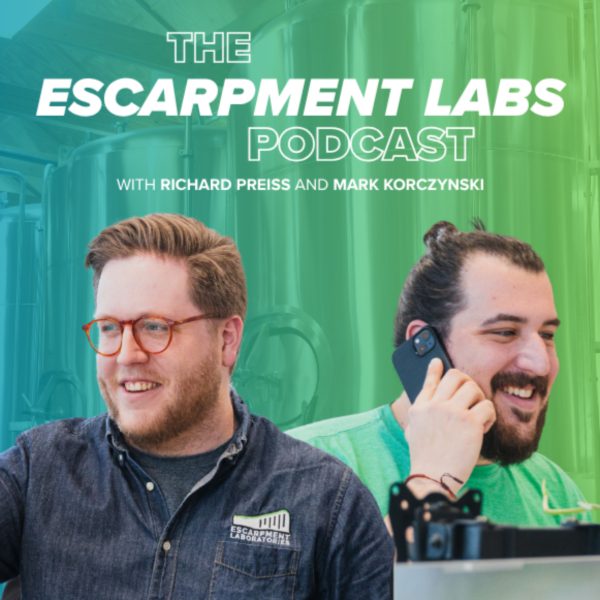
The Escarpment Labs Podcast
- Episodios
- 59
- Se publica
- cada semana
- Último episodio
- 10 Nov 2026
Sobre el podcast
Welcome to The Escarpment Labs Podcast— a weekly podcast that brings you deeper into the science and strategy behind exceptional fermentation. Hosted by Sales Coordinator Mark Korczynski and CEO Richard Preiss, each episode explores popular topics from Escarpment’s blog and Knowledge Base with fresh insight, research updates, and brewer-focused tips. Whether you're a homebrewer looking to level up or a professional chasing consistency and flavour precision, this show has something for every fermentation nerd. New episodes every Tuesday!
Episodios 59
Low-ABV IPAs Don't Have to Lack Body with Sean from Aslin Beer Company
Low-ABV IPAs are notoriously difficult to pull off. Strip away the malt and alcohol, and you usually end up with a thin, hop-water mess.Building legitimate palate weight in a 4% or 4.5% session beer requires a …
Notas del episodio
Low-ABV IPAs are notoriously difficult to pull off. Strip away the malt and alcohol, and you usually end up with a thin, hop-water mess.
Building legitimate palate weight in a 4% or 4.5% session beer requires a complete rethinking of grist design, yeast selection, and body-enhancing brewing tools.
In this episode, Richard sits down with Sean Gorzynski, Head Brewer at Aslin Beer Company, Virginia Beach. Drawing from his brewing experience at Lagunitas and Troegs to his current work at Aslin, Sean walks through a recent MBAA conference collaboration beer (the aptly named, "Conference Beer 1.5") designed specifically to conquer the low-ABV thinness trap.
In this episode, we break down:
- The Low-ABV Grist Strategy: Using 24% flaked oats alongside chit malt and pilsner malt to construct a heavy protein foundation.
- Boosting Viscosity: How adding ISY Enhance (an inactivated yeast product) in the whirlpool at 80g/bbl transforms small beer mouthfeel.
- Fermentation & Hop Synergy: Free-rising Pomona yeast to 70ºF to unlock intense pineapple, tropical, and stone fruit esters alongside Southern Hemisphere hops.
- From 4% to DIPA: How Sean harvested the same Pomona pitch for a heavy-hitting Hazy Double IPA paired with paw paw and vanilla custard flavour additions.
Featured in this Episode:
- To learn more about LalBrew Pomona, our dry yeast collaboration with Lallemand Brewing, visit escarpmentlabs.com/products/lalbrew-pomona.
- Explore the body-enhancing capabilities of ISY Enhance at escarpmentlabs.com/products/abv-isy-enhance.
Oats and Mash Temp Aren't the Only Ways to Build Body
When a beer tastes thin or lacks body, brewers usually tweak their mash temperature or pile on flaked oats. But are you ignoring the biological driver of beer viscosity sitting right inside your …
Notas del episodio
When a beer tastes thin or lacks body, brewers usually tweak their mash temperature or pile on flaked oats. But are you ignoring the biological driver of beer viscosity sitting right inside your fermenter?
Glycerol is the most abundant fermentation byproduct in beer after water, ethanol, and carbon dioxide. It provides natural viscosity, roundness, and palate weight—softening alcohol warmth and smoothing out aggressive hop bite. But glycerol production isn't random; it's a hardcoded survival mechanism dictated by yeast genetics and fermentation stress.
In this episode, Mark and Richard open up the lab vault to share findings from a 46-strain screening and a dedicated 12ºC cold-fermentation lager trial.
In this episode, we break down:
The Glycerol Hierarchy: Why bone-dry Saisons (Farmstand Saison) and robust Kveiks (Hornindal) naturally produce the highest glycerol levels to compensate for low residual sugars or high-gravity stress.
The Hazy IPA Illusion: Why Foggy London actually produces less glycerol than Vermont Ale, relying on unfermented sugars for sweetness rather than true biological viscosity.
The Lager Divide: How bottom-fermenting strains diverge into distinct textural tiers—from ultra-crisp baselines (3470, Mexican Lager) to plush, velvety options (Copenhagen Lager, Staffelberg).
- 4 Cellar Levers for Body: How original gravity, pitch rate, temperature, and FAN levels can be tuned to actively push glycerol synthesis higher or lower.
Featured in this Episode:
- Check out our Knowledge Base article, "Glycerol Production in Beer Yeasts".
- Review episode S06E04, "Stop Treating Lager Yeast Like It's Always Neutral", or read our blog post, "18 Lager Yeasts Under the Microscope: What Our Latest Trial Taught Us About Flavour and Performance".
Stop Treating Lager Yeast Like It's Always Neutral!
Is 34/70 really the end-all-be-all of lager brewing, or are you leaving distinct flavour profiles on the table?While ale cellars enjoy an endless playground of expressive strains, lager brewing has spent …
Notas del episodio
Is 34/70 really the end-all-be-all of lager brewing, or are you leaving distinct flavour profiles on the table?
While ale cellars enjoy an endless playground of expressive strains, lager brewing has spent decades anchored to a near-monoculture. But as craft lagers evolve, brewers are actively seeking new ways to differentiate their pilsners, helles, and dark lagers.
In this episode, Mark and Richard open up the lab vault to share findings from a comprehensive University of Guelph trial comparing 18 distinct lager yeasts—tracking fermentation kinetics, sugar attenuation, and aroma compound profiles via GC headspace analysis under standardized 12ºC conditions.
In this episode, we break down:
Kinetics vs. Flavour: Why most Frohberg-type strains show remarkably similar gravity and pH curves, yet produce drastically different flavor profiles.
The 3 Flavour Clusters: How GC analysis categorized strains into Neutral (blank canvas), Expressive (orchard fruit & subtle esters), and Saaz-type Outliers.
The Ultra-Attenuator: Why Superlager reached 86.5% attenuation, making it ideal for bone-dry West Coast Pilsners or Mexican Lagers.
Surprise Standouts & Lab Mistakes: The story behind Premium Pils (a fast-fermenting S. cerevisiae "lager" yeast)—plus why Richard takes full personal responsibility for accidentally dropping Biergarten Lager from the trial!
Featured in this Episode:
- For any of the lager (or ale strains, in the case of Premium Pils!), you can check out our Lager Collection.
- Read the full trial data and blog post, "Under the Microscope: Comparison of 18 Lager Yeasts" on our website.
Busted or Confirmed? Putting 5 Classic Brewing Myths to the Test
Are the "golden rules" in your brewhouse actually rooted in science, or are they just leftover dogma from 40 years ago?Many traditional brewing guidelines were completely true back when malts were less …
Notas del episodio
Are the "golden rules" in your brewhouse actually rooted in science, or are they just leftover dogma from 40 years ago?
Many traditional brewing guidelines were completely true back when malts were less modified, yeast handling was imprecise, and hop processing was in its infancy. But thanks to modern maltsters, hop breeders, and yeast scientists, many of those old rules no longer apply.
In this special Mythbusters-inspired episode, Mark and Richard turn off the Yeast Lightning Round timer and take the time to bust common brewing myths once and for all.
We tackle:
Myth 1: Three Hop Additions: Do you really need early, middle, and late kettle additions for optimal hop aroma?
Myth 2: Pressure Fermentation: Is pressure fermentation an absolute requirement for clean homebrews and lagers?
Myth 3: Hot Side Aeration (HSA): Is HSA still a threat with modern malts and brewhouse equipment, or an overblown fear?
Myth 4: Complicated Recipes: Why simple grist profiles often outperform complex 10-grain bills.
Myth 5: Yeast Versatility & Tradition: Can modern, non-traditional yeast strains deliver authentic classic beer styles?
Bonus Rapid Fire: Dry vs. liquid yeast, the Carafoam necessity myth, and whether hop quality trumps varietal name!
CPG Lessons for Craft Breweries: Non-Alcoholic, Functional Beverages, and Brand Extensions with Birdway CPG
How can breweries leverage their fermentation expertise, equipment, and brand loyalty to expand beyond beer without losing their core identity?The craft beverage landscape is evolving fast, and more breweries …
Notas del episodio
How can breweries leverage their fermentation expertise, equipment, and brand loyalty to expand beyond beer without losing their core identity?
The craft beverage landscape is evolving fast, and more breweries are becoming "CPG curious." Whether exploring non-alcoholic options, functional pre/pro/postbiotic drinks, energy beverages, or protein trends, moving into new categories brings real operational and brand challenges.
In this episode, Richard sits down with Sara Heitmann (Brand Marketing & Strategy) and Dan Beaudoin (Product Development & Food Manufacturing, ex-AB InBev) from Birdway CPG. Together, they break down what craft breweries can learn from the wider consumer packaged goods world, examining case studies of non-beer fermentation ventures, product expansion pitfalls, and how brewery skillsets naturally translate into broader food and beverage innovation.
In this episode, we cover:
What to Brew (and What to Avoid): Evaluating brand extensions—from waters and functional pre/postbiotics to energy drinks and "protein-maxxing."
Translating Brewer Skills: Why experience in mass-scaling, fluid handling, and sanitary cellar operations makes brewers prime innovators in food tech (including alternative seafood and beyond!).
Product Development SOPs: Starting small, running customer-facing pilot tests, and embedding strict food safety protocols into non-beer innovation.
Spotting Trends Early: How to track broader F&B movements using industry resources like Snaxshot and Natural Products Expo West.
Featured in this Episode:
Learn more about Birdway CPG at birdwaycpg.com
What’s in Your Yeast Nutrient? What 16 Breweries Taught Us About Wort Nutrition
Are your yeast nutrients giving your fermentation precision support, or are they overloading your kettle with heavy metals and unpredictable mineral shifts?Many commercial worts are naturally deficient in zinc …
Notas del episodio
Are your yeast nutrients giving your fermentation precision support, or are they overloading your kettle with heavy metals and unpredictable mineral shifts?
Many commercial worts are naturally deficient in zinc (<0.15 ppm), leading to sluggish fermentations and yeast stress. However, many off-the-shelf nutrients were originally formulated for wine or distilling rather than beer—sometimes adding massive doses of calcium or unwanted pro-oxidant metals like iron and copper.
In this episode, Mark and Richard open up the laboratory vault to share findings from a multi-brewery study evaluating 47 samples across 16 commercial craft breweries.
We break down:
Precision Zinc Delivery: How Yeast Lightning reliably lifts zinc deficient worts (+0.125 ppm avg. increase) straight into the ideal 0.2-0.3 ppm sweet spot.
Heavy Metals & Shelf Life: How excess iron (>0.15 ppm) in competing nutrients triggers Fenton reactions, driving premature lipid oxidation and cardboard off-flavours in packaged beer.
Electrolyte & FAN Balance: Delivering vital cofactors like potassium and magnesium without triggering drastic, unwanted water chemistry shifts or lowering free amino nitrogen.
The Future of Precision Nutrition: Where yeast nutrition research is heading next—from amino acid profiling to custom wort management.
Featured in this Episode:
- Check out our newest blog, "What's In Your Nutrient? What 16 Breweries Taught Us About Wort Nutrition".
- ⚡ Need bulk nutrition in the brewhouse? We’re excited to introduce the new 20kg bulk size for Yeast Lightning! It’s the perfect option for larger production facilities or breweries looking to unlock a major bulk discount on their essential yeast nutrition.
Yeast Capacitance: Real-Time Viable Cell Measurement with Aber Instruments & Equals Brewing
Why do yeast pitch rates vary so drastically between brewing shifts, even when everyone is using the same hemocytometer?Manual microscopic cell counts are standard practice, but they take time, carry operator …
Notas del episodio
Why do yeast pitch rates vary so drastically between brewing shifts, even when everyone is using the same hemocytometer?
Manual microscopic cell counts are standard practice, but they take time, carry operator bias, and can fall short when slurry densities change across strains. If you've ever faced stalled fermentations or batch-to-batch flavour shifts, inconsistent pitching volume might be the hidden culprit.
In this episode, Mark and Richard are joined by Nick Brown (Brewing Sales Specialist at Aber Instruments) and Matt Cummings (Brewmaster at Equals Brewing) to explore capacitance technology — a real-time method for measuring viable yeast biomass directly in the line or tank.
We cover:
The Limits of the Scope: Where manual cell counts, slurry weight, and optical density fall short in a fast-paced production cellar.
The Science of Cell Capacitance: How live yeast cells with intact membranes act like tiny rechargeable batteries under a radio-frequency field, and why trub, dead cells, and hop debris are completely ignored.
Real-World Production at Equals Brewing: How switching from manual sampling to automated, real-time dosing saved labour and tightened fermentation timelines.
SOPs for Success: Best practices for multi-strain handling, sensor calibration, and proactive yeast health monitoring.
Featured in this Episode:
Aber Instruments — Including products for cell counting, pitching, and cropping.
For a more manual approach, check out our FREE Cell Counting Guide.
To download our comprehensive Yeast Management & Repitching Guide, click here.
Mastering Diacetyl: Yeast Nutrition, ALDC, and the Forced Diacetyl Test
Why does a beer taste squeaky clean at final gravity, only to turn into a slick, buttery mess three weeks after it hits the can?Diacetyl and its sneaky, odourless precursor (alpha-acetolactate) remain every …
Notas del episodio
Why does a beer taste squeaky clean at final gravity, only to turn into a slick, buttery mess three weeks after it hits the can?
Diacetyl and its sneaky, odourless precursor (alpha-acetolactate) remain every brewer’s absolute worst quality control nightmare—especially during peak production season when cellar turns are tight. While dropping ALDC enzyme into the fermenter has become standard practice, relying on it as a silver bullet without fixing underlying yeast nutrition can leave your beer vulnerable to hop creep and post-packaging spikes.
In this episode, Mark and Richard break down the complete cellular biochemistry of diacetyl prevention, ALDC limitations, and cellar-tested QC checks.
We explore:
The Precursor Trap: How alpha-acetolactate hides in clean-tasting beer and oxidizes into buttery diacetyl after packaging.
Yeast Nutrition as Defence: Why Free Amino Nitrogen (FAN), zinc, and magnesium suppress precursor formation at the source.
The Limits of ALDC: How hop creep, bacterial spoilers, and low pH can overwhelm your enzyme insurance policy.
- The Forced Diacetyl Test: A step-by-step walkthrough for executing a foolproof heat-forced sensory test—and why boiling your sample creates dangerous false negatives!
Featured in this Episode:
- Learn more about ALDC from Escarpment Labs here.
- For more information about Diacetyl, you can check out our blog posts "The Forced Diacetyl Test" & "5 Off Flavours Caused by Beer Yeast (And How to Prevent Them)", and our Knowledge Base "Troubleshooting Diacetyl in Beer".
Bottle Conditioning: Yeast Health, Acid Shock, and Stability
Why do some bottle-conditioned beers carbonate perfectly in two weeks, while others stall out, develop mousy off-flavours, or turn into dangerous bottle bombs?Relying on exhausted or stressed primary yeast …
Notas del episodio
Why do some bottle-conditioned beers carbonate perfectly in two weeks, while others stall out, develop mousy off-flavours, or turn into dangerous bottle bombs?
Relying on exhausted or stressed primary yeast after a high-gravity or low-pH fermentation is a gamble. In this episode, Mark and Richard break down the cellular science and step-by-step protocols behind reliable bottle conditioning. Moving past simple sugar additions, they explore how living yeast acts as a powerful antioxidant engine that protects beer from oxygen and cleans up lingering off-flavours.
In this episode, we cover:
Re-Yeasting Strains & Myths: Why Champagne yeast (like EC-1118) won't over-attenuate your beer, and how targeting 1 x 10^6 cells/mL ensures uniform carbonation.
The Acid Shock Protocol: How to build a 48-hour acclimatization starter to condition high-ABV or low-pH (<3.5) sour beers without killing your yeast.
Natural Oxygen Scavenging: Leveraging active re-fermentation to metabolize dissolved oxygen, protect delicate hop aromas, and clean up mousy THP off-flavours.
Commercial Packaging SOPs: Priming syrup calculations, homogeneous blending, and managing warm conditioning temperatures (18-22ºC).
Featured in this Episode:
- Check out our article, "Best Practices for Bottle Conditioning", on our Knowledge Base, and the packaging guides on the Milk the Funk Wiki.
- Learn more about the products mentioned: Voss Kveik, Hornindal Kveik Blend, LalBrew House Ale, and LalBrew CBC-1.
Brewing a Global Icon: Inside Heineken’s A-Yeast and H41 (with Willem Van Waesberghe)
What does it take to oversee the yeast, science, and flavour profile of one of the world's most recognizable lagers?In this episode of the Escarpment Labs Podcast, Richard sits down with Willem Van Waesberghe …
Notas del episodio
What does it take to oversee the yeast, science, and flavour profile of one of the world's most recognizable lagers?
In this episode of the Escarpment Labs Podcast, Richard sits down with Willem Van Waesberghe, Global Master Brewer at Heineken. Together, they trace the profound impact Heineken has had on global lager brewing, starting with the fascinating history and genetics of the legendary Heineken A-yeast strain.
Willem also takes us behind the scenes of two groundbreaking projects: the development of H41—a unique lager brewed using Saccharomyces eubayanus, the rare mother strain of lager yeast—and the Heineken Studio, where his team experiments with innovative blending techniques and mixed fermentations.
If you’re interested in scaling a clean lager, fascinated by wild yeast genetics, or curious about how legacy brands push the boundaries of modern brewing, this conversation will bridge historic scale with cutting-edge experimentation.
Saison Philosophy, Clean Brewing & Mixed Fermentation Dynamics (Part 2 with Averie Swanson)
We're back with Part 2 of our interview with Master Cicerone & Keeping Together founder, Averie Swanson! In this episode, Richard and Averie get granular on recipe development, fermentation mechanics, and beer …
Notas del episodio
We're back with Part 2 of our interview with Master Cicerone & Keeping Together founder, Averie Swanson! In this episode, Richard and Averie get granular on recipe development, fermentation mechanics, and beer style philosophies.
They explore Averie’s renowned approach to brewing Saison, what it means for a mixed-culture specialist to approach "clean" beers, and the technical realities of managing Brettanomyces and Lactobacillus. Plus, they break down their recent collaboration brew and discuss fascinating biotransformation interactions—like how lactones influence hop aroma in mixed-fermentation environments.
Featured in this Episode:
- To learn more about the effect of lactones on biotransformation, download our Brewer's Guide to Yeast Flavour & Biotransformation.
- For advice on mixed fermentation, visit our Knowledge Base article, Mixed Fermentation and Sour Beer Advice.
- Check out our saison, sour, and clean beer strains available for purchase at escarpmentlabs.com
Keeping Together & Crafting Intentional Beer (Part 1 with Averie Swanson)
At Escarpment Labs, we love connecting with beer’s brightest minds to help brewers make better, more impactful beer. In Part 1 of this two-part interview, Richard sits down with Averie Swanson—celebrated …
Notas del episodio
At Escarpment Labs, we love connecting with beer’s brightest minds to help brewers make better, more impactful beer. In Part 1 of this two-part interview, Richard sits down with Averie Swanson—celebrated brewer, Master Cicerone, and founder of Keeping Together Brewery and Beverage Garden in Santa Fe, New Mexico.
Averie shares her journey from Chicago to Santa Fe, detailing the triumphs and obstacles of opening a unique beverage space centred on connection, thoughtful brewing, and community. She dives deep into her philosophy on house cultures, the realities of brick-and-mortar execution ("it’s hard when everything goes right"), and how to design a hospitality concept that truly reflects its surroundings.
Does Decoction Mashing Actually Do Anything?
Is decoction mashing a timeless secret to world-class lager brewing, or just an outdated, energy-draining waste of brewhouse time?As lager brewing continues its massive resurgence in craft beer, many brewers …
Notas del episodio
Is decoction mashing a timeless secret to world-class lager brewing, or just an outdated, energy-draining waste of brewhouse time?
As lager brewing continues its massive resurgence in craft beer, many brewers hit a wall with thin mouthfeel, poor head retention, sluggish cold fermentations, or stubborn off-flavours. While it's easy to blame the yeast, the real problem might actually be hiding back in the mash tun.
In this episode, Mark and Richard break down a landmark Czech brewing study by Enge et al. (2005) to explore how boiling physical portions of your mash fundamentally changes wort chemistry, yeast health, and final beer drinkability.
We unpack:
Natural Yeast Fuel: How decoction acts as a brewhouse nutrient engine, driving Free Amino Nitrogen (FAN) up to 207 mg/L to prevent cold fermentation stalls.
Thermal Cell Rupture: The physical mechanism behind boiling mash fractions to unlock bound proteins and starches.
Cleaning Up Off-Flavours: Why triple and double decoctions significantly reduce fusel alcohols, suppress unwanted esters, and cut acetaldehyde nearly in half (6.0 mg/L vs. 10.7 mg/L in infusion).
Finding the Sweet Spot: Weighing the energy costs of a 3.5-hour triple decoction against the practical efficiency and sensory benefits of a modern double decoction.
Whether you're team single-infusion or a traditional step-mash diehard, this episode will change how you look at lager wort preparation.
Featured in this Episode:
- Check out the research: Technological Aspects of Infusion and Decoction Mashing (Enge et al., 2005)
- Read our companion blog post: Does Decoction Mashing Actually Do Anything? (Plus Free Decoction Volume Calculator)
- Our full Lager Collection can be found here.
The Punk-Rock Side of Fermentation: Inside Carnivale Brettanomyces
What happens when you bring the world's most dedicated fermentation rebels into one room?In this special monologue episode, Richard takes the mic solo to share his recent experience at Carnivale …
Notas del episodio
What happens when you bring the world's most dedicated fermentation rebels into one room?
In this special monologue episode, Richard takes the mic solo to share his recent experience at Carnivale Brettanomyces—the legendary Amsterdam festival dedicated entirely to wild, funk-forward, and alternative fermentations.
Far from a typical corporate trade show, Carnivale operates with a fiercely independent, "punk-rock" ethos. Richard explores why this hyper-niche gathering is so vital to the global brewing community. We trace the historical significance of the homebrew market as the original sandbox for craft beer innovation and discuss the immense power of finding and maintaining your specific "tribe."
Most importantly, Richard makes a case for why commercial breweries must prioritize and fund experiments that aren’t immediately viable for the bottom line if they want to survive and innovate long-term.
If you’ve ever felt like your creative brewing spark is getting bogged down by production schedules and core brand KPIs, this episode is a rallying cry to get weird, stay curious, and keep fermenting on the fringe.
Featured in this Episode:
- For more information Carnivale Brettanomyces, visit https://wildegist.nl/
Controlling Esters in Wit & Weizen Yeasts: Driving Citrus, Banana, and Clove
It’s official: wheat beer summer is in full swing, and sales for Hefeweizen, Witbier, and Belgian yeast strains are up a whopping 40% in 2026.But these styles require a masterfully delicate touch. In this …
Notas del episodio
It’s official: wheat beer summer is in full swing, and sales for Hefeweizen, Witbier, and Belgian yeast strains are up a whopping 40% in 2026.
But these styles require a masterfully delicate touch. In this episode, Mark and Richard tackle the "Holy Trinity" of wheat beer flavour drivers—Citrus, Banana, and Clove—and show you how to move past guesswork to orchestrate absolute balance in the cellar.
Whether you want to drop an intentional banana bomb or keep your Witbier's crisp citrus notes from being buried under a mountain of heavy phenols, we break down the precise chemical and process levers you need to pull.
In this episode, we unpack:
The Isoamyl Acetate Equation: The exact relationship between glucose, leucine (FAN), and the metabolic flux that drives classic banana esters.
The Bio-Citrus Route: How to leverage the biotransformation of geraniol-rich hops rather than just leaning on orange peel additions.
Universal Ester Levers: How underpitching by 10–20%, raising temperatures, and restricting oxygen alter your ester-to-phenol ratios.
Temperature Suppression: Why keeping things cool (17–18°C) is actually the best way to let delicate citrus profiles shine.
Featured in this Episode:
- Check out our full Knowledge Base Article: Controlling Esters in Wit and Weizen Yeasts
- Check out our German and Belgian strain collections at escarpmentlabs.com
Moving Beyond POF: The Science and Control of Phenols
To celebrate the one-year anniversary of The Escarpment Labs Podcast—and to kick off Season 5—we want to thank our amazing community of over 5,000 listeners who have racked up more than 4,200 consumption hours …
Notas del episodio
To celebrate the one-year anniversary of The Escarpment Labs Podcast—and to kick off Season 5—we want to thank our amazing community of over 5,000 listeners who have racked up more than 4,200 consumption hours with us over the last 44 episodes. We couldn't do this without your endless curiosity.
For this milestone episode, Mark and Richard tackle a massive topic that is often completely misunderstood: Phenolic Off Flavours (POF). How is it that yeast can take flavourless grain precursors and transform them into complex aromas like cloves, baking spice, wood smoke, barnyard, or even band-aids?
As it turns out, the traditional "POF+ vs. POF-" industry label is a massive oversimplification. Phenol production is a highly tunable spectrum.
In this episode, we break down:
The Phenol Nuance: Why a compound that is an essential "feature" in a Belgian Saison or Hefeweizen is a catastrophic defect in a clean Hazy IPA.
The Role of the Grist: How wheat and rye carry exponentially higher levels of ferulic and p-coumaric acids than barley, and how a step-mash rest at 43-45°C unlocks them.
Hidden Adjunct Danger Zones: Why adding coffee, chocolate, grapes, or stone fruit to a beer can accidentally introduce phenol precursors that your yeast will aggressively biotransform.
Testing & Genetic Engineering: How CRISPR-Cas9 can delete the FDC1 gene to turn a wild strain "clean," and how to run a 72-hour "Forced Phenol Test" in your own brewery.
Featured in this Episode:
- Want to view the full presentation from this year's Carnivale Brettanomyces? Click here.
- For a talk and Q&A on Berliner Weisse with German Brewer and Historian, Benedikt Koch, click here.
- If you're looking to troubleshoot phenols, you can visit our Knowledge Base page on the subject.
Slow vs. Fast Crashing: The Physics of Cold Conditioning
"Crash cold, crash fast." It’s the standard operating procedure in thousands of cellars—but according to physics and biology, it might be completely wrong.In this episode, Richard is joined by Escarpment …
Notas del episodio
"Crash cold, crash fast." It’s the standard operating procedure in thousands of cellars—but according to physics and biology, it might be completely wrong.
In this episode, Richard is joined by Escarpment co-founder Nate Ferguson to demystify beer clarification, settling, and the highly debated mechanics of cold conditioning. Based on our high-performing May blog post, we look under the hood of the fermentor to see what actually happens when you drop the temperature.
It turns out that clearing a beer isn't just about making it cold; it’s a delicate coordination between genetics and physics. And if you rush it, you might be trapping haze in your beer permanently.
We break down:
The Biology (FLO Genes): Why dropping to 2°C instantly panics your yeast and stops them from producing the proteins needed to form dense, easily packable flocs.
The Physics (Stokes' Law): Why the mathematical "squared factor" means you need tight, organized particle meshes to make solids drop four times faster.
The Tetris Analogy: How slow crashing mimics early-game Tetris (perfectly packed blocks) while fast crashing is like the high-speed end game (gaps, traps, and chaos).
The Protocol: Weighing the legendary Ludwig Narziss standard (1°C per day) against modern commercial throughput demands.
Cone Hygiene: The "paste" problem, avoiding tunneling, and why waiting for a single "one-and-done" yeast harvest risks autolysis.
If you’ve been battling stubborn cellar haze or inconsistent yeast harvests, this episode will completely change how you manage your cooling jackets.
Featured in this Episode:
- To follow along with our blog article that inspired this conversation, check out "Slow vs. Fast Crash: How Cold Crashing Affects Your Beer"
- Learn more about Lagers, including understanding haze in lagers, visit our YouTube series: Advanced Lager Techniques.
- You can also download our FREE Yeast Management & Repitching Guide here.
The Ultimate Yeast Draft 2026 (Pt. 2): Designing the Taproom Menu
The draft is over, the rosters are locked, and now it’s time to actually build the business.In Part 2 of our Ultimate Yeast Fantasy Draft, Mark and Richard take their 5-strain yeast lineups from last week and …
Notas del episodio
The draft is over, the rosters are locked, and now it’s time to actually build the business.
In Part 2 of our Ultimate Yeast Fantasy Draft, Mark and Richard take their 5-strain yeast lineups from last week and put them to work. The challenge is strict: design a competitive, 10-to-12-beer mainstay taproom menu where every single strain must be featured at least twice.
Things get wildly creative as the hosts reveal their completely contrasting brewery concepts, full tap lists, and seasonal rotations. Plus, we introduce the Food Item Sub-Draft and "Special Teams"—the three non-beer features designed to maximize taproom margins and drive foot traffic.
The Brewery Showdown:
Richard’s "Crooked Rain Brewing Co.": An indie-rock-inspired hangout running Superlager, Biergarten, Foggy, Ardennes, and House Ale. Expect an ultra-crispy Rice Lager, Nitro Stouts, Matcha Witbiers, and a literal money-printing Slushy Machine program.
Mark’s "Cereal Killer Brewing Co.": A darkly funny, true-crime-themed powerhouse running Hydra, Premium Pils, English II, Weizen I, and Pomona. Featuring high-attenuation East Coast Hazies, a "Kaczynski Kolsch," nitro porters, and a summer backyard Mini Putt course.
Who designed the ultimate taproom experience? Listen to the breakdowns, check out the menus, and then head to our social media to cast your official vote!
Featured in this Episode:
- Explore all the strains mentioned here at escarpmentlabs.com
- Going to Carnivale Brettanomyces this week? We hope to see you there! Join us on June 19th at 10AM for "The Spice Will Flow: Tasting and Origin of Phenolic Off-Flavours" where Richard will take you past the POF +/- binary.
The Ultimate Yeast Draft 2026 (Pt. 1): Selection
If you could start a brand new brewery tomorrow with a blank slate, which yeast strains would you stake your business on?Over 90% of breweries in North America operate as small, nimble taproom models. In this …
Notas del episodio
If you could start a brand new brewery tomorrow with a blank slate, which yeast strains would you stake your business on?
Over 90% of breweries in North America operate as small, nimble taproom models. In this environment, your yeast isn't just a fermentation agent—it's your most flexible employee. It needs to turn tanks fast, adapt to multiple styles, and deliver standout flavour profiles without creating absolute chaos in the cellar.
In Part 1 of this special two-part episode, Mark and Richard go head-to-head in a classic, high-stakes Snake Draft to build their ultimate liquid yeast rosters. The rules are strict: each host can only pick one strain per category, and they have to justify exactly how that strain will keep a tap list full, versatile, and profitable.
The Draft Categories & Results:
Round 1: Exclusives & New Tech (Richard strikes first with Superlager, Mark counters with Hydra)
Round 2: The Lager Board (Mark secures Premium Pils, Richard locks down Biergarten Lager)
Round 3: Classic Ales & Neutrals (A battle of the titans: Foggy London Ale vs. English Ale II)
Round 4: Specialty & Wild Ales (Ardennes goes up against Weizen I)
Round 5: The Dry Yeast Backup (Choosing the ultimate safety net between Pomona and House Ale)
Who drafted the superior starting lineup? Listen in, look at the draft board, and then head over to our social media to cast your vote. Next week, our hosts will take these drafted strains and actually build out their competitive opening taproom menus!
Featured in this Episode:
- Visit our Instagram to view and build your own line-up! Let us know your selections in the comments.
- Want to learn more about the strains we've selected? Visit escarpmentlabs.com
The Hidden Danger of Excess FAN (And Why Hops are to Blame)
We spend all our time choosing the perfect hops and dialing in our water profile—but are we treating our yeast like an afterthought?A few weeks ago, we did a massive, deep-dive Q&A on yeast nutrition. But after …
Notas del episodio
We spend all our time choosing the perfect hops and dialing in our water profile—but are we treating our yeast like an afterthought?
A few weeks ago, we did a massive, deep-dive Q&A on yeast nutrition. But after our joint presentation with Dr. Glen Fox at the Craft Brewers Conference, a lot of brewers reached out asking for a quick, "high-level" breakdown of the fundamentals. On this short and sweet episode, Richard takes you under the hood of that CBC talk to look at yeast nutrition through the lens of the Pareto Principle: the 80/20 rule.
We cover the foundational inputs that drive 80% of your fermentation results, and why modern brewing trends are completely breaking the traditional rules of yeast health.
In this episode, we unpack:
The FAN Goldilocks Zone: Why craft beer has an excess residual FAN problem, how hops add cold-side nitrogen, and why it leads to mousy or cooked-onion staling flavors.
Mind the Zinc Gap: How the malting process accidentally strips away 86.7% of a grain's natural zinc, and why zinc deficiency triggers brutal diacetyl issues during hop creep.
The Calcium vs. Magnesium Battle: Why hammering your Hazy IPA with Calcium Chloride ($CaCl_2$) might actually be blocking magnesium uptake and stalling your ferment.
The $H_2S$ Vitamin Deficit: How a simple lack of Pantothenic Acid ($B_5$) causes yeast to pump out rotten-egg sulfur, even in high-FAN worts.
Think of this as your quick, executive summary of nutrition science—the perfect primer before you tackle our deep-cut Q&A episode!
Featured in this Episode:
- Learn more about our nutrient specifically formulated for the needs of beer yeasts, Yeast Lightning.
The Complete Guide to Quick Souring with Lactobacillus
Kettle souring doesn't have to be a gamble. If you’ve ever been haunted by a "mousy" off-flavour or a stuck fermentation, this episode is your roadmap to safety.In this complete guide, Mark and Richard break …
Notas del episodio
Kettle souring doesn't have to be a gamble. If you’ve ever been haunted by a "mousy" off-flavour or a stuck fermentation, this episode is your roadmap to safety.
In this complete guide, Mark and Richard break down the fast, controlled method of quick souring using pure Lactobacillus cultures. We demystify the entire process, walking through the three essential pillars—wort production, bacterial fermentation, and the optional second boil—while arming you with the data needed to protect your beer's foam, flavour, and turnaround time.
In this episode, we break down:
The Three Steps: A foolproof workflow for conventional quick souring.
The Anatomy of THP: What causes that dreaded cereal/mousy off-flavor, and why a 15-minute pre-boil is your best defense.
Cellar Hacks: The hidden benefits of pre-acidifying to pH 4.5 (spoiler: it saves your head retention).
Advanced Adjustments: Weighing the co-pitch method against a second boil, and how to use Kveik to simplify your brew day.
Lacto vs. The New Wave: How traditional Lactobacillus blends hold up against newer souring yeasts like Philly Sour and Sourvisiae.
Featured in this Episode:
- Check out our full Kettle/Quick Souring Guide for free download here OR watch our YouTube video, "How to Make A Kettle Sour Beer".
- Explore our selection of souring yeasts like the fan favourite Lacto Blend 2.0, and dry options like LalBrew Sourvisiae and Philly Sour.
Beyond the Basics of FAN and Zinc: Yeast Nutrition Q&A
We went to the Craft Brewers Conference in Philly, gave a talk with Dr. Glen Fox, and realized one thing: Brewers have a lot of questions about yeast nutrition.In this episode, Mark and Richard recap their …
Notas del episodio
We went to the Craft Brewers Conference in Philly, gave a talk with Dr. Glen Fox, and realized one thing: Brewers have a lot of questions about yeast nutrition.
In this episode, Mark and Richard recap their recent CBC session on Yeast Nutrition, Zinc, and FAN. Because the live Q&A was so packed with "deep-cut" technical inquiries, we decided to bring those questions back to the lab for a dedicated Yeast Nutrition Lightning Round. We move past the "add a spoonful of nutrient" advice and get into the complex chemistry that actually dictates fermentation success.
We break down:
The FAN vs. YAN Debate: What are you actually measuring, and why does proline matter?
Zinc Security: To sterilize or not to sterilize? Plus, the risks of metal-induced oxidation.
Nutrient Timing: Why TOSNA is great for mead but might not be the right move for your Lager.
Pro-Tips for Repitching: How feeding your yeast today changes the health of your pitch next week.
Non-Alc & Hop Creep: Adjusting your nutrient strategy for modern brewing challenges.
Resources: * Brewers Association members can find the full talk recording and slides with Dr. Glen Fox on the BA website.
Featured in this Episode:
Battle of the Pomona vs. Suava: A Hop-Headed R&D Tasting
Ever wonder what happens when Vinnie from Russian River sends you a care package of hops? You brew a side-by-side trial, obviously.In this episode, Richard and Mark are joined by Escarpment’s own Production …
Notas del episodio
Ever wonder what happens when Vinnie from Russian River sends you a care package of hops? You brew a side-by-side trial, obviously.
In this episode, Richard and Mark are joined by Escarpment’s own Production Manager and brewing veteran, Pat Wynn-Williams, for a deep dive into the glass. We’re tasting through an R&D American Pale Ale split between two heavy-hitters that we developed in the dry yeast world: LalBrew Pomona™ and WLP079 Suava™.
We get into the technical weeds (so you don’t have to) to discuss:
Flavour Profiles: Which strain brings the peach and which brings the tropical punch?
The Haze Factor: Understanding the biotransformation and haze stability of these strains.
Recipe Tweaks: Why you might want to reach for Phantasm when brewing with Suava to unlock those elusive thiols.
Beyond the IPA: Why these yeasts shouldn't be "pigeonholed" and which alternative styles they shine in.
(Note: We’ve done our best to keep the professional sensory slurping to a minimum for your listening comfort!)
Featured in this Episode:
- Learn more about LalBrew Pomona by visiting here.
- Learn more about WLP079 Suava Ale Yeast by visiting here or by listening to last week's episode, "From Farmhouse to Fermentor: The Story Behind WLP079 Suava Ale Yeast"
- Want to dive more into increase thiol expression? We have Phantasm available for purchase through our website!
From Farmhouse to Fermentor: The Story Behind WLP079 Suava Ale Yeast
For over a century, brewing has relied on a narrow band of industrial yeast monocultures.But outside the lab, a different story has been quietly unfolding.In this episode of The Escarpment Labs Podcast, we …
Notas del episodio
For over a century, brewing has relied on a narrow band of industrial yeast monocultures.
But outside the lab, a different story has been quietly unfolding.
In this episode of The Escarpment Labs Podcast, we explore the “living reservoir” of yeast diversity preserved by farmhouse brewers across Northern and Eastern Europe—and why it matters more than ever.
We cover:
- What defines the newly identified “European Farmhouse” genetic group
- Why farmhouse yeast is far more than just kveik
- Insights from our 2024 research paper and newly published work from leading yeast researchers
- How traditional brewing practices preserved genetic diversity lost in industrial brewing
- The behind-the-scenes story of WLP079 Suava Ale Yeast—a farmhouse-derived strain refined through modern science and brought to market through a unique three-way collaboration
This episode connects history, genetics, and modern brewing—showing how the past is shaping the future of yeast.
Featured in this Episode:
- To learn more about WLP079 Suava Ale Yeast, visit our website.
- Read the 2024 article, European farmhouse brewing yeasts form a distinct genetic group, written by Richard Preiss, Eugene Fletcher, Lars Marius Garshol, Barret Foster, Emine Ozsahin, Mark Lubberts, George van der Merwe & Kristoffer Krogerus
CBC Spotlight: Inside Nine Mile Brewing (with John Leingang)
Specially recorded for the Craft Brewers Conference (April 20-22nd, 2026), this special episode of The Escarpment Labs Podcast features a conversation with Richard Preiss and John Leingang, Head Brewer of Nine …
Notas del episodio
Specially recorded for the Craft Brewers Conference (April 20-22nd, 2026), this special episode of The Escarpment Labs Podcast features a conversation with Richard Preiss and John Leingang, Head Brewer of Nine Mile Brewing Co. in Bloomington, MN.
With over a decade in the Minnesota craft beer scene—spanning everything from pouring pints to leading production—John brings a practical, taproom-first perspective on brewing.
We cover:
- The story behind Nine Mile Brewing Co. and its place in the Twin Cities
- John's experience using the newly released WLP079 Suava strain (referenced on the pod as EXP-666!)
- How they’re using LalBrew® House Ale across multiple brands—and repitching it for consistency
- A cross-border collaboration with the Canadian 9 Mile legacy
- The realities and constraints of running a taproom-focused brewery
- Practical advice for brewers balancing creativity, efficiency, and customer expectations
This episode is all about brewing in the real world—where process, people, and pints all have to line up.
Featured in this Episode:
- Learn more about WLP079 Suava™, a experimental Saccharomyces cerevisiae strain developed through a joint effort between Escarpment Labs, Lallemand Brewing, and White Labs to provide brewers with a high-quality solution for modern hop-forward styles. Pre-orders now open!
- Dive into LalBrew House Ale and the true versatility of the strain (Red IPA, anyone?).
Taproom-Focused Brewing: Creativity Without Chaos (with Niko Tonks & Steve Finnie)
How do you stay creative without losing control of your process?In this episode of The Escarpment Labs Podcast, we sit down with Steve Finnie and Niko Tonks from Little Thistle Brewing and Double Elbow Beer to …
Notas del episodio
How do you stay creative without losing control of your process?
In this episode of The Escarpment Labs Podcast, we sit down with Steve Finnie and Niko Tonks from Little Thistle Brewing and Double Elbow Beer to explore how a taproom-focused brewery balances innovation with operational reality.
From experimental releases to consistent core beers, this conversation dives into how decisions actually get made on a working brewhouse floor.
We cover:
- The story behind Niko’s residency brand Double Elbow
- Using American-grown noble hops in lager production
- A four-generation trial of LalBrew Pomona™ across multiple styles
- What changes (and what doesn’t) across repitches
- How taproom breweries navigate constraints, tradeoffs, and customer expectations
- Building a beer program that works for both creativity and consistency
If you’re brewing for a taproom—or trying to balance new ideas with repeatable results—this episode offers a practical, behind-the-scenes look.
Featured in this Episode:
Mind the Yeast: Rethinking English Strains
This episode drops on April Fools Day—but the lessons are no joke.In this solo episode of The Escarpment Labs Podcast, Richard reflects on a recent trip to England, including presenting at BeerX in Liverpool …
Notas del episodio
This episode drops on April Fools Day—but the lessons are no joke.
In this solo episode of The Escarpment Labs Podcast, Richard reflects on a recent trip to England, including presenting at BeerX in Liverpool, visiting modern brewer Azvex, and touring the historic Fuller’s Brewery.
From traditional cask ale to modern hazy beers, English brewing offers a pragmatic, process-first approach that still has a lot to teach today’s brewers.
In this episode, we explore:
- The diversity of English yeast families—and why they behave so differently
- How traditional fermentation shaped highly flocculent and chain-forming strains
- What changed when breweries moved to conical fermentors
- Why UK brewers are comfortable using “hazy” strains across multiple styles
- Higher dissolved oxygen practices—and what we can learn from them
- Why “supplier equivalent” yeast strains are rarely identical
If you’ve ever struggled to get English yeast to behave—or wondered why British beers feel so effortlessly drinkable—this episode connects the dots between yeast, process, and tradition.
Featured in this Episode:
- Learn more about Vermont Ale, English Ale I and II, and Foggy London Ale through our British Strain collection
Dry Yeast FAQ: What Every Brewer Should Know
Dry yeast has come a long way—but not all strains (or packs) are created equal.In this solo episode of The Escarpment Labs Podcast, Richard answers some of the most common questions brewers have about dry …
Notas del episodio
Dry yeast has come a long way—but not all strains (or packs) are created equal.
In this solo episode of The Escarpment Labs Podcast, Richard answers some of the most common questions brewers have about dry yeast—what it does well, where it falls short, and how it compares to liquid cultures in modern brewing.
We cover:
- How big the dry yeast industry really is—and why it dominates globally
- The relationship between Escarpment Labs and Lallemand Brewing
- Why not all yeast strains can be dried
- The real benefits of dry yeast (and when it shines)
- The limitations—especially when it comes to strain selection and lager yeast
Whether you’re choosing between dry and liquid, or just want to better understand what’s in that foil pack, this episode gives you a clear, practical breakdown.
Featured in this Episode:
- To learn more about LalBrew dry yeast products, visit here.
Repitching Yeast (Pt 3): Consistency, Savings and Scale
You’ve started repitching. You understand cell health. Now it’s time to eliminate the last 5%: troubleshooting and buy in from ownership and finance.In the final episode of our Repitching Series, we move into …
Notas del episodio
You’ve started repitching. You understand cell health. Now it’s time to eliminate the last 5%: troubleshooting and buy in from ownership and finance.
In the final episode of our Repitching Series, we move into advanced troubleshooting, optimization, and financial modelling — because repitching isn’t just a technical decision. It’s an operational one.
We cover:
How to identify and eliminate the final 5% of inconsistency
How to model real financial savings for your brewery owner or leadership team
How to use Settled Yeast Volume (SYV) as a simple, field-ready consistency check
When to adjust pitch rate based on stress conditions
How to get the entire production team aligned around one repeatable system
If you want repitching to move from “brewer experiment” to “brewery standard,” this episode shows you how.
Featured in this Episode:
- Check out our Yeast Management & Repitching Guide (available for free download!)
- Download our free guide to Accurate Cell Counting in the Brewery here.
- Going to the 2026 Craft Brewers Conference in Philadelphia this April? Join us before the conference on April 19th for a special yeast-focused seminar on biotransformation. This educational session for professional brewers brings together leading experts in fermentation from Escarpment Labs, White Labs, and Lallemand Brewing to help you better understand how yeast selection can influence biotransformation and shape the final beer. Learn more and reserve your free spot here.
Brewing Better Hazies: Inside Willibald’s Process (with Head Brewer Justin Clouthier)
What does it take to brew award-winning hazy IPAs with half the dry hops most breweries use?In this episode of The Escarpment Labs Podcast, we sit down with the Head Brewer of Willibald Farm Distillery & …
Notas del episodio
What does it take to brew award-winning hazy IPAs with half the dry hops most breweries use?
In this episode of The Escarpment Labs Podcast, we sit down with the Head Brewer of Willibald Farm Distillery & Brewery—and former Homebrew Lead at Escarpment Labs—to talk about the process behind their standout hazy beers.
We cover everything from the unique role water plays in their brewing approach to how careful yeast management drives flavour and consistency.
In this episode we discuss:
How water chemistry shapes the character of Willibald’s beers
Their strategy for harvesting and repitching yeast in hazy IPA production
Why they use roughly half the dry hop rate of many breweries—and still achieve huge aroma
Why New Zealand hops play such a central role in their hop program
How yeast strains like Foggy London Ale, LalBrew Pomona, and LalBrew House Ale influence flavour expression
When and why they retire a yeast pitch
Brewing award-winning hazy IPAs in Copenhagen
Advice for brewers looking to improve their hazy beers
We also tease an upcoming collaboration brew: EXP-666.
If you’re brewing hazy IPAs—or trying to make them more consistent—this conversation is packed with practical insights.
Aquí están los 40 episodios más recientes de 59. Los anteriores están en el feed del podcast.
Podcasts similares
Más podcasts de Ciencias






¿Es tu podcast?
Confírmalo con una entrada en tu feed: aquí recibes un código, lo añades como podcast:txt en el canal de tu feed y nosotros lo comprobamos. Después tu podcast aparecerá como «verificado» en SoundNode.