

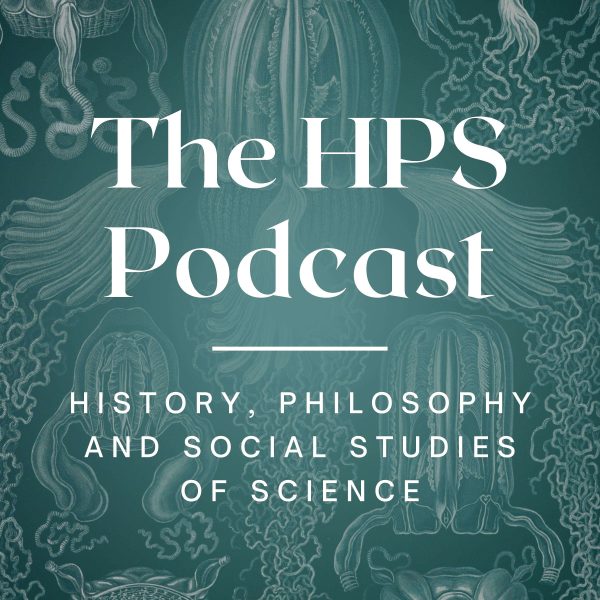
The HPS Podcast – Conversations from History, Philosophy and Social Studies of Science
- Episodios
- 79
- Se publica
- cada dos semanas
- Último episodio
- 30 Oct 2026
Sobre el podcast
Leading scholars in History, Philosophy and Social Studies of Science (HPS) introduce contemporary topics for a general audience. Developed by graduate students from the HPS program at the University of Melbourne.
Lead Host: Thomas Spiteri (2025-2026).
More information on the podcast can be found at hpsunimelb.org
Participantes
- Current Host - Thomas SpiteriPresentación
Episodios 79
Steve Fuller on the Soul of the University (Part 1)
This week, Thomas Spiteri speaks with Professor Steve Fuller, Auguste Comte Professor of Social Epistemology at the University of Warwick. Fuller founded social epistemology as a research programme in the late …
Notas del episodio
This week, Thomas Spiteri speaks with Professor Steve Fuller, Auguste Comte Professor of Social Epistemology at the University of Warwick. Fuller founded social epistemology as a research programme in the late 1980s, launching the journal Social Epistemology in 1987 and setting out the programme in his book of the same name. He has since written on topics ranging from Thomas Kuhn to science and religion, STS, transhumanism and post-truth. This conversation centres on the university, the subject of his books The Academic Caesar (2016) and Back to the University’s Future: The Second Coming of Humboldt (2023).
This first part of a two-part conversation is largely historical. It opens with the speech Fuller gave as salutatorian at Columbia in 1979, reprinted in Back to the University’s Future, and the postmodernism he absorbed as a student. He then explains why his chair carries Auguste Comte’s name, and how Comte’s vision of unified knowledge shaped social epistemology.
The conversation then turns to the history of the university: why Enlightenment thinkers were hostile to it, and how Wilhelm von Humboldt reinvented it. Fuller traces two paths that followed, Comte’s academics as a secular clergy and the German model of disciplines as fenced-off property, and argues that today’s post-truth condition is a revolt against both. The episode closes on what Fuller calls the soul of the university: the unity of teaching and research in a single person.
In part two, we turn to the present-day university and Fuller’s diagnosis and prognosis. We discuss academic rentiership, AI, and what society stands to lose if the Humboldtian ideal disappears.
Relevant Links
- Steve Fuller, University of Warwick
- Back to the University’s Future: The Second Coming of Humboldt (Springer, 2023)
- The Academic Caesar: University Leadership is Hard (Sage, 2016)
- Post-Truth: Knowledge as a Power Game (Anthem, 2018)
- Media and the Power of Knowledge (Bloomsbury, 2025)
- Social Epistemology Review and Reply Collective
Note: This conversation was recorded in May, 2026. Episode introduction updated on Nov 2, 2026 for precision, describing Fuller as “a founder” of social epistemology in reference to his institutional role in establishing the field.
Thanks for listening to The HPS Podcast. You can find more about us on our website, Bluesky, Instagram and Facebook feeds.
This podcast would not be possible without the support of School of Historical and Philosophical Studies at the University of Melbourne and the Hansen Little Public Humanities Grant scheme.Music by ComaStudio.
Website HPS Podcast | hpsunimelb.orgPeter Galison & Sophie Ritson on Imaging the Invisible
This week, Dr Sophie Ritson is in conversation with Professor Peter Galison, Joseph Pellegrino University Professor in History of Science and Physics at Harvard University, a founding member of the Black Hole …
Notas del episodio
This week, Dr Sophie Ritson is in conversation with Professor Peter Galison, Joseph Pellegrino University Professor in History of Science and Physics at Harvard University, a founding member of the Black Hole Initiative, and coordinator of the History, Philosophy and Culture (HPC) Working Group of the next-generation Event Horizon Telescope (ngEHT).
Galison is a historian and philosopher of science whose work has explored how experiments end, how scientific images are made and interpreted, and how practices of objectivity have developed. His books include How Experiments End, Image and Logic, Einstein’s Clocks, Poincaré’s Maps, and Objectivity (with Lorraine Daston). He also co-directed Secrecy and directed Black Holes: The Edge of All We Know, which follows the effort to produce the first image of a black hole.
Sophie Ritson is a historian and philosopher of science at the University of Melbourne, and one of the leaders of the Collaborations focus group within the ngEHT’s HPC Working Group. The group brings historians, philosophers, ethnographers and sociologists into a physics collaboration while it is still being built, rather than studying it retrospectively. Its work examines questions of governance and social epistemology, including authorship, consensus and disagreement. Ritson’s own research has explored the string theory controversy, “non-discovery” in high-energy physics, and research governance, drawing closely on her engagement with physicists at CERN and the Large Hadron Collider.
In this episode, Galison traces his path into the history and philosophy of science through family, teaching, and laboratory experience, emphasising how experimentalists taught him to distinguish effects from artefacts—a question that shaped his first book. He explains his interest in scientific images as a way of recovering the craft and tacit knowledge obscured by the protocol-driven view inherited from logical empiricism. The conversation then turns to the 2019 M87* image, which he presents as the culmination of his interest in secrecy and invisibility. The discussion concludes with broader questions about distributed knowledge, the state of HPS, and how to design billion-dollar instruments that remain open to the unexpected.
This episode:
- Describes Galison's path into physics and the history of science
- Explains how distinguishing a real effect from an artefact shaped How Experiments End
- Introduces visualisation as a topic in HPS, against protocol-driven accounts of knowledge
- Discusses the materiality of science, and why the laboratory has looked like a church, a factory, and a startup
- Frames secrecy as "anti-epistemology," and how blocked knowledge illuminates how knowledge is secured
- Argues the black hole image is a computational image, and that photography is an expansive category
- Reflects on the reconvergence of history and philosophy of science with contemporary practice
- Closes on why images can surprise us, and how to design experiments open enough to find the unexpected
This interview was recorded in July 2025.
Relevant Links
- Peter Galison, Harvard
- Sophie Ritson
- ngEHT History, Philosophy and Culture Working Group
- "Big STEM collaborations should include humanities and social science", Nature Human Behaviour (2023)
- A unique collaboration using a virtual Earth-sized telescope shows how science is changing in the 21st century, The Conversation
- The HPC White Paper, Galaxies (2023)
- Black Holes | The Edge of All We Know (2020)
- Black Hole Initiative, Harvard University
- Event Horizon Telescope, first image, 10 April 2019
- Objectivity (Zone Books, 2007)
- How Experiments End (University of Chicago Press, 1987)
- S3 Ep 7, Sophie Ritson on 'Collaboration in Science'
Episode production assistant: Paul Carter
Thanks for listening to The HPS Podcast. You can find more about us on our website, Bluesky, Instagram and Facebook feeds.
This podcast would not be possible without the support of School of Historical and Philosophical Studies at the University of Melbourne and the Hansen Little Public Humanities Grant scheme.Music by ComaStudio.
Website HPS Podcast | hpsunimelb.orgJahnavi Phalkey on India's Place in the History of Modern Science
This week, Thomas Spiteri speaks with Dr Jahnavi Phalkey, historian of science and technology, filmmaker, and Founding Director of Science Gallery Bengaluru. Phalkey is the author of Atomic State: Big Science …
Notas del episodio
This week, Thomas Spiteri speaks with Dr Jahnavi Phalkey, historian of science and technology, filmmaker, and Founding Director of Science Gallery Bengaluru. Phalkey is the author of Atomic State: Big Science in Twentieth Century India, and producer-director of the documentary film Cyclotron (2020) – a film about the world's oldest functional particle accelerator and the people who keep it running today. Her writing spans the history of science, technology, and the state in twentieth-century India.
The conversation traces Phalkey's route into the history of science by way of political sociology, silent cinema, and a chance funded place at Georgia Tech under John Krige, and her eventual return to studying India after finding its absence conspicuous in accounts of twentieth-century science. She discusses how Atomic State pushes back against two dominant framings in the historiography of science in India: the "tools of empire" argument for the imperial period, and the scarcity of histories of Indian science after independence. Drawing on the early efforts to build particle accelerators in Kolkata and Bangalore, and the eventual rise of the Tata Institute of Fundamental Research and the Department of Atomic Energy, she describes how the demands of a single, resource-intensive field reshaped the relationship between Indian science and the Indian state — and how that "big science" model went on to marginalise both university research and smaller-scale inquiry.
The discussion broadens into Phalkey's work reframing India and China as "conceptual sites" rather than deviant "cases" measured against a European norm, and closes with her current thinking on critique in the history and philosophy of science, informed in part by Bruno Latour, and on what it means for historians of science to help the public make meaning of research in an age of climate change, AI, and new gene technologies.
In this episode, Phalkey:
- Describes her winding path into history of science
- Explains what drew her back to studying science in India specifically, after finding it missing from standard histories of twentieth-century science
- Outlines the two historiographical tendencies Atomic State argues against: the "tools of empire" framework and the neglect of post-independence science
- Discusses the concept of India and China as "conceptual sites," against the limits of a Europe-benchmarked history of science
- Traces the early, fragile efforts to build particle accelerators in Kolkata and Bangalore, and the wartime origins of the Tata Institute of Fundamental Research
- Reflects on how the everyday bureaucracy of running a national laboratory shaped the entangled relationship between Indian science and the postcolonial state
- Discusses her documentary Cyclotron and the material, practical difficulties of building and maintaining a particle accelerator in a resource-constrained setting
- Considers how the "big science" model, centred on the Department of Atomic Energy, drew resources and people away from Indian universities and small-scale research
- Calls for a connected rather than a difference-based history of science in the Global South, and reflects on reconstituting the meaning of critique in history and philosophy of science
Relevant Links
- Atomic State: Big Science in Twentieth Century India — Permanent Black
- Cyclotron (2020) — documentary directed and produced by Jahnavi Phalkey
- Science Gallery Bengaluru
- Science of Giants
- Devi Prize – for promoting "public engagement with science" (2024)
- Infosys Prize, Humanities ( 2023)
Mentioned scholarship
- David Arnold, Science, Technology and Medicine in Colonial India (Cambridge History of India)
- Bruno Latour, "Why Has Critique Run Out of Steam?" (2004)
- Steven Shapin & Simon Schaffer, Leviathan and the Air-Pump (1985)
Note: This conversation was recorded in May, 2026
Thanks for listening to The HPS Podcast. You can find more about us on our website, Bluesky, Instagram and Facebook feeds.
This podcast would not be possible without the support of School of Historical and Philosophical Studies at the University of Melbourne and the Hansen Little Public Humanities Grant scheme.Music by ComaStudio.
Website HPS Podcast | hpsunimelb.orgMazviita Chirimuuta on Simplification in Neuroscience
This week, Thomas Spiteri speaks with Dr Mazviita Chirimuuta, Senior Lecturer in Philosophy at the University of Edinburgh and author of The Brain Abstracted: Simplification in the History and Philosophy of …
Notas del episodio
This week, Thomas Spiteri speaks with Dr Mazviita Chirimuuta, Senior Lecturer in Philosophy at the University of Edinburgh and author of The Brain Abstracted: Simplification in the History and Philosophy of Neuroscience (MIT Press, 2024) – winner of the 2025 Lakatos Award and the 2024 Nayef Al-Rodhan International Prize in Transdisciplinary Philosophy from the Royal Institute of Philosophy.
The conversation centres on the central argument of the book: that the leading ideas which have shaped neuroscience are best understood as attempts to simplify the brain, one of the more complex objects of scientific inquiry. Mazviita describes this in practice as a mismatch between the brain's overwhelming complexity and the representations — models, theories, diagrams — that scientists rely on, which necessarily ignore much of that complexity. She identifies three recurring simplifying strategies running through the book — reduction, mathematisation, and analogy — and discusses how "proxy systems," from anesthetised cats to cerebral organoids, let scientists study minimal, decontextualised versions of the brain built using these strategies.
She also discusses the diverging paths of neuroscience and AI research, the risk of conflating predictive power with genuine understanding, and why she advocates for greater theoretical pluralism in how science approaches the brain.
In this episode, Chirimuuta:
- Describes her academic path from psychophysics and vision science back into philosophy of science
- Introduces The Brain Abstracted and its central concern with simplification in neuroscience
- Unpacks three recurring simplification strategies in neuroscience — reduction, mathematisation, and analogy
- Traces how the computer analogy shaped artificial neural networks, from McCulloch and Pitts through Hubel and Wiesel to today's deep learning models
- Introduces the idea of the "Heraclitean brain" — a system always in flux — and what this means for scientific explanation
- Reflects on the historical back-and-forth between localisationist and dynamic/distributed views of brain function
- Considers the shifting, increasingly divergent relationship between neuroscience and AI research, including energy efficiency as a new point of biological inspiration
- Calls for greater theoretical humility and pluralism in neuroscience, drawing on the 19th-century work of John Hughlings Jackson as a case study
Relevant Links
- The Brain Abstracted: Simplification in the History and Philosophy of Neuroscience (MIT Press)
- Mazviita Chirimuuta wins the 2025 Lakatos Award — LSE
- Mazviita Chirimuuta's research site / Outside Colour
- Outside Color: Perceptual Science and the Puzzle of Color in Philosophy (MIT Press, 2017)
- Nancy Cartwright, The Dappled World (1999)
- Nicole Rust, Elusive Cures (2025)
Note: This conversation was recorded at the end of 2025.
Thanks for listening to The HPS Podcast. You can find more about us on our website, Bluesky, Instagram and Facebook feeds.
This podcast would not be possible without the support of School of Historical and Philosophical Studies at the University of Melbourne and the Hansen Little Public Humanities Grant scheme.Music by ComaStudio.
Website HPS Podcast | hpsunimelb.orgMagdalena Skipper on Scientific Publishing
This week, Thomas Spiteri speaks with Dr. Magdalena Skipper, Editor-in-Chief of Nature. Skipper has held the role since 2018, and has a background in the genetic sciences. She is also notably the first female — …
Notas del episodio
This week, Thomas Spiteri speaks with Dr. Magdalena Skipper, Editor-in-Chief of Nature. Skipper has held the role since 2018, and has a background in the genetic sciences. She is also notably the first female — and only the eighth person — to lead the journal since its founding in 1869.
Skipper reflects on what she has worked to preserve and change since taking on the role, from deepening the connection between Nature's research and journalism teams to broadening the journal's scope beyond the natural sciences into engineering, social sciences, and clinical research. Drawing on her training as a geneticist, she discusses how evidence and rigor take different forms across disciplines, and why she sees no single "final word" in science.
The conversation turns to some of the defining pressures on contemporary research culture: the COVID-19 pandemic's paradoxical effect on public trust in science, the discipline-specific nature of the replication crisis, and the rise of meta-science as a lens for understanding how research itself is produced. Skipper also discusses Nature's move toward transparent peer review, the persistent inequities shaping who gets published, and why she remains fundamentally hopeful about science's capacity for self-correction.
In this episode, Skipper:
- Describes what she set out to preserve and change on becoming Nature's Editor-in-Chief, including expanding the journal's scope into engineering, social sciences, and clinical research
- Reflects on how her background in genetics shaped her thinking about evidence, rigor, and multiple valid paths to a scientific claim
- Discusses the COVID-19 pandemic's dual legacy: accelerating the adoption of preprints while eroding public trust in science
- Unpacks the replication crisis as a discipline-specific phenomenon and what Nature has learned from it
- Explains the growing role of meta-science, particularly at the intersection of psychology, human behaviour, and research practice
- Details Nature's move to transparent and, since June 2025, mandatory published peer review reports
- Addresses persistent inequities in scientific publishing and Nature's editorial efforts to counter "helicopter science"
- Shares why she remains hopeful about science's capacity for self-correction and its role in building a more equitable world
Relevant Links
- Nature Journal
- Nature Profile
- Begley & Ellis (2012), "Raise standards for preclinical cancer research" — Nature comment on reproducibility in cancer research
- Nature: Registered Reports format
- Nature : Transparent Peer Review initiative
Note: This conversation was recorded in October 2025.
Thanks for listening to The HPS Podcast. You can find more about us on our website, Bluesky, Instagram and Facebook feeds.
This podcast would not be possible without the support of School of Historical and Philosophical Studies at the University of Melbourne and the Hansen Little Public Humanities Grant scheme.Music by ComaStudio.
Website HPS Podcast | hpsunimelb.orgSteven Shapin on the Social Life of Scientific Knowledge
This week, Thomas Spiteri speaks with Steven Shapin, Professor Emeritus of the History of Science at Harvard. Shapin reflects on his path into the history and sociology of science and discusses the central …
Notas del episodio
This week, Thomas Spiteri speaks with Steven Shapin, Professor Emeritus of the History of Science at Harvard. Shapin reflects on his path into the history and sociology of science and discusses the central concerns of his work: how knowledge is produced, the social foundations of trust in science, the embodied nature of knowledge, and the performance of expertise.
He revisits Leviathan and the Air-Pump, co-authored with Simon Schaffer, outlining the Boyle–Hobbes controversy and showing how seventeenth-century scientific credibility depended on rhetoric, social standing, and performance, while highlighting the broader relevance of the book’s insights into the social foundations of knowledge. Shapin considers contemporary challenges, including political interventions in science and universities, the effects of digital communication, and the fragmentation of expertise, and reframes the “crisis of truth” as a crisis of social knowledge.
Finally, he connects these themes to his recent work on taste and eating (Eating and Being), examining how communities form shared judgments about food and flavour, paralleling the intersubjective construction of objectivity in science.
In this episode:
- Recounts his path through Edinburgh, UCSD, and Harvard and what each taught about interdisciplinarity.
- Explains the story and broader thesis of Leviathan and the Air-Pump: facts are made credible through practice, rhetoric, and social arrangements.
- Reflects on shifting disciplinary fault lines.
- Describes how credibility is performed today and the growing value of face-to-face embodiment.
- Surveys credibility issues from science’s entanglement with business, government, and partisan politics.
- Discusses Eating and Being, drawing parallels between intersubjective agreement in science and taste.
Transcript being prepared.
Photo: Steven Shapin, Groningen, Netherlands, March 2020, by Newfrogm, CC BY 4.0 via Wikimedia Commons
Relevant links
- Steven Shapin — Harvard profile / home page
- LARB Essay “Is There a Crisis of Truth?” (2019)
- Leviathan and the Air-Pump: Hobbes, Boyle, and the Experimental Life (Shapin & Schaffer, 1985) – Wikipedia entry
- Steven Shapin's books
Thanks for listening to The HPS Podcast. You can find more about us on our website, Bluesky, Instagram and Facebook feeds.
This podcast would not be possible without the support of School of Historical and Philosophical Studies at the University of Melbourne and the Hansen Little Public Humanities Grant scheme.Music by ComaStudio.
Website HPS Podcast | hpsunimelb.orgCordelia Fine on "Patriarchy Inc"
This week, Thomas Spiteri speaks with Professor Cordelia Fine — psychologist, award-winning writer, and professor in the History and Philosophy of Science at the University of Melbourne. Cordelia is one of …
Notas del episodio
This week, Thomas Spiteri speaks with Professor Cordelia Fine — psychologist, award-winning writer, and professor in the History and Philosophy of Science at the University of Melbourne. Cordelia is one of today’s leading voices on how science and society shape our understandings of gender.
In the conversation, Cordelia discusses her new book Patriarchy, Inc.: What We Get Wrong About Gender Equality – and Why Men Still Win at Work. The book challenges two influential views of gender inequality: the “different but equal” view, or the claim that natural differences between the sexes explain persistent inequalities in work and care; and the “business case” for diversity, which treats equality as worthwhile only when it improves efficiency or profit.
Fine argues that both perspectives misrepresent the problem. Drawing on psychology, sociology, economics, and cultural evolution, she shows how divisions of labour are created and reinforced, how expectations are instilled from childhood, and how workplace structures designed around constant availability clash with the realities of people’s lives.
She concludes by outlining a new vision of gender equality — one that rejects both biological determinism and narrow economic utility, and instead centres justice, fairness, and human wellbeing.
In this episode, Fine:
- Explains why the “different but equal” and “business case” narratives remain persuasive yet inadequate
- Traces how gender divisions of labour operate at individual, interactional, and institutional levels
- Describes how children actively take up and reproduce gender norms
- Shows how workplace ideals disadvantage carers and perpetuate inequality
- Proposes a conception of gender justice that measures equality in terms of wellbeing, respect, and fair reward
Relevant Links
- Cordelia's Website
- University of Melbourne profile
- Patriarchy, Inc.: What We Get Wrong About Gender Equality – and Why Men Still Win at Work
- Delusions of Gender: How Our Minds, Society, and Neurosexism Create Difference (W.W. Norton, 2010)
- Testosterone Rex: Unmaking the Myths of Our Sex (W.W. Norton, 2017)
Thanks for listening to The HPS Podcast. You can find more about us on our website, Bluesky, Instagram and Facebook feeds.
This podcast would not be possible without the support of School of Historical and Philosophical Studies at the University of Melbourne and the Hansen Little Public Humanities Grant scheme.Music by ComaStudio.
Website HPS Podcast | hpsunimelb.orgMiriam Solomon on How Stigma Shapes Psychiatry
This week, Thomas Spiteri speaks with Professor Miriam Solomon, Professor of Philosophy at Temple University and a leading voice in philosophy of science, medicine, and psychiatry.Solomon reflects on her …
Notas del episodio
This week, Thomas Spiteri speaks with Professor Miriam Solomon, Professor of Philosophy at Temple University and a leading voice in philosophy of science, medicine, and psychiatry.
Solomon reflects on her intellectual trajectory, from her early studies in the natural sciences at Cambridge and her doctoral work at Harvard, to her later contributions in the philosophy of medicine and psychiatry. She describes how questions about knowledge-making — from consensus conferences to evidence-based medicine — led her to examine psychiatry and, most recently, the constitutive role of stigma in shaping psychiatric categories.
In the conversation, Solomon argues that stigma is not only a social force attached to mental illness from the outside but also a factor that has shaped psychiatry from within. It has influenced the recognition, definition, and revision of diagnostic categories, as she illustrates through cases drawn from the history of psychiatry. She situates these examples within broader debates about the nature of psychiatric disorder, the limitations of the DSM, and possible alternative frameworks.
In this episode, Solomon:
- Recounts her path from philosophy of science to psychiatry, shaped by formative years at Cambridge and Harvard
- Explains why consensus conferences and evidence-based medicine sparked her interest in psychiatry and the DSM
- Argues that stigma is not only a social prejudice but a constitutive force within psychiatric knowledge
- Examines the role of stigma in categories like Asperger’s and PTSD, and its entanglement with hermeneutical injustice
- Assesses debates over defining psychiatric disorder, including the harmful dysfunction model, and emphasises the centrality of “harm” over “dysfunction”
- Discusses the challenges facing the DSM
- Calls for greater awareness of how stigma operates, both within psychiatry and in everyday experiences of mental illness
Relevant Links
- Miriam Solomon’s home page
- On the Concept of "Psychiatric Disorder": Incorporating Psychological Injury
- Miriam Soloman PhilPapers
- Making Medical Knowledge (Oxford University Press, 2015)
Transcript coming soon.
Photo Credit: Amira SolomonThanks for listening to The HPS Podcast. You can find more about us on our website, Bluesky, Instagram and Facebook feeds.
This podcast would not be possible without the support of School of Historical and Philosophical Studies at the University of Melbourne and the Hansen Little Public Humanities Grant scheme.Music by ComaStudio.
Website HPS Podcast | hpsunimelb.orgPhilip Kitcher on Philosophy for Science and the Common Good
This week, Thomas Spiteri speaks with Professor Philip Kitcher, John Dewey Professor Emeritus of Philosophy at Columbia University and one of the most influential philosophers of science of the past …
Notas del episodio
This week, Thomas Spiteri speaks with Professor Philip Kitcher, John Dewey Professor Emeritus of Philosophy at Columbia University and one of the most influential philosophers of science of the past half-century.
Kitcher traces his intellectual journey from his early years at Cambridge and Princeton, where he studied with Thomas Kuhn, Carl Hempel, and Paul Benacerraf, to his later interventions in public debates over creationism, sociobiology, and the Human Genome Project. These experiences, he explains, shifted his understanding of philosophy’s role—from narrow technical problems to broader ethical and political questions.
He also reflects on his evolving views of scientific explanation, his collaborations with historians and sociologists of science, and the recognition of ethical and political dimensions long neglected in philosophy of science. Kitcher concludes with his vision of a pragmatist philosophy that reconnects ethics with politics and ensures science serves democratic ideals and human flourishing in the face of global crises.
In this episode, Kitcher:
- Recounts his path from mathematics to philosophy of science at Cambridge and Princeton
- Reflects on the influence of Thomas Kuhn, Carl Hempel, Paul Benacerraf, and Richard Rorty
- Explains how public debates on creationism, sociobiology, and genomics redirected his work toward questions of science and society
- Discusses his shift from unificationist to pluralist accounts of scientific explanation
- Highlights the importance of history and sociology of science for philosophy’s self-understanding
- Argues for philosophy’s responsibility to address ethical and political dimensions of science
- Outlines his pragmatist vision for democracy, ethics, and science in the service of human flourishing
Relevant Links
- Philip Kitcher – Columbia University profile (emeritus)
- Science, Truth, and Democracy (Oxford University Press, 2001)
- The Rich and the Poor (Columbia University Press, 2021)
Transcript coming soon
Thanks for listening to The HPS Podcast. You can find more about us on our website, Bluesky, Instagram and Facebook feeds.
This podcast would not be possible without the support of School of Historical and Philosophical Studies at the University of Melbourne and the Hansen Little Public Humanities Grant scheme.Music by ComaStudio.
Website HPS Podcast | hpsunimelb.orgLydia Patton on HOPOS
This week, Thomas Spiteri is in conversation with Professor Lydia Patton, philosopher of science and historian of the philosophy of science. Patton traces her unexpected journey from ballet to Kantian …
Notas del episodio
This week, Thomas Spiteri is in conversation with Professor Lydia Patton, philosopher of science and historian of the philosophy of science. Patton traces her unexpected journey from ballet to Kantian philosophy and into the emerging field of HOPOS (history of philosophy of science). She reflects on her years as editor-in-chief of the HOPOS journal, she offers her perspective on the field’s future.
Along the way, she highlights the distinctive character of HOPOS as a historically grounded approach to philosophical problems, reflects on her editorial leadership of HOPOS (2017-2024), emphasises the importance of widening the scope of the discipline, and considers the promise and limits of new and emerging methods of research. She concludes by discussing some of areas of research that continue to capture her attention.
In this episode, Patton:
- Recounts her unlikely path from ballet to philosophy and HOPOS
- Clarifies what makes HOPOS distinctive as a historical approach
- Reflects on her editorial leadership of HOPOS (2017–2024)
- Challenges presentist views of the 19th century and its blurred disciplinary boundaries
- Explores new digital methods in the history of philosophy of science
- Shares concerns and hopes about AI and machine learning
- Looks ahead to the journal’s future under Matthew Brown
Relevant Links- Lydia Patton Website
- Article discussed: Serendipity and the Unexpected in the History of Philosophy of Science: Reflections on My Editorship of HOPOS (2017–2024)
- HOPOS: The Journal of the International Society for the History of Philosophy of Science
- International Society for the History of Philosophy of Science (HOPOS)
- Stuart Russell – Human Compatible: Artificial Intelligence and the Problem of Control
Thanks for listening to The HPS Podcast. You can find more about us on our website, Bluesky, Instagram and Facebook feeds.
This podcast would not be possible without the support of School of Historical and Philosophical Studies at the University of Melbourne and the Hansen Little Public Humanities Grant scheme.Music by ComaStudio.
Website HPS Podcast | hpsunimelb.orgSarah Blaffer Hrdy on ‘Rethinking our Starting Assumptions’
“I love your field. It is making such an important point about scientists who don't understand the extent to which our own upbringing impacts our starting assumptions. It's those starting assumptions …
Notas del episodio
“I love your field. It is making such an important point about scientists who don't understand the extent to which our own upbringing impacts our starting assumptions. It's those starting assumptions that get you in trouble.”
In today’s episode Samara Greenwood returns to interview the pioneering primatologist and evolutionary anthropologist, Sarah Blaffer Hrdy, about her latest book Father Time: A Natural History of Men and Babies. The discussion centres on the shifts Sarah made in her personal assumptions through the process of conceiving and writing this work. The notion that men had the capacity to be expert carers of young babies was foreign to Sarah until she experienced it firsthand when her son-in-law took on the role of primary carer to her first-born grandson in 2012. This ‘lived experience’ of expert male care led Sarah not only to a new mindset, but to a new way of theorising about the evolutionary possibilities for baby-care in men.
Relevant Links:- Sarah B. Hrdy | Anthropology
- Father Time | Princeton University Press
- Should We Expect More from Dads? | Featuring Sarah Hrdy | The New Yorker
- How Feminism changed Primatology | Featuring Samara Greenwood | The Philosopher’s Zone
For more on the topic of supporting men in their care of children, see our series on working fathers.
Working Fathers Podcast Mini-Series:
- Working Fathers Mini-series. Ep 1 - Where's Dad?
- Working Fathers Mini-series. Ep 2 - What Gave Rise to the Breadwinner?
- Working Fathers Mini-series. Ep 3 - Are Fathers Free?
- Working Fathers Mini-series. Ep 4 - Give Dads a Break
- Working Fathers Mini-series. Ep 5 - What's Next?
Thanks for listening to The HPS Podcast. You can find more about us on our website, Bluesky, Instagram and Facebook feeds.
This podcast would not be possible without the support of School of Historical and Philosophical Studies at the University of Melbourne and the Hansen Little Public Humanities Grant scheme.Music by ComaStudio.
Website HPS Podcast | hpsunimelb.orgCristian Larroulet Philippi on Measurement in the Human Sciences
This week, Thomas Spiteri is joined by Dr. Cristian Larroulet Philippi, who joins us at the University of Melbourne this year as the inaugural RW Seddon Fellow in the History and Philosophy of Science program …
Notas del episodio
This week, Thomas Spiteri is joined by Dr. Cristian Larroulet Philippi, who joins us at the University of Melbourne this year as the inaugural RW Seddon Fellow in the History and Philosophy of Science program. With a background in economics and a PhD in History and Philosophy of Science from the University of Cambridge, Larroulet Philippi was previously a Junior Research Fellow at Gonville and Caius College, Cambridge. His research explores the development and justification of quantitative concepts, the role of measurement in the human sciences, and the intersection of scientific objectivity and values.
In this episode, Larroulet Philippi:
- Traces his path from economics into philosophy of science, and how encounters with psychometrics and measurement theory reshaped his research direction
- Explains why measurement in the human sciences is perhaps more philosophically complex than in the physical sciences – highlighting issues of conceptual vagueness, causal complexity, and limited experimental control
- Discusses the difficulties of treating concepts like intelligence or depression severity as measurable quantities, and what kinds of evidence and theory would be needed to justify this
- Examines the risks of treating indices like depression or wellbeing scores as overly objective or precise in policy contexts, and why we need a clearer grasp of what such numbers are meant to represent
- Reflects on why clearer thinking about measurement matters across philosophy, psychology, sociology, and policy — and on his efforts to build cross-disciplinary dialogue
Relevant Links
- Cristian Larroulet-Philippi - University of Melbourne
- Recent Interview - about the RW Seddon Fellowship
- PhilPapers
- Cristian's podcast, FICICO (Spanish-speaking)
Thanks for listening to The HPS Podcast. You can find more about us on our website, Bluesky, Instagram and Facebook feeds.
This podcast would not be possible without the support of School of Historical and Philosophical Studies at the University of Melbourne and the Hansen Little Public Humanities Grant scheme.Music by ComaStudio.
Website HPS Podcast | hpsunimelb.orgHeather Douglas on Rethinking Science’s Social Contract
This week on The HPS Podcast, Thomas Spiteri is in conversation with internationally recognised philosopher of science and professor at Michigan State University, Heather Douglas. Heather’s work has transformed …
Notas del episodio
This week on The HPS Podcast, Thomas Spiteri is in conversation with internationally recognised philosopher of science and professor at Michigan State University, Heather Douglas. Heather’s work has transformed how philosophers and scientists think about values, responsibility, and the relationship between science and society.
In recognition of her contributions, she has been honoured as a Fellow of the American Association for the Advancement of Science (AAAS) and the Institute for Science, Society, and Policy at the University of Ottawa, and has held senior fellowships at the Center for Philosophy of Science at the University of Pittsburgh and, most recently, with the SOCRATES Group at Leibniz Universität Hannover.In this episode, Douglas:
- Shares her intellectual journey, from early interdisciplinary studies to her philosophical work on scientific responsibility, values, and policy
- Explains how the twentieth-century “social contract” for science emerged—shaping the distinction between basic and applied research, determining how science is funded, and insulating scientists from broader social accountability
- Examines the enduring appeal of the “value-free ideal” and why this model is increasingly challenged by contemporary social and ethical realities
- Discusses the pressures that have exposed the limitations of the old social contract for science, including Cold War funding dynamics, issues of public trust, and debates over dual-use research
- Sets out her vision for a new social contract for science—one that recognises the unavoidable role of values in research, makes public trust and inclusivity central, and supports scientists through stronger institutional structures
- Offers practical proposals for reforming science funding, governance, and accountability — arguing that only a more open, responsive, and democratically engaged science can meet the challenges of the twenty-first century
Relevant Links:
- Heather Douglas profile – Michigan State University
- Committee for Freedom and Responsibility in Science
- Science, Policy, and the Value-Free Ideal (University of Pittsburgh Press, 2009)
- Douglas, H. & Branch, T.Y., 2024. The social contract for science and the value-free ideal. Synthese, 203(2), pp.1–19. (Open Access)
Transcript now live!
Thanks for listening to The HPS Podcast. You can find more about us on our website, Bluesky, Instagram and Facebook feeds.
This podcast would not be possible without the support of School of Historical and Philosophical Studies at the University of Melbourne and the Hansen Little Public Humanities Grant scheme.Music by ComaStudio.
Website HPS Podcast | hpsunimelb.orgHans-Jörg Rheinberger on 'Epistemic Things'
Today on The HPS Podcast, Thomas Spiteri talks with Hans-Jörg Rheinberger, distinguished historian and philosopher of science and Director Emeritus at the Max Planck Institute for the History of Science in …
Notas del episodio
Today on The HPS Podcast, Thomas Spiteri talks with Hans-Jörg Rheinberger, distinguished historian and philosopher of science and Director Emeritus at the Max Planck Institute for the History of Science in Berlin. Trained first in philosophy and then in molecular biology, Rheinberger is well-recognised for his work on the history and epistemology of experimentation. His influential work, including concepts like “experimental systems” and “epistemic things,” has helped shape how we understand the material, conceptual, and historical dimensions of scientific research.
In this episode, Rheinberger:
- Describes his path from philosophy to molecular biologist, and how time at the lab bench informed his understanding science
- Explains what “experimental systems” are—carefully arranged environments where scientists interact with both the unknown and the tools that make inquiry possible
- Defines “epistemic things,” the phenomena that underpin scientific curiosity, and “technical objects,” the stable tools and methods that emerge from research over time
- Illustrates these ideas with vivid case examples, from solving the genetic code with synthetic RNA to the invention and evolution of the electron microscope
- Reflects on the impact of new technologies, automation, and digital visualisation, and what persists — and changes — about experimentation in the contemporary lab
Relevant Links
- Hans-Jörg Rheinberger profile – Max Planck Institute for the History of Science
- Split and Splice: A Phenomenology of Experimentation ( University of Chicago Press), 2023
- Epistemology of the Concrete: On Historicizing Epistemology (Duke University Press), 2010
- Toward a History of Epistemic Things (Harvard University Press), 1997
Transcript coming soon
Thanks for listening to The HPS Podcast. You can find more about us on our website, Bluesky, Instagram and Facebook feeds.
This podcast would not be possible without the support of School of Historical and Philosophical Studies at the University of Melbourne and the Hansen Little Public Humanities Grant scheme.Music by ComaStudio.
Website HPS Podcast | hpsunimelb.orgSurekha Davies on Humans: A Monstrous History
Today on The HPS Podcast, Thomas Spiteri speaks with Dr. Surekha Davies, historian of science, art and ideas, and author of the new book Humans: A Monstrous History (University of California Press). Surekha’s …
Notas del episodio
Today on The HPS Podcast, Thomas Spiteri speaks with Dr. Surekha Davies, historian of science, art and ideas, and author of the new book Humans: A Monstrous History (University of California Press). Surekha’s research explores how ideas about humanity have been shaped by encounters with what did not seem to fit. She draws on visual, material and textual sources to show how people have imagined and defined the human across time.
In this episode, Surekha:
- Traces her path into HPS, from Star Trek dreams to Renaissance studies
- Explains why visual and material sources are crucial to understanding early modern science
- Introduces her book Humans: A Monstrous History
- Tell us about how monstrosity functioned as an epistemic tool for organising knowledge and drawing conceptual boundaries
- Examines how these ideas influenced concepts of gender, race and empire
If you’ve ever wondered how the strange and unfamiliar shaped science, culture, and our understanding of humanity, this episode is for you.
Relevant Links:
Surekha Davies Website
Humans: A Monstrous History ((University of California Press, 2025)
Renaissance Ethnography and the Invention of the Human: New Worlds, Maps and Monsters (Cambridge University Press, 2016).Thanks for listening to The HPS Podcast. You can find more about us on our website, Bluesky, Instagram and Facebook feeds.
This podcast would not be possible without the support of School of Historical and Philosophical Studies at the University of Melbourne and the Hansen Little Public Humanities Grant scheme.Music by ComaStudio.
Website HPS Podcast | hpsunimelb.orgS5 E1 - Samara and Thomas: Reflections and Roads Ahead
After a short break, The HPS Podcast is back! Season 5 opens with a special handover episode. After several years as lead host, Samara Greenwood passes the mic to fellow PhD candidate Thomas Spiteri. Together …
Notas del episodio
After a short break, The HPS Podcast is back! Season 5 opens with a special handover episode. After several years as lead host, Samara Greenwood passes the mic to fellow PhD candidate Thomas Spiteri. Together, they look back on the podcast’s journey, what it has meant to them, and where it’s headed next.
Hear from Samara and Thomas as they:
- Introduce Thomas as the new host and share plans for Season 5
- Reflect on hosting highlights and lessons learned
- Discuss insights from the 10th Integrated HPS Conference at Caltech (2025)
- Explore what it means to do integrated HPS
- Wrap up with a lightning round on favourite concepts, research obsessions, and books
Plus, some exciting news: The HPS Podcast has received the 2024 BSHS Ayrton Prize for Public Engagement!
Whether you’ve been with us from the beginning or are tuning in for the first time, this episode sets the stage for an exciting new season. We thank you for joining us!
Relevant Links
- The HPS Podcast Website | hpsunimelb.org
- BSHS Ayrton Prize – Public Engagement
- Integrated HPS Conference 2024 – Caltech
- Samara Greenwood – University of Melbourne
Music by ComaStudio.
Transcript coming soon.
Thanks for listening to The HPS Podcast. You can find more about us on our website, Bluesky, Instagram and Facebook feeds.
This podcast would not be possible without the support of School of Historical and Philosophical Studies at the University of Melbourne and the Hansen Little Public Humanities Grant scheme.Music by ComaStudio.
Website HPS Podcast | hpsunimelb.orgAudience Faves: Daston & Harrison on 'Scientists and History'
In the lead up to the launch of Season 5, we at The HPS Podcast are re-releasing some favourite episodes from our collection.In this episode Professors Lorraine Daston and Peter Harrison talk to Samara …
Notas del episodio
In the lead up to the launch of Season 5, we at The HPS Podcast are re-releasing some favourite episodes from our collection.
In this episode Professors Lorraine Daston and Peter Harrison talk to Samara Greenwood on the often complex, sometimes fraught relationship between practicing scientists and the history of science.
This episode was originally released on March 07, 2024.
The transcript can be found at - S3 Ep1 - Lorraine Daston & Peter Harrison Transcript
Thanks for listening to The HPS Podcast. You can find more about us on our website, Bluesky, Instagram and Facebook feeds.
This podcast would not be possible without the support of School of Historical and Philosophical Studies at the University of Melbourne and the Hansen Little Public Humanities Grant scheme.Music by ComaStudio.
Website HPS Podcast | hpsunimelb.orgAudience Faves: Kristian Camilleri on 'The Disunity of Science'
In the lead up to the launch of Season 5, we at The HPS Podcast are re-releasing some favourite episodes from our collection.First, we have Dr Kristian Camilleri talking with Samara Greenwood about the …
Notas del episodio
In the lead up to the launch of Season 5, we at The HPS Podcast are re-releasing some favourite episodes from our collection.
First, we have Dr Kristian Camilleri talking with Samara Greenwood about the relatively recent realisation that this thing we call 'Science' is a less unified phenomena then is typically supposed. The 'disunity' becomes clear when we appreciate that scientific disciplines have developed in divergent ways and often employ very different methods and practices.
This episode was originally released on June 8, 2023.
The transcript can be found at - S1 Ep 2 - Kristian Camilleri on 'The Disunity of Science'
Thanks for listening to The HPS Podcast. You can find more about us on our website, Bluesky, Instagram and Facebook feeds.
This podcast would not be possible without the support of School of Historical and Philosophical Studies at the University of Melbourne and the Hansen Little Public Humanities Grant scheme.Music by ComaStudio.
Website HPS Podcast | hpsunimelb.orgAudience Faves: Rachael Brown on 'Values in Science'
In the lead up to the launch of Season 5, we at The HPS Podcast are re-releasing some favourite episodes from our collection.In this episode we have Dr Rachael Brown talking to Samara Greenwood on challenge the …
Notas del episodio
In the lead up to the launch of Season 5, we at The HPS Podcast are re-releasing some favourite episodes from our collection.
In this episode we have Dr Rachael Brown talking to Samara Greenwood on challenge the common idea that Science is (and should be) 'Value-Free'. At a practical level, in choosing which phenomena to study, and how best to study them, can science really ever be value-free? Second, would we want it to, even if it could? Isn't it possible that, if used appropriately, values provide a beneficial component of the scientific process.
This episode was originally released on July 13, 2023.
The transcript can be found at - S1 Ep 7 - Rachael Brown on 'Values in Science'
Thanks for listening to The HPS Podcast. You can find more about us on our website, Bluesky, Instagram and Facebook feeds.
This podcast would not be possible without the support of School of Historical and Philosophical Studies at the University of Melbourne and the Hansen Little Public Humanities Grant scheme.Music by ComaStudio.
Website HPS Podcast | hpsunimelb.orgAudience Faves: Hasok Chang on 'Epistemic Iteration'
In the lead up to the launch of Season 5, we at The HPS Podcast are re-releasing some favourite episodes from our collection.In this episode, Professor Hasok Chang talks with Samara Greenwood about his concept …
Notas del episodio
In the lead up to the launch of Season 5, we at The HPS Podcast are re-releasing some favourite episodes from our collection.
In this episode, Professor Hasok Chang talks with Samara Greenwood about his concept of 'Epistemic Iteration', the idea that scientific inquiries do not start from a solid foundation, but rather begin from an imperfect position, using the outcomes of our further inquiry to refine and correct the original starting point.
This episode was originally released on December 4, 2023.
The transcript can be found at - Hasok Chang Transcript - S2 Ep 11
___
Thanks for listening to The HPS Podcast. You can find more about us on our website, Bluesky, Instagram and Facebook feeds.
This podcast would not be possible without the support of School of Historical and Philosophical Studies at the University of Melbourne and the Hansen Little Public Humanities Grant scheme.Music by ComaStudio.
Website HPS Podcast | hpsunimelb.orgS4 Ep 12 - Joshua Eisenthal et al. on 'Philosophy of Science in Practice'
Today we have not one, not two, but five fabulous guests who all presented at this year’s conference for the Society for Philosophy of Science in Practice, or SPSP24 for short. Many philosophers of science we …
Notas del episodio
Today we have not one, not two, but five fabulous guests who all presented at this year’s conference for the Society for Philosophy of Science in Practice, or SPSP24 for short.
Many philosophers of science we have featured on the podcast, including Hasok Chang, Rachel Ankeny and Sabina Leonelli, were founding members of SPSP. Also, our earlier episode on ‘The Turn to Practice’ in philosophy of science has been one of our most popular. Therefore, it seemed an obvious decision to dedicate our final episode of the season to hearing from some of those doing current work in the area.
Leading us further into the world of Philosophy of Science in Practice is our foreign correspondent Joshua Eistenthal, philosopher of physics at Caltech and regular contributor to the podcast. Thanks to Josh, we bring you compelling conversations with philosophers Julia Bursten, Aja Watkins, Sindhuja Bhakthavatsalam, Caleb Hazelwood, and Joseph Rouse.
This is also Samara Greenwood's last episode as co-ordinator, producer and co-host of the podcast.
Transcript coming soon.
Relevant links:- Society for Philosophy of Science in Practice | Mission statement
- SPSP 2024 - 10th Biennial Conference, South Carolina
- SPSP 2024 - Conference Book of Abstracts
Thanks for listening to The HPS Podcast. You can find more about us on our website, Bluesky, Instagram and Facebook feeds.
This podcast would not be possible without the support of School of Historical and Philosophical Studies at the University of Melbourne and the Hansen Little Public Humanities Grant scheme.Music by ComaStudio.
Website HPS Podcast | hpsunimelb.orgS4 Ep 11 - Redux: Fiona Fidler on 'Collective Objectivity'
"It wouldn’t make sense to leave the entire burden of upholding objectivity in science on the shoulders of fallible individuals, right?" Prof. Fiona Fidler Today, we return to one of our favourite episodes …
Notas del episodio
"It wouldn’t make sense to leave the entire burden of upholding objectivity in science on the shoulders of fallible individuals, right?" Prof. Fiona Fidler
Today, we return to one of our favourite episodes, with the person who first came up with the idea for our podcast – Professor Fiona Fidler.
Fiona is head of our History and Philosophy of Science Program at the University of Melbourne and co-lead of the MetaMelb research initiative.
In this episode Fiona first discusses her early move from psychology to HPS when she was struck by the ‘dodgy’ statistical methods she found prevalent in many sciences. She has since dedicated her career to studying scientific practice to help improve confidence in scientific claims.
Fiona introduces us to the concept of ‘Collective Objectivity’. Following from an earlier podcast on 'Values in Science' by Rachel Brown, Fiona discusses how contemporary understandings of objectivity have become more sophisticated.
Rather than viewing objectivity in science as solely the role of individuals, today we understand there are strong social dimensions to ensuring scientific outcomes are not unduly biased. As Fiona discusses, this not only requires diversity in 'who does science' to ensure multiple perspectives are incorporated, but we also need multiple collective review mechanisms to ensure we are developing truly robust, reliable, objective outcomes.A full transcript of this episode can be found here
Relevant links:- AIMOS - Association for Interdisciplinary Meta-Research and Open Science
- Profile: Prof Fiona Fidler (unimelb.edu.au)
- Blog Post: MetaMelb – A New Research Initiative (hpsunimelb.org)
- Website: MetaMelb research group
- Stanford Encyclopedia of Philosophy - Objectivity as a Feature of Scientific Communities & Objectivity as a Social Process
- What is P Hacking: Methods & Best Practices
Thanks for listening to The HPS Podcast. You can find more about us on our website, Bluesky, Instagram and Facebook feeds.
This podcast would not be possible without the support of School of Historical and Philosophical Studies at the University of Melbourne and the Hansen Little Public Humanities Grant scheme.Music by ComaStudio.
Website HPS Podcast | hpsunimelb.orgS4 Ep 10 - Erika Milam on 'Colloquial Science'
"These conversations are the focus of fierce debate, not because scientists lack authority, but because these are the intellectual battles worth fighting. These are the stakes on which modern society …
Notas del episodio
"These conversations are the focus of fierce debate, not because scientists lack authority, but because these are the intellectual battles worth fighting. These are the stakes on which modern society depends"
Our guest today is Erika Milam, Charles C. and Emily R. Gillispie Professor in the History of Science at Princeton University.Through her research, Erika has found it useful to coin the term ‘Colloquial Science’ to describe work that deals with technical scientific topics but is produced in such a way as to be accessible to a variety of audiences.
The term colloquial science can be distinguished from other terms, such as popular science, as it is concerned with shared conversations between specialists and non-specialists.
Examples of colloquial science, including scientific memoirs, magazine articles, documentaries - and even podcasts – can act as critical sources of inspiration for practicing scientists as well as future generations of researchers.
Transcript at: www.hpsunimelb.org/post/s4-ep-10-erika-milam-on-colloquial-science
Related resources- Erika Lorraine Milam | Personal Website
- Erika Lorraine Milam | Princeton University
- Creatures of Cain by Erika Lorraine Milam | Princeton University Press
- Erika Milam on Human Nature in Cold War America | JHI Podcast
- The Immense Journey by Loren Eiseley | Goodreads
- Teaching | Erika Lorraine Milam
Thanks for listening to The HPS Podcast. You can find more about us on our website, Bluesky, Instagram and Facebook feeds.
This podcast would not be possible without the support of School of Historical and Philosophical Studies at the University of Melbourne and the Hansen Little Public Humanities Grant scheme.Music by ComaStudio.
Website HPS Podcast | hpsunimelb.orgS4 Ep 9 - Holden Thorp on 'Teach History and Philosophy of Science'
Con Holden Thorp
“This is Holden Thorp. I'm the Editor in Chief of Science and thanks to Sam and Carmelina for all they're doing to get the word out about the history and philosophy of science”Today's guest is …
Notas del episodio
“This is Holden Thorp. I'm the Editor in Chief of Science and thanks to Sam and Carmelina for all they're doing to get the word out about the history and philosophy of science”
Today's guest is Holden Thorp, professor of chemistry at George Washington University and Editor-in-Chief of the Science family of journals.
In April of this year, Holden published an editorial in Science with the tantalising title ‘Teach Philosophy of Science’. Holden called for more substantial teaching of history and philosophy of science across undergraduate and graduate science curricula. He argued that learning about the historical and philosophical foundations of science is crucial for improving public trust. Encouraging deeper consideration of ongoing revision in science, as well as historical and societal contexts, will better equip future researchers and professionals with a more nuanced perspective on how robust, reliable knowledge is established.
In the months since its publication the editorial provoked significant discussion across social media, so we decided to reach out to Holden to join us for a more in-depth conversation. We were keen to see exactly what role Holden saw for HPS scholars in such a shift and test his willingness to engage with the more challenging insights that research across History, Philosophy and Sociology of Science bring to the surface.
A full transcript of the episode can be accessed here: https://www.hpsunimelb.org/post/s4-ep-9-holden-thorp-on-teach-history-and-philosophy-of-science
Relevant links:- 'Teach philosophy of science' | Editorial by Holden Thorp | Science
- Holden's Seminar | 'Unreasonable Doubt' | The George Washington University
- 'Cracking the Code of Science Denial' | On Holden's Seminar | GW Today
- 'It matters who does science' | Holden Thorp | Science | AAAS
- Holden Thorp | Editor-in-Chief | Science | AAAS
- Why Trust Science? | Naomi Oreskes | Princeton University Press
Thanks for listening to The HPS Podcast. You can find more about us on our website, Bluesky, Instagram and Facebook feeds.
This podcast would not be possible without the support of School of Historical and Philosophical Studies at the University of Melbourne and the Hansen Little Public Humanities Grant scheme.Music by ComaStudio.
Website HPS Podcast | hpsunimelb.orgS4 Ep 8 - Nicole C. Nelson on 'Ethnographies of Science'
Con Dr Nicole C. Nelson
Today, Carmelina is joined by Dr. Nicole C. Nelson, Associate Professor in the Department of Medical History and Bioethics at the University of Wisconsin-Madison. Nicole is an ethnographer of science and a …
Notas del episodio
Today, Carmelina is joined by Dr. Nicole C. Nelson, Associate Professor in the Department of Medical History and Bioethics at the University of Wisconsin-Madison.
Nicole is an ethnographer of science and a familiar face to many within both Science and Technology Studies, and Metascience. Today, Nicole explains how ethnographic studies can help us to make sense of the world, and how she uses ethnography to construct the story of science in a way that the published record of scientific articles can't. By immersing herself within the spaces where science takes place, Nicole's research produces a deeper and richer understanding of how and why science is conducted the way it is.
A full transcript of the episode can be accessed at www.hpsunimelb.org/post/s4-ep-8-nicole-c-nelson-on-ethnographies-of-science
Relevant Links:
Profile:Books:
Articles:
Thanks for listening to The HPS Podcast with current producers, Samara Greenwood and Carmelina Contarino. You can find more about us on our blog, website, bluesky,twitter, instagram and facebook feeds. Music by ComaStudio.
This podcast would not be possible without the support of School of Historical and Philosophical Studies at the University of Melbourne.
HPS Podcast | hpsunimelb.orgThanks for listening to The HPS Podcast. You can find more about us on our website, Bluesky, Instagram and Facebook feeds.
This podcast would not be possible without the support of School of Historical and Philosophical Studies at the University of Melbourne and the Hansen Little Public Humanities Grant scheme.Music by ComaStudio.
Website HPS Podcast | hpsunimelb.orgS4 Ep 7 - Naomi Oreskes on 'Writing on Ignorance'
Con Prof Naomi Oreskes
"In response to that article, I was getting hate mail. I was getting attacked. I thought, these people have a script. This is a story that people need to understand. This isn't just something of academic …
Notas del episodio
"In response to that article, I was getting hate mail. I was getting attacked. I thought, these people have a script. This is a story that people need to understand. This isn't just something of academic interest. This is something that has real political and cultural consequences."
Today's very special guest is acclaimed historian of science, Professor Naomi Oreskes, author of Merchants of Doubt, Science on a Mission and her most recent book with long time collaborator Erik Conway – The Big Myth – all about understanding the rise of free-market fundamentalism.Naomi discusses what lead her shift from exploration geologist to historian and philosopher of science, as well as her somewhat accidental pathway into public discussions on pressing concerns such as climate change, trust in science, and the escalation of misinformation in the public realm.
Naomi also introduces us to the fascinating field of agnotology – the study of socially constructed ignorance. While Naomi has often written about ignorance or doubt that was deliberately cultivated by bad faith actors, she also emphasises the importance of studying ‘inadvertent ignorance.’ This is when the attention of researchers becomes focussed on certain sets of issues and not others, not due to malevolent aims, but rather due to background assumptions, commitments and even funding sources. Of course, our attention can’t be directed everywhere at once, but it is the inevitability and pervasiveness of such ‘directive forces’ that makes studying them so important.
Transcript at: www.hpsunimelb.org/post/s4-ep-7-naomi-oreskes-on-writing-on-ignorance
Relevant links:- Naomi Oreskes | Department of the History of Science, Harvard University
- 'Merchants of Doubt' | Naomi Oreskes | ABC listen
- 'Why we should trust scientists' | Naomi Oreskes | TED YouTube
- ‘Science on a Mission’ | Naomi Oreskes | Science News
- Excerpt from ‘The Big Myth’ | Oreskes & Conway | Harvard Gazette
- Fifteen Questions: Naomi Oreskes on Climate Change Denial, Apolitical Scientists, and Her Favorite Rocks | Magazine | The Harvard Crimson
Thanks for listening to The HPS Podcast. You can find more about us on our website, Bluesky, Instagram and Facebook feeds.
This podcast would not be possible without the support of School of Historical and Philosophical Studies at the University of Melbourne and the Hansen Little Public Humanities Grant scheme.Music by ComaStudio.
Website HPS Podcast | hpsunimelb.orgS4 Ep 6 - Jen Martin on 'Communicating Science'
Con Associate Professor Jen Martin
"Doing the thing is not the whole thing, it's also the sharing it with the audiences who either need it or are simply interested in it...science isn't finished until it's communicated"Our guest …
Notas del episodio
"Doing the thing is not the whole thing, it's also the sharing it with the audiences who either need it or are simply interested in it...science isn't finished until it's communicated"
Our guest today is Associate Professor Jen Martin. Jen leads the University of Melbourne’s acclaimed Science Communication Teaching program and is passionate about helping scientists develop the skills they need to be visible, to make connections and to have impact.As well as teaching, Jen is a prolific communicator of science. Over the last 18 years her voice has become a familiar companion to many as she talks weekly about science on Melbourne radio, and co-hosts the fun and highly informative ‘Let’s Talk SciComm’ podcast.
In today’s episode, Jen shows us how communicating science in inclusive and non-elitist ways is not an ‘optional extra’ to research, but rather a fundamental part of the process, with its own set of teachable skills.
A full transcript of the episode can be accessed here: https://www.hpsunimelb.org/post/s4-ep-5-jen-martin-on-communicating-science
Relevant Links:- A/Prof Jen Martin | The University of Melbourne
- Dr Jen Martin | Personal website (scidocmartin.com)
- Let's Talk SciComm Podcast | Spotify
- Science Communication Program | The University of Melbourne
Episode edited by Samara Greenwood and Grace Martin
Thanks for listening to The HPS Podcast. You can find more about us on our website, Bluesky, Instagram and Facebook feeds.
This podcast would not be possible without the support of School of Historical and Philosophical Studies at the University of Melbourne and the Hansen Little Public Humanities Grant scheme.Music by ComaStudio.
Website HPS Podcast | hpsunimelb.orgS4 Ep 5 - Edouard Machery on 'Experimental Philosophy'
Con Prof Edouard Machery
Today our guest presenter Thomas Spiteri is joined by Professor Edouard Machery, Distinguished Professor in the University of Pittsburgh’s HPS department and director of the Center for Philosophy of …
Notas del episodio
Today our guest presenter Thomas Spiteri is joined by Professor Edouard Machery, Distinguished Professor in the University of Pittsburgh’s HPS department and director of the Center for Philosophy of Science.
Edouard, a leading figure in experimental philosophy (X-Phi), shares insights into the X-Phi movement, which integrates empirical methods into philosophical inquiry. He discusses the limitations of traditional philosophical methods, particularly the use of intuitions, and explains how X-Phi broadens the tools available to philosophers.
Reflecting on the evolution of X-Phi, Edouard talks about its future direction and the need to balance empirical research with philosophical rigor, while cautioning against the risk of the field becoming too isolated from broader philosophical discussions.
A full transcript of the episode can be accessed here: https://www.hpsunimelb.org/post/s4-ep-4-edouard-machery-on-experimental-philosophyRelevant Links:
- Edouard Machery | Personal Website
- Edouard Machery | hps.pitt.edu
- Edouard Machery | phil.papers
- The Center for Philosophy of Science
- You can find Conversations at the Center on YouTube and Spotify
- Experimental Philosophy Overview
Additional Resources:
Thanks for listening to The HPS Podcast. You can find more about us on our website, Bluesky, Instagram and Facebook feeds.
This podcast would not be possible without the support of School of Historical and Philosophical Studies at the University of Melbourne and the Hansen Little Public Humanities Grant scheme.Music by ComaStudio.
Website HPS Podcast | hpsunimelb.orgS4 Ep 4 - Darrin Durant on 'Expertise'
Con Dr Darrin Durant
Today Carmelina is joined by Dr Darrin Durant a Senior Lecturer in HPS at the University of Melbourne specialising in Science and Technology studies. Darrin's research covers two seemingly distinct areas …
Notas del episodio
Today Carmelina is joined by Dr Darrin Durant a Senior Lecturer in HPS at the University of Melbourne specialising in Science and Technology studies. Darrin's research covers two seemingly distinct areas: nuclear energy and expertise. Yet nuclear energy and other contested public policy issues are informed by experts on both sides of the debate. As Darrin explains in today’s episode, there are different types of expertise and we must learn to better judge who is, and who isn’t an expert.
Using real-world case studies, Darrin discusses the problems around creating public policy where conflicting scientific evidence or scientific uncertainty exists. By understanding how conflicting positions are treated when differing expert opinions arise and by understanding the different types of expertise at play, Darrin argues that policymakers and the public are better equipped to make active judgements about the experts involved and the contentious issues under discussion.
Transcript available here (links to an external site)
Relevant Links:
Profile:Books:
- Experts and the Will of the People | Collins, Evans, Durant & Weinel
- The Crisis of Expertise | Eyal
- Merchants of Doubt | Oreskes & Conway
- Impure Science | Epstein
- Vanishing Bees | Suryanarayanan & Kleinman
Book Chapters:
Thanks for listening to The HPS Podcast. You can find more about us on our website, Bluesky, Instagram and Facebook feeds.
This podcast would not be possible without the support of School of Historical and Philosophical Studies at the University of Melbourne and the Hansen Little Public Humanities Grant scheme.Music by ComaStudio.
Website HPS Podcast | hpsunimelb.orgS4 Ep 3 - Simon Schaffer on 'Leviathan and the Air-Pump: 40 years later' (Part 2)
Con Prof Simon Schaffer
This episode forms Part 2 of our extended interview with the celebrated historian of science, and master communicator, Professor Simon Schaffer.Today, we continue to focus our discussion on the book Simon …
Notas del episodio
This episode forms Part 2 of our extended interview with the celebrated historian of science, and master communicator, Professor Simon Schaffer.
Today, we continue to focus our discussion on the book Simon co-wrote with Steven Shapin in the early 1980s, Leviathan and the Air-Pump. Simon reveals fascinating insights into the production of the book, including his many deep dives into rare books collections, as well as the back and forth of typewritten pages between Simon in London and Steven in Edinburgh.
Simon also talks about the rise to prominence of the publication, highlighting the crucial role of other well known HPS figures. At the end of the interview, Simon offers a series of reflections on the future of our wonderful field.
A full transcript of the episode can be accessed here: https://www.hpsunimelb.org/post/s4-ep-3-simon-schaffer-on-leviathan-and-the-air-pump-40-years-later-part-2Relevant links:
- Leviathan and the Air-Pump | Princeton University Press
- Introduction to the 2011 Edition of Leviathan and the Air-Pump
- Simon Schaffer (cambridge.uk)
- Steven Shapin (harvard.edu)
Thanks for listening to The HPS Podcast. You can find more about us on our website, Bluesky, Instagram and Facebook feeds.
This podcast would not be possible without the support of School of Historical and Philosophical Studies at the University of Melbourne and the Hansen Little Public Humanities Grant scheme.Music by ComaStudio.
Website HPS Podcast | hpsunimelb.org
Aquí están los 40 episodios más recientes de 79. Los anteriores están en el feed del podcast.
Recomendado por The HPS Podcast – Conversations from History, Philosophy and Social Studies of Science





Podcasts similares
Más podcasts de Cultura y sociedad





¿Es tu podcast?
Confírmalo con una entrada en tu feed: aquí recibes un código, lo añades como podcast:txt en el canal de tu feed y nosotros lo comprobamos. Después tu podcast aparecerá como «verificado» en SoundNode.