

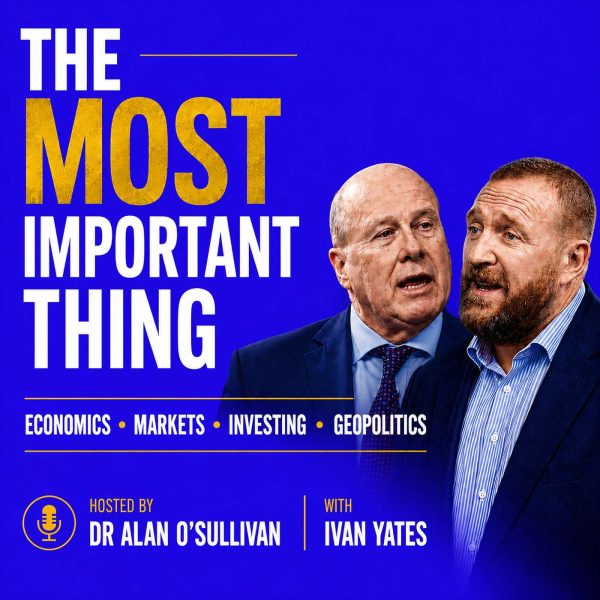
The MOST Important Thing
- Episodios
- 60
- Se publica
- varias veces por semana
- Último episodio
- 13 Nov 2026
Sobre el podcast
The world is full of noise, distraction and now dis-information. How do we extract the truth and become better informed? Join broadcaster Ivan Yates and finance expert Dr Alan O’ Sullivan as they meet the best and brightest minds in finance, investments, economics, and geopolitics. The Most Important Thing reveals what really matters.
Participantes
- Dr Alan O'Sullivan CFP® TEPPresentación
- Ivan YatesCopresentación
Episodios 60
Is the AI Bubble About to Burst? NVIDIA, Interest rates & Energy | Jesse Felder (Part 1)
Is the AI bubble about to burst? Contrarian investor Jesse Felder joins Dr. Alan O’Sullivan on The MOST Important Thing to examine NVIDIA, Big Tech’s AI spending boom, rising US Treasury yields, stubborn …
Notas del episodio
Is the AI bubble about to burst? Contrarian investor Jesse Felder joins Dr. Alan O’Sullivan on The MOST Important Thing to examine NVIDIA, Big Tech’s AI spending boom, rising US Treasury yields, stubborn inflation, and the investment case for gold and energy stocks.
In Part 1, Jesse explains why data-centre opposition and tighter credit markets could threaten the AI infrastructure build-out. They discuss hyperscaler earnings, GPU obsolescence, the risk of overinvestment in AI compute, and why Jesse believes NVIDIA’s share-price chart is signalling a change in momentum.
The conversation then turns to the US 10-year Treasury yield, the possibility of a longer-lasting inflationary regime, and what higher interest rates mean for stock-market valuations. Jesse also makes the case for real assets, exploring gold, commodities, oil and gas producers, the energy capital cycle, and whether an economic slowdown could derail the energy supercycle.
From AI valuations and semiconductor stocks to gold, oil prices and inflation protection, this is a wide-ranging discussion of where investors may be underestimating risk — and overlooking opportunity.
CHAPTERS
00:00 Introduction: Jesse Felder returns
01:00 US elections, inflation and the cost of living
04:05 Data-centre backlash and semiconductor demand
06:43 Hyperscaler earnings, AI capex and credit risk
09:55 GPU obsolescence and the future of AI compute
13:41 Three charts: NVIDIA, Treasury yields and energy
17:25 Rising interest rates and financial-market stress
21:46 A new inflation and interest-rate regime?
25:13 Protecting purchasing power in an inflationary world
26:15 Gold, real assets and the energy supercycle
31:42 Could energy hold up in a recession?
37:24 Physical gold, funds and investor sentiment
CONNECT & FOLLOW
The Felder Report: https://thefelderreport.com
Subscribe to The MOST Important Thing for interviews on investing, financial markets, global macro, asset allocation and long-term wealth.
DISCLAIMER
For education and discussion only. Nothing in this video is personal financial advice. Views expressed by guests are their own.
The Inflation Era: Dr Lacy Hunt on the Keynesian Endgame
Is the global economy entering a new inflationary era — and could rising government debt make the next downturn even harder to manage?In this conversation with Dr Lacy Hunt, Alan O’Sullivan examines the forces …
Notas del episodio
Is the global economy entering a new inflationary era — and could rising government debt make the next downturn even harder to manage?
In this conversation with Dr Lacy Hunt, Alan O’Sullivan examines the forces reshaping the economic outlook: the reversal of globalization, accelerating money supply growth, slowing productivity and labour-force growth, and the escalating cost of servicing government debt.
Dr Hunt introduces what he calls “episodes of the Keynesian Endgame”: a situation in which deficits persist through both recessions and expansions, while rising interest expenses put increasing pressure on fiscal policy. He also explains why the US dollar’s reserve-currency status offers protection — but not necessarily indefinitely.
The discussion turns to what this environment means for investors: inflation expectations, Treasury bills and long-term bonds, the risks posed by heavy AI-related investment, and why an economic slowdown may no longer produce the bond-market response investors have historically expected.
In this episode:
- The shift from globalisation to reshoring and its inflationary implications
- Money supply, the velocity of money and the Fed’s inflation target
- Government deficits, rising interest costs and the “Keynesian Endgame”
- The dollar’s reserve-currency advantage and international capital flows
- Inflation expectations, purchasing power and the outlook for bonds
- AI investment, economic growth and potential financial-market vulnerabilities
- Why economic theories must evolve as the evidence changes
Dr Lacy Hunt is Executive Vice President and Chief Economist at Hoisington Investment Management. He joins Alan O’Sullivan for a discussion of the long-term economic forces that matter far beyond the daily headlines.
Subscribe to The MOST Important Thing for conversations with leading thinkers in economics, investing and business.
Disclaimer: This conversation is for education and information only and does not constitute financial or investment advice. Views expressed are those of the speakers.
#LacyHunt #Inflation #Economics #FederalReserve #GovernmentDebt #Investing
The Most Important Thing - In Focus - Bubble-enomics!
WARNING - This episode should be viewed given the educational content and graphs referred to during the episode.Anyone tells you they "know" what the market is going to do is as dangerous as a one-legged man in …
Notas del episodio
WARNING - This episode should be viewed given the educational content and graphs referred to during the episode.
Anyone tells you they "know" what the market is going to do is as dangerous as a one-legged man in an arse-kicking competition.
We prefer an intelligent framework based on probabilities, valuation and risk management. The core of this is humility.
Is the 60/40 Portfolio Broken? AI, Hedge Funds & the Future of Investing | Dr. Philip Seager (Part 2)
Is the traditional 60/40 portfolio still fit for purpose? What should investors look for in a systematic fund manager? And how is AI changing the careers of people working in finance?In Part 2 of The Most …
Notas del episodio
Is the traditional 60/40 portfolio still fit for purpose? What should investors look for in a systematic fund manager? And how is AI changing the careers of people working in finance?
In Part 2 of The Most Important Thing, Alan O’Sullivan continues his conversation with Dr. Philip Seager, Head of Portfolio Strategy at Capital Fund Management (CFM).
Beginning with the 2008 financial crisis, Philip explains why trend-following strategies stood out during a prolonged market downturn and how investors might think about allocations to genuinely diversifying strategies. They discuss the changing correlation between stocks and bonds, inflationary regimes, the limits of private equity as a diversifier, and why a manager’s investment process may be more revealing than a recent performance chart.
The discussion then turns to CFM’s scientific research culture and the profound impact of artificial intelligence on quantitative finance. Philip describes how AI-assisted coding and prompt-based research are transforming daily workflows, while stressing the continuing importance of domain expertise, critical thinking and statistical judgement.
To close, they explore the influence of physics on financial research, recommended reading, the wisdom of crowds and how market flows shape prices.
Topics include managed futures, the 2008 crisis, portfolio construction, manager selection, inflation, stocks and bonds, AI in finance, scientific research and behavioural markets.
Explore CFM and the resources discussed:
Capital Fund Management on LinkedIn
https://www.linkedin.com/company/capital-fund-management/
Any statements regarding market events, future events or other similar statements constitute only subjective views, are based upon expectations or beliefs, involve inherent risks and uncertainties and should therefore not be relied on. Future evidence and actual results could differ materially from those set forth, contemplated by or underlying these statements. In light of these risks and uncertainties, there can be no assurance that these statements are or will prove to be accurate or complete in any way.
All opinions and estimates included in this document constitute judgments as at the date of this document and are subject to change without notice. CFM accepts no liability for any inaccurate, incomplete or omitted information of any kind or any losses caused by using this information. CFM does not give any representation or warranty as to the reliability or accuracy of the information contained in this document.
The information provided in this document is general information only and does not constitute investment or other advice. The content of this document does not constitute an offer or solicitation to subscribe for any security or interest.
The interviewer selected the graphs and images; CFM was not involved in that decision.
Can AI Beat Fund Managers? Quant Investing, Market Luck & Crisis Protection | Dr. Philip Seager (Part 1)
Can artificial intelligence outperform traditional fund managers? And how much of successful investing is genuine skill rather than market luck?In Part 1 of The Most Important Thing, Alan O’Sullivan speaks with …
Notas del episodio
Can artificial intelligence outperform traditional fund managers? And how much of successful investing is genuine skill rather than market luck?
In Part 1 of The Most Important Thing, Alan O’Sullivan speaks with Dr. Philip Seager, Head of Portfolio Strategy at Capital Fund Management (CFM), about the science behind quantitative investing and what it means for constructing more resilient portfolios.
Drawing on his background in experimental particle physics and more than 25 years at CFM, Philip explains how systematic investors use large datasets, statistical testing and increasingly AI to identify investment opportunities. He also explores why impressive backtests can be misleading, how market beta can be mistaken for manager skill, and why traditional diversification may fail investors when they need it most.
The conversation examines trend following as a potential source of genuine diversification, including its behaviour during prolonged equity drawdowns, the limitations exposed by rapid market reversals, and the difference between trend following and buying downside insurance.
Topics include quantitative versus discretionary investing, alternative data, AI and neural networks, overfitting, active management, the 60/40 portfolio, trend following and crisis alpha.
Read Philip’s Financial Times article referenced in the conversation:
Philip Seager — Financial Times: Beating the Market Is Even Harder Than You Think
https://www.ft.com/content/299b4cd0-9ce8-431e-aaec-3f7b8d704910
Capital Fund Management on LinkedIn
https://www.linkedin.com/company/capital-fund-management/
https://share.google/7AWCMqojgoG1tyZpc
The Most Important Thing Podcast | Hosted by Alan O’Sullivan
Important Disclaimer
Any statements regarding market events, future events or other similar statements constitute only subjective views, are based upon expectations or beliefs, involve inherent risks and uncertainties and should therefore not be relied on. Future evidence and actual results could differ materially from those set forth, contemplated by or underlying these statements. In light of these risks and uncertainties, there can be no assurance that these statements are or will prove to be accurate or complete in any way. All opinions and estimates included in this document constitute judgments as at the date of this document and are subject to change without notice. CFM accepts no liability for any inaccurate, incomplete or omitted information of any kind or any losses caused by using this information. CFM does not give any representation or warranty as to the reliability or accuracy of the information contained in this document. The information provided in this document is general information only and does not constitute investment or other advice. The content of this document does not constitute an offer or solicitation to subscribe for any security or interest. The interviewer selected the graphs and images; CFM was not involved in that decision.
Do financial markets learn from their mistakes—or do fear and greed ensure that history keeps repeating itself?
In this episode of The Long & Short, Ivan Yates and Dr Alan O’Sullivan revisit the Wall Street Crash of 1929, the 2008 global financial crisis and today’s concerns around AI valuations, defence stocks and …
Notas del episodio
In this episode of The Long & Short, Ivan Yates and Dr Alan O’Sullivan revisit the Wall Street Crash of 1929, the 2008 global financial crisis and today’s concerns around AI valuations, defence stocks and changing investment regimes. From speculative bubbles to excessive private debt, they explore why crashes happen, what investors can learn from previous cycles, and whether the old investment playbook still works.
Featuring insights from previous conversations with financial historian Edward Chancellor, economist Professor Steve Keen and investor Jesse Felder, alongside an additional perspective from financial historian Professor Russell Napier.
Topics covered: historical bubbles and market psychology; the role of private debt in 2008; falling interest rates and the shift towards real assets; bull and bear markets; AI and dot-com comparisons; contrarian positioning; economic cycles; and lessons from Ireland’s financial history.
Previous guest interviews featured in this episode:
Edward Chancellor — The Price of Time and historical market bubbles
Professor Steve Keen — How he predicted the 2008 crash
Jesse Felder — The market paradigm shift since the 1980s
Professor Russell Napier — The New Rules of Money (Part 1)
Subscribe to The MOST Important Thing for interviews and commentary on markets, investing, economics and geopolitics.
For information and educational purposes only. Nothing in this episode constitutes personal investment advice. Investments involve risk, including possible loss of capital.
#FinancialMarkets #Investing #MarketHistory #FinancialCrisis #AI #Economics
"Buy Bonds, Wear Diamonds" - Are we there yet?
Are Bonds a Buy?This episode explores whether bonds are becoming attractive again amid sticky inflation, rising fiscal concerns, and the AI spending boom. Alan argues that bond markets are pricing in deeper …
Notas del episodio
Are Bonds a Buy?
This episode explores whether bonds are becoming attractive again amid sticky inflation, rising fiscal concerns, and the AI spending boom. Alan argues that bond markets are pricing in deeper risks, but the best opportunity to buy may come after a significant sell-off in US stocks.
Key topics
- Why Treasury yields have fallen despite hotter-than-expected inflation
- How public debt, fiscal deficits, and bond-market volatility may affect equities
- Why corporate bond yields could be an early warning for stocks
- How falling real yields could make gold more attractive
- Europe’s weak growth outlook and pressure on the euro
- Inflation, interest rates, and the resilient US economy
- Why Alan’s verdict on bonds is “not yet”—and what he’s watching next
Timestamps
00:00 — Are bonds a buy?
01:56 — Falling yields despite hot inflation
03:32 — The potential link between an equity correction and a bond-buying opportunity
05:31 — Debt, deficits, and bond-market concerns
06:21 — Real yields and gold
07:39 — Europe’s growth and debt concerns
08:59 — Inflation and the possibility of more Fed hikes
13:31 — Why the US economy still looks resilient
14:46 — Final verdict on bondsWill AI Replace White-Collar Jobs? The Future of Growth | Robert Gordon — Part 2
Will artificial intelligence transform economic growth—or are expectations running far ahead of reality? And what does the rise of AI mean for graduates, white-collar professionals and the future of work?In …
Notas del episodio
Will artificial intelligence transform economic growth—or are expectations running far ahead of reality? And what does the rise of AI mean for graduates, white-collar professionals and the future of work?
In Part 2 of his conversation with Dr Alan O’Sullivan, renowned economist and Northwestern University professor Robert J. Gordon challenges predictions of limitless AI-driven growth. He explains why many human-centred and physical jobs remain difficult to automate, while roles involving computer-based tasks could face significant disruption.
The discussion also examines the economics behind the AI investment boom: who will ultimately generate the revenue needed to justify enormous spending on data centres, chips and electricity? Professor Gordon considers the implications for productivity, education and independent thinking, drawing on his experience teaching university students.
Turning to the longer-term outlook, Gordon identifies population ageing and declining fertility as central challenges to economic growth. He discusses retirement ages, immigration, inequality and why the labour market may increasingly favour skilled trades over traditional graduate careers.
They close with a recommendation of Brad DeLong’s Slouching Towards Utopia and Gordon’s advice to young people planning a career in an AI-driven economy.
Topics discussed- AI, automation and the future of white-collar employment
- Productivity, technological progress and the return on AI investment
- University education, examinations and AI-generated coursework
- Demographics, fertility, retirement and long-term economic growth
- Immigration, income inequality and skilled-trades shortages
- Career advice and book recommendations
Robert Gordon TED Talk — The death of innovation, the end of growth https://www.youtube.com/watch?v=PYHd7rpOTe8&pp=0gcJCR0AztywvtLA
Subscribe to The MOST Important Thing for conversations on economics, investing, wealth and the forces shaping our future.
Disclaimer: This episode is for general information and discussion only and does not constitute financial or investment advice.
Gold, Commodities & the Coming Monetary Reset | Alan O’Sullivan and Ivan Yates
Is gold the ultimate portfolio insurance — or has its extraordinary rise made it too risky? And could a changing global monetary order reshape how we invest?In this episode of The MOST Important Thing, Dr Alan …
Notas del episodio
Is gold the ultimate portfolio insurance — or has its extraordinary rise made it too risky? And could a changing global monetary order reshape how we invest?
In this episode of The MOST Important Thing, Dr Alan O’Sullivan and Ivan Yates examine gold’s role in a diversified portfolio, the central-bank buying driving demand and the question of trust in the US dollar. They also discuss silver, copper, uranium, oil and other real assets, before weighing the opportunities and risks of Bitcoin.
Drawing on conversations with Ronnie Stoeferle, Russell Napier and Justin Huhn, Alan explores what a potential monetary reset could mean for investors — and why portfolio diversification may matter more than ever.
Previous guest interviews referenced in this episode:
Ronnie Stoeferle — Gold, Trust and the Monetary System — https://podcasts.apple.com/ie/podcast/ep2-why-gold-is-the-best-hedge-against-a/id1876953002?i=1000751266217
Justin Huhn — Uranium and Nuclear Energy — https://podcastrex.com/shows/the-most-important-thing/uraniums-long-runway-china-scarcity-the-nuclear-investment-opportunity
Russell Napier — Gold and the Monetary Reset — https://open.spotify.com/episode/1Aqq65d972ehdcjQOAtxl1
Topics include: gold allocation and volatility; central-bank reserves; inflation and commodities; nuclear energy; Bitcoin as a store of value; and the future of the global monetary system.
Subscribe for more insights from The MOST Important Thing. Available on YouTube, Spotify and Apple Podcasts.
IMPORTANT - PLEASE READ
For information and educational purposes only. Nothing in this episode constitutes personal investment advice.
Robert Gordon: Why the Great Era of Economic Growth May Be Over | Part 1
Professor Robert J. Gordon, one of the world’s leading economists on productivity and long-run economic growth, joins Alan O’Sullivan to examine why the extraordinary gains of the past two centuries may be …
Notas del episodio
Professor Robert J. Gordon, one of the world’s leading economists on productivity and long-run economic growth, joins Alan O’Sullivan to examine why the extraordinary gains of the past two centuries may be becoming harder to repeat.
In Part 1, Gordon explains the difference between economic growth and productivity, traces the three major industrial revolutions, and discusses why the period from 1920 to 1970 delivered such exceptional productivity growth. He also revisits the central thesis of The Rise and Fall of American Growth and explains why productivity growth has slowed since the mid-2000s.
The conversation then turns to the major headwinds facing advanced economies: ageing populations, rising public debt, inequality and the diminishing contribution of education to productivity. Gordon also discusses the contrast between mature economies and faster-growing developing countries, as well as the role of energy, electrification and technology in future growth.
Topics include:
• Economic growth vs productivity
• The three industrial revolutions
• Why 1920–1970 was an exceptional period for productivity
• The post-2005 productivity slowdown
• Demographics and ageing populations
• Government debt and interest rates
• Inequality and living standards
• Education and graduate underemployment
• Growth in China, India and the developing world
• Energy, electrification and the transition away from fossil fuels
Part 2 continues the discussion with artificial intelligence, white-collar employment, education, demographics, retirement, immigration and advice for young people entering the labour market.
Ted talk: https://www.youtube.com/watch?v=PYHd7rpOTe8
Amazon UK – Robert J. Gordon, The Rise and Fall of American Growth
The Long & Short Ep. 2 | Debt, Demographics & Sustainability
In Episode 2 of The Long & Short, Ivan Yates and Dr. Alan O'Sullivan examine three of the major forces shaping economies, markets and long-term investment decisions: debt, demographics and …
Notas del episodio
In Episode 2 of The Long & Short, Ivan Yates and Dr. Alan O'Sullivan examine three of the major forces shaping economies, markets and long-term investment decisions: debt, demographics and sustainability.
The discussion moves from the global sustainability challenge and the renewed debate around nuclear energy to rising government debt and the consequences of increasingly heavy debt burdens. Ivan and Alan also explore what could happen if confidence in sovereign debt is tested and why the financial system ultimately depends on trust.
They then turn to demographics and pensions, including falling worker-to-retiree ratios, longer life expectancy and the pressure these trends place on state pension systems. The episode also looks at private credit and shadow banking, liquidity and underwriting risks, Ireland's deemed disposal rules, and the role of state savings and government bonds in a portfolio.
Topics include:
• Debt, deficits and diminishing economic returns
• US government debt and the Treasury market
• Climate, energy security and nuclear power
• Ageing populations and pension sustainability
• Private credit and shadow banking risks
• Deemed disposal and long-term investing in Ireland
• State savings, government bonds and inflation
Featured clips from previous episodes:
• Justin Huhn – Part 1: Is Uranium the Most Important Investment Story of the Next Decade?
• Justin Huhn – Part 2: Uranium’s Long Runway: China, Scarcity & the Nuclear Investment Opportunity
• Mike Bell, CFA – Part 1: How to Gain an Edge in Markets: History, Cycles & Bubbles
• Mike Bell, CFA – Part 2: Gaining an Edge in Financial Markets
• Dr. Lacy Hunt – The Debt Crisis Nobody Wants to Talk About
• Prof. Brian O'Kelly – Banking Risk, Debt & the Future of Finance
The Long & Short is part of The Most Important Thing, with Ivan Yates and Dr. Alan O'Sullivan, looking beyond the headlines at the forces driving markets, economies and investment portfolios.
Listen / Watch:
Spotify: The MOST Important Thing
YouTube: @TheMOSTImportantThingPod
Ivan Yates: The Game of Life – Success, Failure & Reinvention | The Most Important Thing
In this special episode of The Most Important Thing, the roles are reversed as Alan O’Sullivan sits down with Ivan Yates following the release of his new book, The Game of Life: And How to Win It.Drawing on 50 …
Notas del episodio
In this special episode of The Most Important Thing, the roles are reversed as Alan O’Sullivan sits down with Ivan Yates following the release of his new book, The Game of Life: And How to Win It.
Drawing on 50 years of experience across politics, business and broadcasting, Ivan reflects on the lessons that shaped his life – from leaving school early and becoming Ireland’s youngest TD at the time, to building a business, facing bankruptcy, reinventing himself in broadcasting and continuing to take on new challenges.
Alan and Ivan discuss success, failure and self-responsibility; the importance of people skills and relationships; leadership and resilience; recovering from major setbacks; knowing when to reinvent yourself; and how ambition changes as you move through life.
They also look at what the rise of AI means for the next generation – and why Ivan believes that in a world where information is increasingly accessible, relationships, communication and the ability to connect with people matter more than ever.
The Game of Life brings together Ivan’s own hard-earned lessons with insights gathered from around 200 people whose advice and experiences feature in the book across business, politics, sport, public service and media.
Buy Ivan Yates’ new book, The Game of Life: And How to Win It, using the links below.
Book Links
The Game of Life: And How to Win It by Ivan Yates is published by Gill Books. ISBN: 9781804583456.
Gaining an edge in Financial Markets with Mike Bell, CFA - Part 2
Mike Bell on History, Cycles, and Building Portfolios for Different RegimesMike Bell walks through the framework he uses to understand markets: study financial history, identify the cycle you are in, and match …
Notas del episodio
Mike Bell on History, Cycles, and Building Portfolios for Different Regimes
Mike Bell walks through the framework he uses to understand markets: study financial history, identify the cycle you are in, and match assets to the regime rather than to a simple stock-bond split. He explains why politics, demographics, debt, and central bank policy matter as much as traditional market data. In this interview, Alan speaks with Mike Bell, a macro and investment strategist, about how he built his approach from the 2008 financial crisis onward and why he thinks the biggest mistake investors make is looking at too little history. They also discuss inflation, gold, bonds, financial repression, and how AI may reshape investing and work.
Key Topics
- Mike Bell shares how his interest in markets began with political philosophy, economics, and an early fascination with the relationship between politics and real-world outcomes.
- He describes starting in markets in April 2008 and learning his craft during the financial crisis, when markets were falling hard and investors needed a framework for when to buy risk again.
- We discuss the indicators he used after the crisis, including valuations, initial jobless claims, homebuilding data, new home sales, and other leading indicators that often turned before markets did.
- Mike explains why he believes financial history is essential, not optional, and why he looks back not just 10 years but 100 years or more when possible.
- He argues that cycles are driven by both fundamentals and sentiment, but that sentiment usually affects timing more than the root cause of bubbles and crashes.
- In the episode, he outlines his “zooming out” approach, which means studying long-term history, politics, wars, debt cycles, and structural changes such as demographics and productivity.
- He also outlines “zooming in” by dissecting data more deeply than the headline number, using non-farm payrolls and inflation components as examples.
- Mike discusses why correlations change in stress periods, why 2022 mattered so much for portfolios, and why a plain 60-40 portfolio may not be enough in every regime.
- He explains what tends to work in different environments, including gold, cash, inflation-linked bonds, commodities, and certain government bonds, depending on inflation, growth, and debt conditions.
- We cover the debt problem in developed economies, especially the US and Europe, and why he expects financial repression to remain a major theme.
- Mike closes by explaining how AI can help young investors learn faster, but also why technology that benefits only a small group may trigger political backlash.
Chapters - Part 2 of my interview with Mike Bell, CFA
1 - The short-term business cycle and how it turns
2 - Long-term debt cycles across government, household, and corporate balance sheets
3 - Why momentum, central banks, and fiscal policy drive turning points
4 - Inflation, stock-bond correlations, and why the 1970s matter
5 - What to own when stocks and bonds both struggle
6 - A better benchmark for diversification
7 - What hedges equity risk in stressed environments
8 - Debt, aging populations, and the future of financial repression
9 - How young investors should use AI without overestimating it
10 - Why innovation has to benefit the majority to stay politically sustainable
11 - How to follow Mike Bell’s workKey Frameworks
- Zooming out: Study long-run history, politics, and structural cycles.
- Zooming in: Break down headline data into components and leading signals.
- Short-term business cycle: Track interest rates, inflation, unemployment, wage growth, and credit.
- Long-term debt cycle: Examine public, household, corporate, and financial-sector leverage over decades.
- Regime-based investing: Match assets to the inflation and growth environment rather than assuming one allocation works everywhere.
Action Items
- Study market history beyond the last decade, especially past bubbles, recessions, and inflation regimes.
- Break down macro data into components instead of relying only on headline releases.
- Build portfolios around different regimes, not just around stock and bond exposure.
- Consider gold, inflation-linked bonds, cash, and commodities as part of broader diversification.
- Use AI as a research accelerator, not as a replacement for judgment.
Want to follow Mike and keep the learning going?
Check out Mike's LinkedIn page. He shares a phenomenal amount of useful learning material every week (and most days)!
https://www.linkedin.com/in/mike-bell-cfa/
How to Gain an Edge in Markets: History, Cycles & Bubbles | Mike Bell, CFA — Part 1
Episode DescriptionWhat does it actually take to gain an edge in financial markets? In Part 1 of our conversation with Mike Bell, CFA, Mike joins Alan to explain the investment framework he has developed over …
Notas del episodio
Episode Description
What does it actually take to gain an edge in financial markets?
In Part 1 of our conversation with Mike Bell, CFA, Mike joins Alan to explain the investment framework he has developed over more than two decades in markets — beginning with a front-row seat to the 2008 Global Financial Crisis.
Mike explains why investors need to both "zoom out" and "zoom in": zooming out across more than a century of financial history, politics, economic cycles and market crises, while zooming in on the underlying economic data that headline numbers can often obscure.
They discuss the lessons of the 2008 Financial Crisis, the role of fear and greed in financial bubbles, why economic fundamentals matter more than sentiment alone, and how historical data can help investors identify turning points.
The conversation also explores the interaction between interest rates, inflation, unemployment, credit and fiscal policy, the difference between short-term business cycles and long-term debt cycles, and why demographics and productivity could make the decades ahead very different from the past.
Topics include:
· Mike Bell’s experience investing through the 2008 Financial Crisis
· How financial history can improve investment decisions
· Why bubbles form — and whether markets are in one today
· Finding an investment edge by "zooming in" and "zooming out"
· Using leading economic indicators to identify turning points
· Interest rates, inflation, unemployment and the business cycle
· Short-term and long-term debt cycles
· Monetary policy vs fiscal policy
· Geopolitics, energy shocks and the Ukraine war
· Why demographics and productivity matter for long-term growth
· How economic regimes influence stocks, bonds and gold
The Most Important Thing brings together leading investors, economists and thinkers to discuss the frameworks and ideas that matter most when making investment decisions.The New Geopolitical Disorder: What It Means for Investors | The Long & Short Ep. 1
Description The global order is changing — but what does that actually mean for investors? In Episode 1 of The Long & Short, Ivan Yates and Alan O’Sullivan examine the emergence of a more multipolar world, the …
Notas del episodio
Description
The global order is changing — but what does that actually mean for investors?
In Episode 1 of The Long & Short, Ivan Yates and Alan O’Sullivan examine the emergence of a more multipolar world, the decline of the post-war global order, and the growing influence of geopolitics on markets and investment decisions.
From the rise of China and Russia to Trump, tariffs, deglobalisation and European security, Ivan and Alan explore the major forces reshaping the global economy — and ask whether investors should react to geopolitical risk or simply stay invested and look through the noise.
They discuss:
• The shift from a US-led unipolar world to multipolarity
• China, Russia and competing spheres of influence
• The risk of wider global conflict
• Trump, Iran and the changing role of the United States
• Deglobalisation, reshoring and the implications for inflation
• Defence, aerospace and energy-security investment opportunities
• China’s demographic challenge
• Ireland’s exposure to changes in global trade and European security
• How investors should approach geopolitical riskWatch our full interview with Louis-Vincent Gave:
https://youtu.be/VZoV6Nd_wNc?si=9rN5rDZcHTGv-bgKWatch our full interview with Matt Gertken:
https://youtu.be/Dp5eLCgyXzA?si=v3g3G8wcZw5ZlIrnThe Long & Short brings together politics, economics and markets, with Ivan Yates and Dr Alan O’Sullivan examining the major issues shaping the investment landscape.
Subscribe to The Most Important Thing for more interviews, market analysis and investment insights.
Make Yourself Heard: The Career Lessons Nobody Teaches You
In Part 2 of our conversation, Anne-Marie Curtin discusses how family, career pivots, and mentorship shaped her path, plus the practical ways she built confidence as a speaker and writer.Key topicsA major theme …
Notas del episodio
In Part 2 of our conversation, Anne-Marie Curtin discusses how family, career pivots, and mentorship shaped her path, plus the practical ways she built confidence as a speaker and writer.
Key topics
- A major theme is communication: she describes executive coaching, Toastmasters, writing discipline, and how she learned to be concise, clearer, and more confident in the room.
- She talks about the support she received as a working mother in London, including mentoring, flexible boundaries, and senior women setting an example.
- Anne-Marie also shares a personal project, co-writing her mother’s memoir about growing up in Kilkenny in the 1950s.
- Special advice for young career professionals in this world of AI
- Working in a high-pressure role while raising young children
- Senior women, boundaries, and a model of sustainable success
- Being Irish in London and seeing the city through a family story
- Why communication is hard and why it matters so much
- Toastmasters, coaching, and learning to speak with confidence
- What makes a great presenter
- Advice for young people who want to improve communication
- Paper communication and physical communication
- Writing a memoir with her mother about 1950s Kilkenny
- Advice to young people entering finance today
- Books, Masterclass, and the habit of learning every day
- Mentors, executive coaching, and leadership development
- The most important lesson from her career and personal life
Anne-Marie referred to two specific books in the interview:
- 168 Hours: You Have More Time Than You Think — Laura Vanderkam
This is the time-management book Anne-Marie describes as having “moved the dial” for her when she was a young mother working at the Bank of England. It was originally published in 2010.
Laura Vanderkam – 168 Hours (official book page)
Google Books – 168 Hours - Becoming — Michelle Obama
Anne-Marie says she “absolutely adored” this memoir, particularly Michelle Obama's account of navigating her career alongside motherhood and family life. The memoir was originally published in 2018.
Becoming – Official Michelle Obama book site
Penguin UK – Becoming (includes purchase options)
Here is the official MasterClass website Anne-Marie is referring to:
MasterClass — Official Website
It includes courses across communication, leadership, writing, business, AI, science and technology, among others.
A "Front-Row" seat to the crises that have defined the last 20 years - AnnMarie Curtin
AnneMarie Curtin has had a fascinating career spanning financial regulation, crisis management, consulting and global banking. She spent part of her career on the regulatory side, leading supervisory teams at …
Notas del episodio
AnneMarie Curtin has had a fascinating career spanning financial regulation, crisis management, consulting and global banking.
She spent part of her career on the regulatory side, leading supervisory teams at both the Central Bank of Ireland and the Bank of England, during the enormous regulatory changes that followed the Global Financial Crisis. Her experience subsequently took her into consulting with EY, before she moved into Bank of America as the bank expanded its European operations following Brexit. AnneMarie has more than 20 years' experience across finance, risk management and prudential regulation, including her former role as Head of Recovery & Resolution for the European subsidiary of a global US bank.
What I particularly liked about AnneMarie’s story was that her reputation and professional network played an important role in opening those doors. It is a good example of how expertise, relationships and the ability to operate in complex environments can create career opportunities you may never have planned for.
But the move into American banking brought another lesson.
AnneMarie found herself in a fast-paced, high-performing US banking culture, and received an important piece of feedback: technical knowledge and hard work were not enough on their own. If she wanted to progress, she needed to learn how to hold a room, project her voice and communicate with enough confidence to influence the people making decisions.
Rather than retreat from that feedback, she acted on it — investing in executive coaching and Toastmasters and deliberately developing the communication skills to complement her technical expertise.
And I think that provides one of the central themes for our conversation: career progression isn't simply about becoming better at your job. It's also about developing the confidence, communication skills and relationships that allow your expertise to have an impact.
AnneMarie is now a Director in Grant Thornton Ireland's Banking Risk Advisory practice, which she joined in February 2023.
Share price dropped by 35% since the start of your speech Mr. Goodwin? Decades of experience across Banking, Markets & Risk. A Masterclass from one of Irelands most respected financial experts.
Prof. Brian O'Kelly on banking risk, debt, and the future of financeAlan interviews Brian O'Kelly, Emeritus Professor of Finance at Dublin City University and former chair of the SCA advisory …
Notas del episodio
Prof. Brian O'Kelly on banking risk, debt, and the future of finance
Alan interviews Brian O'Kelly, Emeritus Professor of Finance at Dublin City University and former chair of the SCA advisory committee at the National Treasury Management Agency, about how his career moved from engineering into finance, then into academia and risk management. The conversation focuses on banking regulation, liquidity, debt sustainability, and how AI and data are changing both markets and education. We discuss how Brian’s career was shaped by applied maths, commodity risk at ESB, and the formative MSc in Investment Treasury Banking at DCU. He also shares sharp views on Basel regulation, the post-2008 banking system, and why real interest rates, liquidity, and demographics matter more than most headlines suggest.
Key topics
- Brian shares how he “fell into” finance through engineering and applied maths, then moved from ESB into commodity risk management.
- In the episode: how volatile oil prices in the 1980s pushed him toward risk management and the MSc in Investment Treasury Banking.
- Brian explains how the DCU program became his entry point into lecturing, academic life, and later consulting work with AIB.
- We discuss the evolution from Basel I to Basel II and Basel III, and why Basel II’s reliance on historical data helped set up problems before the 2008 crisis.
- Brian breaks down the difference between capital and liquidity regulation, arguing that liquidity rules were the real game-changer after 2008.
- He argues that Irish banking is now far stronger on liquidity and funding than before, but that the traditional banking business model is still under pressure.
- Brian shares why Silicon Valley Bank was vulnerable, especially because many depositors were above the FDIC-style guarantee threshold.
- We discuss private credit and non-bank lenders, with Brian saying the danger only rises if banks become too exposed to them.
- Brian gives a blunt view on sovereign debt, especially the US path of persistent deficits and rising interest costs.
- He explains why he sees real interest rates as one of the most useful single data points for judging whether markets are becoming overheated.
- The conversation also covers AI, demographics, and why he thinks technology may create efficiencies but cannot fully offset a shrinking working-age population.
- Brian reflects on teaching in China, the changing nature of student learning in the age of AI, and why educators now need to ask better questions rather than reward memorization.
- He closes with advice for graduates: follow what you love, because the industry may shrink, but genuine interest and competence still rise to the top.
Key frameworks
- Basel I to Basel III
- A progression from blunt risk weights to internal models, then to liquidity-focused rules after 2008.
- Capital versus liquidity
- Capital matters when assets fail.
- Liquidity matters when funding disappears.
- Real interest rates as a signal
- Brian treats real yields as a simple but powerful gauge of whether markets are in “sober territory.”
- Data and regime change
- Historical models only work if the underlying economic regime remains similar enough to the past.
Uranium’s Long Runway: China, Scarcity & the Nuclear Investment Opportunity
Justin Huhn on China, uranium scarcity, and how to think about the nuclear investing cycleThis is part two of a deep-dive conversation with Justin Huhn, founder and publisher of Uranium Insider, focused on the …
Notas del episodio
Justin Huhn on China, uranium scarcity, and how to think about the nuclear investing cycle
This is part two of a deep-dive conversation with Justin Huhn, founder and publisher of Uranium Insider, focused on the nuclear fuel cycle, uranium supply-demand dynamics, and what investors should watch next. The discussion centers on China’s reactor buildout, the role of term pricing versus spot pricing, strategic inventories, and how to size positions across the uranium space.We discuss the practical bull and bear cases for uranium, why jurisdiction matters, and how Justin thinks about portfolio construction in a sector where a few names dominate and volatility remains high.
Key topics
- Justin Huhn explains why China is the most important near-term growth story in nuclear, with more than 38 reactors under construction and a stated target of 150 gigawatts by 2035.
- We discuss how China’s reactor buildout, electrification push, and long planning horizon make its demand model unusually visible over the next five to seven years.
- Justin contrasts China’s aggressive new-build strategy with Australia’s lack of nuclear development despite its large uranium reserves.
- The conversation breaks down why restarts are rare, why new builds matter more, and why levelized cost of electricity can be misleading when comparing nuclear with wind and solar.
- Justin argues that advanced nuclear offers much stronger energy return on energy invested than intermittent renewables backed by storage.
- We cover strategic uranium inventories, including China’s accumulation of material, and why sovereign stockpiling could create additional right-tail demand not fully captured in models.
- Justin explains why the uranium market is priced more off term contracts than spot, especially for developers and utilities buying for the long term.
- We discuss how scarcity in uranium is less about the size of the resource base and more about the difficulty, cost, and time required to bring new production online.
- Jurisdiction is a major valuation factor, with examples ranging from Cameco in Canada to Kazatomprom in Kazakhstan and Global Atomic in Niger.
- Justin makes the case for position sizing, cash management, and using liquid foundations like Sprott Physical Uranium Trust as core exposure before adding speculative juniors.
Timestamps
00:00 - Part two setup and what the discussion will cover
02:42 - Why China is the key growth story for nuclear demand
03:32 - China’s reactor construction pace and 150 gigawatt target
06:44 - China versus Australia: reserves, policy, and nuclear adoption
09:58 - Why reactor restarts are rare and often costly
10:36 - Why levelized cost of electricity can distort the nuclear comparison
11:07 - Energy return on energy invested and the case for nuclear
14:07 - Strategic inventories and China’s long-term uranium stockpiling
18:00 - Why sovereign stockpiling could create right-tail demand
21:46 - Why uranium scarcity is really about mining difficulty and timing
24:06 - Why a sustained uranium price above $150 matters for new supply
28:40 - Why term pricing matters more than spot for utilities and developers
32:50 - How jurisdiction affects uranium equity valuation
34:02 - Why Cameco is unusually diversified across the nuclear fuel cycle
35:15 - Global Atomic, Niger, and jurisdictional risk
40:19 - How sizing saved the model portfolio during losing positions
43:33 - Why Sprott Physical Uranium Trust is a foundational position
45:07 - Why juniors can work later in the cycle, but remain speculative
47:55 - When ETFs make more sense than picking individual names
49:44 - The main bear case: a major nuclear accident or demand destruction
51:02 - Why surprise supply is unlikely in the modeled time frame
55:27 - Where Justin gets his information and which analysts he follows
59:40 - What Uranium Insider covers and how the service is structured
61:48 - Why spot can look flat while term pricing and utility activity keep rising
67:19 - Daily, weekly, and monthly research outputs for subscribers
68:46 - Closing remarks and appreciation for the discussionKey frameworks
- Term price versus spot price - Justin treats term pricing as the more useful signal for long-term uranium fundamentals because it reflects utility purchasing behavior.
- Jurisdictional discount - Mining assets in unstable or politically risky regions deserve lower valuation than comparable assets in safer jurisdictions.
- Position sizing first - In a volatile, long-cycle sector, sizing matters as much as stock selection.
- Core plus satellite allocation - Start with liquid, lower-risk exposure such as physical uranium trusts, then layer in higher-risk juniors selectively.
Website: Uranium Insider
Contact email: [email protected]. Their official contact page directs general service and uranium-market enquiries to this address.
Founder & Publisher: Justin Huhn
Subscription: Uranium Insider Pro
The Grid Is the New Oil: Michael Lewis (DWS) on Electrification, Critical Minerals & Energy Security
Episode SummaryAlan is joined by Michael Lewis, Head of ESG Research at DWS and a three-decade veteran of Deutsche Bank's FX, commodities, and sustainability research desks. Drawing on three DWS research …
Notas del episodio
Episode Summary
Alan is joined by Michael Lewis, Head of ESG Research at DWS and a three-decade veteran of Deutsche Bank's FX, commodities, and sustainability research desks. Drawing on three DWS research papers co-authored with Stefan Kutscher (Head of Stewardship), Michael and Alan trace the energy transition from raw materials to the grid to the geopolitics reshaping it — arguing that "ESG" has effectively been repackaged as national security and financial stability. They dig into the structural copper deficit, why lithium keeps burning investors despite a strong long-term story, China's dominance over rare earths and refining, the US government's equity stake in MP Materials, grid and transformer bottlenecks with lead times stretching 2–5 years, the collision between data centres, EV charging, and renewables for scarce grid capacity, Ireland's outsized (and growing) data centre power burden, on-site generation and small modular reactors, the uranium investment case, and Germany's venture capital gap and industrial reinvention. Michael closes with his "most important thing": investors radically underestimate both recurring geopolitical shocks and physical climate risk to portfolios.Guest Bio
Michael Lewis is Head of ESG Research at DWS, one of Europe's leading global asset managers. Over more than three decades at Deutsche Bank/DWS he has held roles including Global Head of Commodities Research and Deputy Head of FX Research. He now leads DWS's research into the major sustainability trends shaping the global economy — climate risk, biodiversity, and the energy transition. He holds economics degrees from the University of Bristol and the London School of Economics.Papers referenced in this episode (co-authored with Stefan Kutscher, Head of Stewardship at DWS):
- The New Energy System: Navigating the Shift from Molecules to Electrons
- Germany's Next Industrial Revolution: Vorsprung durch Technik
- A third paper on European transformation and critical technologies (referenced but not individually titled in conversation)
Timestamps- 03:48 — Welcome and guest introduction
- 04:20 — Michael's career arc: FX (birth of the Euro) → commodities supercycle → ESG/sustainability, and why sustainability is the most complex of the three
- 06:01 — Is "ESG" being reframed as national security and financial stability?
- 09:36 — The three mega forces (geopolitical fragmentation, energy transition, AI/tech disruption) and how bottlenecks show up in valuations
- 12:45 — Copper: only 14 new deposits discovered since 2016 vs. 225 since 2003 — is the structural deficit now baked in?
- 15:37 — Lithium's boom-bust cycles: how investors "burnt twice" should size exposure (diversified equity vs. spot)
- 18:57 — China's grip: 70% of lithium/cobalt, 90%+ of rare earths — and the new geopolitical bargaining chip
- 21:34 — Inside the US DoD–MP Materials deal: equity stakes, price floors, and emerging two-tier commodity pricing
- 24:03 — Where the real bottleneck sits: transmission and distribution, not power generation
- 26:38 — The "great power infrastructure competition" — data centres, EV charging, and renewables all fighting for the same grid capacity
- 29:26 — Why renewable projects are the most exposed: cheap to build, stuck in multi-year interconnection queues
- 31:10 — Ireland's data centre power problem: from ~5% of metered electricity in 2015 to a projected ~33% by 2030
- 35:00 — Ireland's high electricity prices and the puzzle of muted public pushback
- 36:01 — On-site generation and SMRs: Microsoft's Three Mile Island restart, Google's small modular reactor deal, and the hybrid grid model
- 38:05 — The uranium and nuclear investment case as clean baseload — and why it's a genuinely hard market to play
- 40:53 — Germany's venture capital gap (~0.2% of GDP) and the "unicorn exodus"
- 45:39 — Where capital is actually flowing in Germany: defence VC up roughly 10x, plus clean tech and AI hubs
- 47:35 — Top-down portfolio theme: why "electrification" beats picking individual commodities or names
- 50:57 — The Most Important Thing: recurring geopolitical shocks and underestimated physical climate risk to portfolios
- 53:53 — Where to find Michael Lewis (DWS website, LinkedIn)
Key Takeaways
- ESG has been quietly rebranded as security policy. Climate and nature risk are increasingly framed as national security, energy security, and financial stability issues — accelerated by Russia's invasion of Ukraine, the closure of the Strait of Hormuz, and the EU's new electrification action plan.
- The bottleneck has moved downstream. The hard part is no longer generating renewable power — it's moving and connecting it. Transformer and high-voltage cable lead times now run 2–5 years, and grid investment needs to roughly double to around $600bn annually by 2030.
- Copper's deficit looks structural, not cyclical, given collapsing discovery rates and long mine-development timelines — but industrial metals (unlike agriculture) can't quickly flex supply in response to price.
- Lithium and cobalt remain genuinely volatile small markets ("today's god is tomorrow's dog") — Michael favours diversified equity exposure to quality, low-cost producers over trying to time spot prices.
- China's dominance in rare earths (~90% of refining) and lithium/cobalt (~70%) is a multi-decade head start that new Western policy (EU Critical Raw Materials Act, US Section 45X) will not close quickly.
- Governments are now pricing strategic value, not just supply and demand. The US government's equity stake in MP Materials and an implied price floor point to emerging two-tier, region-specific commodity pricing.
- Data centres, EV charging, and renewables are all competing for the same scarce grid capacity, forcing large users toward hybrid models — grid connection plus on-site generation, storage, or deals like Microsoft's 20-year Chevron power purchase agreement.
- Ireland is a live case study: data centres were ~5% of metered electricity in 2015, are already over 20%, and are projected toward a third of national demand by 2030 — among the highest shares globally.
- Uranium/nuclear is an important but genuinely difficult investment theme — long project timelines, high development risk, but growing policy support as baseload complement to intermittent renewables.
- Germany's venture capital base (~0.2% of GDP) lags the US and UK sharply, but defence VC has grown roughly tenfold in a few years as Europe pushes rearmament, fiscal reset, and a "Mittelstand" reinvention.
- The top-down portfolio theme Michael favours is electrification — broader and more diversified than any single commodity or company, spanning transport, data, buildings, and industry.
- His "most important thing": investors underweight both recurring (not one-off) geopolitical shocks and physical climate risk — the latter still poorly integrated into portfolio and supply-chain risk models since DWS's own 2017 research on this.
"This national security, energy security is coming through in a sort of a decarbonisation way... everything really seems to be working in favor of a much faster transition now than say five years ago." — Michael Lewis
Notable Quotes
"It always reminds me of this old commodity adage which was this year's winner is next year's loser. Today's god is tomorrow's dog." — Michael Lewis, on lithium/cobalt volatility
"Silver has a habit of making millionaires out of billionaires. So this is not for the faint-hearted, these markets." — Michael Lewis
"We've become great at manufacturing solar panels and batteries. The challenge is really getting that electricity from where it's generated to actually where it's needed." — Michael Lewis
"The grid infrastructure now is just more important than the generation economics." — Michael Lewis
"The most important thing is... understanding the vulnerability from an investment perspective of geopolitical risk, because people just think it's one-offs — but these are not one-offs, they're happening every single year, if not twice or three times a year." — Michael Lewis
Resources & Links Mentioned- DWS research: The New Energy System: Navigating the Shift from Molecules to Electrons
- DWS research: Germany's Next Industrial Revolution: Vorsprung durch Technik
- EU Critical Raw Materials Act
- US Section 45X (critical minerals production incentive)
- Microsoft–Chevron 20-year power purchase agreement; Microsoft's Three Mile Island restart deal; Google's small modular reactor deal
- Documentary reference: Meltdown: Three Mile Island (Netflix)
- Related episodes referenced: Jeff Currie (formerly Goldman Sachs) on copper; Louis-Vincent Gave; Justin Huhn (Uranium Insider)
Guest Contact
- Michael Lewis is active on LinkedIn and via the DWS website
Is Uranium the Most Important Investment Story of the Next Decade?
Justin Huhn on uranium’s cyclicality, term pricing, and why the sector still has runwayJustin Huhn, founder and publisher of Uranium Insider, breaks down why he moved from technical trading into a deep …
Notas del episodio
Justin Huhn on uranium’s cyclicality, term pricing, and why the sector still has runway
Justin Huhn, founder and publisher of Uranium Insider, breaks down why he moved from technical trading into a deep fundamental thesis on uranium and nuclear energy. He explains how supply discipline, rising electricity demand, and long-dated contracting are shaping the market today. The conversation also covers volatility, policy risk, safety concerns, and why he believes the easiest way to play the sector is still the commodity itself.
Key topics
- Justin shares how he discovered uranium in December 2016 and why that moment changed him from a mostly technical trader into a fundamental investor.
- He explains why the uranium market looked “dead” in 2016, but was actually a contrarian opportunity with a commodity priced below production cost.
- We discuss why experience, not theory, is what helps investors survive uranium’s volatility and large drawdowns.
- Justin outlines the key structural tailwinds: decarbonization, energy security, electrification, and AI-driven data center power demand.
- He breaks down the difference between spot and term pricing, and why the term market is the real signal for the industry.
- We discuss the carry trade, how traders connect spot and term, and why the spread between them can help define a floor in the market.
- Justin explains why higher rates and inflation can still matter for uranium, mainly through producer costs rather than direct demand impact.
- He argues that electrification and rising electricity demand are de-risking existing nuclear fleets and extending reactor lives in the US and elsewhere.
- We cover policy risk in Germany, Spain, the US, and China, and why policy still matters most in Western nuclear markets.
- Justin explains why supply is the bigger problem than demand to model, with major projects repeatedly delayed and inventories largely drawn down.
- He makes the case that physical uranium exposure is the lowest-volatility way to express the thesis, rather than taking company-specific mining risk.
- Safety comes up too, including Fukushima, Chernobyl, Three Mile Island, and why life extensions are being scrutinized much more carefully today.
- Justin closes by describing Uranium Insider’s research process, model portfolios, and the value of physical-market intelligence for investors.
Want to learn more?
Justin Huhn is the founder of Uranium Insider, one of the world's leading independent research services dedicated to uranium, nuclear energy and uranium equities. If you'd like to follow his work or subscribe to his research, you can find him using the links above.
Follow Justin Huhn🌐 Uranium Insider (Official Website & Research)
https://www.uraniuminsider.com📈 Subscribe to Uranium Insider Pro
https://www.uraniuminsider.com/about💼 LinkedIn
https://www.linkedin.com/in/justin-huhn-2b737b16/𝕏 X (formerly Twitter)
https://x.com/uraniuminsider▶️ YouTube
https://www.youtube.com/@UraniumInsiderIMPORTANT [Please read]
Disclaimer: The views and opinions expressed in this podcast are those of the host and guest and are provided for general informational and educational purposes only. Nothing discussed should be considered financial, investment, legal or tax advice, or a recommendation to buy or sell any security. Always conduct your own research and consult a qualified professional before making any investment decisions.
The UNCOMFORTABLE TRUTH about Energy you WONT hear in the mainstream media
Why Energy Security is the Key to Future Growth: Uranium and Grid ReassessmentThis episode delves into the critical, yet often overlooked, role of energy in the global economy, focusing on the future of …
Notas del episodio
Why Energy Security is the Key to Future Growth: Uranium and Grid Reassessment
This episode delves into the critical, yet often overlooked, role of energy in the global economy, focusing on the future of uranium, nuclear power, and infrastructure challenges that will shape investment opportunities over the next decade.Hosted by Alan O'Sullivan, this energy sub-series features insights from leading energy experts to explain why energy resilience is redefining investment priorities.
Key topics covered:
- How societal complexity and growth are fundamentally driven by abundant, affordable energy, according to macroeconomic analyses.
- The limitations of wind and solar in meeting global energy demands — requiring 50 times more capacity by 2050.
- Why uranium is emerging as the essential baseload power source for a clean energy future.
- Market dynamics: rising uranium prices, supply deficits, and the importance of long-term contracts.
- Infrastructure bottlenecks: grid constraints, transformer lead times, and the high cost of connecting renewables.
- The shifting narrative from ESG and sustainability to security and resilience in energy investments.
- The role of nuclear power in ensuring energy security amid changing geopolitical and economic landscapes.
- Future episodes preview: deep dives with Justin Hume on uranium markets and Michael Lewis on grid infrastructure.
Timestamps:
00:00 - The fundamental importance of energy to global growth and society
01:25 - Societal advancement as a function of affordable, abundant energy
02:24 - The risks of underinvestment in oil and gas, and peak oil concerns
03:21 - The massive buildout challenge: doubling global power plant capacity in 25 years
04:50 - Why wind and solar alone can't meet global energy needs
06:46 - The critical role of uranium as a baseload power source
07:41 - Uranium market trends: spot and contract prices reaching 18-year highs
08:37 - Supply constraints: mining reductions, geopolitical risks, and the structural deficit
10:24 - The infrastructure bottleneck: grid limitations, delays, and the need for grid modernization
14:15 - The shift in ESG framing from sustainability to national security and resilience
17:38 - The future outlook: energy as the foundation of growth, with uranium and infrastructure at the core
18:05 - Upcoming episodes featuring experts on uranium markets and grid challenges
Resources & Links:
Macro Voices Podcast
Eric Townsend on Energy Transition
Lazard's 2025 Renewable Energy Cost Analysis
Uranium Insider - Justin Hume
DWS Research & Hunger Games Report
IEA Grid Investment Needs
Nuclear Power Purchase Agreements
Jevons Paradox Explanation
Connect with Alan O'Sullivan:
LinkedIn
TwitterThe Biggest Lie in Investing Is Diversification
Join us for an insightful highlight reel discussion with Sebastian Page, Head of Global Multi-Asset at T. Rowe Price, as he shares his journey from growing up around finance to becoming a leading voice in asset …
Notas del episodio
Join us for an insightful highlight reel discussion with Sebastian Page, Head of Global Multi-Asset at T. Rowe Price, as he shares his journey from growing up around finance to becoming a leading voice in asset allocation and risk management. Discover practical insights into forecasting, fat tails, regime shifts, and the importance of judgment and humility in investing.
Main Topics:
- The influence of upbringing and family on Sebastian’s career in finance
- The organization of asset allocation around forecasts of returns and risks
- Decision-making under uncertainty and framing effects, with references to Kahneman and Tversky
- The significance of conditional forecasts and relevance in market modeling
- Strategies for managing fat tails and tail risks through portfolio construction techniques
- Asymmetric correlations and the myth of diversification
- The pitfalls of relying on averages in risk modeling and the importance of regime-aware analysis
- Incorporating judgment through Bayesian frameworks and regime probabilities
- Lessons from sports psychology and leadership principles for resilience, humility, and effective communication
- A personal reflection on handling criticism and the importance of simplifying finance for broader audiences
Resources & Links:
- Beyond Diversification: Strategic Asset Allocation for a Changing World (Book)
- Sebastian Page on LinkedIn
- Markowitz’s Original Mean Variance Paper (1952)
- Kahneman & Tversky’s Studies on Framing and Decision Making
- Full-Scale Portfolio Optimization Approaches
- Positive Psychology Resources
- Roger Federer’s Commencement Address
Connect with Sebastian Page:
This episode offers a mix of technical insights, practical portfolio management, leadership principles, and ways to navigate uncertainty—valuable for early-career professionals and seasoned investors alike.
The NEW Geopolitical Reality - No longer in Kansas Folks!!!
Global Market Shifts and Geopolitics: Insights from Louis Vincent GaveIn this episode, Alan O'Sullivan interviews Louis Vincent Gave, a seasoned market analyst based in Hong Kong, to explore the evolving …
Notas del episodio
Global Market Shifts and Geopolitics: Insights from Louis Vincent Gave
In this episode, Alan O'Sullivan interviews Louis Vincent Gave, a seasoned market analyst based in Hong Kong, to explore the evolving landscape of global markets, geopolitics, and economic policies. They discuss China's demographic challenges, US exceptionalism, deglobalization trends, and their long-term implications for investors worldwide.
Key topics:
- Louis Vincent Gave’s background and expertise in emerging markets and geopolitics
- The impact of China's demographic decline and urbanization on future growth
- How global geopolitical relationships are shifting, with a focus on US-China dynamics
- The transition from globalization to deglobalization and reshoring trends
- The changing nature of US exceptionalism and its influence on investment strategies
- The implications of rising debt levels, inflation, and the decline of traditional safe assets
- Strategic portfolio construction in an inflationary world, including gold and energy assets
- The long-term effects of trade wars, regional conflicts, and multipolar power balances
Resources & Links
- Out of the Gobi: My Wild Ride from Mao's Village to the Boardroom (by We John Sean)
- Louis Vincent Gave’s official website
- [LinkedIn](https://linkedin.com/in/louis-vincent-gave) - [Twitter](https://twitter.com/LouisGave)
Note: For deeper market insights, check out the "Truth Series" mentioned by Ivan Yates, which complements these discussions.
What you DONT know about GOLD - The INSIGHT you cant afford to ignore!
In this the second episode of our educational sub-series “The MOST important Insight”, Alan highlights the 5 key takeaways from his conversation with Gold expert Ronald-Peter Stoeferle. Dive into this …
Notas del episodio
In this the second episode of our educational sub-series “The MOST important Insight”, Alan highlights the 5 key takeaways from his conversation with Gold expert Ronald-Peter Stoeferle.
Dive into this compelling discussion on the evolving role of gold in the global monetary system, the influence of emerging markets, and how geopolitical shifts shape gold's future value. Discover insights on market phases, valuation models, and the rivalry between gold and Bitcoin. Main Topics:
- The growing influence of emerging markets like China, India, and the Middle East on gold demand
- Key geopolitical triggers influencing gold prices, including sanctions and BRICS alliances
- The stages of market trends in gold, based on Charles Dow's framework
- Gold's role as money versus commodity, and its comparison with Bitcoin
- Future price predictions based on monetary valuation models
- The shift from bonds to gold and other assets in portfolios
Resources & Links:- [Ingold We Trust Report: The Big Long] (Link to report or mention for further reading)
- Charles Dow's Technical Analysis Framework
- BRICS Official Website
- Austrian School of Economics
- Bitcoin
Connect with Alan:
You DON’T need SNOW BOOTS in July – A GLOBAL Quant Expert
The Future of Quant Investing: Strategies, Factors, and Portfolio Insights with Pim Van Vliet. Explore the intricacies of factor investing, risk management, and portfolio construction through insights from Pim …
Notas del episodio
The Future of Quant Investing: Strategies, Factors, and Portfolio Insights with Pim Van Vliet.
Explore the intricacies of factor investing, risk management, and portfolio construction through insights from Pim Van Vliet, a leading quant expert from Robeco. This episode demystifies how quantitative strategies adapt in evolving markets, emphasizing low volatility and multi-factor approaches to optimize returns and control risks.
Main topics covered:
- The role of low volatility strategies in turbulent markets
- Combining multiple factors for stable and outperformance goals
- The relationship between low volatility and other factors like quality, momentum, and size
- The importance of simplicity, including Oxum’s Razor, in factor models
- Risks and realities of long-short versus long-only approaches
- Portfolio diversification through multi-factor blending
- Use of forward-looking metrics and machine learning for stock screening
- Insights into asset classes beyond equities, including bonds and crypto
- How factors like low volatility perform across various markets
- Practical advice for young investors and emerging professionals
Timestamps:
00:00 - Navigating a new market regime with low volatility strategies
00:29 - Why blending multiple factors improves stability and returns
01:01 - The impact of low volatility on other factor exposures
01:31 - Emotional factors like FOMO, envy, and the role of Lovel in investment decisions
02:51 - Does low vol leverage benefits from other factors?
03:07 - The debate on whether low volatility "steals" from quality and momentum
03:55 - Explaining correlations between low volatility and other factors
04:24 - Are low-vol stocks inherently cheap and quality-driven?
04:53 - The principle of Oxum’s Razor: simplicity in factor models
05:22 - Differences in academic versus practitioner approaches to sector constraints and long-short strategies
06:18 - The significance of long-only vs long-short in academic research
07:10 - Portfolio construction insights: blending factors for diversification
07:32 - The role of uncorrelated factors like momentum with low vol
09:03 - Stock screening techniques using machine learning and forward-looking indicators
09:50 - Incorporating market information to adapt to changing risk environments
11:16 - The importance of balancing forward-looking measures vs bias in estimates
13:05 - Concepts of conditional vs unconditional expectation in investing
14:01 - The impact of historical data and the importance of expected future returns
15:32 - Bayesian approaches: updating views with new information
16:02 - Market insights from Robeco: funds, strategies, and their performance
17:16 - The thematic focus on conservative low volatility funds and their risk-adjusted returns
19:27 - Evidence of factor premiums across asset classes, including bonds and crypto
22:28 - Strategies in a stagflation environment and the long-term value of equities and stocks
23:41 - How valuation levels influence investment decisions in different regimes
26:41 - The importance of experience, learning, and adapting in investment careers
30:44 - Pim Van Vliet’s key investment principles: don’t lose money, focus, and avoid benchmarking distractions
31:31 - Recommended books: Erik Falkenstein’s Finding Alpha, Jack Bogle’s The Little Book of Common Sense Investing
32:14 - How to follow Pim Van Vliet’s work and learn more about Robeco’s strategiesResources & Links:
- Robeco Quant Funds
- Pim Van Vliet LinkedIn
- Pim Van Vliet on Twitter
- Paradox Investing
- Book: Finding Alpha by Erik Falkenstein
- Book: The Little Book of Common Sense Investing by Jack Bogle
Connect with Pim Van Vliet:
Note:
This conversation provides a comprehensive overview of quantitative investment strategies, emphasizing practical insights and academic debates, suitable for both practitioners and students in finance and investing.
Book a Meeting with Dr Alan O'Sullivan
For individuals, families, and business owners seeking professional wealth management, estate planning, and long-term financial stewardship, please contact Muriel at [email protected] to arrange a private consultation.
The MOST Important INSIGHT World-class investing ideas in just 15 minutes.
Welcome to The MOST Important INSIGHT—the companion series to The MOST Important Thing podcast. Every week I take a one-hour conversation with one of the world's leading economists, investors or business …
Notas del episodio
Welcome to The MOST Important INSIGHT—the companion series to The MOST Important Thing podcast. Every week I take a one-hour conversation with one of the world's leading economists, investors or business thinkers and distil it into the most important ideas and insights you need to know. If you're short on time but still want world-class insights, you're in exactly the right place.
What a start??? Only the Chief Strategist with JP Morgan
Dr David Kelly CFA
You're Welcome
The Biggest Lie in Investing: More Risk Doesn't Mean More Return
This episode reveals why low-risk stocks can outperform when markets get ugly, and how quant strategies turn academic research into real-world results. If you want smarter investing insights without the fluff …
Notas del episodio
This episode reveals why low-risk stocks can outperform when markets get ugly, and how quant strategies turn academic research into real-world results. If you want smarter investing insights without the fluff, this one’s for you.
Low Volatility Investing in Financial Markets: Insights from Pim Van Vliet
Explore the fascinating world of low volatility strategies with Pim Van Vliet, chief quant strategist at Robeco. Discover how academic research translates into practical investment strategies that perform across various market regimes, especially in uncertain or declining growth environments.
In this episode: Part One
- Pim Van Vliet’s background, academic credentials, and practical experience in portfolio management
- The origins and historical context of low volatility factors, inspired by Robert Hogan’s work
- The misconception that higher risk equals higher returns, and how low volatility stocks challenge this notion
- The mechanics of multi-factor quant models combining risk and return factors like beta, volatility, credit spreads, momentum, and value
- The importance of absolute versus relative risk approaches in portfolio construction
- Strategies to avoid sector and market cap concentration risks
- How low volatility strategies perform during different macroeconomic regimes, especially in downturns and high inflation periods
- The impact of market shocks and macro regime shifts on rule-based quant systems
- The role of human emotion dampening factors like low vol, profitability, and quality in long-term investment success
- Practical advice for aligning multi-factor strategies for resilience over decades
Timestamps:
00:00 - Introduction to Pim Van Vliet and his background in academia and practice
01:21 - The challenge of explaining complex investment concepts simply
02:12 - The pioneering work of Robert Hogan and low volatility anomalies
03:37 - The inspiration for Pim to pursue a PhD and challenge conventional risk-reward notions
04:20 - Market non-linearity and investor irrationality as key factors in low volatility success
05:18 - Practical implementation: transitioning academic insights into multi-year strategies
06:42 - Building a systematic, rules-based multi-factor portfolio focusing on absolute returns
07:37 - Misconceptions around risk, beta, and volatility in portfolio construction
08:56 - The significance of risk as probability of capital loss and how volatility predicts risk
09:44 - Multi-factor screening process based on risk and return metrics
10:43 - How combining risk and return factors like momentum and value creates robust stocks
11:37 - Market cap considerations and sector neutrality in factoring approaches
12:57 - Academic vs. practical constraints: sector and liquidity controls
13:24 - Historical backtests of multi-factor strategies from 1926 onward
14:46 - Cross-pollination risks when combining multiple factors and controlling for size effects
16:00 - Sector concentration controls and the importance of risk constraints in practice
17:25 - Performance resilience and the influence of macro regimes on low volatility factors
18:38 - How low volatility strategies behave through business cycles and market shocks
19:15 - The impact of macro regimes like inflation and deflation on factor premiums
20:43 - Long-term stability of low vol and the importance of patience
21:38 - How income and dividends contribute to the resilience of low volatility strategies
22:37 - The role of income in maintaining investor confidence during turbulent times
23:36 - Historical market environments and the macro regime dependency of low volatility
24:28 - How low volatility outperforms in macro regimes characterized by high inflation or deflation
25:55 - The benefits of low volatility in "bad" regimes, including financial repression scenarios
26:29 - Managing shocks and regime changes with quantitative rules-based models
27:37 - The reflection of financial history in low volatility performance during crisis periods
28:05 - Future macroeconomic risks, including inflation and government policies, and their implications
29:36 - How quantitative strategies respond to shocks like financial repression and interest rate regimes
30:47 - The importance of systematic models in exploiting human behavioral biases
31:44 - The advantage of momentum for short-term sentiment response and trend following
33:10 - Dampening human emotion as the core strength of factors like low volatility and quality
33:59 - Strategies for combining low volatility with other multi-factor approaches in future regimesThe man who called every MARKET CRASH since the Tech Bubble says this is a BUBBLE!
The Price of Time: Unravelling the Mysteries of Interest, Markets, and Human Behaviour. Join us for an insightful discussion with Edward Chancellor, a renowned financial historian and author of The Price of …
Notas del episodio
The Price of Time: Unravelling the Mysteries of Interest, Markets, and Human Behaviour. Join us for an insightful discussion with Edward Chancellor, a renowned financial historian and author of The Price of Time. We explore the philosophical and historical foundations of finance, the misconceptions surrounding interest rates, and the unintended consequences of monetary policy decisions.
Key Topics
- The importance of philosophy and history in understanding financial markets versus reliance on mathematical models
- The concept of reflexivity in markets and the limitations of physics-based analogies
- The real story and implications of interest rates, natural rate of interest, and the influence of central banks
- Historical lessons from Locke, Keynes, Law, and Minsky on speculation, bubbles, and financial stability
- The role of interest rates in economic demographics, inequality, and the ripple effects on society
- Unintended consequences of ultra-low interest rates and quantitative easing, including bubbles and misallocation of capital
- The impact of easy money on technological advancements like AI and the predictability of market shocks
- The significance of courage and contrarian thinking during financial crises
Timestamps
(00:00) - Welcome and introduction to Edward Chancellor
(02:30) - The role of philosophy in finance versus mathematics
(07:15) - Feedback loops, reflexivity, and market unpredictability
(12:00) - Understanding money, time, and the essence of interest
(17:45) - The natural rate of interest according to Locke and Hayek
(23:55) - The impact of monetary policy on demographics and inequality
(29:20) - Unintended consequences of low interest rates since 2005
(35:15) - Historical bubbles: Mississippi, South Sea, dot-com, and credit booms
(42:10) - The irrationality of models and the importance of history in economics
(49:20) - The influence of easy money on innovation, AI, and speculative bubbles
(55:30) - Contrarian thinking, courage, and investment strategies for the futureResources & Links
- [The Price of Time: The Real Story of Interest](Amazon link)
- John Locke's writings on usury laws
- George Soros on reflexivity
- Hyman Minsky's Financial Instability Hypothesis
- Grant's Interest Rate Observer
Connect with Edward Chancellor
Book a Meeting with Dr Alan O'Sullivan
For individuals, families, and business owners seeking professional wealth management, estate planning, and long-term financial stewardship, please contact Muriel at [email protected] to arrange a private consultation.
The Biggest Risk Investors Are Ignoring in 2026 and why Higher Inflation is here to stay - Jim Bianco
When Mr. Jim Bianco is your guest – you show up. Unfortunately my vocals let me down for this episode as I was nursing a heavy cold – Jim’s insights were fantastic and thankfully he did MOST of the talking.Most …
Notas del episodio
When Mr. Jim Bianco is your guest – you show up. Unfortunately my vocals let me down for this episode as I was nursing a heavy cold – Jim’s insights were fantastic and thankfully he did MOST of the talking.
Most market forecasts are wrong — but Jim Bianco's contrarian insights have predicted some of the biggest moves in recent history. How does he do it? And what can you learn from his decades of independent thinking that’s consistently outsmarted Wall Street? Jim Bianco, founder of Bianco Research, reveals the hidden frameworks behind his successful calls — from the post-COVID economy to shifting labor markets and the new rules of interest rates. Discover how understanding the cyclical nature of markets and recognizing profound structural changes can help you avoid costly mistakes and seize huge opportunities.
You’ll hear: why COVID was a catalyst for lasting economic shifts, how de-globalization impacts your investments, and why inflation might settle at higher levels than we've seen in decades. Jim breaks down complex topics like fiscal dominance, rising interest rates, and the true effect of immigration and demographics on the U.S. economy — with practical takeaways for investors and policy thinkers alike.
This episode isn’t just about understanding the world — it’s about transforming your approach to markets in a time of unprecedented change. Whether you're building your portfolio or trying to make sense of today’s headlines, Jim’s insights clarify where to focus next. Essential listening for anyone serious about navigating the economic landscape of tomorrow. Jim Bianco is the founder of Bianco Research, known for his sharp macro insights and accurate market calls that challenge conventional wisdom and keep investors ahead of the curve.
Book a Meeting with Dr Alan O'Sullivan
For individuals, families, and business owners seeking professional wealth management, estate planning, and long-term financial stewardship, please contact Muriel at [email protected] to arrange a private consultation.
Aquí están los 40 episodios más recientes de 60. Los anteriores están en el feed del podcast.
Podcasts similares
Más podcasts de Educación






¿Es tu podcast?
Confírmalo con una entrada en tu feed: aquí recibes un código, lo añades como podcast:txt en el canal de tu feed y nosotros lo comprobamos. Después tu podcast aparecerá como «verificado» en SoundNode.