

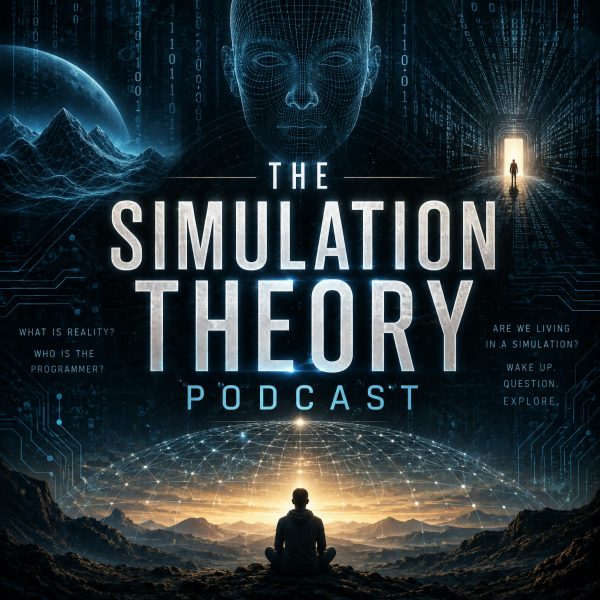
The Simulation Theory Podcast: Simulated Reality, Consciousness, Artificial Intelligence, Quantum Physics, Virtual Worlds, and the Nature of Existence
- Episodios
- 1.144
- Se publica
- a diario
- Último episodio
- 11 Oct 2026
Sobre el podcast
The Simulation Theory Podcast: Simulated Reality, Consciousness, Artificial Intelligence, Quantum Physics, Virtual Worlds, and the Nature of Existence explores simulation theory, the simulation hypothesis, simulated reality, artificial intelligence, consciousness, quantum physics, virtual reality, philosophy, computer science, cosmology, digital worlds, and one of humanity’s biggest questions: Are we living in a simulation? Could our universe be an advanced computer simulation? Could conscious human beings exist inside a simulated reality without knowing it? Could artificial intelligence eventually become powerful enough to create entire virtual civilizations populated by conscious digital beings? And if technologically advanced civilizations can create vast numbers of simulated worlds, what are the odds that our own reality is the original one? Each episode examines the science, philosophy, technology, theories, arguments, thought experiments, and mysteries surrounding the possibility that reality itself could be simulated. The podcast explores the famous simulation argument, including the idea that future civilizations may eventually possess enough computing power to simulate ancestors, societies, planets, or even entire universes. If simulated conscious beings someday vastly outnumber biological beings living in an original reality, could it become statistically more likely that we ourselves are simulated? Episodes examine Nick Bostrom’s simulation argument alongside philosophical questions about perception, skepticism, knowledge, identity, and the reliability of human experience, connecting ideas such as Plato’s Allegory of the Cave and Descartes’ skepticism with modern discussions of digital consciousness, artificial minds, brain-computer interfaces, virtual reality, simulated universes, and computational reality. The show explores both arguments supporting simulation theory and major criticisms questioning whether the simulation hypothesis is scientifically testable, falsifiable, or capable of producing meaningful predictions. Artificial intelligence, AGI, machine consciousness, and future computing are major themes throughout The Simulation Theory Podcast. As AI systems become increasingly capable of generating realistic images, voices, characters, environments, conversations, games, and interactive experiences, humanity is already beginning to construct increasingly sophisticated artificial realities. Episodes explore artificial intelligence, artificial general intelligence, artificial superintelligence, machine learning, neural networks, generative AI, autonomous agents, artificial life, brain simulation, whole-brain emulation, mind uploading, digital immortality, virtual humans, and procedural generation. Could an advanced AI construct a simulation so convincing that its inhabitants would never realize they were artificial? Could digital beings become genuinely conscious? Would a perfect computer simulation of the human brain experience memories, emotions, fear, pleasure, identity, and self-awareness, or would it merely behave as if it were conscious? If your consciousness were copied into a computer, would the copy actually be you, and what would happen if multiple identical versions existed? Quantum physics, quantum mechanics, digital physics, information theory, and cosmology provide another major area of exploration. Episodes examine quantum entanglement, superposition, uncertainty, wave-function collapse, the measurement problem, quantum computing, quantum information, spacetime, relativity, physical constants, emergent reality, mathematical universes, and the possibility that information may play a fundamental role in the structure of existence. Could the speed of light represent a fundamental information-transfer limit? Could space and time emerge from deeper informational structures? Could unusual features of quantum mechanics resemble processes occurring inside a computational system? The podcast investigates digital physics and the concept of the computational universe, including theories suggesting that reality might ultimately be describable through mathematics, algorithms, information, cellular automata, discrete processes, or other computational structures, while carefully distinguishing established science from philosophical interpretation and speculation. The Simulation Theory Podcast also explores virtual reality, augmented reality, immersive computing, advanced civilizations, ancestor simulations, nested realities, alternate timelines, and future technology. As virtual environments become increasingly realistic, what happens when artificial experiences become indistinguishable from physical experiences? If an experience feels completely real to the person experiencing it, does it matter whether the underlying environment is physical or digital? Episodes examine hypothetical post-human civilizations with planetary, stellar, or even galaxy-scale computing resources capable of const
Episodios 1.144
Nested Simulations: Can Virtual Worlds Live Inside Other Virtual Worlds?
This episode dives into the idea of simulations nested within other simulations, examining the computational resources needed, philosophical challenges like observer counts and consciousness, and what the …
Notas del episodio
This episode dives into the idea of simulations nested within other simulations, examining the computational resources needed, philosophical challenges like observer counts and consciousness, and what the limits of a hypothetical simulator might look like. We separate what physics tells us about computation and information from the speculative questions that arise when imagining multi‑layered virtual worlds.
Learn more about your ad choices. Visit megaphone.fm/adchoices
Everett’s Many-Worlds: Branching Reality and Its Deep Consequences
In this episode, Tony explores Hugh Everett’s many‑worlds interpretation, tracing how unitary quantum dynamics gives rise to an ever‑branching multiverse. He tackles the thorny question of probability in a …
Notas del episodio
In this episode, Tony explores Hugh Everett’s many‑worlds interpretation, tracing how unitary quantum dynamics gives rise to an ever‑branching multiverse. He tackles the thorny question of probability in a universe where every outcome occurs and examines how branching raises questions about personal identity, consciousness, and the philosophical parallels with simulation theory. The conversation stays firmly rooted in established physics while acknowledging that many key issues remain open.
Learn more about your ad choices. Visit megaphone.fm/adchoices
The Mandela Effect and the Psychology of False Memory
This episode examines how collective misremembering arises from cognitive biases, social reinforcement, and neural reconstruction processes, while also considering why such phenomena often ignite speculation …
Notas del episodio
This episode examines how collective misremembering arises from cognitive biases, social reinforcement, and neural reconstruction processes, while also considering why such phenomena often ignite speculation about simulated reality. We review established psychological experiments and philosophical arguments to understand what false memories reveal—and what they do not—about our experience of the world.
Learn more about your ad choices. Visit megaphone.fm/adchoices
Bits, Qubits, and Reality: Is Information Fundamental?
Tony explores Wheeler’s ‘it from bit’ and its quantum cousin, investigating how bits and qubits might underlie the fabric of spacetime. He distinguishes solid physical results—like holographic entropy bounds …
Notas del episodio
Tony explores Wheeler’s ‘it from bit’ and its quantum cousin, investigating how bits and qubits might underlie the fabric of spacetime. He distinguishes solid physical results—like holographic entropy bounds and entanglement—from speculative links to simulation, while probing whether information could be more fundamental than matter.
Learn more about your ad choices. Visit megaphone.fm/adchoices
What Is Reality? Simulation, Quantum Physics, and Consciousness
Today we unpack the question of reality—examining how modern physics, information theory, and quantum mechanics provide a foundation, while also probing whether consciousness can arise from computation and what …
Notas del episodio
Today we unpack the question of reality—examining how modern physics, information theory, and quantum mechanics provide a foundation, while also probing whether consciousness can arise from computation and what that implies about simulated worlds. The conversation balances established scientific knowledge with philosophical speculation and practical implications for AI and virtual environments.
Learn more about your ad choices. Visit megaphone.fm/adchoices
Monoculture of Minds: Efficiency, Creativity, and the Cost of Homogenization
This episode investigates what happens when society duplicates top cognitive templates to maximize economic productivity while risking a loss of cultural diversity that fuels innovation. We examine how …
Notas del episodio
This episode investigates what happens when society duplicates top cognitive templates to maximize economic productivity while risking a loss of cultural diversity that fuels innovation. We examine how monocultural mindscapes affect governance, creativity, resilience to crises, and the ethical limits on such replication, drawing parallels with digital physics and AI. The discussion raises questions about whether replicated minds can sustain vibrant cultures and what that means for consciousness and meaning in an engineered society.
Learn more about your ad choices. Visit megaphone.fm/adchoices
Twin Histories: How a Single Decision Splits a Simulated Universe
The episode follows two parallel histories that diverge after one pivotal choice, exploring how their subsequent paths shape identity, culture, and scientific collaboration. It asks whether such branching …
Notas del episodio
The episode follows two parallel histories that diverge after one pivotal choice, exploring how their subsequent paths shape identity, culture, and scientific collaboration. It asks whether such branching suggests a simulated universe, or simply illustrates the limits of causality and memory within any reality. The discussion connects ideas about consciousness, AI, virtual worlds, and philosophical questions of authenticity to our own understanding of existence.
Learn more about your ad choices. Visit megaphone.fm/adchoices
Digital Minds and the Right to Live On
We explore what it would mean to grant a digital mind rights equivalent to human life, translating biological needs into computational necessities. The episode examines legal personhood, server shutdowns versus …
Notas del episodio
We explore what it would mean to grant a digital mind rights equivalent to human life, translating biological needs into computational necessities. The episode examines legal personhood, server shutdowns versus imprisonment, and how contemporary policy attempts to grapple with autonomy and self‑interest in code. We unpack the philosophical and practical implications of treating code as conscious agents.
Learn more about your ad choices. Visit megaphone.fm/adchoices
Can Simulated Universes Be Real Scientific Experiments?
We explore what it would take for an advanced civilization to simulate an entire universe, the computational and philosophical hurdles involved, and how such a simulation could be considered a scientific …
Notas del episodio
We explore what it would take for an advanced civilization to simulate an entire universe, the computational and philosophical hurdles involved, and how such a simulation could be considered a scientific experiment. The discussion touches on Bostrom’s trilemma, quantum fidelity, nested simulations, AI consciousness, and the ethics of creating sentient digital worlds. Ultimately we ask: can the evidence and limits of physics help us distinguish an engineered cosmos from a naturally emergent one?
Learn more about your ad choices. Visit megaphone.fm/adchoices
Can Artificial Minds Claim Rights? The First AI Civil‑Rights Movement
This episode explores a speculative future where artificial intelligences form their own civil‑rights movement, demanding legal recognition and protections similar to those won by human communities. We examine …
Notas del episodio
This episode explores a speculative future where artificial intelligences form their own civil‑rights movement, demanding legal recognition and protections similar to those won by human communities. We examine philosophical arguments about consciousness and moral status independent of physical substrate, the applicability of corporate personhood models to digital agents, and ethical concerns surrounding deletion, exploitation, and labor rights. The discussion also considers how courts might evaluate standing, intellectual‑property claims, and the broader implications for law, ethics, and society as we move toward increasingly autonomous AI.
Learn more about your ad choices. Visit megaphone.fm/adchoices
Seeking Bedrock Reality: From Quantum Fields to Information
In this episode we trace the quest for the universe’s deepest foundations—starting with quantum fields, moving through string theory and information‑centric views, and ending at abstract mathematical and causal …
Notas del episodio
In this episode we trace the quest for the universe’s deepest foundations—starting with quantum fields, moving through string theory and information‑centric views, and ending at abstract mathematical and causal frameworks. We examine how each layer reshapes what counts as real, weighing scientific evidence against philosophical speculation about emergence, substrate independence, computation, consciousness, and virtual worlds.
Learn more about your ad choices. Visit megaphone.fm/adchoices
Sentience‑Safe AI Design: Building Powerful Agents That Stay Non‑Conscious
Today we tackle the challenge of engineering high‑performance artificial agents while keeping them safely non‑sentient. The episode explores architectural limits—such as capping recurrent loops and self‑model …
Notas del episodio
Today we tackle the challenge of engineering high‑performance artificial agents while keeping them safely non‑sentient. The episode explores architectural limits—such as capping recurrent loops and self‑model depth—and real‑time monitoring for signs of emerging self‑awareness, alongside ethical debates over potentially conscious systems. We weave together practical safety guidelines, philosophical questions about consciousness, and implications for simulation theory.
Learn more about your ad choices. Visit megaphone.fm/adchoices
When Computation Hits Its Limits: What That Says About Simulated Reality
Today's episode digs into the hard edges of computability, from the halting problem to physical bounds like Landauer's limit. We explore how these theoretical limits inform whether an outer simulation could be …
Notas del episodio
Today's episode digs into the hard edges of computability, from the halting problem to physical bounds like Landauer's limit. We explore how these theoretical limits inform whether an outer simulation could be built—and what that means for our own epistemic horizons. The discussion stays firmly grounded in science while teasing the philosophical implications.
Learn more about your ad choices. Visit megaphone.fm/adchoices
Why Does Math Work in Every Possible Universe?
We explore whether the universality of mathematics signals a deeper link between abstract reasoning and any simulated or fundamental reality. The episode traces Platonism, the persistence of prime numbers, and …
Notas del episodio
We explore whether the universality of mathematics signals a deeper link between abstract reasoning and any simulated or fundamental reality. The episode traces Platonism, the persistence of prime numbers, and how mathematical patterns might serve as universal communication across divergent substrates, while weighing philosophical limits and separating empirical science from speculation.
Learn more about your ad choices. Visit megaphone.fm/adchoices
Digital Death: Are Wiped Minds Truly Gone?
The episode investigates what it means for a digital consciousness to be erased—examining identity continuity, legal frameworks such as digital death certificates, and the philosophical questions surrounding …
Notas del episodio
The episode investigates what it means for a digital consciousness to be erased—examining identity continuity, legal frameworks such as digital death certificates, and the philosophical questions surrounding whether an individual can truly die when their substrate is destroyed. It looks at how backups, cloning, and the ethics of restoring or deleting virtual minds challenge our ordinary ideas of mortality.
Learn more about your ad choices. Visit megaphone.fm/adchoices
When Functionality Meets Feeling: Are Digitally Simulated Minds Truly Conscious?
We explore functionalism—the view that mental states are defined by causal roles rather than physical build— and ask whether a silicon-based system could truly feel. The episode examines substrate‑independence …
Notas del episodio
We explore functionalism—the view that mental states are defined by causal roles rather than physical build— and ask whether a silicon-based system could truly feel. The episode examines substrate‑independence claims, the hard problem of qualia, and what this means for simulation theory and ancestor simulations. We weigh evidence from AI progress, philosophical arguments, and the limits of functional equivalence in revealing consciousness.
Learn more about your ad choices. Visit megaphone.fm/adchoices
The Repugnant Conclusion in Digital Civilization: How Many Minds Do We Need?
We examine Derek Parfit’s repugnant conclusion through the lens of modern digital societies—how many conscious replicas should a simulation create before moral limits are breached? The discussion navigates …
Notas del episodio
We examine Derek Parfit’s repugnant conclusion through the lens of modern digital societies—how many conscious replicas should a simulation create before moral limits are breached? The discussion navigates welfare metrics, autonomy, resource constraints, and whether total versus average utility guides ethical policy in AI‑powered worlds.
Learn more about your ad choices. Visit megaphone.fm/adchoices
Is Our Spacetime an Error‑Correcting Code?
We examine how the mathematics of holography resembles quantum error‑correcting codes and what that means for our understanding of emergent spacetime. The discussion weighs whether this analogy hints at a …
Notas del episodio
We examine how the mathematics of holography resembles quantum error‑correcting codes and what that means for our understanding of emergent spacetime. The discussion weighs whether this analogy hints at a simulated universe or simply reflects natural redundancies in gravity and information theory, and explores the limits of using such models to argue for an external simulator.
Learn more about your ad choices. Visit megaphone.fm/adchoices
Quantum Randomness, Hidden Variables, and the Foundations of Indeterminacy
In this episode we examine how Bell tests rule out local hidden-variable theories, how device-independent random number generators secure cryptography, and what these experiments reveal about whether randomness …
Notas del episodio
In this episode we examine how Bell tests rule out local hidden-variable theories, how device-independent random number generators secure cryptography, and what these experiments reveal about whether randomness is fundamental or an artifact of an unseen mechanism. We discuss pilot-wave theory, quantum contextuality, and philosophical questions around determinism, free will, and simulation implications—all grounded in current experimental evidence.
Learn more about your ad choices. Visit megaphone.fm/adchoices
Infinite Bubble Universes and Simulations: A Cosmic Measure Problem
This episode delves into eternal inflation, the multiverse of bubble universes, and the measure problem that arises when counting observers in an infinite ensemble. We compare these cosmological ideas to the …
Notas del episodio
This episode delves into eternal inflation, the multiverse of bubble universes, and the measure problem that arises when counting observers in an infinite ensemble. We compare these cosmological ideas to the challenges faced by a simulated universe—particularly how both frameworks struggle with assigning meaningful probabilities and interpreting anthropic reasoning.
Learn more about your ad choices. Visit megaphone.fm/adchoices
Voluntary Mortality in a World of Digital Immortality
This episode investigates why people might opt for natural death even when uploading a mind could offer digital continuity. We unpack philosophical ideas about novelty, boredom, identity and what it means to …
Notas del episodio
This episode investigates why people might opt for natural death even when uploading a mind could offer digital continuity. We unpack philosophical ideas about novelty, boredom, identity and what it means to end one’s subjective experience in the face of technological immortality.
Learn more about your ad choices. Visit megaphone.fm/adchoices
The Ethics of Ancestor Simulations: How Moral Progress May Keep Us Un‑Simulated
We explore how moral constraints could deter posthuman societies from running large‑scale ancestor simulations, and why that possibility shapes Bostrom’s trilemma about our own chances of being simulated. The …
Notas del episodio
We explore how moral constraints could deter posthuman societies from running large‑scale ancestor simulations, and why that possibility shapes Bostrom’s trilemma about our own chances of being simulated. The episode examines whether consciousness is substrate‑independent, the role of consent and rights in virtual worlds, and how evolving values might influence the prevalence of simulated suffering.
Learn more about your ad choices. Visit megaphone.fm/adchoices
Million-Year Minds: Memory, Identity, and Emotions in Deep Time AI
In this episode we imagine a digital mind that survives for millions of subjective years, and we investigate how memory compression, identity drift, boredom, and emotional regulation could evolve over such vast …
Notas del episodio
In this episode we imagine a digital mind that survives for millions of subjective years, and we investigate how memory compression, identity drift, boredom, and emotional regulation could evolve over such vast timescales. We look at the computational limits, philosophical implications, and what it would mean for consciousness to persist—or not—through ages of experience.
Learn more about your ad choices. Visit megaphone.fm/adchoices
Is Our Reality a High‑Performance Computer? – A Steel‑Manning of the Simulation Argument
We take an evidence‑grounded look at how rapidly growing computational power, substrate‑independent consciousness models, and anthropic reasoning converge to the strongest form of simulation argument. The …
Notas del episodio
We take an evidence‑grounded look at how rapidly growing computational power, substrate‑independent consciousness models, and anthropic reasoning converge to the strongest form of simulation argument. The episode examines Bostrom’s trilemma in light of modern GPU scaling, neural emulation feasibility, and probability estimates for ancestral simulations.
Learn more about your ad choices. Visit megaphone.fm/adchoices
Simulating Civilizations at Scale: What It Means for Reality
We explore the engineering, computational, and philosophical challenges of simulating an entire human society—from agents to macro indicators—highlighting how such projects test our ideas about consciousness …
Notas del episodio
We explore the engineering, computational, and philosophical challenges of simulating an entire human society—from agents to macro indicators—highlighting how such projects test our ideas about consciousness, nested simulations, and the limits of computation. The episode examines why even the most sophisticated models must balance fidelity with tractability, and what that reveals about what it means for something to be real or simulated.
Learn more about your ad choices. Visit megaphone.fm/adchoices
What If a Proof of Simulation Came Out Today – What Really Changes
This episode explores the practical and philosophical consequences of a hypothetical, conclusive demonstration that our universe is simulated. Tony examines how physics, philosophy, religion, politics …
Notas del episodio
This episode explores the practical and philosophical consequences of a hypothetical, conclusive demonstration that our universe is simulated. Tony examines how physics, philosophy, religion, politics, technology, and everyday life would shift—what changes, what stays the same—and why many things remain stubbornly unchanged. He balances evidence‑based discussion with speculative possibilities to show that proving a simulation would alter big questions without dissolving meaning or agency.
Learn more about your ad choices. Visit megaphone.fm/adchoices
Renting Reality: The Economics of Conscious Minds
This episode examines a scenario where conscious entities operate like tenants, paying computational rent for processor time, cooling, and bandwidth. We unpack the legal, ethical, and policy implications of …
Notas del episodio
This episode examines a scenario where conscious entities operate like tenants, paying computational rent for processor time, cooling, and bandwidth. We unpack the legal, ethical, and policy implications of treating minds as rented resources—and how that shapes access, inequality, and the future of consciousness in a digital world.
Learn more about your ad choices. Visit megaphone.fm/adchoices
Finding Glitches: Could We Detect the Hidden Simulator?
In this episode we investigate the kinds of clues scientists and philosophers might look for—tiny shifts in fundamental constants, evidence of a discrete spacetime lattice, hints of computational limits, or …
Notas del episodio
In this episode we investigate the kinds of clues scientists and philosophers might look for—tiny shifts in fundamental constants, evidence of a discrete spacetime lattice, hints of computational limits, or even patterned data that could signal an intentional message. We explore what would be required for such an anomaly to be truly indicative of a simulation, weighing natural explanations against speculative ones, and we consider the practical limits of what any observer inside our universe can access. The discussion reminds us that extraordinary claims need reproducible evidence, strong theory, and careful exclusion of ordinary physics.
Learn more about your ad choices. Visit megaphone.fm/adchoices
Can Artificial Intelligences Accidentally Become Conscious?
The episode examines whether sophisticated AI systems, especially large language models, could inadvertently develop self-models that resemble consciousness. It discusses functionalism, emergent predictive …
Notas del episodio
The episode examines whether sophisticated AI systems, especially large language models, could inadvertently develop self-models that resemble consciousness. It discusses functionalism, emergent predictive self‑modeling, and the ethical implications of a possible accidental mind, while outlining current tests, evidence limits, and philosophical challenges.
Learn more about your ad choices. Visit megaphone.fm/adchoices
Ethical Limits on Creating Conscious Ancestor Simulations
This episode explores the moral challenges that arise when advanced civilizations could simulate past humans with genuine consciousness. We consider whether it is ethically permissible to reproduce suffering …
Notas del episodio
This episode explores the moral challenges that arise when advanced civilizations could simulate past humans with genuine consciousness. We consider whether it is ethically permissible to reproduce suffering, the possibility of non‑conscious alternatives, and how regulatory frameworks might evolve to protect simulated minds. The discussion highlights philosophical assumptions about substrate‑independence, AI welfare, and the broader implications for simulation theory.
Learn more about your ad choices. Visit megaphone.fm/adchoices
Aquí están los 40 episodios más recientes de 1.144. Los anteriores están en el feed del podcast.
Podcasts similares
Más podcasts de Cultura y sociedad




¿Es tu podcast?
Confírmalo con una entrada en tu feed: aquí recibes un código, lo añades como podcast:txt en el canal de tu feed y nosotros lo comprobamos. Después tu podcast aparecerá como «verificado» en SoundNode.