

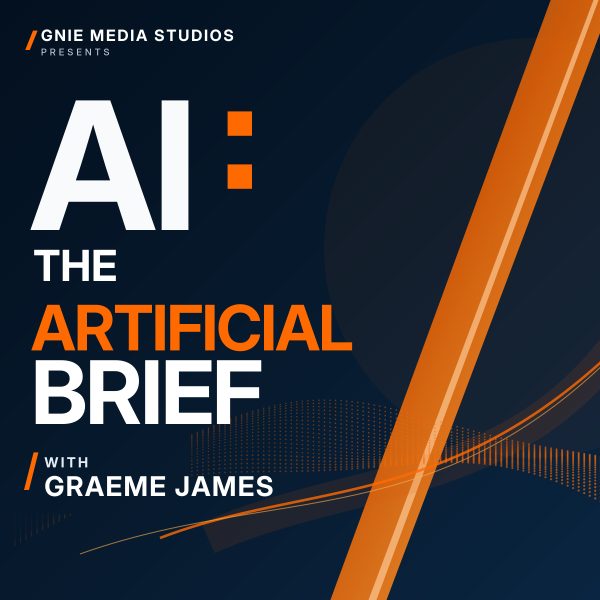
AI: The Artificial Brief
- Épisodes
- 6
- Parution
- plusieurs fois par semaine
- Dernier épisode
- 15 Nov 2026
À propos du podcast
AI: The Artificial Brief examines what artificial intelligence means for work, business and everyday life. Presented by Graeme James, each episode looks beyond the headlines to explore the evidence, practical uses and real costs of AI. A GNIE Media Studios production. Narration is AI-generated using ElevenLabs via Higgsfield.
Épisodes 6
AI Just Cracked Two Enigma Messages. Sort Of.
Two long-unsolved Enigma messages, two AI-assisted approaches, and a useful lesson in how research gets done. Graeme James looks at the archives, human clues, search tools and independent checking behind the …
Notes de l’épisode
Two long-unsolved Enigma messages, two AI-assisted approaches, and a useful lesson in how research gets done. Graeme James looks at the archives, human clues, search tools and independent checking behind the breaks—and asks what other difficult questions have remained unanswered mainly because nobody had the time to investigate them.
When the AI Bill Starts Running the Budget
AI budgets are starting to behave like compute bills rather than seat-based software subscriptions. Graeme James examines Menlo Ventures’ enterprise survey, explains why its average and median tell different …
Notes de l’épisode
AI budgets are starting to behave like compute bills rather than seat-based software subscriptions. Graeme James examines Menlo Ventures’ enterprise survey, explains why its average and median tell different stories, and asks how companies can connect variable AI costs to useful outcomes. Spending more can make sense—but only when someone can show what the work was worth.
AI Is Starting to Rewrite AI. Not Quite the Way You Think.
MIT researchers asked a frontier model to inspect and edit smaller neural networks. Graeme James explains weight-space programming, why fixing a reasoning loop differs from inventing new intelligence, and how …
Notes de l’épisode
MIT researchers asked a frontier model to inspect and edit smaller neural networks. Graeme James explains weight-space programming, why fixing a reasoning loop differs from inventing new intelligence, and how AI-assisted model engineering could affect the cost of specialist systems. Early research, practical implications, and a careful distinction from autonomous recursive self-improvement.
Presented by Graeme James. From Genie Media Studios.
Narration is AI-generated using ElevenLabs via Higgsfield.
Sources:
https://rikiyat.github.io/blog/weight-space-programming/
https://huggingface.co/Qwen/Qwen3.5-0.8B
If Intelligence Gets Cheap, What Becomes Valuable?
If AI makes first-pass thinking cheap, what becomes valuable? Graeme James explores the shift from scarce expertise to abundant cognitive tools, the limits of historical analogies, and why judgement, trust and …
Notes de l’épisode
If AI makes first-pass thinking cheap, what becomes valuable? Graeme James explores the shift from scarce expertise to abundant cognitive tools, the limits of historical analogies, and why judgement, trust and responsibility still matter. A practical look at the work businesses could attempt when analysis, research and experimentation become easier to afford.
AI Is Making Us Faster. So Why Is the Work Getting Worse?
AI can make work look finished in seconds. It can also move the thinking—and the cleanup—to somebody else. In this episode of AI: The Artificial Brief, Graeme James examines “workslop”: polished AI-assisted …
Notes de l’épisode
AI can make work look finished in seconds. It can also move the thinking—and the cleanup—to somebody else. In this episode of AI: The Artificial Brief, Graeme James examines “workslop”: polished AI-assisted output that appears useful but quietly transfers the difficult work downstream. Drawing on workplace research and practical examples, he asks why individual productivity gains so often fail to become better organisational performance—and what careful AI use looks like instead.
The AI Agents Have Arrived. Has Anyone Checked the Bill?
AI agents can complete real work—but does the business case survive the bill? In this pilot of AI: The Artificial Brief, Graeme James examines the gap between impressive demonstrations and dependable …
Notes de l’épisode
AI agents can complete real work—but does the business case survive the bill? In this pilot of AI: The Artificial Brief, Graeme James examines the gap between impressive demonstrations and dependable, affordable results.
From an unusually ambitious agent-led company to the everyday economics of handling customer enquiries, this episode asks what useful automation really costs once human review, mistakes and setup are included.
In this episode
• What separates an AI agent from a chatbot.
• Why token consumption can make costs unpredictable.
• Why benchmark capability and dependable performance are different.
• A worked small-business example: time saved, review costs and the effect of mistakes.
• A practical approach: start with one measurable job, bounded permissions and a human review step.
Sources and context
• Spawn founder account, reproduced by teapawt: https://teapawt.org/jsnnsa/article/2115623382721126826 — Spending, team size and output figures are self-reported and unaudited; the accessible source is a mirror.
• Gartner: Agentic AI’s Next Hurdle Is Cost, Not Capability: https://www.gartner.com/en/articles/agentic-ai-next-hurdle-is-cost — Its case-study findings are not a universal technical failure rate.
• Stanford Digital Economy Lab: How Do AI Agents Spend Your Money?: https://digitaleconomy.stanford.edu/publication/how-do-ai-agents-spend-your-money-analyzing-and-predicting-token-consumption-in-agentic-coding-tasks/ — Results concern the studied coding tasks, not every agent workflow.
• Towards a Science of AI Agent Reliability, revision 3: https://arxiv.org/abs/2602.16666v3 — Evaluates 15 models across two benchmarks.
The small-business figures are hypothetical examples, not reported customer results. Time released is not automatically cash saved.
Credits
Presented under the public name Graeme James. Published by GNIE Media Studios.
Podcasts similaires
Plus de podcasts : Technologies





C’est votre podcast ?
Confirmez-le avec une entrée dans votre flux : vous recevez ici un code, vous l’ajoutez comme podcast:txt dans le canal de votre flux, et nous le vérifions. Votre podcast apparaît ensuite comme « vérifié » sur SoundNode.