

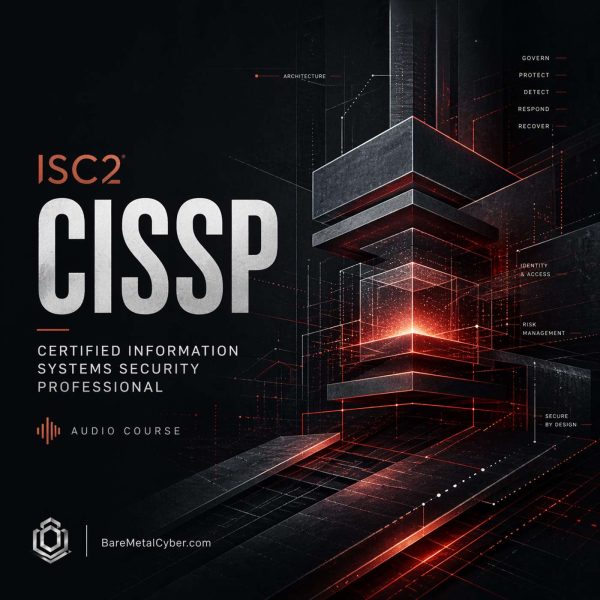
Certified: The CISSP Audio Course
- Épisodes
- 141
- Format
- Série – à écouter depuis le début
- Dernier épisode
- 17 Jan 2026
À propos du podcast
Welcome to The Bare Metal Cyber CISSP Audio Course—your comprehensive companion for mastering the Certified Information Systems Security Professional (CISSP) certification. Built for serious cybersecurity professionals and aspiring leaders alike, this Audio Course transforms the eight domains of the CISSP Common Body of Knowledge into clear, structured, and engaging lessons you can learn anytime, anywhere. Each episode blends real-world context, expert insight, and exam-focused explanations to help you understand not just what to study, but how to think like a security professional. Whether you’re commuting, exercising, or studying after work, this series provides the clarity and direction you need to stay motivated and on track. The CISSP certification, governed by ISC², is one of the most respected and globally recognized credentials in information security. It validates deep technical and managerial expertise across areas such as security architecture, risk management, asset protection, identity and access control, network and software security, and incident response. CISSP holders are trusted to design, implement, and manage comprehensive cybersecurity programs that protect critical systems and data. Earning this certification demonstrates both strategic understanding and hands-on mastery—an achievement that opens doors to leadership roles across government, corporate, and consulting environments. Developed by BareMetalCyber.com, the CISSP Audio Course delivers structured, professional instruction that aligns with the latest exam outline and real-world best practices. It’s more than preparation—it’s a roadmap for advancing your cybersecurity career with confidence, clarity, and purpose.
Épisodes 141
Episode 134: Understanding "Best", "First", and "Most Likely" Wording
CISSP exam questions often hinge on a single word that changes everything. In this episode, we examine how to interpret qualifiers like “best,” “first,” “most appropriate,” and “least likely.” We explain what …
Notes de l’épisode
CISSP exam questions often hinge on a single word that changes everything. In this episode, we examine how to interpret qualifiers like “best,” “first,” “most appropriate,” and “least likely.” We explain what each prompt is asking you to consider—whether it’s prioritization, sequencing, or judgment—and how to choose the answer that aligns with ISC2's expected mindset. You'll hear examples and practice strategies that train you to read between the lines. CISSPs must be precise thinkers, and this episode ensures you don't miss points over semantics.
Episode 133: How to Deconstruct CISSP Questions
CISSP exam questions are known for being complex, layered, and sometimes intentionally confusing. In this episode, we teach you how to break questions apart to find the real point being tested. You'll learn how …
Notes de l’épisode
CISSP exam questions are known for being complex, layered, and sometimes intentionally confusing. In this episode, we teach you how to break questions apart to find the real point being tested. You'll learn how to identify the scenario, isolate the question stem, and evaluate answer choices using elimination strategies. We also discuss common distractors, keywords like “best,” “first,” and “most likely,” and how to avoid overthinking. CISSPs must be able to think critically, quickly, and clearly—this episode helps you build the habits to do just that.
Episode 132: Memory Tricks and Mnemonics for the CISSP
With so much material to retain, memory tools are a CISSP candidate’s secret weapon. In this episode, we provide proven mnemonics, visual associations, and acronym expansions to help you remember everything …
Notes de l’épisode
With so much material to retain, memory tools are a CISSP candidate’s secret weapon. In this episode, we provide proven mnemonics, visual associations, and acronym expansions to help you remember everything from the OSI model and CIA triad to the phases of incident response and risk treatment options. You’ll also learn strategies for reducing cognitive overload and improving recall under exam pressure. These techniques are designed to make memorization more efficient and retention more reliable—especially when you're balancing study time with professional responsibilities.
Welcome to the ISC2 CISSP Audio Course
Dive into a fast, no-fluff overview of what this podcast delivers, who it’s for, and how each episode helps you level up with practical, real-world takeaways. In this trailer, you’ll hear the show’s promise …
Notes de l’épisode
Dive into a fast, no-fluff overview of what this podcast delivers, who it’s for, and how each episode helps you level up with practical, real-world takeaways. In this trailer, you’ll hear the show’s promise, the format you can expect, and a sneak peek at the kinds of stories, tips, and expert insights coming your way. Hit follow to get new episodes as they drop and start listening smarter from day one.
Episode 140: What to Do If You Fail the CISSP
Not everyone passes on the first try—but failure doesn’t define your journey. In this episode, we guide you through a structured plan for recovery if you don’t pass the CISSP exam. We cover how to interpret …
Notes de l’épisode
Not everyone passes on the first try—but failure doesn’t define your journey. In this episode, we guide you through a structured plan for recovery if you don’t pass the CISSP exam. We cover how to interpret your exam feedback, identify weak domains, revise your study strategy, and rebuild confidence. You’ll also learn how to maintain momentum and avoid burnout during your next round of preparation. CISSPs are persistent by nature, and this episode helps you turn setbacks into setups for future success—because your path forward is still wide open.
Episode 139: What Comes After the CISSP: Career and Certification Roadmap
Earning your CISSP opens new doors—but where you go next depends on your goals. In this episode, we explore the post-CISSP landscape, including leadership roles like CISO, and technical specializations like …
Notes de l’épisode
Earning your CISSP opens new doors—but where you go next depends on your goals. In this episode, we explore the post-CISSP landscape, including leadership roles like CISO, and technical specializations like cloud security and digital forensics. We also review advanced certifications such as CCSP, CISM, CRISC, and the CISSP concentrations in architecture, engineering, and management. You’ll learn how to use your CISSP as a launchpad for continuous professional development. CISSPs are expected to lead—this episode shows you how to build a career path that’s secure, strategic, and sustainable.
Episode 138: Adaptive Testing Tips and Time Management
The CISSP exam uses Computerized Adaptive Testing (CAT), which means question difficulty and test length vary based on your performance. In this episode, we demystify the CAT format, explain how scoring works …
Notes de l’épisode
The CISSP exam uses Computerized Adaptive Testing (CAT), which means question difficulty and test length vary based on your performance. In this episode, we demystify the CAT format, explain how scoring works, and share strategies to manage your time across the exam. You’ll learn when to move quickly, when to slow down, and how to pace yourself under pressure. We also provide techniques for staying focused during long test sessions and avoiding mental fatigue. CISSP candidates who understand CAT mechanics have a clear advantage in approaching the exam with confidence and control.
Episode 137: Understanding "Best", "First", and "Most Likely" Wording
CISSP exam questions often hinge on a single word that changes everything. In this episode, we examine how to interpret qualifiers like “best,” “first,” “most appropriate,” and “least likely.” We explain what …
Notes de l’épisode
CISSP exam questions often hinge on a single word that changes everything. In this episode, we examine how to interpret qualifiers like “best,” “first,” “most appropriate,” and “least likely.” We explain what each prompt is asking you to consider—whether it’s prioritization, sequencing, or judgment—and how to choose the answer that aligns with ISC2's expected mindset. You'll hear examples and practice strategies that train you to read between the lines. CISSPs must be precise thinkers, and this episode ensures you don't miss points over semantics.
Episode 136: How to Deconstruct CISSP Questions
CISSP exam questions are known for being complex, layered, and sometimes intentionally confusing. In this episode, we teach you how to break questions apart to find the real point being tested. You'll learn how …
Notes de l’épisode
CISSP exam questions are known for being complex, layered, and sometimes intentionally confusing. In this episode, we teach you how to break questions apart to find the real point being tested. You'll learn how to identify the scenario, isolate the question stem, and evaluate answer choices using elimination strategies. We also discuss common distractors, keywords like “best,” “first,” and “most likely,” and how to avoid overthinking. CISSPs must be able to think critically, quickly, and clearly—this episode helps you build the habits to do just that.
Episode 135: Memory Tricks and Mnemonics for the CISSP
With so much material to retain, memory tools are a CISSP candidate’s secret weapon. In this episode, we provide proven mnemonics, visual associations, and acronym expansions to help you remember everything …
Notes de l’épisode
With so much material to retain, memory tools are a CISSP candidate’s secret weapon. In this episode, we provide proven mnemonics, visual associations, and acronym expansions to help you remember everything from the OSI model and CIA triad to the phases of incident response and risk treatment options. You’ll also learn strategies for reducing cognitive overload and improving recall under exam pressure. These techniques are designed to make memorization more efficient and retention more reliable—especially when you're balancing study time with professional responsibilities.
Episode 131: Top 10 Hardest CISSP Concepts Demystified
Some CISSP topics consistently challenge even experienced professionals. In this episode, we break down ten of the most difficult concepts on the exam—ranging from cryptographic key lifecycle and security …
Notes de l’épisode
Some CISSP topics consistently challenge even experienced professionals. In this episode, we break down ten of the most difficult concepts on the exam—ranging from cryptographic key lifecycle and security models to risk calculations and legal frameworks. We clarify the nuances, provide examples, and share memory aids to help you master these areas. Whether you’re struggling with asset valuation formulas, access control methodologies, or cloud governance, this review will sharpen your understanding. CISSPs must be confident in these complex subjects to handle exam scenarios and real-world leadership challenges.
Episode 130: DevSecOps Culture and Continuous Assurance
DevSecOps is not just a toolset—it’s a culture that integrates security into every phase of the software development lifecycle. In this episode, we explore how DevSecOps breaks down silos between development …
Notes de l’épisode
DevSecOps is not just a toolset—it’s a culture that integrates security into every phase of the software development lifecycle. In this episode, we explore how DevSecOps breaks down silos between development, operations, and security teams. Topics include automated security testing, continuous compliance checks, secure coding training, and real-time feedback loops. You’ll learn how to embed security into CI/CD pipelines and enforce policy-as-code principles. For CISSPs, fostering a DevSecOps culture means shifting security left, enabling rapid innovation while maintaining rigorous standards for protection and assurance.
Episode 129: Secure APIs and Service Integration
APIs enable system integration but can expose your infrastructure to serious vulnerabilities if not secured properly. This episode focuses on how to design and manage secure APIs. We cover authentication …
Notes de l’épisode
APIs enable system integration but can expose your infrastructure to serious vulnerabilities if not secured properly. This episode focuses on how to design and manage secure APIs. We cover authentication methods (API keys, OAuth), input validation, rate limiting, logging, and error handling. You’ll also learn about common API security issues like broken object-level authorization and excessive data exposure. Secure API development is essential for any modern digital service, and CISSPs must ensure that APIs are managed with the same rigor as traditional application interfaces.
Episode 128: Mobile Application Security and Reverse Engineering
Mobile apps introduce unique risks due to their widespread use, diverse platforms, and limited control over user devices. In this episode, we explore mobile app security concerns, including insecure storage …
Notes de l’épisode
Mobile apps introduce unique risks due to their widespread use, diverse platforms, and limited control over user devices. In this episode, we explore mobile app security concerns, including insecure storage, weak authentication, exposed APIs, and code tampering. We also introduce reverse engineering concepts—how attackers decompile apps to uncover secrets or modify behavior. You’ll learn mitigation strategies such as code obfuscation, secure storage APIs, and runtime protections. CISSPs must understand how to assess mobile application threats and ensure that mobile deployments align with organizational security standards.
Episode 127: Application Whitelisting and Sandboxing
Not all applications should be allowed to run in your environment. This episode explores application control mechanisms like whitelisting and sandboxing. You'll learn how whitelisting enforces control by …
Notes de l’épisode
Not all applications should be allowed to run in your environment. This episode explores application control mechanisms like whitelisting and sandboxing. You'll learn how whitelisting enforces control by allowing only approved executables, and how sandboxing isolates applications to prevent them from affecting system integrity. We also discuss implementation strategies, policy management, and how to handle exceptions. These controls are especially valuable in high-security or highly regulated environments. CISSPs must understand how to limit application behavior to reduce attack surfaces and contain potential damage.
Episode 126: Version Control and Code Integrity
Version control systems track changes to code—but they also need to be protected themselves. This episode explores how tools like Git help enforce code integrity, collaboration, and traceability across …
Notes de l’épisode
Version control systems track changes to code—but they also need to be protected themselves. This episode explores how tools like Git help enforce code integrity, collaboration, and traceability across development teams. We cover commit histories, branching strategies, and how to detect unauthorized or malicious changes. You’ll learn about tagging, rollbacks, signed commits, and hash verification to ensure that what gets deployed is what was intended. For CISSPs, maintaining code integrity across distributed teams and tools is key to supporting trustworthy software development practices.
Episode 125: Configuration Management and CI/CD Pipelines
Secure development doesn't stop at writing code—it includes how that code is built, tested, and deployed. In this episode, we explore configuration management and continuous integration/continuous delivery …
Notes de l’épisode
Secure development doesn't stop at writing code—it includes how that code is built, tested, and deployed. In this episode, we explore configuration management and continuous integration/continuous delivery (CI/CD) pipelines. We discuss how insecure configurations, exposed secrets, and unmonitored automation can lead to compromise. Topics include infrastructure as code (IaC), environment hardening, automated security gates, and rollback procedures. CISSPs must know how to assess CI/CD pipeline security and ensure that automation enhances, rather than undermines, control over software deployment.
Episode 124: Code Repositories and Access Controls
Source code repositories are central to modern software development—and to software security. This episode covers the security considerations for using platforms like GitHub, GitLab, Bitbucket, and internal …
Notes de l’épisode
Source code repositories are central to modern software development—and to software security. This episode covers the security considerations for using platforms like GitHub, GitLab, Bitbucket, and internal repositories. We examine access control policies, branching strategies, commit tracking, and how to detect malicious code changes. You’ll learn about secrets scanning, signed commits, and repository hardening. CISSPs must understand how to secure the development pipeline and enforce controls that protect intellectual property and prevent code tampering at its source.
Episode 123: Security Testing: SAST, DAST, IAST
Security testing helps ensure software behaves as intended under hostile conditions. In this episode, we explore different application security testing methodologies, including Static Application Security …
Notes de l’épisode
Security testing helps ensure software behaves as intended under hostile conditions. In this episode, we explore different application security testing methodologies, including Static Application Security Testing (SAST), Dynamic Application Security Testing (DAST), and Interactive Application Security Testing (IAST). We explain how each method works, their strengths and limitations, and when to use them during the software development lifecycle. You’ll also learn how these tools integrate with DevOps workflows and how to interpret test results. CISSPs must be able to recommend and evaluate testing strategies to support secure software delivery.
Episode 122: Buffer Overflows, SQL Injection, and Common Flaws
Many devastating cyberattacks originate from well-known coding flaws. This episode examines classic vulnerabilities including buffer overflows, SQL injection, and other input-related attacks. We explain how …
Notes de l’épisode
Many devastating cyberattacks originate from well-known coding flaws. This episode examines classic vulnerabilities including buffer overflows, SQL injection, and other input-related attacks. We explain how these issues arise, what they allow attackers to do, and how to defend against them using secure coding, bounds checking, input validation, and runtime protections like DEP and ASLR. You'll also learn about real-world incidents that exploited these flaws. For CISSPs, understanding common software weaknesses is critical for conducting risk assessments, reviewing software, and advising development teams.
Episode 121: OWASP Top 10 Threats and Controls
The OWASP Top 10 is a widely recognized list of the most critical security risks to web applications. In this episode, we walk through each entry—from injection and broken authentication to cross-site …
Notes de l’épisode
The OWASP Top 10 is a widely recognized list of the most critical security risks to web applications. In this episode, we walk through each entry—from injection and broken authentication to cross-site scripting, insecure deserialization, and insufficient logging. You'll learn how these vulnerabilities occur, the business impact they can have, and the recommended controls to prevent or mitigate them. We also discuss how developers and security professionals can use the OWASP Top 10 as a baseline for secure coding practices. CISSPs must understand these threats to assess application risk and implement effective defense strategies.
Episode 120: Input Validation and Output Encoding
User input is one of the most common vectors for exploitation in modern applications. In this episode, we focus on two critical programming techniques: input validation and output encoding. We explain how to …
Notes de l’épisode
User input is one of the most common vectors for exploitation in modern applications. In this episode, we focus on two critical programming techniques: input validation and output encoding. We explain how to validate input to ensure it meets expected formats and prevents attacks like SQL injection and cross-site scripting (XSS). We also explore how to encode output for different contexts—such as HTML, JavaScript, or SQL—to avoid executing untrusted data. CISSPs may not write code, but they must understand these defenses to reduce software vulnerabilities and enforce security requirements in development projects.
Episode 119: Secure Design and Secure Coding Guidelines
Secure applications start with secure design. In this episode, we explore how to incorporate security into architecture and code from the very beginning. Topics include threat modeling, input validation, secure …
Notes de l’épisode
Secure applications start with secure design. In this episode, we explore how to incorporate security into architecture and code from the very beginning. Topics include threat modeling, input validation, secure defaults, and fail-safe mechanisms. We also cover secure coding practices that prevent common vulnerabilities such as injection, buffer overflows, and improper error handling. CISSPs must understand the principles of secure design so they can set expectations, evaluate vendor software, and collaborate effectively with developers to reduce risks before code is ever deployed.
Episode 118: Waterfall vs. Agile vs. DevOps Approaches
Development methodologies have a direct impact on how security is integrated into software projects. This episode compares three major approaches—Waterfall, Agile, and DevOps—and how each handles risk, testing …
Notes de l’épisode
Development methodologies have a direct impact on how security is integrated into software projects. This episode compares three major approaches—Waterfall, Agile, and DevOps—and how each handles risk, testing, and control. You'll learn the strengths and challenges of each model, including change management, documentation, and time-to-delivery. We also explore how DevSecOps brings security into the CI/CD pipeline. CISSPs must be familiar with these approaches to advise development teams, align controls with process realities, and adapt governance to fast-moving development environments.
Episode 117: Software Development Lifecycle (SDLC) Models
Secure software doesn’t happen by accident—it’s the result of disciplined development practices. This episode explores common Software Development Lifecycle (SDLC) models, including waterfall, spiral, and …
Notes de l’épisode
Secure software doesn’t happen by accident—it’s the result of disciplined development practices. This episode explores common Software Development Lifecycle (SDLC) models, including waterfall, spiral, and V-model, and how they structure phases such as requirements, design, coding, testing, deployment, and maintenance. We also discuss where and how security should be integrated into each phase. CISSPs must understand SDLC frameworks to support secure software planning, ensure oversight of third-party development, and implement governance for both agile and traditional projects.
Episode 116: Security Operations Center (SOC) Best Practices
The Security Operations Center (SOC) is the nerve center of cybersecurity monitoring and incident response. In this episode, we explore SOC roles, responsibilities, staffing models, tools, and key performance …
Notes de l’épisode
The Security Operations Center (SOC) is the nerve center of cybersecurity monitoring and incident response. In this episode, we explore SOC roles, responsibilities, staffing models, tools, and key performance indicators. We discuss shift scheduling, escalation paths, use cases, and integration with threat intelligence feeds. You'll also learn about SOC maturity models and how to evolve from reactive operations to proactive threat hunting. CISSPs must understand how to structure, support, and evaluate SOCs to ensure they deliver measurable protection and business value.
Episode 115: Personnel Security Controls and Separation of Duties
People are at the heart of every security program—and also one of its greatest vulnerabilities. In this episode, we examine personnel security controls that mitigate human-based risks. Topics include background …
Notes de l’épisode
People are at the heart of every security program—and also one of its greatest vulnerabilities. In this episode, we examine personnel security controls that mitigate human-based risks. Topics include background checks, onboarding protocols, security training, acceptable use policies, and ongoing behavior monitoring. We also explore separation of duties, job rotation, and least privilege principles that reduce fraud and error. CISSPs must be able to design and enforce personnel policies that protect the organization while supporting a strong security culture and clear accountability.
Episode 114: Physical Security Operations: Locks, Guards, Cameras
Cybersecurity extends into the physical world, where threats like unauthorized access, theft, and sabotage can bypass digital defenses. In this episode, we explore physical security operations, including the …
Notes de l’épisode
Cybersecurity extends into the physical world, where threats like unauthorized access, theft, and sabotage can bypass digital defenses. In this episode, we explore physical security operations, including the use of barriers, locks, access control systems, security guards, surveillance cameras, and visitor management. We also cover how physical security integrates with IT through badges, biometrics, and monitoring. CISSPs must understand how to assess facility risks, implement layered physical defenses, and coordinate between IT and facilities teams to protect critical assets from physical compromise.
Episode 113: Malware Analysis and Containment
Understanding malware is essential for effective defense. This episode explores how security teams analyze and contain malicious software, including viruses, worms, ransomware, and trojans. We break down static …
Notes de l’épisode
Understanding malware is essential for effective defense. This episode explores how security teams analyze and contain malicious software, including viruses, worms, ransomware, and trojans. We break down static and dynamic analysis techniques, sandboxing environments, signature development, and reverse engineering basics. You'll also learn how to contain outbreaks, remove malware safely, and update detection tools. CISSPs may not perform deep malware analysis themselves, but they must understand how malware spreads, how it's investigated, and how to manage risk during outbreaks.
Episode 112: Insider Threat Identification and Mitigation
Not all threats come from the outside. Insider threats—whether malicious or accidental—pose a significant risk to organizational security. In this episode, we examine how to identify, monitor, and respond to …
Notes de l’épisode
Not all threats come from the outside. Insider threats—whether malicious or accidental—pose a significant risk to organizational security. In this episode, we examine how to identify, monitor, and respond to threats from employees, contractors, or partners with legitimate access. We discuss behavioral indicators, user activity monitoring, data loss prevention (DLP), and privacy considerations. You'll also learn how to balance detection efforts with employee trust and legal requirements. CISSPs must be able to design and enforce insider threat programs that protect assets without undermining culture or morale.
Voici les 60 derniers épisodes sur 141. Les épisodes plus anciens se trouvent dans le flux du podcast.
Recommandé par Certified: The CISSP Audio Course



Podcasts similaires
Plus de podcasts : Éducation







C’est votre podcast ?
Confirmez-le avec une entrée dans votre flux : vous recevez ici un code, vous l’ajoutez comme podcast:txt dans le canal de votre flux, et nous le vérifions. Votre podcast apparaît ensuite comme « vérifié » sur SoundNode.