

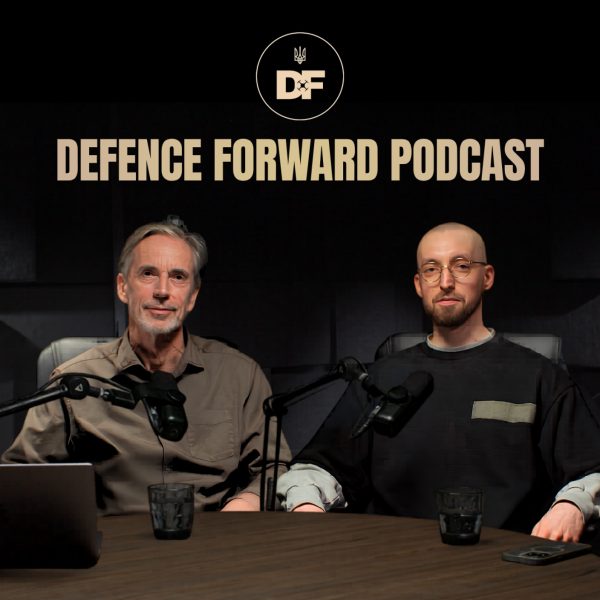
Defence Forward Podcast
- Épisodes
- 15
- Parution
- toutes les deux semaines
- Dernier épisode
- 3 Nov 2026
À propos du podcast
Ukraine is the world's most intense laboratory for defence technology innovation — and the lessons are coming fast.
Defence Forward goes inside Ukraine's fighting machine, bringing you unfiltered conversations with the founders building it, the operators using it, and the experts shaping what comes next. Hosted by cylindr Defence and the Serhiy Prytula Charity Foundation.
For defence leaders, investors and anyone who needs to understand where modern warfare is heading.
Épisodes 15
Trained as an architect, now he demolishes invaders
What does it take to plan and coordinate every drone mission in a brigade, day after day? For this episode of Defence Forward, we travelled to an underground location around 30 km from the Russian border to sit …
Notes de l’épisode
What does it take to plan and coordinate every drone mission in a brigade, day after day? For this episode of Defence Forward, we travelled to an underground location around 30 km from the Russian border to sit down with “Puer”, who plans and controls UAV operations at brigade headquarters in Ukraine’s 2nd Corps Khartiia, one of Ukraine’s most advanced and widely respected formations.
Before the war, Puer was an architect, interior designer and project manager working with British companies. In the army he worked through every position in an FPV crew, as reconnaissance drone operator, spotter and strike drone pilot, flying FPV, Mavic and Vampire drones. Today he oversees the planning, supply and coordination of UAV missions across all units in his brigade.
In this conversation we cover:
🔹 Life in an FPV crew, with up to 25 strike missions a day
🔹 Why tanks now take many drones to stop
🔹 How missions are queued and coordinated across units
🔹 Planning UAV operations at brigade level without micromanaging
🔹 After-action reviews: finding out what went wrong and fixing it
🔹 An expanding kill zone where there is no longer a yellow zone
🔹 Month-long rotations and 10 km walks to and from positions
🔹 Heavy bomber drones as a logistics lifeline
🔹 Matching crews to tasks based on skill and talent
🔹 How new products are tested, and Ukrainian vs Western manufacturers
🔹 AI terminal guidance and the move towards full autonomy
🔹 Life after the war, and the need for a long break
How to support
👉 Subscribe and like to help us bring frontline insights from Ukraine to more people.
Join our UAH 30 million fundraiser with 2nd Corps Khartiia for unmanned systems
Defence Forward is hosted by Jonathan Winch (Cylindr Defence, Copenhagen) and Dan Kucherenko (Serhiy Prytula Charity Foundation, Kyiv), and produced by David Hoskin of Cylindr Defence.
#DefenceForward #Khartiia #Ukraine #UAV #FPV #Drones #DefenceTech #Autonomy
Out of Human Hands: Robotics on the Ukrainian Battlefield
Strike drones are going jet-powered. Above 200 km/h, no human can fly them. And when both sides have the same technology, the side that decides faster wins. "Marine", commander of a Ukrainian unmanned systems …
Notes de l’épisode
Strike drones are going jet-powered. Above 200 km/h, no human can fly them. And when both sides have the same technology, the side that decides faster wins. "Marine", commander of a Ukrainian unmanned systems regiment, on the robot war that’s already here.Before the full-scale invasion he ran his own company with 60 employees and was training for an Ironman. He joined the army on day one, spent a year and a half in the trenches, served three years with the Marines, and now leads his regiment in the National Guard’s 2nd Corps.His unit runs less like a military formation and more like a tech company: in-house labs, 3D printing, its own electronics, and ideas that can go from the workshop to the test range at night and onto the battlefield the next day.We talk about:→ Why his unit builds and upgrades its own systems, and how a plug-and-play control box cut UGV preparation from three or four days to one.→ What a mid-strike mission looks like from planning to impact, including simulators that replicate the real terrain, and the trick to hitting a fast-moving target: slow it down first.→ Why speed is changing everything, and why autonomy is no longer optional.→ How fibre-optic drones ended the era when jamming plus armour kept you safe, and what Ukraine should expect from Russia in 2027: jet engines, Starlink jamming, their own satellite alternative, and mass mobilisation.→ Why decision dominance matters when both sides share the same technology, and how AI has cut his reporting from a week to ten minutes.→ The tempo gap between Ukraine and Europe. As he puts it: “On Monday it’s like for us the whole month.”Thanks to Marine for taking the time and, as always, to my co-host Dan Kucherenko from Serhiy Prytula Charity Foundation for a great discussion. And to our colleague and producer, David Hoskin, for making it all come together.Remember to like and subscribe – and help to support our podcast!And please, make even a small contribution to Ukraine’s war effort at Serhiy Prytula Charity Foundation!#DefenceForward #Ukraine #UnmannedSystems #DefenceTech #EuropeanSecurity
Points for Kills: Inside Ukraine’s Battlefield Economy
In Ukraine, units no longer just ask for equipment. They earn it. Confirmed results on the battlefield turn into e-points, and brigades spend those points directly on Brave1 Market, Ukraine’s Amazon-like …
Notes de l’épisode
In Ukraine, units no longer just ask for equipment. They earn it. Confirmed results on the battlefield turn into e-points, and brigades spend those points directly on Brave1 Market, Ukraine’s Amazon-like miltech marketplace. The system keeps changing as the war changes, and that ability to adapt quickly is an advantage in itself. In this episode of Defence Forward, Dan Kucherenko and Jonathan Winch talk with Juliya Myrna, Project Lead for Brave1 Market, about how the marketplace works from the inside and why it was built the way it was.Brave1 Market: https://market-brave1.delta.mil.gov.ua/en We cover:→ How e-points link frontline performance to procurement, and why the incentive model keeps evolving→ How a brigade’s request becomes a competitive, auction-style match with manufacturers→ Why Brave1 steps out once a match is made, leaving the brigade and manufacturer to deal directly→ Why decentralised supply means every brigade keeps its own contract, and why moving contracting onto the platform would make the process slower, not faster→ What manufacturers, including foreign companies, need to understand to compete on the platform The idea at the centre of the conversation: in a war of rapid adaptation, how equipment gets bought matters as much as what gets built. Support Ukraine’s defenders through the Prytula Foundation — https://prytulafoundation.org/en Defence Forward is produced by Cylindr Defence in partnership with the Serhiy Prytula Charity Foundation. Guest:► Yuliia Myrna — https://www.linkedin.com/in/yuliia-myrna-691118196/Hosted by:► Dan Kucherenko — https://www.linkedin.com/in/dan-kucherenko-aba949216/► Jonathan Winch — https://www.linkedin.com/in/winch/Produced by:► David Hoskin — https://www.linkedin.com/in/davidhoskin/Links: ► Defence Forward: https://linktr.ee/defenceforwardpodcast► Cylindr Defence: https://cylindrdefence.com/Winning 20 to 1 - So Why Could Ukraine Still Lose?
Jackie, a former US Army scout who now instructs corps personnel in Ukraine's 3rd Army Corps, returns to Defence Forward to explain why two cities in Donetsk oblast may decide how this war ends, and how Ukraine …
Notes de l’épisode
Jackie, a former US Army scout who now instructs corps personnel in Ukraine's 3rd Army Corps, returns to Defence Forward to explain why two cities in Donetsk oblast may decide how this war ends, and how Ukraine lives with the outcome.
Kramatorsk and Sloviansk, the "fortress belt", are the last major piece of the Kremlin's stated objectives in Donetsk. Whoever holds them controls the routes beyond. Jackie explains why the ground war has become the most important part of the fight right now, and why it gets so little attention outside Ukraine.
In this episode:
- Why the fortress belt matters, and what a Russian victory claim would mean with or without it
- Loss ratio, not territory, as the measure that matters for an outnumbered army
- Drones as common as rifles at squad level
- "Blue army" mission command versus "red army" Soviet-style command
- What Afghanistan, Vietnam and the US Civil War teach about post-war narrative and veterans
- What Jackie plans to do when the war ends
Guest: Jackie (his callsign), 3rd Army Corps, ArmedForces of Ukraine. Former US Army scout with service in Iraq and Afghanistan;International Legion veteran of Kyiv, Kupiansk and Bakhmut.
Hosts: Jonathan Winch (Cylindr Defence, Copenhagen) and Dan Kucherenko (SerhiyPrytula Charity Foundation, Kyiv)
Producer: David Hoskin (Cylindr Defence, Copenhagen)Like and subscribe for more conversations on battlefield technology, operational realities and the people fighting Russia's war against Ukraine.
#DefenceForward #Ukraine #MilitaryStrategy
Every Infantryman Is Half a Sniper | Jackie, 3rd Army Corps, Ukraine
An American assault instructor in Ukraine's 3rd Army Corps says the NATO bases he has visited would be finished in the first eight hours. Jackie — a callsign, not a name — explains why the wedge formation is …
Notes de l’épisode
An American assault instructor in Ukraine's 3rd Army Corps says the NATO bases he has visited would be finished in the first eight hours. Jackie — a callsign, not a name — explains why the wedge formation is dead, why every Ukrainian infantryman now carries signals kit, and why Ukraine's doctrine has abolished the ground force commander.More: "They're so abysmally unprepared that I'm afraid for them." That is an American professional soldier describing NATO bases he has trained on, on a podcast whose audience largely works for NATO countries.Jackie is a callsign. He spent eight years in the US Army as a scout, deployed seven times, and crossed into Ukraine at Medyka in March 2022 to join the International Legion. He was badly wounded in Kyiv inside three weeks, went back to fight at Kupiansk and Bakhmut, and now instructs corps staff in Ukraine's 3rd Army Corps.He is precise about what four years changed. Direct-fire security sectors are irrelevant against an enemy with permanent fire superiority, so the wedge formation is gone and everything moves in files. Concealment, not firepower, is the organising principle at every echelon — in his phrase, every Ukrainian infantryman is half a sniper. Signals-intelligence receivers are carried by ordinary riflemen rather than by specialists. And the ground force commander, a position American doctrine treats as indispensable, no longer exists in his corps: jamming would leave that man mute for the whole battle, so the decision sits with a battle captain at a networked command post instead.The hardest reform, he argues, is not tactical at all. It is getting soldiers to tell their commanders the truth.More about Defence Forward Podcast
The Ukrainian NGO That Co-Built a Drone Interceptor | Dan Kucherenko, Serhiy Prytula Foundation
Jonathan Winch interviews his co-host Dan Kucherenko about the Serhiy Prytula Charity Foundation — one of Ukraine's largest wartime organisations, funded entirely by ordinary people.The Foundation does …
Notes de l’épisode
Jonathan Winch interviews his co-host Dan Kucherenko about the Serhiy Prytula Charity Foundation — one of Ukraine's largest wartime organisations, funded entirely by ordinary people.
The Foundation does something charities elsewhere in Europe do not do. It has no engineers, but it does have a military department in daily contact with soldiers at the front. Using that data, it worked with a Ukrainian manufacturer on a drone built to intercept Russian reconnaissance UAVs — advising on the speed and altitude it needed to match, and on communications that would still work in a GPS-denied environment. Ukraine's Ministry of Defence went on to rate the result the most effective drone of its kind in 2025.
Dan also explains how military equipment is actually procured in Ukraine. There are three routes: centralised Ministry of Defence contracts, decentralised purchasing where individual units buy direct from manufacturers, and donations through organisations like his own. He explains why the third route is usually where new technology gets proved first — and how the Foundation came to buy Ukraine a satellite.
Dan Kucherenko leads international partnerships at the Serhiy Prytula Charity Foundation in Kyiv — one of Ukraine's largest wartime organisations, with 120+ staff across five legal entities, working with more than 800 military units. He co-hosts Defence Forward.► Support Ukraine with the Serhiy Prytula Charity Foundation
Innovating Ukraine's Electronic Frontline: Countering Drones and Mesh Networks | Yehor Molochkov
In this episode, Yehor Molochkov of the 69th Separate Special Electronic Support Center of the Ukrainian Armed Forces shares insights into the evolving role of electronic warfare (EW) in Ukraine's defence …
Notes de l’épisode
In this episode, Yehor Molochkov of the 69th Separate Special Electronic Support Center of the Ukrainian Armed Forces shares insights into the evolving role of electronic warfare (EW) in Ukraine's defence strategy, the technological challenges faced, and the innovative solutions being developed to counter modern threats like drones and mesh networks.
Key topics:
- The role of EW in modern warfare and Ukraine's strategic approach
- Technological challenges in countering drones and mesh networks
- Innovative software and hardware solutions developed by Ukraine
- Coordination and integration of EW units across Ukrainian defense forces
- The evolution of EW capabilities from 2022 to present
- The importance of automation and AI in EW operations
- Challenges with equipment interoperability and manufacturer collaboration
- The impact of EW on battlefield tactics and civilian safety
► Learn more about Ukraine's Electronic Warfare Forces ()
► Contact Electronic Warfare Forces, [email protected]
► Support Ukraine through the Serhiy Prytula Charity Foundation
► Production thanks to cylindr Defence
📡 Discover more about Defence Forward Podcast
How One Ukrainian Soldier Turned Personal Passion into Massive Military Support
In this episode, we dive into Mykyta Puz’s journey fromcivilian tech entrepreneur to military technology scout and Azov battalion member. He shares how innovation, grassroots fundraising, and volunteer …
Notes de l’épisode
In this episode, we dive into Mykyta Puz’s journey fromcivilian tech entrepreneur to military technology scout and Azov battalion member. He shares how innovation, grassroots fundraising, and volunteer logistics are helping strengthen Ukraine’s defence efforts amid the ongoing conflict.
Main Topics:
- Mykyta Puz’s transition from civilian tech to military service
- Innovative fundraising and logistics for Ukraine’s military
- The role of bottom-up decision-making in Azov
- Personal stories of Ukrainian resilience and adaptation- The impact of civilian initiatives on military support
- How technology and volunteer efforts are shaping defence efforts
- Creative fundraising approaches, including the Maserati raffle
- The importance of individual initiative in wartime support
► Follow Defence Forward Podcast
► Support Ukraine through the Serhiy Prytula Charity Foundation
► Production thanks to cylindr Defence
#DefenceTech #DroneWarfare #UkraineWar #MilitaryTechnology #UnmannedSystems #ModernWarfare #warinukraine2026
I Watched the Assault Fail on My Drone Screen From 500 Meters Away | Defence Forward
Join us for an in-depth conversation with Anton Sukach, Ukrainian defence veteran and business developer at Global Mark, who shares raw experiences from the front lines, insights into modern warfare tech, and …
Notes de l’épisode
Join us for an in-depth conversation with Anton Sukach, Ukrainian defence veteran and business developer at Global Mark, who shares raw experiences from the front lines, insights into modern warfare tech, and the resilience of Ukraine amidst ongoing conflict. Discover how innovative defence solutions like FPV (first-person view) drones, electronic warfare systems, and autonomous underwater vehicles are shaping the future of warfare.
In this episode:
Anton discusses the emotional toll and realities of war from a soldier’s perspective
Insights into friendly fire incidents and the psychological impacts of battlefield decisions
The evolution of drone technology and the role of FPV and fiberoptic drones in Ukraine’s defence
The development and testing of autonomous underwater vehicles with ranges up to 1000 km
Ukraine’s resilience and the importance of international support and technology adaptation amid ongoing conflict
The strategic role of electronic warfare, AI, and new defence innovations against Russian advances
Anton shares his personal journey from civilian to soldier and experience working with Ukrainian military projects
The challenges in defence procurement and the rapid pace of innovation in Ukraine compared to NATO standards
Special thanks for the ongoing bravery and innovation from the Ukrainian forces and their defenders.
Stay tuned for more stories of courage, technology, and resilience.
Learn more about Global Mark.
Follow Anton on LinkedIn.
Follow Defence Forward Podcast.
Eyes in the Forest: A Platoon Commander on Drone Warfare and the Fight for Serebryansky
In this episode, we explore the critical role of drone warfare in Ukraine's ongoing defense efforts, featuring an interview with Lito, a commanding officer of an FPV drone platoon within the National Guard …
Notes de l’épisode
In this episode, we explore the critical role of drone warfare in Ukraine's ongoing defense efforts, featuring an interview with Lito, a commanding officer of an FPV drone platoon within the National Guard. Discover how Ukraine trains civilian pilots, the evolution of drone tactics, and the significance of operations like those in the Serebryansky Forest. We also delve into technological breakthroughs such as fiber optic drones and the importance of interoperability, shedding light on the frontline realities of modern warfare.
Main Topics:
- The role and operational scope of Ukraine’s UAV units across the front lines
- Transition from civilian to military drone pilot: skills, challenges, and training processes
- Key battles and training ground: the strategic importance of the Serebryansky Forest
- Innovations in drone technology: fiber optics, digital systems, and future prospects like drone swarms
- Coordinating drone operations within a broader combined arms strategy
- The underestimated impact of drone warfare on battlefield outcomes and Western responses
- Lessons learned and future improvements for Ukraine’s drone capabilities
This episode offers an authentic frontline perspective that underscores the importance of innovation, adaptability, and resilience in Ukraine’s ongoing defense. The insights presented are vital for understanding modern drone warfare’s strategic and operational dimensions.
More about Defence Forward Podcast: https://linktr.ee/defenceforwardpodcast
Why Europe's Defence Mindset Is Still Too Slow | Benjamin Wolba from EDTH
Most people think defence innovation is all about high-tech weapons and futuristic gadgets. But what if the real game-changer lies in connecting battlefield realities with Europe's slowing ecosystem? Benjamin …
Notes de l’épisode
Most people think defence innovation is all about high-tech weapons and futuristic gadgets. But what if the real game-changer lies in connecting battlefield realities with Europe's slowing ecosystem? Benjamin Wolba, co-founder of the European Defence Tech Hub, pulls back the curtain on how hackathons, startups, and soldier feedback are revolutionizing battlefield tech and why Europe must accelerate this movement now.
In this episode, discover how Ukraine is becoming an R&D laboratory for Europe, where frontline soldiers directly influence the next-generation tech that saves lives. Benjamin shares stories from over 30 hackathons across Europe and Ukraine, revealing the secret sauce behind successful defence startups that go from idea to battlefield deployment. You’ll learn why understanding tactics and operational realities — from drone detection to lightweight equipment — is crucial for real impact.
We break down: how hackathons turn brave soldiers into tech testers, the importance of battle-proven solutions, and why European defence innovation still struggles with bureaucratic hurdles that slow progress.Benjamin exposes the paradox of rapid tactical needs versus long-term strategic development, offering a blueprint for how startups, military units, and governments can close the innovation gap. You'll discover how cross-border collaboration, fast testing, and a relentless mindset are building the future of defence, before the next conflict surprises us.
Whether you're an engineer, a founder or simply passionate about Ukraine's resilience and Europe's security, this episode offers a compelling vision for a more agile, connected defence ecosystem. It’s not just about tech; it’s about saving lives, enabling sovereignty and shaping a safer future.
Benjamin Wolba, based in Berlin, is a thought leader in defence innovation, known for bridging Ukraine and Europe through hackathons, networks and initiatives that turn ideas into operational assets. His work is driving a new wave of civilian-led defence startups that challenge antiquated procurement and military paradigms.
If you're curious about how to support Ukraine’s war effort through innovation, or how startups can influence battlefield strategies, listen to this episode. We talk about how everyone can make a difference. Defence is no longer just for soldiers. It’s for anyone committed to resilience, progress and peace.
► About Defence Forward Podcast
► Learn about European Defence Tech Hub
► Support Ukraine through Serhiy Prytula Charity Foundation
► Production thanks to cylindr Defence
Inside the Software That Turns Ukraine's Drone Footage Into 3D Battlefield Maps in Under 90 Minutes
Viktoriia Yarumchuk, CEO of Farsight Vision, sharesinsights into Farsight Vision’s innovative battlefield intelligence solutions, the technical challenges and the challenges of defence tech integration.Discover …
Notes de l’épisode
Viktoriia Yarumchuk, CEO of Farsight Vision, sharesinsights into Farsight Vision’s innovative battlefield intelligence solutions, the technical challenges and the challenges of defence tech integration.Discover how data processing, orthophotos and real-time analytics are transforming military operations. Viktoriia talks about some of the security, operational challenges and technological innovations in Ukraine's defencesector, opening up about Farsight Vision’s role in modern warfare.
Farsight Vision is the de facto standard for battlefield geospatial intelligence in Ukraine, used by approximately 60% of the country's defence forces. FarsightVision solved an important battlefield challenge. In 2022 and early 2023, Ukraine was fielding thousands of drones - but the data those drones captured was either wasted or backlogged for days. There was no standard for how sensor data should be formatted, no clear place to store it, and no reliable way toprocess drone footage into something commanders could use to plan operations.With satellite imagery sometimes months out of date, commanders were sending units into the unknown. Farsight's solution was a constantly updated 2D and 3D digital twin of the battlefield - orthophotos, orthomosaics and 3D models generated directly from drone footage and ready for planning within 90 minutes of the flight.
One of Farsight's most significant advantages is its neural networks. Most competitors - civilian tools and teams outside Ukraine alike - trained their detection models on open-source footage of poor quality or datasets captured years ago. Farsight trained on constantly updated, real battlefield data across all camera qualities, all weather conditions, all terrain types. The team ran thousands of experiments, drawing on approaches from biochemistry, real estate 3D modeling,and blood-test computer vision. The result: contextual detection that understands pixel combinations, terrain type, camera angle, and elevation simultaneously - and crucially, works without GPS in fully GNSS-denied environments, which most civilian photogrammetry tools fundamentally cannot do.
The competitive landscape is nuanced. Civilian photogrammetry tools exist but require GPS. Detection tools exist - mostly trained on stale data. Simulation systems offer scenario-based training, but in artificial terrain - typically somewhere in the Middle East, not Ukraine's actual frontline. Farsight generates 3D models from real battlefield terrain, updated continuously, and enables genuine after-action review of training on the actual ground where it matters. NATO allies are interested - but the honest assessment from Viktoriia is that most lack the full ecosystem to use Farsight effectively. They need drone pilots who can fly in denied environments, electronic warfare capability, C2 systems, and communication infrastructure. Ukraine was forced to build allof that under fire.
#deepstrike #ukrainewar #defenceforward #defence #defencenews #ukrainerussiawar► Find us on Instagram and Youtube
► Learn about Farsight Vision
► Delta Situation Awareness Platform:
► Support Ukraine through Serhiy Prytula Charity Foundation
► Production thanks to cylindr Defence
► Jonathan Winch — Podcast host
► Dan Kucherenko — Podcast host
IKEA Logic Speeds up Ukraine’s Production
Micael Lawson didn't plan on becoming part of Ukraine's defence story. He drove a car full of generators from Trollhattan, Sweden to Fastiv because someone had to. Then he met soldiers at a Brave1 event. They …
Notes de l’épisode
Micael Lawson didn't plan on becoming part of Ukraine's defence story. He drove a car full of generators from Trollhattan, Sweden to Fastiv because someone had to. Then he met soldiers at a Brave1 event. They asked for one thing: help us save the lives of our soldiers. That sentence changed the direction of his company. Micael is CEO of Recas Sweden and he now applies years of automotive thinking directly to Ukraine's most urgent manufacturing problem.He believes that although Ukrainian manufacturers are brilliant at building products that work, they are not necessarily scalable. Almost every company does product development to create capability, without adding design for manufacturing and design for assembly from the start. The gap between what a product can do and how it can be produced at volume is exactly where the automotive industry has spent decades. Ukraine must do three things now: accelerate production capacity, cut piece price through industrialization, and capture process data digitally. Micael Lawson questions how you can give ten technicians the production power of a hundred? How can you duplicate factories across a cluster of distributed nodes? How can you hand a recipe to a second producer without the original team? The answer is always the same: structured, controlled digital data.What does this mean for Ukraine, with 240 UGV manufacturers each solving the same problems in isolation? Cluster manufacturing, distributing production across multiple nodes so no single attack kills the whole line, is already happening. The next step is formalizing it: mapping every company's capabilities, storage, production tempo and capacity through a system like RIVET (Recas Industrial Visibility and Execution Tracker), so that when one node fails, another absorbs it within days.As the conflict evolves, battlefield outcomes will increasingly depend not on how many soldiers can be recruited, but on which side can put more pieces on the field at lower cost with higher intelligence.
► Follow Micael Lawson on Linkedin► Learn about Recas ► Support Ukraine in the most efficient way with Serhiy Prytula Charity Foundation ► Production thanks to cylindr Defence ► Jonathan Winch — Podcast host► Dan Kucherenko — Podcast host► David Hoskin — Producer📡 Find us on Instagram and Youtube #defencetechnology #ukrainerussiawar #miltech #ukraine #UnmannedSystems #defenceforward
The Next Military Tech Wave That Will Change Warfare in Ukraine | Mykyta Puz, AZOV
Mykyta Puz — Miltech Scouting and Partnership Officer at the 12th Special Forces Brigade of the National Guard of Ukraine, "AZOV". AZOV needs no introduction. The brigade that held the Mariupol Azovstal Steel …
Notes de l’épisode
Mykyta Puz — Miltech Scouting and Partnership Officer at the 12th Special Forces Brigade of the National Guard of Ukraine, "AZOV". AZOV needs no introduction. The brigade that held the Mariupol Azovstal Steel Plant againstoverwhelming Russian forces in 2022 — and made it legendary — is now fighting in the Toretsk and Pokrovsk sectors of the Donetsk region, one of the most intense battlegrounds of the war. Mykyta's background is anything but typical: French translator by education, competitive car racer by hobby — and now the person bridging Western defence tech with one of Ukraine's most battle-hardened brigades. We talk about why 90% of technology pitched to Azov simply isn't battlefield-ready, how fibre-optic drones changed the war and what the next revolution in Ukraine's military technology might look like.
► Follow Mykyta Puz on Linkedin and Instagram
► AZOV One
► Follow Defence Forward Podcast
► Support Ukraine in the most efficient way with Serhiy Prytula Charity Foundation
► Production thanks to cylindr Defence
► Jonathan Winch — Podcast host
► Dan Kucherenko — Podcast host
► David Hoskin — Producer
#DefenceTech #DroneWarfare #UkraineWar #MilitaryTechnology #UnmannedSystems #ModernWarfare #warinukraine2026
Inside Ukraine's Deep Strike: Oleksandr Sukhoi on Data-Driven Warfare and 1500km Drone Strikes
In March 2026, Ukraine launched more drones into Russian territory in a single month than Russia launched into Ukraine. The 1st Unmanned Aerial Systems Center accounts for more than half of that number …
Notes de l’épisode
In March 2026, Ukraine launched more drones into Russian territory in a single month than Russia launched into Ukraine. The 1st Unmanned Aerial Systems Center accounts for more than half of that number. Oleksandr — the head of analytical department — explains the full chain: from mission order and logistics to post-mission reporting and how his team eliminates every bottleneck in between.
The 1st Center is something unprecedented in military history. What started as a battalion in 2022 - the first unit in the world to operate drones simultaneously across tactical, operational, and strategic levels — has grown into a center-level structure launching thousands of drones per month.
Oleksandr Sukhoi spent 25 years building software teams across Europe. Then in late 2024, he made the same choice as thousands of other Ukrainians: he traded his civilian career for military service. Today he heads the analytical department of the 1st Center - the unit responsible for more than half of all Ukrainian deep strikes into Russian territory. This is Episode №1 of Defence Forward podcast, where we go inside Ukraine's fighting machine.
At peak impact, the 1st UAS Center had disrupted 30-40% of Russia's oil export capacity. Oleksandr explains the psychological dimension too: Russian propagandists openly started saying the war should end. That signal is tracked, measured, and factored into how operations are planned.
► Donate to 1st Separate Unmanned Systems Center:
https://1usc.army/en/aid/
USDT-TRC20 / BSC
0x4F7daE47c2a79E5627B57924Ff2fe5A7D165bb61
Solana
8NKuP5tmMpXDSLdSjUpHpabqnbrUn8rMjvc3abt1BsrJ
BTC
Bc1qlkxqhecmd2j4q957a27vzdaegesxenzt2qucwc
► Support Ukraine in the most efficient way with Serhiy Prytula Charity Foundation:
https://prytulafoundation.org/en
Key moments:
00:00 Introduction to Alexander Suchy and His Role03:15 Transition from IT to Military Service
06:22 Understanding Deep Strike Operations
09:06 Analyzing the Impact of Deep Strikes
12:26 Counteroffensive Measures and Tactical Adjustments
15:20 The Dynamics of Warfare and Future Predictions
18:11 Target Selection and Strategic Planning
21:28 Drone Warfare: Tactics and Countermeasures
24:17 Training and Resources for Effective Defense
29:38 Collaboration and Resource Allocation in Warfare
34:02 Feedback Loops and Real-Time Adjustments
36:38 Electronic Warfare: Challenges and Adaptations
38:58 Innovations in Drone Technology
41:02 Russia's Adaptation and Information Warfare
42:06 After Action Reviews and Strategic Insights
43:29 The Psychological Impact of Strikes
44:51 Targeting Moscow: Risks and Rewards
47:02 Long-Term Impact of Strikes on Russian Economy
48:37 Fundraising and Resource Needs
51:30 The Broader Implications of the War
#deepstrike #ukrainewar #defenceforward #defence #defencenews #ukrainerussiawar
Podcasts similaires
Plus de podcasts : Affaires







C’est votre podcast ?
Confirmez-le avec une entrée dans votre flux : vous recevez ici un code, vous l’ajoutez comme podcast:txt dans le canal de votre flux, et nous le vérifions. Votre podcast apparaît ensuite comme « vérifié » sur SoundNode.