

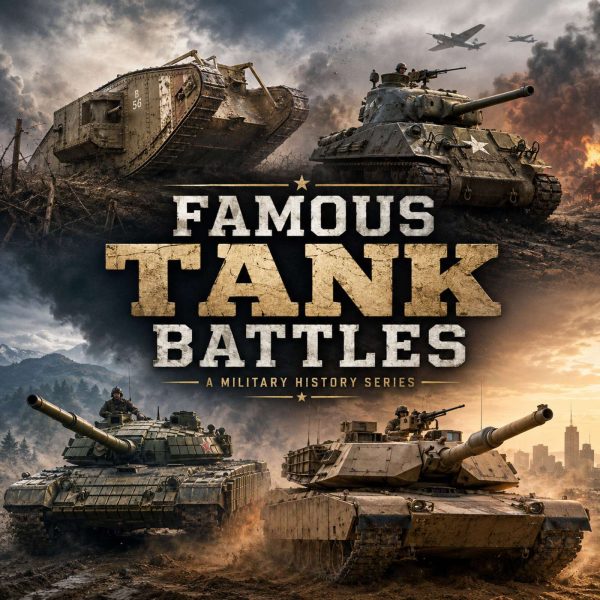
Famous Tank Battles
- Épisodes
- 261
- Format
- Série – à écouter depuis le début
- Dernier épisode
- 11 Juil 2026
À propos du podcast
Famous Tank Battles is a multi-season history podcast series that follows the story of armored warfare from its uncertain beginnings in the First World War to the fast-moving, technology-driven battles of the late twentieth century. Across the full series, listeners move from the muddy shock of Cambrai through the desert campaigns of North Africa, the giant armored clashes of the Second World War, the hard lessons of the Arab-Israeli wars, and finally into the era of thermal sights, modern fire control, and high-speed mechanized combat. The goal is not simply to tell battle stories, but to explain why these battles mattered, how they were fought, and what they revealed about the changing character of war. Each season is built around one famous tank battle or armored campaign, allowing the series to go beyond broad summaries and instead explore the fighting in depth. That means the podcast does not stop with a basic retelling of who won and who lost. It looks closely at the commanders, units, terrain, planning, doctrine, logistics, communications, weapons, and tactical decisions that shaped events on the battlefield. Some seasons focus on innovation and first attempts. Others focus on adaptation under pressure, desperate defense, operational breakthrough, or the moment when older ideas about armor were challenged by new realities. Taken together, the seasons show that tank warfare was never just about the tank itself. Armored combat was always tied to artillery, infantry, engineers, air power, supply, maintenance, and the ability of commanders to make decisions under confusion and extreme pressure. One season may highlight the birth of massed armor and surprise attack. Another may show the brutal learning curve of desert warfare. Another may reveal how industrial strength, doctrine, and sheer scale turned armored battle into something vast and devastating. Later seasons trace the rise of anti-tank missiles, night fighting, better sensors, and the professional training that defined modern armored forces. This series is designed for listeners who want military history with both narrative energy and serious substance. It is for people who enjoy battlefield storytelling, but also want to understand the deeper lessons behind the action. Whether the subject is Cambrai, Kursk, El Alamein, the Golan Heights, the Chinese Farm, or 73 Easting, Famous Tank Battles treats each campaign as part of a larger story: the evolution of armored warfare across decades of conflict, innovation, failure, and hard-won battlefield experience.
Épisodes 261
73 Easting: Episode 26 — Why 73 Easting Matters
Why 73 Easting Matters closes the season by judging the battle as far more than a tank duel in the desert. The episode brings together reconnaissance doctrine, mission command, thermal technology, Abrams and …
Notes de l’épisode
Why 73 Easting Matters closes the season by judging the battle as far more than a tank duel in the desert. The episode brings together reconnaissance doctrine, mission command, thermal technology, Abrams and Bradley crews, artillery, aviation, logistics, training, and VII Corps’ ability to turn operational movement into battlefield destruction. Listeners learn why the 2d Armored Cavalry Regiment’s fight mattered in its own right and why its larger significance lies in opening the way for the 1st Infantry Division, Objective Norfolk, Medina Ridge, and the final defeat of organized Iraqi armored resistance. The battle stands as a major case study in modern armored warfare, showing that technology becomes decisive only when disciplined people, clear communication, and aggressive initiative make it useful. For more military history writing and books, visit MilitaryAuthor.me, and for magazines, galleries, and a massive archive of military photos and video, visit Trackpads.com.73 Easting: Episode 25 — Medina Ridge and the 100 Hours
Medina Ridge and the 100 Hours follows the final heavy blow of VII Corps as the ground campaign neared its cease-fire. On February 27, 1991, after 73 Easting and Objective Norfolk, American armored forces …
Notes de l’épisode
Medina Ridge and the 100 Hours follows the final heavy blow of VII Corps as the ground campaign neared its cease-fire. On February 27, 1991, after 73 Easting and Objective Norfolk, American armored forces struck the Medina Division of the Republican Guard while Iraqi units were withdrawing, collapsing, or trying to form new defenses. This episode explains the tactical fight at Medina Ridge, the wider Iraqi retreat from Kuwait, and the political-military tension of ending a war while battlefield momentum still existed. Listeners learn how the famous 100-hour ground campaign combined airpower, reconnaissance, thermal sights, artillery, logistics, and heavy armor to overwhelm Iraqi mechanized forces. The episode shows victory at speed without simplifying the destruction, suffering, or unanswered strategic questions that followed. For more military history writing and books, visit MilitaryAuthor.me, and for magazines, galleries, and a massive archive of military photos and video, visit Trackpads.com.73 Easting: Episode 24 — Fratricide in the Dark
Fratricide in the Dark tackles one of the most difficult subjects in the 73 Easting and Objective Norfolk story: friendly fire during fast armored combat. This episode examines how darkness, dust, burning …
Notes de l’épisode
Fratricide in the Dark tackles one of the most difficult subjects in the 73 Easting and Objective Norfolk story: friendly fire during fast armored combat. This episode examines how darkness, dust, burning wrecks, thermal sight images, overlapping movements, and weak situational awareness created deadly hazards even for a victorious force. Official Army accounts link the 73 Easting/Norfolk fighting to incidents in which five American tanks and four Bradleys were destroyed, six U.S. soldiers were killed, and thirty were wounded; another Army history notes that friendly fire caused twenty-one of ninety-eight U.S. battle deaths in Desert Storm. Listeners learn why technology did not make the battlefield transparent and why speed must be governed by recognition, communication, and restraint. The episode handles the cost of victory with care and seriousness. For more military history writing and books, visit MilitaryAuthor.me, and for magazines, galleries, and a massive archive of military photos and video, visit Trackpads.com.73 Easting: Episode 23 — Objective Norfolk
Objective Norfolk was the huge night battle that followed 73 Easting and is often overshadowed by it. This episode follows armored forces advancing through darkness, dust, burning Iraqi vehicles, scattered …
Notes de l’épisode
Objective Norfolk was the huge night battle that followed 73 Easting and is often overshadowed by it. This episode follows armored forces advancing through darkness, dust, burning Iraqi vehicles, scattered prisoners, surviving positions, and the wreckage of the earlier cavalry fight. The 1st Infantry Division drove into the remaining Tawakalna and 12th Armored Division forces, using tanks, Bradleys, infantry, artillery, engineers, and thermal sights to continue the attack. Listeners learn why night fighting gave the Americans advantages but also created danger, confusion, and identification challenges. Norfolk demonstrates how a successful pass-through turned the cavalry’s breakthrough into a division-level battle. It also shows the eerie reality of modern mechanized combat, with battlefield illumination coming from destroyed vehicles and movement continuing through uncertainty. For more military history writing and books, visit MilitaryAuthor.me, and for magazines, galleries, and a massive archive of military photos and video, visit Trackpads.com.73 Easting: Episode 22 — The Pass-Through
The Pass-Through follows the morning of February 27, 1991, when the 1st Infantry Division moved through the 2d Armored Cavalry Regiment to continue the attack against remaining Tawakalna and 12th Armored …
Notes de l’épisode
The Pass-Through follows the morning of February 27, 1991, when the 1st Infantry Division moved through the 2d Armored Cavalry Regiment to continue the attack against remaining Tawakalna and 12th Armored Division forces. This episode shows why 73 Easting was not an ending, but a handoff inside the larger VII Corps campaign. Passing one heavy formation through another after a violent battle required route control, recognition, radio discipline, prisoner handling, and careful movement through burning wrecks and uncertain enemy positions. Listeners learn how Lieutenant General Frederick Franks finally brought forward the larger three-division fist he wanted for the last blows against the Republican Guard. The episode explains breakthrough as a relay of momentum: cavalry finds and opens, mechanized divisions exploit and destroy. For more military history writing and books, visit MilitaryAuthor.me, and for magazines, galleries, and a massive archive of military photos and video, visit Trackpads.com.73 Easting: Episode 21 — Four Hours at 73 Easting
Four Hours at 73 Easting measures what the 2d Armored Cavalry Regiment achieved before the battle ended around 1715 on February 26, 1991. Official accounts credit the regiment with destroying at least …
Notes de l’épisode
Four Hours at 73 Easting measures what the 2d Armored Cavalry Regiment achieved before the battle ended around 1715 on February 26, 1991. Official accounts credit the regiment with destroying at least twenty-nine Iraqi tanks, twenty-four armored personnel carriers, and numerous other vehicles and bunkers, while taking about 1,300 prisoners. This episode treats those numbers soberly, as evidence of a defensive system broken by speed, training, thermal sights, artillery, and command initiative rather than as a battlefield scoreboard. Listeners learn how a cavalry screen became a decisive force, why Iraqi positions collapsed unevenly, and how success at 73 Easting opened the way for the 1st Infantry Division’s pass-through. The battle’s four hours revealed modern armored warfare at terrifying speed. For more military history writing and books, visit MilitaryAuthor.me, and for magazines, galleries, and a massive archive of military photos and video, visit Trackpads.com.73 Easting: Episode 20 — Fire Support in the Storm
Fire Support in the Storm restores the guns and helicopters to the center of the 73 Easting story. The 2d Armored Cavalry Regiment’s tank and Bradley crews fought the visible battle, but artillery and aviation …
Notes de l’épisode
Fire Support in the Storm restores the guns and helicopters to the center of the 73 Easting story. The 2d Armored Cavalry Regiment’s tank and Bradley crews fought the visible battle, but artillery and aviation helped prevent Iraqi armor and guns from stabilizing the defense. This episode explains how the 6th Battalion, 41st Field Artillery fired more than 700 rounds in direct support of 2d Squadron, while attack helicopters struck Iraqi batteries during the fight. Listeners learn how fire direction, observers, ammunition supply, radios, and timing turned indirect fire into battlefield tempo. The episode makes clear that 73 Easting was not won by tanks alone. It was a combined-arms battle in which supporting fires widened the cavalry’s reach and helped break Iraqi reactions. For more military history writing and books, visit MilitaryAuthor.me, and for magazines, galleries, and a massive archive of military photos and video, visit Trackpads.com.73 Easting: Episode 19 — Iron, Eagle, and Ghost
Iron, Eagle, and Ghost brings the Battle of 73 Easting down from corps-level maps to the troop fights that soldiers actually experienced. This episode follows the cavalrymen, tank crews, Bradley crews, scouts …
Notes de l’épisode
Iron, Eagle, and Ghost brings the Battle of 73 Easting down from corps-level maps to the troop fights that soldiers actually experienced. This episode follows the cavalrymen, tank crews, Bradley crews, scouts, gunners, drivers, and troop commanders who engaged Iraqi tanks, armored vehicles, bunkers, and moving columns across a battlefield that kept changing shape. Eagle Troop’s fight became famous, but Ghost and Iron were also part of the regimental clash that tore through the Iraqi defensive system. Listeners learn how thermal images, radio reports, dust, wreckage, and seconds-long identification decisions shaped combat at the smallest level. The episode shows 73 Easting as both a major armored battle and a collection of intimate, dangerous encounters inside a wider storm. For more military history writing and books, visit MilitaryAuthor.me, and for magazines, galleries, and a massive archive of military photos and video, visit Trackpads.com.73 Easting: Episode 18 — 73 Easting
73 Easting is the centerpiece of the season and one of the most studied armored battles of the Gulf War. Around 4 p.m. on February 26, 1991, the 2d Armored Cavalry Regiment collided with the main Iraqi defense …
Notes de l’épisode
73 Easting is the centerpiece of the season and one of the most studied armored battles of the Gulf War. Around 4 p.m. on February 26, 1991, the 2d Armored Cavalry Regiment collided with the main Iraqi defense along a north-south map grid line in a shamal dust storm. The regiment found a seam between elements of the Republican Guard’s Tawakalna Division and the Iraqi 12th Armored Division, then fought with Abrams tanks, Bradleys, artillery, helicopters, thermal sights, and disciplined initiative. For a time, the American cavalry was locally outnumbered and outgunned, yet it imposed tempo through training, first-shot advantage, and aggressive leadership. Listeners learn why 73 Easting was not a simple tank duel, but a meeting of reconnaissance, corps maneuver, technology, and human decision-making. For more military history writing and books, visit MilitaryAuthor.me, and for magazines, galleries, and a massive archive of military photos and video, visit Trackpads.com.73 Easting: Episode 17 — Past the Limit of Advance
Past the Limit of Advance examines the risk decision that carried the 2d Armored Cavalry Regiment toward its defining battle. With Iraqi artillery falling and enemy positions ahead, leaders had to decide …
Notes de l’épisode
Past the Limit of Advance examines the risk decision that carried the 2d Armored Cavalry Regiment toward its defining battle. With Iraqi artillery falling and enemy positions ahead, leaders had to decide whether stopping at 70 Easting would protect the regiment or give Iraqi forces time to recover. This episode turns mission command from doctrine into battlefield reality, showing how disciplined initiative allowed commanders to adapt when a control measure no longer served the purpose of the mission. Listeners learn why pushing beyond a limit of advance was dangerous but necessary, how reconnaissance became a fight for tempo, and why leadership under uncertainty shaped the outcome at 73 Easting. The episode captures the moment when the plan bent under pressure and held. For more military history writing and books, visit MilitaryAuthor.me, and for magazines, galleries, and a massive archive of military photos and video, visit Trackpads.com.73 Easting: Episode 16 — The 70 Easting Line
The 70 Easting line was an invisible map boundary that became a real tactical problem in the middle of the storm. Eagle and Ghost Troops halted at the limit of advance under ineffective Iraqi artillery fire …
Notes de l’épisode
The 70 Easting line was an invisible map boundary that became a real tactical problem in the middle of the storm. Eagle and Ghost Troops halted at the limit of advance under ineffective Iraqi artillery fire, caught between the need for control and the danger of surrendering momentum. This episode explains why phase lines and control measures are vital in desert armored warfare, where units can drift, overlap, or outrun support. It also shows how the enemy’s presence beyond the line made caution costly. Listeners learn how 70 Easting became the dividing point between a reconnaissance mission and a larger fight the cavalry could no longer avoid. The episode highlights the tension between obedience, initiative, and battlefield tempo. For more military history writing and books, visit MilitaryAuthor.me, and for magazines, galleries, and a massive archive of military photos and video, visit Trackpads.com.73 Easting: Episode 15 — 68 Easting
68 Easting was the first sharp warning that the 2d Armored Cavalry Regiment had reached the Tawakalna security zone. This episode follows Eagle Troop’s early contact with Iraqi prepared defenses, bunkers, tanks …
Notes de l’épisode
68 Easting was the first sharp warning that the 2d Armored Cavalry Regiment had reached the Tawakalna security zone. This episode follows Eagle Troop’s early contact with Iraqi prepared defenses, bunkers, tanks in revetments, and minefields as the regiment pushed east through dust and reduced visibility. The battlefield was difficult to read: normal sight lines shrank to roughly 800–1,000 meters, while American thermal sights could detect targets out to about 3,000 meters in favorable conditions. Listeners learn how reconnaissance became combat, how mines threatened tempo, and why thermal technology mattered only when paired with identification, crew discipline, and aggressive command. 68 Easting sets the stage for the larger collision by showing the cavalry touching the outer teeth of the Iraqi defensive system. For more military history writing and books, visit MilitaryAuthor.me, and for magazines, galleries, and a massive archive of military photos and video, visit Trackpads.com.73 Easting: Episode 14 — Objective Collins
Objective Collins marked the threshold where the 2d Armored Cavalry Regiment moved from approach march into dangerous contact. This episode follows the regiment east of Objective Collins, screening ahead of the …
Notes de l’épisode
Objective Collins marked the threshold where the 2d Armored Cavalry Regiment moved from approach march into dangerous contact. This episode follows the regiment east of Objective Collins, screening ahead of the 1st Infantry Division after coming off the mine belt near the Saudi border. A shamal dust storm turned weather into a combat factor, shrinking visibility, complicating navigation, and forcing crews to rely on thermal sights, radio discipline, and hard-earned training. Listeners learn how control measures, grid lines, and reconnaissance reports helped impose order on a desert with few landmarks. Objective Collins shows the cavalry entering the uncertain zone before 73 Easting, where the Iraqi defense was not yet fully visible but close enough to shape every decision. For more military history writing and books, visit MilitaryAuthor.me, and for magazines, galleries, and a massive archive of military photos and video, visit Trackpads.com.73 Easting: Episode 13 — Turn East
Turn East follows the crucial moment when Lieutenant General Frederick Franks committed VII Corps to the 90-degree turn that would bring it into the Iraqi armored defense. After the western sweep, the corps had …
Notes de l’épisode
Turn East follows the crucial moment when Lieutenant General Frederick Franks committed VII Corps to the 90-degree turn that would bring it into the Iraqi armored defense. After the western sweep, the corps had to align the 2d Armored Cavalry Regiment, 1st Infantry Division, 3d Armored Division, 1st Armored Division, and supporting formations for a moving attack with limited time for detailed staff work. This episode explains why turning a heavy corps in barren desert was an operational challenge, not just a map arrow. Listeners learn how timing, fuel, communications, weather, reconnaissance, and command judgment shaped the decision. The turn east transformed movement into imminent battle and placed the cavalry screen on the road to the Tawakalna Division, 73 Easting, and the Republican Guard fight. For more military history writing and books, visit MilitaryAuthor.me, and for magazines, galleries, and a massive archive of military photos and video, visit Trackpads.com.73 Easting: Episode 12 — Busayyah
Busayyah was a Desert Storm battle often overshadowed by 73 Easting, but it played an important role in clearing the path for VII Corps’ eastward turn. This episode follows the 1st Armored Division as it …
Notes de l’épisode
Busayyah was a Desert Storm battle often overshadowed by 73 Easting, but it played an important role in clearing the path for VII Corps’ eastward turn. This episode follows the 1st Armored Division as it attacked Iraqi positions around the desert town and military area, dealing with bunkers, vehicles, defensive works, and troops that could not simply be bypassed. Listeners learn how local battles can shape operational tempo, especially when a corps is trying to keep moving toward the Republican Guard. Busayyah illustrates the difference between a famous battle and a necessary battle: one that did not define the campaign in memory, yet helped open the way to Objective Collins, the corps cavalry screen, and the grid lines beyond. For more military history writing and books, visit MilitaryAuthor.me, and for magazines, galleries, and a massive archive of military photos and video, visit Trackpads.com.73 Easting: Episode 11 — The Breach Before
73 Easting could happen, the coalition had to solve the old armored warfare problem of mines, obstacles, trenches, wire, and prepared defenses. This episode follows the 1st Infantry Division as it breached the …
Notes de l’épisode
73 Easting could happen, the coalition had to solve the old armored warfare problem of mines, obstacles, trenches, wire, and prepared defenses. This episode follows the 1st Infantry Division as it breached the Iraqi line and opened the way for the British 1st Armoured Division and other forces to move through. The Big Red One was a modern mechanized formation, using tanks, Bradleys, engineers, artillery, infantry, and air support to force passages through a defensive belt designed to stop armored momentum. Listeners learn why breaching is dangerous, methodical, and essential, and why tanks rarely succeed without engineers and infantry close at hand. The episode shows that modern maneuver begins with the physical act of opening a lane through danger. For more military history writing and books, visit MilitaryAuthor.me, and for magazines, galleries, and a massive archive of military photos and video, visit Trackpads.com.73 Easting: Episode 10 — 24 February
The ground war opened on February 24, 1991, with coalition forces attacking across a front that stretched from the Persian Gulf deep into the western desert. This episode follows the first movements of the …
Notes de l’épisode
The ground war opened on February 24, 1991, with coalition forces attacking across a front that stretched from the Persian Gulf deep into the western desert. This episode follows the first movements of the famous 100-hour war, showing how Marines, Arab coalition forces, airborne units, mechanized formations, artillery, engineers, and airpower struck different parts of the Iraqi defense at once. The attacks near Kuwait and the Wadi al Batin helped fix Iraqi attention, while the western envelopment began to unfold far from the obvious front. Listeners learn why the ground campaign was not a single charge, but a carefully sequenced effort to confuse, breach, bypass, and unhinge Iraqi forces. The road to 73 Easting began with this broad opening blow. For more military history writing and books, visit MilitaryAuthor.me, and for magazines, galleries, and a massive archive of military photos and video, visit Trackpads.com.73 Easting: Episode 9 — Thirty-Eight Days of Air
The coalition air campaign that began on January 17, 1991, shaped the battlefield before VII Corps ever reached the Republican Guard. For thirty-eight days, aircraft struck Iraqi command and control, air …
Notes de l’épisode
The coalition air campaign that began on January 17, 1991, shaped the battlefield before VII Corps ever reached the Republican Guard. For thirty-eight days, aircraft struck Iraqi command and control, air defenses, communications, bridges, supply lines, artillery, and fielded forces in Kuwait and southern Iraq. This episode explains how airpower weakened Iraqi movement, morale, and coordination while creating the conditions for the ground offensive. It also makes clear that bombing did not eliminate the need for armored combat. Iraqi tanks, bunkers, minefields, artillery, and Republican Guard formations still had to be found and defeated on the ground. Listeners learn how Desert Storm combined air supremacy with reconnaissance, engineers, artillery, logistics, and heavy armor to create a faster, more destructive form of mechanized warfare. For more military history writing and books, visit MilitaryAuthor.me, and for magazines, galleries, and a massive archive of military photos and video, visit Trackpads.com.73 Easting: Episode 8 — Abrams, Bradleys, and Thermals
Abrams tanks, Bradley cavalry fighting vehicles, and thermal sights gave American crews a powerful advantage at 73 Easting, but this episode avoids treating technology as a magic answer. The M1A1 Abrams brought …
Notes de l’épisode
Abrams tanks, Bradley cavalry fighting vehicles, and thermal sights gave American crews a powerful advantage at 73 Easting, but this episode avoids treating technology as a magic answer. The M1A1 Abrams brought protection, mobility, stabilized firepower, and long-range lethality, while the Bradley gave cavalry scouts observation, flexibility, and its own weapons against vehicles, bunkers, and infantry positions. Thermal sights proved especially important in dust, darkness, and bad weather, allowing crews to detect Iraqi vehicles before many opponents could respond. Listeners learn how battlefield performance depended on trained crews, clear fire commands, maintenance, fuel, communication, and leadership. The episode places Gulf War hardware in context: decisive not as isolated machines, but as tools inside a disciplined combined-arms system. For more military history writing and books, visit MilitaryAuthor.me, and for magazines, galleries, and a massive archive of military photos and video, visit Trackpads.com.73 Easting: Episode 7 — Train for the Fight
Training was one of the decisive weapons at 73 Easting, and this episode shows how that weapon was forged before the Gulf War began. The focus falls on Eagle Troop, Captain H. R. McMaster, and the hard …
Notes de l’épisode
Training was one of the decisive weapons at 73 Easting, and this episode shows how that weapon was forged before the Gulf War began. The focus falls on Eagle Troop, Captain H. R. McMaster, and the hard professional culture of the 2d Armored Cavalry Regiment in Germany. Listeners learn how gunnery, field exercises, maintenance discipline, radio procedures, crew drills, and mission command prepared soldiers to act under pressure in a dust storm thousands of miles from the Cold War battlefield they had expected. The episode emphasizes competence rather than legend, showing how aggressive leadership and repeated practice allowed American tank and Bradley crews to turn technology into battlefield advantage. At 73 Easting, years of training became seconds of decision. For more military history writing and books, visit MilitaryAuthor.me, and for magazines, galleries, and a massive archive of military photos and video, visit Trackpads.com.73 Easting: Episode 6 — The Corps Cavalry
The 2d Armored Cavalry Regiment was the forward screen of VII Corps, but its mission went far beyond traditional scouting. This episode introduces the regiment that would become central to the Battle of 73 …
Notes de l’épisode
The 2d Armored Cavalry Regiment was the forward screen of VII Corps, but its mission went far beyond traditional scouting. This episode introduces the regiment that would become central to the Battle of 73 Easting, explaining how armored cavalry protects a corps, finds the enemy, reports contact, and fights when reconnaissance turns violent. Moving ahead of the 1st Infantry Division, the 2d ACR carried tanks, Bradley cavalry fighting vehicles, artillery, scouts, helicopters, and the communications needed to operate across a wide desert front. Listeners learn why cavalry in Desert Storm often began as a security force but became a main battle force when it met serious Iraqi resistance. The regiment’s role reveals how modern armored campaigns depend on seeing first and acting before the enemy can recover. For more military history writing and books, visit MilitaryAuthor.me, and for magazines, galleries, and a massive archive of military photos and video, visit Trackpads.com.73 Easting: Episode 5 — The Hail Mary
The Hail Mary was the bold campaign design that turned Desert Storm from a frontal assault into a sweeping armored envelopment. Coalition forces fixed Iraqi attention along Kuwait and the Wadi al Batin while …
Notes de l’épisode
The Hail Mary was the bold campaign design that turned Desert Storm from a frontal assault into a sweeping armored envelopment. Coalition forces fixed Iraqi attention along Kuwait and the Wadi al Batin while VII Corps and XVIII Airborne Corps moved far west, then north and east into Iraq. This episode explains how deception, geography, operational timing, and fuel-hungry armored formations shaped the famous left hook. Listeners learn why the plan was risky, how commanders intended to strike the Republican Guard before it could escape, and why desert navigation and logistics were as important as firepower. The Hail Mary shows modern armored warfare as a contest of movement, surprise, command, and sustainment across immense open distances. For more military history writing and books, visit MilitaryAuthor.me, and for magazines, galleries, and a massive archive of military photos and video, visit Trackpads.com.73 Easting: Episode 4 — Move a Corps
Moving VII Corps was one of the great logistical achievements behind Desert Storm’s armored victory. This episode follows the transformation of a U.S. Army corps in Germany into a desert striking force in Saudi …
Notes de l’épisode
Moving VII Corps was one of the great logistical achievements behind Desert Storm’s armored victory. This episode follows the transformation of a U.S. Army corps in Germany into a desert striking force in Saudi Arabia, tracing tanks, Bradleys, artillery, fuel trucks, recovery vehicles, ammunition, and thousands of soldiers across railheads, ports, ships, and desert assembly areas. By mid-February 1991, VII Corps had launched about 900 convoys, moved more than 6,000 armored vehicles and thousands of additional pieces of equipment, and pushed roughly 340 miles into the desert. Listeners learn why modern tank warfare begins long before combat, with maintenance, supply, route control, communications, and fuel shaping what an armored army can actually do. For more military history writing and books, visit MilitaryAuthor.me, and for magazines, galleries, and a massive archive of military photos and video, visit Trackpads.com.73 Easting: Episode 3 — Bush Sends VII Corps
The decision to send VII Corps from Europe transformed the Gulf crisis from a defensive standoff into preparation for a major armored offensive. This episode explains why President George H. W. Bush and General …
Notes de l’épisode
The decision to send VII Corps from Europe transformed the Gulf crisis from a defensive standoff into preparation for a major armored offensive. This episode explains why President George H. W. Bush and General Norman Schwarzkopf needed a Cold War heavy corps to eject Iraq from Kuwait and defeat the Republican Guard. VII Corps had been built for a mechanized war in Central Europe, with armored divisions, artillery, engineers, logistics, and the 2d Armored Cavalry Regiment as its forward screen. Listeners learn how Lieutenant General Frederick Franks inherited the task of converting that powerful but Europe-focused formation into the offensive punch for the famous western envelopment. The deployment signaled intent, scale, and a new phase of coalition strategy. For more military history writing and books, visit MilitaryAuthor.me, and for magazines, galleries, and a massive archive of military photos and video, visit Trackpads.com.73 Easting: Episode 2 — Desert Shield
Desert Shield was the tense race to protect Saudi Arabia before Iraqi armor could turn Kuwait’s conquest into a wider Gulf disaster. This episode follows the rapid coalition buildup, from early airborne and …
Notes de l’épisode
Desert Shield was the tense race to protect Saudi Arabia before Iraqi armor could turn Kuwait’s conquest into a wider Gulf disaster. This episode follows the rapid coalition buildup, from early airborne and airpower deployments to the arrival of heavier forces, ports, depots, fuel systems, and command networks. The focus is not only on diplomacy and deterrence, but on the practical mechanics of defending a desert kingdom against a large mechanized army. Listeners learn how coalition warfare took shape, why logistics mattered as much as tanks, and how a defensive shield gradually became preparation for an offensive campaign. Desert Shield reveals the hidden foundation of Desert Storm: political permission, strategic patience, and the immense labor of moving modern combat power into place. For more military history writing and books, visit MilitaryAuthor.me, and for magazines, galleries, and a massive archive of military photos and video, visit Trackpads.com.73 Easting: Episode 1 — August 2, 1990
Saddam Hussein’s invasion of Kuwait on August 2, 1990, set the Gulf War in motion and returned large-scale armored warfare to the center of world affairs. This opening chapter places the Battle of 73 Easting in …
Notes de l’épisode
Saddam Hussein’s invasion of Kuwait on August 2, 1990, set the Gulf War in motion and returned large-scale armored warfare to the center of world affairs. This opening chapter places the Battle of 73 Easting in its true strategic context, showing how Iraqi tanks and mechanized infantry overwhelmed Kuwait, threatened Saudi Arabia, and forced the United States and its allies to prepare for a major ground campaign. Listeners learn why the road to 73 Easting began months before the first cavalry troop crossed a map grid line, with oil, debt, regional power, and armored coercion shaping the crisis. The episode also introduces the Iraqi army’s strengths and weaknesses after the Iran-Iraq War. For more military history writing and books, visit MilitaryAuthor.me, and for magazines, galleries, and a massive archive of military photos and video, visit Trackpads.com.Chinese Farm: Episode 26 — Why the Crossing Mattered
The final episode weighs the full meaning of Chinese Farm and the Suez Canal counteroffensive. Egypt’s opening crossing was a strategic and political success that shattered the post-1967 deadlock, while …
Notes de l’épisode
The final episode weighs the full meaning of Chinese Farm and the Suez Canal counteroffensive. Egypt’s opening crossing was a strategic and political success that shattered the post-1967 deadlock, while Israel’s recovery at Deversoir showed how a battered armored force could adapt, find a seam, and regain operational leverage. The campaign’s center was the savage fight for the Chinese Farm corridor, where tanks, infantry, engineers, roads, bridges, and logistics collided under extreme pressure. The war cannot be reduced to a simple Israeli victory or Egyptian defeat. It was a campaign of ambiguity: battlefield reversal on the ground, political transformation beyond it, and enduring lessons about combined arms warfare, operational tempo, and the limits of armored confidence. For more military history writing and books, visit MilitaryAuthor.me, and for magazines, galleries, and a massive archive of military photos and video, visit Trackpads.com.Chinese Farm: Episode 25 — The Third Army Crisis
The encirclement of Egypt’s Third Army turned the end of the Yom Kippur War into a superpower crisis. Israeli forces west of the Suez Canal had cut or threatened the supply routes sustaining Egyptian troops …
Notes de l’épisode
The encirclement of Egypt’s Third Army turned the end of the Yom Kippur War into a superpower crisis. Israeli forces west of the Suez Canal had cut or threatened the supply routes sustaining Egyptian troops east of the water, creating a dangerous situation involving food, fuel, ammunition, water, and medical relief. An operational armored maneuver became a diplomatic emergency involving Cairo, Jerusalem, Washington, and Moscow. The United States and Soviet Union faced the risk that a regional battlefield crisis could escalate into a Cold War confrontation. The Third Army was not destroyed in a final tank battle; it became vulnerable because mobility, bridges, and road control had turned logistics into strategy. For more military history writing and books, visit MilitaryAuthor.me, and for magazines, galleries, and a massive archive of military photos and video, visit Trackpads.com.Chinese Farm: Episode 24 — Resolution 338
United Nations Security Council Resolution 338 called for a ceasefire on 22 October 1973, but around the Suez Canal the guns did not simply fall silent. Israeli armor was still expanding its west-bank position …
Notes de l’épisode
United Nations Security Council Resolution 338 called for a ceasefire on 22 October 1973, but around the Suez Canal the guns did not simply fall silent. Israeli armor was still expanding its west-bank position, Egyptian forces still held bridgeheads east of the canal, and both sides fought to shape the last facts on the ground before diplomacy hardened the lines. Ceasefires in armored campaigns are battlefield events before they become diplomatic realities. Roads, bridges, supply lines, trapped units, and tank positions all carried political weight. Resolution 338 linked the 1973 war back to the unresolved consequences of 1967 and transformed the canal campaign from a military contest into an urgent international negotiation. For more military history writing and books, visit MilitaryAuthor.me, and for magazines, galleries, and a massive archive of military photos and video, visit Trackpads.com.Chinese Farm: Episode 23 — Suez City
The battle for Suez City on 24 October 1973 was a sobering end to Israeli armored momentum. After driving south on the west bank and threatening the Egyptian Third Army’s rear, Israeli forces attacked the city …
Notes de l’épisode
The battle for Suez City on 24 October 1973 was a sobering end to Israeli armored momentum. After driving south on the west bank and threatening the Egyptian Third Army’s rear, Israeli forces attacked the city expecting to tighten their operational grip. Instead, Egyptian soldiers, commandos, militia, and armed locals turned the streets into a punishing urban battlefield. Tanks that had been effective in open maneuver struggled amid buildings, alleys, rooftops, close-range weapons, and poor reconnaissance. Suez City is a warning about the limits of armored exploitation: a successful drive through rear areas does not automatically translate into a successful urban assault. The fight denied Israel a clean final triumph and preserved an Egyptian symbol of resistance. For more military history writing and books, visit MilitaryAuthor.me, and for magazines, galleries, and a massive archive of military photos and video, visit Trackpads.com.
Voici les 60 derniers épisodes sur 261. Les épisodes plus anciens se trouvent dans le flux du podcast.
Recommandé par Famous Tank Battles



Podcasts similaires
Plus de podcasts : Histoire






C’est votre podcast ?
Confirmez-le avec une entrée dans votre flux : vous recevez ici un code, vous l’ajoutez comme podcast:txt dans le canal de votre flux, et nous le vérifions. Votre podcast apparaît ensuite comme « vérifié » sur SoundNode.