

History of the Germans from the Middle Ages to Reunification
- Épisodes
- 257
- Format
- Série – à écouter depuis le début
- Dernier épisode
- 12 Nov 2026
À propos du podcast
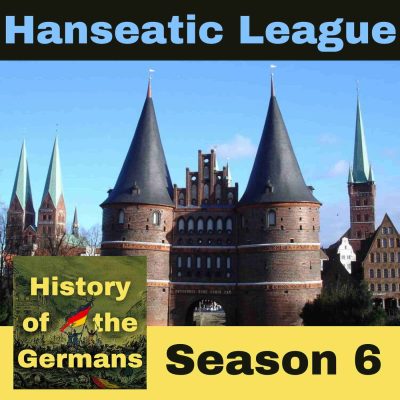
A narrative history of the German people from the Middle Ages to Reunification in 1991. Episodes are 25-35 min long and drop on Thursday mornings every 2 weeks. "A great many things keep happening, some good, some bad". Gregory of Tours (539-594) So far we have covered: Ottonian Emperors (# 1- 21) - Henry the Fowler (#1) - Otto I (#2-8) - Otto II (#9-11) - Otto II (#11-14) - Henry II (#15-17) - Germany in 1000 (#18-21) Salian Emperors(#22-42) - Konrad II (#22- 25) - Henry III (#26-29) - Henry IV/Canossa (#30-39) - Henry V (#40-42) - Concordat of Worms (#42) Early Hohenstaufen (#43-69) - Lothar III (#43-46) - Konrad III (#47-49) - Frederick Barbarossa (#50-69) Late Hohenstaufen (#70-94) - Henry VI (#70-72) - Philipp of Swabia (#73-74) - Otto IV (#74-75) - Frederick II (#75-90) - Epilogue (#91-94) Colonisation of the East (#95-108) The Hanseatic League (#109-127) The Teutonic Knights (#128-137) From the Interregnum to the Golden Bull (#138 -185) - Rudolf von Habsburg (#139-141) - Adolf von Nassau (#142) - Albrecht von Habsburg (#143) - Heinrich VII (#144-148) - Ludwig the Bavarian (#149-153) - Karl IV (#154-163) The Reformation before the Reformation - Wenceslaus the Lazy (#165) - The Western Schism (#166/167) - The Ottomans (#168) - Sigismund (#169-#184 The Empire in the 15th Century - Mainz & Hessen #186 - Printing #187-#188 - Universities #190 - Wittelsbachs #189, #196-#199 - Baden, Wuerrtemberg, Augsburg, Fugger (#191-195) - Maps & Arms (#201-#202) The Fall and Rise of the House of Habsburg - Early Habsburgs (#203-#207) - Albrecht II (#208) - Friedrich III (#209-#215) - Maximilian I (#215-
Épisodes 257
Ep. 244: Martin Luther #6 - The Leipzig Disputation
In June and July 1519, Martin Luther finally got the open debate he had been demanding, and it went badly for him. Johannes Eck, the formidable Ingolstadt theologian, used a quarrel with Luther's colleague …
Notes de l’épisode
In June and July 1519, Martin Luther finally got the open debate he had been demanding, and it went badly for him. Johannes Eck, the formidable Ingolstadt theologian, used a quarrel with Luther's colleague Andreas Karlstadt to lure Luther to Leipzig, onto the territory of Duke George of Saxony.
This episode follows how the debate came about despite Rome's efforts to prevent it, the theatrics of the Wittenbergers' arrival, and how Eck steered Luther away from indulgences and towards papal authority. Pushed into a corner, Luther declared that some of Jan Hus's condemned teachings were "Christian and evangelical", and so that even a church council could err. In Leipzig that made him a Hussite and a heretic, and it turned Duke George into his implacable foe.
And yet Luther came out of it stronger. His pamphlets outsold Eck's, humanist satire made Eck a laughing stock, and the bull Exsurge Domine condemned him without arguing from scripture. With no way back, Luther began to link his fight with the papacy to his own search for a merciful God, which is where the Reformation proper begins.
Chapter
0:00 | Introduction: Lyndal Roper on Leipzig
1:24 | Supporting the show
2:48 | After Augsburg: Luther a de facto prisoner in Saxony
6:55 | Enter Johannes Eck, Luther's nemesis
9:41 | Rome plays for time: Karl von Miltitz and the imperial election
11:42 | Eck goes after Karlstadt
14:47 | Finding a venue: why Leipzig
18:57 | A football derby of the mind
19:45 | The Wittenbergers arrive (and Karlstadt lands in the mud)
24:04 | Eck versus Karlstadt on free will
25:12 | Luther's turn: Matthew 16:18 and the power of the popes
28:40 | Eck plays the Hus card
30:22 | "Some of Hus's theses are Christian and evangelical"
34:54 | The battle of the pamphlets
37:49 | Brand Luther: the economics of short pamphlets
40:51 | Humanist satire and the demolition of Eck
43:03 | Exsurge Domine
44:51 | Luther's reaction: the papacy as Antichrist
47:04 | How Rome pushed Luther towards the Reformation
49:11 | The other struggle: sinner and God
51:15 | Next time and related episodes
Books and sources- Lyndal Roper, Martin Luther: Renegade and Prophet (London: Bodley Head, 2016).
- Roland H. Bainton, Here I Stand: A Life of Martin Luther (New York and Nashville: Abingdon-Cokesbury, 1950). The portrait of Eck's
- Andrew Pettegree, Brand Luther: 1517, Printing, and the Making of the Reformation (New York: Penguin Press, 2015).
- Heinz Schilling, Martin Luther: Rebel in an Age of Upheaval, translated by Rona Johnston (Oxford: Oxford University Press, 2017).
- Volker Leppin, Martin Luther: A Late Medieval Life (Grand Rapids: Baker Academic).
Ep. 243: Martin Luther #5 - Fame, Friends, Foes and a Fat Marmot
In August 1518, Pope Leo X wrote to Frederick the Wise, Elector of Saxony, and demanded that he hand over “a son of iniquity”, Brother Martin Luther. A few weeks later Luther was on the road to Augsburg to face …
Notes de l’épisode
In August 1518, Pope Leo X wrote to Frederick the Wise, Elector of Saxony, and demanded that he hand over “a son of iniquity”, Brother Martin Luther. A few weeks later Luther was on the road to Augsburg to face Cardinal Cajetan. It was arguably the most dangerous moment of his life, more dangerous even than Worms.
This episode follows how Luther got there and how close he came to the stake:
- Fame: four groups (imperial reformers, humanists, friars and ordinary readers) each saw their own Luther.
- Foes: the Dominicans, Johannes Eck, Luther’s old Erfurt teachers and, finally, the full weight of the Roman Church.
- Friends: Melanchthon, Karlstadt, Cranach and Spalatin.
- The Fat Marmot: a portrait of Frederick the Wise, the cautious, pious and remarkably peaceable prince who held Luther’s fate in his hands.
- Augsburg: Luther’s meetings with Cajetan, one of the sharpest theologians of his age, and how they ended in shouting.
- Flight: Luther’s escape through a gate in the city wall at night, and his discovery that Rome had condemned him before he was ever heard.
- The final hour: a farewell dinner in Wittenberg on 1 December 1518, and two letters from the Elector that changed the course of the Reformation.
Further reading
- Armin Kohnle, Friedrich der Weise (2024)
- Roland H. Bainton, Here I Stand: A Life of Martin Luther
Support the show: History of the Germans is advertising-free thanks to listeners like you. Become a member at historyofthegermans.com/support.
★ Support this podcast ★Ep. 242: Martin Luther #4 - A Drunken German Lights a Fire
n spring 1518 Martin Luther assured Pope Leo X that he was a dutiful son of the Church. But was he still one? The 95 Theses were the perfect opening salvo: provocative, popular and, crucially, not obviously …
Notes de l’épisode
n spring 1518 Martin Luther assured Pope Leo X that he was a dutiful son of the Church. But was he still one?
★ Support this podcast ★
The 95 Theses were the perfect opening salvo: provocative, popular and, crucially, not obviously heretical.
Archbishop Albrecht’s own theologians in Mainz refused to condemn them and passed the problem on to Rome.
Then Luther did something new: he wrote the Sermon on Indulgences and Grace in punchy German for ordinary readers.
It became an early bestseller and helped create a mass market for public debate in print.
Tetzel’s Dominicans hit back with counter-theses, which Wittenberg students promptly burned.
Leo X tried to deal with it inside the Augustinian order, but at Heidelberg Luther’s brothers cheered him instead.
There he set out his theology of the cross and denied that fallen humans can earn salvation by their own free will.
After a defiant sermon on excommunication, Rome turned to the papal theologian Prierias, whose verdict was simple: whoever questions the pope is a heretic.
A summons to Rome followed, and a lone friar now faced the full weight of the papacy.Ep. 241: Martin Luther #3 - The 95 Theses, More Cockup than Conspiracy
What if the most famous story of the Reformation has some massive holes? Was Tetzel really a snake oil salesman? Was Albrecht of Brandenburg and the Fuggers really after the indulgence contracts? Were the …
Notes de l’épisode
What if the most famous story of the Reformation has some massive holes? Was Tetzel really a snake oil salesman? Was Albrecht of Brandenburg and the Fuggers really after the indulgence contracts? Were the Germans been ripped off by the papacy more than anyone else? Who could believe that there is still room for new perspectives on this event?
★ Support this podcast ★Ep. 240: Martin Luther #2 - His Youth and His "Anfechtungen"
In this episode we will look at the first 35 years of Martin Luther’s life, from his birth in 1483 to a moment sometime between 1512 and 1519 when he achieved his great theological breakthrough. This is a …
Notes de l’épisode
In this episode we will look at the first 35 years of Martin Luther’s life, from his birth in 1483 to a moment sometime between 1512 and 1519 when he achieved his great theological breakthrough. This is a crucial period in the history of the Reformation, a time when Luther struggled with what he called his “Anfechtungen”. Anfechtungen is one of these untranslatable German words like Schadenfreude and Gemütlichkeit. It is something more than a trial or tribulation, more of an existential assault on faith itself — an overwhelming, often visceral experience of doubt, terror, and despair before God, in which the sinner feels utterly exposed to divine judgment and abandoned by grace. Sounds quite painful. It was these “Anfechtungen” that brought about the cornerstone of his creed, that salvation is to be obtained through faith alone. It is the story how Protestantism is born in the head of just one man.
★ Support this podcast ★Ep. 239: Martin Luther #1 - The Faith of the Common People
On 31 October 1517, an Augustinian monk carried 95 theses through the streets of Wittenberg — whether to nail them to the castle church door, post them by letter, or send them to the printers remains disputed …
Notes de l’épisode
On 31 October 1517, an Augustinian monk carried 95 theses through the streets of Wittenberg — whether to nail them to the castle church door, post them by letter, or send them to the printers remains disputed. Within two months they had spread across the Empire and beyond and the world was never the same again...
In this first episode of the new season we look at the world Martin Luther grew up in, what common people like him experienced in life - mostly godawful things - and how that shaped their worldview and religious leanings.
We will talk about onion-shaped societies, ancient prophecies of an age of bliss, the importance of mass even if no-one gets communion, the benefits of purgatory, pilgrimages and lots more...
For video, go to https://youtu.be/kocPaQrcMyc
The music for the show is Flute Sonata in E-flat major, H.545 by Carl Phillip Emmanuel Bach (or some claim it as BWV 1031 Johann Sebastian Bach) performed and arranged by Michel Rondeau under Common Creative Licence 3.0.
As always:
Homepage with maps, photos, transcripts and blog: www.historyofthegermans.com
If you wish to support the show go to: Support • History of the Germans Podcast
For do it yourself merchandise go to: Merchandise • History of the Germans Podcast
Facebook: @HOTGPod
Threads: @history_of_the_germans_podcast
Bluesky: @hotgpod.bsky.social
Instagram: history_of_the_germans
Twitter: @germanshistory
To make it easier for you to share the podcast, I have created separate playlists for some of the seasons that are set up as individual podcasts. they have the exact same episodes as in the History of the Germans, but they may be a helpful device for those who want to concentrate on only one season.
So far I have:
Salian Emperors and Investiture Controversy
Fredrick Barbarossa and Early Hohenstaufen
The Holy Roman Empire 1250-1356
The Reformation before the Reformation
The Empire in the 15th century
The Fall and Rise of the Habsburgs
★ Support this podcast ★Season 12: The Reformation! (Trailer)
When it comes to events from German history that left a mark on the world, most minds turn towards the 19th and 20th century. But there is at least one, arguably two periods that can claim to have had equally …
Notes de l’épisode
When it comes to events from German history that left a mark on the world, most minds turn towards the 19th and 20th century. But there is at least one, arguably two periods that can claim to have had equally lasting impact. One is the Investiture Controversy that we discussed in Season 2, and the other is what we will learn about now, the Reformation!
★ Support this podcast ★Ep. 238: The Habsburg Empire at its Zenith - Ferdinand I and the Siege of Vienna
Today we celebrate the topping out of the Habsburg empire. By the middle of the 16th century it reached its furthest extent as a political entity ruled by one man. Over the last 42 episodes we have seen this …
Notes de l’épisode
Today we celebrate the topping out of the Habsburg empire. By the middle of the 16th century it reached its furthest extent as a political entity ruled by one man. Over the last 42 episodes we have seen this family of minor counts playing their game of snakes and ladders until they had amassed lordships over Austria, the Netherlands, Spain and large parts of Italy. Today we look at how they finally got hold of the last bits, Bohemia and Hungary.
The story features a dutiful younger brother, the most cruel execution I have ever heard of, a foolish duke and an even more foolish king, the collapse of a kingdom, a love story and the reason for the incessant Habsburg inbreeding. I hope that will be enough to fill the last episode of this season.
The music for the show is Flute Sonata in E-flat major, H.545 by Carl Phillip Emmanuel Bach (or some claim it as BWV 1031 Johann Sebastian Bach) performed and arranged by Michel Rondeau under Common Creative Licence 3.0.
As always:
Homepage with maps, photos, transcripts and blog: www.historyofthegermans.com
If you wish to support the show go to: Support • History of the Germans Podcast
For do it yourself merchandise go to: Merchandise • History of the Germans Podcast
Facebook: @HOTGPod
Threads: @history_of_the_germans_podcast
Bluesky: @hotgpod.bsky.social
Instagram: history_of_the_germans
Twitter: @germanshistory
To make it easier for you to share the podcast, I have created separate playlists for some of the seasons that are set up as individual podcasts. they have the exact same episodes as in the History of the Germans, but they may be a helpful device for those who want to concentrate on only one season.
So far I have:
Salian Emperors and Investiture Controversy
Fredrick Barbarossa and Early Hohenstaufen
The Holy Roman Empire 1250-1356
The Reformation before the Reformation
The Empire in the 15th century
The Fall and Rise of the Habsburgs
★ Support this podcast ★Ep. 237: How Italy Fell to the Habsburgs - From the Peace of Madrid to the Sack of Rome 1527.
We are coming closer to the end of our series on the Fall and Rise of the House of Habsburg. We have seen the reconsolidation of Austria, the acquisition of Burgundy, the inheritance of Spain and today, we will …
Notes de l’épisode
We are coming closer to the end of our series on the Fall and Rise of the House of Habsburg. We have seen the reconsolidation of Austria, the acquisition of Burgundy, the inheritance of Spain and today, we will look at the last stages of the Italian wars. This conflict, kicked off by king Charles VIII in 1494 had given “rise to changes of dominions, subversion of kingdoms, desolation of countries, destruction of cities and the cruellest massacres, but also new fashions, new customs, new and bloody ways of waging warfare, and diseases which had been unknown to that time”. Many players of this game had exited stage left and it was now just France and the Habsburgs in various alliances with the remaining Italian powers, who fought for control. The War of the League of Cognac, 1526 to 1530 was when brutality reached its zenith with the Sacco di Roma, the Sack of Rome that brought back the specter of the Vandals.
A lot of drama to get through.
The music for the show is Flute Sonata in E-flat major, H.545 by Carl Phillip Emmanuel Bach (or some claim it as BWV 1031 Johann Sebastian Bach) performed and arranged by Michel Rondeau under Common Creative Licence 3.0.
As always:
Homepage with maps, photos, transcripts and blog: www.historyofthegermans.com
If you wish to support the show go to: Support • History of the Germans Podcast
For do it yourself merchandise go to: Merchandise • History of the Germans Podcast
Facebook: @HOTGPod
Threads: @history_of_the_germans_podcast
Bluesky: @hotgpod.bsky.social
Instagram: history_of_the_germans
Twitter: @germanshistory
To make it easier for you to share the podcast, I have created separate playlists for some of the seasons that are set up as individual podcasts. they have the exact same episodes as in the History of the Germans, but they may be a helpful device for those who want to concentrate on only one season.
So far I have:
Salian Emperors and Investiture Controversy
Fredrick Barbarossa and Early Hohenstaufen
The Holy Roman Empire 1250-1356
The Reformation before the Reformation
The Empire in the 15th century
The Fall and Rise of the Habsburgs
★ Support this podcast ★Ep. 236: Charles V (1520-1555) - The Battle of Pavia
In 1521 four men dominated Europe. They were all in their twenties: King Henry VIII of England, born 1491, King Francois I of France, born 1494, Suleiman the Magnificent, Ottoman Sultan, born that same year …
Notes de l’épisode
In 1521 four men dominated Europe. They were all in their twenties: King Henry VIII of England, born 1491, King Francois I of France, born 1494, Suleiman the Magnificent, Ottoman Sultan, born that same year, 1494 and the youngest of them, Charles V, Holy Roman Emperor, King of Spain, Sicily, Naples and Sardinia, lord of the Netherlands, duke of Austria and Count of Tyrol.
How the world had changed. In the days of Charles’ predecessor, the emperor Maximilian, European politics was a impenetrable maze of alliances and enmities involving roughly a dozen mid-sized powers trying to get a leg up on each other.
Now we are down to four guys, dancing a political Ceilidh, all elegantly dressed, swiftly moving and swapping partners at every turn.
In this episode we are going to look at the first rounds of Gay Gordons and Dashing White Sergeants up to the point where Charles V gets a lock on Francois I at the Battle of Pavia in 1525
The music for the show is Flute Sonata in E-flat major, H.545 by Carl Phillip Emmanuel Bach (or some claim it as BWV 1031 Johann Sebastian Bach) performed and arranged by Michel Rondeau under Common Creative Licence 3.0.
As always:
Homepage with maps, photos, transcripts and blog: www.historyofthegermans.com
If you wish to support the show go to: Support • History of the Germans Podcast
For do it yourself merchandise go to: Merchandise • History of the Germans Podcast
Facebook: @HOTGPod
Threads: @history_of_the_germans_podcast
Bluesky: @hotgpod.bsky.social
Instagram: history_of_the_germans
Twitter: @germanshistory
To make it easier for you to share the podcast, I have created separate playlists for some of the seasons that are set up as individual podcasts. they have the exact same episodes as in the History of the Germans, but they may be a helpful device for those who want to concentrate on only one season.
So far I have:
Salian Emperors and Investiture Controversy
Fredrick Barbarossa and Early Hohenstaufen
The Holy Roman Empire 1250-1356
The Reformation before the Reformation
The Empire in the 15th century
The Fall and Rise of the Habsburgs
★ Support this podcast ★Ep. 235: The Youth and Election of the Emperor Charles V (1520-1555)
Born during a ball in Ghent on 24 February 1500, Charles of Habsburg would grow up to rule an empire stretching from the Philippines to Prague and from Lima to Lauwersoog. But who was the man behind one of …
Notes de l’épisode
Born during a ball in Ghent on 24 February 1500, Charles of Habsburg would grow up to rule an empire stretching from the Philippines to Prague and from Lima to Lauwersoog. But who was the man behind one of history's most powerful titles — and how did an unremarkable teenager come to be elected Holy Roman Emperor?
In this episode, we explore the remarkable — and often dysfunctional — upbringing of Charles V. Raised like an orphan in the Burgundian Netherlands while his mother Joanna of Castile was confined at Tordesillas, Charles was shaped by two very different mentors: the theologian Adrian of Utrecht, who introduced him to Erasmus and laid the groundwork for his complex relationship with the Reformation, and William de Croy, Lord of Chièvres, who drilled into him the discipline of statecraft.
We examine how Charles' worldview was rooted in Burgundian chivalric tradition, why his advisors kept him politically cautious in his early reign, and how the death of his grandfather Maximilian I in 1519 forced him to step up and fight for the imperial crown against the formidable Francis I of France.
We also cover the extraordinary financial muscle of banker Jakob Fugger, the crucial diplomatic role of Margaret of Austria, and how a brief stop in Dover to visit Henry VIII helped prevent a Franco-English alliance that could have derailed everything at the Field of Cloth of Gold.
Topics covered in this episode:
- Charles V's childhood in Mechelen and his education under Adrian of Utrecht and Lord Chièvres
- The Burgundian chivalric culture that shaped his worldview
- The death of Maximilian I and the scramble for the imperial election of 1519
- The role of the Fugger banking dynasty in funding Charles' election campaign
- The Field of Cloth of Gold and Habsburg diplomacy with Henry VIII
- The coronation at Aachen in October 1520 and what it meant for the future of the Holy Roman Empire
Plus: an update on upcoming episodes and a summer break announcement.
★ Support this podcast ★Ep. 234: The Charisma of Emperor Maximilian (1493-1519)
Maximilian I died on January 12th, 1519. But his likeness is everywhere. None of his predecessors left behind as many depictions of their life, from being fed by his nurse as a toddler to the Totenbild, the …
Notes de l’épisode
Maximilian I died on January 12th, 1519. But his likeness is everywhere. None of his predecessors left behind as many depictions of their life, from being fed by his nurse as a toddler to the Totenbild, the picture of the emperor in death, stripped of all his paraphernalia, even his teeth broken out.
If you search in google for the most reproduced image of a Holy Roman Emperor, two come up, the portrait of Maximilian that Albrecht Dürer produced in Augsburg in 1518, as shown on last weeks episode artwork and Titian’s equestrian portrait of Charles V after the battle of Mühlberg, which in turn is a composition that goes back to several equestrian portraits of Maximilian I.
Basically, Maximilian I is the most visually present Holy Roman emperor of them all. And that is not by chance. As he said on several occasions, quote:
"Whoever does not provide for his commemoration during his lifetime has no commemoration after his death and is forgotten with the sound of the bell that rings at his burial"
The music for the show is Flute Sonata in E-flat major, H.545 by Carl Phillip Emmanuel Bach (or some claim it as BWV 1031 Johann Sebastian Bach) performed and arranged by Michel Rondeau under Common Creative Licence 3.0.
As always:
Homepage with maps, photos, transcripts and blog: www.historyofthegermans.com
If you wish to support the show go to: Support • History of the Germans Podcast
For do it yourself merchandise go to: Merchandise • History of the Germans Podcast
Facebook: @HOTGPod
Threads: @history_of_the_germans_podcast
Bluesky: @hotgpod.bsky.social
Instagram: history_of_the_germans
Twitter: @germanshistory
To make it easier for you to share the podcast, I have created separate playlists for some of the seasons that are set up as individual podcasts. they have the exact same episodes as in the History of the Germans, but they may be a helpful device for those who want to concentrate on only one season.
So far I have:
Salian Emperors and Investiture Controversy
Fredrick Barbarossa and Early Hohenstaufen
The Holy Roman Empire 1250-1356
The Reformation before the Reformation
The Empire in the 15th century
The Fall and Rise of the Habsburgs
★ Support this podcast ★Ep. 233: Maximilian I (1493-1519) - Last Days and Legacy
The last decade of emperor Maximilian’s reign was overshadowed by all three challenges to the emerging Habsburg empire gaining strength. The Ottoman empire was piling on resources by taking over Syria, Lebanon …
Notes de l’épisode
The last decade of emperor Maximilian’s reign was overshadowed by all three challenges to the emerging Habsburg empire gaining strength. The Ottoman empire was piling on resources by taking over Syria, Lebanon and Egypt. A vigorous new king of France, Francois I was turning the tide in the incessant Italian wars into his favor. And finally the greatest of threats to the dynasty emerged as the Prince Electors were contemplating to raise that self-same Francois I to the imperial title.
In this episode we will look at how the prematurely aged and exhausted emperor tried to shield his grandsons Charles and Ferdinand from the ton of bricks that was coming down on them. And we will look at his last days and legacy. Clocking in at 18 episodes, Maximilian did achieve one of his objectives in life, outpacing the great emperor Frederick Barbarossa. Let’s find out whether he did this only in terms of number of HotGPod episodes, or in other ways too.
The music for the show is Flute Sonata in E-flat major, H.545 by Carl Phillip Emmanuel Bach (or some claim it as BWV 1031 Johann Sebastian Bach) performed and arranged by Michel Rondeau under Common Creative Licence 3.0.
As always:
Homepage with maps, photos, transcripts and blog: www.historyofthegermans.com
If you wish to support the show go to: Support • History of the Germans Podcast
For do it yourself merchandise go to: Merchandise • History of the Germans Podcast
Facebook: @HOTGPod
Threads: @history_of_the_germans_podcast
Bluesky: @hotgpod.bsky.social
Instagram: history_of_the_germans
Twitter: @germanshistory
To make it easier for you to share the podcast, I have created separate playlists for some of the seasons that are set up as individual podcasts. they have the exact same episodes as in the History of the Germans, but they may be a helpful device for those who want to concentrate on only one season.
So far I have:
Salian Emperors and Investiture Controversy
Fredrick Barbarossa and Early Hohenstaufen
The Holy Roman Empire 1250-1356
The Reformation before the Reformation
The Empire in the 15th century
The Fall and Rise of the Habsburgs
★ Support this podcast ★Ep. 232: The Ottomans – From Mehmet the Conqueror to Selim the Grim (1444-1520)
These last dozen or so episodes we have examined the genesis of two of the three major strategic preoccupations of the Habsburg empire, the rivalry with the French kings and the relationship with the imperial …
Notes de l’épisode
These last dozen or so episodes we have examined the genesis of two of the three major strategic preoccupations of the Habsburg empire, the rivalry with the French kings and the relationship with the imperial princes. Today we will look at the build-up of the third major strategic challenge to the rulers of the Holy Roman Empire, the Ottomans. One can argue, and many have, that the threat of an Ottoman invasion in the 1520s and 1530s prevented the emperor Charles V from clamping down on the protestants in the empire. By the time the border had been stabilised and the Habsburgs could focus again on the religious and political changes in the German lands, it was too late to reverse events. There is an element of irony here that I will refrain from elaborating on.
When Constantinople fell in 1453, the Christian nations of Western Europe assumed that they could regain the ancient capital of Byzantium and even Jerusalem if only they were united under the crusading banner. By the time Suleiman the Magnificent appeared before Belgrade in 1521, that had become inconceivable. The Christian nations, and in particular the Habsburgs were on their back foot.
So, what had happened in these 70 years that made the Ottoman armies appear unbeatable?
The music for the show is Flute Sonata in E-flat major, H.545 by Carl Phillip Emmanuel Bach (or some claim it as BWV 1031 Johann Sebastian Bach) performed and arranged by Michel Rondeau under Common Creative Licence 3.0.
As always:
Homepage with maps, photos, transcripts and blog: www.historyofthegermans.com
If you wish to support the show go to: Support • History of the Germans Podcast
For do it yourself merchandise go to: Merchandise • History of the Germans Podcast
Facebook: @HOTGPod
Threads: @history_of_the_germans_podcast
Bluesky: @hotgpod.bsky.social
Instagram: history_of_the_germans
Twitter: @germanshistory
To make it easier for you to share the podcast, I have created separate playlists for some of the seasons that are set up as individual podcasts. they have the exact same episodes as in the History of the Germans, but they may be a helpful device for those who want to concentrate on only one season.
So far I have:
Salian Emperors and Investiture Controversy
Fredrick Barbarossa and Early Hohenstaufen
The Holy Roman Empire 1250-1356
The Reformation before the Reformation
The Empire in the 15th century
The Fall and Rise of the Habsburgs
★ Support this podcast ★Ep. 231: Maximilian I (1493-1519) - Marrying Bohemia and Hungary
You have almost certainly seen the image in today’s episode artwork before. It is a family portrait showing Maximilian, his first wife Marie of Burgundy, his son, Philip the Handsome and three children. When …
Notes de l’épisode
You have almost certainly seen the image in today’s episode artwork before. It is a family portrait showing Maximilian, his first wife Marie of Burgundy, his son, Philip the Handsome and three children. When Bernhard Strigel painted this image in around the year 1516, Philip the Handsome was already dead for 10 years and Marie of Burgundy had gone more than 30 years before. Then there are the inscriptions over the heads of these well-known and easily identifiable figures. There is a lot of Habsburg chin on show here. But they do not describe Maximilian as emperor, but as Cleophas, blood brother of Joseph, husband of the divine Virgin Mary, Marie of Burgundy is Mary Cleophas, sister of the Virgin Mary, and Philip the Handsome as James the Lesser, apostle and son of the other two. Two of the three little boys are named as Joseph the Just and Simon the Zealot, the cousin of the lord. Who are these saints? Well they do appear in the bible, so they are real, but in very minor roles. One of them was even rejected as an apostle. But they do have something special, they are Jesus’ aunt, uncle, nephews and cousin. And since he had died without offspring, his heirs. So this is a picture about succession and inheritance, not necessarily about family love.
Ok, making the emperor the brother in law of Joseph is quite odd already, but let’s talk about the three children. They were all alive when this picture was painted and roughly the age they are depicted as. The one in the middle is Charles, the future emperor Charles V. And the little boy cuddling up to Maximilian is his brother Ferdinand, the future emperor Ferdinand I., again identified as holy nephew and cousin. But who is the third child? Well, that is Louis, the future king Louis II of Hungary and Bohemia, son of king Vladislav II and his French wife Anne de Foix. So no close blood relation. What does he do in one of the most famous Habsburg family portraits? It must have something to do with succession and inheritance.
That is indeed what we are going to talk about today. Little Louis will be the key to the creation of the Austro-Hungarian Empire, this agglomeration of lands centered around Austria, Czechia and Hungary that stayed or was made to stay together for nearly 400 years.
The music for the show is Flute Sonata in E-flat major, H.545 by Carl Phillip Emmanuel Bach (or some claim it as BWV 1031 Johann Sebastian Bach) performed and arranged by Michel Rondeau under Common Creative Licence 3.0.
As always:
Homepage with maps, photos, transcripts and blog: www.historyofthegermans.com
If you wish to support the show go to: Support • History of the Germans Podcast
For do it yourself merchandise go to: Merchandise • History of the Germans Podcast
Facebook: @HOTGPod
Threads: @history_of_the_germans_podcast
Bluesky: @hotgpod.bsky.social
Instagram: history_of_the_germans
Twitter: @germanshistory
To make it easier for you to share the podcast, I have created separate playlists for some of the seasons that are set up as individual podcasts. they have the exact same episodes as in the History of the Germans, but they may be a helpful device for those who want to concentrate on only one season.
So far I have:
Salian Emperors and Investiture Controversy
Fredrick Barbarossa and Early Hohenstaufen
The Holy Roman Empire 1250-1356
The Reformation before the Reformation
The Empire in the 15th century
The Fall and Rise of the Habsburgs
★ Support this podcast ★Ep.230: Margaret of Austria (1480-1530) - The League of Cambrai
Another Thursday and another episode dealing with another epic fail of our hero, Maximilian I. But despite a military campaign that once again failed for all the usual reasons, no money, no strategy, no luck …
Notes de l’épisode
Another Thursday and another episode dealing with another epic fail of our hero, Maximilian I. But despite a military campaign that once again failed for all the usual reasons, no money, no strategy, no luck, this time he is rescued not by a marriage or imperial princes suddenly inflicted with an unlikely case of backbone, but by his daughter, Margaret, archduchess of Austria, dowager duchess of Savoy and governor of the Netherlands.
In an age that featured a number of impressive women, from Caterina Sforza to Elisabeth I, Margaret may be lesser known, but could easily hold her own amongst such illustrious company. She brought together an alliance that rescued her father’s lands, re-established imperial power in Northern Italy and brought the mighty republic of Venice almost to collapse. And then did it again, again and once more.
Meanwhile her father first made himself emperor in the least impressive ceremony ever, before throwing his hat in the ring to become – tat, tat, taa – the pope.
★ Support this podcast ★Ep. 229: Joanna the (not?) Mad (1504-1555) - How the Habsburgs gained Spain
“Bella gerant alii, tu felix Austria nube" – ‘Let others wage war; thou, happy Austria, marry’ is one of the few terms that almost anyone with a cursory interest in European history knows, only rivalled by the …
Notes de l’épisode
“Bella gerant alii, tu felix Austria nube" – ‘Let others wage war; thou, happy Austria, marry’ is one of the few terms that almost anyone with a cursory interest in European history knows, only rivalled by the Voltaire quote thou shall not utter in my presence ever. It evokes the image of a handsome alpine boy full of charm and apple strudel wooing some princess into peacefully handing over the richest lands is Europe. And this narrative of peaceful transition to a benign dynasty is another one of the great propaganda successes of the house of Habsburg.
The saying was attributed to Matthias Corvinus, the king of Hungary who had once occupied Vienna, then to the humanist Ulrich von Hutten, but first evidence of its use dates back to 1654, more than 150 years after the famous marriages that made an empire. From 1680 it was read out at Habsburg weddings to emphasise the peaceful nature of its rulers.
It definitely did not originate in the days of Maximilian I when all these dynastic alliances were formed and bore fruit. Talking about gentle and peaceful transition was preposterous against the backdrop of a 15 -year long war over the succession to the grand Dukes of Burgundy, and the roller coaster ride that is today’s topic, the way the Habsburgs acquired the crown of Spain.
The music for the show is Flute Sonata in E-flat major, H.545 by Carl Phillip Emmanuel Bach (or some claim it as BWV 1031 Johann Sebastian Bach) performed and arranged by Michel Rondeau under Common Creative Licence 3.0.
As always:
Homepage with maps, photos, transcripts and blog: www.historyofthegermans.com
If you wish to support the show go to: Support • History of the Germans Podcast
For do it yourself merchandise go to: Merchandise • History of the Germans Podcast
Facebook: @HOTGPod
Threads: @history_of_the_germans_podcast
Bluesky: @hotgpod.bsky.social
Instagram: history_of_the_germans
Twitter: @germanshistory
To make it easier for you to share the podcast, I have created separate playlists for some of the seasons that are set up as individual podcasts. they have the exact same episodes as in the History of the Germans, but they may be a helpful device for those who want to concentrate on only one season.
So far I have:
Salian Emperors and Investiture Controversy
Fredrick Barbarossa and Early Hohenstaufen
The Holy Roman Empire 1250-1356
The Reformation before the Reformation
The Empire in the 15th century
The Fall and Rise of the Habsburgs
★ Support this podcast ★Ep. 228: Maximilian I (1493-1519) - The Princes and the Emperor.
If there was one group that consistently thwarted Maximilian’s grand plans for world domination, it was the princes of the Holy Roman Empire. He had given in to their demands for Imperial Reform, had granted …
Notes de l’épisode
If there was one group that consistently thwarted Maximilian’s grand plans for world domination, it was the princes of the Holy Roman Empire. He had given in to their demands for Imperial Reform, had granted the Reichstag far reaching powers, had established the Reichskammergericht as a law court independent of imperial authority and had announced the much longed for ban on feuding. But did the princes, counts, knights and cities hold up their end of the bargain and paid him taxes to raise the armies needed to defend the borders of the empire – well you bet.
They left him hanging before Livorno, they collected berries instead of fighting in the Swiss war, and – spoiler alert – they will not raise a little finger to help Ludovioco il Moro to regain his duchy of Milan, even though Milan had been an imperial fief since the days of Charlemagne and Otto the Great. No money, no soldiers, nothing.
The music for the show is Flute Sonata in E-flat major, H.545 by Carl Phillip Emmanuel Bach (or some claim it as BWV 1031 Johann Sebastian Bach) performed and arranged by Michel Rondeau under Common Creative Licence 3.0.
As always:
Homepage with maps, photos, transcripts and blog: www.historyofthegermans.com
If you wish to support the show go to: Support • History of the Germans Podcast
For do it yourself merchandise go to: Merchandise • History of the Germans Podcast
Facebook: @HOTGPod
Threads: @history_of_the_germans_podcast
Bluesky: @hotgpod.bsky.social
Instagram: history_of_the_germans
Twitter: @germanshistory
To make it easier for you to share the podcast, I have created separate playlists for some of the seasons that are set up as individual podcasts. they have the exact same episodes as in the History of the Germans, but they may be a helpful device for those who want to concentrate on only one season.
So far I have:
Salian Emperors and Investiture Controversy
Fredrick Barbarossa and Early Hohenstaufen
The Holy Roman Empire 1250-1356
The Reformation before the Reformation
The Empire in the 15th century
The Fall and Rise of the Habsburgs
★ Support this podcast ★Ep. 227: Landsknechte vs. Swiss Mercenaries – The Swabian (Swiss) War of 1499
Why are the Swiss called the Swiss? After all, Schwyz in only of 26 cantons, and not one of the largest ones. How did the proud and prosperous citizens of Zurich or Berne, mighty city states in their own right …
Notes de l’épisode
Why are the Swiss called the Swiss? After all, Schwyz in only of 26 cantons, and not one of the largest ones. How did the proud and prosperous citizens of Zurich or Berne, mighty city states in their own right, decide they wanted to be named after a mountainous region largely inhabited by peasants tending to their gorgeous brown cattle, the Braunvieh. They even called their national airline Swissair, until my former colleagues at McKinsey let the air out of that one.
So, why Swiss? The answer goes back to today’s topic, a war that the Swiss call the Schwabenkreig or Swabian War. This war played a massive role in Swiss historiography, and its main battles at the Caven and at Dornach was mentioned in the same breath as Morgarten and Sempach. It was seen as the moment when Switzerland de facto exited the Holy Roman Empire and began ploughing its own furrow in European history. Meanwhile in Germany, this war that we called the Schweizerkreig or Swiss War is largely forgotten amongst the hundreds of other military conflicts.
It was also the first of many contests between the two formidable fighting forces of the Renaissance, the Swiss Reisläufer and the German Landsknechte. These soldiers of fortune have percolated the national consciousness on both sides, their fanciful dress depicted in art on both sides of the Rhine and still providing one of Rome’s most instagrammable photo opportunities.
That on top of the usual incompetence and skullduggery should be incentive enough to listen to this episode.
The music for the show is Flute Sonata in E-flat major, H.545 by Carl Phillip Emmanuel Bach (or some claim it as BWV 1031 Johann Sebastian Bach) performed and arranged by Michel Rondeau under Common Creative Licence 3.0.
As always:
Homepage with maps, photos, transcripts and blog: www.historyofthegermans.com
If you wish to support the show go to: Support • History of the Germans Podcast
For do it yourself merchandise go to: Merchandise • History of the Germans Podcast
Facebook: @HOTGPod
Threads: @history_of_the_germans_podcast
Bluesky: @hotgpod.bsky.social
Instagram: history_of_the_germans
Twitter: @germanshistory
To make it easier for you to share the podcast, I have created separate playlists for some of the seasons that are set up as individual podcasts. they have the exact same episodes as in the History of the Germans, but they may be a helpful device for those who want to concentrate on only one season.
So far I have:
Salian Emperors and Investiture Controversy
Fredrick Barbarossa and Early Hohenstaufen
The Holy Roman Empire 1250-1356
The Reformation before the Reformation
The Empire in the 15th century
The Fall and Rise of the Habsburgs
★ Support this podcast ★Ep. 226: Maximilian I (1493-1519) - A Grand Plan for a Great War
Europe's political landscape is shifting fundamentally. No longer are wars fought between kings and their vassals, and emperors against popes - it is all about the balance of power. and this balaance is firmly …
Notes de l’épisode
Europe's political landscape is shifting fundamentally. No longer are wars fought between kings and their vassals, and emperors against popes - it is all about the balance of power. and this balaance is firmly out of whack. The largest, richest and most populous part of Europe, the empire that still formally included Italy, the Low Countries, the Swiss Confederation, Bohemia and Burgundy, was also its politically weakest entity, whilst the kings of France leveraged their smaller but more coherent state into European dominance.
The struggle between France and its neighbours with england looking on was to become the dominant political pattern of Western European politics for 250 or arguable 350 years.
Maximilian has a Grand Plan that could have nipped these centuries of death and destruction in the bud. But he did not...
Karl Marx once said that history repeates itself twice, first as tragedy and then as farce. he was wrong on many (not all) things. This one repeats not twice but ten, if not dozens of times, but first as farce and then as tragedy...
Enjoy the ride..
The music for the show is Flute Sonata in E-flat major, H.545 by Carl Phillip Emmanuel Bach (or some claim it as BWV 1031 Johann Sebastian Bach) performed and arranged by Michel Rondeau under Common Creative Licence 3.0.
As always:
Homepage with maps, photos, transcripts and blog: www.historyofthegermans.com
If you wish to support the show go to: Support • History of the Germans Podcast
For do it yourself merchandise go to: Merchandise • History of the Germans Podcast
Facebook: @HOTGPod
Threads: @history_of_the_germans_podcast
Bluesky: @hotgpod.bsky.social
Instagram: history_of_the_germans
Twitter: @germanshistory
To make it easier for you to share the podcast, I have created separate playlists for some of the seasons that are set up as individual podcasts. they have the exact same episodes as in the History of the Germans, but they may be a helpful device for those who want to concentrate on only one season.
So far I have:
Salian Emperors and Investiture Controversy
Fredrick Barbarossa and Early Hohenstaufen
The Holy Roman Empire 1250-1356
The Reformation before the Reformation
The Empire in the 15th century
The Fall and Rise of the Habsburgs
★ Support this podcast ★The Imperial Reform of 1495 with Prof. Duncan Hardy
Prof Duncan Hardy is one of the leading experts in the history of the Holy Roman Empire and one of his main topics is the Imperial reform of 1495, making him the ideal guest for our show.In his first book …
Notes de l’épisode
Prof Duncan Hardy is one of the leading experts in the history of the Holy Roman Empire and one of his main topics is the Imperial reform of 1495, making him the ideal guest for our show.
In his first book, Associative Political Culture in the Holy Roman Empire he tries to define what the Holy Roman Empire was a question we will almost certainly spend quite some time discussing today.
His forthcoming book, which he had so kindly sent me an advance copy, should be familiar to you all, since I do use it as a source for the show. It is titled Law, Society and Political Culture in Late Medieval and Reformation Germany and contains a large number of edited and translated primary sources illustrating German history circa 1350 to 1550.
As a special treat, listeners to the Hstory of the Germans can order the book at Manchester University press with a 30% discount. The discount code is mentioned at the end of teh interview, so listen out. You can order ithere:
Duncan has a PHD from Oxford University, fellowships from Cambridge, Erfurt and Bielefeld and currently teaches at the University of Central Florida.
And he is a fellow listener of the show. So this will be the time where all my mistakes and random speculations will be dragged into the glare of academic scrutiny.
The music for the show is Flute Sonata in E-flat major, H.545 by Carl Phillip Emmanuel Bach (or some claim it as BWV 1031 Johann Sebastian Bach) performed and arranged by Michel Rondeau under Common Creative Licence 3.0.
As always:
Homepage with maps, photos, transcripts and blog: www.historyofthegermans.com
If you wish to support the show go to: Support • History of the Germans Podcast
For do it yourself merchandise go to: Merchandise • History of the Germans Podcast
Facebook: @HOTGPod
Threads: @history_of_the_germans_podcast
Bluesky: @hotgpod.bsky.social
Instagram: history_of_the_germans
Twitter: @germanshistory
To make it easier for you to share the podcast, I have created separate playlists for some of the seasons that are set up as individual podcasts. they have the exact same episodes as in the History of the Germans, but they may be a helpful device for those who want to concentrate on only one season.
So far I have:
Salian Emperors and Investiture Controversy
Fredrick Barbarossa and Early Hohenstaufen
The Holy Roman Empire 1250-1356
The Reformation before the Reformation
The Empire in the 15th century
The Fall and Rise of the Habsburgs
★ Support this podcast ★Ep. 225: Imperial Reform 1495 - The Ewige Landfrieden (Public Peace) of 1495
Let me start today’s episode with some outrageous national stereotypes. If an Englishman is disappointed with the way the affairs of state are conducted, he writes a letter to his member of Parliament. A …
Notes de l’épisode
Let me start today’s episode with some outrageous national stereotypes. If an Englishman is disappointed with the way the affairs of state are conducted, he writes a letter to his member of Parliament. A Frenchman in that same situation rents a tractor and dumps manure outside the Palais d’Elysee. A German threatens to file a lawsuit with the constitutional court, the Bundesverfassungsgericht.
Where did the Germans pick up the belief that courts and the law will protect them against government overreach? Sure, 19th and early 20th century judges had on occasion stood up to the Kaiser’s administration and the Grundgesetz, the liberal constitution of 1949, had become a cornerstone of our national identity following the comprehensive loss of moral standing.
But there is also a long strain that goes back to the Holy Roman Empire and the two imperial courts, the Reichskammergericht and the Reichshofrat. These courts have a bad reputation, not only because Johan Wolfgang von Goethe saw it fit to ridicule his former place of work. However, not everyone shared this negative perspective. Many social groups down to mere commoners relied on these independent judges to protect their life and property against rapacious princes.
The music for the show is Flute Sonata in E-flat major, H.545 by Carl Phillip Emmanuel Bach (or some claim it as BWV 1031 Johann Sebastian Bach) performed and arranged by Michel Rondeau under Common Creative Licence 3.0.
As always:
Homepage with maps, photos, transcripts and blog: www.historyofthegermans.com
If you wish to support the show go to: Support • History of the Germans Podcast
For do it yourself merchandise go to: Merchandise • History of the Germans Podcast
Facebook: @HOTGPod
Threads: @history_of_the_germans_podcast
Bluesky: @hotgpod.bsky.social
Instagram: history_of_the_germans
Twitter: @germanshistory
To make it easier for you to share the podcast, I have created separate playlists for some of the seasons that are set up as individual podcasts. they have the exact same episodes as in the History of the Germans, but they may be a helpful device for those who want to concentrate on only one season.
So far I have:
Salian Emperors and Investiture Controversy
Fredrick Barbarossa and Early Hohenstaufen
The Holy Roman Empire 1250-1356
The Reformation before the Reformation
The Empire in the 15th century
The Fall and Rise of the Habsburgs
★ Support this podcast ★Ep. 224: Imperial Reform 1495 – The Reichstag of the Holy Roman Empire
I am afraid today’s episode is not your usual swordplay and skullduggery. What we are looking at today is the Reichstag as it operated throughout the Holy Roman Empire from 1495 to 1803. Sounds a bit like dour …
Notes de l’épisode
I am afraid today’s episode is not your usual swordplay and skullduggery. What we are looking at today is the Reichstag as it operated throughout the Holy Roman Empire from 1495 to 1803. Sounds a bit like dour constitutional law, but bear with me.
We will look at a couple of classic tropes, like, whether the empire consisted of more than 300 sovereign states who could do whatever they wanted, whether the Reichstag was a talking shop hat never did anything except stopping the emperor from becoming a proper monarch. And, as usual, we will talk about money and printing, and why German politician speeches are invariably long on fact and short on rhetoric.
The music for the show is Flute Sonata in E-flat major, H.545 by Carl Phillip Emmanuel Bach (or some claim it as BWV 1031 Johann Sebastian Bach) performed and arranged by Michel Rondeau under Common Creative Licence 3.0.
As always:
Homepage with maps, photos, transcripts and blog: www.historyofthegermans.com
If you wish to support the show go to: Support • History of the Germans Podcast
For do it yourself merchandise go to: Merchandise • History of the Germans Podcast
Facebook: @HOTGPod
Threads: @history_of_the_germans_podcast
Bluesky: @hotgpod.bsky.social
Instagram: history_of_the_germans
Twitter: @germanshistory
To make it easier for you to share the podcast, I have created separate playlists for some of the seasons that are set up as individual podcasts. they have the exact same episodes as in the History of the Germans, but they may be a helpful device for those who want to concentrate on only one season.
So far I have:
Salian Emperors and Investiture Controversy
Fredrick Barbarossa and Early Hohenstaufen
The Holy Roman Empire 1250-1356
The Reformation before the Reformation
The Empire in the 15th century
The Fall and Rise of the Habsburgs
★ Support this podcast ★Ep. 223: Imperial Reform 1495 – The Diet of Worms
We are now 7 episodes into the action-packed life of emperor Maximilian and he is only 35 years old. We still have another 24 years to go and they will be again full of wars, outlandish schemes, including one …
Notes de l’épisode
We are now 7 episodes into the action-packed life of emperor Maximilian and he is only 35 years old. We still have another 24 years to go and they will be again full of wars, outlandish schemes, including one where he wants to make himself pope and of course marriages that create an empire. But if you look into German history schoolbooks, the thing that Maximilian is most famous for is what we will discuss today, the Imperial reforms that start in earnest in 1495 and will go through some iterations, before being largely completed in 1555.
Of the 1495 reforms, the Ewige Landfrieden is the most impactful. And it begins as follows quote:
“..from this moment on, no person of whatever rank, status, or condition shall make war on others, or rob, declare feud with, invade, or besiege them, or help anyone else to do so in person or through servitors; or violently occupy any castle, town, market, fortress, village, farmstead, or hamlet, or seize them illegally against another's will, or damage them with fire or in any other way, or assist by word or deed or in any other way support or supply any perpetrators of such deeds, or knowingly harbor, house, feed, or give drink, aid, and comfort to such persons.”
That sounds great. Who could possibly disagree with that? Why did it take months and months of negotiations to agree this?
Let’s find out.
The music for the show is Flute Sonata in E-flat major, H.545 by Carl Phillip Emmanuel Bach (or some claim it as BWV 1031 Johann Sebastian Bach) performed and arranged by Michel Rondeau under Common Creative Licence 3.0.
As always:
Homepage with maps, photos, transcripts and blog: www.historyofthegermans.com
If you wish to support the show go to: Support • History of the Germans Podcast
For do it yourself merchandise go to: Merchandise • History of the Germans Podcast
Facebook: @HOTGPod
Threads: @history_of_the_germans_podcast
Bluesky: @hotgpod.bsky.social
Instagram: history_of_the_germans
Twitter: @germanshistory
To make it easier for you to share the podcast, I have created separate playlists for some of the seasons that are set up as individual podcasts. they have the exact same episodes as in the History of the Germans, but they may be a helpful device for those who want to concentrate on only one season.
So far I have:
Salian Emperors and Investiture Controversy
Fredrick Barbarossa and Early Hohenstaufen
The Holy Roman Empire 1250-1356
The Reformation before the Reformation
The Empire in the 15th century
The Fall and Rise of the Habsburgs
★ Support this podcast ★Ep. 222: Maximilian I (1493-1519) – Italian Wars and Spanish Marriages
The world is a-changing. Maximilian I may still dream of the medieval universal empire where he will lead Christendom in an epic crusade to expel the Turks from the European mainland, even reconquering …
Notes de l’épisode
The world is a-changing. Maximilian I may still dream of the medieval universal empire where he will lead Christendom in an epic crusade to expel the Turks from the European mainland, even reconquering Jerusalem. Meanwhile his main adversary, king Charles VIII of France unleashed the fury of war in Italy, kicking off a struggle that would last for 50 years and replaced the medieval world of popes and emperors with a system based on the balance of powers.
In the near term, this expedition to conquer the kingdom of Naples triggered not only the outbreak of Syphilis, but also the double marriage between Habsburg and Spain that Maximilian did not want, but ended up being the second of the three marriages that created an empire.
Lots to get through, none of it boring..
The music for the show is Flute Sonata in E-flat major, H.545 by Carl Phillip Emmanuel Bach (or some claim it as BWV 1031 Johann Sebastian Bach) performed and arranged by Michel Rondeau under Common Creative Licence 3.0.
As always:
Homepage with maps, photos, transcripts and blog: www.historyofthegermans.com
If you wish to support the show go to: Support • History of the Germans Podcast
For do it yourself merchandise go to: Merchandise • History of the Germans Podcast
Facebook: @HOTGPod
Threads: @history_of_the_germans_podcast
Bluesky: @hotgpod.bsky.social
Instagram: history_of_the_germans
Twitter: @germanshistory
To make it easier for you to share the podcast, I have created separate playlists for some of the seasons that are set up as individual podcasts. they have the exact same episodes as in the History of the Germans, but they may be a helpful device for those who want to concentrate on only one season.
So far I have:
Salian Emperors and Investiture Controversy
Fredrick Barbarossa and Early Hohenstaufen
The Holy Roman Empire 1250-1356
The Reformation before the Reformation
The Empire in the 15th century
The Fall and Rise of the Habsburgs
★ Support this podcast ★Ep. 221: Maximilian I (1493-1519) – Taking Back Austria and Tyrol
After 13 years of fighting in the Low Countries, Maximilian, the newly elected king of the Roman, returns home to a rammed full inbox. There is his cousin, the dissolute count Sigismund of Tyrol who is about to …
Notes de l’épisode
After 13 years of fighting in the Low Countries, Maximilian, the newly elected king of the Roman, returns home to a rammed full inbox. There is his cousin, the dissolute count Sigismund of Tyrol who is about to sell out the family fortune to the dukes of Bavaria. The king of Hungary is still occupying Vienna – and there is a new heiress out on the market, Anne of Brittanny.
Some of the issues he tackles together with his now seriously elderly father, the emperor Friedrich III, others are very much his own tasks. In the process Friedrich creates a structurally new political entity, the Swabian League, Maximilian builds a relationship with Jakob Fugger, the money man who will grease the cogs of the Habsburg empire, and once again they fight, one battle after another.
And despite tremendous success, this period from 1489 to 1493, ends with some epic humiliation, not in war, but in love. “No man on earth has ever been disgraced as I have been at the hands of the French” is how he summarised it.
Come along and watch as the plot thickens.
The music for the show is Flute Sonata in E-flat major, H.545 by Carl Phillip Emmanuel Bach (or some claim it as BWV 1031 Johann Sebastian Bach) performed and arranged by Michel Rondeau under Common Creative Licence 3.0.
As always:
Homepage with maps, photos, transcripts and blog: www.historyofthegermans.com
If you wish to support the show go to: Support • History of the Germans Podcast
For do it yourself merchandise go to: Merchandise • History of the Germans Podcast
Facebook: @HOTGPod
Threads: @history_of_the_germans_podcast
Bluesky: @hotgpod.bsky.social
Instagram: history_of_the_germans
Twitter: @germanshistory
To make it easier for you to share the podcast, I have created separate playlists for some of the seasons that are set up as individual podcasts. they have the exact same episodes as in the History of the Germans, but they may be a helpful device for those who want to concentrate on only one season.
So far I have:
Salian Emperors and Investiture Controversy
Fredrick Barbarossa and Early Hohenstaufen
The Holy Roman Empire 1250-1356
The Reformation before the Reformation
The Empire in the 15th century
The Fall and Rise of the Habsburgs
★ Support this podcast ★Ep. 220: Maximilian I (1493-1519) - The Burgundian Experience(s)
In this episode the 15-year long war over the Burgundian succession will come to its end. You may have thought it was done last time, but no. The revolutionary spirit of the Flemish cities is not yet broken and …
Notes de l’épisode
In this episode the 15-year long war over the Burgundian succession will come to its end. You may have thought it was done last time, but no. The revolutionary spirit of the Flemish cities is not yet broken and their most audacious move is still to come. And this time they are not going up against an archduke and regent, but against a newly elected king of the Romans.
Maximilian of Habsburg’s experience in Burgundy swung between moments of utter delight and happiness and depths of death, destruction and despair. It shaped this young duke who arrived aged 18 full of dreams of chivalry and left, aged 31 an battle hardened general with a clear view of where he wanted to take the empire. Get ready for the ultimate roller coaster.
The music for the show is Flute Sonata in E-flat major, H.545 by Carl Phillip Emmanuel Bach (or some claim it as BWV 1031 Johann Sebastian Bach) performed and arranged by Michel Rondeau under Common Creative Licence 3.0.
As always:
Homepage with maps, photos, transcripts and blog: www.historyofthegermans.com
If you wish to support the show go to: Support • History of the Germans Podcast
For do it yourself merchandise go to: Merchandise • History of the Germans Podcast
Facebook: @HOTGPod
Threads: @history_of_the_germans_podcast
Bluesky: @hotgpod.bsky.social
Instagram: history_of_the_germans
Twitter: @germanshistory
To make it easier for you to share the podcast, I have created separate playlists for some of the seasons that are set up as individual podcasts. they have the exact same episodes as in the History of the Germans, but they may be a helpful device for those who want to concentrate on only one season.
So far I have:
Salian Emperors and Investiture Controversy
Fredrick Barbarossa and Early Hohenstaufen
The Holy Roman Empire 1250-1356
The Reformation before the Reformation
The Empire in the 15th century
The Fall and Rise of the Habsburgs
★ Support this podcast ★Where To Go in Germany - Part 2
One of the legacies of the Holy roman empire is that Germany does not have just one place where everything happens, where politicians, entrepreneurs, bankers, artists, and actors travel on the same underground …
Notes de l’épisode
One of the legacies of the Holy roman empire is that Germany does not have just one place where everything happens, where politicians, entrepreneurs, bankers, artists, and actors travel on the same underground trains and eat at the same restaurants. Berlin is the capital with its political class of members of the Bundestag, journalists and lobbyist and at the same time a major gathering place for artists, musicians and thespians of all stripes and home to many tech startups. But the bankers are in Frankfurt, the headquarters of the major companies are in Stuttgart, Munich, Düsseldorf and spread around everywhere. Several of the major publishing houses are in Hamburg, the private TV stations in Munich, but none of these places have a monopoly on any of these activities. There are banks headquartered in Munich and major corporates in Frankfurt, there is great theater in Düsseldorf, Dresden and Schwerin, there are world leading companies headquartered in tiny towns like Künzelsau.
And that cuts through to the major cultural sites. Though the quip that there were 365 states in the Holy Roman empire is vastly exaggerated, there were once a hundred capital cities, from splendid Dresden to tiny Hohenzollern-Hechingen, each with its princely residence, cathedral, grand monastery and theater. The great artists either travelled from court to court, leaving behind their works here or there, or stayed in one of the free imperial cities, operating large workshops.
Therefore what you cannot do in Germany is to go to one city and see all the major treasures the country has “collected” over the centuries, as you can do in the Louvre or the British Museum and the National Gallery. In Germany you have to move around, see one thing at the time, always in the knowledge that its significant counterpart is a few hundred miles north, south, east or west of you. This is one of the legacies of the medieval empire that Germany has in common with Italy.
And hence we are going through each of the Bundesländer trying to pick out one absolute must-see and one place where you are likely to encounter fewer people. And as we have covered 9 Bundesländer up to Mecklenburg-Vorpommern already, the next location we will have to get to is Nordrhein-Westfalen, Germany’s most populous state.
★ Support this podcast ★Chapitres (20)
Where To Go in Germany - Part 1
As you are still awaiting your presents, mine has already arrived, which is the chance to make this show. Despite all my occasional moaning and groaning about how much work it is, I have never enjoyed anything …
Notes de l’épisode
As you are still awaiting your presents, mine has already arrived, which is the chance to make this show. Despite all my occasional moaning and groaning about how much work it is, I have never enjoyed anything as much this. Who could have imagined that digging through often dusty books and articles and trying to put together an interesting and compelling narrative together for a discerning audience was that much fun. And the reason I can do all this is you, the listeners and patrons of the History of the Germans Podcast. So thank you, thank you and thank you.
Now let’s get to your Christmas present. I had promised you 5 to 10 places I particularly love and that are not on the standard itinerary for a trip to Germany. But when I shortlisted the places I particularly like, I noticed a bit of a pattern. They were all within a limited range, basically near places I had lived or that have some link to my family. That is human, but not exactly helpful. Because if you want to go to Germany and for some inexplicable reason choose not to spend all your time in either Hamburg or the sunniest, most beautiful and culinarily attractive area that is Baden, then this episode would be profoundly useless to you.
I clearly needed some discipline. The plan is now to go through each Bundesland and point out two places, one that is a genuine must-see, and the other a place fewer people go and that is still interesting in its own right. That makes it 32 locations plus 2 bonus ones where I will fully indulge myself by dragging you into deepest Tauberfranken. And I know that still leaves room for enormous bias, in particular when it comes to the larger or richer Lands. But note, this is my Podcast and a choose when I want to.
Music: Es ist ein Ros ensprungen (Michael Pretorius, 1609) arranged and performed by Michel Rondeau
ks15.imslp.org/files/imglnks/usimg/2/29/IMSLP271191-PMLP67213-EsIstEn.mp3
★ Support this podcast ★Chapitres
Chargement des chapitres…
Ep.219: Maximilian I (1493-1519) – The Fall of Ghent
The words High and Late Middle Ages conjures up images of fog rising up over a field where knights in shining armor are trading blows with double handed swords, mighty bishops overseeing the construction of …
Notes de l’épisode
The words High and Late Middle Ages conjures up images of fog rising up over a field where knights in shining armor are trading blows with double handed swords, mighty bishops overseeing the construction of monumental cathedrals and peasants toiling on the land as serfs.
The reason we see it that way goes back to the chivalric literature that celebrated the aristocratic lifestyle where tournaments and poetry mattered more than the humdrum world of business.
But let’s just take a look back at the High Middle Ages, the time of Richard the Lionheart, Saint Louis and Frederick Barbarossa. Who controlled access to the great endeavor of the time, the conquest of the Holy Land? Who re-opened up the connections to the wider world, from Novgorod to India and China? Who were the most ferocious fighters who neither expected norgranted any quarter? Who had all the money?
These were the great cities of Italy, of Flanders, of Picardie and Provence and of the Holy Roman Empire. Verona under the Della Scala in the 14th century generated tax revenues twice as high as those of England, Venice capacity was sixty percent of what France could generate. And these cities fielded armies that, as we know, defeated the Holy Roman Emperors, even the most capable ones like Barbarossa and Frederick II time and time again. Their absolute dedication to fight to the end was evidenced by their extremely heavy and slow war carts, the Carroccios and by the bravery of the Flemish Militia at the Battle of the Golden Spurs. And the first European since Roman times to make to India and China wasn’t a Knight errant, but a Venetian merchant, nor were the vast lands on the Eastern side of the continent linked up by military force. The crusades, the grand project of the age was as much a venetian mercantile adventure as a religious pilgrimage, culminating in the sack of Constantinople in 1204.
What happened? Where did all these city states go? And why?
That is what we are going to discuss today, when we look at the showdown between Maximilian of Habsburg, widower of the last duchess of Burgundy and father of Philip, the universally recognised heir of the Low Countries and the Flemish cities, and specifically its largest, the city of Ghent.
The music for the show is Flute Sonata in E-flat major, H.545 by Carl Phillip Emmanuel Bach (or some claim it as BWV 1031 Johann Sebastian Bach) performed and arranged by Michel Rondeau under Common Creative Licence 3.0.
As always:
Homepage with maps, photos, transcripts and blog: www.historyofthegermans.com
If you wish to support the show go to: Support • History of the Germans Podcast
For do it yourself merchandise go to: Merchandise • History of the Germans Podcast
Facebook: @HOTGPod
Threads: @history_of_the_germans_podcast
Bluesky: @hotgpod.bsky.social
Instagram: history_of_the_germans
Twitter: @germanshistory
To make it easier for you to share the podcast, I have created separate playlists for some of the seasons that are set up as individual podcasts. they have the exact same episodes as in the History of the Germans, but they may be a helpful device for those who want to concentrate on only one season.
So far I have:
Salian Emperors and Investiture Controversy
Fredrick Barbarossa and Early Hohenstaufen
The Holy Roman Empire 1250-1356
The Reformation before the Reformation
The Empire in the 15th century
The Fall and Rise of the Habsburgs
★ Support this podcast ★
Voici les 60 derniers épisodes sur 257. Les épisodes plus anciens se trouvent dans le flux du podcast.
Recommandé par History of the Germans from the Middle Ages to Reunification
Podcasts similaires
Plus de podcasts : Éducation







C’est votre podcast ?
Confirmez-le avec une entrée dans votre flux : vous recevez ici un code, vous l’ajoutez comme podcast:txt dans le canal de votre flux, et nous le vérifions. Votre podcast apparaît ensuite comme « vérifié » sur SoundNode.