

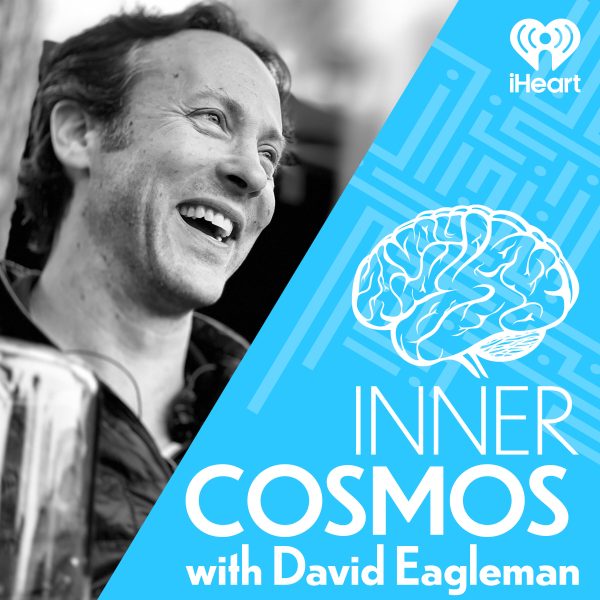
Inner Cosmos with David Eagleman
- Épisodes
- 193
- Parution
- hebdomadaire
- Dernier épisode
- 9 Nov 2026
À propos du podcast
Neuroscientist and author David Eagleman discusses how our brain interprets the world and what that means for us. Through storytelling, research, interviews, and experiments, David Eagleman tackles wild questions that illuminate new facets of our lives and our realities.
Épisodes 193
Ep176 "Where Does Your Mind End and AI Begin?" with Steven Johnson
When a machine can remember your intellectual life and propose the next connection, is it still a tool or has it become part of the mind doing the thinking? In other words, who gets credit when AI supplies the …
Notes de l’épisode
When a machine can remember your intellectual life and propose the next connection, is it still a tool or has it become part of the mind doing the thinking? In other words, who gets credit when AI supplies the crucial connection for an idea? Join Eagleman with Steven Johnson, historian of innovation & one of the creators of Gemini Notebook, as they wrestle with what happens when computers start thinking collaboratively with us.
Re-Release " What is Color? Part 2: Why royals wear purple"
This week we reach into the archive for one of the most popular episodes of Inner Cosmos. Are there new colors you could see? And why are they impossible to imagine before you've seen them? Can you lose your …
Notes de l’épisode
This week we reach into the archive for one of the most popular episodes of Inner Cosmos.
Are there new colors you could see? And why are they impossible to imagine before you've seen them? Can you lose your color vision? And what does any of this have to do with linguistic color terms, why the military likes colorblind people for a particular task, and why Eagleman suggests that the cultural history of Thailand was influenced by one single, unknown neurodivergent?
Re-Release "What is color? Part 1: Why hunters wear orange"
This week we reach into the archive for one of the most popular episodes of Inner Cosmos. Why do birds and bees choose different flowers? Why do mammals' eyes seem to be optimized for moving around at night …
Notes de l’épisode
This week we reach into the archive for one of the most popular episodes of Inner Cosmos.
Why do birds and bees choose different flowers? Why do mammals' eyes seem to be optimized for moving around at night, and what does that have to do with hairless humans getting angry? What does any of this have to do with road signs, camouflage, mantis shrimp, the sun, the dress that broke the internet, and women who can see more colors than you can?
Ep175 Who Are You When Your Brain Changes? with Robert Kolker
Is your personality written into the circuitry of your brain? With brain disease, can someone lose who they are without realizing it? What happens when the person changing is the only one who can't see it? What …
Notes de l’épisode
Is your personality written into the circuitry of your brain? With brain disease, can someone lose who they are without realizing it? What happens when the person changing is the only one who can't see it? What does it mean to love someone whose personality has become unrecognizable? If you carried a genetic mutation that would alter your brain in the near future, would you want to know? Join Eagleman with bestselling author Robert Kolker to discuss these questions in the context of his new book about frontotemporal dementia, The Vanishing Family.
Ep174 "Can Evolution Teach AI?" with Athena Aktipis
How do you get trillions of cells to collaborate as the single organism that we call you? Does that kind of cooperation create opportunities for hijacking -- for example, is cancer a form of "cellular …
Notes de l’épisode
How do you get trillions of cells to collaborate as the single organism that we call you? Does that kind of cooperation create opportunities for hijacking -- for example, is cancer a form of "cellular cheating"? Can we take the lessons learned from biology and apply them to understanding politics? And what do models of cooperation tell us about building and living with AI? Join Eagleman with evolutionary biologist and cooperation theorist Athena Aktipis to understand cooperation and competition from cells to societies to our technological future.
Re-Release "Why Do Brains Dream"
This week we reach into the archive for one of the most popular episodes of Inner Cosmos. Why do brains dream, and why are dreams so bizarre? Why doesn't your clock work in your dreams? And even though you …
Notes de l’épisode
This week we reach into the archive for one of the most popular episodes of Inner Cosmos.
Why do brains dream, and why are dreams so bizarre? Why doesn't your clock work in your dreams? And even though you spend much of your working day looking at your cell phone and computer – why do they almost never make appearances in your dream content? Is dream content the same across cultures and across time? Are dreams experienced in black & white, or in color? Are dreams the strange love child of brain plasticity and the rotation of the planet? What is the relationship between schizophrenia and dreaming? In the future, will we be able to read out the content of somebody's dream? Join Eagleman this week to learn why and how we spend a fraction of our sleep time locked in different realities, swimming in plots which aren't real but which compel us entirely nonetheless.
Ep173 "Why Do We Have Emotions?" with Robert Kurzban
What's a feeling for? What is jealousy measuring and motivating? Why do both awe and grief slow us down? What happens when ancient emotions meet dating apps and like buttons? Does the intensity of a feeling …
Notes de l’épisode
What's a feeling for? What is jealousy measuring and motivating? Why do both awe and grief slow us down? What happens when ancient emotions meet dating apps and like buttons? Does the intensity of a feeling decide which part of you takes control? Can understanding an emotion loosen its grip? Today we sit down with evolutionary psychologist Robert Kurzban to understand the logic behind the our varied panoply of emotions.
Ep172 "Can You Quantify Yourself to Improve Health?" with Michael Snyder
Can your smartwatch detect subtle changes before you feel them? Might a continuous glucose monitor pick up on things you didn’t know about yourself? Could a drop of blood map your future health? Why does your …
Notes de l’épisode
Can your smartwatch detect subtle changes before you feel them? Might a continuous glucose monitor pick up on things you didn’t know about yourself? Could a drop of blood map your future health? Why does your personal baseline matter more than a population average? Could AI decode the massive signaling networks of your body? Does seeing your own data change your behavior? Join Eagleman with Michael Snyder, Stanford professor of genetics and a pioneer in massive personal data, to understand what happens when healthcare moves from a snapshot of your body to a movie.
Ep171 "Why Do Some Urges Feel Irresistible?" with Paige Gordon
Why do two people facing the same choice feel different urges? How much effort hides behind resisting a cookie? Why can the brain keep wanting something long after pleasure fades? Can a molecule crank down the …
Notes de l’épisode
Why do two people facing the same choice feel different urges? How much effort hides behind resisting a cookie? Why can the brain keep wanting something long after pleasure fades? Can a molecule crank down the volume of your internal radio? Does a biological understanding of behavior reduce responsibility, or does it deepen compassion? And how would your life change if your loudest urge went quiet? Today Eagleman examines free will through the lens of eating disorders, with guest Paige Gordon, an author and former model who spent decades suffering an invisible internal battle.
Ep 170 "Will Mars Create a New Species of Human?" with Scott Solomon
What happens when we start birthing babies on Mars? Might a Martian human become unable to survive on Earth because of differences in microbes and gravity? How much of your body is shaped by the details of this …
Notes de l’épisode
What happens when we start birthing babies on Mars? Might a Martian human become unable to survive on Earth because of differences in microbes and gravity? How much of your body is shaped by the details of this planet? Will radiation accelerate human evolution on Mars? Could living on Mars eventually create a new species of human? Could Mars change the way humans dream? Would a Martian child find Earth's oceans as strange and awe-inspiring as we find another planet? Could two branches of humanity become too different to recognize each other? Today we’re joined by Scott Solomon, evolutionary biologist and author of the book “Becoming Martian: How Living in Space Will Change Our Bodies and Minds”.
Ep169 "What Is Claude Thinking But Not Saying?" with Jack Lindsey
Is AI thinking things it never says aloud? How would we know if a large language model were having a subjective experience? Is there a way to read the 'thoughts' of an LLM? Human brains seem to have a 'global …
Notes de l’épisode
Is AI thinking things it never says aloud? How would we know if a large language model were having a subjective experience? Is there a way to read the 'thoughts' of an LLM? Human brains seem to have a 'global workspace' -- what would it mean if we discovered that AI has something similar? Can you reach inside an LLM to change one of its 'thoughts'? Join Eagleman with Anthropic interpretability researcher Jack Lindsey to talk about what might be going on inside the mind of Claude.
Ep168 "Will it Someday Make Sense to Elect an AI President?"
Could there be a better form of government than the one we have now? As we enter an AI-powered world, when might we choose an AI leader? Will your grandchildren ever vote for a human president, who comes with a …
Notes de l’épisode
Could there be a better form of government than the one we have now? As we enter an AI-powered world, when might we choose an AI leader? Will your grandchildren ever vote for a human president, who comes with a political party & the weaknesses of a human, or will they vote for a system that has a jaw-dropping capacity to extract patterns from vast rivers of data, simulate millions of possible futures, & govern with a deeper wisdom than a human could naturally possess? Will we all have personal AI agents that know our strongest political opinions, such that we finally achieve (for the first time at scale) a direct democracy rather than a representative one? Join Eagleman as he explores the future of an AI leader (pros & cons) and where he thinks we’re inevitably heading.
Ep167 "What Happens With Stone Age Brains + Godlike Tools?" with Steven Kotler
What happens when old brain circuitry collides with modern tech? Are we heading into an age of abundance, and can abundance create its own psychological problems? Do we need friction in our lives to become …
Notes de l’épisode
What happens when old brain circuitry collides with modern tech? Are we heading into an age of abundance, and can abundance create its own psychological problems? Do we need friction in our lives to become better humans? Could curiosity become the most important survival skill of the twenty-first century? What happens to your biological neural networks when artificial neural networks do your thinking for you? Eagleman sits down with author and researcher Steven Kotler to discuss his new book, We Are As Gods.
Ep166 "Could the Next Brain Interface Get Sprayed Up Your Nose?" with Tetiana Aleksandrova & Scott Meek
A brain computer interface (BCI) is any technology that allows you to connect your 3 pounds of wetware to a computer. But instead of implanting electrodes via neurosurgery, might the next revolution in BCIs …
Notes de l’épisode
A brain computer interface (BCI) is any technology that allows you to connect your 3 pounds of wetware to a computer. But instead of implanting electrodes via neurosurgery, might the next revolution in BCIs come from something very small, like nanoparticles? Would this allow us to spy on millions (or billions) of neurons talking at once -- and could we do so without opening the skull? Will this allow BCI tech to become as common as smartphones? Join Eagleman as he talks with the company Subsense about why the next brain-computer interface might come from thinking small.
Ep165 "What's a Doom Loop & How Do You Escape It?" with Jonathan Downar
Have you ever spent hours with a thought cycling around in your head? What happens when the brain continuously worries, craves, or replays something without finding the exit? Where does the feeling of being …
Notes de l’épisode
Have you ever spent hours with a thought cycling around in your head? What happens when the brain continuously worries, craves, or replays something without finding the exit? Where does the feeling of being “done” come from? Might depression, addiction, OCD, and PTSD all share the same problem? Is mental freedom just the ability to change states? Join Eagleman with neuroscientist and psychiatrist Jonathan Downar to talk about doom loops and how we might break them.
Ep164 "Why Do We Act Differently Around Different People?" With Claude Steele
Does your identity and performance change in different situations? What does this have to do with wondering how you’re being judged? What if polarization grows from uncertainty more than hatred? Might social …
Notes de l’épisode
Does your identity and performance change in different situations? What does this have to do with wondering how you’re being judged? What if polarization grows from uncertainty more than hatred? Might social uncertainty be more common than prejudice? Why do strangers become enemies so easily? Can we engineer more trust into society? Today Eagleman sits down with Stanford social psychologist Claude Steele to explore the hidden psychological forces that shape who we become whenever we wonder how other people see us.
Ep163 "How Quickly Does AI Become Smarter Than Humanity?" with Ben Goertzel
What is artificial general intelligence (AGI) and how close are we to getting there? What defines the next step, called artificial superintelligence (ASI), and why might the gap between those two be so …
Notes de l’épisode
What is artificial general intelligence (AGI) and how close are we to getting there? What defines the next step, called artificial superintelligence (ASI), and why might the gap between those two be so dangerous? When machines become smarter than us, what roles are left for humanity? Should we think of AI as software, or as something we’re raising like a child? Will tomorrow’s AI destroy us, ignore us, or protect us? This week Eagleman talks with computer scientist & AI researcher Ben Goertzel.
Ep162 "What Does Medicine Look Like in Ten Years?" with Jeanne Loring
For all of medical history, we’ve tried to persuade sick cells to behave better. What if instead we just swapped them out? Can we insert new brain cells grown from your own skin cells? And what does any of this …
Notes de l’épisode
For all of medical history, we’ve tried to persuade sick cells to behave better. What if instead we just swapped them out? Can we insert new brain cells grown from your own skin cells? And what does any of this have to do with sending one’s own cells into space, or rescuing animals on the very brink of extinction? Today we talk with stem cell biologist Jeanne Loring about the exciting next horizons.
Ep161 "What Do Ancient Brains and Future AIs Have in Common?" with Read Montague
What do honeybee brains have in common with human brains -- and with the AI that beat the world's best Go player? What simple algorithm has been hiding inside brains for 100s of millions of years? When babies …
Notes de l’épisode
What do honeybee brains have in common with human brains -- and with the AI that beat the world's best Go player? What simple algorithm has been hiding inside brains for 100s of millions of years? When babies throw food from a high chair again and again, are they being mischievous or are they running physics experiments? And what does any of this have to do with whether dopamine is more than a pleasure molecule, or whether there are laws of physics we have yet to discover, or whether large language models are going to get outdated in favor of a new approach? Join Eagleman with computational neuroscientist Read Montague to explore how very old systems in our brains map onto the future of AI.
Ep160 "Do You Really Have a Self?" with Sam Harris
re you the author of your thoughts or just their witness? Do we simply watch our thoughts like we watch unfolding dream plots? What if the most familiar thing you experience — yourself — isn’t really there? If …
Notes de l’épisode
re you the author of your thoughts or just their witness? Do we simply watch our thoughts like we watch unfolding dream plots? What if the most familiar thing you experience — yourself — isn’t really there? If that’s the case, why does the experience of the self feel so solid that it often takes a lifetime to notice something strange? Why would evolution invent the feeling of a self at all? Join Eagleman with philosopher & neuroscientist Sam Harris as they explore the self, meditation, dreams, movies, and much more.
Ep159 "If Your Brain Changed Slightly, Would You Still Be You?" with Masud Husain
Could a tiny injury to your brain change your personality? If your friends didn’t know something had happened in your brain, would they just think you're choosing to act strangely? What if the self is nothing …
Notes de l’épisode
Could a tiny injury to your brain change your personality? If your friends didn’t know something had happened in your brain, would they just think you're choosing to act strangely? What if the self is nothing but a fragile coalition of neural processes? Join Eagleman today with Masud Husain, a neurologist and neuroscientist at Oxford, to explore fascinating case studies about how changes in the brain lead to changes in the self.
Ep158 "What do babies, animals, and AI have in common?" with Melanie Mitchell
When AI gets the right answer, how do we know it got there the right way? Why do we assume that fluent language means intelligence? What do infants and chatbots have in common? What do AI’s mistakes teach us …
Notes de l’épisode
When AI gets the right answer, how do we know it got there the right way? Why do we assume that fluent language means intelligence? What do infants and chatbots have in common? What do AI’s mistakes teach us about our own minds? And what does any of this have to do with Frankenstein’s creature, why some people wear a stop sign on their T-shirt, or smiling monkeys? Join Eagleman today with computer scientist Melanie Mitchell, a professor at the Santa Fe Institute who’s working to bridge AI and cognitive science.
Ep157 "Where Did the Letter "A" Come From?" with Danny Bate
How can we use 26 symbols to capture everything in the cosmos of human experience? Where do our written symbols in English come from? What ancient ghosts are still hiding inside the letters you read every day? …
Notes de l’épisode
How can we use 26 symbols to capture everything in the cosmos of human experience? Where do our written symbols in English come from? What ancient ghosts are still hiding inside the letters you read every day? Does learning to read reconfigure the circuitry of your brain? Does dyslexia reveal how unnatural reading really is? And could AI freeze the evolution of language for the first time in history? Today we dive into the alphabet with linguist Danny Bate, who’s just written a book on the surprising history of every letter.
Ep156 What Do We Learn About AI by Dancing with Robots? with Catie Cuan
Why do we read so much into how a robot moves, and what does that tell us about human brains? Why did our history make us so sensitive to movement? Why do we trust graceful motion? Should we make a robot 'look' …
Notes de l’épisode
Why do we read so much into how a robot moves, and what does that tell us about human brains? Why did our history make us so sensitive to movement? Why do we trust graceful motion? Should we make a robot 'look' at an object it’s about to pick up, even if it doesn’t need to? Is movement the original form of animal intelligence? Join Eagleman with guest Catie Cuan, a roboticist, dancer, and choreographer. Catie’s an expert on the strange social interface between humans and machines, and she’s gotten there by dancing with robots.
Ep155 "Why Can’t Some People Stop Thinking Certain Thoughts?" with Jon Hershfield
Why do brains generate strange thoughts sometimes? And why do some brains refuse to let go of those thoughts? Today we'll talk about Obsessive Compulsive Disorder (OCD) with expert Jon Hershfield, getting a …
Notes de l’épisode
Why do brains generate strange thoughts sometimes? And why do some brains refuse to let go of those thoughts? Today we'll talk about Obsessive Compulsive Disorder (OCD) with expert Jon Hershfield, getting a view from the inside and the outside. Why do some people lock the door but go back repeatedly to check it, and still have a feeling of uncertainty that it’s locked? Why do some people wash their hands over and over and never feel that they reach a point when it’s “done”. How, for some people, are intrusive thoughts like junkmail that the brain just cant help opening? We’ll see how obsessive thoughts can get caught in loops, and how those loops might therapeutically be broken.
Ep154 "Can a Depressed Brain Find Its Way Out?" with Jon Nelson
What if your brain got stuck in sadness and never reset? What does it feel like when joy disappears completely? Can a person love their family deeply and still want to die? What do you do when treatment after …
Notes de l’épisode
What if your brain got stuck in sadness and never reset? What does it feel like when joy disappears completely? Can a person love their family deeply and still want to die? What do you do when treatment after treatment fails? What if the difference between despair and recovery is electrical? How can we better recognize invisible struggles in those around us? Join Eagleman with guest Jon Nelson, a man who suffered for years under the grip of depression, and finally found a science-fiction like treatment which gave him relief.
Ep153 Can You Unlearn Anxiety? with Judson Brewer
Week 2 of Mental Health Awareness month: Anxiety is close to everyone’s experience, either because you've had it or someone close to you has. Does your brain accidentally teach itself to stay anxious by looping …
Notes de l’épisode
Week 2 of Mental Health Awareness month: Anxiety is close to everyone’s experience, either because you've had it or someone close to you has. Does your brain accidentally teach itself to stay anxious by looping on the same fears? Is anxiety helping you perform better, or does it make everything harder? Is it possible to unlearn worry the same way you learned it? Join Eagleman with Dr. Jud Brewer, who suffered with anxiety as a young man... and then became a psychiatrist and neuroscientist who studies anxiety and developed a very different approach to its treatment.
Ep152 "How do you survive your own thoughts?" with Jewel
What do you do when your own mind stops feeling safe? How does a person sing on stage while panicking inside? How do you catch your thoughts before they catch you? Join Eagleman with singer/songwriter Jewel to …
Notes de l’épisode
What do you do when your own mind stops feeling safe? How does a person sing on stage while panicking inside? How do you catch your thoughts before they catch you? Join Eagleman with singer/songwriter Jewel to talk about mental health: the battles she’s lived, the wisdom she’s earned, and the lives she’s helping shape. This episode kicks off Mental Health Awareness month, when we’re reminded to look directly at what is typically hidden. A troubled mind with stormy weather can often remain dark; join us this month to bring some light.
Ep151 "Can One Be a Rational Optimist About the World?" with Matt Ridley
Why do we generally feel like the world is getting worse, when by almost all measures it’s getting better? How do ideas "have sex”, and why does that matter for innovation? Why do brains tend to systematically …
Notes de l’épisode
Why do we generally feel like the world is getting worse, when by almost all measures it’s getting better? How do ideas "have sex”, and why does that matter for innovation? Why do brains tend to systematically misread the future? What if optimism is a more rational stance than pessimism? If innovation isn’t primarily about lone geniuses, what’s it really about? Join Eagleman with scientist and author Matt Ridley to explore what it means to be, in Ridley’s phrasing, a "rational optimist".
Ep150 "Can We Engineer Dreams?" with Adam Haar Horowitz
Can you influence what you dream about tonight? Are you spending years of your life in a world you don’t recall? Can nightmares be manipulated as a therapy? Are dreams sometimes predictive of changes in your …
Notes de l’épisode
Can you influence what you dream about tonight? Are you spending years of your life in a world you don’t recall? Can nightmares be manipulated as a therapy? Are dreams sometimes predictive of changes in your health before you become aware of them? Join Eagleman with Adam Haar Horowitz, a neuroscientist and dream engineer who spends his working days trying to help people during their night time.
Voici les 40 derniers épisodes sur 193. Les épisodes plus anciens se trouvent dans le flux du podcast.
Podcasts similaires
Plus de podcasts : Éducation

C’est votre podcast ?
Confirmez-le avec une entrée dans votre flux : vous recevez ici un code, vous l’ajoutez comme podcast:txt dans le canal de votre flux, et nous le vérifions. Votre podcast apparaît ensuite comme « vérifié » sur SoundNode.