

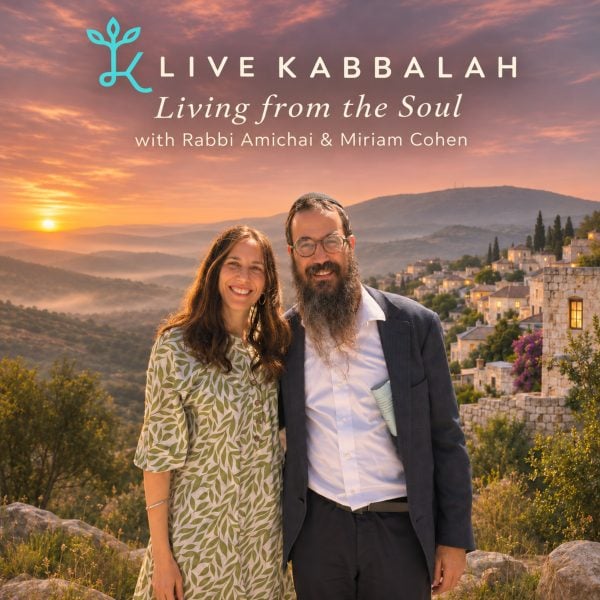
Live Kabbalah: Living from the Soul
- Épisodes
- 209
- Parution
- plusieurs fois par semaine
- Dernier épisode
- 22 Nov 2026
À propos du podcast
What does it mean to live from the soul? How can we find deeper faith, more loving relationships, and purpose in everyday life? We are Rabbi Amichai and Miriam Cohen. Through Torah, Kabbalah, guided meditations and heartfelt conversations, we explore these questions together. We are honored to share this space of learning and discovery with you. We run Live Kabbalah, an online school offering classes, courses, retreats and practitioner trainings: https://www.livekabbalah.com Start with our free Living On Purpose course: https://www.livekabbalah.com/offers/5KKYcF7G/checkout
Épisodes 209
Why One Mitzvah Reaches Higher Than Paradise: The Ancient of Days
Daniel sees the Ancient of Days take His seat. What is he seeing?Atik Yomin is the source beyond creation, concealed beyond all concealment. Arich Anpin is the face turned toward the world. The Tanya teaches …
Notes de l’épisode
Daniel sees the Ancient of Days take His seat. What is he seeing?
Atik Yomin is the source beyond creation, concealed beyond all concealment. Arich Anpin is the face turned toward the world. The Tanya teaches that the 613 mitzvot are rooted there, in the supernal will. A mitzvah is a connection. It draws the hidden light into this physical world, which is more than basking in it in Olam HaBa. We close with will and pleasure, ratzon and taanug, and what happens when we pronounce a Kamatz.
Part 3 of 3 on Kamatz and Keter, with Rabbi Amichai Cohen.
Read the teaching: https://www.livekabbalah.com/blog/kamatz-the-vowel-that-holds-what-cannot-be-said
Join the weekly live class in the Live Kabbalah community: https://www.livekabbalah.com
Grounded Enough to Rise: Yaakov's Ladder and the Nervous System
What can Yaakov Avinu teach us about nervous system regulation?Yaakov leaves Be'er Sheva, lies down on the earth, and only then sees a ladder reaching into heaven. In this short Vayetze teaching, Rabbi Amichai …
Notes de l’épisode
What can Yaakov Avinu teach us about nervous system regulation?
Yaakov leaves Be'er Sheva, lies down on the earth, and only then sees a ladder reaching into heaven. In this short Vayetze teaching, Rabbi Amichai Cohen follows the Ohr HaChaim's reading of the soul descending into the body, the ladder as prayer, Torah and the way we relate to livelihood, the secret of Luz, and the twenty years in the house of Lavan, where the Haggadah begins the story of our exile.
The body is the anchor of the soul. We are able to pause, to ground, to dream and to connect.
Read the full article: Grounded Enough to Rise
Learn more at livekabbalah.com
Why Does Keter Mean Waiting? The Hidden Light and the Crown
Why would the highest Sefirah be called "waiting"?We begin with the Or HaGanuz, the hidden light, and the 36 candles of Chanukah. Why does Kabbalah need both light and water, Or and Shefa, to describe creation? …
Notes de l’épisode
Why would the highest Sefirah be called "waiting"?
We begin with the Or HaGanuz, the hidden light, and the 36 candles of Chanukah. Why does Kabbalah need both light and water, Or and Shefa, to describe creation? Then the Ramchal on light that stays concealed, and the Ramak on the three meanings of Keter: to wait, a crown, and to surround. When we wait, the chatter stops and something higher can come through.
Part 2 of 3 on Kamatz and Keter, with Rabbi Amichai Cohen.
Read the teaching: https://www.livekabbalah.com/blog/kamatz-the-vowel-that-holds-what-cannot-be-said
Join the weekly live class in the Live Kabbalah community: https://www.livekabbalah.com
Is It Me Thinking, or G-d? The Secret of the Hebrew Vowel Kamatz
When you think, is it you thinking, or is G-d speaking to you?The first Hebrew vowel is Kamatz. The name comes from likmotz, to gather into a closed hand. The Tikkunei Zohar says it comes from Keter, concealed …
Notes de l’épisode
When you think, is it you thinking, or is G-d speaking to you?
The first Hebrew vowel is Kamatz. The name comes from likmotz, to gather into a closed hand. The Tikkunei Zohar says it comes from Keter, concealed in thought. In this class we look at the shape of the Kamatz, the Ein Sof as water held behind a dam, and the verse in Job: Chochmah me'ayin timatze, wisdom comes from nothingness. Then we bring it home. Where does a thought begin, and what can AI never replace?
Part 1 of 3 on Kamatz and Keter, with Rabbi Amichai Cohen.
Read the teaching: https://www.livekabbalah.com/blog/kamatz-the-vowel-that-holds-what-cannot-be-said
Join the weekly live class in the Live Kabbalah community: https://www.livekabbalah.com
The Letter Tav: The Seal of Truth
The last letter of the Hebrew alphabet is Tav, the seal of truth. Why does Avraham pay 400 silver coins for the Cave of Machpelah, and what does gravity have to do with Malchut? A teaching from the Light …
Notes de l’épisode
The last letter of the Hebrew alphabet is Tav, the seal of truth. Why does Avraham pay 400 silver coins for the Cave of Machpelah, and what does gravity have to do with Malchut? A teaching from the Light Warrior Circle with Rabbi Amichai Cohen on how truth runs through and through, from G-d, through the heart, into action.
Read the full teaching: https://www.livekabbalah.com/blog/the-letter-tav-the-seal-of-truth
Learn with us at Live Kabbalah: https://www.livekabbalah.com
The Letter Shin: The Flame That Never Goes Out | Guided Meditation
The letter Shin rises in three branches from a single root, like a flame rising from its coal. Sefer Yetzirah describes the flame bound to its coal, and the soul itself is called a shalhevet, a flame. It stays …
Notes de l’épisode
The letter Shin rises in three branches from a single root, like a flame rising from its coal. Sefer Yetzirah describes the flame bound to its coal, and the soul itself is called a shalhevet, a flame. It stays rooted in its source at all times, even when we do not feel its light.
In this guided meditation, Rabbi Amichai Cohen takes us into the image of the Shin. We enter sheket, inner quiet, so that we can hear our own flame and stoke it. We notice where we swing between over-giving and harsh judgment, and we return to the steady middle branch, Yaakov, rachamim, compassion, where the flame burns with warmth and clarity.
We learn that Shin carries the value of the name Elokim, G-d hidden within nature, that simcha shares its letters with machshava, thought, and that our fire lights the fire of others, and theirs lights ours. This is the work of the Light Warrior: to illuminate the world and dispel darkness, one day at a time.
May this meditation steady your flame and remind you that the eternal fire within you, the esh tamid, can never go out.
More teachings, courses and meditations: www.livekabbalah.com
Avraham and Bitachon: When Faith Becomes Trust
Avraham faced ten tests, and one thread runs through all of them: trust. The Torah says that he believed in G-d, and G-d counted it for him as tzedakah. How can belief be charity? And how can we give anything …
Notes de l’épisode
Avraham faced ten tests, and one thread runs through all of them: trust. The Torah says that he believed in G-d, and G-d counted it for him as tzedakah. How can belief be charity? And how can we give anything to G-d?
In this short teaching, Rabbi Amichai Cohen explains that there are two kinds of faith. Passive faith carries us. Active faith, emunah lived as bitachon, brings what we believe into our lives. Rav Saadia Gaon teaches that one cannot exist without the other.
The word bitachon together with the name Avram adds up to 318, the number of men Avram took with him to rescue Lot from the four kings. Trust is how Avram met his tests, and it is how we meet ours. When we live our faith actively, we give G-d something new in this world, and we receive the greatest gift ourselves.
Where in your life are you being asked to move from believing to trusting?
If you are a therapist, a healer, a teacher or a coach and want to bring teachings like this into your work, the Lamplighter Practitioner Certification begins on 8 November. Only a few places remain. Details at livekabbalah.com/light-warrior-lamplighter.
New teachings every week at livekabbalah.com.
The Letter Shin: The Fire Within
Where does the fire come from once the holidays are over? In this class on the Hebrew letter Shin, Rabbi Amichai Cohen teaches Shin as the letter of fire, one of the three mother letters of Sefer Yetzirah, and …
Notes de l’épisode
Where does the fire come from once the holidays are over? In this class on the Hebrew letter Shin, Rabbi Amichai Cohen teaches Shin as the letter of fire, one of the three mother letters of Sefer Yetzirah, and as the balance of Chesed, Gevurah and Tiferet held in its three branches.
King Solomon calls the soul the candle of G-d. Like a flame, it longs to return to its source, and Sefer Yetzirah describes the flame bound to the coal. Our strength is already there. We need to remember to draw from it. We also learn Shin as change, the number 300 and the name Elohim hidden within nature, Shin as a tooth that chews a teaching until it becomes part of us, and simcha, joy, written with a Sin.
Recorded live in the Light Warrior Circle, the weekly Exploring Oneness class of Live Kabbalah. Join the live classes and the full library at livekabbalah.com.
Stretching From Love: Tanya Chapter 15 with Miriam
In this teaching from her weekly Tanya class, Miriam explores Chapter 15 and the two kinds of Benoni: the one who serves G-d and the one who has grown comfortable. Why does learning something one hundred and …
Notes de l’épisode
In this teaching from her weekly Tanya class, Miriam explores Chapter 15 and the two kinds of Benoni: the one who serves G-d and the one who has grown comfortable. Why does learning something one hundred and one times change everything? What does it mean that we rent the donkey but never own it? And why must real growth come from love, not from pushing or shame?
A warm and practical teaching on stretching beyond your comfort zone with tenderness.
The full class, with reflection questions, lives in the Light Warrior Circle: livekabbalah.com
#Tanya #Kabbalah #Chassidus #InnerGrowth #LiveKabbalah
The Letter Resh: When Emptiness Becomes a Beginning
Resh (ר) begins with a surprising possibility: the place where we feel empty may become the place where we learn how to receive.Rabbi Amichai Cohen explores five dimensions of the letter Resh, including its …
Notes de l’épisode
Resh (ר) begins with a surprising possibility: the place where we feel empty may become the place where we learn how to receive.
Rabbi Amichai Cohen explores five dimensions of the letter Resh, including its connection to rash, the difference between Resh and Dalet, the movement from acher to echad, the meaning of its numerical value of 200, and the promise of return found in the relationship between Kuf and Resh.
Along the way, we ask what separates having enough from feeling enough, and how humility can become a doorway to awareness, connection, and a new beginning.
This class was recorded live in the Light Warrior Circle on October 18, 2026.
Explore Live Kabbalah: https://www.livekabbalah.com/
The Blues, the Temple & the Soul | Eduard Shyfrin
What could the blues have to do with the music of the ancient Temple? And why can one melody hold both sorrow and joy? Rabbi Amichai Cohen welcomes Eduard Shyfrin—a scientist, entrepreneur, author and blues …
Notes de l’épisode
What could the blues have to do with the music of the ancient Temple? And why can one melody hold both sorrow and joy? Rabbi Amichai Cohen welcomes Eduard Shyfrin—a scientist, entrepreneur, author and blues musician—for a conversation that begins with the blues and opens into the questions of the soul. Raised in a home filled with jazz, blues and books, Eduard returned to playing during lockdown and discovered a new passion for composing. …Staying Connected After Prayer: Terumat HaDeshen
We can feel close to Hashem during prayer, then find ourselves becoming hard on ourselves or someone else as we return to the day. In this short teaching, I explore what the ashes left on the altar can teach us …
Notes de l’épisode
We can feel close to Hashem during prayer, then find ourselves becoming hard on ourselves or someone else as we return to the day. In this short teaching, I explore what the ashes left on the altar can teach us about that transition. Terumat HaDeshen helps us understand what to hold on to and what to let go of within ourselves. We look at how to release harsh, punitive judgment while keeping the discernment that helps us grow. …Bereishit: Why Was G-d Sad in His Heart?
At the end of Parshat Bereishit, the Torah says something startling. Vayitatzev el libo, G-d was saddened in His heart, and regretted creating humanity. Does G-d have a heart? And what does it mean for G-d to …
Notes de l’épisode
At the end of Parshat Bereishit, the Torah says something startling. Vayitatzev el libo, G-d was saddened in His heart, and regretted creating humanity. Does G-d have a heart? And what does it mean for G-d to be sad? The Rambam teaches that these are expressions, not literal attributes. Chassidus goes deeper. The Alter Rebbe explains that the heart is the place of Malchut, the place where knowledge has to land. …October 7: Remembering Who We Are
Today marks three years since October 7. We remember where we were that day, what happened, and how much has changed since then. We are three years after October 7, and in many ways we are still within it. The …
Notes de l’épisode
Today marks three years since October 7. We remember where we were that day, what happened, and how much has changed since then. We are three years after October 7, and in many ways we are still within it. The Torah constantly reminds us to remember. Zachor. We remember coming out of Egypt, we remember the Beit Hamikdash, and on Rosh Hashanah we remember that Hashem is present in our lives. Life goes on. …Hoshana Rabbah: The Willow and the Great Salvation
The last day of Sukkot is Hoshana Rabbah, the Great Salvation. On this day the simplest of the four species takes the primary focus: the aravah, the willow. It has no taste and no smell. Its only virtue is that …
Notes de l’épisode
The last day of Sukkot is Hoshana Rabbah, the Great Salvation. On this day the simplest of the four species takes the primary focus: the aravah, the willow. It has no taste and no smell. Its only virtue is that it is part of the community, and without it we do not fulfill the mitzvah of the four species. In this short teaching, Rabbi Amichai looks at why the willow grows by a stream of water, the flow of life, and why its branches move together in the wind. …Surrounded by Light: A Guided Sukkot Meditation
A Sukkot gift from Kavana Academy. Join Rabbi Amichai Cohen for a gentle guided meditation on presence, the heart and the embrace of the sukkah. Set aside about fifteen minutes, find a quiet place and allow …
Notes de l’épisode
A Sukkot gift from Kavana Academy. Join Rabbi Amichai Cohen for a gentle guided meditation on presence, the heart and the embrace of the sukkah. Set aside about fifteen minutes, find a quiet place and allow yourself to arrive.
Read more and listen on Live Kabbalah:
https://www.livekabbalah.com/blog/sukkot-guided-meditation
Chag sameach!
The Letter Tzaddik: Staying Connected Through the Seasons
The letter Tzaddik stands upright like a tree, rooted and still reaching. In this class, taught between Yom Kippur and Sukkot, Rabbi Amichai Cohen opens the Kabbalah of the Tzaddik through the etrog, the fruit …
Notes de l’épisode
The letter Tzaddik stands upright like a tree, rooted and still reaching. In this class, taught between Yom Kippur and Sukkot, Rabbi Amichai Cohen opens the Kabbalah of the Tzaddik through the etrog, the fruit that stays on its tree through every season. We look at the bent Tzaddik, who knows how to choose his battles and sometimes be smart rather than right, and the straight Tzaddik, the foundation of the world who carries blessing all the way down. …5787: The Year of Paz, Finding the Gold Within
The final two letters of the Hebrew year 5787, peh and zayin, spell paz: fine gold.Rabbi Amichai Cohen explores this image as an invitation to discover the treasures within us. What are we communicating through …
Notes de l’épisode
The final two letters of the Hebrew year 5787, peh and zayin, spell paz: fine gold.
Rabbi Amichai Cohen explores this image as an invitation to discover the treasures within us. What are we communicating through our words? How can the seven sefirot help us bring inner growth into everyday life? And how do we use the tools around us with greater presence?
A teaching on Hebrew letters, Malchut, and the work of uncovering our inner gold.
Rabbi Amichai Cohen | Live Kabbalah
Entering Rosh Hashanah 5787: Holding Awe and Inner Joy
As we enter the two days of Rosh Hashanah, the head and mind of the entire year, Rabbi Amichai Cohen opens the inner work of these days: how to stand in awe (yirah) while holding a deep, internal joy (gila). In …
Notes de l’épisode
As we enter the two days of Rosh Hashanah, the head and mind of the entire year, Rabbi Amichai Cohen opens the inner work of these days: how to stand in awe (yirah) while holding a deep, internal joy (gila). In this episode: - Why Rosh Hashanah is called the mind and brain of the year, and the elevated consciousness it asks of us - "Ivdu et Hashem b'yirah, v'gilu bir'adah" - serving God with awe, and rejoicing with trembling - The letters of Tishrei and the movement from below to above - Gila…The 25th of Elul: The Beginning of Creation
A short teaching from Rabbi Amichai Cohen for the 25th of Elul—the day associated with the beginning of Creation. As Rosh Hashanah approaches, pause to reconnect with the purpose, possibility, and Divine …
Notes de l’épisode
A short teaching from Rabbi Amichai Cohen for the 25th of Elul—the day associated with the beginning of Creation. As Rosh Hashanah approaches, pause to reconnect with the purpose, possibility, and Divine intention woven into the world and into your own life.
The Letter Peh: Face, Speech, and Return
The Hebrew letter Peh means mouth, yet it also reveals the relationship between our face, our inner life, and the words we bring into the world. Rabbi Amichai explores Peh through Elul, Moshe’s calling, the …
Notes de l’épisode
The Hebrew letter Peh means mouth, yet it also reveals the relationship between our face, our inner life, and the words we bring into the world. Rabbi Amichai explores Peh through Elul, Moshe’s calling, the King in the field, the shofar, and the blessing of the Kohanim. This class offers a grounded way to understand teshuvah as closing the distance between what is within us and what we show.
Communal Love & Unity
What prepares a people to carry Torah into ordinary life? As Moshe transfers leadership to Yehoshua, the Jewish people are leaving the miraculous life of the desert and entering the Land of Israel. They will …
Notes de l’épisode
What prepares a people to carry Torah into ordinary life? As Moshe transfers leadership to Yehoshua, the Jewish people are leaving the miraculous life of the desert and entering the Land of Israel. They will need courageous leadership, the guidance of Torah, and the strength of community. In this short teaching on Parashat Vayelech, Rabbi Amichai explores the mitzvah of Hakhel: once every seven years, men, women, children, and the stranger gathered to hear the Torah read aloud. …Choose Life
Choose Life: What Are You Here to Give?The Torah tells us:“I have placed life and death before you, blessing and curse. Choose life, so that you and your descendants may live.” Devarim 30:19Choosing life is …
Notes de l’épisode
Choose Life: What Are You Here to Give?
The Torah tells us:
“I have placed life and death before you, blessing and curse. Choose life, so that you and your descendants may live.” Devarim 30:19
Choosing life is more than wanting to live. It means choosing goodness, purpose, growth, and what we are here to give.
In this short reflection on Nitzavim–Vayelech, I share a powerful teaching for preparing ourselves for Rosh Hashanah and the new year ahead
18th of Elul - Higher and Lower Unity
Rabbi Amichai continues the teaching of the letter Ayin through the two unities of the Shema.Higher unity reveals that nothing exists outside G-d. Lower unity asks us to live faithfully within the apparent …
Notes de l’épisode
Rabbi Amichai continues the teaching of the letter Ayin through the two unities of the Shema.
Higher unity reveals that nothing exists outside G-d. Lower unity asks us to live faithfully within the apparent separateness of creation, bringing oneness into the body, the animal soul, our choices, and the ordinary details of life.
The class also explores garments of skin and light, Chai Elul, the Baal Shem Tov and Alter Rebbe, and the inner preparation for Rosh Hashanah.
The Letter Ayin: The 70 Gates of Seeing
The Hebrew letter Ayin means both eye and wellspring. Its numerical value is 70, the number of many facets returning to one source. Rabbi Amichai explores ayin tovah, the good eye, the difference between …
Notes de l’épisode
The Hebrew letter Ayin means both eye and wellspring. Its numerical value is 70, the number of many facets returning to one source. Rabbi Amichai explores ayin tovah, the good eye, the difference between discernment and judgment, the 70 facets of Torah, and Yosef's ability to remain rooted in G-d while living visibly in the world. The teaching closes with a simple question: What am I looking at, but not truly seeing? …Tanya Chapter 13: The Inner Judges of Elul, with Miriam
In this teaching from our weekly Tanya class, Miriam continues into Chapter 13 and the Benoni, the in-between person that each one of us can be. She looks at the two impulses within us as internal judges, one …
Notes de l’épisode
In this teaching from our weekly Tanya class, Miriam continues into Chapter 13 and the Benoni, the in-between person that each one of us can be. She looks at the two impulses within us as internal judges, one that speaks in fear and one that speaks in love, and the tender teaching that G-d Himself is the third judge who helps the good in us. All of this in the light of Elul, when the King is in the field and G-d comes out to meet us exactly where we are.
Learn with us at livekabbalah.com.
Re'eh: Seeing the Blessing Inside the Test
The name of this week's portion is Re'eh, which means "See." From its very first word, the Torah is teaching us how to look. Life sets a blessing and a curse before us, and so much of our work is learning to …
Notes de l’épisode
The name of this week's portion is Re'eh, which means "See." From its very first word, the Torah is teaching us how to look. Life sets a blessing and a curse before us, and so much of our work is learning to see the blessing that is hidden inside the challenge. In this reflection we explore the nisyonot, the tests we each move through, and how they are not obstacles on the path but the very doorway of it. …Tu B'Av: The Return of Love
Just six days after the breaking of Tisha B'Av, the calendar turns to its very opposite. Tu B'Av, the fifteenth of Av, is named by our sages as one of the most joyful days of the entire year. The moon that went …
Notes de l’épisode
Just six days after the breaking of Tisha B'Av, the calendar turns to its very opposite. Tu B'Av, the fifteenth of Av, is named by our sages as one of the most joyful days of the entire year. The moon that went dark at the start of the month now stands full again. The mourning of the Temple gives way to love, to reunion, and to the quiet promise that what was broken can be mended. …The Letter Mem: Water, the Womb, and the Hidden
Mem is the mother letter, the first sound a child makes, and it carries us back to the waters we were formed in. In this Exploring Oneness class we delve into the letter Mem: water and maim as life force, the …
Notes de l’épisode
Mem is the mother letter, the first sound a child makes, and it carries us back to the waters we were formed in. In this Exploring Oneness class we delve into the letter Mem: water and maim as life force, the higher and lower waters, Mem as Binah and the patience of gestation, the open Mem and the closed final Mem, the mikvah and the four Yuds hidden within, and the sacred silence where something is quietly being born in us. One question runs underneath it all. …Tisha B'Av: The Seed of Redemption in the Ruins
As we enter Tisha B'Av, the day of the destruction of both Temples, this reflection is an invitation not to run from the pain but to sit with it, face to face, and to meet Hashem in the very place of the …
Notes de l’épisode
As we enter Tisha B'Av, the day of the destruction of both Temples, this reflection is an invitation not to run from the pain but to sit with it, face to face, and to meet Hashem in the very place of the breaking. This year we have been cracked open, by war, by turmoil, by watching the old structures fall. Tisha B'Av asks us not to reach for the quick distractions, but to go inward and become present to the true strength underneath. The foundations of the Temple are still intact. …
Voici les 40 derniers épisodes sur 209. Les épisodes plus anciens se trouvent dans le flux du podcast.
Podcasts similaires
Plus de podcasts : Religion et spiritualité

C’est votre podcast ?
Confirmez-le avec une entrée dans votre flux : vous recevez ici un code, vous l’ajoutez comme podcast:txt dans le canal de votre flux, et nous le vérifions. Votre podcast apparaît ensuite comme « vérifié » sur SoundNode.