

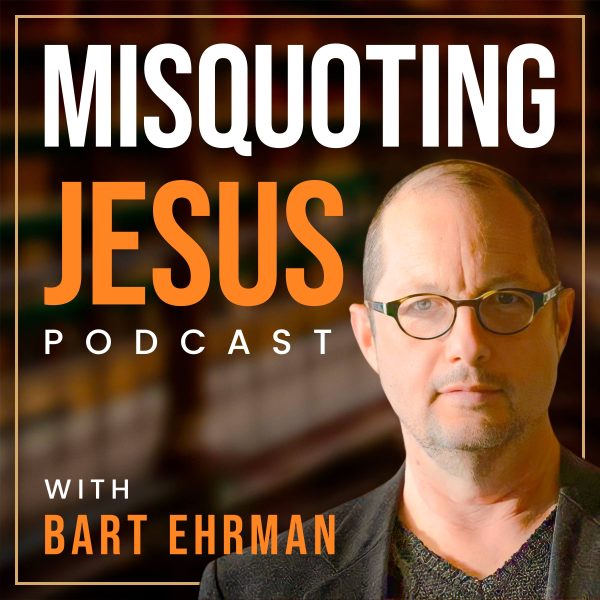
Misquoting Jesus with Bart Ehrman
- Épisodes
- 213
- Parution
- hebdomadaire
- Dernier épisode
- 10 Nov 2026
À propos du podcast
"Misquoting Jesus" is the only show where a six-time New York Times bestselling author and world-renowned Bible scholar uncovers the many fascinating, little known facts about the New Testament, the historical Jesus, and the rise of Christianity. The show features Dr. Bart Ehrman and host, Megan Lewis.
Épisodes 213
Which John Wrote New Testament Books? Even Church Fathers Didn't Know
Five books, nearly a fifth of the New Testament, have the name John attached to them. Many Christians might think this is John the fisherman, the son of Zebedee, and that perhaps he was the "Disciple who Jesus …
Notes de l’épisode
Five books, nearly a fifth of the New Testament, have the name John attached to them. Many Christians might think this is John the fisherman, the son of Zebedee, and that perhaps he was the "Disciple who Jesus loved." But the evidence is surprisingly murky. The Gospel never names its author. The letters are signed by someone calling himself only "the Elder." And the author of Revelation says he's John without once claiming to be an apostle. In fact, early Christian writers couldn't agree on who this John or the Johns were either. And they might have even invented a John or two along the way.
Bart joins host Megan Lewis to work out how many people named John we're actually dealing with. Why more Johns may have been invented to solve the problem. Why the claim that the Beloved Disciple wrote the Gospel rests on an appendix somebody else appears to have added. And how can we even discover an author when that author may have held one of the most common Jewish names from the period.
Was 70 the year that changed everything?
In the summer of 70 CE, Roman legions broke into Jerusalem and burned the temple. The sacrifices that had organized Jewish worship for centuries stopped, and never started again. Everyone in the early Jesus …
Notes de l’épisode
In the summer of 70 CE, Roman legions broke into Jerusalem and burned the temple. The sacrifices that had organized Jewish worship for centuries stopped, and never started again. Everyone in the early Jesus movement lived through it or grew up in its shadow, and every Gospel in the New Testament was almost certainly written afterward. Bart joins host Megan Lewis to look at what the temple's fall did to a movement that was still a small Jewish sect: how the Gospel writers wrote about a world that no longer existed, why Judaism and Christianity both reorganized around texts once the sacrifices ended, and what it means that Christianity's founding documents were all written on the far side of a catastrophe.
Did the Winners Write the Bible?
As early christians wrestled with their beliefs and theologies surrounding Jesus, they both produced new texts and gospels, and edited existing ones to better fit with specific theological views. What were some …
Notes de l’épisode
As early christians wrestled with their beliefs and theologies surrounding Jesus, they both produced new texts and gospels, and edited existing ones to better fit with specific theological views. What were some of these early heretical beliefs? How did the Church Fathers fight against them? And can we see traces of that battle in the manuscripts of the New Testament? Today on Misquoting Jesus, we're talking about how the New Testament was shaped by theological fights between early Christian groups.
Did Jesus Believe in Ghosts?
The Bible's world is crowded and unsystematic: ghosts, familiar spirits, demons that cause illness, and the dead who can be summoned. And at times, this world breaks through in ways modern readers don't always …
Notes de l’épisode
The Bible's world is crowded and unsystematic: ghosts, familiar spirits, demons that cause illness, and the dead who can be summoned. And at times, this world breaks through in ways modern readers don't always appreciate. When the disciples see Jesus walking on the water, their first thought is that he's a ghost. After the resurrection, Jesus has to reassure them he isn't one. King Saul has a medium call the prophet Samuel up from the dead, and it works.
So what happened to all those ghosts? Bart joins host Megan Lewis to explore the haunted world the Bible was written in, and how later Christians tidied it into a neater system of angels and demons, heaven and hell. Along the way: why demons were blamed for illness, why Jesus was accused of sorcery, and why believing in angels but not ghosts turns out to be a choice Christians made, not one the Bible made for them.
Where Did Original Sin Come From?
Most Christians grow up believing that everyone is born a sinner, that when Adam and Eve ate the fruit, humanity inherited a broken nature and a guilt we can't escape. It's one of the most influential ideas in …
Notes de l’épisode
Most Christians grow up believing that everyone is born a sinner, that when Adam and Eve ate the fruit, humanity inherited a broken nature and a guilt we can't escape. It's one of the most influential ideas in Western Christianity. But it isn't in Genesis, Jesus never taught it, and it didn't take its familiar form until four centuries after him.
Bart joins host Megan Lewis to trace where original sin actually came from: what the Garden of Eden story says and doesn't say, what Paul meant when he wrote that sin came into the world through one man, and how Augustine turned that line into a doctrine about every human being from the moment of conception. Along the way, why Eastern Orthodox Christians never fully accepted it, and what changes when you realize this belief has a history.
How Apologists Use (and Misuse) Manuscripts
Do manuscripts prove the Bible never changed? Some Christian apologists have argued that the Great Isaiah scroll (1QIsaa) is proof of an unchanging Bible, that it's "Word for Word" identical to the later …
Notes de l’épisode
Do manuscripts prove the Bible never changed? Some Christian apologists have argued that the Great Isaiah scroll (1QIsaa) is proof of an unchanging Bible, that it's "Word for Word" identical to the later Masoretic Text. Some have argued that P52 – a small fragment of John's gospel – shows that eyewitnesses quickly wrote down gospels. In a debate with Bart a decade back, Daniel Wallace even referenced a first century Gospel of Mark, that turned out to be a stolen manuscript that was eventually dated much later. For some modern Christians and apologists, manuscripts are "proof" of something... that the Bible is unchanging or perhaps inerrant. But can that claim hold up?
In this episode, Bart unpacks what manuscripts do and don't prove, and the challenges they raise for people who want to argue for an unchanging Bible.
Was Daniel Jesus' Favorite Book?
The Book of Daniel is set in the sixth century BCE, during the Babylonian exile. It describes visions of empires rising and falling — and for a long stretch, the sequence tracks real history with remarkable …
Notes de l’épisode
The Book of Daniel is set in the sixth century BCE, during the Babylonian exile. It describes visions of empires rising and falling — and for a long stretch, the sequence tracks real history with remarkable precision. Kingdom after kingdom, exactly as it happened. Then, at a certain point, it stops being right. That break is one of the most important pieces of evidence. Bart joins host Megan Lewis to explain what Daniel gets right, where it goes wrong, and why the exact point of failure tells us when the book was really written. And Bart will talk about how this book and its ideas may have shaped Jesus' thinking.
The KJV is a Literary Masterpiece, and a Disaster Study Bible
The King James Bible is arguably the most influential book in the English language, and Bart thinks it's a literary masterpiece. He also thinks it's one of the worst Bibles you can study from. In this episode …
Notes de l’épisode
The King James Bible is arguably the most influential book in the English language, and Bart thinks it's a literary masterpiece. He also thinks it's one of the worst Bibles you can study from.
In this episode of Misquoting Jesus, Bart and host Megan Lewis trace where the KJV came from, starting with William Tyndale, whose translation it largely reuses and who was burned at the stake for making it. They look at why its unicorns and cockatrices trip up modern readers, and why the words you think you understand, like "conversation," "strange," and "admiration," are more misleading than the ones you don't. They cover the theological choices its translators made, the late Greek manuscripts behind its New Testament, and a 1631 printing that told readers "thou shalt commit adultery." Bart also shares which modern translations he recommends instead.
In the listener Q&A: where the doctrine of original sin came from, whether early Christians evangelized door to door, and what Jesus meant about eunuchs in Matthew 19:12.
Fixing Gospel Contradictions: 2nd Century to Now
Around 170 CE, a Syrian Christian named Tatian noticed what a lot of readers have noticed since: the four Gospels don't always agree. So he fixed it. Tatian wove all four into a single, seamless account of …
Notes de l’épisode
Around 170 CE, a Syrian Christian named Tatian noticed what a lot of readers have noticed since: the four Gospels don't always agree. So he fixed it. Tatian wove all four into a single, seamless account of Jesus' life. And for roughly two hundred years, in the Syriac-speaking churches of the East, that harmony was the Gospel. Then the church came for it. Bishops collected copies and destroyed them. Tatian was condemned as a heretic. Today not a single copy survives in its original language — we know the text only through a commentary, some translations, and a sixth-century Latin Bible that still carries its shape. Bart unpacks what Tatian actually did to the Gospels, why the church found it so threatening, and what it means that an entire branch of Christianity once read a Bible we can no longer read.
Why Are There Four Gospels?
Most Christians are used to reading four Gospels. But why are there four? Why not one? Or twelve? The early Church thinker Irenaeus fought hard to keep Christians reading all four gospels, but it wasn't a …
Notes de l’épisode
Most Christians are used to reading four Gospels. But why are there four? Why not one? Or twelve? The early Church thinker Irenaeus fought hard to keep Christians reading all four gospels, but it wasn't a foregone conclusion.
In this episode, Bart unpacks how a four gospel new testament came to be, and what could have been the alternative.
Was Paul an Eyewitness of Jesus' Resurrection?
In a recent response to Wes Huff, Bart said the only eyewitness we know of who's converting people is Paul. A lot of people pointed out that Paul never met Jesus. Fair. But Paul is also the only person in the …
Notes de l’épisode
In a recent response to Wes Huff, Bart said the only eyewitness we know of who's converting people is Paul. A lot of people pointed out that Paul never met Jesus. Fair. But Paul is also the only person in the New Testament who tells us, in his own words, that he saw Jesus alive after his death. Everyone else reaches us secondhand. Bart unpacks what Paul actually claims to have seen, why Paul is the only person who claims to see a resurrected Jesus, and why the earliest firsthand evidence for the resurrection suggests visions.
How Bart Learned to Live Without God
For many religious people who deconvert, losing their faith leaves a giant hole in their lives. They can lose their community, their purpose in life, and their understanding of how the world works. What does …
Notes de l’épisode
For many religious people who deconvert, losing their faith leaves a giant hole in their lives. They can lose their community, their purpose in life, and their understanding of how the world works. What does life look like on the other side of deconversion, once the dust has settled? Today we're talking about how Bart lives without God. We also have our bonus segment at the end, which this week is listener's questions, where I'll be asking Bart - among other things - whether he uses early Christian art as a source for his research.
Where did Satan actually come from?
In the Old Testament, Satan is a minor figure at best, and one fully under the control of YHWH. He appears briefly in the New Testament, notably in the temptation of Jesus. How did Christianity take those minor …
Notes de l’épisode
In the Old Testament, Satan is a minor figure at best, and one fully under the control of YHWH. He appears briefly in the New Testament, notably in the temptation of Jesus. How did Christianity take those minor references and end up with the lord of all evil?
What Moody Bible College Didn't Prepare Me For
Those familiar with Dr. Bart Ehrman's career trajectory will know that he attended Moody Bible Institute, where he received his early training in textual criticism - but what is a "bible institute", exactly …
Notes de l’épisode
Those familiar with Dr. Bart Ehrman's career trajectory will know that he attended Moody Bible Institute, where he received his early training in textual criticism - but what is a "bible institute", exactly, and why do people attend them?
Was Jesus Actually John's Disciple? (Q&A)
Did you know that Jesus wasn't the only apocalyptic prophet traveling around Galilee during the 1st century CE? If the answer is "yes Megan, of course!", then you probably know something about John the Baptist …
Notes de l’épisode
Did you know that Jesus wasn't the only apocalyptic prophet traveling around Galilee during the 1st century CE? If the answer is "yes Megan, of course!", then you probably know something about John the Baptist. But what do we really know about him, and what impact did his teachings have on the historical Jesus?
Bart Fact Checks Apologist Wes Huff
Last year, Wes Huff was a relatively unknown Christian apologist. Then he went on The Joe Rogan Experience, one of the biggest podcasts in the world, and spent more than three hours talking with Joe Rogan about …
Notes de l’épisode
Last year, Wes Huff was a relatively unknown Christian apologist. Then he went on The Joe Rogan Experience, one of the biggest podcasts in the world, and spent more than three hours talking with Joe Rogan about biblical manuscripts, the New Testament, the historical Jesus, and the case for Christianity. The interview exploded online. It now has more than 8 million views on YouTube alone, over 40,000 comments, and it essentially launched Wes into apologetics stardom overnight. Wes is smart, articulate, and clearly very knowledgeable when it comes to manuscripts and textual criticism. But as the interview goes on, there are several moments where manuscript evidence starts turning into much bigger claims about eyewitnesses, Gospel reliability, canon formation, and even evidence for the resurrection. Today, I'm joined by Bible scholar Bart Ehrman. We're going to watch some clips from the interview and ask an important question: where does solid scholarship end and apologetics begin? Welcome to the Misquoting Jesus Podcast with Bart Ehrman.
Did Jesus Actually Believe in Heaven?
Did you know that Jesus didn't believe in the soul, heaven, or hell? As an apocalyptic Jew, these ideas would have been completely foreign to him. So where on earth did Christianity get the idea that a life …
Notes de l’épisode
Did you know that Jesus didn't believe in the soul, heaven, or hell? As an apocalyptic Jew, these ideas would have been completely foreign to him. So where on earth did Christianity get the idea that a life well-lived would be rewarded with a place in paradise for your soul? Today, we're talking about where the idea of heaven came from.
8 Bible Myths Many Christians Believe
Have you ever heard a Christian say something about the Bible and wondered exactly where they were getting their information from? Today we are talking about the most common claims Christians make about the …
Notes de l’épisode
Have you ever heard a Christian say something about the Bible and wondered exactly where they were getting their information from? Today we are talking about the most common claims Christians make about the Bible that are not actually based in reality.
Who Really Chose the Books of the New Testament?
Have you ever read something in the New Testament, maybe the Book of Revelation, and wondered why on earth it's included in the Bible? Why were these specific books included, and why are they considered …
Notes de l’épisode
Have you ever read something in the New Testament, maybe the Book of Revelation, and wondered why on earth it's included in the Bible? Why were these specific books included, and why are they considered inspired by God while the non-canonical writings are just the work of humans? Today we're talking about the formation of the New Testament, using listeners' questions.
John's Rewritten Gospel: What Did Scribes Change?
Did you know that scribes made changes to all of the books of the New Testament? Some of them were accidental, but some of them were very deliberate. The gospel of John is no exception - but what was changed, and why?
Three Myths Atheists Believe
Atheists often accuse people of religious faith of uncritically accepting a bunch of myths - but do atheists do the same? How closely do people actually examine their dearly-held views and beliefs, regardless …
Notes de l’épisode
Atheists often accuse people of religious faith of uncritically accepting a bunch of myths - but do atheists do the same? How closely do people actually examine their dearly-held views and beliefs, regardless of their religious persuasion?
Did Jesus Suffer During His Crucifixion? (Depends Which Gospel You Read!)
In the gospels, Jesus' suffering is on a sliding scale - from sweating blood, to calmly accepting his fate. What did Jesus think about his own suffering, and is it even possible to answer that question from the …
Notes de l’épisode
In the gospels, Jesus' suffering is on a sliding scale - from sweating blood, to calmly accepting his fate. What did Jesus think about his own suffering, and is it even possible to answer that question from the evidence we have?
This 1,700-Year-Old Song Is the Oldest Christian Music We Have
Ever wondered what the first Christian praise and worship service sounded like? Join us as Dr. Charles Cosgrove unveils the mystery of the Oxyrhynchus Hymn, the earliest known Christian hymn with musical notation!
Why No One Can Prove the Resurrection
The resurrection of Jesus is probably one of the most well known stories from the New Testament. But how do historians deal with this miraculous event? Should it be discounted in its entirety, or can it be …
Notes de l’épisode
The resurrection of Jesus is probably one of the most well known stories from the New Testament. But how do historians deal with this miraculous event? Should it be discounted in its entirety, or can it be investigated using the historical method? Today, we're talking about what historians can and can't say about the resurrection.
Before Genesis: What the Old Testament Borrowed from Mesopotamian Stories
The Old Testament wasn't written in a cultural vacuum, but who and what influenced its writers. Today we're talking about the cultural background of the Old Testament and how the literature and societies of the …
Notes de l’épisode
The Old Testament wasn't written in a cultural vacuum, but who and what influenced its writers. Today we're talking about the cultural background of the Old Testament and how the literature and societies of the surrounding cultures impacted its creation.
5 Evangelical Truisms that Aren't True
Love him or hate him, if you're listening to this podcast then you're probably familiar with some of Dr. Bart Ehrman's beliefs - but how familiar are you with the ideas he used to hold when he was an …
Notes de l’épisode
Love him or hate him, if you're listening to this podcast then you're probably familiar with some of Dr. Bart Ehrman's beliefs - but how familiar are you with the ideas he used to hold when he was an evangelical Christian?
Is the Trinity Really in the Bible?
The doctrine of the Trinity - that there's one single God who is father, son, and holy spirit - is central to modern Christianity. But is it even in the Bible?
Do the Dead Sea Scrolls Actually Prove the Bible Never Changed?
The discovery of the Dead Sea Scrolls shook the field of biblical studies to its core. But did they actually change how we view the Old Testament? Today we're talking about the Dead Sea Scrolls, what they are …
Notes de l’épisode
The discovery of the Dead Sea Scrolls shook the field of biblical studies to its core. But did they actually change how we view the Old Testament? Today we're talking about the Dead Sea Scrolls, what they are, what they can tell us about the editorial history of the Old Testament, and whether they really show the perfect error-free transmission of the Hebrew Bible.
Did Jesus Actually Believe in Hell?
Hell – the fiery eternal torment known from many Baptist pulpits – is maybe the ultimate consequence for misbehaviour. But is it an afterlife that is present in the Bible? Today, Dr. Bart Ehrman joins me to to …
Notes de l’épisode
Hell – the fiery eternal torment known from many Baptist pulpits – is maybe the ultimate consequence for misbehaviour. But is it an afterlife that is present in the Bible? Today, Dr. Bart Ehrman joins me to to discuss what Jesus believed about life after death, where the idea of hell came from, and whether we can even find it in the Bible.
Is the Rapture Really in the Bible – or Was It Invented Later?
The Rapture, the ascent of Jesus' faithful flock to heaven at the end of the world is enthusiastically anticipated by many evangelical Christians. But is this expectation grounded in what the Bible actually …
Notes de l’épisode
The Rapture, the ascent of Jesus' faithful flock to heaven at the end of the world is enthusiastically anticipated by many evangelical Christians. But is this expectation grounded in what the Bible actually says? Today, Dr. Bart Ehrman joins me to talk about the Rapture, what it is and whether it actually appears in the Bible.
Voici les 40 derniers épisodes sur 213. Les épisodes plus anciens se trouvent dans le flux du podcast.
Podcasts similaires
Plus de podcasts : Histoire

C’est votre podcast ?
Confirmez-le avec une entrée dans votre flux : vous recevez ici un code, vous l’ajoutez comme podcast:txt dans le canal de votre flux, et nous le vérifions. Votre podcast apparaît ensuite comme « vérifié » sur SoundNode.