

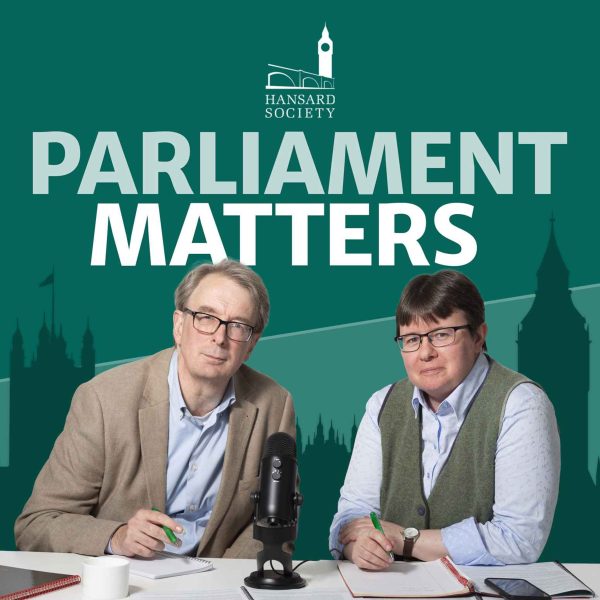
Parliament Matters
- Épisodes
- 168
- Parution
- hebdomadaire
- Dernier épisode
- 20 Nov 2026
À propos du podcast
Join two of the UK's leading parliamentary experts, Mark D'Arcy and Ruth Fox, as they guide you through the often mysterious ways our politicians do business and explore the running controversies about the way Parliament works. Each week they will analyse how laws are made and ministers held accountable by the people we send to Westminster. They will be debating the topical issues of the day, looking back at key historical events and discussing the latest research on democracy and Parliament. Why? Because whether it's the taxes you pay, or the laws you've got to obey... Parliament matters!
Mark D'Arcy was the BBC's parliamentary correspondent for two decades. Ruth Fox is the Director of the parliamentary think-tank the Hansard Society.
- ❓ Submit your questions on all things Parliament to Mark and Ruth via our website here: hansardsociety.org.uk/pm#qs
- 📱 Follow us across social media @HansardSociety and...
- ✅ Subscribe to our newsletter for all the latest updates related to the Parliament Matters podcast and the wider work of the Hansard Society: hansardsociety.org.uk/nl.
Parliament Matters is a Hansard Society production supported by the Joseph Rowntree Charitable Trust • Founding producer Luke Boga Mitchell; episode producer Richard Townsend.
Hosted on Acast. See acast.com/privacy for more information.
Épisodes 168
Why can’t Parliament fix its own home? A conversation with Jesse Norman MP
Who’s in charge of fixing the Palace of Westminster? With projected costs potentially running into tens of billions of pounds and a parliamentary decision still awaited, Conservative Shadow Leader of the House …
Notes de l’épisode
Who’s in charge of fixing the Palace of Westminster? With projected costs potentially running into tens of billions of pounds and a parliamentary decision still awaited, Conservative Shadow Leader of the House of Commons Jesse Norman MP tells us why he thinks the Restoration and Renewal project needs an urgent rethink.
He blames successive failures of political leadership for allowing the scope and costs to grow. He calls for a three-month review to pin down what work is essential, what it should cost and who should be accountable for delivering it. Ruth and Mark press him on what another review would achieve, the Conservatives’ share of responsibility for past delays and whether a project that could span several parliaments needs a government minister to drive it forward. They also discuss why comparisons with the renovation of the Cathedral of Notre Dame and Buckingham Palace only go so far.
The conversation also turns to what happens inside the Commons chamber. Norman argues that speeches designed to yield a 30-second social media clip make it harder for MPs to build on each other’s arguments. Could shorter questions and a firmer steer from the Speaker help? He makes the case for more time to examine legislation on the floor of the House and for select committees to use their influence more assertively.
Finally, Norman reflects on what writing about Edmund Burke and adapting his political novel The Winding Stair for the stage bring to his work as an MP.
___
Chapters
00:00 Introduction
02:00 Jesse Norman on becoming Shadow Commons Leader
03:00 What happened to the art of Commons debate?
05:00 Shorter questions and a firmer steer from the Speaker
08:00 What the Commons loses when experienced MPs leave
14:00 How well does Parliament examine legislation?
15:00 Treaty scrutiny and Parliament’s role in military decisions
18:00 Should select committees throw their weight around?
19:00 Why has the cost of restoring Westminster risen?
22:00 What would a three-month review achieve?
24:00 Who should lead the project? Lessons from London 2012
28:00 Which repairs are essential?
30:00 Does Westminster need a minister in charge?
33:00 A possible vote and the question of party whipping
35:00 Who bears responsibility for the delays?
39:00 From Edmund Burke to The Winding Stair
42:00 Ruth and Mark on whether another review would help
45:00 What can Westminster learn from Notre Dame and Buckingham Palace?
___
🎓 Learn more using our resources for the issues mentioned in this episode.
❓ Send us your questions about Parliament:
✅ Subscribe to our newsletter.
📱 Follow us across social media @HansardSociety / @hansardsociety.bsky.social
£ - Support the Hansard Society and this podcast by making a donation today.
Parliament Matters is a Hansard Society production supported by the Joseph Rowntree Charitable Trust.
Presenters: Mark D’Arcy and Ruth Fox
Producer: Richard Townsend
Hosted on Acast. See acast.com/privacy for more information.
The EU reset: How much say will Parliament have?
As the Government prepares to strike new deals with the EU, will Parliament help shape the future relationship or simply rubber-stamp decisions already taken?We explore a new House of Lords report calling for …
Notes de l’épisode
As the Government prepares to strike new deals with the EU, will Parliament help shape the future relationship or simply rubber-stamp decisions already taken?
We explore a new House of Lords report calling for stronger parliamentary oversight of the EU reset. Drawing extensively on Hansard Society evidence, the European Affairs Committee argues that MPs and peers need the information, resources and opportunities to hold ministers to account as the UK moves towards closer alignment with EU rules.
What should Parliament know before approving a deal? Could the promised legislation give ministers sweeping powers over future agreements? And does Parliament need its own eyes and ears in Brussels? We explain why the arrangements established now could determine Parliament’s influence for years to come and why ministers must be candid about costs as well as benefits.
Then, MPs prepare to examine new planning rules for data centres. How should national ambitions for AI be balanced against local pressures on electricity, water and the landscape? And could AI become a defining issue at the next general election?
Finally, could Parliament Square become a more welcoming place to explore Britain’s constitutional heart? With pedestrianisation proposals under consideration, we discuss how a wider vision could bring together a redesigned square, Parliament’s restoration and a World Heritage visitor centre, making the most of one of the world’s great civic spaces.
Chapters
00:00 Introduction
00:45 EU reset: Will Parliament get a say?
07:00 Ministers, missing evidence and honest trade-offs
10:00 The EU reset bill: How much power for ministers?
14:00 Parliament’s eyes and ears in Brussels
17:00 Rebuilding Parliament’s EU oversight
21:45 Data centres: National ambitions, local costs
29:30 Will the next election be an AI election?
32:15 Parliament Square: A place for people?
40:00 A visitor centre for Britain’s constitutional heart
43:00 Improving visitor access to Parliament through the Restoration and Renewal Programme
47:00 Closing remarks
____
🎓 Learn more using our resources for the issues mentioned in this episode.
❓ Send us your questions about Parliament:
✅ Subscribe to our newsletter.
📱 Follow us across social media @HansardSociety / @hansardsociety.bsky.social
£ - Support the Hansard Society and this podcast by making a donation today.
Parliament Matters is a Hansard Society production supported by the Joseph Rowntree Charitable Trust.
Presenters: Mark D’Arcy and Ruth Fox
Producer: Richard Townsend
Hosted on Acast. See acast.com/privacy for more information.
Taking on Big Tech: Beeban Kidron on the art of legislating
How do you turn a campaign into law when some of the world’s richest companies are determined to stop you?Filmmaker and crossbench peer Baroness Beeban Kidron joins us to discuss the art of legislating for the …
Notes de l’épisode
How do you turn a campaign into law when some of the world’s richest companies are determined to stop you?
Filmmaker and crossbench peer Baroness Beeban Kidron joins us to discuss the art of legislating for the digital world. From protecting children online to defending creators’ copyright against AI companies, she explains how she built support, won amendments and persuaded reluctant ministers to act.
But winning a vote is only part of the battle. Kidron contrasts her experience of the children’s privacy code with Ofcom’s implementation of the Online Safety Act, arguing that Parliament needs stronger powers to hold regulators to its intentions.
She also describes Big Tech’s tactics for resisting regulation, the pressure to back down during parliamentary “ping-pong”, and why she rejects the claim that technology moves too fast for lawmakers.
Her new book is Users: How Big Tech Took Control and How to Fight Back.
___
Chapters
00:00 Introduction
01:00 From filmmaking to campaigning
04:00 Turning children’s rights into legislation
09:00 Winning amendments and building support
13:00 Delegated legislation and regulatory accountability
18:00 Can Parliament keep up with technology?
22:00 Challenging “tech exceptionalism”
27:00 Reforming Parliament’s legislative machinery
32:00 Big Tech’s resistance playbook
40:00 AI, copyright and celebrity allies
43:00 Parliamentary ping-pong: when should peers give way?
47:00 Is the political tide turning against Big Tech?
51:00 Book details and closing remarks
____
🎓 Learn more using our resources for the issues mentioned in this episode.
❓ Send us your questions about Parliament:
✅ Subscribe to our newsletter.
📱 Follow us across social media @HansardSociety / @hansardsociety.bsky.social
£ - Support the Hansard Society and this podcast by making a donation today.
Parliament Matters is a Hansard Society production supported by the Joseph Rowntree Charitable Trust.
Presenters: Mark D’Arcy and Ruth Fox
Hosted on Acast. See acast.com/privacy for more information.
Inside the new Congress
Winning the election is one thing. Making Congress work is another. How will the Democrats now turn electoral success into effective congressional power to constrain Donald Trump and advance their own policy …
Notes de l’épisode
Winning the election is one thing. Making Congress work is another. How will the Democrats now turn electoral success into effective congressional power to constrain Donald Trump and advance their own policy agenda?
Daniel Schuman of the American Governance Institute joins us to explain how the new Congress will organise itself between election day and January, when the new House of Representatives and Senate are sworn in.
The outgoing “lame duck” Congress faces the prospect of last-minute confirmation battles and an urgent funding deadline if a government shutdown before Christmas is to be avoided. Next year will bring fresh battles over the budget and spending.
Meanwhile, incoming representatives must recruit staff, establish offices and learn the ropes of an unfamiliar institution.
For Democrats, there are decisions to be made about leadership positions, who gets coveted committee places, and agree the rules that will govern the House.
Their choices will shape whose priorities advance, who can block them and how effectively the party can work together. Daniel explains how these internal party bargains distribute power and why a stronger Speaker may not mean a stronger Congress.
The conversation examines Democratic factions, Congress’s strongest levers, especially appropriations, and the limits of oversight, subpoenas, contempt and impeachment when an administration resists compliance and courts take time.
Then comes the confrontation with the White House. Can lawmakers use the power of the purse to curb Trump’s foreign adventures and reinstate support for Ukraine?
Could the Senate block appointments to the courts and federal agencies? And how should committees balance investigating the administration with advancing legislation that delivers for voters?
We explore what happens if officials refuse to testify, why contempt proceedings can stall, and how immunity, presidential pardons and lengthy court battles complicate accountability.
Daniel offers a stark assessment of checks and balances under strain: Congress has formidable powers on paper, but making them work depends on more than an election victory.
From induction to internal bargaining, this is a guide to the decisions, procedures and pressure points that will determine what the new Congress can achieve and where its limits lie.
______
00:00 Introduction: Inside the new Congress
01:49 Why the outgoing Congress stays in power
03:39 Shutdown deadlines and last-minute Supreme Court appointments
07:16 Learning the job: How new representatives are inducted
10:40 New Congress, new House rules: An opening for reform?
15:32 Who runs the House? The Speaker, committees and members
19:50 The Democrats’ internal battles: Factions, leadership and reform
23:10 What powers can Congress use against Trump?
26:09 Ukraine funding and the limits of impeachment
27:35 The power of the purse: How spending deals get made
30:07 Investigations, subpoenas and officials who refuse to cooperate
33:40 Investigate or legislate? Delivering the Democrats’ agenda
36:54 Immunity, pardons and running down the clock
40:03 Can America’s checks and balances be repaired?
43:46 Blocking nominees and debating Supreme Court reform
47:08 A crisis moment: What happens when presidential power defies the rules?
48:00 Our next episode: Baroness Kidron talks about her work at the centre of parliamentary efforts to regulate the online world
____
🎓 Learn more using our resources for the issues mentioned in this episode.
❓ Send us your questions about Parliament:
✅ Subscribe to our newsletter.
📱 Follow us across social media @HansardSociety / @hansardsociety.bsky.social
£ - Support the Hansard Society and this podcast by making a donation today.
Parliament Matters is a Hansard Society production supported by the Joseph Rowntree Charitable Trust.
Presenters: Mark D’Arcy and Ruth Fox
Producer: Richard Townsend
Hosted on Acast. See acast.com/privacy for more information.
Order! Order! Nusrat Ghani on how she keeps MPs in line during the Budget debate
How do you keep order when the House of Commons is packed, passions are running high and the country is watching?Deputy Speaker Nusrat Ghani joins us for an exclusive interview the morning after chairing the …
Notes de l’épisode
How do you keep order when the House of Commons is packed, passions are running high and the country is watching?
Deputy Speaker Nusrat Ghani joins us for an exclusive interview the morning after chairing the Budget debate. She takes us inside the preparation, nerves and split-second decisions involved in managing one of Parliament’s biggest occasions.
From spotting where trouble might erupt to using eye contact and humour to keep MPs in line, she explains how she balances authority with allowing the Chamber to express itself. She reflects on her experience of John Bercow’s approach, why she wants to avoid undermining MPs’ confidence, and what occupying the historic Chair means to her and her family. And could chairing the Budget be an audition for the speakership?
Beyond the Chair, we assess a Budget that offered breathing room but postponed bigger decisions. What should select committees do now to test the Government’s spending promises?
We also untangle the curious case of Nigel Farage’s missing prayer card: does losing your reserved seat really prevent you from attending the Budget? And why were details of an energy announcement shared with Martin Lewis before Parliament heard them?
Finally, we reveal a proposal buried in the Budget paperwork to downgrade parliamentary scrutiny of future changes to tax-clearance rules for major investment projects. With 108 Ways and Means motions awaiting approval, what else might MPs miss in the small print?
______
🎓 Learn more using our resources for the issues mentioned in this episode.
❓ Send us your questions about Parliament:
✅ Subscribe to our newsletter.
📱 Follow us on social media: @HansardSociety / @hansardsociety.bsky.social
Support the Hansard Society and Parliament Matters by making a donation.
Parliament Matters is a Hansard Society production supported by the Joseph Rowntree Charitable Trust.
Presenters: Mark D’Arcy and Ruth Fox
Producer: Richard Townsend
Hosted on Acast. See acast.com/privacy for more information.
The Budget: Who checks the Chancellor?
How do you respond to a Budget you’ve only just heard, and spot what the Chancellor would rather you missed? Treasury Committee Chair Meg Hillier joins us to explain how she prepares for Budget day and how her …
Notes de l’épisode
How do you respond to a Budget you’ve only just heard, and spot what the Chancellor would rather you missed? Treasury Committee Chair Meg Hillier joins us to explain how she prepares for Budget day and how her Committee tests the promises behind the headlines. She weighs the benefits of Budget secrecy against the risk of policies going untested, argues for tougher scrutiny of sensitive defence spending, and explains why Parliament needs to look beyond the annual set piece event to how public money is actually spent. Her central challenge: can MPs and ministers give long-term financial choices the attention they deserve?
The Chancellor’s speech is only the beginning. Ruth and Mark offer a “cut out and keep” guide to what happens next: the days of Budget debate, the Ways and Means resolutions and the Finance Bill that turns the announcements into law. How can some tax changes take effect that very night? What can MPs amend and how does the Government limit their options? It’s your essential companion to following the Budget through the Commons.
Beyond the Budget, we discuss Darren Jones’s striking evidence to the Public Administration and Constitutional Affairs Committee. His account of trying to make Whitehall work across departmental boundaries raises an uncomfortable question: are constitutional safeguards protecting accountability, or being used to resist change? From funding the Government’s missions to getting departments’ financial systems to talk to one another, he describes a system in which even apparently straightforward reforms become a battle. Jones argues that senior civil servants have become more political without facing sufficient parliamentary scrutiny. But where should responsibility lie when ministers’ ambitions collide with officials’ advice about what the constitution permits? We explore his challenge to Whitehall’s accountability arrangements and his concerns about scrutiny of increasingly powerful mayors.
____
🎓 Learn more using our resources for the issues mentioned in this episode.
❓ Send us your questions about Parliament:
✅ Subscribe to our newsletter.
📱 Follow us across social media @HansardSociety / @hansardsociety.bsky.social
£ - Support the Hansard Society and this podcast by making a donation today.
Parliament Matters is a Hansard Society production supported by the Joseph Rowntree Charitable Trust.
Presenters: Mark D’Arcy and Ruth Fox
Producer: Gareth Jones
Hosted on Acast. See acast.com/privacy for more information.
Parliament under pressure: Select committees in the age of lawfare
Are House of Commons select committees equipped to meet the new challenges facing parliamentary scrutiny? Liam Byrne, the Labour former minister leading a review of the committee system, joins us to explore …
Notes de l’épisode
Are House of Commons select committees equipped to meet the new challenges facing parliamentary scrutiny? Liam Byrne, the Labour former minister leading a review of the committee system, joins us to explore whether committees have the powers, resources and support they need in the modern scrutiny environment.
Among his concerns is the increasing use of “lawfare” to force the disclosure of information provided by whistleblowers who give evidence to committees. How can Parliament protect witnesses from retaliation? And does the Commons have adequate powers to compel people to appear and obtain the documents its committees need?
With Andy Burnham promising closer ties with the EU, is it time to reinvent the European Scrutiny Committee? Could Westminster learn from New Zealand by setting aside a week for committees to examine departmental public spending? And does Parliament need a parliamentary budget office to help MPs interrogate the public finances and the cost of policy choices? It would not come cheap, Liam acknowledges, but he argues that it looks increasingly necessary.
Plus, how has the Burnham factor reshaped British politics? As MPs return to Westminster after the conference season, we explore how the shifting balance of power could play out in Parliament. The new Prime Minister has set out ambitious long-term goals. But he already has a commanding Commons majority. How might he use it?
We finish with some unsolicited advice for Ed Davey. Facing criticism that the Liberal Democrats have made too little impact since the election, how could he use his 72 MPs – the party’s largest-ever contingent – to make a bigger splash at Westminster?
____
🎓 Learn more using our resources for the issues mentioned in this episode.
❓ Send us your questions about Parliament:
✅ Subscribe to our newsletter.
📱 Follow us across social media @HansardSociety / @hansardsociety.bsky.social
£ - Support the Hansard Society and this podcast by making a donation today.
Parliament Matters is a Hansard Society production supported by the Joseph Rowntree Charitable Trust.
Presenters: Mark D’Arcy and Ruth Fox
Producer: Gareth Jones
Hosted on Acast. See acast.com/privacy for more information.
This is No Way to Run a Country: A conversation with former veterans minister Johnny Mercer
Former veterans minister Johnny Mercer joins us to discuss his new book, No Way to Run a Country: An Outsider’s Journey into the Heart of our Broken Politics, and his struggle to change veterans’ policy from …
Notes de l’épisode
Former veterans minister Johnny Mercer joins us to discuss his new book, No Way to Run a Country: An Outsider’s Journey into the Heart of our Broken Politics, and his struggle to change veterans’ policy from inside Westminster and Whitehall.
Mercer entered Parliament after serving in Afghanistan, determined to improve support for former service personnel. He recalls arriving with little knowledge of parliamentary politics, the unexpected impact of his maiden speech, and how he used his role on the Defence Select Committee and the media to press for change.
He takes us behind the scenes at Prime Minister’s Questions: what happens when an MP is chosen to ask a question, and why do so many use the opportunity to ask a planted question? He explains why select committees offered him a more effective way to hold people to account than exchanges in the Commons Chamber, and how party discipline and the pursuit of ministerial office can shape an MP’s choices.
Mercer also explains why he fought to establish an Office for Veterans’ Affairs outside the Ministry of Defence, and how political instability helped him win commitments from successive Prime Ministers. He is candid about the relationships he damaged, the mistakes he made, and what he learned about working with people whose priorities differed from his own.
Finally, he offers his prescription for a more effective Parliament, assesses the current government’s approach to veterans and the Northern Ireland legacy debate, and considers whether he would ever return to politics and Parliament.
🎓 Learn more using our resources for the issues mentioned in this episode.
❓ Send us your questions about Parliament:
✅ Subscribe to our newsletter.
📱 Follow us across social media @HansardSociety / @hansardsociety.bsky.social
£ - Support the Hansard Society and this podcast by making a donation today.
Parliament Matters is a Hansard Society production supported by the Joseph Rowntree Charitable Trust.
Presenters: Mark D’Arcy and Ruth Fox
Producer: Richard Townsend
Hosted on Acast. See acast.com/privacy for more information.
PMQs: Parliament Matters Questions
Recorded at Queen Mary University of London as part of Student Week, welcoming students at the start of the new academic year, this special live edition features three expert guests: historian Dr Robert …
Notes de l’épisode
Recorded at Queen Mary University of London as part of Student Week, welcoming students at the start of the new academic year, this special live edition features three expert guests: historian Dr Robert Saunders; Private Members’ Bill specialist Dr Daniel Gover; and historian Dr Catherine Haddon, a senior fellow at the Institute for Government and former Queen Mary student.
The panel begins by assessing the new Burnham Government. Has the Prime Minister’s more optimistic, personable style marked a substantive break with Keir Starmer or merely improved the presentation? They consider the fiscal and geopolitical constraints facing the Government; Burnham’s management of Labour MPs; the balance of power among senior ministers and advisers; relations with the civil service; and whether experience as a metro mayor is useful preparation for Downing Street.
The students then put the questions. Should Britain cap political donations after Reform UK received unprecedented sums from two billionaires, and would retrospective legislation be justified? Is the emerging five-party system here to stay, and can Parliament’s rules properly accommodate smaller parties? Will social media displace traditional journalism, or make trusted scrutiny and fact-checking more important?
The discussion also covers whether Parliament has too many recesses; the tension between national infrastructure needs and local opposition; devolution, separatism and the future of the Union; and reform of Private Members’ Bills. Finally, the panel recommends essential reading for students of Parliament, from political diaries and Anthony Trollope to contemporary accounts by Rory Stewart and Jess Phillips.
_____
🎓 Learn more using our resources for the issues mentioned in this episode.
❓ Send us your questions about Parliament:
✅ Subscribe to our newsletter.
📱 Follow us across social media @HansardSociety / @hansardsociety.bsky.social
£ - Support the Hansard Society and this podcast by making a donation today.
Parliament Matters is a Hansard Society production supported by the Joseph Rowntree Charitable Trust.
Presenters: Mark D’Arcy and Ruth Fox
Producer: Richard Townsend
Sound mixing: Matthew Kowalczuk, Queen Mary University of London
Hosted on Acast. See acast.com/privacy for more information.
MPs reject the assisted dying bill: What happened, and what next?
MPs have rejected the assisted dying bill – but why did a proposal they had previously supported lose this time, and what happens now? Andrew Lewin MP, a supporter of the bill, hot-foots it from the Chamber to …
Notes de l’épisode
MPs have rejected the assisted dying bill – but why did a proposal they had previously supported lose this time, and what happens now?
Andrew Lewin MP, a supporter of the bill, hot-foots it from the Chamber to give us his immediate reaction. He describes the atmosphere when the result was announced, offers his explanation for the bill’s defeat and considers whether and how the campaign to change the law might continue.
Back in the studio, Hansard Society researcher Matthew England joins us to crunch the numbers. Turnout proved crucial to the final result: was the bill defeated because MPs changed their minds, or because previous supporters stayed away?
We explore why support has slowly ebbed in the Commons and examine the substantive and procedural problems that confronted the bill.
Could there now be a backlash against the House of Lords over the role Peers played in derailing the legislation? Might the Commons seek to curb the Upper House’s powers or was the Lords simply doing its job by scrutinising a deeply consequential and technically complex bill? And with this latest proposal defeated, is assisted dying now off Parliament’s agenda for the foreseeable future?
Plus, Nigel Farage told Reform UK’s conference that he would declare a “national emergency” over the small boats crisis. But would such a declaration actually give a Prime Minister any additional legislative powers? And Lee Anderson accused MPs of being lazy and suggested that, under a Reform government, Parliament would sit seven days a week to force through its legislative programme. What would that mean in practice for the management – and, more importantly, the scrutiny – of parliamentary business? Would MPs, officials and the wider parliamentary machinery be able to sustain it? And even if legislation were driven rapidly through the Commons, what would happen when it reached the House of Lords?
______
🎓 Learn more using our resources for the issues mentioned in this episode.
❓ Send us your questions about Parliament:
✅ Subscribe to our newsletter.
📱 Follow us across social media @HansardSociety / @hansardsociety.bsky.social
£ - Support the Hansard Society and this podcast by making a donation today.
Parliament Matters is a Hansard Society production supported by the Joseph Rowntree Charitable Trust.
Presenters: Mark D’Arcy and Ruth Fox
Producer: Richard Townsend
Hosted on Acast. See acast.com/privacy for more information.
Andy Burnham’s rewired state: Can Parliament provide the circuit breaker?
Andy Burnham made his despatch box debut as Prime Minister in the House of Commons this week with one of the longest ministerial statements on record and a promise to strengthen the Prime Minister’s grip on …
Notes de l’épisode
Andy Burnham made his despatch box debut as Prime Minister in the House of Commons this week with one of the longest ministerial statements on record and a promise to strengthen the Prime Minister’s grip on Whitehall while transferring power and resources away from it. We examine the new Office of the Prime Minister and Cabinet and No. 10 North. Are they instruments of genuine decentralisation or a more powerful prime-ministerial centre with a Manchester outpost? …Joanna Cherry: The SNP, Westminster, and a decade of political battles
Joanna Cherry joins us this week to discuss her newly published memoir, in which she looks back on some of the most contentious battles in British and Scottish politics in the last two decades. She arrived at …
Notes de l’épisode
Joanna Cherry joins us this week to discuss her newly published memoir, in which she looks back on some of the most contentious battles in British and Scottish politics in the last two decades. She arrived at Westminster in 2015 as one of 56 SNP MPs elected in a historic landslide that transformed Scottish politics and made the SNP the third-largest party in the House of Commons. …Unparliamentary: Colourful tales from the Canadian Parliament
Canada’s Parliament shares its Westminster roots with the UK, but it has developed its own distinctive traditions, procedures and political culture. In this episode, Charlie Feldman – former President of the …
Notes de l’épisode
Canada’s Parliament shares its Westminster roots with the UK, but it has developed its own distinctive traditions, procedures and political culture. In this episode, Charlie Feldman – former President of the Canadian Study of Parliament Group and author of Unparliamentary, a collection of stories from the stranger corners of Canadian political history – explains how the federal Parliament in Ottawa reflects its British inheritance while developing a character all of its own. …Labour’s last chance saloon? Burnham’s new Cabinet faces familiar parliamentary problems
Andy Burnham has unveiled his ministerial team. So, we assess what his appointments reveal about the Government’s priorities, the political calculations behind them, and the parliamentary tests that lie ahead …
Notes de l’épisode
Andy Burnham has unveiled his ministerial team. So, we assess what his appointments reveal about the Government’s priorities, the political calculations behind them, and the parliamentary tests that lie ahead. We begin with the appointment of the new Chief Whip, Anneliese Midgley MP, who takes on one of Westminster’s toughest jobs despite having just two years’ parliamentary experience and no experience on the front bench. …How do we protect politicians in a dangerous age?
Following the murder of Ann Widdecombe, we reflect on the dangers facing those in Parliament and public life. Earlier this year, former Lord Chancellor Sir Robert Buckland was appointed to lead the independent …
Notes de l’épisode
Following the murder of Ann Widdecombe, we reflect on the dangers facing those in Parliament and public life. Earlier this year, former Lord Chancellor Sir Robert Buckland was appointed to lead the independent review into the circumstances surrounding the murder of Sir David Amess MP, examining whether any opportunities to prevent his death were missed. …Nigel Farage leaves Parliament: What now happens to the standards investigation?
Nigel Farage has quit the House of Commons to force a by-election in his constituency. In a blistering attack on what he called the media “pile-on” and a political stitch-up by the Westminster establishment, he …
Notes de l’épisode
Nigel Farage has quit the House of Commons to force a by-election in his constituency. In a blistering attack on what he called the media “pile-on” and a political stitch-up by the Westminster establishment, he insisted that the “people of Clacton should be the judge of my actions.” So, this week we dissect his “resignation” statement and ask whether he has a point. …New PM, new Clerk of the House of Commons: A new chapter at Westminster?
With a new Prime Minister preparing to take office and the Commons appointing its first female Clerk, we discuss these two pivotal appointments that will help shape how Parliament works in the years ahead. We …
Notes de l’épisode
With a new Prime Minister preparing to take office and the Commons appointing its first female Clerk, we discuss these two pivotal appointments that will help shape how Parliament works in the years ahead. We explore the challenges they will face in managing Parliament, examine fresh warnings from the Lord Speaker that Westminster’s restoration plans risk stalling for lack of political support, and hear from Baroness Hayter about her bid to close a loophole in the lobbying laws. …The Burnham question: A new approach to whipping Westminster?
What would an Andy Burnham government actually look and feel like? This week we explore how Andy Burnham might govern, drawing on his experience as a Cabinet minister, his time as Mayor of Greater Manchester …
Notes de l’épisode
What would an Andy Burnham government actually look and feel like? This week we explore how Andy Burnham might govern, drawing on his experience as a Cabinet minister, his time as Mayor of Greater Manchester, and his own writings on constitutional reform. We ask whether a Burnham government would take a fundamentally different approach to Parliament – particularly the use of the party whip – and what that could mean for MPs and the balance of power at Westminster. …Andy Burnham’s March on Westminster: How Could He Become Prime Minister?
Three by-elections delivered three very different results this week. To discuss the implications, we are joined by Professor Philip Cowley, a leading expert on MPs, party discipline and the realities of …
Notes de l’épisode
Three by-elections delivered three very different results this week. To discuss the implications, we are joined by Professor Philip Cowley, a leading expert on MPs, party discipline and the realities of parliamentary power. The Conservatives secured their first Scottish by-election victory since 1967, taking Aberdeen South from the SNP. Meanwhile, the SNP held on in Arbroath and Broughty Ferry, limiting the damage from what could have been a bruising night. …Brexit, 10 years on: Parliament and the democratic crisis
This month marks the tenth anniversary of the Brexit referendum – a vote that unleashed four years of extraordinary political turmoil. Judges were branded "enemies of the people", MPs denounced as "saboteurs" …
Notes de l’épisode
This month marks the tenth anniversary of the Brexit referendum – a vote that unleashed four years of extraordinary political turmoil. Judges were branded "enemies of the people", MPs denounced as "saboteurs", political parties fractured, and Prime Ministers rose and fell amid relentless parliamentary drama. …The Cabinet Manual: Why Britain's constitutional "highway code" needs updating
The Cabinet Manual has been described as the “highway code” of the UK constitution, a guide that brings together the laws, conventions, precedents and procedures under which the Government operates. First …
Notes de l’épisode
The Cabinet Manual has been described as the “highway code” of the UK constitution, a guide that brings together the laws, conventions, precedents and procedures under which the Government operates. First published in 2011, it has not been updated since, despite a decade and a half of constitutional change. So why is the Government revising it now? What needs updating? Should Parliament have a role in approving it? And how important is the Manual as a guide to the UK’s unwritten constitution? …The £5m question: Who funds our politicians?
In this episode, we explore the rules governing MPs’ financial interests, gifts and donations, as Reform UK leader Nigel Farage faces questions over a £5 million gift from cryptocurrency billionaire Christopher …
Notes de l’épisode
In this episode, we explore the rules governing MPs’ financial interests, gifts and donations, as Reform UK leader Nigel Farage faces questions over a £5 million gift from cryptocurrency billionaire Christopher Harborne. Ruth and Mark are joined by Duncan Hames, a former MP and now Director of UK Policy at Transparency International, to ask whether the current transparency regime is working, whether a requirement to declare large gifts is enough on its own to protect public confidence, and…Is the Government censoring the Mandelson Papers?
The row over Lord Mandelson’s appointment as Britain’s ambassador to Washington flared up again this week after the Intelligence and Security Committee (ISC) accused the Government of improperly redacting …
Notes de l’épisode
The row over Lord Mandelson’s appointment as Britain’s ambassador to Washington flared up again this week after the Intelligence and Security Committee (ISC) accused the Government of improperly redacting documents linked to his appointment. Back in February, ministers were forced to release papers under a Humble Address to the King, with the ISC tasked with deciding what could be withheld on national security or diplomatic grounds. …Labour’s leadership tangle: What does it mean for Parliament?
A battle for Downing Street touched off by a ministerial resignation, a chunky new King’s Speech, and an increasingly unpredictable political environment provide plenty for us to discuss with our special guest …
Notes de l’épisode
A battle for Downing Street touched off by a ministerial resignation, a chunky new King’s Speech, and an increasingly unpredictable political environment provide plenty for us to discuss with our special guest, Professor Meg Russell, the former Director of the Constitution Unit. We begin with the Labour leadership contest, which was unfolding in real time as the podcast was recorded. …What now? The local election fallout hits Westminster
After an awful set of elections for Labour across England, Scotland and Wales, are the Prime Minister’s days numbered? Could the Cabinet revolt? Might a rival formally launch a leadership challenge? Or might it …
Notes de l’épisode
After an awful set of elections for Labour across England, Scotland and Wales, are the Prime Minister’s days numbered? Could the Cabinet revolt? Might a rival formally launch a leadership challenge? Or might it take another defining crisis – a further final straw – to trigger a revolt by the parliamentary foot soldiers? We also examine how Labour’s leadership rules operate, including the nomination requirements for a leadership challenger to trigger a race. …Keir Starmer’s week of parliamentary torture over Mandelson appointment
Keir Starmer has faced “ordeal by Parliament” this week. A tense statement in the House of Commons over his handling of Peter Mandleson’s nomination as Ambassador to the United States was followed by an …
Notes de l’épisode
Keir Starmer has faced “ordeal by Parliament” this week. A tense statement in the House of Commons over his handling of Peter Mandleson’s nomination as Ambassador to the United States was followed by an emergency debate and then an awkward session of PMQs. Meanwhile the Foreign Affairs Committee held a series of hearings to pick over the PM’s account of what he knew about Mandelson’s security vetting, and when he knew it. …Dynamic alignment and Henry VIII powers: What will the Government’s EU reset mean for Parliament?
A bill to deliver the Government’s proposed “EU reset” is set to be a centrepiece of May’s King’s Speech. It will reportedly give Ministers powers to update UK law in line with certain EU rules (so-called …
Notes de l’épisode
A bill to deliver the Government’s proposed “EU reset” is set to be a centrepiece of May’s King’s Speech. It will reportedly give Ministers powers to update UK law in line with certain EU rules (so-called “dynamic alignment”) in areas such as animal and plant health (known as Sanitary and Phytosanitary (SPS)), energy co-operation and emissions trading. …Will key Government bills pass by the end of the parliamentary Session?
The Government has announced that the State Opening of Parliament and King’s Speech will take place on Wednesday 13 May - just as we predicted last Autumn! However, Ministers have not confirmed when prorogation …
Notes de l’épisode
The Government has announced that the State Opening of Parliament and King’s Speech will take place on Wednesday 13 May - just as we predicted last Autumn! However, Ministers have not confirmed when prorogation – marking the end of the current Session – will take place. It is likely to be the last week in April but could slip into the week of the local elections. …Who really decides Immigration Rules: Parliament or the Home Secretary?
The Home Secretary, Shabana Mahmood MP, is planning sweeping changes to the immigration system. So, this week we put immigration law under the microscope. Jonathan Featonby of the Refugee Council joins us to …
Notes de l’épisode
The Home Secretary, Shabana Mahmood MP, is planning sweeping changes to the immigration system. So, this week we put immigration law under the microscope. Jonathan Featonby of the Refugee Council joins us to explain how major shifts to refugees’ rights, settlement routes and visa rules can be pushed through using Immigration Rules, with Parliament left largely powerless to influence or block them. …Jury trials under threat? The Courts and Tribunals Bill explained
The Government’s plan to restrict the right to a jury trial for certain defendants cleared its Second Reading in the Commons this week – but the fight is far from over. The proposals in the Courts and Tribunals …
Notes de l’épisode
The Government’s plan to restrict the right to a jury trial for certain defendants cleared its Second Reading in the Commons this week – but the fight is far from over. The proposals in the Courts and Tribunals Bill are already provoking fierce criticism, including from a determined group of Labour backbenchers. To explore what’s at stake, we speak to barrister and former Director of Public Prosecutions, Lord Macdonald of River Glaven. …
Voici les 40 derniers épisodes sur 168. Les épisodes plus anciens se trouvent dans le flux du podcast.
Podcasts similaires
Plus de podcasts : Actualités






C’est votre podcast ?
Confirmez-le avec une entrée dans votre flux : vous recevez ici un code, vous l’ajoutez comme podcast:txt dans le canal de votre flux, et nous le vérifions. Votre podcast apparaît ensuite comme « vérifié » sur SoundNode.