

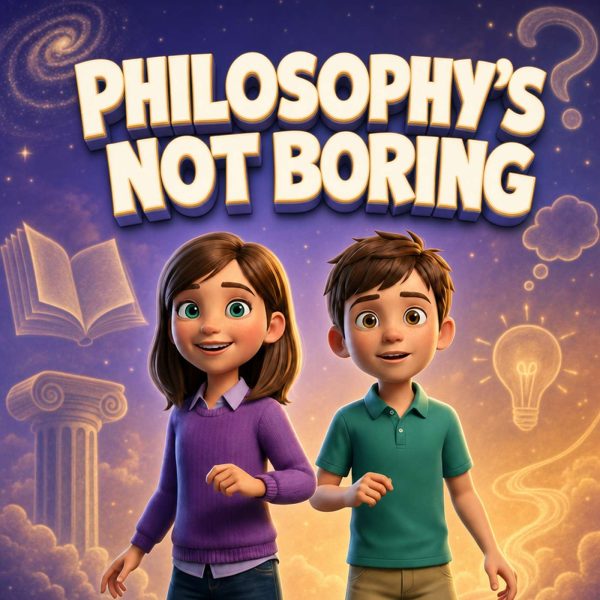
Philosophy for Kids / Philosophy’s Not Boring: The Kids Philosophy Podcast
- Épisodes
- 115
- Parution
- quotidienne
- Dernier épisode
- 15 Nov 2026
À propos du podcast
A groundbreaking podcast for curious kids aged 4-12, and the grown-ups listening with them, that proves philosophy, psychology and religion are anything but dull.
Join our fictional AI hosts Mira, a brilliant 9-year-old, and her younger brother Finn, age 7, as they explore philosophy, psychology and religion as one big family of questions about how we make sense of things. Each episode takes a real thinker or idea seriously, from what makes you the same person you were as a baby to why people across the world believe such different things about the soul, and then lands it somewhere in your actual life.
We don't hand you the answer and move on. Some questions have one; some have several worth comparing; some nobody has ever settled, and we'll tell you which is which. On matters of faith we stay even-handed: we describe what people believe from the outside, and never tell you what to believe yourself. Because philosophy isn't a pile of hard words to memorize. It's learning to ask a better question, and to sit with it honestly, even when it's uncomfortable.
A note on why we use AI. For us, AI allows us to deliver learning at a scale and quality that previously would have been too expensive. If we make the odd technical error, or the sound goes a bit funny, bear with us, we're trying our best. We hope you enjoy the show!
Épisodes 115
What is anchoring bias?
Have you ever wondered why a toy on sale feels like such a massive deal? Or why the very first number you hear can actually control your brain? Join Mira and Finn on an incredible journey back to 1974 to …
Notes de l’épisode
Have you ever wondered why a toy on sale feels like such a massive deal? Or why the very first number you hear can actually control your brain? Join Mira and Finn on an incredible journey back to 1974 to uncover a sneaky mental glitch called anchoring bias! You will learn about two brilliant psychologists, Amos Tversky and Daniel Kahneman, who set up a wild experiment using a giant, rigged carnival wheel of fortune. By spinning the wheel and stopping on a random number like 10 or 65, they secretly changed how people guessed the answers to totally unrelated geography questions! How did a meaningless number drag guesses so far off track? It turns out, our brains drop a heavy mental anchor on the very first piece of information we get. You will discover how toy stores use crossed-out prices to trick us, why even expert judges fall for this number glitch, and how knowing about it can make you super smart! Tune in for mind-bending science, tricky experiments, and an epic trivia quiz to see if you can outsmart the anchor!Who was Blaise Pascal?
Imagine you are playing a giant, complicated game where you don't know all the rules or if there is even a prize at the end. How do you choose a side? Travel back to 17th-century France to meet a …
Notes de l’épisode
Imagine you are playing a giant, complicated game where you don't know all the rules or if there is even a prize at the end. How do you choose a side? Travel back to 17th-century France to meet a super-smart prodigy named Blaise Pascal! Did you know he wrote a massive mathematical paper on geometry when he was just sixteen years old? Pascal was an absolute genius who helped invent the math of chance and probability. He even built one of the world's very first mechanical calculators, called the Pascaline, just to help his dad do taxes! But Pascal didn't just love numbers; he loved deep, philosophical mysteries. He wrote down his biggest ideas on little scraps of paper, which were published as a famous book called the Pensées in 1670. In today’s episode, Mira and Finn explore Pascal's most famous idea: Pascal's Wager! He argued that since no one can scientifically prove if God exists, everyone has to place a giant bet with how they live their lives. Join us as we use math to explore one of the biggest mysteries of the universe!Who was Iris Murdoch?
Have you ever had to spend time with someone who really, really annoyed you? Maybe they chew their food too loudly or always make up the rules in a game! You try your hardest to be polite. You smile, you nod …
Notes de l’épisode
Have you ever had to spend time with someone who really, really annoyed you? Maybe they chew their food too loudly or always make up the rules in a game! You try your hardest to be polite. You smile, you nod, and you share your toys. But what if you're secretly thinking grumpy thoughts about them inside your head? Are you still being a good person? For a long time, people thought being good was only about your actions. But in 1970, a brilliant philosopher (who also wrote twenty-six novels!) named Iris Murdoch completely flipped this idea upside down! She argued that true kindness actually starts in your mind, before you ever move a muscle. Murdoch called this a "just and loving gaze." It means paying fair attention to people. Instead of seeing someone as annoying and silly, what if you looked closer and realized they were just fun and energetic? Join Mira and Finn on Philosophy is Not Boring as they explore how changing the way you see others is like a secret kindness workout for your brain!What is the rubber hand illusion?
Have you ever wondered how your brain knows which body parts belong to you? It sounds like a silly question—obviously, your hands are yours! But what if your brain could be tricked into thinking a fake piece of …
Notes de l’épisode
Have you ever wondered how your brain knows which body parts belong to you? It sounds like a silly question—obviously, your hands are yours! But what if your brain could be tricked into thinking a fake piece of plastic was actually part of your body? In this mind-bending episode of Philosophy is Not Boring, Mira and Finn explore one of the wildest science experiments ever: The Rubber Hand Illusion! In 1998, scientists Matthew Botvinick and Jonathan Cohen in Pittsburgh set up a crazy test. They hid a volunteer's real hand behind a cardboard screen and put a lifelike rubber hand right in front of them. Then, they used two soft paintbrushes to stroke both hands at the exact same time! What happened next will shock you! Within minutes, the volunteers' brains got totally confused and actually felt the paintbrush touching the fake rubber hand! Tune in to discover how your super-smart brain uses sight and touch to build a map of your body, and find out what happens when you play a video game. Get ready to question reality—and wiggle your fingers just to be sure they are still yours!Who was Saint Martin?
Have you ever had just one piece of your absolute favorite candy left, and a friend asks for it? It's super hard to share when you don’t have much! But what if you could just snap it in half? In this …
Notes de l’épisode
Have you ever had just one piece of your absolute favorite candy left, and a friend asks for it? It's super hard to share when you don’t have much! But what if you could just snap it in half? In this episode of Philosophy is Not Boring, Mira and Finn explore an amazing 1,700-year-old story about a Roman soldier named Martin who did exactly that—but with something way more important than candy! Martin was a cavalry soldier riding through the freezing winter snow when he spotted a shivering beggar. Since he had already given away all his extra money, all Martin had left to stay warm was his own heavy wool cloak. What did he do? He drew his huge metal sword and sliced his beautiful cloak right down the middle to share! That night, he had an incredible dream that changed his life forever. Join us as we learn how this one act of giving half became famous around the world! Discover why kids in the Netherlands, Germany, and Austria walk through the dark, cold streets every November 11th with glowing paper lanterns singing songs. Learn how you don’t have to be a superhero to make a massive difference!What is the Stroop Effect?
Have you ever noticed that once you learn how to read, you completely lose the ability to turn it off? In 1935, an American psychologist named John Ridley Stroop discovered a fascinating brain glitch! Imagine …
Notes de l’épisode
Have you ever noticed that once you learn how to read, you completely lose the ability to turn it off? In 1935, an American psychologist named John Ridley Stroop discovered a fascinating brain glitch! Imagine looking at the word "RED" but it is printed in bright blue ink. Your mission is to name the ink color out loud as fast as you can without reading the word. It sounds incredibly easy, right? Think again! Your super-fast reading brain will automatically try to shout "RED!" before you can even think about the color blue! This hilarious brain jam is called the Stroop Effect, and it proves that your brain has two different systems fighting for control. Did you know this exact mind-bending test was supposedly used by intelligence officers during the Cold War to catch secret spies? Join Mira and Finn as they explore how your bossy, automatic brain works, and learn how you can use a few simple felt-tip pens to trick your family at home. Get ready for the ultimate brain battle!Who was Heraclitus?
Have you ever looked at a picture of yourself as a baby and thought, "Is that really me?!" Well, you are not the only one asking that brain-bending question! Travel way back in time to around 500 BCE in the …
Notes de l’épisode
Have you ever looked at a picture of yourself as a baby and thought, "Is that really me?!" Well, you are not the only one asking that brain-bending question! Travel way back in time to around 500 BCE in the ancient city of Ephesus, where a brilliant philosopher named Heraclitus asked a world-famous puzzle: Can you step into the exact same river twice? He said no! Because water is always flowing, the second you step back in, it's totally different water! But what does a rushing river have to do with you? It turns out, you are constantly changing too! From the thoughts in your brain to the trillions of tiny cells making up your body, you are always replacing your parts like flowing water. Join Mira and Finn as they explore this two-thousand-year-old mystery! Discover why having a bad day doesn't permanently freeze who you are, why change is actually a superpower, and what happened to Heraclitus's lost book. Put on your philosophical thinking caps and get ready to go with the flow!What is Diwali?
Have you ever imagined walking down a street glowing with thousands of tiny, flickering lamps? Welcome to Diwali, the spectacular Festival of Lights! Celebrated by millions of people around the world, this …
Notes de l’épisode
Have you ever imagined walking down a street glowing with thousands of tiny, flickering lamps? Welcome to Diwali, the spectacular Festival of Lights! Celebrated by millions of people around the world, this amazing holiday features colorful rangoli patterns, dazzling fireworks, and giant boxes of delicious sweets called mithai. But did you know that different religions light these lamps for completely different reasons? For Hindus, the tiny clay diyas are lit to welcome Prince Rama home after a fourteen-year exile in the dark forest. For Jains, the lamps remember the great teacher Mahavira and keep the light of his wisdom shining bright. And for Sikhs, it is the thrilling story of Guru Hargobind, who cleverly outsmarted a tricky emperor by sewing fifty-two long tails onto his giant cloak to rescue innocent prisoners! Even though the stories are totally different, they all share one beautiful message: light always wins over darkness. Join Mira and Finn as we explore the magic, history, and brilliant meaning behind the Festival of Lights!What is a facial expression?
Have you ever wondered if a smile means the exact same thing everywhere in the world? Or could a smile actually mean you're angry in a different country?! In this mind-bending episode of Philosophy is Not …
Notes de l’épisode
Have you ever wondered if a smile means the exact same thing everywhere in the world? Or could a smile actually mean you're angry in a different country?! In this mind-bending episode of Philosophy is Not Boring, Mira and Finn explore the amazing science of faces! Travel back to 1967 with an American psychologist named Paul Ekman. He journeyed all the way to the highlands of Papua New Guinea to meet the isolated Fore people. His mission? To see if we all share the same basic facial expressions! By telling simple stories, Ekman discovered that people everywhere seemed to recognize the same six emotions: happiness, sadness, fear, disgust, anger, and surprise. He thought our brains were perfectly hardwired like a tablet! But wait, is it really that simple? Enter modern scientist Lisa Feldman Barrett! She argues that real feelings are much messier. Can you cry when you are super happy? Can you laugh when you are frustrated? Yes! Learn why your brain is actually a giant prediction machine, discover how to wiggle your ears, and find out why we must always ask questions instead of just guessing how someone feels!What is a pilgrimage?
Imagine going on a vacation where you don't relax at the beach, but instead, you walk for a whole month until your feet are covered in blisters! Why would anyone choose to do that? Welcome to the …
Notes de l’épisode
Imagine going on a vacation where you don't relax at the beach, but instead, you walk for a whole month until your feet are covered in blisters! Why would anyone choose to do that? Welcome to the fascinating world of pilgrimages! Join Mira and Finn as they explore why millions of people travel thousands of miles to visit holy places around the world. Discover the Hajj, where over a million Muslims travel to Mecca wearing simple white clothes so everyone looks exactly the same, whether they are a billionaire or a baker! Learn about the Kumbh Mela in India, a massive Hindu gathering so enormous you can actually see the crowd from space! Plus, find out why Christians walking the 500-mile Camino de Santiago in Spain carry a special scallop shell on their backpacks. You'll learn all about "communitas," the super-strong feeling of togetherness that happens when strangers do something really difficult side-by-side. Get ready to pack your bags, lace up your hiking boots, and discover why sometimes the hardest journeys are the most meaningful ones!What is the Liar's Paradox?
Have you ever felt like your brain was completely tied in a knot? Get ready for the ultimate puzzle! Imagine someone walks right up to you and says, "Everything I say is a lie." Wait... if they are telling the …
Notes de l’épisode
Have you ever felt like your brain was completely tied in a knot? Get ready for the ultimate puzzle! Imagine someone walks right up to you and says, "Everything I say is a lie." Wait... if they are telling the truth, then they really are lying. But if they are lying, then they must be telling the truth! How is that even possible?! This brain-breaking glitch is called the Liar's Paradox! In this mind-bending episode, Mira and Finn dive into a logic trap that has confused humans for over two thousand years. Journey all the way back to ancient Greece to meet Epimenides, a man from the island of Crete who claimed all Cretans were liars! Then, fast forward to 1901 to discover how a brilliant mathematician named Bertrand Russell found the exact same glitch hiding inside the rules of math using a simple story about a town with only one barber. Can a sentence be true and false at the exact same time? Hit play to test your brain against one of history's most famous puzzles. Warning: this fun philosophy glitch might make you dizzy!What is the McGurk Effect?
Have you ever wondered if your eyes can actually hear? It sounds like a superpower, but it is a real trick your brain plays on you every single day! Back in 1976, two scientists named Harry McGurk and John …
Notes de l’épisode
Have you ever wondered if your eyes can actually hear? It sounds like a superpower, but it is a real trick your brain plays on you every single day! Back in 1976, two scientists named Harry McGurk and John MacDonald accidentally discovered a mind-bending illusion. They played an audio recording of a voice saying "ba" over a video of a person's lips mouthing "ga." But instead of hearing the real sound, people heard a totally made-up third sound: "da"! This incredible glitch in our senses is called the McGurk Effect! Your brain doesn't keep sight and sound in separate boxes. Instead, it acts like a super detective, taking clues from your eyes and your ears to mash together one best guess! It is why looking at your friend's face in a loud, noisy cafeteria actually helps you hear their secret, and why badly dubbed movies feel so completely wrong! Join Mira and Finn as they explore how your eyes hack your ears to change the audio files in your brain. The craziest part? Even when you know the secret, you still can't turn the trick off!What is democracy?
Imagine you are on a giant wooden ship in the middle of a dangerous, stormy ocean! Who should steer? Should it be a trained, expert captain who knows how to read the stars, or should all the passengers take a …
Notes de l’épisode
Imagine you are on a giant wooden ship in the middle of a dangerous, stormy ocean! Who should steer? Should it be a trained, expert captain who knows how to read the stars, or should all the passengers take a vote? In this brain-twisting episode, Mira and Finn travel back over two thousand years to Ancient Athens to answer a massive question: What is democracy, and is it really the fairest way to make decisions? Dive into the incredible mind of the philosopher Plato! In his famous book The Republic, Plato argued that only trained experts should be in charge—otherwise, it's like letting someone who just throws a good party fly an airplane! But the ancient Athenians believed that everyone living on the ship deserves a say in where it goes. Get ready for wild historical facts about how Athenians voted using broken pottery, picked leaders by random lottery, and the ultimate debate between knowing what is best versus doing what is fair! Will you choose Plato's expert captain, or will you vote with the passengers?What is a Zen koan?
Have you ever tried to solve a riddle that is actually impossible? What if the whole point of a puzzle is to completely break your brain? Welcome to the wild world of the Zen koan! In the 1700s, a famous …
Notes de l’épisode
Have you ever tried to solve a riddle that is actually impossible? What if the whole point of a puzzle is to completely break your brain? Welcome to the wild world of the Zen koan! In the 1700s, a famous Japanese Zen teacher named Hakuin asked his students a brain-twisting question: 'Two hands clap and there is a sound. What is the sound of one hand?' Students would spend months—even years!—trying to figure it out. They would guess snapping, waving, or even total silence, but every single answer was wrong! Why? Because this special puzzle wasn't meant to test their logic. It was designed to exhaust their busy, thinking minds until they simply gave up! Once their brains stopped trying to solve the problem, they could finally relax and experience the beautiful present moment without worrying. Join Mira and Finn on Philosophy is Not Boring as they explore this amazing ancient brain hack, learn how to turn off the noisy static in our heads, and challenge you with a fun trivia quiz! Get ready to listen... with one hand!Why do we pick sides?
Have you ever been on the playground and suddenly found yourself in an intense game of "sneakers versus boots"? Why do our brains pick sides so incredibly fast, even over silly, meaningless things? In this …
Notes de l’épisode
Have you ever been on the playground and suddenly found yourself in an intense game of "sneakers versus boots"? Why do our brains pick sides so incredibly fast, even over silly, meaningless things? In this mind-bending episode of Philosophy is Not Boring, Mira and Finn uncover the hidden secrets of how humans form groups! First, we travel back to 1970 to meet researcher Henri Tajfel. He discovered that kids would form fiercely loyal teams over something as tiny as picking between two abstract paintings—even if they never actually met their teammates! It gets even wilder when we learn that people will sometimes give up a good deal just to make sure the "other team" loses. But wait, can we stop a rivalry once it starts? Yes! We explore a famous 1954 summer camp experiment called Robbers Cave, where two rival groups of kids learned to get along. How did they do it? By fixing a broken water supply and pulling a heavy food truck out of the mud together! Join us to find out how a shared problem (and a round of milkshakes!) can turn bitter enemies into fast friends!What is Halloween?
Get ready to uncover the ultimate mystery of spooky season! Have you ever wondered why we celebrate Halloween on October 31st, or why it is called Halloween in the first place? Join Mira and Finn on Philosophy …
Notes de l’épisode
Get ready to uncover the ultimate mystery of spooky season! Have you ever wondered why we celebrate Halloween on October 31st, or why it is called Halloween in the first place? Join Mira and Finn on Philosophy is Not Boring as they travel back in time to discover the secret history of this famous holiday! It turns out, Halloween comes from an old phrase meaning All Hallows' Eve, the night before the Christian holiday of All Saints' Day. But the story goes back even further! Thousands of years ago, the ancient Celts celebrated a festival called Samhain, where they believed the boundary between the living and spirit worlds grew super thin. From inviting ancestors to dinner, to lighting paper lanterns in Japan for the summer festival of Obon, to building beautiful marigold-covered altars for Mexico's Day of the Dead, people all over the world have incredible ways to remember loved ones! Discover why remembering someone is an amazing superpower, how traditions stack on top of each other, and why death doesn't mean someone stops being part of your family. Hit play and let's explore the beautiful magic of memories!Who was Ibn Sina?
Have you ever tried to feel absolutely nothing? It’s almost impossible! You can always feel your toes in your shoes or hear your own heartbeat. But what if you couldn't? Join Mira and Finn on a …
Notes de l’épisode
Have you ever tried to feel absolutely nothing? It’s almost impossible! You can always feel your toes in your shoes or hear your own heartbeat. But what if you couldn't? Join Mira and Finn on a mind-bending journey back to the early 1000s to meet a brilliant Persian doctor and philosopher named Ibn Sina! During the Islamic Golden Age, Ibn Sina created one of the most famous and spooky thought experiments in history: The Floating Man. Imagine a man created in a single instant, floating in total darkness, with no memories and absolutely no way to feel his own physical body. Would he still know that he exists? Ibn Sina said yes! This wild puzzle proved that our minds, or our "selves," are completely different from our physical bodies. It even inspired the famous philosopher René Descartes to declare, "I think, therefore I am" over 600 years later! Tune in to discover why you are so much more than just a pile of bones and muscles, and explore the ultimate magic of the human mind!How did babies count?
Have you ever wondered what is going on inside a tiny baby's head? Do they only know how to sleep, cry, and eat snacks, or are their brains already working super hard? For a long time, famous thinkers …
Notes de l’épisode
Have you ever wondered what is going on inside a tiny baby's head? Do they only know how to sleep, cry, and eat snacks, or are their brains already working super hard? For a long time, famous thinkers believed babies were born with a "blank slate"—like an empty computer with zero programs installed! But in 1992, a scientist named Karen Wynn at the University of Arizona decided to test this with a brilliant experiment. She created a tiny puppet stage with colorful toys to see if five-month-old babies could actually do math! But how do you give a math test to someone who can't even hold a pencil? With a sneaky magic trick! Using a hidden trap door, researchers secretly took a toy away. When the screen dropped, one plus one suddenly equaled one! The babies were so surprised that they stared for a super long time! Does this mean we are all born with a built-in math calculator in our brains, or were the babies just tracking their toys? Join Mira and Finn as we dive into this amazing mystery, discover ancient Roman pebbles, and find out if tiny babies are actually math geniuses!Who was John Stuart Mill?
Have you ever wanted to eat a whole gallon of double chocolate fudge ice cream for dinner and thought, 'It's my body, it's my choice!'? Well, get ready to test that idea! Travel back to 1859 …
Notes de l’épisode
Have you ever wanted to eat a whole gallon of double chocolate fudge ice cream for dinner and thought, 'It's my body, it's my choice!'? Well, get ready to test that idea! Travel back to 1859 England to meet a super-smart philosopher named John Stuart Mill. He was a certified genius who started learning Ancient Greek when he was just three years old! When he grew up, he wrote a famous book called 'On Liberty' and came up with one giant rule for the world: The Harm Principle. This rule says you should be allowed to do whatever you want, as long as you aren't hurting anyone else! Sounds awesome, right? But wait... what actually counts as 'harm'? If you play the drums at 3 AM and make your neighbors grumpy, is that causing harm? What if your bad choices make your family sad? Join Mira and Finn as they untangle the invisible spiderweb of human connection, discover what 'experiments in living' are, and learn why this famous rule doesn't actually apply to kids!What is the invisible gorilla?
Have you ever been staring right at something, like a missing Lego piece or the ketchup in the fridge, but you literally cannot see it? Get ready for a mind-bending episode that will change how you look at the …
Notes de l’épisode
Have you ever been staring right at something, like a missing Lego piece or the ketchup in the fridge, but you literally cannot see it? Get ready for a mind-bending episode that will change how you look at the world! In 1999, psychologists Daniel Simons and Christopher Chabris set up a famous experiment at Harvard University. They asked students to watch a video of people passing basketballs and carefully count the passes. But halfway through the game, someone in a giant, furry black gorilla suit walked right into the middle of the players, thumped their chest, and walked away. Guess what? Almost half of the viewers completely missed the giant gorilla! How is that even possible?! Join Mira and Finn as they uncover the wild science of "inattentional blindness." You will learn how your brain acts like a busy movie editor, quietly deleting things from your vision so you don't get overwhelmed. Discover why your brain tricks you, how even expert doctors miss crazy details, and why you might not hear your parents when you are playing a tough video game. Tune in to test your own brain!What is the Amish community?
Imagine waking up tomorrow and deciding to get rid of your family car, the television, and all the iPads for good! Sounds crazy, right? But for the Amish community, living without modern technology isn't a …
Notes de l’épisode
Imagine waking up tomorrow and deciding to get rid of your family car, the television, and all the iPads for good! Sounds crazy, right? But for the Amish community, living without modern technology isn't a punishment—it's a thoughtful choice! Travel back in time with Mira and Finn to 1500s Switzerland to discover the origins of the Anabaptists, and find out why thousands later settled in Pennsylvania for religious freedom. Today, over 400,000 Amish people drive horse-drawn buggies, wear plain clothes without zippers, and live very simply. But why do they say no to super-fast cars and video games? Because they ask a totally different question about new inventions: Does this bring our family closer together, or pull us apart? You won't believe what happens when an Amish community works together—they can build an entire two-story wooden barn from the ground up in just a single day! Tune in to learn why sometimes, you don't need the fastest modern gadgets to have a wonderful life, you just need your neighbors!What is a blank slate?
Have you ever looked closely at a tiny, squishy newborn baby and wondered... what is actually going on inside their head? Are they thinking, or is their brain totally empty? Join Mira and Finn on Philosophy is …
Notes de l’épisode
Have you ever looked closely at a tiny, squishy newborn baby and wondered... what is actually going on inside their head? Are they thinking, or is their brain totally empty? Join Mira and Finn on Philosophy is Not Boring for a mind-bending puzzle! In 1689, an English philosopher named John Locke argued that babies are born knowing absolutely nothing. He called their minds a "Tabula Rasa" or a blank slate, like an empty piece of white paper waiting to be filled with everything they see, taste, and touch! But jump ahead almost 300 years, and a linguist named Noam Chomsky says that can't be entirely true! He noticed that toddlers learn tricky grammar rules way too fast to be starting from scratch. Chomsky believed we are actually born with a built-in "app" in our brains for language! So, which is it? Are you a totally blank page, or did you arrive with an invisible instruction manual already written inside you? Discover the incredible Nature vs. Nurture debate, find out why identical twins can be so spooky, and see if you can ace our fun trivia quiz!What is sibling rivalry?
Do you ever wonder why your brother or sister can drive you absolutely bananas?! You are definitely not alone! In this exciting episode of Philosophy is Not Boring, Mira and Finn dive into the wild world of …
Notes de l’épisode
Do you ever wonder why your brother or sister can drive you absolutely bananas?! You are definitely not alone! In this exciting episode of Philosophy is Not Boring, Mira and Finn dive into the wild world of family psychology to answer a huge question: Why do the people we live with annoy us the most? It turns out, there is an amazing scientific reason behind all those arguments! We'll explore something called "natural rivalry," which goes all the way back to ancient human history when kids had to compete for their parents' attention. Plus, learn all about the incredible discoveries of psychologist Judy Dunn, who found out that your sibling knows exactly which buttons to push because they are actually an emotional genius! We will also uncover the mystery of the "social allergy"—where tiny habits get magnified in our brains just because we see them every single day! Tune in to find out how boundary-setting and perspective-taking can turn your most annoying sibling into your lifelong best friend and greatest ally. Get ready for some mind-blowing psychology facts!What is a phobia?
Have you ever wondered why you might be terrified of a tiny little spider in the bathtub, but you aren't scared of getting into a fast-moving car every day? It turns out, our fears aren't just silly …
Notes de l’épisode
Have you ever wondered why you might be terrified of a tiny little spider in the bathtub, but you aren't scared of getting into a fast-moving car every day? It turns out, our fears aren't just silly glitches in our brains—they are ancient survival tools! Join Mira and Finn as they explore the wild world of fear and phobias. You'll discover the amygdala, a tiny, almond-shaped part of your brain that acts like a built-in fire alarm. We will learn all about "biological preparedness," a cool theory by psychologist Martin Seligman that explains why we are born ready to fear ancient threats like snakes and falling off cliffs, but not modern things like electricity! But what happens if your brain's alarm gets stuck on too loud? Can you unlearn a fear? Yes, you can! We'll explore how psychiatrist Joseph Wolpe invented "systematic desensitization," and how a trick called "reciprocal inhibition" proves you can't be relaxed and terrified at the exact same time. We will even learn how modern doctors use super cool Virtual Reality headsets to help people become braver! Get ready to hack your brain!What is naive realism?
Have you ever gotten into a massive argument over something silly, like whether a hot dog is a sandwich, and felt one hundred percent sure you were right? You're not alone! In this fascinating episode …
Notes de l’épisode
Have you ever gotten into a massive argument over something silly, like whether a hot dog is a sandwich, and felt one hundred percent sure you were right? You're not alone! In this fascinating episode, Mira and Finn explore the big question: why do people disagree? Journey back over two thousand years to ancient India to hear the famous parable of the blind men and the elephant! When a group of blind men all touch different parts of an elephant, they end up furious at each other because they each think their piece is the whole truth. It turns out, our brains do the exact same thing today! In the 1990s, Stanford psychologist Lee Ross called this "naïve realism"—the sneaky habit of assuming we see reality perfectly, so anyone who disagrees must be totally crazy! But don't worry, there's a secret to getting along! Discover how a famous 1954 summer camp experiment by Muzafer Sherif proved that arguing enemies can become best friends when they are given a "superordinate goal"—a massive shared problem they must solve together. Tune in to uncover the incredible psychology of arguments, elephants, and learning to finally agree!What is Eid?
Imagine trying not to eat a single snack or take a sip of water from sunrise to sunset for an entire month! That’s exactly what millions of Muslims do during the holy month of Ramadan to practice patience and …
Notes de l’épisode
Imagine trying not to eat a single snack or take a sip of water from sunrise to sunset for an entire month! That’s exactly what millions of Muslims do during the holy month of Ramadan to practice patience and gratitude. But when that month finally ends? It’s time for one of the biggest, most joyful celebrations on the planet: Eid! Join Mira and Finn on a delicious and heart-warming journey to discover what Eid is all about! Did you know there are actually TWO major Eids? First, there’s Eid al-Fitr, the legendary festival of breaking the fast! Then there's Eid al-Adha, which honors trust and sacrifice during the amazing annual Hajj journey to Mecca. Learn about incredible traditions like wearing brand-new clothes, praying together in huge parks, and sharing mouth-watering treats like sweet, crunchy noodles called sheer khurma! Best of all, discover the beautiful rule of Zakat al-Fitr, which ensures nobody goes hungry on Eid, and the ultimate kid-favorite tradition: getting surprise gifts of money called Eidi! Get ready to say "Eid Mubarak" and celebrate the incredible power of sharing joy!What is the purpose of life?
Have you ever watched a tiny ant carrying a crumb and wondered... what is it actually doing? What is the point of it all? That little mental jolt you just felt is the biggest question ever asked: What is the …
Notes de l’épisode
Have you ever watched a tiny ant carrying a crumb and wondered... what is it actually doing? What is the point of it all? That little mental jolt you just felt is the biggest question ever asked: What is the purpose of life? In this amazing episode of Philosophy is Not Boring, Mira and Finn go on a global adventure to find the answer! First, we look at science! Biology tells us our drive is survival, like passing the baton in a giant relay race of life. But human beings do so much more than just survive—we build spaceships and tell ridiculous jokes! That's where philosophers come in! We travel back to Ancient Greece where Aristotle talks about "eudaemonia"—flourishing and growing your mind like a mighty oak tree. Then, we explore the beautiful Southern African philosophy of "Ubuntu," which means we find our purpose by caring for our community and playing as a team! Finally, we travel to Japan to learn about "Ikigai," discovering the sweet spot between what you love doing and what the world needs. Join us to learn why finding your purpose is an exciting adventure!What is the Spotlight Effect?
Have you ever tripped in the cafeteria, spilled your milk, or worn your shirt inside out by accident? Did you feel like the whole world stopped just to stare at you? That terrible feeling is called the …
Notes de l’épisode
Have you ever tripped in the cafeteria, spilled your milk, or worn your shirt inside out by accident? Did you feel like the whole world stopped just to stare at you? That terrible feeling is called the Spotlight Effect, and it might just be a giant trick your brain is playing on you! Join Mira and Finn as they explore a brilliant and super funny experiment from the year 2000. Psychologist Thomas Gilovich at Cornell University wanted to know why humans are so self-conscious. He made college students wear the most embarrassing t-shirt imaginable—featuring a giant picture of singer Barry Manilow—and walk into a room full of strangers! The students were absolutely sure everyone was staring and judging them. But the actual results of the study will completely shock you! Discover why people aren't actually secretly laughing at your bad hair days, and how everyone is just busy starring in their own movie! This mind-bending psychology secret will take that heavy invisible backpack off your shoulders and let you just be you. Tune in to find out the truth!What is the Turing Test?
Have you ever wondered if your tablet, smartphone, or smart speaker is actually thinking, or just pretending? In this mind-boggling episode of Philosophy is Not Boring, Mira and Finn tackle a massive question …
Notes de l’épisode
Have you ever wondered if your tablet, smartphone, or smart speaker is actually thinking, or just pretending? In this mind-boggling episode of Philosophy is Not Boring, Mira and Finn tackle a massive question: Can a computer think?! Back in 1950, a genius mathematician named Alan Turing decided to stop arguing about what the word "think" means and created a super fun hide-and-seek game instead. It is called the Turing Test! Imagine texting a stranger hidden in another room—could you figure out if they were a real human or a clever robot? But wait, the debate doesn't stop there! In 1980, a philosopher named John Searle came up with a wild thought experiment called "The Chinese Room" to prove that computers do not actually understand anything—they just follow giant, super-fast rulebooks! From giant, noisy vintage computers the size of whole rooms to the very first chatting robot named ELIZA, get ready for an awesome ride through the history of artificial intelligence. Will Finn figure out how to trick his smart speaker? Tune in to find out!What is confirmation bias?
Have you ever been absolutely sure you were right about something, only to find out you were totally wrong? Welcome to the ultimate brain trap! In this mind-bending episode of Philosophy is Not Boring, Mira and …
Notes de l’épisode
Have you ever been absolutely sure you were right about something, only to find out you were totally wrong? Welcome to the ultimate brain trap! In this mind-bending episode of Philosophy is Not Boring, Mira and Finn dive into a sneaky psychological puzzle from 1960. A clever psychologist named Peter Wason challenged people to figure out his secret math rule using the numbers 2, 4, and 6. It sounds super easy, right? But almost everyone failed! Why? Because of a tricky little thing called confirmation bias! Our brains love to be right, so we usually only look for clues that prove our own ideas and completely ignore everything else. It’s like wearing invisible sunglasses that only let you see what you want to see! Join us as we explore how this sneaky bias works, why we fall into its trap even when arguing with our friends, and how you can develop a mental superpower to beat it. Get ready to discover why the absolute smartest thing you can ever do to find the real truth is to hunt for a "no" and try to prove yourself wrong!
Voici les 40 derniers épisodes sur 115. Les épisodes plus anciens se trouvent dans le flux du podcast.
Podcasts similaires
Plus de podcasts : Éducation

C’est votre podcast ?
Confirmez-le avec une entrée dans votre flux : vous recevez ici un code, vous l’ajoutez comme podcast:txt dans le canal de votre flux, et nous le vérifions. Votre podcast apparaît ensuite comme « vérifié » sur SoundNode.