

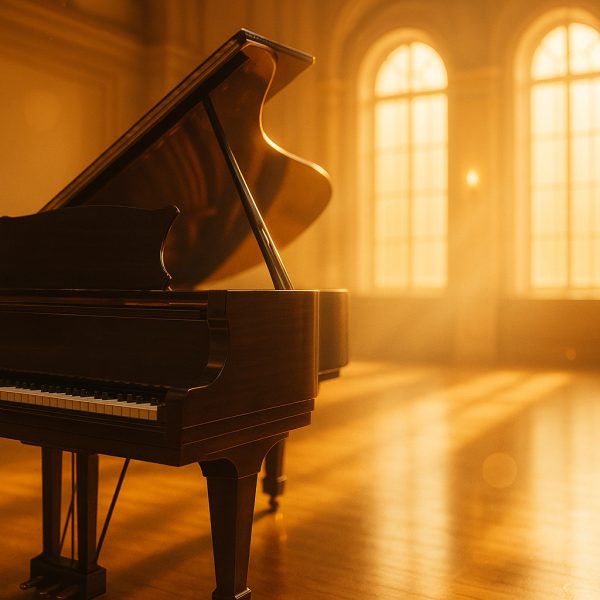
Piano Music
- Épisodes
- 70
- Parution
- hebdomadaire
- Dernier épisode
- 14 Nov 2026
À propos du podcast
Original Piano Music for the Soul
Épisodes 70
Recording 102
Recording 102 was finished on October 25. Parts for the version 5 LED bar prototype have arrived, and work on the album, Hallowed Be Your Name, is close to starting. It’s the full overhead take on the acoustic …
Notes de l’épisode
Recording 102 was finished on October 25. Parts for the version 5 LED bar prototype have arrived, and work on the album, Hallowed Be Your Name, is close to starting.
It’s the full overhead take on the acoustic piano with Piano VFX, mastered in 4K at 60 frames per second. The audio edition comes from that same master.
Recording 101
Recording 101 was finished on October 20. The hope is to begin work on the album, Hallowed Be Your Name, the week of October 26. It’s an overhead take on the acoustic piano with Piano VFX, mastered in 4K at 60 …
Notes de l’épisode
Recording 101 was finished on October 20. The hope is to begin work on the album, Hallowed Be Your Name, the week of October 26.
It’s an overhead take on the acoustic piano with Piano VFX, mastered in 4K at 60 frames per second, with the audio edition cut from the same master.
Recording 100
Recording 100 makes 30 recordings since the series relaunched in April. Like the others, it’s a full overhead take on the acoustic piano with Piano VFX, mastered in 4K at 60 frames per second, and the audio …
Notes de l’épisode
Recording 100 makes 30 recordings since the series relaunched in April.
Like the others, it’s a full overhead take on the acoustic piano with Piano VFX, mastered in 4K at 60 frames per second, and the audio edition is cut from that same master. Parts for the first version 5 LED bar test are still on the way.
Recording 99
Recording 99 is part of a push to record ahead, so there’s enough material scheduled to run through the end of November, including two weeks of work travel. It’s the full overhead take on the acoustic piano …
Notes de l’épisode
Recording 99 is part of a push to record ahead, so there’s enough material scheduled to run through the end of November, including two weeks of work travel.
It’s the full overhead take on the acoustic piano with Piano VFX, mastered in 4K at 60 frames per second. The audio edition is cut from that same master.
Recording 98
Recording 98 was played on version 4 of the LED bar, printed in transparent filament. It is brighter than the black bar, but the light spills onto neighboring keys, so the black bar is back in use until the …
Notes de l’épisode
Recording 98 was played on version 4 of the LED bar, printed in transparent filament. It is brighter than the black bar, but the light spills onto neighboring keys, so the black bar is back in use until the per-key version 5 design is built. That design needs a custom circuit board, which puts a prototype at least a month out.
As usual, this is the complete overhead performance on the acoustic piano with Piano VFX, delivered in 4K at 60 frames per second. The audio edition uses the same finished master and skips the short title card at the start.
Once enough episodes are scheduled to cover the weeks through mid-November, recording shifts to the album Hallowed Be Your Name.
Recording 97
Recording 97 is the first one since version 3 of the LED bar was finished. Version 4 is being printed in transparent filament for comparison, and a version 5 design with one focused LED per key is in early …
Notes de l’épisode
Recording 97 is the first one since version 3 of the LED bar was finished. Version 4 is being printed in transparent filament for comparison, and a version 5 design with one focused LED per key is in early testing.
The edit is the full overhead performance on the acoustic piano with Piano VFX, delivered at 3840×2160 and 60 frames per second. The audio edition comes from the same finished master, minus the opening title card.
Live streams will probably pause for the first two weeks of November because of work travel.
Recording 96
Recording 96 was finished during a week with no live streams. The streaming schedule is now seven weeks on and one week off, plus any week with work travel, and the next break falls the week of November 9th …
Notes de l’épisode
Recording 96 was finished during a week with no live streams. The streaming schedule is now seven weeks on and one week off, plus any week with work travel, and the next break falls the week of November 9th.
The edit is the full overhead performance on the acoustic piano with Piano VFX, delivered at 3840×2160 and 60 frames per second. The audio edition is cut from that same finished master and leaves out the opening title card.
Version 3 of the LED bar is still in progress and is on track for Recording 97.
Recording 95
Recording 95 is the first one made with version 2 of the LED bar over the keys. The bar puts more focused light on the hands, which helps on camera, but too much of it reflects off the keys. Version 3 is in …
Notes de l’épisode
Recording 95 is the first one made with version 2 of the LED bar over the keys. The bar puts more focused light on the hands, which helps on camera, but too much of it reflects off the keys. Version 3 is in progress with the bar angled at 45 degrees so the light falls onto the keys instead of across them.
The video keeps the overhead view of the acoustic piano with the Piano VFX treatment, mastered at 4K and 60 frames per second. The podcast audio is prepared from the finished source, without the video’s opening title card.
Editing is running ahead of schedule on purpose, to clear at least two weeks for album work next month.
Recording 94
I finished Recording 94 at the beginning of the week to make more room for album work. The video keeps the overhead view of the acoustic piano and the current Piano VFX treatment, with a 4K, 60-frame-per-second …
Notes de l’épisode
I finished Recording 94 at the beginning of the week to make more room for album work. The video keeps the overhead view of the acoustic piano and the current Piano VFX treatment, with a 4K, 60-frame-per-second master.
The physical LED bar is still a separate project. This week’s test fits focused on how the boards sit in their printed holders, the clearance around the piano keys, and where the light falls. I’m aiming to have the final version ready for Recording 95, after some live camera tests.
For this recording, the complete edited performance stays intact. The podcast audio is prepared separately from the finished source, without the video’s opening title card.
Recording 93
Recording 93 is a 4K/60 Disklavier set with Piano VFX over the real overhead piano. The source mornings were June 19 and June 22.
Recording 92
Recording 92 is the first weekly episode being prepared for 4K video delivery. The overhead piano footage and Piano VFX composite remain part of the finished Final Cut Pro master, now exported at 3840 × 2160 …
Notes de l’épisode
Recording 92 is the first weekly episode being prepared for 4K video delivery. The overhead piano footage and Piano VFX composite remain part of the finished Final Cut Pro master, now exported at 3840 × 2160 and 60 frames per second.
A new lens on the Canon provides the framing for the 4K setup, while an OBSBOT video conferencing camera adds another angle. Lighting adjustments continue around the MIDI-reactive LED strip. The latest printed parts for its replacement are finished, with assembly planned for the coming week.
Recording 91
After a lot of measuring, test prints, and revisions, the LED rail now has printed mounts and bar sections that work. That replaces the temporary metal ends. The next step is cartridge spacing. Each short …
Notes de l’épisode
After a lot of measuring, test prints, and revisions, the LED rail now has printed mounts and bar sections that work. That replaces the temporary metal ends.
The next step is cartridge spacing. Each short section has to aim its LEDs at the correct piano keys, and a few millimeters is enough to show up from the overhead camera. I am tuning one section at a time before committing to the full keyboard.
Recording 90
I got a 3D printer so I can replace the angle-iron ends with printed mounts that sit in the fallboard supports. The metal worked, but I never liked that hardware that close to the piano, even with felt tape. I …
Notes de l’épisode
I got a 3D printer so I can replace the angle-iron ends with printed mounts that sit in the fallboard supports. The metal worked, but I never liked that hardware that close to the piano, even with felt tape.
I also added a second LED strip. Fitting and reprinting took longer than I expected. The bar was out of commission for the first two morning streams. When it is on, it adds a really cool dynamic while I play.
Recording 89
First working LED rail. Removable aluminum bar in the existing fallboard supports — nothing glued to the finish or the keys. A Raspberry Pi reads the MIDI and drives per-key lights so the overhead camera can …
Notes de l’épisode
First working LED rail. Removable aluminum bar in the existing fallboard supports — nothing glued to the finish or the keys. A Raspberry Pi reads the MIDI and drives per-key lights so the overhead camera can show more of the shape in the playing.
First version, not the last. Next up: printed clips and baffles, and a cleaner power path for a second strip.
Recording 88
I spent this episode fighting Piano VFX drift. One MIDI timing issue is fixed, but a longer render still walks off the keys. The reliable fix is splitting the VFX layer by song in Final Cut and using Retime on …
Notes de l’épisode
I spent this episode fighting Piano VFX drift. One MIDI timing issue is fixed, but a longer render still walks off the keys. The reliable fix is splitting the VFX layer by song in Final Cut and using Retime on each section. That adds another two or three hours.
New effects this week, less flame, more around the notes. After Disklavier listen tests I also limited release-velocity edits to tight repeated notes with the pedal down. The rest of the performance stays untouched.
Recording 87
Seven pieces from May 28 through June 2. New camera: much closer to true overhead, more keyboard in the frame, the inside of the Yamaha C7 visible. I had to pull the keyboard cover. The front lip hid the key …
Notes de l’épisode
Seven pieces from May 28 through June 2. New camera: much closer to true overhead, more keyboard in the frame, the inside of the Yamaha C7 visible.
I had to pull the keyboard cover. The front lip hid the key tops from that angle, especially with falling notes. Only my hands are in the shot now.
Recording 86
Seven pieces from May 25–28. First episode with Piano VFX all the way into the finished video: real overhead piano underneath, falling notes composited in Final Cut so they follow what I actually played. Dark …
Notes de l’épisode
Seven pieces from May 25–28. First episode with Piano VFX all the way into the finished video: real overhead piano underneath, falling notes composited in Final Cut so they follow what I actually played. Dark background, keyboard mask, and edges took some work.
I also moved the production desk off a single-vendor app so I can switch models without rebuilding the workflow.
Recording 85
Six pieces from May 21 and May 25. I took 56 of my own past edits and had the production model try the first timing pass instead of Smart Tempo. Through the middle of a song it now matches my hand edits almost …
Notes de l’épisode
Six pieces from May 21 and May 25. I took 56 of my own past edits and had the production model try the first timing pass instead of Smart Tempo. Through the middle of a song it now matches my hand edits almost note for note.
It still misses the big feel changes, so it’s on the shelf. It keeps learning from the episodes I still edit myself.
Recording 84
Five pieces from May 19–20. I recorded this back-to-back with the previous episode in one sitting so two weeks would already be in the queue.
Recording 83
Five pieces from May 15–19. Recorded as part of working ahead. No new camera or MIDI change this week.
Recording 82
Six pieces from May 13–18. A quieter production week. Same compile: morning streams cleaned up into one listen.
Recording 81
Six pieces from May 11–13. The change you can hear is the sustain pedal. When timing gets stretched, the tiny gap where the pedal lifts can collapse and the next chord lands dry. That cleanup is automatic now …
Notes de l’épisode
Six pieces from May 11–13. The change you can hear is the sustain pedal. When timing gets stretched, the tiny gap where the pedal lifts can collapse and the next chord lands dry.
That cleanup is automatic now. Nearly four hundred late lifts on this episode, with the deliberate pauses left alone.
Recording 80
Six pieces from May 6–8. The real ship this week is chapters on everything. Streams get song names. Spontaneous pieces are labeled Selah in the key they live in. Podcast chapters point back to the exact morning …
Notes de l’épisode
Six pieces from May 6–8. The real ship this week is chapters on everything. Streams get song names. Spontaneous pieces are labeled Selah in the key they live in. Podcast chapters point back to the exact morning they came from.
I rolled that through the back catalog too, so the rough take and the cleaned take stay linked.
Recording 79
Seven pieces this week, from four mornings (April 30 through May 5). I recorded it a week early so I can keep a couple of episodes in the queue. For the live-room clips I switched from glasses-only POV to a …
Notes de l’épisode
Seven pieces this week, from four mornings (April 30 through May 5). I recorded it a week early so I can keep a couple of episodes in the queue.
For the live-room clips I switched from glasses-only POV to a split view with a locked camera. The head motion was hard to watch for more than a few seconds.
Recording 78
A short week on the bench. Same compile of the morning streams into one listen. No new instrument or camera work to report.
Recording 77
More distribution than piano this week. There’s a 24/7 shuffled replay of past sessions on Twitch, and the same playlist on Rumble: continuous piano, no commentary, new order each day. The weekday morning …
Notes de l’épisode
More distribution than piano this week. There’s a 24/7 shuffled replay of past sessions on Twitch, and the same playlist on Rumble: continuous piano, no commentary, new order each day.
The weekday morning stream stays at 6:00 AM CT.
Recording 76
Not a gear week. The record-to-publish path is finally routine, which is the point — I spent more time on music than on workflow. I also had a scheduler bug that posted the same clip twice. Deleting the …
Notes de l’épisode
Not a gear week. The record-to-publish path is finally routine, which is the point — I spent more time on music than on workflow.
I also had a scheduler bug that posted the same clip twice. Deleting the scheduled item did not cancel the job. There’s a trap now that pulls the duplicate within a couple of minutes.
Recording 75
I had to re-record this episode. While adding an auto-switching scene — overhead keys versus FaceTime — I found the piano mics sitting on the overhead scene and in the global mix. They were doubled. Soft …
Notes de l’épisode
I had to re-record this episode. While adding an auto-switching scene — overhead keys versus FaceTime — I found the piano mics sitting on the overhead scene and in the global mix. They were doubled. Soft passages can actually be soft now.
Same week I found Logic Smart Tempo crushing Disklavier sustain. After I simplify a pedal press to about seven CC64 events, Smart Tempo can squash the release into under 15 ms and kill the chord tail. A small fix widens those ramps back to about 60 ms.
Recording 74
Same compile as last week: morning streams stitched into one listen, still about two weeks behind the calendar. That’s fine. The weekly ship matters more than which days the tape came from. On the live-room …
Notes de l’épisode
Same compile as last week: morning streams stitched into one listen, still about two weeks behind the calendar. That’s fine. The weekly ship matters more than which days the tape came from.
On the live-room side I finished a cutover from analog (MainStage to an Apogee box to analog runs to the board) to Dante end to end. Keys stay digital the whole way, and I can record the mix plus an isolated keys track into Logic. The live clips should come out a lot cleaner.
Recording 73
This week was Logic Pro’s Auto Tempo. I don’t play to a click, so Disklavier MIDI used to land off the grid and eat a full day of dragging notes. Auto Tempo listens to what I played and bends the project tempo …
Notes de l’épisode
This week was Logic Pro’s Auto Tempo. I don’t play to a click, so Disklavier MIDI used to land off the grid and eat a full day of dragging notes. Auto Tempo listens to what I played and bends the project tempo to match.
I haven’t run a whole episode through it yet, but I’m estimating it cuts the 8-hour MIDI floor down to about 3–4 hours. The publish steps (trim, intro card, encode, MP3, site, social) are scripted now. Auto Tempo is the real time saver. The rest just keeps publish from becoming the new bottleneck.
Voici les 40 derniers épisodes sur 70. Les épisodes plus anciens se trouvent dans le flux du podcast.
C’est votre podcast ?
Confirmez-le avec une entrée dans votre flux : vous recevez ici un code, vous l’ajoutez comme podcast:txt dans le canal de votre flux, et nous le vérifions. Votre podcast apparaît ensuite comme « vérifié » sur SoundNode.