

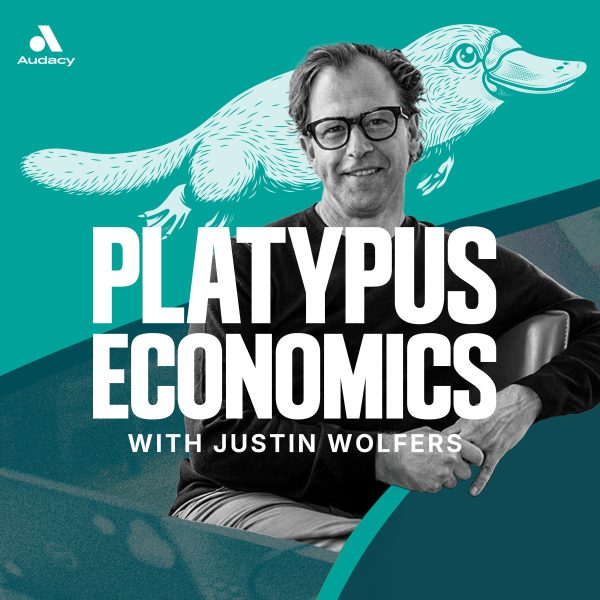
Platypus Economics with Justin Wolfers
- Épisodes
- 158
- Parution
- quotidienne
- Dernier épisode
- 14 Nov 2026
À propos du podcast
From world events to everyday decisions, economics explains it all. Platypus Economics makes it clear, useful, and actually fun.
Épisodes 158
Huang Out, Robots In and the Real Cost of Thanksgiving | Off The Clock
Nvidia lost its CEO this week, and about $600 billion in value went with him. With every new report about Jensen Huang, from an alleged affair with a suspected Chinese spy to two more alleged affairs, the stock …
Notes de l’épisode
Nvidia lost its CEO this week, and about $600 billion in value went with him. With every new report about Jensen Huang, from an alleged affair with a suspected Chinese spy to two more alleged affairs, the stock fell again. Justin Wolfers and Stacey Vanek Smith unpack what happens when a $4.5 trillion company has no succession plan, and whether one man’s private life can really shake the whole AI economy. Then Stacey brings back a dispatch from China, where she beat a humanoid robot at rock, paper, scissors and saw a very different bet on AI. Plus the real cost of Thanksgiving, and the winner of our Halloween costume contest.
Subscribe:
on YouTube 👉 https://youtube.com/platypuseconomics
on Substack 👉 https://newsletter.platypuseconomics.com
the Podcast 👉 https://platypuseconomics.com/podcast
Follow on Social Media @PlatypusEconomics and @JustinWolfersThe Most Expensive Shag in the History of Humanity | The Professor Is In
Why can Nvidia stock fall even when its chips haven't changed?Justin Wolfers explains how leadership risk, succession planning, and corporate governance shape expectations of future profits. Using Nvidia stock …
Notes de l’épisode
Why can Nvidia stock fall even when its chips haven't changed?
Justin Wolfers explains how leadership risk, succession planning, and corporate governance shape expectations of future profits. Using Nvidia stock as the case study, he shows why knowing a risk exists isn't the same as knowing what happens when it materializes. If you own shares through a mutual fund or 401(k), a board's planning failures can affect the value of your retirement savings.
He also tackles the idea that a market decline is “just a paper loss”: shares represent a claim on future profits, not simply pieces of paper moving around Wall Street. You'll learn how concentrated corporate power raises questions about prices, efficiency, and political influence—and why antitrust law distinguishes being a monopoly from illegally monopolizing a market.
The breaking-news allegations and loss estimates discussed in this recording have not been independently verified and should not be treated as established facts.
Diversify your feed without calling your broker—subscribe:
on YouTube 👉 https://youtube.com/platypuseconomics
on Substack 👉 https://newsletter.platypuseconomics.com
the Podcast 👉 https://platypuseconomics.com/podcast
Follow on Social Media @PlatypusEconomics and @JustinWolfers
Thanks, Jensen: The Affair That Cost You $2,000 | Diving In
Jensen Huang’s weekend scandal didn’t just cost Nvidia. It cost you. After reports that the CEO was targeted by a foreign intelligence effort, and his admission of an extramarital affair, Nvidia shed hundreds …
Notes de l’épisode
Jensen Huang’s weekend scandal didn’t just cost Nvidia. It cost you. After reports that the CEO was targeted by a foreign intelligence effort, and his admission of an extramarital affair, Nvidia shed hundreds of billions in value while the rest of the market rallied. Justin Wolfers follows that money into American households and finds a loss of nearly $2,000 per home, about the size of a COVID stimulus check, running in reverse. But that average hides a twist in who’s really paying, and a bigger question: how did one man’s private life get the power to move American wealth on the scale of an act of Congress?
Subscribe:
on YouTube 👉 https://youtube.com/platypuseconomics
on Substack 👉 https://newsletter.platypuseconomics.com
the Podcast 👉 https://platypuseconomics.com/podcastFollow on Social Media @PlatypusEconomics and @JustinWolfers
The October Inflation Report Explains That Sinking Feeling | Diving In
October 2026 CPI inflation is about 4%—here's why it's an estimate, and why it matters.Justin Wolfers unpacks an October inflation report with a missing headline: last year's government shutdown left no October …
Notes de l’épisode
October 2026 CPI inflation is about 4%—here's why it's an estimate, and why it matters.
Justin Wolfers unpacks an October inflation report with a missing headline: last year's government shutdown left no October 2025 price reading. He fills that gap using September and November data to estimate annual inflation at about 4%, up from 3.7% in September. Prices rose 0.4% this month, while core prices, excluding food and energy, rose 0.3%—both hotter than markets expected.
Subscribe:
on YouTube 👉 https://youtube.com/platypuseconomics
on Substack 👉 https://newsletter.platypuseconomics.com
the Podcast 👉 https://platypuseconomics.com/podcast
Follow on Social Media @PlatypusEconomics and @JustinWolfers
Elon Musk Lost Far More Than $474 Million | Diving In
Elon Musk’s $474 million in midterm spending looks enormous—until you compare it with what he had riding on the result. On Diving In, Justin Wolfers estimates that Musk’s Tesla and SpaceX holdings lost roughly …
Notes de l’épisode
Elon Musk’s $474 million in midterm spending looks enormous—until you compare it with what he had riding on the result. On Diving In, Justin Wolfers estimates that Musk’s Tesla and SpaceX holdings lost roughly $70 billion relative to their expected market performance. He flags the uncertainty, especially around SpaceX, and distinguishes the election-night surprise from the much larger financial stakes across different congressional outcomes.
Subscribe:
on YouTube 👉 https://youtube.com/platypuseconomics
on Substack 👉 https://newsletter.platypuseconomics.com
the Podcast 👉 https://platypuseconomics.com/podcast
Follow on Social Media @PlatypusEconomics and @JustinWolfers
Why Justin Is More Upbeat About the Economy | The Professor Is In
What does the October jobs report mean for your paycheck and your next career move?Your next raise may depend on your alternatives, not just your loyalty. Justin shows how outside offers create bargaining …
Notes de l’épisode
What does the October jobs report mean for your paycheck and your next career move?
Your next raise may depend on your alternatives, not just your loyalty. Justin shows how outside offers create bargaining power, why employers can reward good work without waiting for a resignation threat, and how scarce AI skills can give you leverage. If your employer isn’t valuing you, his advice is to look elsewhere.
No outside offer needed to get more economics—subscribe:
on YouTube 👉 https://youtube.com/platypuseconomics
on Substack 👉 https://newsletter.platypuseconomics.com
the Podcast 👉 https://platypuseconomics.com/podcast
Follow on Social Media @PlatypusEconomics and @JustinWolfers
What Does October’s Jobs Report Really Tell Us? | Diving In
The October jobs report delivered 165,000 new payroll jobs against forecasts of just 60,000. On Diving In, Justin Wolfers explains why that surprise—and upward revisions lifting the three-month average to …
Notes de l’épisode
The October jobs report delivered 165,000 new payroll jobs against forecasts of just 60,000. On Diving In, Justin Wolfers explains why that surprise—and upward revisions lifting the three-month average to 137,000—points to an improving labor market.
Subscribe:
on YouTube 👉 https://youtube.com/platypuseconomics
on Substack 👉 https://newsletter.platypuseconomics.com
the Podcast 👉 https://platypuseconomics.com/podcast
Follow on Social Media @PlatypusEconomics and @JustinWolfers
Blue Wave Economics | The Professor Is In
What did the midterm elections reveal about the economy—and your household budget?Justin Wolfers examines the Democratic sweep through a puzzle: how can the economy grow while people feel so anxious? He …
Notes de l’épisode
What did the midterm elections reveal about the economy—and your household budget?
Justin Wolfers examines the Democratic sweep through a puzzle: how can the economy grow while people feel so anxious? He contrasts GDP growth of 3.4% at an annual rate with record-low University of Michigan consumer sentiment. His argument is that distrust of economic leadership helps explain the gap—and the vote against the party in power. He also explains what prediction markets saw coming, and why picking the winner doesn't necessarily make a poll accurate.
Subscribe:
on YouTube 👉 https://youtube.com/platypuseconomics
on Substack 👉 https://newsletter.platypuseconomics.com
the Podcast 👉 https://platypuseconomics.com/podcast
Follow on Social Media @PlatypusEconomics and @JustinWolfers
The Hidden Feedback Loop Behind Rising Prices | The Professor Is In
Why did the Fed hold interest rates, and what is it waiting for?Justin Wolfers makes a crucial distinction about the Fed’s decision to hold interest rates: there can be a strong case for delaying a hike, but …
Notes de l’épisode
Why did the Fed hold interest rates, and what is it waiting for?
Justin Wolfers makes a crucial distinction about the Fed’s decision to hold interest rates: there can be a strong case for delaying a hike, but waiting to see September’s hike in next month’s inflation numbers is a weak one. Monetary policy works with delays, and a quarter-point move is hard to isolate amid everything else happening in the economy.
For a little less forward silence in your feed, subscribe:
on YouTube 👉 https://youtube.com/platypuseconomics
on Substack 👉 https://newsletter.platypuseconomics.com
the Podcast 👉 https://platypuseconomics.com/podcast
Follow on Social Media @PlatypusEconomics and @JustinWolfers
America's Jekyll-and-Hyde Economy | Off The Clock
The economy is growing — so why does your paycheck feel like it's shrinking?GDP is up 3.4%, unemployment is near record lows, the stock market keeps hitting highs — and yet it doesn't feel good. On this …
Notes de l’épisode
The economy is growing — so why does your paycheck feel like it's shrinking?
GDP is up 3.4%, unemployment is near record lows, the stock market keeps hitting highs — and yet it doesn't feel good. On this Halloween episode of Off the Clock, Justin Wolfers and journalist Stacey Vanek Smith dig into the "Jekyll and Hyde economy," where the pie is growing but a bigger slice is going to owners instead of workers.
Subscribe:
on YouTube 👉 https://youtube.com/platypuseconomics
on Substack 👉 https://newsletter.platypuseconomics.com
the Podcast 👉 https://platypuseconomics.com/podcast
Follow on Social Media @PlatypusEconomics and @JustinWolfers
What the New GDP Report Actually Says | Diving In
GDP grew 3.4% last quarter — so why does inflation still hurt? Justin Wolfers untangles it.The last big data dump before the 2026 midterms just landed, and it's a tangle: GDP grew at a 3.4% annualized rate last …
Notes de l’épisode
GDP grew 3.4% last quarter — so why does inflation still hurt? Justin Wolfers untangles it.
The last big data dump before the 2026 midterms just landed, and it's a tangle: GDP grew at a 3.4% annualized rate last quarter — faster than forecasters expected — while the Fed's preferred inflation gauge is still running hot. In this Diving In episode, Justin Wolfers walks you through why both political parties can grab accurate numbers and tell you completely opposite stories.
Subscribe:
on YouTube 👉 https://youtube.com/platypuseconomics
on Substack 👉 https://newsletter.platypuseconomics.com
the Podcast 👉 https://platypuseconomics.com/podcast
Follow on Social Media @PlatypusEconomics and @JustinWolfers
Did the Midterms Delay a Fed Rate Hike? | Diving In
Why did the Fed hold interest rates steady when inflation is still above 2%?Inflation is running hot by every measure — PCE at 3.4%, core at 3.0%, and the CPI that tracks your actual cost of living at 3.7% — …
Notes de l’épisode
Why did the Fed hold interest rates steady when inflation is still above 2%?
Inflation is running hot by every measure — PCE at 3.4%, core at 3.0%, and the CPI that tracks your actual cost of living at 3.7% — yet the Federal Reserve just chose to do nothing. Justin Wolfers walks you through what that decision means for your money, and admits up front he's a little puzzled too. Markets put an 85% chance on a rate hike in December, so what the Fed really did was delay a move almost everyone agrees is coming.
Subscribe:
on YouTube 👉 https://youtube.com/platypuseconomics
on Substack 👉 https://newsletter.platypuseconomics.com
the Podcast 👉 https://platypuseconomics.com/podcast
Follow on Social Media @PlatypusEconomics and @JustinWolfers
The Dilemma Behind Debunking Trump | The Professor Is In
President Trump brags that he's brought $21 trillion in new investment into America. Justin Wolfers already debunked that number (the White House's own list only reaches $11.3 trillion), so in this office-hours …
Notes de l’épisode
President Trump brags that he's brought $21 trillion in new investment into America. Justin Wolfers already debunked that number (the White House's own list only reaches $11.3 trillion), so in this office-hours episode he answers your questions about what that claim would even mean if it were true.
Subscribe:
on YouTube 👉 https://youtube.com/platypuseconomics
on Substack 👉 https://newsletter.platypuseconomics.com
the Podcast 👉 https://platypuseconomics.com/podcast
Follow on Social Media @PlatypusEconomics and @JustinWolfers
What Is The State of Your Economy?
Why do strong economic numbers feel so bad? Justin Wolfers says there are three economies, not one.Unemployment is 4.2%, the stock market is near a record, and GDP is growing — so why does your grocery bill …
Notes de l’épisode
Why do strong economic numbers feel so bad? Justin Wolfers says there are three economies, not one.
Unemployment is 4.2%, the stock market is near a record, and GDP is growing — so why does your grocery bill, your rent, and your fill-up tell a different story? In this live call-in on NPR's The Middle with Jeremy Hobson, economist Justin Wolfers gives the economy three grades at once: an A if you own stock and a company, a B if you look at the lived reality of regular folks, and a C for how people actually feel — consumer sentiment at the lowest level ever recorded. The puzzle isn't a mystery, he argues: the share of Americans who think economic management is poor beats the share who think it's good by 66 points, an all-time high.
From Justin's conversation with Jeremy Hobson on NPR's The Middle, alongside CNBC's Steve Leisman.
Chapters:
Subscribe:
on YouTube 👉 https://youtube.com/platypuseconomics
on Substack 👉 https://newsletter.platypuseconomics.com
the Podcast 👉 https://platypuseconomics.com/podcast
Follow on Social Media @PlatypusEconomics and @JustinWolfers
Trump Says $21 Trillion Is Coming. Is It? | Diving In
President Trump says he’s brought $21 trillion of new investment into America since taking office. Sometimes it’s $18 trillion, sometimes $22 trillion. The exact figure isn’t the problem. All of them are wrong …
Notes de l’épisode
President Trump says he’s brought $21 trillion of new investment into America since taking office. Sometimes it’s $18 trillion, sometimes $22 trillion. The exact figure isn’t the problem. All of them are wrong, by a lot.
In this episode, Justin Wolfers gives you the questions you need to ask to test any huge number.
🎃 Enter our first-ever econ-themed Halloween costume contest by November 1 for a chance to win a limited-edition Gus the Platypus pillow: https://platypuseconomics.com/halloween
Subscribe:
on YouTube 👉 https://youtube.com/platypuseconomics
on Substack 👉 https://newsletter.platypuseconomics.com
the Podcast 👉 https://platypuseconomics.com/podcastFollow on Social Media @PlatypusEconomics and @JustinWolfers
Why Americans Don't Believe the Good Economic News | The Professor Is In
Unemployment is low, inflation has cooled, and by most hard numbers the economy is doing okay — yet Americans sound miserable. Consumer sentiment this summer sat at 52, roughly where it was in May 1980, when …
Notes de l’épisode
Unemployment is low, inflation has cooled, and by most hard numbers the economy is doing okay — yet Americans sound miserable. Consumer sentiment this summer sat at 52, roughly where it was in May 1980, when unemployment was nearly twice as high and inflation was running around 14%. Justin Wolfers thinks he's cracked the puzzle: the 30-point gap between how you feel and how the economy is actually performing lines up almost exactly with how little Americans trust the people running economic policy right now.
In this office-hours episode, producer Augusta Chapman tries to poke holes in that story, and Justin defends it. Does the gloom cause the distrust, or the other way around? Does sentiment even matter if you keep spending anyway?
Subscribe:
on YouTube 👉 https://youtube.com/platypuseconomics
on Substack 👉 https://newsletter.platypuseconomics.com
the Podcast 👉 https://platypuseconomics.com/podcast
Follow on Social Media @PlatypusEconomics and @JustinWolfers
Don’t Be Fooled by Trump’s Diesel Gimmicks | The Professor Is In
Tax-free red dye diesel won't make a single extra drop — so who really pays for it?President Trump signed an executive order letting truckers fill up with red dye diesel — the cheaper, untaxed fuel normally …
Notes de l’épisode
Tax-free red dye diesel won't make a single extra drop — so who really pays for it?
President Trump signed an executive order letting truckers fill up with red dye diesel — the cheaper, untaxed fuel normally reserved for tractors and bulldozers — and the White House says it'll save truckers about $60 a tank. In this "Professor Is In" episode, Justin Wolfers and producer Augusta Chapman take your questions and show why the tax-free diesel policy creates no new fuel at all. There's only so much diesel in the world, so every gallon truckers gain, farmers lose.
Subscribe:
on YouTube 👉 https://youtube.com/platypuseconomics
on Substack 👉 https://newsletter.platypuseconomics.com
the Podcast 👉 https://platypuseconomics.com/podcast
Follow on Social Media @PlatypusEconomics and @JustinWolfers
What Halloween Candy Reveals About Inflation | Off the Clock
Why is inflation rising faster than your wages? It's a cost-push energy shock, not the good kind.Justin Wolfers and Bloomberg's Stacey Vanek Smith dig into the latest inflation report on Off the Clock, and the …
Notes de l’épisode
Why is inflation rising faster than your wages? It's a cost-push energy shock, not the good kind.
Justin Wolfers and Bloomberg's Stacey Vanek Smith dig into the latest inflation report on Off the Clock, and the news isn't fun: prices are climbing 3.7% while wages crawl along at 3%, which means the average American — maybe you — is quietly falling behind. Justin walks through the difference between demand-pull inflation (the economy runs hot, prices rise, but your paycheck rises too) and cost-push inflation (energy and tariffs push costs up, prices rise, and nobody hands you a raise). Guess which one we're living through.
Along the way, Justin grades new Fed chair Kevin Warsh (forecasters gave him a shaky report card), explains why computers are suddenly getting pricier again, and announces the first-ever Platypus Economics Halloween costume contest.
Subscribe:
on YouTube 👉 https://youtube.com/platypuseconomics
on Substack 👉 https://newsletter.platypuseconomics.com
the Podcast 👉 https://platypuseconomics.com/podcast
Follow on Social Media @PlatypusEconomics and @JustinWolfers
Why Official Inflation Can Seem Too Low | The Professor Is In
Prices rose 3.7% over the past year, core inflation is stuck around 2.6%, and your paycheck is buying less than it used to — yet it feels like everything costs way more than that. Economist Justin Wolfers sits …
Notes de l’épisode
Prices rose 3.7% over the past year, core inflation is stuck around 2.6%, and your paycheck is buying less than it used to — yet it feels like everything costs way more than that. Economist Justin Wolfers sits down with producer Augusta Chapman for office-hours-style answers to your questions: why your gut says prices doubled.
Subscribe:
on YouTube 👉 https://youtube.com/platypuseconomics
on Substack 👉 https://newsletter.platypuseconomics.com
the Podcast 👉 https://platypuseconomics.com/podcast
Follow on Social Media @PlatypusEconomics and @JustinWolfers
The Latest Inflation Report, Explained | Diving In
The latest inflation report just dropped, and Justin Wolfers digs into why it's worse than Wall Street expected. Headline inflation came in at an eye-popping 3.7% — well above the Fed's 2% target — and core …
Notes de l’épisode
The latest inflation report just dropped, and Justin Wolfers digs into why it's worse than Wall Street expected. Headline inflation came in at an eye-popping 3.7% — well above the Fed's 2% target — and core inflation is stuck above 2.6%. The really worrying part is the latest month: prices rose 0.6% in a single month, and whatever momentum was pulling inflation back toward normal seems to have vanished.
Subscribe:
on YouTube 👉 https://youtube.com/platypuseconomics
on Substack 👉 https://newsletter.platypuseconomics.com
the Podcast 👉 https://platypuseconomics.com/podcast
Follow on Social Media @PlatypusEconomics and @JustinWolfers
The Hidden Force Dragging Down Consumer Sentiment | Diving In
Americans feel almost exactly as gloomy today as they did in 1980 — when inflation was near 14% and unemployment was close to 8%. Today those numbers are a fraction of that, yet consumer sentiment hit an …
Notes de l’épisode
Americans feel almost exactly as gloomy today as they did in 1980 — when inflation was near 14% and unemployment was close to 8%. Today those numbers are a fraction of that, yet consumer sentiment hit an all-time low. Justin Wolfers treats this like a detective case: the standard economic statistics predict sentiment should sit around 82, but the actual reading is 52 — a 30-point gap begging for an explanation.
Subscribe:
on YouTube 👉 https://youtube.com/platypuseconomics
on Substack 👉 https://newsletter.platypuseconomics.com
the Podcast 👉 https://platypuseconomics.com/podcast
Follow on Social Media @PlatypusEconomics and @JustinWolfers
The Nobel-Winning Insight That Made Spending Hard to Predict | Diving In
Why Robert Hall and Michael Woodford won the 2026 Nobel Prize in Economics — explained simply. This morning Robert Hall and Michael Woodford won the 2026 Nobel Prize in Economics, and Justin Wolfers couldn't …
Notes de l’épisode
Why Robert Hall and Michael Woodford won the 2026 Nobel Prize in Economics — explained simply.
This morning Robert Hall and Michael Woodford won the 2026 Nobel Prize in Economics, and Justin Wolfers couldn't wait to explain what they figured out — and why it touches how much you spend every month. By the end of the episode you'll understand why your next big purchase hinges more on what you think is coming than on what's in your bank account today, how modern macro got built, and why this is the way we all teach and read the economy now.
Subscribe:
on YouTube 👉 https://youtube.com/platypuseconomics
on Substack 👉 https://newsletter.platypuseconomics.com
Follow on Social Media @PlatypusEconomics and @JustinWolfers
The G7’s 100 Million Barrel Announcement Changes Nothing | The Professor Is In
Justin Wolfers takes apart a headline that circled the globe: the G7 announcing it will release 100 million barrels of oil it had already promised to release back in March 2026. On this episode of Diving In …
Notes de l’épisode
Justin Wolfers takes apart a headline that circled the globe: the G7 announcing it will release 100 million barrels of oil it had already promised to release back in March 2026. On this episode of Diving In, producer Augusta Chapman brings him your questions, office-hours style, and Justin explains why a press release dressed up as a deal does nothing to lower the price you pay at the pump.
Subscribe:
on YouTube 👉 https://youtube.com/platypuseconomics
on Substack 👉 https://newsletter.platypuseconomics.com
the Podcast 👉 https://platypuseconomics.com/podcast
Follow on Social Media @PlatypusEconomics and @JustinWolfers
Trump's Red Diesel Order, Explained | Diving In
Justin Wolfers digs into President Trump's new executive order letting truckers fill up with red diesel — the tax-free fuel normally reserved for farmers, construction crews, and miners — and deferring the …
Notes de l’épisode
Justin Wolfers digs into President Trump's new executive order letting truckers fill up with red diesel — the tax-free fuel normally reserved for farmers, construction crews, and miners — and deferring the 24.4-cent federal highway tax until after the election. The White House says it'll save a trucker about $60 a fill-up. But diesel hit a record $6.52 a gallon a few weeks ago, and this order doesn't create a single new drop of it.
Subscribe:
on YouTube 👉 https://youtube.com/platypuseconomics
on Substack 👉 https://newsletter.platypuseconomics.com
the Podcast 👉 https://platypuseconomics.com/podcast
Follow on Social Media @PlatypusEconomics and @JustinWolfers
This Oil Deal Sounds Huge. Until You Do the Math | Diving In
Trump calls it a massive win: 100 million barrels of emergency oil and fuel released to bring diesel prices down. In this episode of Diving In, Justin Wolfers reads the G7 communique line by line and finds …
Notes de l’épisode
Trump calls it a massive win: 100 million barrels of emergency oil and fuel released to bring diesel prices down. In this episode of Diving In, Justin Wolfers reads the G7 communique line by line and finds something much smaller — an agreement to finally deliver on a release already promised back in March, in exchange for the US dropping a diesel export ban it should never have threatened.
Subscribe:
on YouTube 👉 https://youtube.com/platypuseconomics
on Substack 👉 https://newsletter.platypuseconomics.com
the Podcast 👉 https://platypuseconomics.com/podcast
Follow on Social Media @PlatypusEconomics and @JustinWolfers
Why the Jobs Report Keeps Changing | The Professor Is In
The September jobs report landed weak, and the numbers for July and August got quietly revised downward. Economist Justin Wolfers takes your questions on what that actually means — and why a statistical agency …
Notes de l’épisode
The September jobs report landed weak, and the numbers for July and August got quietly revised downward. Economist Justin Wolfers takes your questions on what that actually means — and why a statistical agency that corrects itself is more trustworthy, not less.
Subscribe:
on YouTube 👉 https://youtube.com/platypuseconomics
on Substack 👉 https://newsletter.platypuseconomics.com
the Podcast 👉 https://platypuseconomics.com/podcast
Follow on Social Media @PlatypusEconomics and @JustinWolfers
Trump Wants Cheap Money. Why Are Rates Going Up Anyway?
What happens when a president wants lower interest rates—but the economy, inflation, and bond markets are all pushing the other way?In this episode of What Next with Mary Harris from Slate, Justin Wolfers …
Notes de l’épisode
What happens when a president wants lower interest rates—but the economy, inflation, and bond markets are all pushing the other way?
In this episode of What Next with Mary Harris from Slate, Justin Wolfers explains why the latest fight over interest rates is about much more than one Federal Reserve meeting.
Subscribe:
on YouTube 👉 https://youtube.com/platypuseconomics
on Substack 👉 https://newsletter.platypuseconomics.com
the Podcast 👉 https://platypuseconomics.com/podcast
Follow on Social Media @PlatypusEconomics and @JustinWolfers
Why Workers Are Getting Less of What the Economy Produces | Off The Clock
Justin Wolfers and Bloomberg columnist Stacey Vanek Smith slow down to unpack the one number that quietly shapes your paycheck: labor's share of income. For most of modern history, workers took home about …
Notes de l’épisode
Justin Wolfers and Bloomberg columnist Stacey Vanek Smith slow down to unpack the one number that quietly shapes your paycheck: labor's share of income. For most of modern history, workers took home about two-thirds of the pie. Today it's down to 53% — and the rest goes to the people who own the companies, not the ones who show up to work. Then the stakes get bigger.
Justin argues that past $100 million, the only thing money buys is power — and in an election decided by 115,000 votes, one billionaire's checkbook could theoretically swing thousands more. The same logic drives the AI question: the same technology makes your life utopian if you own the robot and dystopian if your boss does.
From the first-ever live edition of Off the Clock, recorded at Stanford.
Subscribe:
on YouTube 👉 https://youtube.com/platypuseconomics
on Substack 👉 https://newsletter.platypuseconomics.com
the Podcast 👉 https://platypuseconomics.com/podcast
Follow on Social Media @PlatypusEconomics and @JustinWolfers
What September's Employment Numbers Really Say | Diving In
The September jobs report landed with a thud: just 29,000 jobs created, well short of the 80,000–90,000 forecasters expected, with July and August both revised down and unemployment ticking up to 4.2%. In this …
Notes de l’épisode
The September jobs report landed with a thud: just 29,000 jobs created, well short of the 80,000–90,000 forecasters expected, with July and August both revised down and unemployment ticking up to 4.2%. In this episode of Diving In, Justin Wolfers walks you through why those numbers are disappointing by historical standards — yet why unemployment can still stay low and stable at the same time.
Then there's your paycheck. Wage growth has slumped to around 3% — slower than prices — so if you feel like you can't keep up, you're not imagining it. Justin explains what weak wages mean for the Fed, why a rate hike now looks more likely in December than October, and why Wall Street shrugged.
Subscribe:
on YouTube 👉 https://youtube.com/platypuseconomics
on Substack 👉 https://newsletter.platypuseconomics.com
the Podcast 👉 https://platypuseconomics.com/podcast
Follow on Social Media @PlatypusEconomics and @JustinWolfers
Are Your Financial Mistakes Making Someone Else Rich? | The Professor Is In
Every dollar you spend having your money actively managed by someone in a sports car is paying for that sports car. In this Professor Is In episode, Justin Wolfers takes questions after his keynote at …
Notes de l’épisode
Every dollar you spend having your money actively managed by someone in a sports car is paying for that sports car. In this Professor Is In episode, Justin Wolfers takes questions after his keynote at Stanford's Initiative for Financial Decision Making and lands on the core ideas he thinks every personal finance course must teach.
Subscribe:
on YouTube 👉 https://youtube.com/platypuseconomics
on Substack 👉 https://newsletter.platypuseconomics.com
the Podcast 👉 https://platypuseconomics.com/podcast
Follow on Social Media @PlatypusEconomics and @JustinWolfers
Voici les 40 derniers épisodes sur 158. Les épisodes plus anciens se trouvent dans le flux du podcast.
Podcasts similaires
Plus de podcasts : Éducation







C’est votre podcast ?
Confirmez-le avec une entrée dans votre flux : vous recevez ici un code, vous l’ajoutez comme podcast:txt dans le canal de votre flux, et nous le vérifions. Votre podcast apparaît ensuite comme « vérifié » sur SoundNode.