

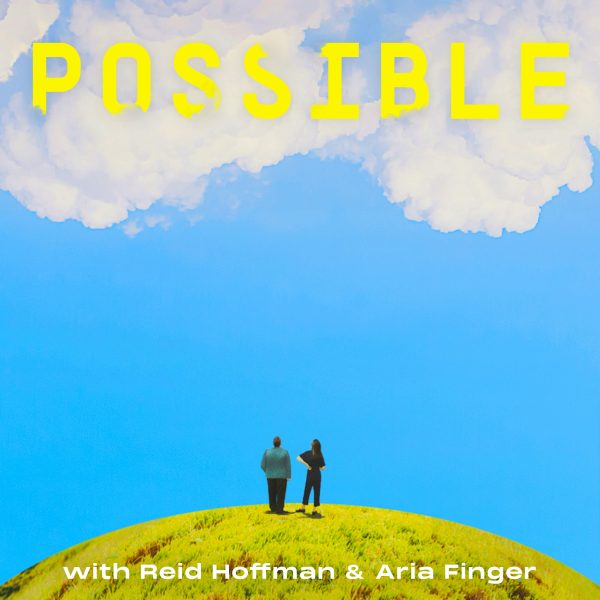
Possible with Reid Hoffman
- Épisodes
- 170
- Parution
- hebdomadaire
- Dernier épisode
- 18 Nov 2026
À propos du podcast
What if, in the future, everything breaks humanity's way? Possible is an award-winning, weekly podcast that sketches out the brightest version of the future—and what it will take to get there. Hosts Reid Hoffman and Aria Finger take that question to the people building the answer: founders, scientists, artists, and deep thinkers working across AI, healthcare, education, and geopolitics. The conversations run deep and specific, testing optimism against hard questions rather than trading hot takes. And between guest episodes, Reid riffs on the AI news that matters and what to make of it.
Épisodes 170
AI guardrails, data center demands, and the fight for jobs | Reid Hoffman
In a special live Reid Riffs from Masters of Scale Summit, Reid Hoffman and Aria Finger tackle rapid-fire questions in a new segment called “Pardon the Disruption.” Reid digs into steering the AI frontier …
Notes de l’épisode
In a special live Reid Riffs from Masters of Scale Summit, Reid Hoffman and Aria Finger tackle rapid-fire questions in a new segment called “Pardon the Disruption.” Reid digs into steering the AI frontier rather than slowing it, negotiating data center deals that benefit towns, and earning public trust amid AI job disruption. Manas AI co-founder Ujjwal Singh joins to explain how AI shrinks early drug discovery from years to weeks.
For more info on the podcast and transcripts of all the episodes, visit https://www.possible.fm/podcast/
OpenAI’s Chief Economist on AI, jobs, and the economy | Ronnie Chatterji
OpenAI chief economist Ronnie Chatterji joins Reid Hoffman and Aria Finger to unpack when AI will show up in the productivity statistics and what it means for jobs. Ronnie explains why the shift to AI agents is …
Notes de l’épisode
OpenAI chief economist Ronnie Chatterji joins Reid Hoffman and Aria Finger to unpack when AI will show up in the productivity statistics and what it means for jobs. Ronnie explains why the shift to AI agents is still early for most companies, why legal and HR teams may adopt fastest, and why he doubts AI will triple unemployment soon. They also discuss AI and entrepreneurship, the care economy, GDPval, and trade policy.
For more info on the podcast and transcripts of all the episodes, visit https://www.possible.fm/podcast/
Why Democrats won the 2026 midterms | Reid Hoffman
After Democrats win the House and Senate in the 2026 midterms, Reid Hoffman sees a clear demand: an economy that works for everyday Americans. He and Aria Finger examine Democratic breakthroughs in Texas and …
Notes de l’épisode
After Democrats win the House and Senate in the 2026 midterms, Reid Hoffman sees a clear demand: an economy that works for everyday Americans. He and Aria Finger examine Democratic breakthroughs in Texas and across the South, and what those candidates got right. Reid tackles the tension in his own political giving: why he keeps donating while backing efforts to get big money out of elections. They also discuss why Elon Musk’s spending fell short and what tech leaders who embraced the Trump administration must do to rebuild trust. From campaign donations to data centers, the conversation returns to one question: what are you doing for the American people?
For more info on the podcast and transcripts of all the episodes, visit https://www.possible.fm/podcast/
AI’s midterm coalitions, Anthropic’s safety bill, and VC conflicts
Reid Hoffman and Aria Finger weigh in on AI policy heading into the midterms, from Bernie Sanders and Greg Casar’s proposal to ban superintelligence to Anthropic’s own frontier AI safety bill. They map the …
Notes de l’épisode
Reid Hoffman and Aria Finger weigh in on AI policy heading into the midterms, from Bernie Sanders and Greg Casar’s proposal to ban superintelligence to Anthropic’s own frontier AI safety bill. They map the political coalitions forming around AI regulation, including a bipartisan push from Chris Murphy and Josh Hawley to hold developers liable when AI agents hack. Reid explains why pausing AI for a congressional process would be a mistake. He argues AI companies should work with any administration but stay transparent about political spending, and that government can borrow expertise through councils and working groups. He also makes the case for his dual mandate: keep America in the lead on AI while making sure it helps people now. They also examine Satya Nadella’s call to treat AI models as potential insider risks, the public feud between Factory and Cognition, and whether VCs can still back competing AI startups. Along the way, Reid uses water-cooler conversations to explore where company IP ends and human nature begins.
For more info on the podcast and transcripts of all the episodes, visit https://www.possible.fm/podcast/
Karpathy’s AI gap, free Adobe clones, and AI’s effect on persistence
What happens to software businesses when AI makes their products easier to recreate? Reid Hoffman and Aria Finger explore what a developer’s effort to rebuild seven Adobe apps with Claude means for software …
Notes de l’épisode
What happens to software businesses when AI makes their products easier to recreate? Reid Hoffman and Aria Finger explore what a developer’s effort to rebuild seven Adobe apps with Claude means for software pricing, competitive moats, and intellectual property. They also unpack Andrej Karpathy’s AI capability gap: why everyday users and researchers inside frontier labs have very different views of what AI can do. Then, they examine a randomized study showing that brief AI assistance caused—not just correlated with—reduced persistence after that help was removed. Reid makes the case for AI as a cognitive exoskeleton—and for designing tools that build grit alongside capability.
For more info on the podcast and transcripts of all the episodes, visit https://www.possible.fm/podcast/
Why Americans are so worried about AI
Only 36% of AI-aware Americans expect AI to mostly help their country, according to a Gallup and Microsoft survey. Reid traces that unease to three forces: fear that the future will be worse than the present …
Notes de l’épisode
Only 36% of AI-aware Americans expect AI to mostly help their country, according to a Gallup and Microsoft survey. Reid traces that unease to three forces: fear that the future will be worse than the present (which AI amplifies when prosperity has not reached much of the country), an instinct to protect what Americans have, and doubts about who will share in AI’s gains. With Aria Finger, he makes the case for winning at AI while spreading its prosperity, including through AI and robotics in manufacturing. They also examine HackerRank’s Chakra AI interviewer and why hiring should remain a team decision. Finally, OpenAI’s plan to test visual ads in ChatGPT raises another question: can a free AI assistant earn trust while carrying advertising? Reid calls for a clear separation between ads and answers, enforceable commitments, and third-party audits.
For more info on the podcast and transcripts of all the episodes, visit https://www.possible.fm/podcast/
Building safety tools no one can take away with ROOST’s Camille François
Protecting people online shouldn’t depend on whether a company keeps its safety tools effective, affordable, and available. ROOST founding president Camille François joins Reid Hoffman and Aria Finger to …
Notes de l’épisode
Protecting people online shouldn’t depend on whether a company keeps its safety tools effective, affordable, and available. ROOST founding president Camille François joins Reid Hoffman and Aria Finger to explain how a nonprofit is turning trust and safety into shared infrastructure. She digs into why social media was a blip in how we build tech, what Discord did after Twitter bought Smyte and shut it down, and how two people running a fandom app caught 19 cases of child exploitation in two weeks. A daycare switching its Alexa wake word to "computer" becomes a lesson in how the next generation should relate to machines. They also examine why policy without tools is ineffective, how a shared safety commons helps startups compete, and what it will take to make safety as invisible as encryption.
Who gets to pull the plug on AI?
Reid Hoffman sees promise in an AI buildout and wants its financial risks in the open. He and Aria Finger unpack a Financial Times report on up to $300 billion in AI infrastructure guarantees largely absent …
Notes de l’épisode
Reid Hoffman sees promise in an AI buildout and wants its financial risks in the open. He and Aria Finger unpack a Financial Times report on up to $300 billion in AI infrastructure guarantees largely absent from the balance sheets of technology companies. They explore California Governor Gavin Newsom’s push for independent lab auditors and an AI kill switch, and discuss what effective federal oversight could look like. Reid explains how these proposals differ from the 2024 bill he opposed and makes the case for an international cyber treaty. A Truth Social poll to rename AI also prompts a debate about why “artificial” sells the technology short.
AI safety warnings from Dario Amodei and Sam Altman | Reid Hoffman
Read “AI for All Americans” on Substack: https://reidhoffman.substack.com/p/ai-dual-mandate
Seven creators, $1,000 a week in AI tokens, one summer
Reid Hoffman and Parth Patil argue that if your AI experiments always work, you’re not pushing hard enough. Wrapping up the Tokens to the Future series, they revisit seven grantees’ experiments with $1,000 a …
Notes de l’épisode
Reid Hoffman and Parth Patil argue that if your AI experiments always work, you’re not pushing hard enough. Wrapping up the Tokens to the Future series, they revisit seven grantees’ experiments with $1,000 a week each in tokens. Their conversations span Dungeons & Dragons worldbuilding, an iOS game built in a weekend, and personal agents whose usefulness compounds over years. They explore how AI can shift more people from execution-focused “cog jobs” to creative “spark jobs,” and why expertise can sometimes make new possibilities harder to see. Throughout, they ask what to delegate and where story, pacing, and judgment still demand human direction. Plus, Parth’s example of ChatGPT picking seven for a “random” number raises a bigger question: how do you get surprise from a system built to predict?
AI cybersecurity: can we defend against AI hacks? | Dozie Anazia
Infosec analyst Dozie Anazia joins Reid Hoffman and Parth Patil to explain how AI is transforming cyberattacks, penetration testing, and autonomous defense. Drawing on projects like the Breakfast news app and …
Notes de l’épisode
Infosec analyst Dozie Anazia joins Reid Hoffman and Parth Patil to explain how AI is transforming cyberattacks, penetration testing, and autonomous defense. Drawing on projects like the Breakfast news app and the Aegis URL scanner, he shows how Claude and Codex can build software and uncover XSS vulnerabilities. Hear specific attack vectors, defensive patterns, and what still counts as proof of identity in an AI-driven world. …Physical Intelligence's Chelsea Finn on robot models that handle the unknown
Physical Intelligence cofounder Chelsea Finn (TIME100 AI 2026) joins Reid Hoffman and Aria Finger to explain how general-purpose robot models learn to act in messy, unfamiliar physical environments. Hear why …
Notes de l’épisode
Physical Intelligence cofounder Chelsea Finn (TIME100 AI 2026) joins Reid Hoffman and Aria Finger to explain how general-purpose robot models learn to act in messy, unfamiliar physical environments. Hear why adaptability matters for useful robots, the challenges posed by lower-quality training data, and what generalization looks like for real-world robot learning. …Inside an AI-powered personal dashboard | Matthew Tiemann
AI strategist Matthew Tiemann is building toward a world where AI agents work around the clock—and humans step in for the decisions that matter. Across his work at energy services company Foundry-Logic and his …
Notes de l’épisode
AI strategist Matthew Tiemann is building toward a world where AI agents work around the clock—and humans step in for the decisions that matter. Across his work at energy services company Foundry-Logic and his personal projects, he uses Claude Code, Codex, and Fable to automate knowledge work and accelerate software development. Those projects range from an AI-assisted iOS game to a personal dashboard informed by his goals, to-do list, and Oura Ring sleep data. …How AI enables a one-person animation studio | Jonathan Brazeau
Jonathan Brazeau joins Reid Hoffman and Parth Patil to explain how AI animation and filmmaking enable one‑person studios. He breaks down workflows and tools—Midjourney, Luma AI, Suno, Stable Diffusion—and …
Notes de l’épisode
Jonathan Brazeau joins Reid Hoffman and Parth Patil to explain how AI animation and filmmaking enable one‑person studios. He breaks down workflows and tools—Midjourney, Luma AI, Suno, Stable Diffusion—and shares examples: a fantasy‑western short, an RPG art book, and Dungeons & Dragons world‑building. Practical takeaways for creators: tool comparisons, production steps, and how to scale solo film projects. …Making taxes fun with Pikachu and AI | Cadi Zhang
Cadi Zhang joins Reid Hoffman and Parth Patil to explore how generative AI is changing game development, world models, and robotics. Drawing on her work across Unity games, VR teleoperation, AI accounting, and …
Notes de l’épisode
Cadi Zhang joins Reid Hoffman and Parth Patil to explore how generative AI is changing game development, world models, and robotics. Drawing on her work across Unity games, VR teleoperation, AI accounting, and robotics product operations, Cadi explains what virtual worlds can teach embodied intelligence—and why physical robots still lack the tactile, real-world data that can’t be scraped from the internet. …How Sougwen Chung teaches robots to pause
Sougwen Chung has spent more than a decade drawing alongside robots—not to automate their art, but to discover what changes when a machine becomes a creative partner. They join Reid to trace the evolution of …
Notes de l’épisode
Sougwen Chung has spent more than a decade drawing alongside robots—not to automate their art, but to discover what changes when a machine becomes a creative partner. They join Reid to trace the evolution of D.O.U.G., a series of robotic collaborators that learns from Sougwen’s gestures, including a neural network trained on two decades of their drawings. …How AI agents automate ad campaigns | Joe Salvatore
Visual artist and brand content creator Joe Salvatore joins Reid Hoffman and Parth Patil to explain how generative AI is turning creatives into orchestrators of systems rather than one-off makers. After four …
Notes de l’épisode
Visual artist and brand content creator Joe Salvatore joins Reid Hoffman and Parth Patil to explain how generative AI is turning creatives into orchestrators of systems rather than one-off makers. After four years testing image and video models, Joe shares how he shifted from hands-on creation to directing model pipelines for brands. Hear practical lessons for orchestrating AI tools, structuring workflows, and applying these approaches to brand content. …How AI agents automate social media content | Will Weinbach
Social media strategist Will Weinbach joins Reid Hoffman and Parth Patil to show how creators can use AI agents to automate content, boost distribution, and scale viral growth. Will traces his path from never …
Notes de l’épisode
Social media strategist Will Weinbach joins Reid Hoffman and Parth Patil to show how creators can use AI agents to automate content, boost distribution, and scale viral growth. Will traces his path from never writing code to using ChatGPT, 'vibe coding' his own tools, and running autonomous remote agents — with practical lessons for creators on no-code starts, iteration, and distribution strategy. For more info on the podcast and transcripts of all the episodes, visit https://www.possible.fm/podcast/The film director winning awards with AI | Ben Hansford
Commercial director, AI filmmaker, and USC professor Ben Hansford joins Reid Hoffman and Parth Patil to explain how AI is reshaping Hollywood, film production, VFX, and comics. Ben has been experimenting with …
Notes de l’épisode
Commercial director, AI filmmaker, and USC professor Ben Hansford joins Reid Hoffman and Parth Patil to explain how AI is reshaping Hollywood, film production, VFX, and comics. Ben has been experimenting with generative AI since before DALL-E and Midjourney went mainstream, using the earliest tools to sharpen commercial treatments, win jobs, and teach one of the country's first AI film courses. …Tokens to the Future: $1,000/week in AI tokens for builders
Tokens to the Future (limited series) explores how AI tokens, custom agents, and community funding expand what builders can create. In this first episode, Reid Hoffman speaks with Parth Patil, co-creator of …
Notes de l’épisode
Tokens to the Future (limited series) explores how AI tokens, custom agents, and community funding expand what builders can create. In this first episode, Reid Hoffman speaks with Parth Patil, co-creator of Reid AI and co-architect of the Token Grantee Program, to explain the program thesis and how a small inaugural group of creators will use free tokens to build custom agents and new tools.
For more info on the podcast and transcripts of all the episodes, visit https://www.possible.fm/podcast/
Boom Supersonic's Blake Scholl on rebuilding American aerospace
Blake Scholl of Boom Supersonic explains how the company rebuilt an aerospace supply chain and why reinventing—not reviving—aviation matters. Learn how AI‑powered engineering teams outpace legacy organizations …
Notes de l’épisode
Blake Scholl of Boom Supersonic explains how the company rebuilt an aerospace supply chain and why reinventing—not reviving—aviation matters. Learn how AI‑powered engineering teams outpace legacy organizations and how software transforms product design, testing, and manufacturing. Key takeaways: 1) Practical steps Boom used to rebuild suppliers; 2) How small AI teams accelerate hardware development; 3) Software practices that cut iteration time. …Stripe's Nan Ransohoff on public goods, carbon removal, and the future of philanthropy
Reid Hoffman and Aria Finger talk with Nan Ransohoff (Head of Public Goods, Stripe; leader behind Frontier) about the carbon removal market and why cutting emissions alone won’t meet climate goals. Nan breaks …
Notes de l’épisode
Reid Hoffman and Aria Finger talk with Nan Ransohoff (Head of Public Goods, Stripe; leader behind Frontier) about the carbon removal market and why cutting emissions alone won’t meet climate goals. Nan breaks down Frontier’s advanced market commitment, practical steps to scale carbon removal, and what market-building and policy need to look like next. Key takeaways: why removal matters, scaling barriers, and market solutions.
For more info on the podcast and transcripts of all the episodes, visit https://www.possible.fm/podcast/
AI’s next big test: the public market
Reid and Aria explore what the coming wave of AI IPOs could mean for the future of technology, investing, and the broader economy. They discuss why public ownership may become an important way for society to …
Notes de l’épisode
Reid and Aria explore what the coming wave of AI IPOs could mean for the future of technology, investing, and the broader economy. They discuss why public ownership may become an important way for society to participate in AI’s upside, where Reid sees the strongest long-term opportunities across the AI landscape, and why the next generation of software engineers will be defined by managing AI agents. …Satya Nadella on making human and token capital compound
Reid sits down with Microsoft CEO Satya Nadella fresh off Microsoft Build 2026. The conversation goes wide: how AI is reshaping work, business, and society—and why the transformation sweeping through software …
Notes de l’épisode
Reid sits down with Microsoft CEO Satya Nadella fresh off Microsoft Build 2026. The conversation goes wide: how AI is reshaping work, business, and society—and why the transformation sweeping through software development today is only a preview of what's coming for all knowledge work. …Imbue's Kanjun Qiu on building trustworthy AI agents
Reid Hoffman and Aria Finger sit down with Kanjun Qiu (Imbue) to explain how to design trustworthy AI systems and reliable AI agents. Before founding Imbue — which raised $200 million from NVIDIA and others — …
Notes de l’épisode
Reid Hoffman and Aria Finger sit down with Kanjun Qiu (Imbue) to explain how to design trustworthy AI systems and reliable AI agents. Before founding Imbue — which raised $200 million from NVIDIA and others — Kanjun wrote high-frequency trading algorithms while at MIT. They discuss trust-by-design, power and agency in AI, and technical and leadership trade-offs for building reliable production agents.
For more info on the podcast and transcripts of all the episodes, visit https://www.possible.fm/podcast/
AI drug discovery and Manas AI | Reid Hoffman
Reid Hoffman and Aria Finger dig into where AI is creating real, durable value. Reid shares an inside look at his AI-driven drug discovery work at Manas AI and makes the case that medicine could be one of AI’s …
Notes de l’épisode
Reid Hoffman and Aria Finger dig into where AI is creating real, durable value. Reid shares an inside look at his AI-driven drug discovery work at Manas AI and makes the case that medicine could be one of AI’s biggest opportunities. They also explore why AI may shift toward specialized AI agents and “front doors” rather than one dominant assistant, and what Anthropic signals about the business of AI. …How fast can you upskill in AI? We did a sprint to find out.
We all feel the urgency: learn to use AI, or risk falling behind at work. And we all know there’s upside: AI can reduce tedious tasks, streamline operations, and boost output. But knowing is half the battle …
Notes de l’épisode
We all feel the urgency: learn to use AI, or risk falling behind at work. And we all know there’s upside: AI can reduce tedious tasks, streamline operations, and boost output. But knowing is half the battle (maybe even less) and implementing AI needs to happen across an entire organization. So what does it take to start? Well, here at WaitWhat (the company behind this podcast!) we paused all operations for three days to find out. …Anthropic’s push into finance
Reid and Aria explore how an AI-native world is reshaping trust, money, and work. Reid breaks down why crypto could power identity and transactions in an agent-driven internet, and what recent layoffs at …
Notes de l’épisode
Reid and Aria explore how an AI-native world is reshaping trust, money, and work. Reid breaks down why crypto could power identity and transactions in an agent-driven internet, and what recent layoffs at Coinbase and Cloudflare signal about the shift toward AI-native organizations. They also examine Anthropic’s push into finance, and what it means for accuracy, regulation, and fraud. Plus, Reid responds to listener questions on “AI slop,” and why human taste and judgment matter more than ever. …The artist AI can’t kill
Beeple didn’t turn an 18-year daily JPEG habit into a $69 million Christie’s sale by waiting for permission. He posted, missed, learned, repeated, and inadvertently walked straight into the moment NFTs forced …
Notes de l’épisode
Beeple didn’t turn an 18-year daily JPEG habit into a $69 million Christie’s sale by waiting for permission. He posted, missed, learned, repeated, and inadvertently walked straight into the moment NFTs forced the art world to take digital work seriously. In this episode, Reid Hoffman talks with Mike Winkelmann (aka Beeple) about the real story behind the sale, why deadlines beat inspiration, how satire lets artists ask dangerous questions without preaching, and why AI is not a soul, a friend…Pope Leo and AI as a human challenge | Reid Hoffman
Reid Hoffman and Aria Finger unpack a turning point for AI as generative image tools like ChatGPT Images 2.0 raise questions about culture, habits, and creative work. They explore how voices like Pope Leo frame …
Notes de l’épisode
Reid Hoffman and Aria Finger unpack a turning point for AI as generative image tools like ChatGPT Images 2.0 raise questions about culture, habits, and creative work. They explore how voices like Pope Leo frame AI as a fundamentally human challenge, why Reid says the future depends on how actively we steer it, and the shift from selling software to delivering outcomes.
For more info on the podcast and transcripts of all the episodes, visit https://www.possible.fm/podcast/
Voici les 40 derniers épisodes sur 170. Les épisodes plus anciens se trouvent dans le flux du podcast.
Podcasts similaires
Plus de podcasts : Culture et société







C’est votre podcast ?
Confirmez-le avec une entrée dans votre flux : vous recevez ici un code, vous l’ajoutez comme podcast:txt dans le canal de votre flux, et nous le vérifions. Votre podcast apparaît ensuite comme « vérifié » sur SoundNode.