

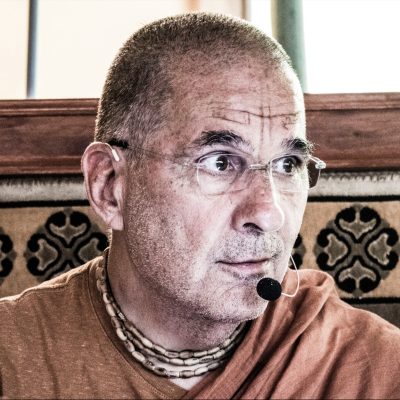
Swami B. V. Tripurari Q&A; April 26, 2026: The Gopis and Their Husbands All Belong to Sri Krishna
Notes de l’épisode
Questions on today’s Swami Call:
If Krishna's marriage to Radha and the young gopis happens during the gopi vasta harana lila, and is a legitimate form of marriage, then it seems the gopis' subsequent marriages to their "husbands" would be parakiya and their relationships to Krishna would be svakiya. Jiva Goswami says so I believe. Is this correct? Is this another case of wonderful inconceivable simultaneous difference and non-difference? Also, if all the young gopis are expansions of Srimati Radharani and all their "husbands" expansions of Krishna, or at least his parshads, may we think (as I like to) that their marriages were in fact very happy and satisfying and the gopis went to Krishna for rasa lila not out of any sense of dissatisfaction or cheating tendency but that in the sound of the flute and in Krishna's form they found a more concentrated manifestation of what they loved in their own husbands. Indeed, since we are discussing lila and not some ordinary event, is it possible that the gopis may not have left their husbands at all, but expanded themselves into two, with one staying at home and the other rushing off to be with Krishna?
I have some technical questions about bhakti. First, is there a difference between bhakti and bhakti yoga? I'd like to know if it's called bhakti yoga at a certain stage. In other words, do śuddha-bhaktas also practice bhakti yoga?
Another question is based on something you said in Chile. You cited a source, but I'm not sure if it was from the Śrī Sampradāya, where they differentiated between bhakti and śaraṇāgati, emphasizing that if you weren't qualified for bhakti, you could practice śaraṇāgati. I'd like to know if it's possible to elaborate on this a bit or add some perspectives. I found it very interesting.
In the Śrī Sampradāya, is śaraṇāgati a process or an attitude?
Has any acarya commented on the parallell between Lord Balarama returning to Vraja to console the Vraja-vasis and Lord Nityananda returning to Navadvipa to console the Navadvipa-vasis?
For someone who is integrating into the Vaiṣṇava saṅgha, what do you recommend they begin studying, and in what order? And on the other hand, what does Gurumaharaj expect from his students?
(Reading of Caitanya-caritamrta Madhya Lila 15.16-19)
Sri Chaitanya Mahaprabhu instructed Raghunatha Dasa Gosvami: “You should not eat very palatable food, nor should you dress very nicely.” Raghunatha Dasa set a great example of renunciation by living very simply, and Mahaprabhu did the same. Jesus also led a materially poor life. Today, under the banner of preaching, service, or preserving the image of the tradition before society, it seems that the main representatives of spiritual traditions enjoy special material comfort: they eat sumptuously, dress opulently, travel in luxury cars, associate with the most privileged sectors of society, and so on.
I wanted to ask: if the six Gosvamis, Mahaprabhu, Jesus, and other great personalities set the example of living simply, why is that aspect not considered essential to emulate today for the benefit of devotion? Thank you.
Isn’t today GM’s 51st anniversary of taking sannyas in Vrindavan? Just wondering, if it’s okay or common to congratulate? If yes, happy „birthday“! Also I was wondering if GM would like to say a bit about the encounter he had with Yogi Bhajan in LA, as he briefly mentioned last week.