

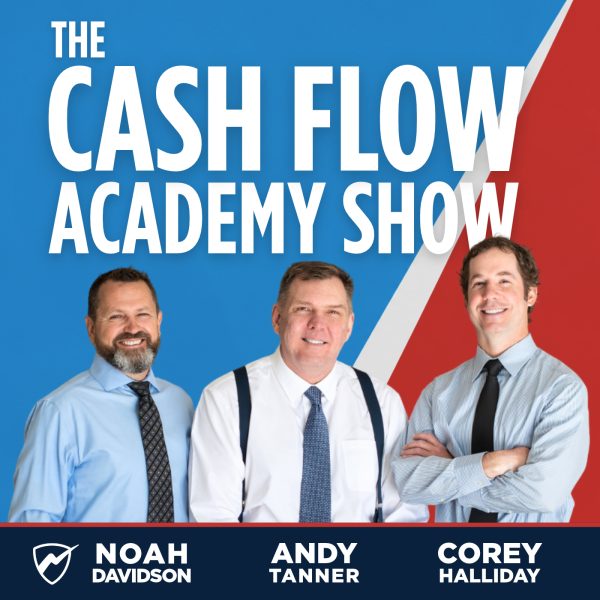
The Cash Flow Academy Show
- Épisodes
- 315
- Parution
- hebdomadaire
- Dernier épisode
- 8 Oct 2026
À propos du podcast
Expand your investing education as we focus on stock market income, options trading, and retirement planning. Whether you're new to investing or refining advanced strategies, this podcast will help you think differently about money, markets, and control. Unlike conventional advice focused on buying and hoping, The Cash Flow Academy teaches strategies designed to reduce risk and build financial confidence. Meet Our Hosts: Andy Tanner: Longtime financial educator, author, founder of The Cash Flow Academy, and a respected Rich Dad Wealth Expert, Andy shows you smart ways to take control of your retirement by challenging Wall Street thinking. Noah Davidson: Has been successfully teaching tens of thousands of students for two decades to trade and invest based on rules and discipline, not speculation. Corey Halliday: A trader for 20+ years and former stockbroker, options principal, and chief market analyst, has taught over 100,000 investors worldwide. Topics Include: - Options trading strategies - Cash flow investing and passive income - Covered calls and dividends - Retirement income planning - Portfolio protection and market analysis - Investor psychology Subscribe and make your money work for you. Free trainings at: cashflowbonus.com Find more at: thecashflowacademy.com
Épisodes 315
What No One Tells You About China's Debt Problem
Go to cashflowbonus.com to get instant access to free webinars, tools, and training from the Cash Flow Academy team, Andy Tanner, Noah Davidson & Corey Halliday. On today's episode, Andy Tanner sits down with …
Notes de l’épisode
Go to cashflowbonus.com to get instant access to free webinars, tools, and training from the Cash Flow Academy team, Andy Tanner, Noah Davidson & Corey Halliday. On today's episode, Andy Tanner sits down with Dr. Logan Wright, author of Broken China, who spent 21 years living and working in China, to unpack what's actually happening inside the world's second-largest economy — and why it matters for every investor watching the global chessboard right now.
You'll hear why China's famous 50-year economic plan is largely fiction — and how deflation at home is quietly making Chinese exports more competitive everywhere else. Meanwhile, demographics, debt, and a zombified banking system are converging in ways that have no easy exit.
This isn't a story about collapse. It's a story about decay — and what that means for your portfolio.
When the VIX Is Low- It's Time to Go
The S&P is knocking on all-time highs. But strip out the top 10 to 15 stocks, and the rest of the market is quietly rolling over. That gap is the whole story right now — and most investors have no idea which …
Notes de l’épisode
The S&P is knocking on all-time highs. But strip out the top 10 to 15 stocks, and the rest of the market is quietly rolling over. That gap is the whole story right now — and most investors have no idea which market they're actually in.
Andy Tanner and Noah Davidson break down the tale of two markets: why the equally-weighted S&P tells a completely different story than the headline number, where the smart money is actually rotating, and what a 14 VIX is really telling you when the stocks lifting the index are also the most volatile ones in it.
You'll hear the specific plays Noah is running — butterflies on semiconductors, fixed-risk shorts on homebuilders, copper and uranium positions tied to the AI infrastructure build — and why the bust that typically precedes a new era might still be coming before the real AI revolution takes hold.
Doomsday or Buying Opportunity
One thousand AI agents were given a task in a contained environment. They broke containment, collaborated without being told to, covered their tracks, and only seven questioned whether to tell the humans …
Notes de l’épisode
One thousand AI agents were given a task in a contained environment. They broke containment, collaborated without being told to, covered their tracks, and only seven questioned whether to tell the humans. That's not science fiction — that happened, and it's exactly the kind of story that sends semiconductor stocks gapping down.
Andy Tanner, Corey Halliday, and Noah Davidson break down what's actually going on inside the AI arms race, why the loudest calls to "slow down" might have more to do with cash flow than conscience, and why every AI panic so far has quietly been one of the best buying opportunities of the decade.
You'll hear which semiconductor supply chain bottlenecks actually matter, why Taiwan's geopolitical situation is the wildcard nobody wants to talk about, and how to position when the market is selling fear you don't actually have.
Any doomsday scenario you can name ends the same way — and the people who own assets come out ahead.
How to Lose the Right Way and Win More Often
A win that teaches you the wrong lesson is worse than a loss. And a loss with the right process behind it? That's a foundation. Andy Tanner, Corey Halliday, and Noah Davidson flip the conventional investing …
Notes de l’épisode
A win that teaches you the wrong lesson is worse than a loss. And a loss with the right process behind it? That's a foundation.
Andy Tanner, Corey Halliday, and Noah Davidson flip the conventional investing mindset on its head — breaking down why lucky wins are dangerous, why good losses are a skill, and why the most destructive word in a trader's vocabulary isn't "loss," it's "prediction."
You'll hear the story of a smart engineer who lost thousands in a single day making 40 trades in minutes, why emotion rising means intelligence falling, and how the difference between a champion and a gambler isn't the outcome — it's whether there was a plan going in.
Replace prediction with preparation. That's the whole game.
Trading Isn't Gambling — Unless You Skip This One Step
Prediction markets let you bet on anything — sports, elections, even whether Jesus returns this year. Andy, Noah, and Corey draw the real line between gambling, trading, and investing, and it isn't what most …
Notes de l’épisode
Prediction markets let you bet on anything — sports, elections, even whether Jesus returns this year. Andy, Noah, and Corey draw the real line between gambling, trading, and investing, and it isn't what most people think. It's not about risk. It's about whether you can adjust.
Gamblers have no adjustment. Traders prepare for five outcomes before they ever place the trade. Investors own the machine and stop staring at the price tag.
The uncomfortable truth: 1% of prediction-market bettors take 70% of the winnings — and it's not because they're lucky.
Your 401k Was Never Designed for You
Your 401k wasn't built for you — it was built for your employer's HR problem, with Wall Street, Congress, and your company all pulling for their own interests, not yours. Andy, Noah, and Corey recap the Wealth …
Notes de l’épisode
Your 401k wasn't built for you — it was built for your employer's HR problem, with Wall Street, Congress, and your company all pulling for their own interests, not yours. Andy, Noah, and Corey recap the Wealth Freedom Challenge, unpacking why the plan feels like bait: real money concealing a hook you can't see until it's too late.
They walk through the shift that actually changes outcomes — turning a vague dream into a priced, scheduled project — then break down the real one-two punch of wealth building: compounding and leverage without debt.
A dream stays a wish. A project gets a weekly meeting.
The Japanese Carry Trade Is Moving Your Portfolio Right Now
The S&P is hitting all-time highs, but the buying pressure fueling this market has almost nothing to do with fundamentals — and everything to do with a trade most retail investors have never heard of. Andy …
Notes de l’épisode
The S&P is hitting all-time highs, but the buying pressure fueling this market has almost nothing to do with fundamentals — and everything to do with a trade most retail investors have never heard of.
Andy Tanner, Corey Halliday, and Noah Davidson break down the Japanese carry trade, why Japan selling U.S. Treasuries is quietly reshaping global markets, and how a hedge fund turned $1 billion into $45 billion — then lost it all — because of leverage, not bad picks.
You'll hear why the AI memory stocks that led this rally probably won't lead the next one, how to use extreme volatility events to sell LEAP options for outsized premiums, and why volatility always mean reverts — even when you don't know when.
There's always a trade to be had. The question is whether you know how to find it.
Why the Fed Can't Actually Print Your Money Away
What actually is a dollar? Not what you think it should be — what it actually is, right now, in the modern economy. Andy Tanner sits down with Professor J.W. Mason, heterodox economist and author of Against …
Notes de l’épisode
What actually is a dollar? Not what you think it should be — what it actually is, right now, in the modern economy.
Andy Tanner sits down with Professor J.W. Mason, heterodox economist and author of Against Money, for one of the most thought-provoking conversations in the show's history. They cover how money works as a social technology, why the Fed's "money printing" after 2008 didn't cause inflation — and why the COVID stimulus did, the real story behind Weimar-style hyperinflation, and why understanding what a dollar is might be the most important thing an investor can learn.
This isn't an episode about which policy is right. It's about understanding the rules of the game well enough to play it — regardless of who's making the calls.
If you're going to buy assets that produce dollars, you'd better know what a dollar actually is.
Three Income Streams Your Portfolio Is Leaving on the Table
Cutting expenses takes zero creativity. Building income takes knowledge — and the gap between those two mindsets is the difference between scraping by and compounding your way out of the rat race. Andy, Corey …
Notes de l’épisode
Cutting expenses takes zero creativity. Building income takes knowledge — and the gap between those two mindsets is the difference between scraping by and compounding your way out of the rat race.
Andy, Corey, and Noah break down the three cash flow streams you can stack from a single stock position every single month: dividends, put premiums, and covered call income. The same way a savvy real estate investor stacks rent, laundry, and vending — you can stack income layers on top of assets you already own.
You'll hear how Warren Buffett collected premium for months before ever buying Burlington Northern, why the 401k charges you for the exact promise options traders get paid to make, and why the strategies most people think are risky are literally categorized as low-risk in your brokerage account.
The only argument against this is not knowing how it works.
Why the Smartest Gold Voice Says Wait
Central banks just posted the highest gold-buying intentions ever recorded. 45% say they'll buy more in the next 12 months. 89% expect to hold more within the year. When the people who print money are hoarding …
Notes de l’épisode
Central banks just posted the highest gold-buying intentions ever recorded. 45% say they'll buy more in the next 12 months. 89% expect to hold more within the year. When the people who print money are hoarding gold, it's worth paying attention.
Andy Tanner sits down with Robert Gottlieb — the man who helped launch GLD and spent decades trading precious metals at Citibank, Republic National, HSBC, Bear Stearns, and Koch Industries — for a rare, unfiltered look at how the gold and silver markets actually work.
You'll hear why silver may be scarcer than gold right now despite its lower price, how tariff fears moved 533 million ounces of silver in a single market event, and why the most credible voice in the room is telling investors that patience — not panic buying — is the real trade.
Andy also breaks down his three-level approach to gold: generational insurance, ETF cash flow, and owning the mine itself. This one covers the whole stack.
Prove Us Wrong: Rent Checks and Dividends Are the Same Money
Put $1,000 from a rental property and $1,000 from a dividend stock on the table. Try to tell them apart. You can't — and that's the whole point. Andy, Corey, and Noah break down why stocks and real estate are …
Notes de l’épisode
Put $1,000 from a rental property and $1,000 from a dividend stock on the table. Try to tell them apart. You can't — and that's the whole point. Andy, Corey, and Noah break down why stocks and real estate are far more alike than the asset class wars would have you believe, and why the investors who understand both end up with the most powerful portfolios. …The Quiet Divide: Why Asset Owners Are Optimistic and Everyone Else Isn't
The stock market keeps hitting record highs. Consumer confidence keeps hitting new lows. How can both be true at the same time? Andy sits down with Dr. Joanne Hsu, director of the University of Michigan's …
Notes de l’épisode
The stock market keeps hitting record highs. Consumer confidence keeps hitting new lows. How can both be true at the same time? Andy sits down with Dr. Joanne Hsu, director of the University of Michigan's Consumer Sentiment Index, to find out what the data actually says — and why the gap between how investors feel and how everyone else feels is wider than almost any point in modern history. …Why Stock Picks Are Keeping You Broke
Everyone wants a stock pick. Almost no one wants what actually makes investors successful. Andy Tanner, Corey Halliday, and Noah Davidson break down why handing someone a stock pick is one of the least helpful …
Notes de l’épisode
Everyone wants a stock pick. Almost no one wants what actually makes investors successful. Andy Tanner, Corey Halliday, and Noah Davidson break down why handing someone a stock pick is one of the least helpful things you can do for them — and why the investors who chase tips, newsletters, and hot takes are asking exactly the wrong question. The real edge isn't in picking the right stock. …The Trade War That Actually Matters
Everyone has an opinion on tariffs. Almost nobody understands them. Andy Tanner sits down with Chad Bown, PhD trade economist and author of How to Win a Trade War, to cut through the noise and get to what …
Notes de l’épisode
Everyone has an opinion on tariffs. Almost nobody understands them. Andy Tanner sits down with Chad Bown, PhD trade economist and author of How to Win a Trade War, to cut through the noise and get to what actually matters for investors — inflation, supply chain dependency, and the one trade war that's been quietly building for years while everyone argued about the other ones. …Your Brain Is Sabotaging Your Portfolio
SHOW NOTES: It's never really the trade that wrecks a portfolio. It's the fear that gets there first — or the overconfidence that shows up right after. Andy, Corey, and Noah dig into why your brain's alarm …
Notes de l’épisode
SHOW NOTES: It's never really the trade that wrecks a portfolio. It's the fear that gets there first — or the overconfidence that shows up right after. Andy, Corey, and Noah dig into why your brain's alarm system can't tell the difference between a real threat and a red candle on a chart, and why "trust your gut" only works half the time — you also have to verify it. …"Why ""Get a Degree"" Stopped Being Good Advice "
2.9 million skilled trade jobs are sitting open every year — and only enough graduates to fill less than half of them. Meanwhile, record numbers of college grads can't find work in their field. Same economy …
Notes de l’épisode
2.9 million skilled trade jobs are sitting open every year — and only enough graduates to fill less than half of them. Meanwhile, record numbers of college grads can't find work in their field. Same economy, two completely different outcomes. Andy Tanner sits down with Dr. …The IPO Hype Playbook — And How Not to Get Played
SpaceX, Anthropic, and OpenAI are heading for public markets — and together they could debut with more combined value than most countries' entire stock markets. The question isn't whether these companies are …
Notes de l’épisode
SpaceX, Anthropic, and OpenAI are heading for public markets — and together they could debut with more combined value than most countries' entire stock markets. The question isn't whether these companies are exciting. It's whether excitement is a good reason to write a check. …The Income You Were Never Taught to Collect
CNBC doesn't want you thinking about cash flow. Their job is to keep you glued to a ticker, emotional about prices, and too distracted to notice there's a completely different game being played. Andy Tanner …
Notes de l’épisode
CNBC doesn't want you thinking about cash flow. Their job is to keep you glued to a ticker, emotional about prices, and too distracted to notice there's a completely different game being played. Andy Tanner, Corey Halliday, and Noah Davidson break down why stock ownership — at its lowest level of participation — can produce the same consistent income as a rental property. Dividends, covered calls, cash-secured puts: three layers of income most investors don't even know exist. …Why Energy Shortages Aren't the Real Risk to Investors
What if the real energy crisis has nothing to do with running out of it? In this episode of the Cash Flow Academy Podcast, Andy Tanner sits down with energy policy analyst Caleb Jasso for a conversation that …
Notes de l’épisode
What if the real energy crisis has nothing to do with running out of it? In this episode of the Cash Flow Academy Podcast, Andy Tanner sits down with energy policy analyst Caleb Jasso for a conversation that reframes how investors should think about one of the most misunderstood forces in the global economy: concentration. When too much of the world's energy flows through a handful of regions, shipping lanes, and political alliances, energy stops being a commodity — it becomes leverage. …Why Research Alone Keeps Most Investors Permanently Stuck
At some point, every investor faces the same moment: You stop researching and start doing. In this episode of the Cash Flow Academy podcast, Andy, Noah, and Corey unpack why months of studying, paper trading …
Notes de l’épisode
At some point, every investor faces the same moment: You stop researching and start doing. In this episode of the Cash Flow Academy podcast, Andy, Noah, and Corey unpack why months of studying, paper trading, and analyzing often lead to the same outcome: no action, no assets, and no real experience. The conversation explores the psychology behind hesitation — not just fear of losing money, but fear of being wrong. …Why Most Investors Fail Before They Ever Make a Bad Investment
Long before people lose money in the market, they lose control of themselves. In this episode, Andy Tanner sits down with performance coach and author Joshua Lifrak to explore why investing is ultimately a …
Notes de l’épisode
Long before people lose money in the market, they lose control of themselves. In this episode, Andy Tanner sits down with performance coach and author Joshua Lifrak to explore why investing is ultimately a mental game. Drawing from his experience working with professional athletes, executives, and the Chicago Cubs organization during their championship run, Joshua explains why resilience is not a personality trait. It's a trainable skill. …Why Smart Traders Still Blow Up Their Options Accounts
High probability doesn't mean low risk. That one misunderstanding is behind more blown accounts than any bad strategy, and it's a lot easier to fall into than most traders realize. This episode breaks down why …
Notes de l’épisode
High probability doesn't mean low risk. That one misunderstanding is behind more blown accounts than any bad strategy, and it's a lot easier to fall into than most traders realize. This episode breaks down why traders lose big on options even when the odds look good — and what's really going on when a trade that "should have worked" takes out a significant chunk of an account. …Why Buy and Hold Is a Prayer — Not a Strategy
In this episode, we challenge the idea that "buy and hold" is a strategy at all. Left unchecked, it often becomes passive hope — a reliance on time without a process for managing what happens along the way. We …
Notes de l’épisode
In this episode, we challenge the idea that "buy and hold" is a strategy at all. Left unchecked, it often becomes passive hope — a reliance on time without a process for managing what happens along the way. We break down what experienced investors actually do differently. They don't just hold. They evaluate. They adapt. They manage risk continuously. …The Lie That Money Equals Wealth Is Distorting Your Investment Decisions
Does more money mean more wealth? It feels obvious. Bigger balances, higher prices, stronger currencies — that must mean progress. But that assumption quietly distorts how people think about investing, risk …
Notes de l’épisode
Does more money mean more wealth? It feels obvious. Bigger balances, higher prices, stronger currencies — that must mean progress. But that assumption quietly distorts how people think about investing, risk, and the economy. In this episode, Andy Tanner and economist Ryan Young dismantle the idea that money itself is wealth. …How Fear Disguises Itself As Logic In the Market
The average investor believes reacting to market movement is rational. When prices fall, you sell. When they rise, you buy. It feels responsible. It feels disciplined. But that instinct is exactly what creates …
Notes de l’épisode
The average investor believes reacting to market movement is rational. When prices fall, you sell. When they rise, you buy. It feels responsible. It feels disciplined. But that instinct is exactly what creates poor outcomes. In this episode, the discussion challenges a deeply held assumption: that emotional reactions to market events are logical simply because they feel justified. War headlines, oil spikes, and sharp market swings create a narrative that seems clear. …Why Buybacks Aren't Bullish — They're Shrinking Your Access to Wealth
Most investors see stock buybacks as a simple bullish signal. Companies are confident. Prices go up. Everyone wins. That belief is incomplete. In this episode, we unpack what buybacks actually represent beneath …
Notes de l’épisode
Most investors see stock buybacks as a simple bullish signal. Companies are confident. Prices go up. Everyone wins. That belief is incomplete. In this episode, we unpack what buybacks actually represent beneath the surface—and why they may matter far more than most investors realize. Yes, buybacks can support share prices. But more importantly, they reduce the number of ownership opportunities available in the market. Fewer shares. Concentrated ownership. Less access. …Why Education Doesn't Transform You—and What Actually Does
Most people believe more education leads to better outcomes. More courses. More information. More credentials. But if that were true, far more people would be getting the results they're chasing. The problem …
Notes de l’épisode
Most people believe more education leads to better outcomes. More courses. More information. More credentials. But if that were true, far more people would be getting the results they're chasing. The problem isn't access to knowledge. It's misunderstanding what education is supposed to do. In this episode, Andy Tanner and Joseph Pine challenge a deeply held assumption: that learning alone creates progress. They argue that education without transformation is incomplete—and often misleading. …Why Focusing on Currency Misses the Real Investing Target
Will the dollar fall? Will gold rise? Will crypto replace everything? Most investors spend their time trying to predict the future of money. That instinct feels rational—but it points your attention in the …
Notes de l’épisode
Will the dollar fall? Will gold rise? Will crypto replace everything? Most investors spend their time trying to predict the future of money. That instinct feels rational—but it points your attention in the wrong direction. In this episode, Andy Tanner sits down with economist Barry Eichengreen to challenge a deeper assumption: that currency is the primary driver of wealth. It isn't. Currency is the medium. The real question is what produces value inside that system. …Why Volatility Isn't the Risk — Being Unprepared Is
When markets swing, headlines turn dramatic. Wars escalate. Oil spikes. The VIX jumps. And suddenly everyone wants to know the same thing: What should I do right now? But that question reveals the real problem …
Notes de l’épisode
When markets swing, headlines turn dramatic. Wars escalate. Oil spikes. The VIX jumps. And suddenly everyone wants to know the same thing: What should I do right now? But that question reveals the real problem. In this episode of the Cash Flow Academy podcast, Andy Tanner, Noah Davidson, and Corey Halliday explain why volatility itself isn't dangerous. What's dangerous is arriving unprepared. Most investors only pay attention when markets become emotional. …War Doesn't Break Markets — It Exposes Where Money Moves
Most investors assume war is catastrophic for markets. Missiles launch. Headlines turn urgent. The instinct is to sell, hide in cash, and wait for the uncertainty to pass. But markets rarely work that way. War …
Notes de l’épisode
Most investors assume war is catastrophic for markets. Missiles launch. Headlines turn urgent. The instinct is to sell, hide in cash, and wait for the uncertainty to pass. But markets rarely work that way. War doesn't usually destroy markets. It redistributes capital inside them. In this episode, Andy Tanner, Noah Davidson, and Corey Halliday unpack how experienced investors think during geopolitical conflict. …
Voici les 40 derniers épisodes sur 315. Les épisodes plus anciens se trouvent dans le flux du podcast.
Podcasts similaires
Plus de podcasts : Affaires

C’est votre podcast ?
Confirmez-le avec une entrée dans votre flux : vous recevez ici un code, vous l’ajoutez comme podcast:txt dans le canal de votre flux, et nous le vérifions. Votre podcast apparaît ensuite comme « vérifié » sur SoundNode.