

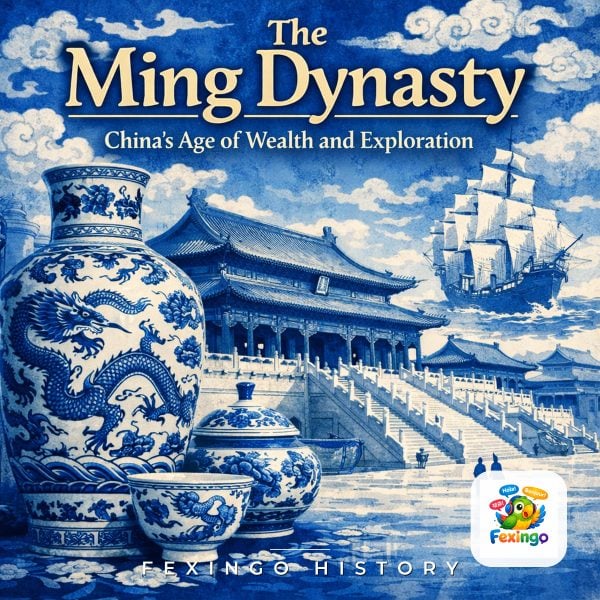
The Ming Dynasty: China’s Age of Wealth and Exploration — Fexingo History
- Épisodes
- 301
- Parution
- quotidienne
- Dernier épisode
- 23 Nov 2026
À propos du podcast
From the fall of the Mongol Yuan dynasty to the rise of the Ming, China entered a golden age of wealth, exploration, and cultural splendor. Join hosts Lucas and Luna as they unravel the epic story of the Ming dynasty (1368–1644), a period that saw the construction of the Forbidden City, the epic voyages of Admiral Zheng He across the Indian Ocean, and the flourishing of blue-and-white porcelain that became a global symbol of Chinese artistry. This series delves into the reign of the Hongwu Emperor, a peasant turned founder who established a ruthless autocracy; the Yongle Emperor, who moved the capital to Beijing and commissioned the monumental Yongle Encyclopedia; and the later Ming emperors who faced threats from Mongols, Japanese pirates, and internal corruption. Explore the Ming economy, driven by silver trade with Spanish Manila and Portuguese Macau; the role of the civil service examination system; and the cultural achievements in literature, painting, and lacquerware. Debates over the Ming's maritime policy—why did they abruptly halt the treasure fleets?—and the dynasty's eventual collapse amid peasant rebellions and Manchu invasion are examined through primary sources and modern scholarship. The Ming legacy persists in China's identity, its architectural marvels like the Great Wall's brick sections, and its porcelain traditions. How did this dynasty of explorers and builders ultimately succumb to the very isolation it created? Tune in to find out. #MingDynasty #ZhengHe #ForbiddenCity #YongleEmperor #HongwuEmperor #BlueAndWhitePorcelain #ChineseHistory #TreasureFleets #GreatWall #MingPorcelain #IndianOceanTrade #SilverTrade #CivilServiceExams #MingCollapse #ManchuConquest #EastAsianHistory #WorldHistory #FexingoHistory Keep every episode free: buymeacoffee.com/fexingo
Participants
- LucasAnimation
- LunaCoanimation
Épisodes 301
Ming Dynasty's Forbidden Scholars: The Grand Secretariat
In Episode 301, Lucas and Luna peel back the layers of Ming imperial administration to explore the rise of the Grand Secretariat. While earlier episodes focused on the Wanli Emperor’s withdrawal and the …
Notes de l’épisode
In Episode 301, Lucas and Luna peel back the layers of Ming imperial administration to explore the rise of the Grand Secretariat. While earlier episodes focused on the Wanli Emperor’s withdrawal and the Jinyiwei’s terror, this conversation examines how the Grand Secretaries—initially humble editors—gained immense soft power through their control over drafting edicts. We look at key figures like Xu Guangqi and his engagement with Jesuit mathematics, as well as the complex relationship between the civil bureaucracy and the eunuch apparatus. The episode also touches on the intellectual shifts during the late Ming period, including the influence of Wang Yangming’s philosophy on scholar-officials. Discover how a group of low-ranking officials quietly shaped the empire’s policies, navigated court intrigue, and laid the groundwork for China’s encounter with Western science in the seventeenth century.
#GrandSecretariat #MingDynasty #XuGuangqi #JesuitMission #WangYangming #YongleEmperor #ZhuDi #ZhaoGongshu #BureauOfRites #EastAsiaHistory #ChinesePhilosophy #ImperialAdministration #FexingoHistory #HistoryPodcast #MingChina #ScholarOfficials #CulturalExchange #LateMing
Ming Dynasty's Secret Police: The Jinyiwei
While previous episodes explored the Ming’s porcelain trade, silver economy, and the Wanli Emperor’s withdrawal, this episode turns inward to the shadow machinery of imperial control. We examine the Jinyiwei …
Notes de l’épisode
While previous episodes explored the Ming’s porcelain trade, silver economy, and the Wanli Emperor’s withdrawal, this episode turns inward to the shadow machinery of imperial control. We examine the Jinyiwei, the Emperor’s personal guard and secret police, who operated outside the standard bureaucratic hierarchy of the Grand Secretariat and Ministry of Justice. Founded by Zhu Yuanzhang, the Hongwu Emperor, these agents were tasked with rooting out corruption and dissent, often bypassing legal procedures entirely. We look at how the Jinyiwei evolved from a ceremonial honor guard into a feared instrument of state terror under the Yongle Emperor, Zhu Di. The narrative follows key figures like Feng Bao, whose loyalty was rewarded with immense power, and explores the psychological toll of living under constant surveillance in Beijing’s Forbidden City. This is not just about torture chambers; it is about the structural paranoia that defined Ming autocracy and how the empire balanced its image of Confucian harmony with brutal internal enforcement.
#Jinyiwei #MingDynasty #ZhuYuanzhang #HongwuEmperor #ZhuDi #YongleEmperor #FengBao #ForbiddenCity #BeijingHistory #SecretPolice #ImperialGuard #ChineseHistory #EastAsia #HistoricalTerror #Autocracy #Confucianism #GrandSecretariat #FexingoHistory #History
Ming China's Forbidden Cities and the Imperial Lineage
This episode moves beyond the political struggles of the Grand Secretariat to examine the physical and spiritual architecture that sustained the Ming Empire. We explore how the Yongle Emperor relocated the …
Notes de l’épisode
This episode moves beyond the political struggles of the Grand Secretariat to examine the physical and spiritual architecture that sustained the Ming Empire. We explore how the Yongle Emperor relocated the capital to Beijing, constructing the Purple Forbidden City as a microcosm of the cosmos aligned with Heaven’s Mandate. Lucas details the engineering marvels behind the wooden bracket systems, the symbolic weight of the Nine-Dragon Wall, and the strict spatial hierarchies that governed imperial life. Luna asks about the daily reality within these walls, leading to a discussion on the labor forces, including the 'porcelain slaves' and architectural artisans, who built this enduring symbol of power. We also touch upon the ritual significance of the Temple of Heaven and the astronomical observations conducted by the Bureau of Astronomy, revealing how every stone and tile was calculated to maintain cosmic order. This conversation highlights the intersection of geometry, theology, and absolute authority in 15th-century East Asia.
#MingDynasty #BeijingHistory #ForbiddenCity #YongleEmperor #ZhuDi #PurpleForbiddenCity #DaMingHuiDian #HeavenMandate #CaiXiu #Fangshan #ChineseArchitecture #WoodenBracket #NineDragonWall #TempleOfHeaven #BureauOfAstronomy #PorcelainSlaves #Jingdezhen #EastAsianHistory #History #FexingoHistory
The Ming Dynasty's Hidden Urban Life
While previous episodes have explored the political intrigues of the Jiajing Emperor, the silver flows of the Single Whip Reform, and the maritime ambitions of Zheng He, this episode turns its gaze to the …
Notes de l’épisode
While previous episodes have explored the political intrigues of the Jiajing Emperor, the silver flows of the Single Whip Reform, and the maritime ambitions of Zheng He, this episode turns its gaze to the domestic sphere of late Ming China. We focus on the Wanli period and the profound cultural shift captured in the novel Jin Ping Mei. Lucas and Luna discuss how Lanling Xiaoxiaosheng used the fictional household of Ximen Qing to expose the moral decay and commercial saturation of Qinghe County. The conversation examines the role of Pan Jinlian and Li Ping'er not just as literary archetypes, but as reflections of real social tensions regarding gender, property, and the erosion of Neo-Confucian ideals. By analyzing the text alongside historical records of Huizhou merchants and the bustling urban life of Suzhou and Nanjing, we uncover how literature became a mirror for a society increasingly driven by wealth rather than virtue. This episode offers a deep dive into the hidden urban reality that preceded the dynasty’s final collapse.
#MingDynasty #JinPingMei #LanlingXiaoxiaosheng #XimenQing #PanJinlian #LiPingEr #WanliEmperor #ZhuYijun #ZhangJuzheng #SingleShibReform #NeoConfucianism #QingheCounty #HuizhouMerchants #JiangnanRegion #SuzhouHistory #NanjingCulture #ChineseLiterature #FexingoHistory
The Wanli Emperor's Great Withdrawal
This episode explores the forty-eight-year silence of Zhu Yijun, known as the Wanli Emperor, who refused to hold court, audiences, or perform his duties. We examine how this unprecedented act of passive …
Notes de l’épisode
This episode explores the forty-eight-year silence of Zhu Yijun, known as the Wanli Emperor, who refused to hold court, audiences, or perform his duties. We examine how this unprecedented act of passive resistance destabilized the Ming bureaucracy and allowed regional warlords like Nurhaci to rise. Lucas and Luna discuss the tension between Neo-Confucian ideals and imperial autocracy, the role of the Donglin Academy in criticizing the throne, and the economic reforms of Zhang Juzheng that preceded the decline. We also look at the Jinyiwei secret police, the Grand Secretariat's struggle for power, and the Little Ice Age's impact on the empire's stability.
#WanliEmperor #ZhuYijun #MingDynasty #ChinaHistory #DonglinAcademy #ZhangJuzheng #SingleShib Reform #Nurhaci #Jinyiwei #NeoConfucianism #GrandSecretariat #LittleIceAge #TaichangEmperor #MingPolitics #EastAsia #ImperialAutocracy #FexingoHistory #History
The Wanli Emperor's 48-Year Silence
This episode explores the reign of Zhu Yijun, known as the Wanli Emperor, and his extraordinary decision to stop attending court for nearly half a century. We examine the political deadlock with the Grand …
Notes de l’épisode
This episode explores the reign of Zhu Yijun, known as the Wanli Emperor, and his extraordinary decision to stop attending court for nearly half a century. We examine the political deadlock with the Grand Secretariat, the influence of Donglin scholars, and the personal tragedy that fueled his withdrawal. The conversation details how this administrative vacuum allowed regional powers like Nurhaci to rise in Manchuria while the central government stagnated. We also look at the economic reforms, such as the Single Whip policy, which continued despite the emperor's absence, revealing a complex machinery of state that outlasted its ruler. Through the lens of the Jinyiwei secret police and the ideological battles of Neo-Confucianism, we uncover how one man's refusal to rule reshaped China's trajectory.
#WanliEmperor #ZhuYijun #MingDynasty #GrandSecretariat #DonglinAcademy #Nurhaci #SingleShibReform #Jinyiwei #NeoConfucianism #TaichangEmperor #MingHistory #ChineseImperialCourt #ManchurianRise #LateMingCrisis #ImperialSuccession #EastAsianHistory #FexingoHistory #History
The Wanli Emperor's Strike: The Man Who Refused to Rule
In this episode, we explore the unprecedented political stalemate of late sixteenth-century China, focusing on Zhu Yijun, the Wanli Emperor. For forty-eight years, he refused to attend court audiences, sign …
Notes de l’épisode
In this episode, we explore the unprecedented political stalemate of late sixteenth-century China, focusing on Zhu Yijun, the Wanli Emperor. For forty-eight years, he refused to attend court audiences, sign edicts, or appoint ministers, effectively paralyzing the Grand Secretariat and the Ministry of Rites. We trace how this silent strike began as a personal protest over the succession crisis—the dispute over who should be named heir apparent—and evolved into a systemic collapse of imperial governance. Through the eyes of scholars like Gu Xiancheng and officials caught in the crossfire, we examine the tension between Neo-Confucian ideals of ritual propriety and the absolute power of the throne. This was not mere laziness; it was a calculated withdrawal that left the Ming Dynasty vulnerable to internal decay and external threats from the rising Jianzhou Jurchens.
#WanliEmperor #ZhuYijun #MingDynasty #SuccessionCrisis #GrandSecretariat #NeoConfucianism #GuXiancheng #Jinyiwei #SingleShrimpReform #ChineseHistory #ImperialCourt #SilentStrike #EastAsia #HistoricalPolitics #FexingoHistory #HistoryPodcast #MingChina #PoliticalStalemate
The Wanli Emperor's Strike: China's Silent Revolution
For over thirty years, the Wanli Emperor refused to attend court, fill ministerial posts, or sign laws. This wasn't just personal stubbornness; it was a systemic revolt against the bureaucratic machine that …
Notes de l’épisode
For over thirty years, the Wanli Emperor refused to attend court, fill ministerial posts, or sign laws. This wasn't just personal stubbornness; it was a systemic revolt against the bureaucratic machine that governed Ming China. In this episode, we explore the Great Withdrawal, examining how Zhu Yijun’s silent protest paralyzed the central government and accelerated the dynasty’s decline. We look at the power struggle between the Grand Secretariat and the eunuch faction, the role of Donglin Academy scholars, and the catastrophic military failures on the northern frontier while Beijing remained locked in silence. Discover how one man’s refusal to rule reshaped East Asia, leaving the empire vulnerable to the rising Jurchen tribes who would eventually overthrow the Ming.
#WanliEmperor #ZhuYijun #MingDynasty #GreatWithdrawal #GrandSecretariat #DonglinAcademy #Jurchen #Nurhaci #MingHistory #ChineseImperialCourt #EunuchFaction #LiZicheng #TaichangEmperor #Bureaucracy #EastAsiaHistory #FexingoHistory #HistoryPodcast #LateMingPeriod
The Wanli Emperor: China's Great Withdrawal
For decades, the Wanli Emperor ruled from behind closed doors, refusing audiences and ignoring state business in what historians call a 'silent protest' against the bureaucratic establishment. This episode …
Notes de l’épisode
For decades, the Wanli Emperor ruled from behind closed doors, refusing audiences and ignoring state business in what historians call a 'silent protest' against the bureaucratic establishment. This episode explores the political paralysis of the late Ming Dynasty, focusing on the succession crisis that triggered his three-decade strike. We examine how the Grand Secretariat maintained governance through routine while the throne remained empty, and how this withdrawal coincided with the rise of Nurhaci and the Jurchen tribes in the northeast. By looking at court diaries and memorials, we uncover the personal motivations behind one of history's most famous acts of civil disobedience, revealing a man trapped by ritual and ambition rather than merely lazy or indifferent.
#WanliEmperor #MingDynasty #Zhu Yijun #GrandSecretariat #SuccessionCrisis #Nurhaci #Jianzhou #SilentProtest #MingPolitics #BeijingHistory #EastAsianHistory #ImperialCourt #Bureaucracy #ManchuRise #MingDecline #ChineseHistory #FexingoHistory #History
The Ming Dynasty's Lost Treasures: The Rhinoceros and the Elephant
In this episode, Lucas and Luna explore the extraordinary diplomatic gifts received by the Yongle Emperor following the voyages of Zheng He. They examine the famous Hui Yun rhinoceros scroll, a masterpiece of …
Notes de l’épisode
In this episode, Lucas and Luna explore the extraordinary diplomatic gifts received by the Yongle Emperor following the voyages of Zheng He. They examine the famous Hui Yun rhinoceros scroll, a masterpiece of Chinese painting that depicted a rare gift from the Kingdom of Kotte in Sri Lanka. The conversation delves into how these exotic animals were integrated into Ming court life, the political symbolism of receiving such tribute, and the cultural impact of these displays on Chinese art and perception of the world. We also look at the Haijin policy and how these maritime expeditions contrasted with later isolationist tendencies, providing a nuanced view of Ming China's global engagement during its golden age.
#MingDynasty #ZhengHe #YongleEmperor #RhinocerosScroll #HuiYun #KotteKingdom #Jingdezhen #BlueAndWhitePorcelain #ForbiddenCity #Haijin #DaMingBaoChao #Nanjing #Beijing #XuandeEmperor #SriLankaHistory #ChineseArt #DiplomaticGifts #History #FexingoHistory
The Great Rites Controversy: How Ceremony Toppled the Ming
In 1519, a seemingly minor debate over funeral etiquette ignited the Great Rites Controversy, a political earthquake that reshaped the Ming Dynasty. When the young Jiajing Emperor ascended the throne as the …
Notes de l’épisode
In 1519, a seemingly minor debate over funeral etiquette ignited the Great Rites Controversy, a political earthquake that reshaped the Ming Dynasty. When the young Jiajing Emperor ascended the throne as the nephew of the previous ruler, he refused to accept his adoptive parents as his primary ancestors, insisting instead on honoring his biological father, Prince of Xing. This theological and ritual stance clashed violently with the Grand Secretariat, led by Yang Tinghe, who argued that imperial succession required strict adherence to Confucian lineage laws. Lucas and Luna explore how this dispute over ancestral rites became a proxy war for power, leading to public beatings in the Forbidden City, the exile of hundreds of officials, and the eventual consolidation of Jiajing’s absolute authority through Daoist mysticism. We examine the specific edicts of the Da Ming Hui Dian, the role of the Ministry of Rites, and the tragic fate of those who stood up for traditional bureaucratic norms against an emperor determined to rewrite family history.
#GreatRitesControversy #JiajingEmperor #YangTinghe #MingDynastyHistory #ChineseImperialRituals #GrandSecretariat #Zhu Houzao #MinistryOfRites #DaMingHuiDian #DaoistAlchemy #ForbiddenCityPolitics #MingBureaucracy #ConfucianEthics #ImperialLineage #BeijingHistory #EastAsianHistory #FexingoHistory #HistoryPodcast #HistoricalDebate
The Ming Dynasty's Hidden Urban Life
In this episode of The Ming Dynasty: China's Age of Wealth and Exploration, we dive into the vibrant, often overlooked world of urban entertainment and social mobility during the late Ming period. We explore …
Notes de l’épisode
In this episode of The Ming Dynasty: China's Age of Wealth and Exploration, we dive into the vibrant, often overlooked world of urban entertainment and social mobility during the late Ming period. We explore how the rise of a wealthy merchant class in cities like Suzhou and Hangzhou created a new demand for leisure, leading to the flourishing of teahouses, pleasure quarters, and the famous literary phenomenon known as Jin Ping Mei. Lucas and Luna discuss how these spaces became crucibles for cultural exchange, where scholars, merchants, and performers mingled in ways that challenged traditional Confucian hierarchies. We also examine the economic backdrop of the Single Whip Reform, which monetized taxes and further accelerated commercial growth, allowing even lower-class individuals to participate in the city's dynamic social life. Through the lens of characters like Ximen Qing and Pan Jinlian, we uncover the complex moral ambiguities of Ming urbanity, revealing a society far more secular and commercially driven than previously assumed. Join us as we peel back the layers of the Forbidden City’s shadow to find the bustling streets below.
#MingDynasty #JinPingMei #XimenQing #PanJinlian #Suzhou #Hangzhou #SingleSh Reform #Zhang Juzheng #WanliEmperor #MingLiterature #UrbanHistory #ChineseNovel #LanlingXiaoxiaosheng #QingheCounty #MingCommerce #TeaHouseCulture #SocialMobility #History
Ming Dynasty's Hidden Labor: The Porcelain Slaves of Jingdezhen
We often think of the Ming Dynasty through its grand architecture or its famous blue-and-white porcelain, but we rarely look at the hands that made it. This episode explores the brutal reality of the imperial …
Notes de l’épisode
We often think of the Ming Dynasty through its grand architecture or its famous blue-and-white porcelain, but we rarely look at the hands that made it. This episode explores the brutal reality of the imperial kilns in Jingdezhen during the early fifteenth century. We examine the system known as 'Porcelain Slaves'—convicted criminals and political dissidents forced to work under lethal conditions for the Yongle Emperor. You will meet the specific types of laborers who fueled this industry, from executed officials to ordinary thieves caught in a tightening legal net. Lucas and Luna discuss how the demand for Da Guan Wu vessels created a unique form of state-sponsored slavery, where artistic perfection was extracted through fear and exhaustion. We also look at the social fallout, including the rise of merchant guilds like the Huizhou traders who eventually bought their way out of this cycle. It is a story about the hidden cost of luxury, the power of the Jinyiwei secret police, and the complex economy of Jiangxi province. This is not just a tale of beautiful ceramics; it is a look at the human machinery behind the empire’s most prized exports.
#Jingdezhen #PorcelainSlaves #YongleEmperor #ZhuDi #DaGuanWu #Jinyiwei #HuizhouMerchants #MingDynasty #BlueAndWhitePorcelain #CobaltBlue #KaolinClay #ImperialKilns #ChineseHistory #LaborHistory #FexingoHistory #EastAsia #HistoricalSlavery #Ceramics
Ming Dynasty's Lost Treasures: The Rhinoceros and the Elephant
We explore the bizarre and beautiful diplomatic gifts that arrived in Beijing during the early Ming period, focusing on the live animals sent by foreign kingdoms. We discuss the Hui Yun rhinoceros, depicted in …
Notes de l’épisode
We explore the bizarre and beautiful diplomatic gifts that arrived in Beijing during the early Ming period, focusing on the live animals sent by foreign kingdoms. We discuss the Hui Yun rhinoceros, depicted in a famous scroll painting, and the elephants gifted from Kotte Kingdom in Sri Lanka. These creatures were not just curiosities but symbols of imperial power and cosmic harmony. We examine how the Ming court managed these exotic beasts, their dietary needs, and the political significance of receiving such rare gifts. This episode also touches on the broader context of tribute missions, the role of the Jinyiwei in monitoring these events, and the eventual decline of such grand displays as the empire turned inward. Join us as we delve into the living artifacts of Ming diplomacy.
#MingDynasty #ZhengHe #RhinocerosScroll #KotteKingdom #HuiYun #Jingdezhen #ForbiddenCity #TributeSystem #Diplomacy #SriLanka #ChineseHistory #ImperialCourt #ExoticAnimals #SongDynasty #YongleEmperor #XuandeEmperor #FexingoHistory #History
Ming China's Forbidden Cities and the Imperial Lineage
While previous episodes explored the porcelain trade, the Jesuit missions, and the political intrigues of the Jiajing reign, this episode turns its gaze to the very heart of Ming power: the Purple Forbidden …
Notes de l’épisode
While previous episodes explored the porcelain trade, the Jesuit missions, and the political intrigues of the Jiajing reign, this episode turns its gaze to the very heart of Ming power: the Purple Forbidden City. We trace how Zhu Di, the Yongle Emperor, moved the capital from Nanjing to Beijing not just for strategic defense against the Mongols, but to physically embody his legitimacy as the successor to the Yuan dynasty. Lucas walks us through the architectural symbolism of the Nine Gates, the rigid hierarchy of the imperial court, and the role of the Grand Secretariat in governing an empire that stretched from Vietnam to Siberia. Luna guides the conversation toward the human cost of these monumental projects, asking about the laborers, the 'porcelain slaves' of Jingdezhen who also built the palaces, and the quiet resilience of the women who lived within those high walls. Together, they unpack how the Forbidden City was not merely a residence, but a cosmic map designed to align earthly rule with heavenly mandate, creating a bureaucratic machine that would define Chinese governance for centuries.
#MingDynasty #ForbiddenCity #YongleEmperor #ZhuDi #BeijingHistory #ImperialArchitecture #NineGates #GrandSecretariat #HongwuEmperor #NanjingCapital #MingBureaucracy #ChinesePalace #HeavenlyMandate #MingCourtLife #JingdezhenPorcelain #EastAsianHistory #HistoricalCities #FexingoHistory
The Ming Dynasty's Paper Money Crisis
This episode examines the catastrophic failure of the Da Ming Bao Chao, China's first major state-issued fiat currency. We trace how the Yongle Emperor's initial confidence in paper money led to hyperinflation …
Notes de l’épisode
This episode examines the catastrophic failure of the Da Ming Bao Chao, China's first major state-issued fiat currency. We trace how the Yongle Emperor's initial confidence in paper money led to hyperinflation, the collapse of trade, and a forced return to silver and grain. Through the lens of economic policy and daily life, we explore how the Ming court struggled to maintain value without gold or silver reserves, ultimately reshaping the empire's financial landscape.
#MingDynasty #DaMingBaoChao #YongleEmperor #PaperMoney #Hyperinflation #ChineseHistory #EconomicHistory #FexingoHistory #Jiangnan #SilverStandard #GrandSecretariat #HongwuEmperor #XuanDeEmperor #Inflation #CurrencyCrisis #EastAsia #HistoryPodcast #MingChina
Ming Dynasty's Hidden Urban Life: Jin Ping Mei
We leave the imperial courts and porcelain kilns behind to step into the bustling streets of Qinghe County, a fictional stand-in for Ming-era commercial hubs. This episode explores how the novel Jin Ping Mei …
Notes de l’épisode
We leave the imperial courts and porcelain kilns behind to step into the bustling streets of Qinghe County, a fictional stand-in for Ming-era commercial hubs. This episode explores how the novel Jin Ping Mei, often dismissed as mere erotica, served as a razor-sharp satire of late Ming society. We trace the story through Ximen Qing, a corrupt medicine merchant whose rise and fall mirror the era’s rapid urbanization and moral decay. Through his interactions with figures like Pan Jinlian and Li Ping’er, we see the intricate social web of gossip, bribery, and gender dynamics that defined daily life beyond the Forbidden City walls. The conversation examines how authors like Lanling Xiaoxiaosheng used vernacular Chinese to capture the voices of merchants, courtesans, and servants, offering a raw look at consumer culture, opium smoking, and the breakdown of traditional Confucian norms in a world increasingly driven by silver and trade.
#JinPingMei #XimenQing #PanJinlian #MingLiterature #LanlingXiaoxiaosheng #QingheCounty #VernacularChinese #MingUrbanLife #MerchantCulture #SocialSatire #GenderDynamics #OpiumSmoking #SilverTrade #ConfucianDecay #ZhangJuzheng #SingleSh Reform #HistoryPodcast #FexingoHistory
The Ming Dynasty's Hidden Urban Life
We step away from the imperial court and grand voyages to explore the vibrant, often overlooked daily life of Ming China’s urban centers. While earlier episodes focused on porcelain trade and political …
Notes de l’épisode
We step away from the imperial court and grand voyages to explore the vibrant, often overlooked daily life of Ming China’s urban centers. While earlier episodes focused on porcelain trade and political intrigue, this episode delves into the literary and social fabric of cities like Nanjing and Suzhou during the late 16th century. We examine how the Single Whip Reform transformed the economy, allowing merchants to flourish and creating a new class of wealthy urbanites who commissioned art and literature. Lucas and Luna discuss the scandalous novel Jin Ping Mei, which captured the decadence and moral ambiguity of this era, and how figures like Zhang Juzheng reshaped taxation and society. This conversation highlights the human side of the Ming Dynasty, revealing a world of tea houses, gambling dens, and complex social hierarchies that thrived beneath the surface of official history.
#MingDynasty #JinPingMei #ZhangJuzheng #SingleShibgReform #Nanjing #Suzhou #WanliEmperor #MingLiterature #ChineseHistory #UrbanLife #MerchantClass #FexingoHistory #EastAsia #QingbaiPorcelain #BixieKiln #DaGuanWu #HistoricalNovel #SocialHistory
The Ming Dynasty's Hidden Urban Life
We step away from emperors and explorers to explore the bustling streets of late Ming Beijing and Suzhou. In the early seventeenth century, a vibrant commercial culture emerged where tea houses, brothels, and …
Notes de l’épisode
We step away from emperors and explorers to explore the bustling streets of late Ming Beijing and Suzhou. In the early seventeenth century, a vibrant commercial culture emerged where tea houses, brothels, and print shops thrived. We examine how urbanization transformed social norms, creating new spaces for leisure and debate. The episode focuses on the 'jinshi' scholars who navigated this complex world, the rise of vernacular literature like 'Jin Ping Mei', and the intricate economy of entertainment districts. We also look at how the single tax reform reshaped daily life for merchants and artisans. Through the lens of these hidden urban dynamics, we see a society in flux, balancing Confucian ideals with emerging consumer desires.
#MingDynasty #UrbanHistory #BeijingHistory #SuzhouCulture #ChineseLiterature #JinPingMei #MingEconomy #SingleShuiReform #VernacularLiterature #TeaHouses #PrintCulture #MingScholars #Jinshi #ConsumerCulture #EastAsiaHistory #SocialHistory #FexingoHistory #History
Ming Dynasty's Global Silver Trade
While we often think of the Ming Dynasty in terms of isolation or internal ritual, its economy was deeply entangled with the global silver trade. This episode explores how Chinese demand for silver, driven by …
Notes de l’épisode
While we often think of the Ming Dynasty in terms of isolation or internal ritual, its economy was deeply entangled with the global silver trade. This episode explores how Chinese demand for silver, driven by the Single Whip Reform, pulled bullion from Japanese mines and Spanish Americas into Jiangnan’s markets. We follow the journey of merchants like Zhang Jianzi and the complex financial instruments that allowed this wealth to flow despite strict maritime bans. Through the lens of Jingdezhen porcelain and Huizhou merchant networks, we uncover how a policy meant to control trade inadvertently created one of history’s most vibrant global economic systems, reshaping currency values and social mobility across East Asia.
#MingDynasty #SingleWhipReform #SilverTrade #JingdezhenPorcelain #HuizhouMerchants #ZhangJianzi #JiangnanEconomy #SpanishSilver #JapaneseSilver #MaritimeBan #Haijin #WanliEmperor #GlobalHistory #EastAsiaHistory #QingbaiCeramics #CobaltBlue #BureauOfRevenue #FexingoHistory #History
The Ming Dynasty: China's Age of Wealth and Exploration
While previous episodes have traced the political intrigues of the Forbidden City, the spy networks of the Jinyiwei, and the grand maritime voyages of Zheng He, this episode turns its gaze to the engine room of …
Notes de l’épisode
While previous episodes have traced the political intrigues of the Forbidden City, the spy networks of the Jinyiwei, and the grand maritime voyages of Zheng He, this episode turns its gaze to the engine room of Ming prosperity: the artisanal revolution in Jingdezhen. We explore how the imperial kilns transformed local clay into a global commodity that funded the state and connected East Asia to the Ottoman Empire and beyond. Lucas and Luna discuss the specific chemistry of cobalt blue, the brutal labor conditions known as 'porcelain slaves,' and the fierce competition between Chinese potters and European imitators. You will meet key figures like the Yongle Emperor, who demanded perfection for his diplomatic gifts, and learn about the technical innovations in the Bixie kiln that allowed for thinner, stronger ware. The conversation also touches on the economic ripple effects of the Single Whip Reform and how foreign demand for Ming porcelain inadvertently shaped global trade routes. From the kaolin mines of Jiangxi to the markets of Venice, we examine how a humble bowl became a symbol of imperial power and a driver of early globalization.
#MingDynasty #Jingdezhen #Porcelain #BlueAndWhite #YongleEmperor #CobaltBlue #KaolinClay #BixieKiln #PorcelainSlaves #OttomanEmpire #IslamicArt #VenetianTrade #SingleShoeReform #ChineseHistory #EastAsia #Globalization #Craftsmanship #FexingoHistory
The Ming Dynasty's Great Salt War: Merchant Princes
Episode 280 moves away from the grand military campaigns and imperial rituals to explore the economic engine that fueled the Ming Empire: salt. We focus on the rise of the Huizhou merchants in Zhejiang …
Notes de l’épisode
Episode 280 moves away from the grand military campaigns and imperial rituals to explore the economic engine that fueled the Ming Empire: salt. We focus on the rise of the Huizhou merchants in Zhejiang province, who navigated the complex intersection of state monopoly and private enterprise. The episode details how the Haijin maritime ban forced domestic trade networks to flourish, creating a class of merchant princes with wealth rivaling the nobility. Lucas traces the lifecycle of a salt license, the corruption within the Bureau of Revenue, and the eventual collapse of the system under the Wanli Emperor. Luna guides us through the human cost of this 'Great Salt War,' asking about the lives of those who smuggled salt and the officials who tried to curb the power of these financial dynasties. This is a story about money, bureaucracy, and the quiet revolution that happened in the shadows of the Forbidden City.
#MingDynasty #HuizhouMerchants #SaltTrade #HaijinPolicy #WanliEmperor #BureauOfRevenue #SingleShrimpReform #ChineseEconomy #ZhejiangProvince #Ningbo #MerchantPrinces #StateMonopoly #SmugglingHistory #QianDu #DaMingHuiDian #NeoConfucianism #Jinyiwei #FexingoHistory
The Ming Dynasty's Great Ritual War
In this episode of The Fexingo History podcast network, Lucas and Luna explore the intense conflict between the Jiajing Emperor and his court ministers over ritual propriety. Known as the Great Ritual …
Notes de l’épisode
In this episode of The Fexingo History podcast network, Lucas and Luna explore the intense conflict between the Jiajing Emperor and his court ministers over ritual propriety. Known as the Great Ritual Controversy or 'Great Rites Dispute,' this political battle reshaped the Ming bureaucracy in the mid-sixteenth century. We discuss how Zhu Houzao, later known as the Jiajing Emperor, challenged the orthodox Neo-Confucian interpretation of filial piety to honor his biological parents rather than his adoptive imperial lineage. This clash pitted the emperor against powerful Grand Secretaries like Yang Tinghe and Feng Bao, leading to purges, exile, and the consolidation of Daoist influence at court. The episode delves into the specific rituals of sacrifice, the role of the Ministry of Rites, and the impact on the Censorate. Through detailed analysis of primary sources and historical context, we reveal how a dispute over ceremony became a struggle for absolute power, affecting the stability of the Ming state and the daily lives of scholars and officials alike.
#MingDynasty #JiajingEmperor #ZhuHouzao #GreatRitualControversy #ChineseHistory #YangTinghe #FengBao #GrandSecretariat #NeoConfucianism #DaoistAlchemy #MinistryOfRites #Censorate #ImperialClanCourt #TempleOfHeaven #FilialPiety #BeijingHistory #SixteenthCentury #EastAsianHistory #FexingoHistory #History
The Great Ritual War: Jiajing's Daoist Obsession
In this episode of Fexingo History, we explore the intense spiritual and political crisis known as the Great Ritual War during the Ming Dynasty. While previous episodes touched on the Jiajing Emperor’s interest …
Notes de l’épisode
In this episode of Fexingo History, we explore the intense spiritual and political crisis known as the Great Ritual War during the Ming Dynasty. While previous episodes touched on the Jiajing Emperor’s interest in Daoist alchemy and the Bureau of Astronomy, here we dive deep into the clash between the Emperor and his Confucian ministers over ancestral rites. We examine how Zhu Houzao’s unconventional accession to the throne sparked a debate about filial piety versus state protocol, leading to violent confrontations in the palace. Lucas and Luna discuss the roles of key figures like Yang Tinghe and Feng Bao, the Western Inner Court, and the Ministry of Rites. You will learn about the Grand Secretariat's resistance, the Censorate's petitions, and the tragic fate of scholars who stood up to the Emperor's Daoist obsession. This narrative reveals how a personal family dispute escalated into a systemic crisis that reshaped Ming governance, highlighting the tension between Neo-Confucian ideals and imperial autocracy. Through specific details about the Temple of Heaven ceremonies and the Imperial Clan Court, we uncover a pivotal moment where ideology met power, leaving a lasting mark on Chinese history.
#JiajingEmperor #GreatRitualWar #MingDynasty #ZhuHouzao #YangTinghe #FengBao #DaoistAlchemy #WesternInnerCourt #GrandSecretariat #MinistryOfRites #Censorate #ImperialClanCourt #TempleOfHeaven #NeoConfucian #FilialPiety #AncestralRites #History #FexingoHistory #ChineseHistory #AsianHistory
Ming China's Lost Treasures: The Rhinoceros and the Elephant
In this episode, we look beyond the Forbidden City’s white marble and Jingdezhen’s cobalt blue to explore the Ming Dynasty’s most exotic diplomatic gifts. We trace the journey of Hui Yun, a Chinese eunuch who …
Notes de l’épisode
In this episode, we look beyond the Forbidden City’s white marble and Jingdezhen’s cobalt blue to explore the Ming Dynasty’s most exotic diplomatic gifts. We trace the journey of Hui Yun, a Chinese eunuch who accompanied Zheng He on his final voyages to Africa, bringing back a living rhinoceros that captivated Emperor Xuande. Lucas and Luna discuss how this creature was depicted in art, such as the famous 'Rhinoceros Scroll', and what it reveals about the Ming court’s fascination with the unknown. We also examine the elephant sent by the Kingdom of Kotte from Sri Lanka, detailing its care in Beijing and its symbolic role in imperial power. Through these animals, we uncover the logistical challenges of maintaining a treasure fleet, the economic strain of extravagant diplomacy, and the eventual shift toward isolationism under the Haijin policy. This conversation connects the biological reality of these animals with the political symbolism they held, offering a fresh perspective on the Ming Dynasty’s global reach before its retreat.
#MingDynasty #ZhengHe #RhinocerosScroll #XuandeEmperor #HuiYun #ForbiddenCity #Jingdezhen #TreasureFleet #ChineseHistory #DiplomaticGifts #AfricanRhino #SriLanka #KotteKingdom #HaijinPolicy #ImperialZoo #EastAsianArt #HistoricalAnimals #GlobalTrade #History #FexingoHistory
Jingdezhen: The Porcelain Empire's Secret
While the Ming court focused on diplomacy and war, a quiet industrial revolution was taking place in the southern province of Jiangxi. This episode explores Jingdezhen, the town that became the world’s …
Notes de l’épisode
While the Ming court focused on diplomacy and war, a quiet industrial revolution was taking place in the southern province of Jiangxi. This episode explores Jingdezhen, the town that became the world’s porcelain capital under imperial command. We trace how the Yongle Emperor transformed scattered kilns into a massive state-run factory, demanding specific cobalt blues from Persia and pure kaolin clay from local mountains. Lucas and Luna examine the intense labor conditions of the 'porcelain slaves,' the rigorous quality control that saw rejected wares smashed and buried, and the technological innovations like the bixie kiln that allowed for mass production without sacrificing artistry. From the iconic blue-and-white dishes sent as diplomatic gifts to Zheng He’s fleets, to the secret formulas guarded with their lives, we uncover how this fragile material built one of history’s most powerful economic engines.
#Jingdezhen #MingDynasty #BlueAndWhitePorcelain #KangxiEra #KaolinClay #CobaltBlue #YongleEmperor #ZhuDi #ImperialKilns #JiangxiProvince #ChineseCeramics #PorcelainSlaves #BixieKiln #DaGuanWu #ZhengHe #TradeRoutes #History #FexingoHistory #EastAsianHistory
Ming Dynasty's Forbidden City: Architects and Labor
We leave behind the eunuch fleets and imperial intrigues to focus on the physical creation of Beijing’s Forbidden City. This episode details the massive logistical undertaking ordered by the Yongle Emperor in …
Notes de l’épisode
We leave behind the eunuch fleets and imperial intrigues to focus on the physical creation of Beijing’s Forbidden City. This episode details the massive logistical undertaking ordered by the Yongle Emperor in 1406, tracing the sourcing of camphor wood from Yunnan and white marble from Fangshan. We explore the lives of the chief architect Cai Xiu and the tens of thousands of artisans, soldiers, and convicts who built the complex. Through the lens of labor and material culture, we uncover how this architectural masterpiece reflected Neo-Confucian order while relying on immense human cost and state power. The conversation examines the specific techniques of joinery, the symbolism of color and layout, and the political messaging embedded in stone and timber that defined Ming authority for centuries.
#ForbiddenCity #YongleEmperor #CaiXiu #BeijingHistory #MingDynasty #ChineseArchitecture #CamphorWood #FangshanMarble #ImperialPalace #ZhuDi #NanjingToBeijing #TraditionalJoinery #MingLabor #NeoConfucianism #PurpleForbiddenCity #YunnanForests #ArchitecturalHistory #History #FexingoHistory
The Ming Dynasty's Great Salt War
In the mid-Ming period, the state monopoly on salt created a unique breed of merchant princes who wielded more power than many provincial governors. This episode explores the rise of the Huizhou merchants in …
Notes de l’épisode
In the mid-Ming period, the state monopoly on salt created a unique breed of merchant princes who wielded more power than many provincial governors. This episode explores the rise of the Huizhou merchants in Zhejiang and Anhui, who navigated the treacherous waters of the Haijin (sea ban) policies to build vast commercial networks. We look at how figures like Qian Du used their wealth to influence local politics and fund public works, often bypassing the rigid Confucian hierarchy that frowned upon trade. The conversation examines the Single Whip Reform under Wanli Emperor, which shifted tax collection from grain to silver, further empowering these cash-rich merchants. Despite their economic dominance, they faced constant suspicion from the Neo-Confucian bureaucracy and occasional crackdowns by the Jinyiwei secret police. Through the lens of salt smuggling and legal trade, we see how the Ming economy was not just agrarian but deeply entangled with early capitalism, creating tensions that would eventually weaken the dynasty’s central control.
#MingDynasty #HuizhouMerchants #SaltMonopoly #QianDu #WanliEmperor #SingleShrimpReform #HaijinPolicy #Jinyiwei #NeoConfucianism #ZhejiangHistory #AnhuiCulture #MingEconomy #SilverTrade #ChineseMerchantPrinces #BureauOfRevenue #MingCommerce #HistoryPodcast #FexingoHistory
Ming China's Great Salt War: The Merchant Princes of Zhejiang
While the Forbidden City watched over Beijing, a different kind of empire rose along the eastern coast. This episode explores the rise of the Huizhou and Ningbo merchant clans during the mid-Ming period …
Notes de l’épisode
While the Forbidden City watched over Beijing, a different kind of empire rose along the eastern coast. This episode explores the rise of the Huizhou and Ningbo merchant clans during the mid-Ming period, focusing on how salt monopolies fueled an economic revolution that rivaled the imperial treasury. We follow the story of Qian Du, a merchant who challenged the state’s control over the salt trade, and the violent crackdowns that followed. You will learn about the Haijin coastal prohibition laws, the complex bureaucracy of the Bureau of Revenue, and how private traders navigated the dangerous waters between legal commerce and treason. Through the lens of these merchant princes, we see a Ming Dynasty where wealth flowed not just from porcelain or silver, but from the very food on the table. Join Lucas and Luna as they uncover the hidden financial networks that sustained the empire and ultimately strained its political foundations.
#MingDynasty #ChineseHistory #SaltMonopoly #HuizhouMerchants #NingboTraders #QianDu #HaijinPolicy #BureauOfRevenue #ZhejiangProvince #MingEconomy #AsianCommerce #ImperialChina #TradeRoutes #MerchantPrinces #FexingoHistory #HistoryPodcast #EastAsia #HistoricalEconomics
The Ming Dynasty's Forgotten Women: Empress Zhang and the Throne
While we often focus on emperors, eunuchs, and generals in Ming China, the court was also shaped by women who wielded influence from behind the scenes. In this episode, Lucas and Luna explore the life of …
Notes de l’épisode
While we often focus on emperors, eunuchs, and generals in Ming China, the court was also shaped by women who wielded influence from behind the scenes. In this episode, Lucas and Luna explore the life of Empress Zhang, a key figure during the Hongzhi Emperor’s reign. We examine how she navigated the complex politics of the inner palace, managed the imperial harem with unprecedented restraint, and supported her husband’s efforts to reduce corruption. Through primary sources like the Ming Shilu, we uncover stories of diplomatic marriage, quiet resistance, and the delicate balance of power in the Neiyuan. This is a look at the human side of the Ming court, where personal relationships often dictated political outcomes. Join us as we peel back the layers of the Forbidden City to reveal the voices of those who were often silenced in history books.
#MingDynasty #EmpressZhang #HongzhiEmperor #ZhuYoutang #ForbiddenCity #Neiyuan #MingShilu #ChineseHistory #ImperialHarem #EastAsia #FexingoHistory #HistoryPodcast #WomenInHistory #AncientChina #ZhuDi #YongleEmperor #Jinyiwei #Dongchang #History
Voici les 40 derniers épisodes sur 301. Les épisodes plus anciens se trouvent dans le flux du podcast.
Podcasts similaires
Plus de podcasts : Éducation






C’est votre podcast ?
Confirmez-le avec une entrée dans votre flux : vous recevez ici un code, vous l’ajoutez comme podcast:txt dans le canal de votre flux, et nous le vérifions. Votre podcast apparaît ensuite comme « vérifié » sur SoundNode.