

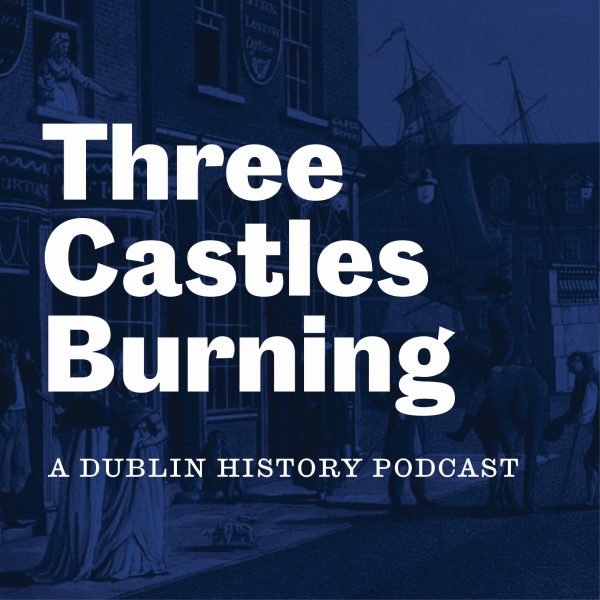
Three Castles Burning
- Épisodes
- 100
- Parution
- toutes les deux semaines
- Dernier épisode
- 29 Oct 2026
À propos du podcast
Three Castles Burning is a social history podcast, dedicated to the story of the Irish capital. Dublin is a city of many stories, Three Castles Burning tells some of the more forgotten ones.
Épisodes 100
From The Sack 'Em Ups to the Anatomy Act: Body Snatching in Dublin Graveyards (with Warren Farrell)
Historian Warren Farrell is the author of the forthcoming Curious Ireland, a follow-up to his best-selling social history of Glasnevin Cemetery. A tour guide at the cemetery over many years, he was the perfect …
Notes de l’épisode
Historian Warren Farrell is the author of the forthcoming Curious Ireland, a follow-up to his best-selling social history of Glasnevin Cemetery. A tour guide at the cemetery over many years, he was the perfect choice for this discussion at the historic Green Street Court. Part of the Bram Stoker Festival, I am grateful to the Irish Court Services who facilitated this live edition of the podcast. A content warning on this one, which is morbid enough at times.
The Dublin of Magill Magazine: From Merrion Row to the Ballymun Towers
Vincent Browne's Magill magazine remains one of the most important publications of its kind in Irish history. Joined by Kevin Rafter (author of Fearless, a new history of the magazine published by New Island …
Notes de l’épisode
Vincent Browne's Magill magazine remains one of the most important publications of its kind in Irish history. Joined by Kevin Rafter (author of Fearless, a new history of the magazine published by New Island Books), we journey through some of its important Dublin stories and locations. From the heroin crisis in suburban Dublin to the failures of the Ballymun project, Magill reported truthfully and fearlessly on life in the capital. Available now from: https://thebookshop.ie/kevin-rafter-fearless-vincent-browne-magill-and-ireland-in-the-1980s-brand-new/
Before the Olympia: Dan Lowrey's Palace of Varieties
In the Victorian age, the entertainer Dan Lowrey created a truly special theatre, music hall and Palace of Varieties in the laneway of Crampton Court. Today, it has grown into the Olympia Theatre. The story of …
Notes de l’épisode
In the Victorian age, the entertainer Dan Lowrey created a truly special theatre, music hall and Palace of Varieties in the laneway of Crampton Court. Today, it has grown into the Olympia Theatre. The story of this theatre involves daredevil antics, the occasional tragedy and visiting celebrities. In this episode we meet characters as diverse as Peadar Kearney and the male impersonator Vesta Tilley.
FÓGRA: The Dublin Festival of History launches this weekend!
A Tribute to Frank McDonald (1950-2026)
Marking the passing of one of the most significant commentators on the past and present of Dublin city, this episode draws from a different discussion with McDonald from the one that featured in an earlier …
Notes de l’épisode
Marking the passing of one of the most significant commentators on the past and present of Dublin city, this episode draws from a different discussion with McDonald from the one that featured in an earlier edition of the show. Reflecting on his own career and friendships, McDonald was in fine flying form as we chatted in Henretta Street. This episode is dedicated to his memory.
Executioners: The Pierrepoint Family
Albert Pierrepoint was a household name in his own lifetime, even penning the best-selling memoir Executioner. A hangman who followed in the footsteps of his father and uncle, Dublin was an important part of …
Notes de l’épisode
Albert Pierrepoint was a household name in his own lifetime, even penning the best-selling memoir Executioner. A hangman who followed in the footsteps of his father and uncle, Dublin was an important part of his story, including both Kilmainham Gaol and Mountjoy prison. In the years of the War of Independence, more than one plan was devised by republicans to keep his uncle Tom from carrying out an execution. In this episode, we look not only at the Pierrepoint family, but the strange history of capital punishment in Ireland.
Madame Tussaud and Dublin: Guillotines and Escape Cars
In the early nineteenth century, Madame Tussaud spent several years in Dublin. Her waxworks and relics of the French Revolution proved a big draw for crowds here, packing out a gallery on Exchequer Street and …
Notes de l’épisode
In the early nineteenth century, Madame Tussaud spent several years in Dublin. Her waxworks and relics of the French Revolution proved a big draw for crowds here, packing out a gallery on Exchequer Street and touring the country. She would even create works honouring the leading Irish politician of the day. Her time in Ireland would shape her later world famous museum, and decades later it acquired a particularly gruesome relic connected to a violent day in Dublin.
Bia Duit: Food in Dublin in 1904 (Live at The Signal House)
In Ulysses, the pub we know as J & M Cleary's appears as The Signal House. It seemed a good location to explore food in the time of James Joyce. Ann Marie Duffin's fantastic page Bia Duit has been exploring …
Notes de l’épisode
In Ulysses, the pub we know as J & M Cleary's appears as The Signal House. It seemed a good location to explore food in the time of James Joyce. Ann Marie Duffin's fantastic page Bia Duit has been exploring food history and folklore, and she joins me to talk all things food in 1904. Ken and Gwen from the brilliant Assassination Custard - a beloved institution on Kevin Street - brought along their own unique contribution to proceedings, with food inspired by the time.
Support TCB at: www.patreon.com/threecastlesburning
A Vision for Irish Theatre: Deirdre O'Connell (with Sabina Higgins)
At the recent Luke Kelly Festival, I was delighted to speak with Sabina Higgins (née Coyne) all about the Focus Theatre and Deirdre O'Connell. Bringing the Stanislavski acting system to Ireland in the 1960s …
Notes de l’épisode
At the recent Luke Kelly Festival, I was delighted to speak with Sabina Higgins (née Coyne) all about the Focus Theatre and Deirdre O'Connell. Bringing the Stanislavski acting system to Ireland in the 1960s, Deirdre transformed how young actors felt about the possibility of the theatre. The tiny Focus Theatre - with the support of Luke Kelly and others - had a massive impact on the theatre here, producing a generation of actors who would have real impact in the Irish arts. We talk about it, and Sabina's career more broadly, including the landmark television programme Insurrection (1966).
Cold War Football: Yugoslavia in Dalymount Park
In October 1955, the visit of Yugoslavia to Dublin caused real division in Irish society. A top-class football side on the world stage, opposition to communism led Archbishop McQuaid and others to call for a …
Notes de l’épisode
In October 1955, the visit of Yugoslavia to Dublin caused real division in Irish society. A top-class football side on the world stage, opposition to communism led Archbishop McQuaid and others to call for a boycott of the game. In a new book, Cold War Football: A History in Ten Matches, Alan McDougall and Tony Shaw examine this match and others like it, weaving Cold War tensions and the excitement of the beautiful game.
Citizen or Lord? The Life of Edward Fitzgerald (with Fergus Whelan and Annie Hughes)
There could be nowhere more fitting to discuss the life of Edward Fitzgerald than upstairs in the Lord Edward, as part of Culture Date with Dublin 8. That he was born into privilege is clear, but Fitzgerald …
Notes de l’épisode
There could be nowhere more fitting to discuss the life of Edward Fitzgerald than upstairs in the Lord Edward, as part of Culture Date with Dublin 8. That he was born into privilege is clear, but Fitzgerald also rejected it, his sister recalling that "he was a Paddy and no more; he desired no other title than this." Annie Hughes is a singer and a member of An Góilín Traditional Singers. Fergus Whelan is author of Enemies of the State: Richard Musgrave, the Rebellion of 1798 and the Making of Sectarian Irish History.
Back to the Census: The Story of Us (with John Gibney)
John Gibney is co-editor of The Story of Us: Independent Ireland and the 1926 Census. On a sunny day, we sat on a bench dedicated in part to a man you'll find in that census, and discussed what is in this …
Notes de l’épisode
John Gibney is co-editor of The Story of Us: Independent Ireland and the 1926 Census. On a sunny day, we sat on a bench dedicated in part to a man you'll find in that census, and discussed what is in this extraordinary landmark census. We look at some interesting people, like the writer Dorothy Macardle, the widowed Maud Gonne MacBride and an influential Italian on Pearse Street. An earlier episode made some predictions, but here we are looking at the real thing. The Story of Us is available now in all good bookshops.
Support TCB: www.patreon.com/threecastlesburning
Stephen's Green Shopping Centre: Dandelions and Developers
It would seem everyone in the city has an opinion on the shopping centre at the top of Grafton Street. With that in mind, it seems a good time for a potted history of it and the site it occupies. Controversial …
Notes de l’épisode
It would seem everyone in the city has an opinion on the shopping centre at the top of Grafton Street. With that in mind, it seems a good time for a potted history of it and the site it occupies. Controversial in its own day, the project was overseen by the architect James Toomey, though it fell somewhat short of the original vision. What is to be done with this 1988 centre, and why has its proposed replacement irked so many?
Support TCB: www.patreon.com/threecastlesburning
Unquiet Ghost: The Bones of Roger Casement (with Rory Carroll)
In 1965, the body of Roger Casement was returned to Ireland. No longer condemned to the grounds of Pentonville Prison, he would be buried in Dublin's Glasnevin Cemetery, where he is one of the first graves a …
Notes de l’épisode
In 1965, the body of Roger Casement was returned to Ireland. No longer condemned to the grounds of Pentonville Prison, he would be buried in Dublin's Glasnevin Cemetery, where he is one of the first graves a visitor encounters today. There were political questions around Casement's body in the 1960s, and his final request was not honoured. Rory Carroll, author of the bestselling 'A Rebel and a Traitor: A Fugitive, the Manhunt and the Birth of the IRA' joins me to discuss Casement, life and afterlife.
More Pricks Than Kicks: The Dublin of Samuel Beckett
Today marks the 120th birthday of Samuel Beckett. Inspired both by this milestone anniversary and by the wonderful new exhibition of the work of photographer John Minihan in the National Gallery of Ireland …
Notes de l’épisode
Today marks the 120th birthday of Samuel Beckett. Inspired both by this milestone anniversary and by the wonderful new exhibition of the work of photographer John Minihan in the National Gallery of Ireland, this episode explores sites that are important to the story of Beckett and Dublin. Some, like Trinity College Dublin, will be familiar. Others, like the family business on Clare Street where he wrote some of his collection More Pricks Than Kicks are unmarked today. Our journey brings us to places as diverse as Elvery's sport shop and Kennedy's pub, as we get to walk in Beckett's footsteps across a city he did love, despite the challenges it put before him.
Quiet Revolutionary: The Life of Éamonn Ceannt
With the 110th anniversary of the Easter Rising upon us, it seems a good time to look at one of the less familiar figures of the story. Somewhat in the shadows, Éamonn Ceannt was a meticulous organiser, vitally …
Notes de l’épisode
With the 110th anniversary of the Easter Rising upon us, it seems a good time to look at one of the less familiar figures of the story. Somewhat in the shadows, Éamonn Ceannt was a meticulous organiser, vitally important not only to the revolutionary movements of his time but traditional music too. His Dublin centred on Rialto, Dolphin's Barn, Crumlin and the surrounding areas, and in this episode we learn about Ceannt's importance to the story of 1916.
(Thanks for your patience as we move - and thanks to all Patreon supporters as always)
Drowning the Shamrock? The Gaelic League and the War on Pubs
In 1903, Saint Patrick's Day formally became a national holiday in Ireland, following a push from the Gaelic League. In the pages of their newspaper, An Claidheamh Soluis, a battle was waged for the closure of …
Notes de l’épisode
In 1903, Saint Patrick's Day formally became a national holiday in Ireland, following a push from the Gaelic League. In the pages of their newspaper, An Claidheamh Soluis, a battle was waged for the closure of public houses on the day. Some publicans stood in opposition to this. This is the story of how a sober St Patrick's Day was achieved, and how it would take until the 1960s for change.
Little Wonder: David Bowie's Secret Gig at The Factory (with Ray O'Donoghue)
In 1997, David Bowie released Earthling, an album deeply influenced by the sound of drum and bass and industrial electronic music. Spending time in Dublin city, Bowie befriended the Quadraphonic collective, who …
Notes de l’épisode
In 1997, David Bowie released Earthling, an album deeply influenced by the sound of drum and bass and industrial electronic music. Spending time in Dublin city, Bowie befriended the Quadraphonic collective, who brought the drum and bass sound to the city at venues like The Globe and The Kitchen. This led to a secret concert at The Factory venue in Ringsend. My guest Ray O'Donoghue is now the Night Time Economy Advisor to Dublin City Council, but was then part of Quadraphonic and opened for Bowie on the night.Contributions also come from John Brereton, Director of the DublinBowie Festival. This episode contains bad language.
Support TCB: www.patreon.com/threecastlesburning
Census City: Dublin 1926
The release of the 1926 census from the National Archives of Ireland is now imminent. These returns should give us fascinating insights into a post-revolutionary Ireland. In this episode, we look at the capital …
Notes de l’épisode
The release of the 1926 census from the National Archives of Ireland is now imminent. These returns should give us fascinating insights into a post-revolutionary Ireland. In this episode, we look at the capital in 1926. It was a defining year in Irish cultural history, with the birth of 2RN and O'Casey's Plough and the Stars, but it was also an austere time. Strikes were plentiful, with the General Strike in Britain grabbing the imagination of some, while the controversial IRA campaign against Moneylenders took up plenty of column inches. From the reconstruction of the city to the birth of Fianna Fáil, this is the story of the capital in a defining census year.
Before the Summer of Love: Emmett Grogan's Dublin Adventure
SERIES 4, EPISODE 1. Welcome back to a new series. Emmett Grogan was one of the defining figures of American counterculture in the 1960s. Though his name is almost completely unknown in Ireland, the author of …
Notes de l’épisode
SERIES 4, EPISODE 1.
Welcome back to a new series. Emmett Grogan was one of the defining figures of American counterculture in the 1960s. Though his name is almost completely unknown in Ireland, the author of Ringolevio: A Life Played for Keeps is a man for whom Bob Dylan dedicated an album, and who was described by Abbie Hoffman (who he distrusted greatly) as "the hippie warrior par excellence." Yet before the Summer of Love took San Francisco, Grogan was in Dublin in the early 1960s. His accounts of the city are fascinating, from Neary's to Guinness, but how much of it is true?
You can read his account here: https://stealthiswiki.com/library/emmett-grogan-ringolevio
From Rutland to Parnell: The Story of a Dublin Square (With Elizabeth Kehoe)
One of Dublin's Historians in Residence, Elizabeth Kehoe has developed a walking tour of Parnell Square which shines a lot on many aspects of its history. Walking around it, we encounter things as diverse as …
Notes de l’épisode
One of Dublin's Historians in Residence, Elizabeth Kehoe has developed a walking tour of Parnell Square which shines a lot on many aspects of its history. Walking around it, we encounter things as diverse as symbolic weapons in the mosaic tiles of the Garden of Remembrance and the coat of arms of the Duke of Rutland. In recognition of the involvement of the Hugh Lane Gallery in Dublin City Council Dublin Winter Lights, Elizabeth took me on a walk around one of Dublin's most important squares. With thanks to Dublin City Council for supporting this edition of the podcast.
When Earley Met Gandon: Bringing Light to the Custom House
James Earley comes from a family rooted in the story of Irish stained glass. As an artist, his work often pays homage to Earley Studios and those who came before him. As part of Dublin City Council Dublin …
Notes de l’épisode
James Earley comes from a family rooted in the story of Irish stained glass. As an artist, his work often pays homage to Earley Studios and those who came before him. As part of Dublin City Council Dublin Winter Lights, he has brought an extraordinary show to James Gandon's Custom House. This offered an opportunity to talk about his career to date, stained glass broadly, and art in the public sphere. With thanks to Dublin City Council for supporting this edition of the podcast. For more information.
Simms City (with Gayle Cullen Doyle and Eoin Ó Broin)
More than just a resident of Oliver Bond House, Gayle Cullen Doyle is a vital voice within her community, advocating for and representing her neighbours. Eoin Ó Broin is the new author (with photographer Mal …
Notes de l’épisode
More than just a resident of Oliver Bond House, Gayle Cullen Doyle is a vital voice within her community, advocating for and representing her neighbours. Eoin Ó Broin is the new author (with photographer Mal McCann) of a study on Herbert Simms, which places schemes like Oliver Bond House in context. Recorded in Oliver Bond House, this discussion is one that emphasises the importance of good quality public housing in any urban environment. Flats and Cottages: Hebert Simms and the Housing of Dublin's Working Class 1932-48 is available now.
You can support Three Castles Burning at www.patreon.com/threecastlesburning
A Christmas Carol and Fenian Fears: Charles Dickens in Dublin
On three occasions, Charles Dickens would speak in Dublin. Each time huge crowds came to hear him speak in the Rotunda, with the crowds spilling out into Sackville Street and well beyond. A Christmas Carol was …
Notes de l’épisode
On three occasions, Charles Dickens would speak in Dublin. Each time huge crowds came to hear him speak in the Rotunda, with the crowds spilling out into Sackville Street and well beyond. A Christmas Carol was the highlight of all three tours. Beyond his readings, Dickens also wrote interesting letters from the city, comparing it favourably to London and Edinburgh. There was once a time when Dublin even had street names taken from the world of Dickens.
Modernist Mausoleum or Masterpiece? The US Embassy in Ballsbridge (With Cormac Murray)
Cormac Murray is the author of a new study of the US Embassy in Ballsbridge. A visual feast, it explores one of Dublin's most unusual buildings in its architectural, social, cultural and political contexts. The …
Notes de l’épisode
Cormac Murray is the author of a new study of the US Embassy in Ballsbridge. A visual feast, it explores one of Dublin's most unusual buildings in its architectural, social, cultural and political contexts. The work of John M. Johansen,described as "a Neoclassical Modernist", the building was something of a never-ending saga. In an edition of just 400, the study is available from Phibsboro Press
You can support Three Castles Burning at Patreon.
The Making of a Brewery (with Ned Guinness)
The story of Guinness is one of great success, yes, but also turbulence. Together with historian Antonia Hart, Ned Guinness has produced a family history that doesn't shy away from the challenges faced, while …
Notes de l’épisode
The story of Guinness is one of great success, yes, but also turbulence. Together with historian Antonia Hart, Ned Guinness has produced a family history that doesn't shy away from the challenges faced, while shining a spotlight on some of the key figures in the ultimate success of the brand. Our story passes through events like 1798 and 1916, but there is also talk of the future.
Please vote for The Dublin Pub: https://www.irishbookawards.ie/
Lord Leitrim, John Twiss and the songs of our year (with Michael Steen)
Lord Leitrim, John Twiss and the songs of our year (with Michael Steen) This edition of the podcast is dedicated to the memory of Manchán Magan. Singer Michael Steen (a member of the An Góilín Traditional …
Notes de l’épisode
Lord Leitrim, John Twiss and the songs of our year (with Michael Steen)
This edition of the podcast is dedicated to the memory of Manchán Magan.
Singer Michael Steen (a member of the An Góilín Traditional Singers Club) has developed an intriguing calendar of the year, which creates a journey of song through the seasons. Some of these songs are tied to folklore traditions, others mark key anniversaries. In this discussion, we touch on all from the story of a detested landlord buried in St Michan's Church to the recently pardoned John Twiss. The calendar is available to view at www.songcalendar.ie.
Please vote For The Dublin Pub at https://www.irishbookawards.ie/vote/
Follow the Irish Traditional Song Calendar on Instagram at: https://www.instagram.com/irishsongcalendar/
Castle Island Colossus: Remembering Con (With Roy Curtis and Brendan Conroy)
At a packed Oak Room in the Mansion House, a celebration of the life of the journalist Con Houlihan last Saturday brought the audience on a journey into the work and passions of one of Ireland's most beloved …
Notes de l’épisode
At a packed Oak Room in the Mansion House, a celebration of the life of the journalist Con Houlihan last Saturday brought the audience on a journey into the work and passions of one of Ireland's most beloved scribes. Born in Castle Island (two words, he insisted) in 1925, Con became the heart of the Evening Press newspaper on Dublin's Burgh Quay. His love for his native Kerry, sport, literature, the theatre, St Patrick's Athletic, the public houses of Dublin and more besides are all explored here. One of Ireland's great actors of the stage, Brendan Conroy reads march reports and other pieces from Con, while the journalist, writer and friend of Con, Roy Curtis, held the attention of the room throughout with his beautiful memories of a man who influenced him greatly. Recorded at the Dublin Festival of History.
Thanks to all Patreons of the podcast (www.patreon.com/threecastlesburning) The Dublin Pub is available (with free post and packaging) from independent bookshop TheBookshop.ie.
Grainne Shaffrey in Conversation: On Cities, Towns and Our Built Environment
Shaffrey Architects was established in 1967 by Patrick and Maura Shaffrey. Based on Ormond Quay,the practice has made a real and meaningful contribution to Dublin and beyond, with projects including 14 …
Notes de l’épisode
Shaffrey Architects was established in 1967 by Patrick and Maura Shaffrey. Based on Ormond Quay,the practice has made a real and meaningful contribution to Dublin and beyond, with projects including 14 Henrietta Street and Wicklow Head Lighthouse. Fifty years on from Patrick Shaffrey producing The Irish Town: An Approach to Survival, Grainne Shaffrey joins me to talk about the journey since. This event was part of the brilliant Seán Corcoran Series in Drogheda's Highlanes Gallery, an annual event dedicated to the life, work and memory of one of Ireland's great collectors and local champions: www.seancorcoranseries.com/
(Image: William Murphy shot of 14 Henrietta Street. Creative Commons. With thanks to William for his on-going photography capturing Dublin.)
Brian Kerr in Conversation: Drimnagh, Libya and Beyond
Brian Kerr's voice is instantly familiar as a broadcaster, and his contribution to Irish football is extraordinary. Born in 1953, his first coaching role came while barely a teenager. In the 1980s he would come …
Notes de l’épisode
Brian Kerr's voice is instantly familiar as a broadcaster, and his contribution to Irish football is extraordinary. Born in 1953, his first coaching role came while barely a teenager. In the 1980s he would come to manage the team he had supported since his childhood, St Patrick's Athletic, before going on to historic victories with Ireland's youth teams in the 1990s. In this discussion, we touch on everything from the 1966 World Cup Final to the visit of the Al-Helal Football Academy in Gaza to Dublin. A little language in this one.
With thanks to Naoise Nunn and all at Mindfield/Electric Picnic. For more on Kerr's story, see Joe O'Rourke's 'The People's Champions' exploring his 1989/1990 league winning side.
Support Three Castles Burning, an independent ad-free podcast, at www.patreon.com/threecastlesburning
Or at www.ko-fi.com/threecastlesburning
Famine Soup: Alexis Soyer, Trevelyan and The Great Hunger in Dublin
Padraic X. Scanlan is the author of Rot: A History of the Irish Famine. Framing the crisis in Ireland within the broader picture of Empire, this book brings much to how we understood the events that reshaped …
Notes de l’épisode
Padraic X. Scanlan is the author of Rot: A History of the Irish Famine. Framing the crisis in Ireland within the broader picture of Empire, this book brings much to how we understood the events that reshaped Ireland. While the crisis recalls rural Ireland, Dublin was central to the story, as the location of the Castle Administration and a bustling port. In this episode we touch on the peculiar story of Alexis Soyer, chef to London's Reform Club, who would arrive in the city in 1847. Establishing a soup kitchen in front of the Royal Barracks, Soyer's intervention was widely condemned in the contemporary press. Rot is available now in all good bookshops.
Voici les 40 derniers épisodes sur 100. Les épisodes plus anciens se trouvent dans le flux du podcast.
Podcasts similaires
Plus de podcasts : Histoire



C’est votre podcast ?
Confirmez-le avec une entrée dans votre flux : vous recevez ici un code, vous l’ajoutez comme podcast:txt dans le canal de votre flux, et nous le vérifions. Votre podcast apparaît ensuite comme « vérifié » sur SoundNode.