

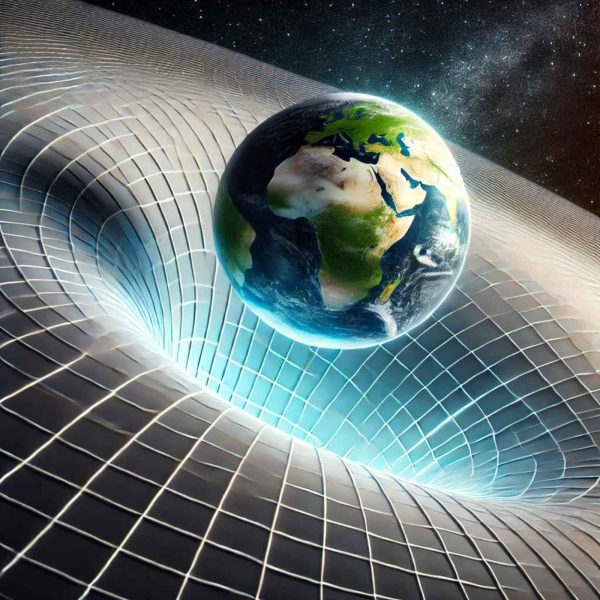
Wonders of Relativity
- Épisodes
- 60
- Parution
- hebdomadaire
- Dernier épisode
- 12 Nov 2026
À propos du podcast
"Theory of Relativity: Simplified" makes Einstein’s groundbreaking ideas accessible to everyone. We break down complex topics like special relativity, general relativity, time dilation, mass-energy equivalence (E=mc²), and gravitational waves in a clear, step-by-step manner. Discover how time slows down, why moving objects shrink, and how gravity warps spacetimeall explained in a way that anyone can understand. Whether you’re a beginner or just curious, join us to explore the wonders of relativity, one concept at a time.
#Relativity #SpecialRelativity #GeneralRelativity #Einstein #TimeDilation #GravitationalWaves #Eequalsmc2 #PhysicsSimplified #TheoryOfRelativity #SpaceTime
Épisodes 60
How Would Our Universe End
Exploring the ultimate fate of the cosmos, modern science evaluates four primary scenarios governed by the spatial geometry of the universe and the dynamic behavior of dark energy. The large-scale shape of the …
Notes de l’épisode
Exploring the ultimate fate of the cosmos, modern science evaluates four primary scenarios governed by the spatial geometry of the universe and the dynamic behavior of dark energy.
The large-scale shape of the universe—categorized as flat, saddle-shaped, or spherical—is determined by the balance between inward gravitational pull and outward expansion, quantified by the critical density parameter Omega. High-precision measurements from the Planck satellite and Baryon Acoustic Oscillation surveys indicate that the universe is remarkably close to flat, with Omega measuring less than 0.04 percent above 1.
However, the cosmos is dominated by dark energy, making up roughly 68% of its composition, whose elusive pressure and behavior over time, represented by the parameter w, dictate its long-term trajectory.
Depending on these delicate cosmic dials, cosmologists outline four potential endpoints for reality. The first is Heat Death, or the great chill, which involves the slow cooling of the cosmos as stars exhaust their fuel, black holes fizzle out, and temperatures approach absolute zero, leaving behind an everlasting state of darkness and stillness.
The second is the Big Rip, a catastrophic scenario where intensifying phantom dark energy accelerates expansion to the point where it overwhelms all attractive forces, violently shredding galaxy clusters, stars, planets, and ultimately molecules and atoms.
The third is the Big Crunch, where dark energy weakens or reverses, causing the universe's expansion to halt and contract into an unimaginably dense, hot point that could potentially trigger a rebound and spark a fresh Big Bang.
Finally, the fourth scenario is the Big Slurp, an alarming possibility involving the universe's metastable Higgs field spontaneously rolling into a lower energy state, generating a bubble of new reality that expands at the speed of light to instantly erase existing physical laws and matter.
Black Hole Information Paradox
Addressing the "black hole information paradox," astronomical observations such as the Event Horizon Telescope's imaging of M87* confirm the presence of event horizons—boundaries marking a point of no return …
Notes de l’épisode
Addressing the "black hole information paradox," astronomical observations such as the Event Horizon Telescope's imaging of M87* confirm the presence of event horizons—boundaries marking a point of no return where general relativity dictates matter proceeds toward an unknown singularity.
While classical mixing or burning preserves underlying physical information through microscopic states and entropy, Jacob Bekenstein and Stephen Hawking established that black holes possess thermodynamic entropy proportional to one-quarter of their horizon area. Recent 2024 mathematical models by Vijay Balasubramanian, Albion Lawrence, Javier Magán, and Martin Sasieta demonstrated that quantum overlaps in nonrotating black hole interiors account for the extensive internal states predicted by the Bekenstein–Hawking area law.
However, Hawking's 1974 and 1975 calculations revealed that quantum vacuum fluctuations near the horizon generate thermal "Hawking radiation" at a temperature inversely proportional to mass, causing black holes to slowly lose energy and evaporate over immense timescales—such as roughly 10⁶⁷ years for a solar-mass black hole.
Because outgoing thermal radiation appears stripped of specific details regarding ingested matter, the complete evaporation of a black hole implies that information is permanently destroyed, presenting a fundamental conflict with the core rules of quantum mechanics.
How Relativity Makes Mercury Weirdest Metal in Universe
Element 80 (mercury) represents a unique liquid anomaly among metals, maintaining a liquid state at standard temperature and pressure down to its freezing point of –39°C, accompanied by an extreme density of …
Notes de l’épisode
Element 80 (mercury) represents a unique liquid anomaly among metals, maintaining a liquid state at standard temperature and pressure down to its freezing point of –39°C, accompanied by an extreme density of 13.5 grams per cubic centimeter and high surface tension.
While group 12 periodic trends—characterized by full d- and s-shells—would predict a solid state, quantum-mechanical simulations published in Physical Review Letters in 2013 by researchers from the University of Tokyo and the Japan Atomic Energy Agency demonstrated that Einstein’s special relativity is required to explain mercury's properties.
The intense positive charge of mercury's 80-proton nucleus accelerates innermost electrons to 58 percent of the speed of light, inducing a relativistic contraction of the outermost 6s orbital.
This relativistic "inert pair effect" tightly binds these bonding electrons, preventing the formation of a delocalized metallic electron sea and reducing interatomic binding to weak van der Waals forces.
Consequently, mercury exhibits "pseudo-noble gas" behavior, characterized by an exceptionally low melting point, poor electrical conductivity relative to other metals, and high cohesive isolation.
Quantum Mechanics vs General Relativity: The Biggest Divide in Physics Right Now
Imagine the universe as a grand puzzle, but two of its most fundamental pieces refuse to fit. Quantum mechanics, the realm of the infinitesimally small, and General Relativity, the theory of gravity and the …
Notes de l’épisode
Imagine the universe as a grand puzzle, but two of its most fundamental pieces refuse to fit.
Quantum mechanics, the realm of the infinitesimally small, and General Relativity, the theory of gravity and the cosmos, offer wildly different, and often conflicting, pictures of reality. In this episode, we delve into the shocking contradictions that arise when these two pillars of modern physics collide.
Why does the smooth, predictable universe of Einstein's gravity clash so violently with the probabilistic, uncertain world of quantum mechanics?
We explore the places where this cosmic divide becomes glaringly apparent: the singularity at the heart of black holes, the birth of the universe, and the enigmatic realm of quantum gravity.
Could this fundamental incompatibility mean our understanding of the universe is fundamentally flawed? Or is there a deeper, hidden reality waiting to be uncovered?
Join us as we confront the terrifying implications of this cosmic schism, where the very fabric of space and time is caught in a battle between two seemingly irreconcilable truths.
Could Quantum Gravity Save Physics?
We examine the current state of Lambda Cold Dark Matter (Lambda CDM), our best model of cosmology. While it remains the reigning champion of cosmology, it is facing an unprecedented onslaught of data from the …
Notes de l’épisode
We examine the current state of Lambda Cold Dark Matter (Lambda CDM), our best model of cosmology. While it remains the reigning champion of cosmology, it is facing an unprecedented onslaught of data from the James Webb Space Telescope (JWST) and advanced underground detectors that are stirring up revolutionary questions.
Lambda CDM has brilliantly predicted the Cosmic Microwave Background (CMB), the distribution of galaxies in colossal filaments, and the chemical elements forged just after the Big Bang. However, several "tensions" are pushing the model to its limits.
The Information Paradox: Can Black Holes Disappear?
Imagine a black hole, that devours everything in its path, including information—the fundamental building block of reality. But what if that information isn't truly lost? In this episode, we dive into the …
Notes de l’épisode
Imagine a black hole, that devours everything in its path, including information—the fundamental building block of reality.
But what if that information isn't truly lost?
In this episode, we dive into the mind-bending information paradox, a clash between Einstein's relativity and quantum mechanics that challenges our very understanding of the universe.
We'll explore the bizarre concept of Hawking radiation, the faint glow emitted by black holes, and the shocking possibility that these cosmic behemoths might actually evaporate, taking their secrets with them.
Do black holes erase information, violating the laws of quantum mechanics? Or does it somehow escape, encoded in the subtle whispers of Hawking radiation?
We'll delve into the radical theories, including the controversial 'firewall' paradox, that attempt to reconcile these conflicting ideas.
Join us as we journey into the heart of the black hole mystery, where the fate of information—and perhaps the universe itself—hangs in the balance.
Amplitude of primordial ripples: Numbers That Make Universe Possible
This episode investigates Q, the fifth of the fundamental constants, which represents the amplitude of primordial ripples in the newborn universe. Measuring approximately 1 in 100,000, this number represents …
Notes de l’épisode
This episode investigates Q, the fifth of the fundamental constants, which represents the amplitude of primordial ripples in the newborn universe. Measuring approximately 1 in 100,000, this number represents the faint "tremor" at the dawn of time that determined whether the cosmos would become a fertile ground for life or a sterile void.
Is this "exquisite calibration" a cosmic coincidence, or are we simply living in one rare bubble of a vast multiverse where the lottery of physics happened to go our way?
Einstein Called this his "Biggest Blunder". Here's Why?
We're talking about the cosmological constant, a mysterious term that once seemed like a mathematical fudge factor, but now appears to be driving the accelerating expansion of the cosmos. In this episode, we …
Notes de l’épisode
We're talking about the cosmological constant, a mysterious term that once seemed like a mathematical fudge factor, but now appears to be driving the accelerating expansion of the cosmos.
In this episode, we journey through the turbulent history of this enigmatic constant, tracing its roots from Einstein's attempts to create a static universe to its modern-day resurgence as a key player in the dark energy puzzle.
Why did Einstein call it his biggest mistake?
What hidden truths about the vacuum of space does it reveal? And could this 'blunder' actually hold the key to understanding the universe's ultimate destiny?
Join us as we delve into the shocking twists and turns of a cosmic mystery that continues to baffle and intrigue the world's greatest minds.
Gravastars: Black Holes' Evil Twin - Part 2
In this second installment, we move past the theory of the Gravastar to look at its engineering—and the massive structural flaws that might break the whole idea. On paper, a static gravastar works perfectly …
Notes de l’épisode
In this second installment, we move past the theory of the Gravastar to look at its engineering—and the massive structural flaws that might break the whole idea.
On paper, a static gravastar works perfectly. But the real universe is a messy, spinning place, and calculations show that the moment a gravastar begins to rotate, it faces catastrophic structural instability.
We pull apart the gravastar’s outer shell—an impossibly delicate skin that, for an object the size of our sun, would be only a tiny fraction of a centimeter thick.
This razor-thin boundary has to handle a brutal cosmic tug-of-war: resisting immense outward pressure from a dark energy core while managing the crushing gravitational pull on the outside.
We explore how this engineering crisis has forced physicists to dream up even wilder alternatives, from "smooth" continuous-pressure stars to the mind-bending "Nestar"—a theoretical object that behaves like a Russian Matryoshka doll of nested matter shells and dark energy cores.
Finally, we look at how these black hole mimickers would actually look through our telescopes, and whether the Event Horizon Telescope can spot the difference between a true singularity and a phantom shell.
Gravastars: Black Holes' Evil Twin - Part 1
In this episode, we pull back the curtain on the most terrifying objects in the cosmos to ask a fundamental question: Do black holes actually exist, or are we looking at something else entirely? We trace the …
Notes de l’épisode
In this episode, we pull back the curtain on the most terrifying objects in the cosmos to ask a fundamental question: Do black holes actually exist, or are we looking at something else entirely?
We trace the incredible journey of how these dark stars went from a dismissed 18th-century theory to an accepted reality, cemented by Karl Schwarzschild's wartime mathematics, Oppenheimer's theories of total collapse, and groundbreaking imagery from the Event Horizon Telescope.
But there is a catch. Our advanced telescopes don't actually see inside a black hole; they only record the superheated plasma swirling outside its borders.
This leaves a small but critical blind spot in our physics—one that avoids the impossible, infinite density of a singularity. Enter the Gravastar (Gravitational Vacuum Star).
We introduce this leading alternative theory: a structured, bizarre cosmic entity that perfectly mimics a black hole from the outside, but operates as a deadly, hollow twin on the inside.
Can Time Flow in Multiple Directions?
In this episode, we dive into one of the most profound mysteries in modern physics: the arrow of time. While our daily lives march relentlessly from past to future, the fundamental equations of the universe …
Notes de l’épisode
In this episode, we dive into one of the most profound mysteries in modern physics: the arrow of time.
While our daily lives march relentlessly from past to future, the fundamental equations of the universe don’t actually care which way time flows; they work perfectly fine in reverse.
We start by exploring the traditional explanation for this one-way street: entropy and the thermodynamic journey from order to disorder.
But then, we push into radical new territory. What if the Big Bang wasn't the absolute beginning of a single timeline, but a "Janus Point"—a cosmic mirror where time split into two futures heading in opposite directions?
We examine the mind-bending theory proposed by physicist Julian Barbour, which flips cosmology on its head by suggesting that time isn't driven by a universe slowly degrading into chaos, but by a relentless, beautiful growth in complexity and structure.
Dark Matter vs Modified Gravity: Biggest Battle in Astrophysics - Part 2
In this second installment, we push past the outer edges of individual galaxies to the largest, most violent events since the Big Bang: colliding galaxy clusters. For years, mainstream astronomers thought they …
Notes de l’épisode
In this second installment, we push past the outer edges of individual galaxies to the largest, most violent events since the Big Bang: colliding galaxy clusters.
For years, mainstream astronomers thought they had a "smoking gun" that completely buried modified gravity.
This was the famous Bullet Cluster, where an invisible mass seemed to sail right through a cosmic smash-up, leaving normal matter far behind, a classic hallmark of dark matter.
But the plot thickens. Armed with groundbreaking 2025-2026 data from the James Webb Space Telescope, the debate has been blown wide open.
While new imagery reveals our universe's invisible components to be more "ghostly" than ever, alternative gravity advocates are fighting back with a provocative claim: dark matter simulations can't explain how these massive structures are moving so fast.
We dive into the mind-bending mathematical tricks, trying to prove that "dark matter" isn't a physical particle at all, but a geometric quirk of spacetime itself.
It’s a high-stakes theoretical showdown where fixing the early universe might just break our reality today.
Dark Matter vs Modified Gravity: Biggest Battle in Astrophysics - Part 1
In this episode, we tackle one of the greatest mysteries in modern astronomy: the universe's missing pull. When scientists realized that the visible matter in galaxies wasn't enough to generate the gravity …
Notes de l’épisode
In this episode, we tackle one of the greatest mysteries in modern astronomy: the universe's missing pull. When scientists realized that the visible matter in galaxies wasn't enough to generate the gravity keeping them intact, it sparked a massive cosmic debate.
We look back at the pioneering work of Vera Rubin and Kent Ford in the desert night, whose unexpected discoveries brought this "missing mass" problem to light.
To fix the math, mainstream science introduced an invisible, untraceable substance known as dark matter. But what if we don't need a mysterious new particle? What if the problem is that our understanding of gravity is wrong?
We dive into the controversial alternative known as MOND (Modified Newtonian Dynamics), which suggests that gravity changes its behavior when it gets incredibly weak.
It’s a fascinating, high-stakes detective story where the prize is figuring out what 85% of our universe is actually made of.
How Relativity Makes Mercury the Weirdest Metal in the Universe
In this episode, we dive into the strange, quantum-mechanical world of heavy metals to uncover how physics alters the elements right before our eyes. We explore the "why" behind gold’s iconic hue and contrast …
Notes de l’épisode
In this episode, we dive into the strange, quantum-mechanical world of heavy metals to uncover how physics alters the elements right before our eyes.
We explore the "why" behind gold’s iconic hue and contrast it with its chemical sibling, silver, to see how massive atomic nuclei change the behavior of electrons.
But this isn't just a physics lesson. The very same relativistic properties that make mercury so unique also make it an environmental nightmare.
We trace the journey of this elusive element from the silent danger of its vapors to the tragic history of Minamata, Japan, where industrial pollution led to a devastating neurological crisis.
Finally, we look at why mercury remains an active global threat today, tracking the latest 2026 environmental bans and the ongoing political battles to keep this toxic legacy out of our ecosystems.
Are White Holes Real: Where Matter Only Comes Out
In this episode, we dive into one of the most provocative and debated predictions of General Relativity: White Holes. While their dark cousins have been photographed and proven to exist, white holes remain a …
Notes de l’épisode
In this episode, we dive into one of the most provocative and debated predictions of General Relativity: White Holes. While their dark cousins have been photographed and proven to exist, white holes remain a tantalizing mathematical "shadow"—an object that defies the laws of cause and effect by allowing matter to only ever exit, never to enter. Are they real cosmic features, or just a beautiful quirk of the equations?
Currently, white holes remain in the realm of high-level math and wild imagination. They represent the boundary where our current understanding of physics might be "contrived" or incomplete. However, as we peer closer at the birth of the universe and the death of black holes, we may find that these cosmic fountains are the missing link in the story of spacetime.
Relativity vs Black Holes
In this episode, we venture into the most extreme environment imaginable: the Singularity. While General Relativity successfully predicts the existence of black holes, it also leads us to a mathematical "brick …
Notes de l’épisode
In this episode, we venture into the most extreme environment imaginable: the Singularity. While General Relativity successfully predicts the existence of black holes, it also leads us to a mathematical "brick wall." We explore why these gravitational prisons are the ultimate laboratory for the next great revolution in physics—the quest to unify the very big with the very small.
Are black holes truly the "end of the road" for matter, or are they signposts pointing toward a deeper reality we haven't yet decoded? By studying the "ringdown" of gravitational waves from merging black holes, we are looking for the first tiny clues that might reveal what's actually happening behind the curtain.
Gravitational Lenses: Nature’s Magnifying Glass
In this episode, we explore Gravitational Lensing, a phenomenon so precise and powerful that it acts as a "cosmic magnifying glass." By using the gravity of entire galaxy clusters to bend and amplify light …
Notes de l’épisode
In this episode, we explore Gravitational Lensing, a phenomenon so precise and powerful that it acts as a "cosmic magnifying glass." By using the gravity of entire galaxy clusters to bend and amplify light, astronomers can peer at objects billions of light-years away that would otherwise remain invisible. It is our most effective tool for weighing the unweighable and seeing the unseeable.
With upcoming missions like the Nancy Grace Roman Space Telescope and the Vera C. Rubin Observatory, we are about to enter a "golden age" of lensing. These observatories will discover thousands of new lenses, helping us solve the greatest mysteries of cosmic expansion and the true nature of dark energy.
Timescape: Model That Could Solve Dark Energy
What if "dark energy" doesn't exist at all, and our clocks are simply ticking at different rates depending on where we are in space?In 2025, a revolutionary proposal called the Timescape model is challenging …
Notes de l’épisode
What if "dark energy" doesn't exist at all, and our clocks are simply ticking at different rates depending on where we are in space?
In 2025, a revolutionary proposal called the Timescape model is challenging the standard consensus that an invisible force is driving the universe's acceleration. Instead of tinkering with the properties of dark energy, this audacious theory throws it out completely, reimagining the cosmos as a landscape of different "time zones" shaped by the uneven distribution of matter.
While Timescape remains outside the mainstream, it provides a provocative alternative to a universe dominated by invisible forces. It suggests that the "accelerated" sprinting of the cosmos might just be the result of a lumpy, layered reality we are only beginning to understand.
Adaptive Optics: How Astronomers Watch Universe
Light from a distant galaxy can travel for a billion years through the vacuum of space, only to be blurred in a fraction of a millisecond by Earth’s turbulent atmosphere. For decades, this "shimmer" limited …
Notes de l’épisode
Light from a distant galaxy can travel for a billion years through the vacuum of space, only to be blurred in a fraction of a millisecond by Earth’s turbulent atmosphere. For decades, this "shimmer" limited even the world's largest telescopes, making them no sharper than much smaller instruments. This episode explores Adaptive Optics (AO)—the revolutionary technology that allows ground-based observatories to cancel out atmospheric distortion in real-time and achieve their full theoretical potential.
Adaptive optics has transformed from an astronomical tool into a vital system for managing the congested space around our world.
What is the Shape of the Universe
For most of history, we viewed our world as a flat plane until observation triumphed over intuition. Today, we face a similar crossroads: space appears flat to our instruments, but could it possess a curvature …
Notes de l’épisode
For most of history, we viewed our world as a flat plane until observation triumphed over intuition. Today, we face a similar crossroads: space appears flat to our instruments, but could it possess a curvature so immense that it is imperceptible from our single vantage point? This episode explores the geometry and global structure of the cosmos, moving from Einstein's vision of a finite universe without boundaries to modern attempts to find "circles in the sky".
Our most powerful tool in this search is the Cosmic Microwave Background (CMB). By measuring the apparent size of hot and cold spots in this 13.8-billion-year-old light, cosmologists create a "cosmic triangle".
While the simplest tests for the universe's shape have come up empty, they set a new minimum scale for the cosmos. Any possible curvature or finiteness lies hidden beyond our current cosmic horizon.
What is Standard Model of Cosmology
In this episode, we pull back the curtain on Lambda CDM, the "guiding star" of modern cosmology. For over two decades, this framework has served as our most reliable map for understanding the universe’s …
Notes de l’épisode
In this episode, we pull back the curtain on Lambda CDM, the "guiding star" of modern cosmology. For over two decades, this framework has served as our most reliable map for understanding the universe’s 14-billion-year history, from the first fraction of a second to the accelerating expansion of today.
Despite its triumphs, Lambda CDM isn't perfect. We still don't know what dark matter is, why dark energy has the value it does, or why local measurements of expansion disagree with early-universe calculations—a mystery known as the Hubble Tension.
Until a challenger emerges that fits the data better, Lambda CDM remains our most coherent storyline of how we arrived at a universe full of stars, planets, and us.
Why Neutrinos Are Weirdest Particles in the Universe
In this episode, we dive into the world of neutrinos—particles so elusive they could travel through a light-year of solid lead without being stopped. These "little neutral ones" are the ultimate cosmic …
Notes de l’épisode
In this episode, we dive into the world of neutrinos—particles so elusive they could travel through a light-year of solid lead without being stopped. These "little neutral ones" are the ultimate cosmic messengers, carrying secrets from the Big Bang, the core of the Sun, and violent stellar explosions directly to us.
We also look beneath our feet at geoneutrinos—ghost particles produced by radioactive decay in Earth’s crust and mantle. By capturing these, scientists are beginning to perform "planetary tomography," mapping the hidden heat and structures of our own world.
Whether they are revealing the chaotic heart of our galaxy or helping us watch a supernova explode hours before its light reaches us, neutrinos are proving that the most influential things in the universe are often the ones we cannot see.
Can We Ever Test Quantum Gravity
Our two best descriptions of reality, General Relativity and Quantum Mechanics, are fundamentally incompatible. For nearly a century, this disconnect has been the most serious enigma in physics. In this …
Notes de l’épisode
Our two best descriptions of reality, General Relativity and Quantum Mechanics, are fundamentally incompatible. For nearly a century, this disconnect has been the most serious enigma in physics.
In this episode, we explore the quest for the "holy grail" of science: Quantum Gravity. While Einstein’s vision of smooth, curved spacetime governs the dance of galaxies, the jittery, probabilistic world of quantum mechanics rules the microscopic realm. When forced together at the heart of a black hole or the moment of the Big Bang, our mathematical equations break down into nonsensical infinities.
#EinsteinRelativity #WarpedSpacetime #GeneralRelativity #PhysicsExplained #Wormholes #PhysicsPodcast
Why Black Holes are Surrounded by a Firewall
In this episode, we explore The Burning Horizon. For decades, the classical view of black holes—informed by Albert Einstein—suggested that crossing the event horizon would be a smooth, uneventful journey into …
Notes de l’épisode
In this episode, we explore The Burning Horizon. For decades, the classical view of black holes—informed by Albert Einstein—suggested that crossing the event horizon would be a smooth, uneventful journey into darkness. But a modern realization in physics suggests that this boundary might actually be a "firewall" of high-energy particles that would instantly erase anything attempting to enter.
We delve into the Fuzzball Theory, which replaces the empty pit of a black hole with a tangled ball of strings as large as the horizon itself. We also examine Black Hole Complementarity, the idea that an astronaut could both be scrambled into radiation and drift safely through the horizon depending on who is watching.
How To Kill A Black Hole
At the heart of our galaxy lies a beast four million times heavier than the Sun—a place where the laws of physics sign a non-disclosure agreement. In this episode,we travel 26,000 light-years away to the edge …
Notes de l’épisode
At the heart of our galaxy lies a beast four million times heavier than the Sun—a place where the laws of physics sign a non-disclosure agreement.
In this episode,we travel 26,000 light-years away to the edge of Sagittarius A. We aren't just here to sightsee; we’re here to ask the ultimate provocation: Can anything kill a black hole? While these titans seem eternal, we explore the theoretical "evil master plans" that could one day topple them.
From the "spaghettification" of the human body to the "impossible" family trees of intermediate-mass holes, join us as we investigate if anything in this universe is truly permanent.
We then, continue our journey through the wonders of relativity, exploring the warped fabric of spacetime and the mysteries that still elude our greatest detectors.
#EinsteinRelativity #WarpedSpacetime #GeneralRelativity #PhysicsExplained #Wormholes #PhysicsPodcast
Mystery of Early Massive Black Holes
This episode investigates a profound "impossible timeline" in our cosmic history. While the first stars only began to shine roughly 200 million years after the Big Bang, astronomers have discovered massive …
Notes de l’épisode
This episode investigates a profound "impossible timeline" in our cosmic history. While the first stars only began to shine roughly 200 million years after the Big Bang, astronomers have discovered massive quasars—engines of unimaginable brightness powered by supermassive black holes—existing just 670 million years after the dawn of time.
We examine the unique prediction of the heavy seed model—early galaxies where the central black hole is actually more massive than all the stars combined. With the James Webb Space Telescope (JWST) now peering back to the cosmic dawn, we are finally receiving answers to how these impossible giants were forged.
What Really Happened at The Big Bang
Welcome back to Wonders of Relativity, where we take us on a cinematic odyssey back to the dawn of everything. We explore the universe’s first 1 second of existence, a fleeting moment that forever defined the …
Notes de l’épisode
Welcome back to Wonders of Relativity, where we take us on a cinematic odyssey back to the dawn of everything.
We explore the universe’s first 1 second of existence, a fleeting moment that forever defined the laws of physics and the fabric of reality.
From the "mind-melting" heat of the Planck Epoch to the explosive stretching of Cosmic Inflation, discover how the universe grew from the size of a bacterium to the scale of the Milky Way in a fraction of a heartbeat.
#EinsteinRelativity #WarpedSpacetime #GeneralRelativity #PhysicsExplained #Wormholes #PhysicsPodcast
Are time-travel Warp Drives possible under General Relativity?
Imagine traversing the vast cosmic distances not by exceeding the speed of light, but by bending the very fabric of space-time itself. The concept of a warp drive, popularized in science fiction, finds a …
Notes de l’épisode
Imagine traversing the vast cosmic distances not by exceeding the speed of light, but by bending the very fabric of space-time itself.
The concept of a warp drive, popularized in science fiction, finds a theoretical, albeit controversial, foothold in Einstein's General Relativity.
But is it truly possible?
In this episode, we delve into the mind-bending physics of the Alcubierre drive, a theoretical construct that proposes 'warping' space to achieve faster-than-light travel.
We'll explore the mind-boggling requirements: negative energy, exotic matter, and the potential paradoxes that arise when we dare to manipulate the very essence of space-time.
Could we ever bypass the ultimate speed limit, or are we forever bound by cosmic laws?
Join us as we navigate the treacherous waters of theoretical physics, where the dream of interstellar travel clashes with the stark realities of our universe, and discover if warp drives are a tantalizing possibility or a cosmic illusion.
How Relativity Predicts White Holes: Where Matter Can Only Exit but never Enter
"What if everything you thought you knew about black holes was only half the story? Imagine a cosmic entity that doesn't consume, but violently expels—a theoretical phenomenon known as a white hole. In this …
Notes de l’épisode
"What if everything you thought you knew about black holes was only half the story?
Imagine a cosmic entity that doesn't consume, but violently expels—a theoretical phenomenon known as a white hole.
In this episode, we plunge into the baffling realm of these hypothetical objects, where time and space might reverse.
Are they the explosive counterparts to black holes, or something far stranger?
We'll journey through the mind-bending physics that suggests matter and light could be ejected from these enigmatic regions, exploring theories that link them to the very birth of universes and the far side of black holes.
Join us as we unravel the mystery of white holes: the cosmic enigma that dares to challenge our understanding of reality, and where the impossible just might be real."
Quasiparticles that are both Light and Matter: Mystery of Polaritons
Ever wondered how light and matter can merge? Dive into the fascinating world of polaritons! In this episode, we break down these hybrid quasiparticles into simple physics terms. Imagine light, as photons …
Notes de l’épisode
Ever wondered how light and matter can merge? Dive into the fascinating world of polaritons!
In this episode, we break down these hybrid quasiparticles into simple physics terms. Imagine light, as photons, dancing with excitons, the excited states in materials.
When they strongly couple, they become polaritons – neither fully light nor matter, but something uniquely in between.
We'll explore how this "light-matter dance" creates quasiparticles with extraordinary properties. Learn why scientists are excited about their potential in quantum technologies and ultra-efficient photonics.
Forget complex equations; we're focusing on the basic concepts, making polaritons accessible to everyone. Tune in to understand this cutting-edge area of physics!
Voici les 40 derniers épisodes sur 60. Les épisodes plus anciens se trouvent dans le flux du podcast.
Podcasts similaires
Plus de podcasts : Sciences



C’est votre podcast ?
Confirmez-le avec une entrée dans votre flux : vous recevez ici un code, vous l’ajoutez comme podcast:txt dans le canal de votre flux, et nous le vérifions. Votre podcast apparaît ensuite comme « vérifié » sur SoundNode.