

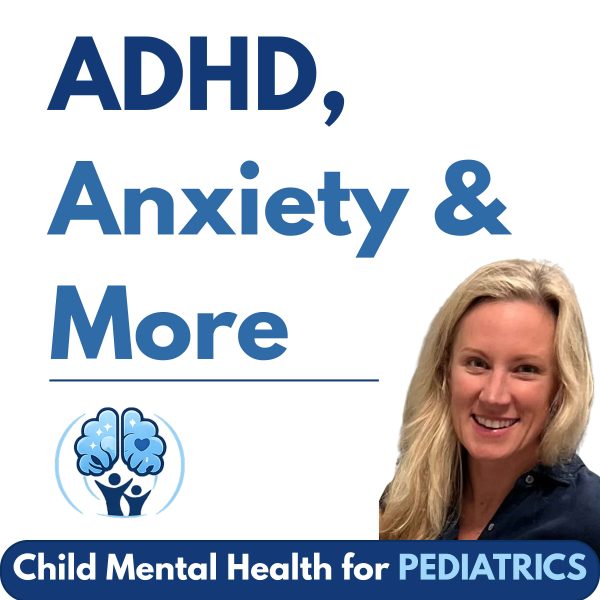
ADHD, Anxiety & More: Child Mental Health for Pediatrics
- Folgen
- 93
- Erscheint
- wöchentlich
- Letzte Folge
- 10. Nov. 2026
Über den Podcast
ADHD, Anxiety & More - formerly Child Mental Health for Pediatric Clinicians / PsychEd4Peds - is the podcast for pediatric primary care clinicians who want practical, evidence-based guidance for diagnosing and treating children and adolescents with mental health conditions.
Hosted by Elise Fallucco, MD, a nationally recognized child and adolescent psychiatrist and speaker whose educational programs have helped thousands of
pediatric clinicians improve their confidence in caring for children with mental health problems. This podcast is for pediatricians, pediatric nurse practitioners, physician assistants, family physicians, and other pediatric clinicians who want to confidently care for kids with ADHD, anxiety, depression, autism spectrum disorder, behavioral concerns, trauma, and other common pediatric mental health conditions.
Each episode translates the latest evidence into practical clinical pearls you can use in your office the very next day. Through conversations with leading experts in child psychiatry, psychology, pediatrics, and behavioral health, Dr. Fallucco shares real-world strategies, diagnostic tips, medication guidance, and communication tools designed specifically for busy primary care clinicians.
Are you looking for answers to questions like:
• Which ADHD medication should I start first?
• When should I use a non-stimulant?
• How do I treat ADHD and anxiety together?
• Could this be ADHD, anxiety, autism, bipolar disorder, trauma, or a learning disorder?
• Which screening tools should I use?
• When should I start an SSRI?
• How do I manage common medication side effects?
• When should I refer to child psychiatry?
• How can I support children, teens, and families with confidence?
Whether you're evaluating ADHD, treating anxiety, managing behavioral challenges, prescribing stimulants or SSRIs, collaborating with schools, or navigating complex mental health presentations, ADHD, Anxiety & Beyond delivers practical, evidence-based clinical pearls to help you provide exceptional mental health care for children and adolescents.
Folgen 93
91. Parenting Middle Schoolers: How to Raise Confident, Independent Teens
Send us Fan MailChild psychiatrist Dr. Elise Fallucco discusses why parenting middle schoolers is uniquely stressful and how to raise confident, independent teens by focusing on resilience rather than removing …
Shownotes
Child psychiatrist Dr. Elise Fallucco discusses why parenting middle schoolers is uniquely stressful and how to raise confident, independent teens by focusing on resilience rather than removing obstacles.
She explains three common default parenting styles that we use when kids are upset—rescuer, laid-back, and coaching—highlighting the strengths and drawbacks of each, and emphasizes coaching as an effective approach.
Dr. Fallucco describes the intense social and performance pressures middle schoolers face, amplified by a 24/7 digital world, and outlines resilience as “fail, try, succeed.” Through case examples (not making a team, losing a best friend, forgetting an item at school), she demonstrates coaching steps: validate emotions, then ask how to support and empower the child to solve the problem, using rescue only for true safety or high-stakes situations.
00:00 Middle School Parenting Intro
00:45 Parenting Styles Check-In
01:49 Why Middle School Is Hard
05:15 Building Resilience Basics
06:36 Case Study Missing the Team
10:24 Case Study Friendship Fallout
12:28 Case Study Forgotten Item
13:45 Wrap-Up and Takeaways
Sign-up for our NEWSLETTER
Check out PsychEd4Peds.com for more resources!
SOCIAL @psyched4peds
On-demand CME Course online at: Pediatric Mental Health CME Toolkit - Cracking the ADHD Code: Essentials for Pediatric Clinicians.
90. Autism Runs in Families: How Pediatricians Can Support Neurodivergent Children and Parents with Greer Jones
Send us Fan MailWe continue our conversation with Greer Jones, host of Neurodivergent Conversations and mom of two neurodivergent children, about practical ways pediatric clinicians can better support families …
Shownotes
We continue our conversation with Greer Jones, host of Neurodivergent Conversations and mom of two neurodivergent children, about practical ways pediatric clinicians can better support families raising autistic children.
We explore why neurodivergence often runs in families, how a parent’s own undiagnosed ADHD or autism may shape their parenting experience, and why something as simple as simplifying intake forms can make a big difference.
Greer also shares insights about sensory differences within families, resources to help parents manage the stress of caregiving, and the importance of connection and community. Most importantly, we wrap up with a powerful reminder: our job isn’t to help autistic children fit into the world, but to understand their world, recognize their strengths, and partner with them along the way.
About our guest: Greer Jones, host of Neurodivergent Conversations, neuro-affirming parent coach, and mother of two neurodivergent children.
Greer's own resources
- The Unfinished Idea — her website, blog, and parent support resources.
- Neurodivergent Conversations — episodes on autistic burnout, emotional regulation, school support, and the realities of neurodivergent parenting.
Sign-up for our NEWSLETTER
Check out PsychEd4Peds.com for more resources!
SOCIAL @psyched4peds
On-demand CME Course online at: Pediatric Mental Health CME Toolkit - Cracking the ADHD Code: Essentials for Pediatric Clinicians.
89. Autism and Parenting : What Pediatricians Need to Know about Meltdowns, Emotions, and Family Stress with Greer Jones
Send us Fan MailWhat is it really like to parent an autistic child? And what do pediatricians need to understand about the experience that families may not share during a brief office visit?In Part 1 of this …
Shownotes
What is it really like to parent an autistic child? And what do pediatricians need to understand about the experience that families may not share during a brief office visit?
In Part 1 of this two-part conversation, I’m joined by Greer Jones, a UK-based neuro-affirming parent coach, speaker, host of the Neurodivergent Podcast, and "mum" to two neurodivergent children. Greer brings a valuable perspective to this conversation, helping us better understand the day-to-day realities of raising a neurodivergent child.
In this episode, we discuss:
- The strengths, joys, and unique experiences of parenting autistic children
- What meltdowns and big emotions may communicate about a child's experience
- Why we need to look beyond behavior to understand what's happening beneath the surface
- The challenges of recognizing and supporting children whose disabilities may not be immediately visible
- How pediatricians can better understand parents' experiences and help families feel heard, validated, and less alone
Most importantly, we discuss how pediatricians can shift their perspective to see the whole child—not just the diagnosis or the behavior—and better support the entire family.
Whether you're a pediatrician, a primary care clinician, or someone who works with neurodivergent children and their families, this conversation is an invitation to listen, learn, and approach autism with greater curiosity, compassion, and understanding.
About our Guest:Greer Jones, host of Neurodivergent Conversations, neuro-affirming parent coach, and mother of two neurodivergent children.
- The Unfinished Idea — her website, blog, and parent support resources.
- Neurodivergent Conversations — episodes on autistic burnout, emotional regulation, school support, and the realities of neurodivergent parenting.
Sign-up for our NEWSLETTER
Check out PsychEd4Peds.com for more resources!
SOCIAL @psyched4peds
On-demand CME Course online at: Pediatric Mental Health CME Toolkit - Cracking the ADHD Code: Essentials for Pediatric Clinicians.
88. Raising Resilient Kids: When to Step In, When to Step Back (Rescuer vs Coach Parenting)
Send us Fan MailDr. Elise Fallucco, child psychiatrist and host of the ADHD Anxiety and More podcast, shares parent-focused tips for raising resilient, capable children.She talks about 3 contrasting parenting …
Shownotes
Dr. Elise Fallucco, child psychiatrist and host of the ADHD Anxiety and More podcast, shares parent-focused tips for raising resilient, capable children.
She talks about 3 contrasting parenting styles—rescuer, laid-back, and coach— and talks about when each style makes sense.
The Rescuer Parent - wants to FIX problems FOR their child
The Laid-back Parent - lets their child sort things out on their own
The Coach Parent - Workings WITH the child to help them solve problems
She explains common age-based struggles (emotional regulation in preschool, frustration with academics and skills in early grades, and social dynamics in grades 3–5) and reframes disappointment and failure as normal developmental opportunities.
Using the “fail, try, succeed” cycle, she shows how rescuing can stunt growth, then offers coaching steps—validate feelings and ask how to support or guide with questions—through examples like not getting a desired role in a play, homework meltdowns, and forgetting water bottles.
00:00 Welcome and Goals
01:02 Parenting Styles Quiz
02:17 Why Kids Struggle
04:30 Fail Try Succeed Cycle
05:41 Stop Rescuing Start Coaching
07:26 Case Study School Play
10:08 Case Study Homework Meltdown
11:36 Case Study Forgotten Water Bottle
12:41 Final Takeaways and Wrap Up
Sign-up for our NEWSLETTER
Check out PsychEd4Peds.com for more resources!
SOCIAL @psyched4peds
On-demand CME Course online at: Pediatric Mental Health CME Toolkit - Cracking the ADHD Code: Essentials for Pediatric Clinicians.
87. Teen Suicide Prevention: Why Depression Screening Isn't Enough
Send us Fan MailDepression screening and suicide screening are not the same thing—and relying on the PHQ-9 alone can miss youth who are at risk for suicide.In this episode, I break down a quick, practical …
Shownotes
Depression screening and suicide screening are not the same thing—and relying on the PHQ-9 alone can miss youth who are at risk for suicide.
In this episode, I break down a quick, practical approach to suicide screening and risk assessment in primary care —including what to do when a screening tool comes back positive.
In this episode, you’ll learn:
- 🚨 Why the PHQ-9 isn’t enough — and how many at-risk youth can slip through the cracks when you rely on depression screening alone.
- 🔎 Who deserves extra attention — including youth with ADHD, anxiety, depression, substance use, trauma, self-harm, or a family history of suicide.
- 📝 The quick, free screening tool I recommend — the ASQ (Ask Suicide-Screening Questions), which can be used alongside your usual depression screener.
- 🧭 What to do when the suicide screen is positive — without automatically sending every child to the ER.
- 🚦 The 4-step framework for deciding: ER or outpatient?
- Ask about current suicidal thoughts
- Assess plan, intent, and previous attempts
- Check whether the child can be safe at home
- Decide whether they need emergency evaluation or outpatient management
- 🏠 The two home-safety questions you should always ask before sending a higher-risk child home.
- 💡 How to make suicide screening actually work in a busy pediatric practice without adding another impossible-to-manage task to your day.
The big takeaway:
Depression screening ≠ suicide screening. Adding a brief, validated suicide screening tool can help you identify kids who might otherwise be missed—and give you a structured way to decide what to do next.Resources mentioned
- ASQ (Ask Suicide-Screening Questions) Toolkit, including the PHQ-9 + ASQ screening tool available at https://www.nimh.nih.gov/research/research-conducted-at-nimh/asq-toolkit-materials
- Brief Suicide Safety Assessment Worksheet
- https://www.nimh.nih.gov/research/research-conducted-at-nimh/asq-toolkit-materials/youth-asq-toolkit#outpatient
24/7 National Suicide Prevention Lifeline 1-800-273-TALK (8255)
En Español: 1-888-628-9454
24/7 Crisis Text Line: Text “HOME” to 741-741
References
Horowitz LM et al. Screening Pediatric Medical Patients for Suicide Risk: Is Depression Screening Enough? J Adolesc Health. 2021 Jun;68(6):1183-1188.
Kemper AR et al. Depression and Suicide-Risk Screening Results in Pediatric Primary Care. Pediatrics. 2021 Jul;148(1):e2021049999.
Kim Y, Krause TM, Lane SD. Trends and Seasonality of Emergency Department Visits and Hospitalizations for Suicidality Among Children and Adolescents in the US from 2016 to 2021. JAMA Netw Open. 2023 Jul 3;6(7):e2324183.
Sign-up for our NEWSLETTER
Check out PsychEd4Peds.com for more resources!
SOCIAL @psyched4peds
On-demand CME Course online at: Pediatric Mental Health CME Toolkit - Cracking the ADHD Code: Essentials for Pediatric Clinicians.
86. Pediatric Mental Health: From Overwhelmed to Confident
Send us Fan MailWhere are YOU on your pediatric mental health journey?If you’ve ever felt nervous when a child’s mental health screen comes back positive, frustrated when straightforward ADHD treatment suddenly …
Shownotes
Where are YOU on your pediatric mental health journey?
If you’ve ever felt nervous when a child’s mental health screen comes back positive, frustrated when straightforward ADHD treatment suddenly becomes complicated, or overwhelmed because you’ve become the “mental health person” in your practice—this episode is for you.
In this episode, Dr. Elise Fallucco introduces the 4 phases of the Pediatric Mental Health Champion Journey:
Phase 1: Running Scared →
Phase 2: Basic Treatment Frustration →
Phase 3: Mental Health Overload →
Phase 4: Champion Mode.
She walks through the signs and challenges of each phase and, most importantly, the practical steps you can take to move forward—from building confidence with ADHD evaluation and treatment, to managing anxiety and more complex comorbidities, to creating systems, boundaries, and workflows that prevent burnout.
The goal isn’t to become a child psychiatrist. It’s to become a confident, competent pediatric clinician who can recognize, evaluate, and treat the mental health problems you’re equipped to manage—and know where your boundaries are. Listen to discover which phase you’re in and your next step toward becoming a pediatric mental health champion.
00:00 Pediatric Champion Journey
01:34 Phase One Running Scared
04:25 Phase One Action Steps
07:13 Phase Two Frustration
08:46 Phase Two Level Up
12:20 Systems Templates Boundaries
16:19 Phase Four Champion Mode
17:18 Recap and Next Steps
Sign-up for our NEWSLETTER
Check out PsychEd4Peds.com for more resources!
SOCIAL @psyched4peds
On-demand CME Course online at: Pediatric Mental Health CME Toolkit - Cracking the ADHD Code: Essentials for Pediatric Clinicians.
85. Anxiety in Kids: When Is Therapy Enough—and When Should You Add an SSRI? (And why Remission Matters)
Send us Fan MailEpisode 85 of ADHD, Anxiety & More is for pediatric clinicians who want to know when to prescribe medication for children and teens with anxiety. In this episode, you will learn about:Which …
Shownotes
Episode 85 of ADHD, Anxiety & More is for pediatric clinicians who want to know when to prescribe medication for children and teens with anxiety.
In this episode, you will learn about:
- Which treatment (therapy, medication, or combination of both) offers the highest response for child and teen anxiety
- Why it is important to treat anxiety to remission
- The 3 things to do when referring to CBT
She explains why remission matters, citing follow-up findings that remission is associated with better long-term outcomes including lower suicidal behavior and substance use problems.
She also advises clinicians to ensure therapy is true CBT, track symptoms over time with tools like the SCARED, and revisit treatment within 4–6 week intervals if improvement is not robust.
00:00 Anxiety Treatment Choices
03:01 CBT vs SSRI vs Both
03:35 Evidence From CAMS
04:26 Why Remission Matters
07:43 Option One CBT Done Right
12:20 Option Two SSRI When Therapy Is Hard
14:07 Option Three Combination Gold Standard
15:49 Take Home Points and Wrap Up
Sign-up for our NEWSLETTER
Check out PsychEd4Peds.com for more resources!
SOCIAL @psyched4peds
On-demand CME Course online at: Pediatric Mental Health CME Toolkit - Cracking the ADHD Code: Essentials for Pediatric Clinicians.
84. Anxiety: When is it normal? When does it need treatment?
Send us Fan MailAnxiety is a normal human emotion. So, how do you know when it’s developmentally typical and when it has crossed the line into something that needs treatment? In this episode, Dr. Fallucco walks …
Shownotes
Anxiety is a normal human emotion. So, how do you know when it’s developmentally typical and when it has crossed the line into something that needs treatment?
In this episode, Dr. Fallucco walks through a practical approach pediatric clinicians can use to recognize clinically significant anxiety that requires treatment.
We talk about Screening, Taking a focused history of Anxiety, and determining whether the anxiety needs treatment.
In this episode, you’ll learn:
- Who to screen for anxiety—and when to keep anxiety on your radar during ADHD, depression, or unexplained physical/behavioral evaluations
- Why the SCARED-5 is a practical anxiety screening tool for pediatric primary care
- Simple questions you can ask after a positive screen to better understand what a child is worried about
- The four questions that can help you distinguish developmentally typical anxiety from clinically significant anxiety: Is it proportional? Is it developmentally expected? Is it causing distress? Is it impairing the child or family?
- How anxiety may look different in younger versus older children, including behavioral symptoms, physical complaints, irritability, and avoidance
- When to consider treatment—and why CBT is an important first-line intervention for many children with anxiety
Sign-up for our NEWSLETTER
Check out PsychEd4Peds.com for more resources!
SOCIAL @psyched4peds
On-demand CME Course online at: Pediatric Mental Health CME Toolkit - Cracking the ADHD Code: Essentials for Pediatric Clinicians.
83. ADHD and Epilepsy: Can You Safely Prescribe Stimulants?
Send us Fan MailJoin us for the latest Mystery Case: A teen with ADHD + EpilepsyWould you prescribe a stimulant?How do you treat ADHD in people who have epilepsy?In this episode, we unpack:• The surprising …
Shownotes
Join us for the latest Mystery Case: A teen with ADHD + Epilepsy
Would you prescribe a stimulant?
How do you treat ADHD in people who have epilepsy?
In this episode, we unpack:
• The surprising relationship between ADHD and epilepsy
• Why ADHD is easy to miss in kids with epilepsy
• Where the concern about stimulants and seizures came from
• What newer research tells us about stimulant treatment in kids with epilepsy
• How I would approach treatment—and monitoring—in people with epilepsy00:00 Welcome and Mystery Case
00:30 ADHD and Epilepsy Link
01:30 Bidirectional Risk Explained
02:58 Seizure History Details
04:00 Treatment Options Debate
06:03 Stimulants and Seizure Evidence
09:14 Best Answer and Monitoring Plan
10:28 Wrap Up and Thanks
Studies referenced in the episode:
Auvin S et al. Systematic review of the screening, diagnosis, and management of ADHD in children with epilepsy. Consensus paper of the Task Force on Comorbidities of the ILAE Pediatric Commission. Epilepsia. 2018
Brikell I et al. Medication treatment for ADHD and the risk of acute seizures in individuals with epilepsy. Epilepsia. 2019
Cochrane Database of Systematic Reviews. Stimulant and non-stimulant drug-therapy for people with ADHD and Epilepsy 2022.
Kwon CS et al. Psychiatric comorbidities in persons with epilepsy compared with persons without epilepsy. JAMA Neurology. 2025
Liu X et al. Stimulant do not increase the risk of seizure-related hospitalization in children with epilepsy. J Child Adol Psychopharm. 2018.
Wang S et al. Comorbidity of epilepsy and ADHD: a Systematic review and meta-analysis. J Neurology. 2023
Wiggs KK, Chang Z, Quinn PD, Hur K, Gibbons R, Dunn D, Brikell I, Larsson H, D'Onofrio BM. Attention-deficit/hyperactivity disorder medication and seizures. Neurology. 2018
Sign-up for our NEWSLETTER
Check out PsychEd4Peds.com for more resources!
SOCIAL @psyched4peds
On-demand CME Course online at: Pediatric Mental Health CME Toolkit - Cracking the ADHD Code: Essentials for Pediatric Clinicians.
82. ADHD Treatment beyond Meds: Exercise and Nutrition
Send us Fan MailWhat ELSE helps ADHD symptoms (in addition to meds?) What does the evidence say about non-medication treatment options for ADHD? We talk about...behavioral therapy exercise - which is an …
Shownotes
What ELSE helps ADHD symptoms (in addition to meds?) What does the evidence say about non-medication treatment options for ADHD? We talk about...
- behavioral therapy
- exercise - which is an under-prescribed intervention,
- Think 30 minutes of moderate-to-vigorous activity 3 times weekly for 8–12 weeks
- What about Nutrition?
- omega-3 fatty acids may help with emotional lability in ADHD
- broad-spectrum micronutrients??
00:00 ADHD Treatmetn BEYOND MEDS Overview
02:16 Therapy Evidence Basics
03:47 Medication Hesitancy Case
04:53 Exercise As Treatment
06:34 How Exercise Works
08:14 Exercise Prescription Tips
08:59 Omega 3 For Mood
11:08 Micronutrients Caution
13:22 Recap And Next Steps
14:09 Wrap Up And Subscribe
Sign-up for our NEWSLETTER
Check out PsychEd4Peds.com for more resources!
SOCIAL @psyched4peds
On-demand CME Course online at: Pediatric Mental Health CME Toolkit - Cracking the ADHD Code: Essentials for Pediatric Clinicians.
81. Chronic Abdominal Pain in Kids: The Gut-Brain Connection and How to Help
Send us Fan MailHow can we support children and families who struggle with chronic abdominal pain? Dr. Fallucco shares an episode from The Pediatrician Next Door, an excellent podcast hosted by pediatrician Dr …
Shownotes
How can we support children and families who struggle with chronic abdominal pain? Dr. Fallucco shares an episode from The Pediatrician Next Door, an excellent podcast hosted by pediatrician Dr. Wendy Hunter. Dr. Hunter talks with Dr. Ali Navidi, a psychologist who specializes in disorders of gut-brain interaction.
- Dr. Navidi explains why some kids experience abdominal pain, nausea, diarrhea in a way that makes sense to families
- Dr. Navidi talks about the role of psychological treatments—including clinical hypnosis—in helping kids retrain these brain-gut pathways.
For more helpful episodes for parents and families about
The Pediatrician Next Door with Dr. Wendy Hunter:
"I answer the questions you forgot or were too embarrassed to ask your doctor. I mix the science of medicine with the reality of parenting to give you satisfying answers to your parenting questions!"
Website: https://www.pediatriciannextdoorpodcast.com/
Dr. Ali Navidi, PsyD from GI Psychology
https://www.gipsychology.com/
Sign-up for our NEWSLETTER
Check out PsychEd4Peds.com for more resources!
SOCIAL @psyched4peds
On-demand CME Course online at: Pediatric Mental Health CME Toolkit - Cracking the ADHD Code: Essentials for Pediatric Clinicians.
80. Viloxazine (Qelbree) or Atomoxetine (Strattera) for ADHD: Which should you choose?
Send us Fan Mail Dr. Elise Fallucco continues this series on non-stimulant medication for ADHD and shares practical tips about using Norepinephrine Reuptake Inhibitors (NRIs): viloxazine ER (Qelbree) and …
Shownotes
Dr. Elise Fallucco continues this series on non-stimulant medication for ADHD and shares practical tips about using Norepinephrine Reuptake Inhibitors (NRIs): viloxazine ER (Qelbree) and atomoxetine (Strattera) for pediatric clinicians.
Who can benefit from NRIs? What are the potential benefits, drawbacks, and side effects?
Working through the case of a 12-year-old girl with inattentive ADHD and anxiety who cannot tolerate methylphenidate or amphetamine , she explains why she generally prefers Viloxazine ER (Qelbree)
- FDA approval for ADHD in children ages 6+
- Quicker onset (often within 1–2 weeks vs 4–6 weeks for atomoxetine)
- Better tolerability
- More straightforward dosing
- Unlike Atomoxetine (Strattera), you can dose this medication without worrying about significant genetic variability in drug metabolism
00:00 NRIs for ADHD
00:38 When to Use
01:07 Case Introduction
02:51 Stimulant Trials Fail
04:09 Considering NRIs
04:30 Why Qelbree First
05:51 Atomoxetine Caveats
07:23 Treating Sophie
08:45 Clinical Pearls Recap
09:50 Wrap Up and CME
Sign-up for our NEWSLETTER
Check out PsychEd4Peds.com for more resources!
SOCIAL @psyched4peds
On-demand CME Course online at: Pediatric Mental Health CME Toolkit - Cracking the ADHD Code: Essentials for Pediatric Clinicians.
79. When stimulants don't work: Guanfacine and Clonidine explained
Send us Fan MailWhile stimulant meds are first-line treatment for ADHD, they do NOT work for everyone... or sometimes they only PARTIALLY help. So, what can you do in these situations?When is the right time to …
Shownotes
While stimulant meds are first-line treatment for ADHD, they do NOT work for everyone... or sometimes they only PARTIALLY help. So, what can you do in these situations?
- When is the right time to try a non-stimulant medication like Guanfacine and Clonidine (a.k.a - alpha-agonists?)?
- In which clinical situations can these alpha-agonists be helpful?
- How do you know when to switch from one stimulant to another stimulant
- When should you try adding on or switching to an alpha-agonist?
In this episode, Dr. Elise Fallucco talks about guanfacine XR (Intuniv) and clonidine (Kapvay/Onyda XR)—and how to decide whether to switch stimulants or augment them. Using an 11-year-old with improved attention on a stimulant but persistent impulsivity/oppositionality and dose-limiting side effects, she explains that switching is best when there’s little benefit or unacceptable side effects, while augmentation makes sense with partial response. She reviews key scenarios for alpha agonists: residual impulsivity/hyperactivity/behavior dysregulation, ADHD with tics, possible adjunct use in ADHD with anxiety (not primary anxiety treatment), and late-day rebound near bedtime. She describes “peanut butter and jelly” synergy with stimulants, monitoring vitals, dosing/titration, sedation differences (more with clonidine), and the need to taper to avoid rebound hypertension.
Sign-up for our NEWSLETTER
Check out PsychEd4Peds.com for more resources!
SOCIAL @psyched4peds
On-demand CME Course online at: Pediatric Mental Health CME Toolkit - Cracking the ADHD Code: Essentials for Pediatric Clinicians.
78. ADHD Meds: Which Stimulant Should you start first?
Send us Fan MailIt’s back-to-school season—and that often means a surge of ADHD concerns as academic demands ramp up, especially around key school transitions like 3rd, 6th, and 9th grade. In this episode of …
Shownotes
It’s back-to-school season—and that often means a surge of ADHD concerns as academic demands ramp up, especially around key school transitions like 3rd, 6th, and 9th grade.
In this episode of ADHD, Anxiety, and More, Dr. Elise Fallucco shares a practical, confidence-building approach to picking stimulant treatment for children and teens, answering questions like:
Which ADHD medication should I start first?
When should you use methylphenidate medications like Ritalin or Concerta?
When should you use amphetamine-salt medications like Adderall or Vyvanse?
How does family history help direct treatment choices?
When does it make sense to try a d-methylphenidate medication like Focalin?
00:00 Podcast Rebrand Update
00:30 Back to School ADHD Surge
01:09 ADHD Evaluation Basics
02:36 Case Introduction Third Grader
03:04 Rule of Three Transitions
04:09 Parents Nervous About Meds
04:45 Family History Medication Clues
06:06 Step One Start Methylphenidate
06:33 Short Acting First Rationale
08:05 When to Use Long Acting
08:30 Long Acting Coverage Limits
09:27 Step Two Try Amphetamines
10:59 Step Three Consider Focalin
11:52 Wrap Up Simple Stimulant Toolkit
12:43 Bonus Algorithm and Course
14:00 Closing and Next Week Preview
Sign-up for our NEWSLETTER
Check out PsychEd4Peds.com for more resources!
SOCIAL @psyched4peds
On-demand CME Course online at: Pediatric Mental Health CME Toolkit - Cracking the ADHD Code: Essentials for Pediatric Clinicians.
Helping Kids Thrive Through Sports with Coach Peter Verhoef (Summer Replay)
Send us Fan MailWhat can we learn from an Elite Coach about how to help young athletes THRIVE through sports? Join us as we chat with Coach Peter Verhoef, head coach and aquatics director at the Bolles School …
Shownotes
What can we learn from an Elite Coach about how to help young athletes THRIVE through sports? Join us as we chat with Coach Peter Verhoef, head coach and aquatics director at the Bolles School Swimming Program and former Olympic Trials finalist (2x).
We discuss:
- Why do so many kids quit organized sports by age 13?
- How can we prevent burnout?
- When are teens MOST vulnerable to burnout?
- How much time off/rest is reasonable? Does it very by sport?
03:36 Benefits of Youth sports
06:04 Preventing Burnout in Youth Sports
06:32 Engagement in Youth Sports and Burnout
06:44 Promoting Individual Achievement
08:35 Managing Physical and emotional exhaustion
09:13 Driver's License BURNOUT
12:00 Tips for Parents to help Preventing Burnout
16:21 TIME OFF
20:58 Multi-Sport Athelte vs. Specialization
Sign-up for our NEWSLETTER
Check out PsychEd4Peds.com for more resources!
SOCIAL @psyched4peds
On-demand CME Course online at: Pediatric Mental Health CME Toolkit - Cracking the ADHD Code: Essentials for Pediatric Clinicians.
Are Youth Athletes Burning Out? 2 Questions To Ask at Every Sports Physical with Dr. Joel Brenner (Summer Replay)
Send us Fan MailSummer sports physical season is here! Before you sign that next pre-participation physical, are you asking the questions that could help prevent burnout, overuse injuries, and early sports …
Shownotes
Summer sports physical season is here! Before you sign that next pre-participation physical, are you asking the questions that could help prevent burnout, overuse injuries, and early sports dropout?
In this timely replay, pediatric sports medicine expert Dr. Joel Brenner shares practical, evidence-based strategies to help young athletes stay healthy—and stay in the game. Learn why early sports specialization may do more harm than good, how much rest young athletes really need, and the two simple questions every pediatric clinician should ask during every sports physical.
Whether you're counseling a recreational athlete or the next aspiring Olympian, this episode will give you practical pearls you can use in clinic today. He shares practical strategies to reduce burnout and over use injuries in our young athletes. Most importantly, we're going to find out how early is too early for kids to specialize in one sport.
Our Guest: Dr. Joel Brenner is the co-author of the American Academy of Pediatrics' 2024 Clinical Report on overuse injuries over-training and burnout in young athletes. Dr. Brenner is a pediatric sports medicine physician and Director of the Sports Medicine, Sports Concussion, and Dance Medicine programs at Children's Hospital of the King's daughters in Norfolk, Virginia.Sign-up for our NEWSLETTER
Check out PsychEd4Peds.com for more resources!
SOCIAL @psyched4peds
On-demand CME Course online at: Pediatric Mental Health CME Toolkit - Cracking the ADHD Code: Essentials for Pediatric Clinicians.
77. ADHD Treatment Essentials for Pediatric Clinicians: Earn CME Credit
Send us Fan MailWould you be surprised to learn that there has been a MAJOR INCREASE in child mental health visits in primary care? A recent study published in JAMA Network Open found clinically significant …
Shownotes
Would you be surprised to learn that there has been a MAJOR INCREASE in child mental health visits in primary care? A recent study published in JAMA Network Open found clinically significant increases in child mental health visits over a 10-year period. While ADHD remained the most common MH concern, ANXIETY visits rose by 300% from 2014-2023.
We know that it can be challenging and sometimes nearly impossible to connect these children and families with specialty child mental health care. AND we know that families often PREFER to receive care from their trusted pediatric clinician in the comfort of their medical home.
To support YOU and other pediatric clinicians, we are excited to announce the launch of our new Pediatric Mental Health CME Toolkit - Cracking the ADHD Code: Essentials for Pediatric Clinicians.
Available online at:
https://ce.nemours.org/content/podcast-series-cracking-adhd-code-essential-skills-pediatric-clinicians#group-tabs-node-course-default1
This on-demand, AUDIO-BASED course features 5 mini-modules on:
- ADHD Evaluation Essentials
- ADHD Differential Diagnosis: Recognizing Comorbidities and Look-Alikes (Anxiety, Traumatic Stress, mood disorders like BIPOLAR)
- ADHD TREATMENT: Stepwise approach to treatment with stimulants, managing side effects, addressing common parental concerns
- ADHD with ANXIETY TREATMENT: Which to treat first? Algorithmic approach to choosing medications, including stimulants and non-stimulant medications (alpha-agonists, norepinephrine reuptake inhibitors)
- Advanced ADHD Treatment: What to do when meds stop working
In addition, we have downloadable clinical tools, patient handouts, clinical pearls that you can use the next day in your office! We hope you check out the course and share it with a friend!
Pediatric Mental Health CME Toolkit - Cracking the ADHD Code: Essentials for Pediatric Clinicians.
https://ce.nemours.org/content/podcast-series-cracking-adhd-code-essential-skills-pediatric-clinicians#group-tabs-node-course-default1
Study: Pediatric Primary Care Visits with Mental Health Needs by Dr. Gallagher KM et al available online at: https://jamanetwork.com/journals/jamanetworkopen/fullarticle/2849123
Sign-up for our NEWSLETTER
Check out PsychEd4Peds.com for more resources!
SOCIAL @psyched4peds
On-demand CME Course online at: Pediatric Mental Health CME Toolkit - Cracking the ADHD Code: Essentials for Pediatric Clinicians.
76. 5 ADHD & Pediatric Mental Health Clinical Pearls Every Clinician Should Know
Send us Fan MailDr. Elise Fallucco reviews five practice-changing lessons from the previous season of Child Mental Health for Pediatric Clinicians: 1 - Ask better questions For example, use Dr. Waxmonsky’s ADHD …
Shownotes
Dr. Elise Fallucco reviews five practice-changing lessons from the previous season of Child Mental Health for Pediatric Clinicians:
- 1 - Ask better questions
- For example, use Dr. Waxmonsky’s ADHD assessment prompt, “When is the hardest time of day, and what is going on there?” to guide ADHD medication choice
- 2 - Look for the problem behind the problem
- Ask teens about energy drinks/caffeine and sleep timing, recognizing energy drink use may signal sleep deprivation;
- 3 - Update how we talk to families about stimulants
- Emphasize that stimulants support wakefulness, alertness, and motivation rather than directly improving attention (based on Dr. Nico Dosenbach’s Cell study)
- 4 - Remember the brain prefers gradual change
- Review Dr. Jeff Strawn’s SSRI cross-titration approach while monitoring serotonergic side effects;
- 5 - Prioritize clinician wellbeing!
00:00 Season Lessons Overview
00:19 Ask Better ADHD Questions
01:07 Energy Drinks and Sleep Clues
02:37 What Stimulants Really Do
03:54 Brain Prefers Gradual Med Changes
04:29 Cross Titration SSRI Switching
06:41 Clinician Wellbeing Matters
07:26 Thanks and Stay Connected
Links to Episodes Referenced:
69. How to Switch SSRIS with Dr. Jeffrey Strawn
71. ADHD stimulants do NOT impact the brain’s attention networks with Dr. Nico Dosenbach
74. Burnout in Healthcare: “The Pitt”, Stats, and Solutions!
75. Beyond the Buzz: Energy Drinks, Teen Health, and Safer Ways to Stay Energized with Roshni Patel
Sign-up for our NEWSLETTER
Check out PsychEd4Peds.com for more resources!
SOCIAL @psyched4peds
On-demand CME Course online at: Pediatric Mental Health CME Toolkit - Cracking the ADHD Code: Essentials for Pediatric Clinicians.
- 1 - Ask better questions
75. Energy Drinks and Teens: What Pediatric Clinicians Need to Know with Roshni Patel
Send us Fan MailHighly caffeinated energy drinks are taking the teenage world by storm! While the AAP (Peds) says that these beverages are NOT safe, a growing number of kids and teens use them. To help us learn …
Shownotes
Highly caffeinated energy drinks are taking the teenage world by storm! While the AAP (Peds) says that these beverages are NOT safe, a growing number of kids and teens use them. To help us learn the latest about the health risks, join this conversation with Registered Dietitian, Roshni Patel! We talk about:
- What is really INSIDE these eye-catching, bright, metallic cans?
- Hint: potentially toxic amounts of caffeine plus sugar
- What are risks for teens?
- What are HEALTHY but practical alternatives for our sleep-deprived, overstretched teens?
Roshni Patel, MS, RD works at the Mayo Clinic in Jacksonville, Florida in the Division of Obesity Medicine.
Sign-up for our NEWSLETTER
Check out PsychEd4Peds.com for more resources!
SOCIAL @psyched4peds
On-demand CME Course online at: Pediatric Mental Health CME Toolkit - Cracking the ADHD Code: Essentials for Pediatric Clinicians.
- What is really INSIDE these eye-catching, bright, metallic cans?
74. Burnout in Healthcare: "The Pitt", Stats, and Solutions!
Send us Fan MailLet's talk about clinician wellbeing and burnout...In this episode, Dr. Elise Fallucco shares results from the recent AMA national survey about physician and APP burnout, and then shifts to …
Shownotes
Let's talk about clinician wellbeing and burnout...
In this episode, Dr. Elise Fallucco shares results from the recent AMA national survey about physician and APP burnout, and then shifts to talk about the portrayal of burnout and boundaries in a scene from HBO's "The Pitt".
She shared resources to address SYSTEMIC issues that contribute to burnout -
- The AMA's “Saving Time Playbook” found at:
- https://www.ama-assn.org/practice-management/sustainability/saving-time-playbook
Finally, we talk about a simple, grounding exercise
- Pay attention to - 3 things you can see, 3 things you can hear, and 3 things you can feel... to reset during stressful moments.
Sign-up for our NEWSLETTER
Check out PsychEd4Peds.com for more resources!
SOCIAL @psyched4peds
On-demand CME Course online at: Pediatric Mental Health CME Toolkit - Cracking the ADHD Code: Essentials for Pediatric Clinicians.
73. ADHD Assessment + Treatment: 3 Clinical Pearls from Dr. James Waxmonsky
Send us Fan MailThree Clinical Pearls for Evaluating and Treating ADHD Dr. Elise Fallucco chats with Dr. James Waxmonsky (Chair of Child Psychiatry at Penn State) about practical strategies to evaluate and …
Shownotes
Three Clinical Pearls for Evaluating and Treating ADHD
Dr. Elise Fallucco chats with Dr. James Waxmonsky (Chair of Child Psychiatry at Penn State) about practical strategies to evaluate and treat children and teens with ADHD.
Clinical Pearl #1 - Ask Patients about their biggest Challenge and define their Goals, Set Relevant Finish Lines
- Dr. Waxmonsky emphasizes starting with family- and patient-defined functional goals rather than symptom scores,
- Keep in Mind: stimulant sensations like alertness or “academic confidence” can fade with physiologic tolerance and may not reflect real-world improvement.
Clinical Pearl #2 - Ask about the hardest time of the day
- Ask about the family WHEN is the hardest time-of-day and WHAT is the specific problem (e.g., meds may help careless errors and pacing more than organization).
Clinical Pearl #3 Ask about Drift Time
- He also recommends measuring “drift time” by asking how many minutes of a class period the student is on task
00:00 73. 3 ADHD Tips with Dr. James Waxmonsky
01:00 TIP #1 - Ask Patients about their biggest Challenge and define their Goals, Set Relevant Finish Lines
03:07 Measuring Evidence of Real Focus and Motivation
06:22 TIP#2 - Ask about the hardest time of the day
08:37 Need Branded Concerta not generic
10:01 TIP#3 Ask about Drift Time
13:48 Recap of Clinical Pearls
About our Guest: Dr. James Waxmonsky
Professor, Vice Chair for Children's Services and University Chair in Child Psychiatry, Department of Psychiatry and Behavioral Health
Penn State Neuroscience Institute
Sign-up for our NEWSLETTER
Check out PsychEd4Peds.com for more resources!
SOCIAL @psyched4peds
On-demand CME Course online at: Pediatric Mental Health CME Toolkit - Cracking the ADHD Code: Essentials for Pediatric Clinicians.
Kapitel (7)
72. Can we develop Tolerance to stimulants? with Dr. James Waxmonsky
Send us Fan MailDoes our brain adapt to stimulant medication over time, develop tolerance, so that we require higher doses to achieve the same effect?When patients tell us their stimulant doesn't seem as …
Shownotes
Does our brain adapt to stimulant medication over time, develop tolerance, so that we require higher doses to achieve the same effect?
When patients tell us their stimulant doesn't seem as helpful (after working well for a while), could this be tolerance? ... or could it be something else?To answer these questions, Dr. Elise Fallucco chats with Dr. James Waxmonsky, co-PI for NIMH-funded study: Examining Tolerance to CNS Stimulants in ADHD.
00:00 Introduction of Dr. James Waxmonsky
01:26 What Is Tolerance?
02:10 Clinical Evidence for Tolerance
02:57 Longer-term Tolerance to stimulants
03:40 "The Brain Moves Its Targets"
04:16 Clinical Considerations in evaluating when "meds not as helpful": Changing Life Demands or true tolerance?
06:30 Management of Stimulant Tolerance
06:56 Clinical Pearl: Ask about increases in executive functioning and life demands
07:40 Taking a break from stimulant medication
08:14 Waxmonsky Longitudinal Study
09:00 Weekend Holiday Design
09:32 Recap - Do weekend holidays matter and reduce the need for higher doses?
11:46 Quicker dose escalation in continuous vs. holiday groups
14:00 Weekend Dosing Tradeoffs
15:45 Growth vs Dose Myth and Mg/Kg Dosing
17:35 Recap of how to Manage Tolerance
17:57 Toolbox for Recapturing Effect
18:37 Closing Thoughts
19:04 Final Recap
Dr. James Waxmonsky is the Division Chief of Child Adolescent Psychiatry at the Hershey Medical Center, the University Chair in Child Psychiatry at Penn State and a Professor of Psychiatry at the Penn State College of Medicine. He serves as Co-PI for an NIMH-funded study, Examining Tolerance to ADHD Stimulants.
Sign-up for our NEWSLETTER
Check out PsychEd4Peds.com for more resources!
SOCIAL @psyched4peds
On-demand CME Course online at: Pediatric Mental Health CME Toolkit - Cracking the ADHD Code: Essentials for Pediatric Clinicians.
71. ADHD stimulants do NOT impact the brain's attention networks?!?! with Dr. Nico Dosenbach
Send us Fan MailBench to Bedside: How ADHD Stimulants Really Work—Arousal and Reward, Not Attention NetworksDr. Elise Fallucco launches a new “Bench to Bedside” series and interviews Dr. Nico Dosenbach, senior …
Shownotes
Bench to Bedside: How ADHD Stimulants Really Work—Arousal and Reward, Not Attention Networks
Dr. Elise Fallucco launches a new “Bench to Bedside” series and interviews Dr. Nico Dosenbach, senior author of a ground-breaking fMRI study published in CELL that found that stimulants do NOT significantly change the brain’s attention networks!?!?!
Instead, effects are strongest in arousal (less drowsy, more wide awake) and reward/motivation systems (increasing predicted reward and tolerance of “drudgery”).
We discuss:
- how these findings align with patient experience
- why ADHD can be a misnomer
- how video games/TikTok exploit variable reward schedules
- how this changes what we tell patients and families about stimulants
Our conversation highlights implications for destigmatizing ADHD, reframing stimulants as helping wakefulness and motivation rather than “making you smarter,” and how strategies like habit pairing and gamification can make necessary tasks more rewarding.
00:00 Welcome to Bench to Bedside Series
01:34 What We Thought We Knew about Stimulants
03:30 Examining brain networks in ADHD
04:03 No Attention Network Effect
04:50 Patient reaction to the paper's fundings
05:30 Where in the brain are stimulants working?
05:45 Arousal Signature
06:29 Stimulants also affect the Dopaminergic REWARD and Motivational systems
06:41 "More Tolerant of Drudgery"
07:18 Stimulants affect Arousal
08:08 Stimulants act on Motivation and Reward
08:50 Why motivation matters in kids with ADHD
09:21 Findings consistent with other human behavioral data and macaque data
09:47 Raking Leaves and Hacking the Reward Systems
11:24 Clinical Implications of Study
11:41 Implications for ADHD Treatment
12:58 Did Einstein need stimulants?
13:16 Hyperfocus and Real Life Examples: Deer Hunting
15:24 Reward Hacking : Video Games and TikTok
16:42 Non Prescription Tricks to Hack the Reward System
18:15 Procrastination in ADHD and dopamine
19:01 Different ADHD distribution in medicine?
19:34 Reframing ADHD
20:26 Gamifying Life
22:09 Closing Recap - Clinical Implications
About Our Guest, Dr. Nico Dosenbach:
https://dosenbachlab.wustl.edu/
For access to the full paper, Stimulant medication affect arousal and reward, not attention networks:
https://www.cell.com/cell/fulltext/S0092-8674(25)01373-X
Sign-up for our NEWSLETTER
Check out PsychEd4Peds.com for more resources!
SOCIAL @psyched4peds
On-demand CME Course online at: Pediatric Mental Health CME Toolkit - Cracking the ADHD Code: Essentials for Pediatric Clinicians.
70. Anxiety that has failed 2 SSRIs: How to switch and which med to choose next with Dr. Strawn
Send us Fan MailSSRI Switching in Pediatrics: When to Try a Third SSRI, When to Use Luvox, and Key Metabolism PearlsDr. Elise Fallucco continues her discussion with child psychiatrist Dr. Jeffrey Strawn …
Shownotes
SSRI Switching in Pediatrics: When to Try a Third SSRI, When to Use Luvox, and Key Metabolism Pearls
Dr. Elise Fallucco continues her discussion with child psychiatrist Dr. Jeffrey Strawn (University of Cincinnati; co-author of Stahl’s DePrescribing) on practical tips regarding how to stop/decrease an SSRI and switch to another SSRI (or SNRI) for pediatric anxiety.
Highlights from the Episode:
- After trying 2 different SSRIs for pediatric anxiety, in most cases, it makes sense to try a third SSRI as opposed to an SNRI
- Rationale: SSRIs tend to be more effective and have fewer side effects than SNRIs
- "We Don't Talk about LUVOX": Luvox can be a great option for youth with OCD OR anxiety (generalized, social, separation)
- Dosing strategy: start at 25mg with the plan to titrate up to a target dose of 150-200mg
- Consider grouping 3 of the SSRIs by their similar metabolic pathways (2C19): Sertraline, Citalopram, and Escitalopram
- If your patient develops significant side effects on a low dose of one of these 3 meds, they MIGHT be a 2C19 poor metabolizer, which means that you may want to avoid trials of the other 2C19 meds in the group
- Fluoxetine has a LOOOOONg half-life: and it's related 2D6 inhibition will persist 4–5 weeks after stopping Fluoxetine - and affect the metabolism of other 2D6-metabolized meds during that time
- The 2D6 group includes meds like Fluoxetine, Paroxetine and 2 of the SNRIs: Duloxetine and Venlafaxine
-- And Check Out Dr. Jeffrey Strawn's new book which I highly recommend - Stahl's Deprescriber's Guide available on Amazon!
00:00 Introduction of Dr. Jeffrey Strawn
00:38 Preview of Episode: Switching SSRIs, when to use FluVOXamine or SNRIs, plus 2D6 and 2C19 metabolism of antidepressant medication
01:59 Try 2 different SSRIs or Duloxetine?
03:45 CYP 2D6 Inhibition with Fluoxetine
04:28 Clinical Pearl: Fluoxetine 2D6 inhibition continues 4-5 weeks after stopping
05:05 2D6 Metabolized Antidepressants: Venlafaxine, Duloxetine, Paroxetine
05:31 Choosing a Third SSRI
05:48 SSRIs generally more effective, fewer side effects than SRNIs in youth
06:49 Only 1 SNRI for child anxiety
07:27 People forget about Fluvoxamine
08:30 Sertraline and Es/Citalopram 2C19 metabolism
09:32 Fluoxetine to FluVOXamine cross-titration
11:16 Gratitude for Dr. Strawn
11:31 Check out Stahl's DEPrescribing Guide
12:23 Recap of Advanced SSRI and SNRI case discussion
Sign-up for our NEWSLETTER
Check out PsychEd4Peds.com for more resources!
SOCIAL @psyched4peds
On-demand CME Course online at: Pediatric Mental Health CME Toolkit - Cracking the ADHD Code: Essentials for Pediatric Clinicians.
Kapitel (14)
- After trying 2 different SSRIs for pediatric anxiety, in most cases, it makes sense to try a third SSRI as opposed to an SNRI
69. How to Switch SSRIs with Dr. Jeffrey Strawn
Send us Fan Mail3 Ways to Switch SSRIs in Kids: Direct Switch vs Taper vs Cross-Titration Dr. Elise Fallucco continues a conversation with child psychiatrist and anxiety GURU Dr. Jeffrey Strawn about …
Shownotes
3 Ways to Switch SSRIs in Kids: Direct Switch vs Taper vs Cross-Titration
Dr. Elise Fallucco continues a conversation with child psychiatrist and anxiety GURU Dr. Jeffrey Strawn about evidence-informed ways to switch SSRIs in pediatric patients when an adequate trial hasn’t led to remission.
They review 3 strategies:
1. direct stop/start
a. Stop SSRI#1 then start SSRI#2: best for patients with side effects on the 1st SSRI, but creates a gap in antidepressant coverage during the transition
2. taper-then-switch
a. Taper SSRI#1 off then start SSRI#2: best for patients who are highly sensitive to medication changes, but leaves a LONG time without effective antidepressant/SSRI coverage
3. cross-titration
a. Continue SSRI#1 while adding SSRI#2 with the plan to later taper down on SSRI#1: best for patients without side effects on 1st SSRI as it allows for optimal SSRI coverage in the transition between meds; watch out with SEROTONERGIC SIDE EFFECTS (nausea, vomiting, diarrhea, flushing) while 2 SSRIs on board
Clinical Pearl: Dr. Strawn emphasizes that higher starting doses don’t speed time to steady state, so start the new medication at LOW doses
Clinical Case: Teen on sertraline 150 mg switches to fluoxetine
· How to cross-titrate
· How to monitor for serotonergic side effects
· How to taper sertraline
Bonus Psychopharm: They receptor pharmacology considerations and the need to distinguish withdrawal effects from new-medication side effects, illustrated by an atomoxetine (Strattera) -to- fluvoxamine (LUVOX) switch affecting ADHD symptoms.
Sign-up for our NEWSLETTER
Check out PsychEd4Peds.com for more resources!
SOCIAL @psyched4peds
On-demand CME Course online at: Pediatric Mental Health CME Toolkit - Cracking the ADHD Code: Essentials for Pediatric Clinicians.
Kapitel
Kapitel werden geladen …
68. Deprescribing - The Science and Art of Stopping Medication with Dr. Jeffrey Strawn
Send us Fan MailWhat is the safest, most effective way to taper or stop psychotropic meds in children and teens? Dr. Elise Fallucco kicks off a new Deprescribing series with guest Dr. Jeffrey Strawn, coauthor …
Shownotes
What is the safest, most effective way to taper or stop psychotropic meds in children and teens? Dr. Elise Fallucco kicks off a new Deprescribing series with guest Dr. Jeffrey Strawn, coauthor of Stahl’s Deprescriber’s Guide.
They discuss how clinicians and patients “deprescribe” in real life, and what can happen when tapering off or abruptly stopping medication including:
- how to distinguish discontinuation (withdrawal) from relapse
- Focus on timing, symptom pattern (including dysesthesias/“brain zaps” and dizziness), and symptom trajectory
- how to manage cases of discontinuation
- pause - then more slowly taper off of medication
- how to manage relapse
- pause - and potentially increase back to the original dose
Dr. Jeffrey Strawn is a Professor of Psychiatry at the University of Cincinnati (UC) and the Director of Anxiety Disorders Research Program.
Stahl's Deprescriber's Guide by Dr. Jeffrey Strawn and Dr. Stephen Stahl available at Amazon:
https://www.amazon.com/Stahls-Deprescribers-Guide-Jeffrey-Strawn/dp/1009642200
Sign-up for our NEWSLETTER
Check out PsychEd4Peds.com for more resources!
SOCIAL @psyched4peds
On-demand CME Course online at: Pediatric Mental Health CME Toolkit - Cracking the ADHD Code: Essentials for Pediatric Clinicians.
- how to distinguish discontinuation (withdrawal) from relapse
67. From Screen Addiction to Sextortion: Your Guide to Digital Safety with Tech Insider Ashley
Send us Fan MailOn Part 3 of our Series on Tech and Child Mental Health, Dr. Elise Fallucco continues her conversation with Ashley (Tech Insider, Senior Manager of Global Risk Assessment at Twitch) …
Shownotes
On Part 3 of our Series on Tech and Child Mental Health, Dr. Elise Fallucco continues her conversation with Ashley (Tech Insider, Senior Manager of Global Risk Assessment at Twitch) about:
- "Screen addiction"
- How to talk with kids and teens about online privacy and potential dangers like groomers and sextortion in an age-appropriate way
- Go-to resources for families navigating the digital world like
- The Family IT Guy on Social Media and online
- App/game parental control webpages
- Common Sense Media
- How to take down inappropriate content online
- Report directly to the app/platform
- Where/how to report child sexual exploitation
- When to involve the FBI
- Are kids with ADHD more vulnerable to problematic screen use and cyberbullying?
- Can heavy screen use cause inattention, impatience, impulsivity and ADHD-like symptoms?
Sign-up for our NEWSLETTER
Check out PsychEd4Peds.com for more resources!
SOCIAL @psyched4peds
On-demand CME Course online at: Pediatric Mental Health CME Toolkit - Cracking the ADHD Code: Essentials for Pediatric Clinicians.
66. Keeping Kids Safer Online with Tech-Insider Ashley: Parental Controls, Hidden App Risks, and Tech Alternatives to Smartphones
Send us Fan MailHow can parents set real boundaries around kids’ screen use when every app has different settings—and kids can get around them? In part two of this tech safety series, Dr. Elise Fallucco …
Shownotes
How can parents set real boundaries around kids’ screen use when every app has different settings—and kids can get around them? In part two of this tech safety series, Dr. Elise Fallucco continues her conversation with tech trust-and-safety insider (and mom) Ashley, senior manager of global risk assessment at Twitch. They break down why parents need to set parental controls inside each individual app (not just on the device), what to watch for in hidden or unexpected features like messaging and photo uploads (even in seemingly harmless games), and how kids may disguise apps to bypass rules. Ashley also shares practical tips like avoiding identifying details in usernames and profile photos, plus creative alternatives to a smartphone.
They also discuss safer ways for kids to listen to music, including risks on platforms like Spotify and a workaround
Finally, Ashley answers the question, “WHEN IS THE RIGHT time to introduce social media?” She talks about how to weigh factors like child maturity, family values, platform differences, ads, and risks like influencer content and mental health impacts—
00:00 Introduction
01:20 Setting Parental Controls and App Monitoring
02:29 Set Parental controls for EACH app!?
03:20 Monitoring Parental Controls
03:32 Apps in Disguise
04:45 Color By Number Surprises
06:13 Messaging and Grooming Risks
06:49 Practical Tips for Securing Tech Use for Kids
07:36 Username and Profile Picture Safety
09:21 Smartphones: Balancing risks and benefits
13:06 Music Players without graphic content
15:35 Social Media: When is it safe for kids to use?
17:59 Ashley's approach to thinking about Social Media
Listen to Part ONE of this Tech Series
65. Digital Dangers: Tips from a Tech Insider
https://www.buzzsprout.com/2182143/episodes/18649898
About Ashley: She is Senior Manager of Global Risk Assessment for Twitch, the world’s leading live-streaming platform.
Sign-up for our NEWSLETTER
Check out PsychEd4Peds.com for more resources!
SOCIAL @psyched4peds
On-demand CME Course online at: Pediatric Mental Health CME Toolkit - Cracking the ADHD Code: Essentials for Pediatric Clinicians.
65. Digital Dangers: Tips from a Tech Insider
Send us Fan MailJust when you thought it was safe to let kids play online... a Tech Insider shares surprising information about online/digital safety. Dr. Fallucco chats with a seasoned professional in the …
Shownotes
Just when you thought it was safe to let kids play online... a Tech Insider shares surprising information about online/digital safety. Dr. Fallucco chats with a seasoned professional in the trust and safety field about...
- How to balance the benefits of technology while minimizing RISKS like exposure to violence, cyberbullying, and grooming.
- How to set up a Child Tech contract - that defines WHEN a child can use technology, WHERE they can use it, and HOW they can use it (i.e. which apps/games are safe and approved)
- The NUMBER one rule for Tech Safety - DO NOT USE SCREENS IN THE BEDROOM.... and why this is so important
Send us YOUR questions about tech safety! Drop us a comment at our instagram site @psyched4peds, leave us a "chat" on our website, Psyched4peds.com, or reply to our mailing list with YOUR QUESTIONS ABOUT TECH SAFETY!
Sign-up for our NEWSLETTER
Check out PsychEd4Peds.com for more resources!
SOCIAL @psyched4peds
On-demand CME Course online at: Pediatric Mental Health CME Toolkit - Cracking the ADHD Code: Essentials for Pediatric Clinicians.
64. Mystery Case: 12yo ADHD "acts like she is on speed"
Send us Fan MailLet's kick off the new year with a NEW Mystery Case! Dr. Elise Fallucco works through the case of a 12-year-old girl with ADHD and a family history of bipolar. After starting a new …
Shownotes
Let's kick off the new year with a NEW Mystery Case! Dr. Elise Fallucco works through the case of a 12-year-old girl with ADHD and a family history of bipolar. After starting a new stimulant medication, the patient exhibits what seems like 'super ADHD.' Could this be a medication side effect, emerging bipolar, or something else? Dr. Fallucco guides you through a detailed differential diagnosis, exploring possible causes and solutions. Tune in to discover effective strategies for managing ADHD medications and ensuring better outcomes for your pediatric patients!
00:00 Introduction and Case Overview
00:15 Initial Diagnosis and Medication
01:33 Evaluating Symptoms and Differential Diagnosis
03:34 Detailed Symptom Analysis
04:37 Ruling out Bipolar in Children and Teens
08:49 Understanding Rebound Hyperactivity
15:40 Managing Rebound and Treatment Adjustments
16:02 Kids at risk for rebound
21:06 Conclusion and Final Thoughts
Sign-up for our NEWSLETTER
Check out PsychEd4Peds.com for more resources!
SOCIAL @psyched4peds
On-demand CME Course online at: Pediatric Mental Health CME Toolkit - Cracking the ADHD Code: Essentials for Pediatric Clinicians.
Hier stehen die neuesten 40 von 93 Folgen. Ältere Folgen findest du im Feed des Podcasts.
Ähnliche Podcasts
Mehr Gesundheit und Fitness-Podcasts






Ist das dein Podcast?
Bestätige es mit einem Eintrag in deinem Feed: Du bekommst hier einen Code, trägst ihn als podcast:txt in den Kanal deines Feeds ein, und wir prüfen ihn. Danach steht dein Podcast als „verifiziert“ bei SoundNode.