

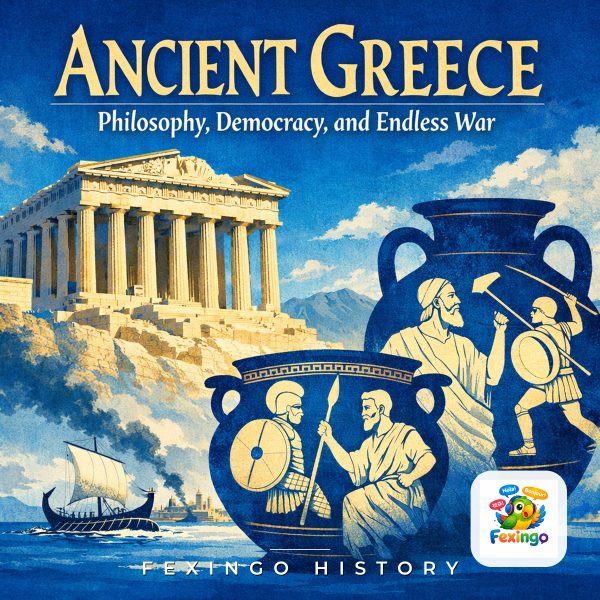
Ancient Greece: Philosophy, Democracy, and Endless War — Fexingo History
- Folgen
- 287
- Erscheint
- täglich
- Letzte Folge
- 14. Nov. 2026
Über den Podcast
Ancient Greece: Philosophy, Democracy, and Endless War plunges into the crucible of Western civilization, where city-states clashed, thinkers questioned everything, and democracy was born—and died. From the Mycenaean palaces of the Bronze Age to the rise of Athens under Pericles, hosts Lucas and Luna guide you through the Persian Wars, the Peloponnesian War that tore Hellas apart, and the campaigns of Alexander the Great that stretched from the Ionian Sea to the Indus. Explore the intellectual revolutions of Socrates, Plato, and Aristotle, whose ideas still shape how we reason and govern. Witness the brutal realities of the Delian League, the Spartan helot system, the plague of Athens, and the trial and execution of Socrates. Delve into daily life in the agora, the roles of women and slaves, the Olympic Games, and the mysteries of the Eleusinian cults. This show treats Greece not as a marble ideal but as a vibrant, often violent, world of competing visions—oligarchy vs. democracy, Athenian naval power vs. Spartan hoplites, the Parthenon's glory against the backdrop of empire and exploitation. Why does Greece matter today? Because every debate on citizenship, tyranny, or the good life traces back to these rocky shores and restless minds. No pedestals, no nostalgia—just the messy, magnificent story of a people who invented history itself. #AncientGreece #Athens #Sparta #AlexanderTheGreat #Pericles #Socrates #Plato #Aristotle #PeloponnesianWar #PersianWars #DelianLeague #GoldenAge #GreekPhilosophy #AthenianDemocracy #HellenisticAge #History #WorldHistory #FexingoHistory Keep every episode free: buymeacoffee.com/fexingo
Mitwirkende
- LucasModeration
- LunaCo-Moderation
Folgen 287
Agora of Ideas: Greek Philosophy and Daily Life
While we often think of ancient Greece through the lens of marble temples or battlefield tactics, the real engine of its cultural explosion was the agora. In this episode, we explore how philosophy moved out of …
Shownotes
While we often think of ancient Greece through the lens of marble temples or battlefield tactics, the real engine of its cultural explosion was the agora. In this episode, we explore how philosophy moved out of abstract theory and into the dusty streets of fifth-century Athens. We look at the relationship between Socrates and his wealthy patron, Aristophanes' satirical portrayal of intellectuals in The Clouds, and the everyday debates that took place among merchants, potters, and politicians. From the Stoic roots in the Stoa Poikile to the democratic ideals discussed on the Pnyx, we examine how ideas shaped civic identity. Join us as we trace the footsteps of thinkers who questioned everything, from the nature of justice to the cost of a loaf of bread, revealing a society where intellect was both a commodity and a danger.
#AncientGreece #Socrates #Aristophanes #TheClouds #StoaPoikile #Agora #Pnyx #FifthCenturyBC #GreekPhilosophy #CivicIdentity #Democracy #Athens #Plato #Xenophon #Sophists #Kerameikos #HellenisticThought #History #FexingoHistory
The Women of Sparta: Power, Property, and Paradox
We often think of ancient Greece through the lens of Athenian democracy or Spartan military might, but both systems relied heavily on women who operated in the shadows—or sometimes, quite literally, in plain …
Shownotes
We often think of ancient Greece through the lens of Athenian democracy or Spartan military might, but both systems relied heavily on women who operated in the shadows—or sometimes, quite literally, in plain sight. This episode explores the unique status of Spartan women, who enjoyed rights, property ownership, and physical freedom that would have seemed scandalous to their neighbors. We look at figures like Gorgo, the only woman named in Herodotus’s Histories, and examine how Spartan law allowed women to inherit land and control wealth. While Athens restricted women to the home, Sparta’s societal structure created a paradox where women were celebrated for their strength yet still bound by rigid state expectations. We’ll also touch on the role of female priests, such as those serving Artemis Orthia, and how ritualized competition shaped female identity. Through literary fragments from poets like Alcman and historical accounts from Plutarch and Xenophon, we piece together a world where women were not just passive subjects but active participants in the political and cultural life of Laconia.
#Sparta #AncientGreece #Gorgo #SpartanWomen #Laconia #Herodotus #Plutarch #Xenophon #Alcman #ArtemisOrthia #PropertyRights #GreekHistory #FexingoHistory #History #ClassicalAntiquity #MediterraneanHistory #GenderInAntiquity #AncientLegislation
The Oxyrhynchus Papyri: Reading Ancient Greece
In 1896, two young scholars at Oxford University began sifting through mounds of discarded trash in a dusty Egyptian town called Oxyrhynchus. What they found wasn't gold or jewelry, but thousands of fragmented …
Shownotes
In 1896, two young scholars at Oxford University began sifting through mounds of discarded trash in a dusty Egyptian town called Oxyrhynchus. What they found wasn't gold or jewelry, but thousands of fragmented pieces of papyrus—rotting scraps of paper thrown away by ancient Romans and Greeks over fifteen hundred years ago. This episode explores how these accidental discoveries rewrote our understanding of classical antiquity. We follow Bernard Grenfell and Arthur Hunt as they unearth lost plays by Menander, previously unknown fragments of Sappho, and personal letters that reveal the mundane joys and frustrations of daily life in Roman Egypt. From the chaotic dig sites to the quiet library rooms where scholars piece together sentences from jagged shards, we trace the journey of texts like the Gospel of Thomas and early copies of Homer from the desert sands to modern bookshelves. It is a story about luck, persistence, and the fragile nature of history itself.
#OxyrhynchusPapyri #BernardGrenfell #ArthurHunt #OxfordUniversity #AncientEgypt #RomanEgypt #Menander #Sappho #GospelOfThomas #PapyrusPreservation #ClassicalStudies #Archaeology #MuseumOfAntiquities #GrecoRomanCulture #LiteraryFragments #HistoricalDiscovery #AncientGreekHistory #FexingoHistory
The Delian League: Athens' Imperial Mask
In this episode, Lucas and Luna explore the Delian League, the alliance formed after the Persian Wars that evolved into the Athenian Empire. We examine how the treasury moved from Delos to Athens in 454 BCE, a …
Shownotes
In this episode, Lucas and Luna explore the Delian League, the alliance formed after the Persian Wars that evolved into the Athenian Empire. We examine how the treasury moved from Delos to Athens in 454 BCE, a pivotal moment marking the shift from cooperation to domination. The conversation covers Perikles’ use of league funds for the Parthenon, the suppression of revolts by Naxos and Thasos, and the role of the Heliaia courts in enforcing imperial loyalty. We also look at the strategic importance of the Piraeus port and the naval power built on trireme crews. This story reveals the complex reality of ancient democracy, where freedom for Athenians was maintained through the control of other Greek city-states.
#DelianLeague #Perikles #AthensEmpire #Parthenon #AncientGreece #HellenicHistory #Naxos #Thasos #Delos #Piraeus #Trieres #Heliaia #AthenianDemocracy #PersianWars #ClassicalAntiquity #GreekPolitics #FexingoHistory #History
The Spartan Silence: Lycurgus and the Mystery of Reform
We often picture Sparta as a military machine, but its foundations were laid by a figure shrouded in myth: Lycurgus. In this episode, we step away from the battlefield to explore the Great Rhetra and the …
Shownotes
We often picture Sparta as a military machine, but its foundations were laid by a figure shrouded in myth: Lycurgus. In this episode, we step away from the battlefield to explore the Great Rhetra and the radical social engineering that transformed Laconia into a society obsessed with equality among citizens and absolute control over helots. We examine how the agoge system wasn't just about training soldiers, but about creating a specific type of human being—one who valued the collective over the individual. Through the lens of Xenophon’s accounts and Plutarch’s legends, we dissect the controversial land reforms, the syssitia communal messes, and the strange economic isolationism that kept Sparta unique for centuries. Join us as we trace the origins of a state that feared change more than death, and ask whether its ultimate strength was also the cause of its quiet disappearance.
#Lycurgus #Sparta #GreatRhetra #Agoge #Helots #Laconia #Xenophon #Plutarch #SpartanConstitution #Syssitia #AncientGreece #MilitaryHistory #SocialEngineering #HopliteWarfare #ClassicalAntiquity #GreekMythology #FexingoHistory #HistoryPodcast #AncientCivilizations
The Athenian Ostracism: Exile Without Death
In ancient Athens, democracy had a failsafe mechanism for when its most powerful citizens became too powerful. This episode explores the practice of ostracism, where ten thousand citizens could vote to banish a …
Shownotes
In ancient Athens, democracy had a failsafe mechanism for when its most powerful citizens became too powerful. This episode explores the practice of ostracism, where ten thousand citizens could vote to banish a political figure from the city-state for ten years without confiscating their property or stripping them of rights. We trace the origins of this制度 under the reforms of Kleisthenes in 508 BCE and examine how it was used not just against tyrants, but against former allies like Themistocles and Cimon. Unlike exile born of defeat or conviction, ostracism was a preventative measure rooted in the fear of stasis, or civil strife. The process involved the Pnyx, the Agora, and clay shards called ostraka, which served as ballots. We look at the specific mechanics of the quorum required—six thousand votes—to make an expulsion valid, and what happened after the decade passed. Why did Athens eventually abandon this tool? Was it because it failed, or because it worked too well? Join us as we dig into the pottery shards that shaped one of history’s first experiments in balancing merit with mob rule.
#AncientGreece #AthenianDemocracy #Ostracism #Kleisthenes #Themistocles #Cimon #Pnyx #Agora #Ostraka #Stasis #508BCE #ClassicalAthens #GreekHistory #PoliticalExile #DirectDemocracy #FexingoHistory #HistoryPodcast #Mediterranean
The Spartan Code: Lycurgus and the Agoge
While Athens built an empire on silver and rhetoric, Sparta constructed a society on silence and sweat. This episode explores the mythos and reality of Lycurgus, the semi-legendary lawgiver who allegedly …
Shownotes
While Athens built an empire on silver and rhetoric, Sparta constructed a society on silence and sweat. This episode explores the mythos and reality of Lycurgus, the semi-legendary lawgiver who allegedly instituted the agoge, the rigorous state education system that turned Spartan boys into warriors from age seven. We examine how this extreme social engineering created a citizenry so cohesive it held off Persian invasions and dominated the Peloponnese for centuries, yet collapsed under its own rigidity. Through the lens of Xenophon’s Hellenica and Plutarch’s Lives, we unpack the daily brutality of the crypteia, the enigmatic helot population, and the paradoxical role of women in Sparta compared to their Athenian counterparts. We also look at the Battle of Leuctra, where Theban general Epaminondas shattered the Spartan mystique, proving that even the most disciplined army could be broken by superior tactics. This is a story about the cost of perfection and the fragility of a society built on fear.
#Sparta #Lycurgus #Agoge #Laconia #Xenophon #Plutarch #Helots #Crypteia #Leuctra #Epaminondas #AncientGreece #MilitaryHistory #SocialEngineering #ClassicalEra #MediterraneanHistory #Warfare #FexingoHistory #HistoryPodcast #GreekMythology
The Athenian Silver Mines: Wealth Behind the Parthenon
We often associate ancient Athens with marble temples and philosophical debates, but the city’s true power was forged in the dark, dangerous tunnels of the Laurion silver mines. In this episode, we uncover how …
Shownotes
We often associate ancient Athens with marble temples and philosophical debates, but the city’s true power was forged in the dark, dangerous tunnels of the Laurion silver mines. In this episode, we uncover how a single vein of silver transformed a modest coastal community into a naval superpower. We explore the story of the slave workforce, known as douloi, who risked their lives deep underground to fuel the triremes that defeated Xerxes at Salamis. Lucas and Luna discuss the economic mechanics of the Pnyx, where citizens voted on how to spend windfall revenues, and the moral contradictions of a democracy built on forced labor. You will hear about the specific conditions in the mines, the role of the state-owned slaves, and how this wealth funded the Golden Age of Perikles. This is not just a story about money; it is a look at the brutal infrastructure that made Athenian culture possible.
#LaurionMines #AncientAthens #SilverTrade #AthenianDemocracy #SlaveLabor #TriremeNavy #PeriklesEra #GreekEconomy #MarathonToSalamis #HellenisticHistory #ClassicalGreece #Thucydides #Xenophon #MineralExtraction #AncientTechnology #SocialInequality #FexingoHistory #History
The Mystery of the Antikythera Mechanism
In this episode, we uncover the story of the Antikythera Mechanism, a bronze gear-based computer recovered from a shipwreck off the coast of Greece. Discovered in 1901, this complex device dates to around …
Shownotes
In this episode, we uncover the story of the Antikythera Mechanism, a bronze gear-based computer recovered from a shipwreck off the coast of Greece. Discovered in 1901, this complex device dates to around 150-100 BCE and was used to predict astronomical positions and eclipses. Lucas and Luna explore how such sophisticated engineering challenges our assumptions about ancient technology, featuring insights from Derek de Solla Price and modern CT scanning techniques. We discuss the role of Hipparchus in its design, the significance of the Saros cycle, and what this artifact reveals about the intellectual life of Hellenistic Rhodes.
#AntikytheraMechanism #AncientGreekTechnology #ShipwreckDiscovery #HellenisticScience #DerekdeSollaPrice #AstronomyHistory #BronzeGears #RhodesAncient #SarosCycle #EclipsePrediction #ArchaeologyNews #MediterraneanHistory #GreekInventions #NauticalHistory #AncientMathematics #FexingoHistory #HistoryPodcast #EngineeringHistory
The Athenian Navy: How Oarsmen Built an Empire
While most histories of Ancient Greece focus on the marble temples of Athens or the philosophical debates of Socrates, the true engine of Athenian power was hidden beneath the waves. This episode explores the …
Shownotes
While most histories of Ancient Greece focus on the marble temples of Athens or the philosophical debates of Socrates, the true engine of Athenian power was hidden beneath the waves. This episode explores the trireme and the social revolution it triggered. We trace how Perikles’ building program funded the expansion of the navy, turning rowers from the poorest citizens—the thetes—into political stakeholders with a voice in the Pnyx. You will hear about the specific geometry of the trireme, the grueling training regimens at Piraeus, and the tactical innovations that allowed a smaller fleet to defeat larger Persian forces at Salamis. We also examine the dark side of this maritime dominance: the forced conscription, the harsh discipline of the floggers, and the economic reliance on slave labor for both mining silver and operating ships. Through the eyes of ordinary sailors and their commanders, we uncover how democracy was not just an idea debated in the Agora, but a practical necessity forged in saltwater and oar-driven conflict.
#AncientGreece #AthenianNavy #Trireme #Perikles #Thetes #Piraeus #Salamis #Oarsmen #Democracy #MediterraneanHistory #NavalWarfare #ClassicalAthens #MaritimeEmpire #FexingoHistory #AncientDemocracy #GreekHistory #TacticalHistory #SocialHistory
Ancient Greek Medicine: Hippocratic Oath Origins
We often think of the Hippocratic Oath as a timeless symbol of medical ethics, but its origins are far messier than the textbook version suggests. In this episode, we explore the real history of Ancient Greek …
Shownotes
We often think of the Hippocratic Oath as a timeless symbol of medical ethics, but its origins are far messier than the textbook version suggests. In this episode, we explore the real history of Ancient Greek medicine during the fifth century BCE, focusing on Asclepius, Alcmaeon, and the rational breakthrough that shifted healing from ritual to reason. We’ll look at how the humoral theory emerged, why trepanation was common, and the role of iatrosofia in challenging traditional religious cures. You will hear about specific figures like Socrates, who questioned the limits of medical knowledge, and the complex social dynamics within the Kerameikos district where healers operated. This story reveals that ancient doctors were not just proto-scientists but also navigating a world where gods like Asclepius still held significant sway over public health beliefs.
#HippocraticOath #AncientGreekMedicine #Asclepius #Alcmaeon #iatrosofia #humoralTheory #trepanation #Kerameikos #Socrates #Hippocrates #AncientHealing #GreekPhilosophy #MedicalHistory #RationalMedicine #FexingoHistory #History #MediterraneanHistory #AncientScience #ClassicalAntiquity
The Athenian Black Glaze Revolution
In this episode, Lucas and Luna explore the technological and artistic revolution of ancient Greek pottery, focusing on the innovation of black-figure and red-figure techniques. We examine how the Kerameikos …
Shownotes
In this episode, Lucas and Luna explore the technological and artistic revolution of ancient Greek pottery, focusing on the innovation of black-figure and red-figure techniques. We examine how the Kerameikos district became a hub for master painters like Euphronios and the Amasis Painter, transforming everyday vessels like kylix cups and oinochoe jugs into canvases for myth and daily life. The conversation traces the evolution from rigid silhouettes to dynamic naturalism, highlighting specific works such as the Panathenaic amphora and the Koros Painter’s contributions. Listeners will discover how these ceramic exports fueled Athens’ economy and spread Hellenic culture across the Mediterranean, while also revealing the anonymous labor behind the famous signed pots. From the chemical composition of the slip to the shift in perspective during the Peloponnesian War, this deep dive offers a tangible look at how clay shaped Greek identity and art history.
#AncientGreekPottery #BlackFigureVase #RedFigureVase #Euphronios #AmasisPainter #Kerameikos #Kylix #Oinochoe #PanathenaicAmphora #KorosPainter #AthensArt #GreekMythology #ClassicalAntiquity #MediterraneanTrade #Archaeology #HellenicCulture #FexingoHistory #History
The Athenian Black Glaze Revolution
In this episode of Ancient Greece, we explore the industrial and artistic revolution that transformed Athenian pottery from local utility to a global commodity. Lucas and Luna trace how the invention of …
Shownotes
In this episode of Ancient Greece, we explore the industrial and artistic revolution that transformed Athenian pottery from local utility to a global commodity. Lucas and Luna trace how the invention of black-figure technique by the Koros Painter and later refined by the Euphronios and Amasis Painters changed everything. We look at the specific kiln technology in the Kerameikos district that allowed for the three-stage firing process, turning red clay into durable, glossy black vessels. The conversation dives into the export networks that shipped these kylikes and oinochoes across the Mediterranean, influencing cultures from Etruria to Egypt. You will learn why the Panathenaic amphora became a symbol of civic pride and how the shift to red-figure painting eventually signaled deeper cultural changes in Athens. This is a deep dive into material culture, economics, and art history.
#AncientGreece #AthenianPottery #Kerameikos #Euphronios #AmasisPainter #Kylix #Oinochoe #PanathenaicAmphora #BlackFigure #RedFigure #GreekArt #MediterraneanTrade #HellenisticCulture #Archaeology #HistoryPodcast #FexingoHistory #ClassicalAntiquity #MaterialCulture
Ancient Greek Warfare: The Art of the Siege
While Athens and Sparta dominated the headlines with their naval blockades and hoplite clashes, a quieter, more terrifying technology was reshaping the ancient world. This episode explores the rise of siege …
Shownotes
While Athens and Sparta dominated the headlines with their naval blockades and hoplite clashes, a quieter, more terrifying technology was reshaping the ancient world. This episode explores the rise of siege warfare in classical Greece, focusing on the innovations that turned static city walls into obsolete barriers. We trace the development of the battering ram, the tortoise shield formation, and the first use of torsion-powered artillery at Syracuse. Through the lens of figures like Dionysius I and the engineer Philon of Byzantium, we examine how the threat of siege altered political stability, forced cities to invest in heavy fortifications, and ultimately contributed to the psychological exhaustion of the Peloponnesian War. It is a story of engineering meeting violence, where the survival of a polis depended less on the courage of its citizens and more on the strength of its mortar and the ingenuity of its engineers.
#SiegeWarfare #AncientGreece #ClassicalAntiquity #DionysiusIofSyracuse #TorsionArtillery #Polybolos #BatteringRam #Hoplite #PeloponnesianWar #PhilosophyOfWar #AncientEngineering #Syracuse #AthenianNavy #SpartanArmy #Fortification #FexingoHistory #HistoryPodcast #MilitaryHistory
Sappho's Lost Lyrics and the Fragments of Ancient Love
In Episode 273, we step away from the battlefields and political machinations of Athens to explore one of antiquity’s most elusive voices: Sappho. While earlier episodes touched on her life and the Aeolic …
Shownotes
In Episode 273, we step away from the battlefields and political machinations of Athens to explore one of antiquity’s most elusive voices: Sappho. While earlier episodes touched on her life and the Aeolic dialect she wrote in, this conversation digs into the physical reality of her surviving work. We examine how a once-celebrated poet of Lesbos was reduced to mere fragments, preserved not in complete books but in scattered quotations by later grammarians and papyrus scraps found in Egyptian rubbish heaps. Lucas and Luna trace the journey of these texts—from the Byzantine editors who censored her explicit love poetry to the nineteenth-century discoveries that began piecing her back together. You will hear about specific lines that describe the trembling of the heart and the burning of skin, as well as the modern scholarly efforts to reconstruct her melodies. This is a story about literary survival, the biases of history, and the enduring power of personal voice against the silence of time.
#Sappho #Lesbos #AncientGreekPoetry #Fragments #Papyrology #AeolicDialect #HellenisticLiterature #ByzantineCensorship #ClassicalAntiquity #WomenInHistory #MediterraneanHistory #LyricPoetry #Oxyrhynchus #GreekMythology #Alcaeus #Plato #HistoricalReconstruction #History #FexingoHistory
Ancient Greek Astronomy: Hipparchus and the Star Catalog
We explore how Hipparchus of Nicaea transformed astronomy from guesswork into a precise science, creating the first comprehensive star catalog that mapped over a thousand stars by brightness and position. His …
Shownotes
We explore how Hipparchus of Nicaea transformed astronomy from guesswork into a precise science, creating the first comprehensive star catalog that mapped over a thousand stars by brightness and position. His discovery of precession revealed Earth’s slow wobble, while his work on trigonometry laid the groundwork for future navigators and mathematicians. Join us as we trace his legacy in Alexandria and beyond, uncovering how ancient Greeks measured the heavens with remarkable accuracy long before telescopes.
#Hipparchus #Nicaea #StarCatalog #Precession #Trigonometry #AncientAstronomy #GreekScience #Alexandria #Ptolemy #Almagest #EarthWobble #CelestialMeasurement #MathHistory #SkyMapping #FexingoHistory #History #ScienceHistory #Mediterranean
The Plague of Athens: Pericles, Death, and Democracy
In the winter of 430 BCE, a mysterious illness swept through the besieged city of Athens, killing perhaps a third of the population and claiming the life of its greatest leader, Perikles. This episode explores …
Shownotes
In the winter of 430 BCE, a mysterious illness swept through the besieged city of Athens, killing perhaps a third of the population and claiming the life of its greatest leader, Perikles. This episode explores the catastrophic impact of the Plague of Athens on Athenian society, military strategy, and political stability during the early Peloponnesian War. We examine Thucydides’ clinical yet harrowing firsthand account of the symptoms and social breakdown, the failure of traditional religion to provide comfort or explanation, and how the vacuum left by Perikles’ death led to the rise of demagogues like Kleon. By contrasting the orderly democracy of the pre-plague era with the chaos that followed, we see how disease can unravel even the most sophisticated civic institutions. The narrative follows the plague’s path from the Piraeus port into the crowded city walls, analyzing the architectural and sanitary conditions that exacerbated the spread. We also look at the long-term cultural trauma embedded in Greek tragedy and philosophy, questioning whether the loss of Perikles was truly the beginning of Athens’ decline or if other factors were at play. This is a story of resilience, fear, and the fragility of civilization when faced with an invisible enemy.
#PlagueOfAthens #Perikles #Thucydides #PeloponnesianWar #Kleon #AthenianDemocracy #AncientMedicine #GreekHistory #Socrates #Euripides #Piraeus #HippocraticOath #ClassicalAthens #Miasma #Xenophon #Diphilus #History #FexingoHistory #Podcast
Alexander the Great's Lost Succession Crisis
When Alexander the Great died in Babylon in 323 BCE, he left no clear heir and no written will. The resulting power vacuum triggered a decade of violent conflict known as the Wars of the Diadochi, or …
Shownotes
When Alexander the Great died in Babylon in 323 BCE, he left no clear heir and no written will. The resulting power vacuum triggered a decade of violent conflict known as the Wars of the Diadochi, or Successors. This episode explores the chaotic months immediately following his death at the Banquets of Babylon, where generals like Perdiccas, Antigonus, Ptolemy, and Seleucus vied for control of an empire that stretched from Greece to India. We examine how the absence of a strong central authority led to the fragmentation of Alexander’s conquests into separate Hellenistic kingdoms. By focusing on the political maneuvering and military betrayals that followed, we uncover why Alexander’s vision of a unified world never materialized. Listeners will learn about the role of Philip Arrhidaeus, Alexander’s half-brother with intellectual disabilities, and the infant son Alexander IV who were used as puppets in this deadly game. Through the accounts of ancient historians like Diodorus Siculus and Plutarch, we reconstruct the tense negotiations and sudden assassinations that reshaped the Mediterranean world.
#AlexanderTheGreat #Diadochi #HellenisticPeriod #BabylonDeath323BCE #PtolemyISoter #SeleucusINicator #AntigonusIGonatas #Perdiccas #WarsOfTheSuccessors #PhilipArrhidaeus #AlexanderIV #AncientMacedonia #AncientGreekHistory #EmpireFragmentation #BanquetOfBabylon #DiodorusSiculus #PlutarchLife #FexingoHistory
Sappho: The Lost Poet of Lesbos and Ancient Song
Before we dive into the fragments, it helps to remember that ancient Greece wasn't just about marble temples and political debate. It was a culture deeply rooted in music, performance, and oral tradition. This …
Shownotes
Before we dive into the fragments, it helps to remember that ancient Greece wasn't just about marble temples and political debate. It was a culture deeply rooted in music, performance, and oral tradition. This episode explores the life and work of Sappho, the poet from the island of Lesbos who lived around 630 to 570 BCE. While much of her extensive body of work has been lost to time, surviving fragments offer a glimpse into her lyrical genius and the all-female community she led. We examine how her poetry challenged traditional gender roles and explored themes of desire, friendship, and emotion with a rawness that resonates today. We also look at the historical context of archaic Greece, where women could wield cultural influence through art and religion, even if they were excluded from politics. Join us as we reconstruct the voice of one of history's most silenced poets.
#Sappho #AncientGreece #Lesbos #ArchaeicPoetry #WomenInHistory #GreekLiterature #LyricPoetry #FexingoHistory #HistoryPodcast #AncientWomen #Classics #Mythology #HellenisticEra #PoetryAnalysis #HistoricalFragments #MediterraneanHistory #CulturalHistory #AncientCulture
Ancient Greek Medicine: The Rational Breakthrough
Before Hippocrates, illness was often viewed as divine punishment or demonic possession. This episode explores the radical shift in fifth-century BCE Greece, where physicians began to look for natural causes of …
Shownotes
Before Hippocrates, illness was often viewed as divine punishment or demonic possession. This episode explores the radical shift in fifth-century BCE Greece, where physicians began to look for natural causes of disease rather than supernatural ones. We follow the journey from the healing cults of Asclepius to the emerging field of rational medicine, focusing on the figure of Alcmaeon of Croton and his dissections that revealed the brain's role in sensation. You will hear about the humoral theory, the controversial practice of trepanation, and how the Athenian jury system eventually regulated medical malpractice through the concept of iatrosofia. It is a story about how curiosity, anatomy, and legal accountability combined to turn healing into a science.
#AncientGreekMedicine #HippocraticOath #AlcmaeonOfCroton #AsclepiusCult #HumoralTheory #BrainAnatomy #Trepanation #Iatrosofia #AthenianLaw #MedicalHistory #MediterraneanHistory #ClassicalAntiquity #FexingoHistory #HistoryPodcast #AncientScience #GreekPhilosophy #NeurologyOrigins #AncientHealth
The Ostraka of Themistocles: Democracy's Irony
We revisit the exile of Athens' greatest naval architect, Themistocles, through the lens of ostracism. While previous episodes touched on his role at Salamis and the Delian League, this episode dives deep into …
Shownotes
We revisit the exile of Athens' greatest naval architect, Themistocles, through the lens of ostracism. While previous episodes touched on his role at Salamis and the Delian League, this episode dives deep into the political mechanics that forced him out. We explore how the Athenian democratic process, designed to prevent tyranny, became a weapon against its own heroes. Through the voices of Thucydides and Aristophanes, we examine the tension between civic duty and personal ambition. You will hear about the specific votes in the Pnyx, the role of Cimon in his downfall, and the tragic irony of a man who saved Greece only to be exiled by it. This is a story of how democracy protects itself, even from those who built it.
#Themistocles #AthenianDemocracy #Ostracism #Ostraka #Salamis #Thucydides #Cimon #Pnyx #DelianLeague #AncientGreece #GreekHistory #PersianWars #Exile #Kleroterion #Heliaia #FexingoHistory #HistoryPodcast #MediterraneanHistory #PoliticalExile
The Delian League: Athens Empire in Disguise
We often think of ancient Greece through the lens of democracy and philosophy, but behind the marble columns lay a brutal engine of empire. This episode explores the Delian League, originally formed as a …
Shownotes
We often think of ancient Greece through the lens of democracy and philosophy, but behind the marble columns lay a brutal engine of empire. This episode explores the Delian League, originally formed as a defensive alliance against Persia after the battles of Marathon and Salamis. Under the leadership of Themistocles and later Pericles, the league’s treasury moved from the sacred island of Delos to Athens in 454 BCE. What began as a coalition of equal partners transformed into an Athenian hegemony where member states paid tribute instead of providing ships. We examine how this financial shift funded the Parthenon and the golden age of art, while simultaneously breeding resentment that would eventually fuel the Peloponnesian War. From the suppression of Naxos’s rebellion to the strategic use of naval power, we uncover the hidden costs of Athens’ cultural supremacy and the complex reality of its imperial rule.
#DelianLeague #AncientAthens #Pericles #Themistocles #AchaemenidEmpire #Parthenon #PeloponnesianWar #GreekHistory #Marathon #Salamis #TributeStates #NaxosRebellion #AegeanSea #Trireme #Hegemony #ClassicalGreece #FexingoHistory #HistoryPodcast #DemocracyAndEmpire
The Athenian Black Glaze Revolution
While we often focus on the grand politics of Athens and Sparta, the everyday life of ancient Greeks was shaped by their pottery. This episode explores the technological innovation behind black-figure and …
Shownotes
While we often focus on the grand politics of Athens and Sparta, the everyday life of ancient Greeks was shaped by their pottery. This episode explores the technological innovation behind black-figure and red-figure vase painting, a craft that fueled trade across the Mediterranean. We follow the journey of specific artisans like the Amasis Painter and Euphronios, examining how kiln techniques changed from firing in three stages to a single-step process. You will hear about the workshops in the Kerameikos district, the export markets in Etruria, and how these clay vessels became canvases for myth and daily life. Beyond the art, we discuss the economic reality of mass-producing thousands of identical-looking jugs and bowls, and what those objects tell us about gender roles, symposia culture, and social status. Join Lucas and Luna as they dig into the dust of the Athenian agora to uncover how a simple change in temperature transformed Greek visual culture forever.
#AncientGreece #AthenianPottery #BlackFigure #RedFigure #Kerameikos #AmasisPainter #Euphronios #Kylix #Oinochoe #KilnTechnology #GreekTrade #EtruscanArt #Symposium #ClayFiring #HellenisticCulture #Archaeology #History #FexingoHistory #Mediterranean
The Greek Fire That Burned Empires
We usually think of ancient warfare in terms of bronze swords and shield walls, but the late Roman Empire faced a different kind of threat that required a chemical solution. This episode explores the invention …
Shownotes
We usually think of ancient warfare in terms of bronze swords and shield walls, but the late Roman Empire faced a different kind of threat that required a chemical solution. This episode explores the invention of Greek fire, the secret incendiary weapon developed by Kallinikos of Heliopolis for the Byzantine navy around 678 CE. We trace how this sticky, liquid flame defied water and saved Constantinople from Arab sieges, reshaping the balance of power in the Mediterranean. Lucas and Luna discuss the technical mystery of its composition, the psychological terror it inflicted on enemy fleets, and why the secret was guarded so fiercely within the imperial court. You will learn about the dromon warships, the siphons used to project the fire, and the historical accounts of Emperor Constantine IV witnessing his fleet burn the enemy armada. It is a story of engineering, desperation, and the terrifying beauty of early chemistry.
#GreekFire #ByzantineEmpire #Kallinikos #Constantinople #678CE #ArabSiege #Dromon #IncendiaryWeapon #NavalHistory #ChemicalWarfare #ByzantineNavy #ConstantineIV #Heliopolis #Siphon #MedievalTechnology #MediterraneanHistory #FexingoHistory #History
The Ostraka of Themistocles: Democracy's Irony
We explore the complex legacy of Themistocles, the Athenian leader who saved Greece at Salamis but was later exiled through the very democratic tool he helped perfect. This episode examines how the ostraka …
Shownotes
We explore the complex legacy of Themistocles, the Athenian leader who saved Greece at Salamis but was later exiled through the very democratic tool he helped perfect. This episode examines how the ostraka system evolved from a safety valve into a weapon of political vengeance, focusing on the controversial exile of Hyperbolus and the failed attempt to ostracize Cleon. We look at primary sources like Thucydides and Aristophanes to understand the tension between individual genius and collective fear in fifth-century Athens. You will hear about the Pnyx, the Agora, and the specific mechanics of the kleroterion that selected jurors for these high-stakes votes. The narrative traces how democracy’s self-preservation instinct can sometimes turn against its greatest defenders, leaving us with questions about civic trust and political accountability that remain strikingly relevant today.
#Themistocles #AthenianDemocracy #Ostraka #Hyperbolus #Cleon #Nicias #Pnyx #Agora #Kleroterion #Salamis #Thucydides #Aristophanes #Plutarch #DelianLeague #FifthCenturyBCE #AncientGreece #History #FexingoHistory #PoliticalExile
The Sacred Band of Thebes: Elite Warriors and Equality
While Athens and Sparta dominate the historical narrative, Thebes quietly cultivated a military force that shattered Spartan invincibility. This episode explores the Sacred Band of Thebes, an elite unit …
Shownotes
While Athens and Sparta dominate the historical narrative, Thebes quietly cultivated a military force that shattered Spartan invincibility. This episode explores the Sacred Band of Thebes, an elite unit composed entirely of 150 pairs of lovers. We examine how these soldiers, trained in the art of combined arms and spear phalanx tactics, achieved victory at Leuctra in 371 BCE against overwhelming odds. Lucas and Luna discuss the political reforms of Epaminondas, the social structure of pederastic relationships in ancient Greece, and the tactical innovations that redefined warfare. We also look at the tragic end of the band at Chaeronea in 336 BCE, where Alexander the Great’s father, Philip II, finally broke their spirit. Through primary sources like Plutarch and Xenophon, we uncover the human cost of loyalty and the enduring legacy of a force built on mutual affection rather than mere duty.
#SacredBandOfThebes #Thebes #AncientGreece #Epaminondas #Leuctra #Sparta #Pelopidas #Plutarch #GreekWarfare #Phalanx #Chaeronea #PhilipII #AlexanderTheGreat #Xenophon #Hipparchos #Mantineia #Boeotia #History #FexingoHistory
The Great Persian War: Marathon to Salamis
We explore the pivotal decade between 490 and 479 BCE that defined the Greek world. Lucas walks us through the first Persian invasion, the miraculous stand at Marathon, and the political maneuvering of …
Shownotes
We explore the pivotal decade between 490 and 479 BCE that defined the Greek world. Lucas walks us through the first Persian invasion, the miraculous stand at Marathon, and the political maneuvering of Themistocles in Athens. We then dive into Xerxes I’s massive second invasion, detailing the heroic but tragic defense at Thermopylae and the naval strategy that turned the tide at Salamis. This episode moves beyond the myths to examine the logistical realities of the Persian Empire versus the fragmented city-states, focusing on how a coalition of Greeks, led by Sparta and Athens, survived against overwhelming odds. You will hear about the roles of Leonidas, Darius I, Herodotus, and the Delian League’s origins. It is a story of tactical innovation, from the heavy hoplite phalanx to the trireme’s ramming speed, and the birth of Athenian imperial power.
#Marathon #Salamis #Thermopylae #XerxesI #Themistocles #Leonidas #DariusI #Herodotus #Trireme #DelianLeague #PersianWars #AthenianNavy #SpartanArmy #Hoplite #AncientGreece #MediterraneanHistory #FexingoHistory #History
The Spartan Ostraka: Exile, Democracy, and the Irony of Cleon
We often imagine ancient Greek democracy as a grand experiment in civic virtue, but its mechanisms were sometimes messy, personal, and deeply flawed. In this episode, we turn our attention to the ostraka—the …
Shownotes
We often imagine ancient Greek democracy as a grand experiment in civic virtue, but its mechanisms were sometimes messy, personal, and deeply flawed. In this episode, we turn our attention to the ostraka—the broken pottery shards used for voting—and the surprising story of Hyperbolus, the man who became the first victim of Athenian exile not for his greatness, but for his mediocrity. We explore how political rivals Cleon and Nicias, two of Athens’ most polarizing figures, conspired to get rid of him rather than face each other, exposing the fragile ego at the heart of the democratic process. Through the lens of this failed ostracism, we examine the role of Aristophanes’ satire, the shifting power dynamics in the Pnyx, and how Thucydides viewed the erosion of meritocracy in wartime Athens. Join us as we dig into the Kerameikos to understand why one man’s failure actually reveals more about the health of Athenian politics than any success ever could.
#AncientGreece #AthenianDemocracy #Ostracism #Hyperbolus #Cleon #Nicias #Thucydides #Aristophanes #Pnyx #Kerameikos #GreekHistory #PoliticalExile #ClassicalAthens #PeloponnesianWar #Socrates #FexingoHistory #HistoryPodcast #DemocracyOrigins
The Great Persian War: Marathon to Salamis
We often think of Ancient Greece as a collection of city-states united by culture, but their history is defined by an existential threat from the East. This episode explores the Persian Wars, specifically the …
Shownotes
We often think of Ancient Greece as a collection of city-states united by culture, but their history is defined by an existential threat from the East. This episode explores the Persian Wars, specifically the invasions of Xerxes I and the pivotal battles that saved Athenian democracy. We look at the Battle of Marathon in 490 BCE, where a tired Athenian army faced a massive Persian force, and then jump forward to 480 BCE, when Xerxes launched his second invasion with hundreds of thousands of soldiers. You will hear about the stand at Thermopylae, the naval strategy at Salamis, and how Themistocles convinced Athens to build a navy that would ultimately defeat the greatest empire on earth. It is a story of desperate courage, strategic brilliance, and the fragile moment when Greece chose to fight rather than submit.
#PersianWars #BattleOfMarathon #XerxesI #Themistocles #BattleOfSalamis #Thermopylae #Leonidas #AthenianNavy #Trireme #DariusI #Herodotus #GrecoPersianWars #AncientGreekHistory #ClassicalAntiquity #MediterraneanHistory #MilitaryStrategy #DelianLeague #FexingoHistory #History
The Tragedy of Alcibiades: Athens' Most Dangerous Star
This episode explores the volatile life of Alcibiades, the Athenian general whose ambition shaped the Peloponnesian War. We trace his role in the Sicilian Expedition, the scandal of the Herms, and his eventual …
Shownotes
This episode explores the volatile life of Alcibiades, the Athenian general whose ambition shaped the Peloponnesian War. We trace his role in the Sicilian Expedition, the scandal of the Herms, and his eventual defection to Sparta. You will hear how he turned the tide at Cyzicus as a Spartan ally before returning to save Athens at Arginusae. We examine the contradictions of a man loved and hated by the same city, and how his personal rivalries with Nicias and Lamachus dictated military strategy. Through the lens of Thucydides and Plutarch, we uncover the cost of charisma in a democracy that could not tolerate its own brilliance.
#Alcibiades #PeloponnesianWar #SicilianExpedition #Athens #Sparta #Thucydides #Plutarch #HermsScandal #Cyzicus #Arginusae #Nicias #Lysander #AthenianDemocracy #AncientHistory #MilitaryHistory #GreekTragedy #FexingoHistory #History
Hier stehen die neuesten 40 von 287 Folgen. Ältere Folgen findest du im Feed des Podcasts.
Ähnliche Podcasts
Mehr Bildung-Podcasts







Ist das dein Podcast?
Bestätige es mit einem Eintrag in deinem Feed: Du bekommst hier einen Code, trägst ihn als podcast:txt in den Kanal deines Feeds ein, und wir prüfen ihn. Danach steht dein Podcast als „verifiziert“ bei SoundNode.