

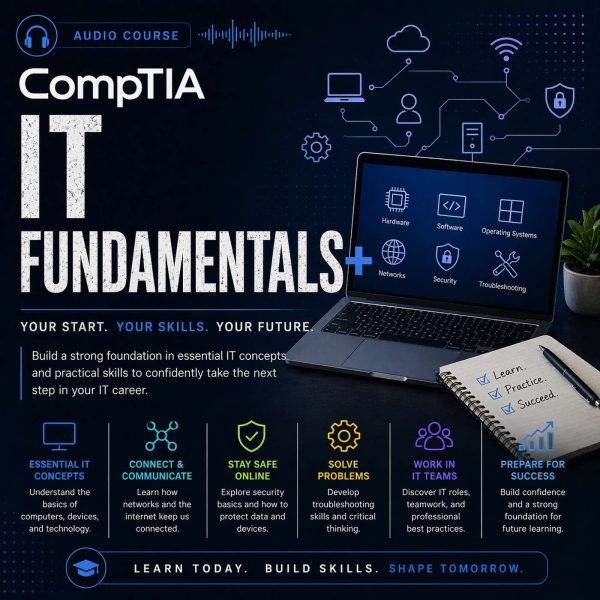
Certified – CompTIA IT Fundamentals+ Audio Course
- Folgen
- 91
- Format
- Serie – von Anfang an hören
- Letzte Folge
- 14. Okt. 2025
Über den Podcast
The CompTIA IT Fundamentals+ Audio Course is your step-by-step guide to building a rock-solid foundation in information technology. Covering hardware, software, networking, databases, and security, each episode breaks down complex concepts into simple, engaging lessons designed for absolute beginners. Whether you’re exploring a new career path, supporting technology at home, or preparing for more advanced certifications, this Audio Course helps you understand how computers, devices, and systems work together in the real world. Every topic is aligned to the official exam objectives and delivered in a structured, easy-to-follow format—perfect for learning on the go or reviewing key concepts before test day. The CompTIA IT Fundamentals+ (ITF+) certification is the ideal starting point for anyone new to technology or considering a career in IT. It validates essential digital literacy and introduces the core principles of computing, networking, data management, and cybersecurity. Unlike more technical exams, ITF+ focuses on understanding—not memorization—helping learners grasp the “why” behind today’s most common technologies. Earning this certification shows you can navigate digital environments with confidence, setting the stage for future success with advanced CompTIA credentials like A+, Network+, and Security+.
Folgen 91
Episode 90 — Configuring Small Wireless Network Security
In this episode, we examine wireless network security configurations, an important topic in the CompTIA IT Fundamentals (ITF+) certification exam. You’ll learn how to change default SSIDs and passwords, choose …
Shownotes
In this episode, we examine wireless network security configurations, an important topic in the CompTIA IT Fundamentals (ITF+) certification exam. You’ll learn how to change default SSIDs and passwords, choose encryption protocols like WPA2 or WPA3, and secure access with pre-shared keys.
We’ll also discuss disabling unused services, managing guest access, and ensuring that devices on the network are properly secured. These steps will prepare you to recommend or configure secure wireless networks for both the exam and real-world scenarios. Produced by BareMetalCyber.com.
Episode 89 — Mobile and Application Encryption Use Cases
Here, we focus on specific encryption use cases for mobile devices and applications, a topic within the CompTIA IT Fundamentals (ITF+) certification exam. You’ll learn how mobile device encryption protects data …
Shownotes
Here, we focus on specific encryption use cases for mobile devices and applications, a topic within the CompTIA IT Fundamentals (ITF+) certification exam. You’ll learn how mobile device encryption protects data if a device is lost or stolen, and how application-level encryption secures sensitive information within apps.
We’ll cover examples from secure messaging platforms, mobile banking apps, and enterprise applications, showing how encryption fits into broader security strategies. This knowledge will help you answer exam questions that address mobile and application security requirements. Produced by BareMetalCyber.com.
Episode 88 — Encryption for Data at Rest and In Transit
Encryption is a fundamental security tool, and this episode explains its role in protecting both data at rest and data in transit for the CompTIA IT Fundamentals (ITF+) certification exam. You’ll learn how …
Shownotes
Encryption is a fundamental security tool, and this episode explains its role in protecting both data at rest and data in transit for the CompTIA IT Fundamentals (ITF+) certification exam. You’ll learn how file-level, disk-level, and mobile device encryption protect stored data, and how protocols like HTTPS, VPN, and secure email safeguard information during transmission.
We’ll also discuss encryption keys, algorithms, and the importance of proper key management. Mastering these concepts ensures you can identify the correct encryption method for different situations on the exam. Produced by BareMetalCyber.com.
Episode 87 — Password Best Practices and Managers
In this episode, we cover password best practices as outlined in the CompTIA IT Fundamentals (ITF+) certification exam. You’ll learn about creating strong passwords using length, complexity, and …
Shownotes
In this episode, we cover password best practices as outlined in the CompTIA IT Fundamentals (ITF+) certification exam. You’ll learn about creating strong passwords using length, complexity, and unpredictability, as well as how to avoid common mistakes like password reuse.
We’ll also discuss password managers, how they securely store credentials, and how to select a trustworthy option. Understanding these practices ensures you can answer exam questions related to authentication security and improve your own account protection. Produced by BareMetalCyber.com.
Episode 86 — Safe Browsing: Certificates and Website Validity
Safe browsing is a critical topic in the CompTIA IT Fundamentals (ITF+) certification exam, and this episode shows you how to verify website certificates, identify secure connections, and recognize invalid or …
Shownotes
Safe browsing is a critical topic in the CompTIA IT Fundamentals (ITF+) certification exam, and this episode shows you how to verify website certificates, identify secure connections, and recognize invalid or suspicious certificates. We’ll explain how HTTPS works, the role of certificate authorities, and why expired or mismatched certificates are red flags.
We’ll also discuss phishing websites and other malicious online traps, giving you practical steps for assessing website legitimacy before entering sensitive information. These skills will help you in both exam scenarios and real-world security practices. Produced by BareMetalCyber.com.
Episode 85 — Safe Software Installation and Licensing Models
In this episode, we discuss safe software installation practices and licensing models, both of which are covered in the CompTIA IT Fundamentals (ITF+) certification exam. You’ll learn how to verify software …
Shownotes
In this episode, we discuss safe software installation practices and licensing models, both of which are covered in the CompTIA IT Fundamentals (ITF+) certification exam. You’ll learn how to verify software sources, check digital signatures, and follow proper installation procedures to avoid introducing malware or vulnerabilities.
We’ll also explain licensing types — including open source, proprietary, subscription, and perpetual — and the legal and ethical considerations for each. Knowing these concepts will help you answer exam questions and make responsible software decisions in the workplace. Produced by BareMetalCyber.com.
Episode 84 — USB and Cable Lock Physical Security Practices
Physical security is just as important as digital safeguards, and this episode examines USB and cable lock practices for the CompTIA IT Fundamentals (ITF+) certification exam. We’ll explain how USB port locks …
Shownotes
Physical security is just as important as digital safeguards, and this episode examines USB and cable lock practices for the CompTIA IT Fundamentals (ITF+) certification exam. We’ll explain how USB port locks prevent unauthorized device connections and how cable locks secure laptops, desktops, and other hardware against theft.
We’ll also cover scenarios where physical security controls are critical, such as public workspaces, shared offices, and mobile work environments. Understanding these tools ensures you can answer exam questions about protecting equipment from physical compromise. Produced by BareMetalCyber.com.
Episode 83 — Device Security: Firewalls, Patch Management, Anti-Malware
This episode covers device security measures that are essential knowledge for the CompTIA IT Fundamentals (ITF+) certification exam. You’ll learn how firewalls filter network traffic to block unauthorized …
Shownotes
This episode covers device security measures that are essential knowledge for the CompTIA IT Fundamentals (ITF+) certification exam. You’ll learn how firewalls filter network traffic to block unauthorized access, how patch management ensures systems stay updated against vulnerabilities, and how anti-malware tools detect and remove malicious software.
We’ll discuss best practices for configuring each of these defenses and how they work together in a layered security approach. Mastering these concepts prepares you to identify and implement appropriate security solutions on both the exam and in real-world IT environments. Produced by BareMetalCyber.com.
Episode 82 — Recognizing Social Engineering and Phishing Attacks
Social engineering and phishing are among the most common threats you’ll need to identify for the CompTIA IT Fundamentals (ITF+) certification exam. In this episode, we’ll explain how attackers manipulate human …
Shownotes
Social engineering and phishing are among the most common threats you’ll need to identify for the CompTIA IT Fundamentals (ITF+) certification exam. In this episode, we’ll explain how attackers manipulate human behavior to gain unauthorized access, from deceptive emails to fraudulent phone calls and fake websites. We’ll cover real-world examples and the warning signs that indicate a possible attack.
We’ll also discuss preventative measures such as user awareness training, multi-factor authentication, and verification protocols. By learning to recognize these attacks, you’ll be better equipped to answer scenario-based exam questions and protect against one of the most prevalent threats in IT. Produced by BareMetalCyber.com.
Episode 81 — Logs, Location Data, and Browser History
In this episode, we examine how logs, location data, and browser history are used in system monitoring and security, all of which appear in the CompTIA IT Fundamentals (ITF+) certification exam objectives …
Shownotes
In this episode, we examine how logs, location data, and browser history are used in system monitoring and security, all of which appear in the CompTIA IT Fundamentals (ITF+) certification exam objectives. You’ll learn how system and application logs record activities for troubleshooting, compliance, and forensic investigations. We’ll also discuss the privacy and security implications of location tracking, particularly on mobile devices and connected applications.
We’ll explore how browser history can be a valuable tool for diagnosing issues but also a potential security risk if not managed properly. By understanding how to access, interpret, and protect these data sources, you’ll be prepared for exam questions and real-world situations involving user activity tracking and privacy protection. Produced by BareMetalCyber.com.
Episode 80 — Authorization and Least Privilege Explained
In this episode, we focus on authorization, which is distinct from authentication, as tested in the CompTIA IT Fundamentals (ITF+) certification exam. Authorization determines what resources a user can access …
Shownotes
In this episode, we focus on authorization, which is distinct from authentication, as tested in the CompTIA IT Fundamentals (ITF+) certification exam. Authorization determines what resources a user can access and what actions they can perform after being authenticated. You’ll learn about permission settings, access control lists, and the concept of role-based access.
We’ll also cover the principle of least privilege, which limits user permissions to only what is necessary for their role. This reduces the risk of accidental or malicious misuse of systems and data. Understanding these concepts will help you identify the right security configurations for both the exam and real-world IT environments. Produced by BareMetalCyber.com.
Episode 79 — Authentication Models: Single, Multi, SSO
Authentication models are central to IT security, and this episode covers them in detail for the CompTIA IT Fundamentals (ITF+) certification exam. You’ll learn the differences between single-factor …
Shownotes
Authentication models are central to IT security, and this episode covers them in detail for the CompTIA IT Fundamentals (ITF+) certification exam. You’ll learn the differences between single-factor authentication, multifactor authentication (MFA), and single sign-on (SSO). We’ll explain how each model works, where it’s most appropriate, and the trade-offs between security and convenience.
We’ll also explore real-world examples of MFA implementations, including combinations of passwords, smart cards, and biometrics. This knowledge prepares you to recommend the right authentication approach for a given situation, both in exam scenarios and professional practice. Produced by BareMetalCyber.com.
Episode 78 — Understanding PII, GDPR, and Privacy Regulations
In this episode, we discuss privacy and compliance topics that are critical for the CompTIA IT Fundamentals (ITF+) certification exam. You’ll learn what constitutes personally identifiable information (PII) …
Shownotes
In this episode, we discuss privacy and compliance topics that are critical for the CompTIA IT Fundamentals (ITF+) certification exam. You’ll learn what constitutes personally identifiable information (PII), why it must be protected, and how regulations like the General Data Protection Regulation (GDPR) set legal requirements for handling personal data.
We’ll cover examples of PII, from names and addresses to biometric data, and explain how misuse can lead to severe legal and reputational consequences. Knowing how to identify and protect sensitive information is a skill that will help you answer exam questions and work responsibly in any IT environment. Produced by BareMetalCyber.com.
Episode 77 — CIA Triad: Confidentiality, Integrity, Availability
This episode introduces one of the most fundamental security models tested in the CompTIA IT Fundamentals (ITF+) certification exam — the CIA triad. You’ll learn how confidentiality ensures that data is only …
Shownotes
This episode introduces one of the most fundamental security models tested in the CompTIA IT Fundamentals (ITF+) certification exam — the CIA triad. You’ll learn how confidentiality ensures that data is only accessible to authorized users, integrity guarantees that information is accurate and unaltered, and availability ensures that data and systems remain accessible when needed.
We’ll also explore how these principles guide IT security strategies, from encryption and access control to backup planning and disaster recovery. Understanding the CIA triad not only prepares you for the exam but also provides a framework for making sound security decisions in any IT role. Produced by BareMetalCyber.com.
Episode 76 — Understanding Database Availability and Access Models
Database availability and access are critical topics in the CompTIA IT Fundamentals (ITF+) certification exam, and this episode explains why. We’ll discuss how uptime is measured, the importance of …
Shownotes
Database availability and access are critical topics in the CompTIA IT Fundamentals (ITF+) certification exam, and this episode explains why. We’ll discuss how uptime is measured, the importance of high-availability configurations, and methods like clustering and replication that ensure databases remain accessible even in the event of hardware or network failures.
We’ll also cover access models, including online versus offline databases, read-only versus read/write permissions, and controlled access through authentication mechanisms. This knowledge helps you evaluate database solutions for both reliability and security in professional IT environments. Produced by BareMetalCyber.com.
Episode 75 — Storage Locations: Local, Cloud, and Portable Devices
In this episode, we explore different storage location options as covered in the CompTIA IT Fundamentals (ITF+) certification exam. You’ll learn how local storage, such as internal hard drives and SSDs, offers …
Shownotes
In this episode, we explore different storage location options as covered in the CompTIA IT Fundamentals (ITF+) certification exam. You’ll learn how local storage, such as internal hard drives and SSDs, offers speed and direct control but may be limited in capacity or vulnerable to hardware failure. We’ll compare this with cloud storage, which provides scalability, remote accessibility, and redundancy, but depends heavily on internet connectivity and vendor security.
We’ll also discuss portable storage devices, including USB flash drives, external hard drives, and SD cards, which are ideal for backups, transfers, and offline access. Understanding the pros and cons of each method prepares you to select the most appropriate storage location for specific needs and to answer scenario-based questions accurately on the exam. Produced by BareMetalCyber.com.
Episode 74 — Backup Concepts: Files, Systems, and Recovery
Backups are critical to data protection, and this episode covers the core concepts tested in the CompTIA IT Fundamentals (ITF+) certification exam. You’ll learn about different backup types, including …
Shownotes
Backups are critical to data protection, and this episode covers the core concepts tested in the CompTIA IT Fundamentals (ITF+) certification exam. You’ll learn about different backup types, including file-level, system-level, and image-based backups, as well as their respective recovery processes.
We’ll also cover the importance of backup schedules, off-site storage, and periodic testing to ensure data can be restored when needed. This knowledge prepares you to select the most appropriate backup method for a given situation, both on the exam and in professional IT practice. Produced by BareMetalCyber.com.
Episode 73 — Non-Relational Databases: Key/Value and Document Models
In this episode, we examine non-relational databases and their importance in the CompTIA IT Fundamentals (ITF+) certification exam. Key/value stores and document databases offer flexible structures ideal for …
Shownotes
In this episode, we examine non-relational databases and their importance in the CompTIA IT Fundamentals (ITF+) certification exam. Key/value stores and document databases offer flexible structures ideal for handling unstructured or semi-structured data, such as logs, multimedia content, or JSON documents.
We’ll compare these models to relational systems, explaining why they’re often chosen for high-performance web applications and large-scale distributed environments. Knowing when to recommend non-relational options will help you answer scenario-based questions with precision. Produced by BareMetalCyber.com.
Episode 72 — Relational Database Concepts: Tables, Fields, Keys
This episode breaks down relational database structure for the CompTIA IT Fundamentals (ITF+) certification exam. You’ll learn how data is organized into tables, with each table consisting of fields (columns) …
Shownotes
This episode breaks down relational database structure for the CompTIA IT Fundamentals (ITF+) certification exam. You’ll learn how data is organized into tables, with each table consisting of fields (columns) and records (rows). We’ll explain the roles of primary keys, which uniquely identify records, and foreign keys, which establish relationships between tables.
We’ll also explore constraints that enforce data accuracy, such as requiring values to be unique or non-empty. Mastering these relational concepts will prepare you for questions involving database design and query interpretation. Produced by BareMetalCyber.com.
Episode 71 — Scalability and Multi-User Environments
Scalability and multi-user support are essential features in modern databases, and the CompTIA IT Fundamentals (ITF+) certification exam expects you to know how they work. We’ll explain how scalability allows a …
Shownotes
Scalability and multi-user support are essential features in modern databases, and the CompTIA IT Fundamentals (ITF+) certification exam expects you to know how they work. We’ll explain how scalability allows a database to handle increasing amounts of data or users without performance loss, and how multi-user environments ensure that multiple people can access and update information simultaneously.
We’ll also cover concurrency control, data locking, and transaction management, which keep shared data accurate and secure. These concepts are vital for understanding how large organizations manage critical databases in real time. Produced by BareMetalCyber.com.
Episode 70 — Flat Files vs. Relational Databases
In this episode, we compare flat file systems with relational databases for the CompTIA IT Fundamentals (ITF+) certification exam. Flat files store data in plain text or spreadsheet formats, making them simple …
Shownotes
In this episode, we compare flat file systems with relational databases for the CompTIA IT Fundamentals (ITF+) certification exam. Flat files store data in plain text or spreadsheet formats, making them simple but limited in flexibility and scalability. Relational databases, on the other hand, organize data into tables with defined relationships, enabling more powerful queries and better data integrity.
We’ll explain when each is appropriate, providing examples from small-scale record keeping to enterprise-grade applications. Understanding the strengths and limitations of these storage methods prepares you for questions that test your ability to choose the right database structure for a given scenario. Produced by BareMetalCyber.com.
Episode 69 — What Is a Database? Inputs, Queries, and Reports
This episode focuses on the fundamentals of databases, a core topic in the CompTIA IT Fundamentals (ITF+) certification exam. You’ll learn what a database is, how data is entered through inputs, retrieved using …
Shownotes
This episode focuses on the fundamentals of databases, a core topic in the CompTIA IT Fundamentals (ITF+) certification exam. You’ll learn what a database is, how data is entered through inputs, retrieved using queries, and organized into meaningful reports. We’ll explain the role of database management systems (DBMS) in ensuring accuracy, consistency, and accessibility of stored information.
We’ll also cover real-world examples, from customer relationship management (CRM) systems to inventory tracking tools, showing how databases power nearly every modern application. This understanding will help you identify database functions and answer exam questions with confidence. Produced by BareMetalCyber.com.
Episode 68 — Big Data, Monetization, and Analytics
Here, we dive into the world of big data, monetization, and analytics, all of which are topics in the CompTIA IT Fundamentals (ITF+) certification exam. You’ll learn what makes data “big,” from its massive …
Shownotes
Here, we dive into the world of big data, monetization, and analytics, all of which are topics in the CompTIA IT Fundamentals (ITF+) certification exam. You’ll learn what makes data “big,” from its massive volume and variety to the speed at which it is generated. We’ll discuss how organizations leverage analytics to discover patterns, predict trends, and make informed decisions that drive growth.
We’ll also address the concept of data monetization — turning raw information into revenue through targeted advertising, product improvements, and third-party partnerships. By understanding both the potential and the risks of large-scale data usage, you’ll be ready to answer exam questions involving the benefits, challenges, and ethical considerations of analytics. Produced by BareMetalCyber.com.
Episode 67 — Why Data Matters: Value, Privacy, and Business Use
In this episode, we explore why data is considered one of the most valuable resources in modern technology, as emphasized in the CompTIA IT Fundamentals (ITF+) certification exam. You’ll learn how organizations …
Shownotes
In this episode, we explore why data is considered one of the most valuable resources in modern technology, as emphasized in the CompTIA IT Fundamentals (ITF+) certification exam. You’ll learn how organizations use data to make strategic decisions, improve operations, and deliver better products and services. We’ll examine the difference between critical and non-critical data, highlighting how classification impacts storage, access, and protection strategies.
We’ll also cover privacy considerations, including how personally identifiable information (PII) must be handled to comply with laws and regulations. Understanding the value of data and the responsibilities that come with managing it will help you recognize best practices and answer exam questions that address the balance between business use and ethical data stewardship. Produced by BareMetalCyber.com.
Episode 66 — Debugging and Interpreting Program Logic
In this episode, we cover debugging and logic interpretation skills required for the CompTIA IT Fundamentals (ITF+) certification exam. You’ll learn systematic approaches to finding and fixing errors, from …
Shownotes
In this episode, we cover debugging and logic interpretation skills required for the CompTIA IT Fundamentals (ITF+) certification exam. You’ll learn systematic approaches to finding and fixing errors, from syntax mistakes to logical flaws that cause unexpected results. We’ll explain how to use debugging tools, log output, and step-through execution to pinpoint issues.
We’ll also focus on interpreting existing program logic, helping you understand how different components interact to produce specific outcomes. These skills not only prepare you for exam questions but also build your ability to troubleshoot code in real IT environments. Produced by BareMetalCyber.com.
Episode 65 — Sequence, Branching, and Looping in Code
Here, we focus on three fundamental logic structures for the CompTIA IT Fundamentals (ITF+) certification exam — sequence, branching, and looping. Sequence refers to code executing in order, branching uses …
Shownotes
Here, we focus on three fundamental logic structures for the CompTIA IT Fundamentals (ITF+) certification exam — sequence, branching, and looping. Sequence refers to code executing in order, branching uses conditions to determine which code path to follow, and looping repeats actions until a condition is met.
We’ll provide practical examples for each, showing how they are implemented in common programming languages. Understanding these structures is crucial for reading code, predicting program behavior, and solving exam problems that involve logical flow. Produced by BareMetalCyber.com.
Episode 64 — Object-Oriented Methods in Simple Terms
This episode breaks down object-oriented methods into simple, understandable concepts as they appear in the CompTIA IT Fundamentals (ITF+) certification exam. We’ll explain key principles like encapsulation …
Shownotes
This episode breaks down object-oriented methods into simple, understandable concepts as they appear in the CompTIA IT Fundamentals (ITF+) certification exam. We’ll explain key principles like encapsulation, inheritance, and polymorphism, using clear examples to show how each works in real-world applications. You’ll see how these principles make code more modular, reusable, and easier to maintain.
We’ll also discuss common object-oriented design patterns and their practical uses in building scalable systems. By the end, you’ll be able to recognize object-oriented approaches in exam questions and understand why they are central to modern programming. Produced by BareMetalCyber.com.
Episode 63 — Pseudo Code and Documentation Techniques
In this episode, we explore pseudo code and documentation practices, both important for the CompTIA IT Fundamentals (ITF+) certification exam. Pseudo code is a simplified, human-readable representation of a …
Shownotes
In this episode, we explore pseudo code and documentation practices, both important for the CompTIA IT Fundamentals (ITF+) certification exam. Pseudo code is a simplified, human-readable representation of a program’s logic that omits strict syntax rules, allowing developers to focus on the algorithm before coding. You’ll learn how pseudo code helps in planning, communicating ideas with team members, and catching logical errors early in development.
We’ll also cover documentation techniques, including inline code comments, structured API documentation, and system-level guides. Good documentation ensures that code can be understood, maintained, and updated by others. This episode prepares you for exam questions that focus on planning, clarity, and collaboration in software projects, as well as best practices for professional development work. Produced by BareMetalCyber.com.
Episode 62 — Flowcharts, Logic, and Programming Structure
In this episode, we examine flowcharts, logic, and programming structure, all core topics in the CompTIA IT Fundamentals (ITF+) certification exam. Flowcharts provide a visual representation of a program’s …
Shownotes
In this episode, we examine flowcharts, logic, and programming structure, all core topics in the CompTIA IT Fundamentals (ITF+) certification exam. Flowcharts provide a visual representation of a program’s workflow, helping developers map processes before writing code. Logic structures — including sequences, decisions, and loops — determine how programs respond to different inputs and conditions.
We’ll explore how well-structured programs improve readability, maintainability, and error handling. Understanding these concepts equips you to answer both theory-based and scenario-driven exam questions while also building skills you can apply in real-world problem-solving. Produced by BareMetalCyber.com.
Hier stehen die neuesten 60 von 91 Folgen. Ältere Folgen findest du im Feed des Podcasts.
Empfohlen von Certified – CompTIA IT Fundamentals+ Audio Course

Ähnliche Podcasts
Mehr Bildung-Podcasts






Ist das dein Podcast?
Bestätige es mit einem Eintrag in deinem Feed: Du bekommst hier einen Code, trägst ihn als podcast:txt in den Kanal deines Feeds ein, und wir prüfen ihn. Danach steht dein Podcast als „verifiziert“ bei SoundNode.