

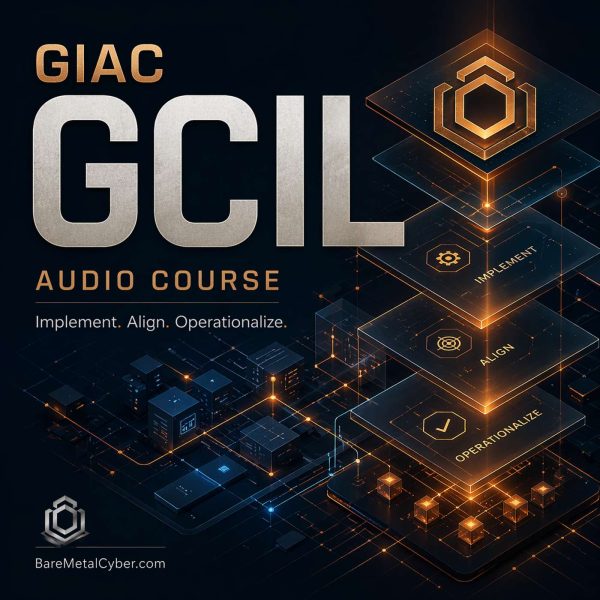
Certified: The GIAC GCIL Audio Course
- Folgen
- 59
- Format
- Serie – von Anfang an hören
- Letzte Folge
- 14. Feb. 2026
Über den Podcast
Welcome to Certified: The ISACA GCIL Audio Course. I’m Dr Jason Edwards, and I built this series for people who need governance leadership skills that hold up under real pressure—tight timelines, conflicting priorities, and stakeholders who want answers today. Across these lessons, you’ll hear a clear, practical walkthrough of what governance leadership means, how it differs from management, and how to apply it in organizations where technology, risk, and business goals collide. Expect short, focused episodes with straightforward explanations, common-sense examples, and language you can reuse in conversations with executives, auditors, and delivery teams. If you’re working toward the ISACA GCIL credential, this course is also designed to support exam readiness without turning into a memorization drill. To get the most out of Certified: The ISACA GCIL Audio Course, treat each episode like a working session, not background noise. Listen once for the big idea, then listen again when you’re about to write a policy, join a steering meeting, or prepare a governance update. As you go, pause and ask yourself one question: what decision is being made here, and who is accountable for it? That habit turns the material into a tool you can use immediately. If you’re following along for certification, keep a simple set of notes with terms, relationships, and “why it matters” examples from your own environment. If this is useful, follow the show so new episodes land automatically. Subscribe wherever you get podcasts.
Folgen 59
Episode 58 — Last-Mile Confidence Check: Common GCIL Pitfalls and How to Avoid Them
The last-mile confidence check involves identifying and naming common GCIL pitfalls directly so they can be systematically avoided during the exam and in real-world crises. Pitfalls such as unclear ownership …
Shownotes
The last-mile confidence check involves identifying and naming common GCIL pitfalls directly so they can be systematically avoided during the exam and in real-world crises. Pitfalls such as unclear ownership, vague status updates, and premature closure are frequently tested and can be fixed with explicit accountability, structured briefings, and verification gates. You must also guard against tool obsession by maintaining a decision-first leadership approach that prioritizes strategy over software outputs. Weak scoping can be corrected through evidence-driven hypotheses, while approval bottlenecks are mitigated by establishing preapproved authority thresholds for the incident leader. Poor documentation and team burnout are managed through disciplined timeline logging and mandatory shift rotations to preserve human performance. By choosing to apply a specific prevention rule for each of these traps, you move into the certified leader category with the maturity needed to handle any security event. Produced by BareMetalCyber.com, where you’ll find more cyber audio courses, books, and information to strengthen your educational path. Also, if you want to stay up to date with the latest news, visit DailyCyber.News for a newsletter you can use, and a daily podcast you can commute with.
Episode 57 — Final Blueprint Rapid Recall: Hit Every Objective in One Pass
This final rapid recall episode ties the entire curriculum together by hitting every major objective of the GCIL blueprint in a single, high-yield pass. You must be able to recall the preparation components of …
Shownotes
This final rapid recall episode ties the entire curriculum together by hitting every major objective of the GCIL blueprint in a single, high-yield pass. You must be able to recall the preparation components of readiness, policies, and playbooks alongside the team leadership requirements of roles and authority. The response domain focuses on incident classification, goal alignment, and the maintenance of a disciplined timeline and decision log. Communications mastery involves managing stakeholder updates with safe, consistent language while ensuring legal and regulatory compliance. Reporting and improvement require the identification of root causes and the implementation of verified corrective actions to harden future defenses. Finally, you must recall the major attack families—cloud, credential, email, and ransomware—and their respective first leadership actions. This full-cycle review ensures you can pivot between domains with professional poise and strategic clarity. Produced by BareMetalCyber.com, where you’ll find more cyber audio courses, books, and information to strengthen your educational path. Also, if you want to stay up to date with the latest news, visit DailyCyber.News for a newsletter you can use, and a daily podcast you can commute with.
Episode 56 — Exam-Day Tactics and Mental Models for Calm GCIL Decision-Making
Success on the GCIL exam day requires more than technical knowledge; it requires calm decision-making habits and a disciplined pacing plan to manage the high-pressure session. You should establish a pacing plan …
Shownotes
Success on the GCIL exam day requires more than technical knowledge; it requires calm decision-making habits and a disciplined pacing plan to manage the high-pressure session. You should establish a pacing plan with clear checkpoints and time reserves to ensure that every question receives professional attention. Using a simple mental model like Evidence-Action-Outcome allows for consistent evaluation of complex leadership scenarios and prevents assumptions. To protect your time, utilize skip-and-return rules for exceptionally dense questions, ensuring you capture the easier wins throughout the entire exam. Systematic elimination of wrong options is the best way to handle uncertainty, especially when faced with distractors that are technically correct but strategically inappropriate. Maintaining a steady rhythm—read, decide, verify, and continue—is what allows a certified expert to demonstrate mastery over the full incident lifecycle without succumbing to fatigue. Produced by BareMetalCyber.com, where you’ll find more cyber audio courses, books, and information to strengthen your educational path. Also, if you want to stay up to date with the latest news, visit DailyCyber.News for a newsletter you can use, and a daily podcast you can commute with.
Episode 55 — Spaced Retrieval Review: Cloud, Supply Chain, and Ransomware Attack Playbooks
This retrieval review reinforces the key attack patterns and response habits for cloud, supply chain, and ransomware incidents to ensure recognition remains fast under pressure. For cloud playbooks, the focus …
Shownotes
This retrieval review reinforces the key attack patterns and response habits for cloud, supply chain, and ransomware incidents to ensure recognition remains fast under pressure. For cloud playbooks, the focus is on identity abuse, accidental resource exposure, and unauthorized permission changes within the virtual control plane. In supply chain scenarios, you must recall the focus areas of transitive trust, malicious updates, and the potential blast radius across partner integrations. Ransomware recall centers on the patterns of operational disruption, rapid lateral spread, and the psychological pressure of extortion. Across all families, first actions remain constant: isolate the threat, stabilize the environment, document every move, and communicate through secure channels. This auditory drill ensures that your scoping habits—using evidence to test hypotheses—stay sharp for the certification exam and real-world leadership challenges. Produced by BareMetalCyber.com, where you’ll find more cyber audio courses, books, and information to strengthen your educational path. Also, if you want to stay up to date with the latest news, visit DailyCyber.News for a newsletter you can use, and a daily podcast you can commute with.
Episode 54 — Handle Ransomware Communications: Stakeholders, Attackers, and Legal Coordination
Handling communications during a ransomware crisis demands extreme discipline to ensure that pressure does not lead to self-inflicted legal or reputational damage. Internal message discipline must focus on …
Shownotes
Handling communications during a ransomware crisis demands extreme discipline to ensure that pressure does not lead to self-inflicted legal or reputational damage. Internal message discipline must focus on verified facts, current actions, and clear timelines for the next update to prevent organizational panic. You must establish who is authorized to speak externally and coordinate closely with legal counsel on the specific wording and timing of mandatory disclosures. It is essential to separate attacker communications from internal response operations, typically utilizing specialized third-party negotiators to manage the extortion dialogue. Best practices include using pre-approved scripts and consistent terminology so that the organization’s credibility holds firm across all stakeholder updates. Avoiding the disclosure of operational details that could help the attacker adjust their tactics is a core requirement of operational security during the event. Produced by BareMetalCyber.com, where you’ll find more cyber audio courses, books, and information to strengthen your educational path. Also, if you want to stay up to date with the latest news, visit DailyCyber.News for a newsletter you can use, and a daily podcast you can commute with.
Episode 53 — Manage Ransomware Incidents: Containment, Recovery Choices, and Risk Tradeoffs
Leading a ransomware response requires a clear understanding of the tactical tradeoffs and strategic priorities involved in reclaiming a compromised environment. Immediate containment involves isolating network …
Shownotes
Leading a ransomware response requires a clear understanding of the tactical tradeoffs and strategic priorities involved in reclaiming a compromised environment. Immediate containment involves isolating network segments and protecting backups to stop the spread of the encryption engine. While stabilizing operations, incident leaders must decide on recovery paths—whether to rebuild from known good backups or attempt decryption—based on the status of their data and the level of trust in the infrastructure. A critical best practice is to avoid rushing restores that might reintroduce persistence mechanisms or backdoors into the new environment. Leaders must create quick wins by prioritizing the restoration of critical business services through verified and clean rebuild paths. Final recovery is only declared after rigorous verification checks prove that the threat has been eradicated and the data integrity is intact. Produced by BareMetalCyber.com, where you’ll find more cyber audio courses, books, and information to strengthen your educational path. Also, if you want to stay up to date with the latest news, visit DailyCyber.News for a newsletter you can use, and a daily podcast you can commute with.
Episode 52 — Trace Ransomware Methodology: Initial Access, Privilege Gain, Encryption, Extortion
Tracing the ransomware methodology allows an incident leader to identify and interrupt the attacker’s path before they reach the final stages of the mission. The methodology typically begins with initial access …
Shownotes
Tracing the ransomware methodology allows an incident leader to identify and interrupt the attacker’s path before they reach the final stages of the mission. The methodology typically begins with initial access achieved through stolen credentials, exploited vulnerabilities in exposed services, or sophisticated phishing campaigns. Once inside, the adversary seeks privilege gain, expanding their control across systems to achieve the administrative authority needed to disable security software. Lateral movement follows as the attacker spreads through the network to maximize leverage and identify high-value data and backup repositories. The staging phase involves preparing for the strike by exfiltrating sensitive data and deploying ransomware binaries to as many endpoints as possible. Finally, the attacker triggers encryption to cause disruption and applies extortion pressure through deadlines and threats of public data exposure. Produced by BareMetalCyber.com, where you’ll find more cyber audio courses, books, and information to strengthen your educational path. Also, if you want to stay up to date with the latest news, visit DailyCyber.News for a newsletter you can use, and a daily podcast you can commute with.
Episode 51 — Differentiate Ransomware Attacks and Understand the Business-Stopper Impact
Recognizing ransomware quickly is essential because in these scenarios, time translates directly into measurable business damage. The GCIL exam defines ransomware as a combination of operational disruption and …
Shownotes
Recognizing ransomware quickly is essential because in these scenarios, time translates directly into measurable business damage. The GCIL exam defines ransomware as a combination of operational disruption and psychological coercion, involving more than just the technical act of file encryption. You must be able to distinguish between encryption-only incidents and the more complex world of double extortion, where attackers exfiltrate sensitive data before locking systems to gain additional leverage. Early signals often manifest as sudden surges in file changes, the appearance of ransom notes, and widespread service failures that bring revenue-generating activity to a halt. Best practices for an incident leader include immediately isolating infected systems and preserving volatile evidence while stabilizing organizational communications. Understanding the business impact—ranging from downtime and safety risks to long-term reputational harm—is critical for aligning executive leadership on recovery priorities. Produced by BareMetalCyber.com, where you’ll find more cyber audio courses, books, and information to strengthen your educational path. Also, if you want to stay up to date with the latest news, visit DailyCyber.News for a newsletter you can use, and a daily podcast you can commute with.
Episode 50 — Manage Supply Chain Incidents: Scope Blast Radius, Coordinate, and Remediate
Managing a supply chain incident requires a disciplined focus on scoping the blast radius across products, environments, and customer exposure points. Initial containment moves must isolate affected …
Shownotes
Managing a supply chain incident requires a disciplined focus on scoping the blast radius across products, environments, and customer exposure points. Initial containment moves must isolate affected integrations and halt suspicious updates while preserving evidence for later accountability and legal review. Coordination with vendors is a high-stakes task, requiring clear requests for forensic timelines and technical indicators to identify the root cause of the external failure. For the exam, you must understand that remediation involves patching, replacing compromised components, and permanently tightening third-party access controls. Best practices include avoiding the assumption that a single product is the only issue and instead performing a comprehensive audit of your Software Bill of Materials (S B O M). Verification of the recovery process must utilize technical scans and monitoring to prove that the environment is clean before declaring the incident closed. Produced by BareMetalCyber.com, where you’ll find more cyber audio courses, books, and information to strengthen your educational path. Also, if you want to stay up to date with the latest news, visit DailyCyber.News for a newsletter you can use, and a daily podcast you can commute with.
Episode 49 — Explain Supply Chain Attack Methodology and Impact Across Partners and Products
Understanding how trust becomes an attacker pathway is critical for managing the widespread compromise and hard scoping challenges of a supply chain breach. Methodology begins with entry via compromised vendor …
Shownotes
Understanding how trust becomes an attacker pathway is critical for managing the widespread compromise and hard scoping challenges of a supply chain breach. Methodology begins with entry via compromised vendor systems or tampered updates, followed by propagation through established integrations and shared data repositories. Because the threat moves through trusted channels, traditional perimeter defenses are often bypassed, making detection significantly harder without behavioral monitoring of partner activity. The business impact can include the exposure of sensitive customer information and long-term reputational damage to the entire ecosystem. For the exam, you must be prepared to trace an intrusion from an upstream update to its downstream impact on internal services. Best practices involve validating every configuration change made by a partner and ensuring that your Virtual Private Network (V P N) tunnels are strictly monitored for anomalies. A successful response requires coordinated efforts across legal, procurement, and technical teams to manage the risk of cascading failures. Produced by BareMetalCyber.com, where you’ll find more cyber audio courses, books, and information to strengthen your educational path. Also, if you want to stay up to date with the latest news, visit DailyCyber.News for a newsletter you can use, and a daily podcast you can commute with.
Episode 48 — Differentiate Supply Chain Attacks: Vendor Breach, Dependency Poisoning, and Trust
Supply chain attacks exploit transitive risk by targeting third-party partners and software components to gain a foothold in an organization. A vendor breach occurs when an adversary leverages the …
Shownotes
Supply chain attacks exploit transitive risk by targeting third-party partners and software components to gain a foothold in an organization. A vendor breach occurs when an adversary leverages the infrastructure or credentials of a trusted provider to enter your network directly, while dependency poisoning involves tampering with software libraries or updates during the build process. Trust abuse is a broader category where attackers exploit existing business relationships or remote access tunnels that were left open after a project's conclusion. For the exam, you must monitor for early signals such as unexpected modifications to binary hashes or unusual login attempts from partner service accounts. Best practices involve implementing a Zero Trust (Z T) model for external integrations and maintaining the ability to rapidly isolate vendor connections during an anomaly. Coordination with partners requires structured questions and a demand for hard forensic evidence rather than relying on verbal assurances. Produced by BareMetalCyber.com, where you’ll find more cyber audio courses, books, and information to strengthen your educational path. Also, if you want to stay up to date with the latest news, visit DailyCyber.News for a newsletter you can use, and a daily podcast you can commute with.
Episode 47 — Manage Cloud Attack Incidents: Contain Exposure, Rotate Secrets, Verify Recovery
Leading a cloud response requires a relentless focus on speed and control, utilizing the management layer to restrict access and remove risky permissions. Containment involves the immediate isolation of …
Shownotes
Leading a cloud response requires a relentless focus on speed and control, utilizing the management layer to restrict access and remove risky permissions. Containment involves the immediate isolation of compromised identities and the closure of public exposure points, such as open storage buckets or unrestricted ports. Evidence preservation is critical, requiring responders to capture cloud audit logs and resource snapshots before remediation destroys forensic artifacts. Secret rotation must be handled safely, ensuring that new A P I keys are synchronized across dependent services without breaking production workloads. For the exam, you must understand the recovery gates of restoring configurations and verifying data integrity through technical scans. Best practices include avoiding broad, unrecorded changes that could create new outages or obscure the attacker's original modifications. Final verification is only complete when an audit proves that all persistence mechanisms, such as unauthorized delegates or backdoors, have been fully eradicated from the tenant. Produced by BareMetalCyber.com, where you’ll find more cyber audio courses, books, and information to strengthen your educational path. Also, if you want to stay up to date with the latest news, visit DailyCyber.News for a newsletter you can use, and a daily podcast you can commute with.
Episode 46 — Describe Cloud Attack Methodology and Impact: Identity, Data, and Service Abuse
Understanding the specific path an attacker takes in a cloud environment is essential for interrupting the intrusion before it reaches its strategic objective. Attacker methodology typically begins with initial …
Shownotes
Understanding the specific path an attacker takes in a cloud environment is essential for interrupting the intrusion before it reaches its strategic objective. Attacker methodology typically begins with initial access via stolen credentials, access keys, or session tokens, followed by permission escalation through exploited misconfigurations. Once authority is gained, data access patterns emerge, including the discovery, enumeration, and unauthorized sharing or exfiltration of sensitive information. Service abuse involves the hijacking of compute resources for crypto-jacking or causing widespread disruption through the deletion of infrastructure components. For the exam, you must recognize persistence mechanisms such as the creation of new I A M users or the modification of serverless automation functions. Best practices for an incident leader include monitoring for high-privilege policy modifications and unusual data egress patterns that deviate from established baselines. By tracing the adversary from access to impact, you can implement targeted containment moves that protect the control plane from further exploitation. Produced by BareMetalCyber.com, where you’ll find more cyber audio courses, books, and information to strengthen your educational path. Also, if you want to stay up to date with the latest news, visit DailyCyber.News for a newsletter you can use, and a daily podcast you can commute with.
Episode 45 — Differentiate Cloud Attacks Using Shared Responsibility and Misconfiguration Clues
Recognizing cloud attack patterns requires an understanding of the Shared Responsibility Model (S R M), which divides security duties between the Cloud Service Provider (C S P) and the customer. Most cloud …
Shownotes
Recognizing cloud attack patterns requires an understanding of the Shared Responsibility Model (S R M), which divides security duties between the Cloud Service Provider (C S P) and the customer. Most cloud incidents result from customer misconfigurations, such as accidentally exposed storage buckets, overly permissive Identity and Access Management (I A M) roles, or weak identity boundaries. You must be able to distinguish between identity abuse, where an adversary steals a session token, and service disruption, where an attacker modifies or deletes cloud resources. For the exam, early clues such as unusual A P I activity and unauthorized permission changes are critical indicators of a breach in the virtual control plane. Best practices involve avoiding the assumption of provider failure and instead focusing on the logical layers where the customer maintains control. Troubleshooting these exposures requires a meticulous audit of cloud configuration logs to identify exactly which policy was modified and the identity responsible for the change. Produced by BareMetalCyber.com, where you’ll find more cyber audio courses, books, and information to strengthen your educational path. Also, if you want to stay up to date with the latest news, visit DailyCyber.News for a newsletter you can use, and a daily podcast you can commute with.
Episode 44 — Spaced Retrieval Review: Email and Credential Attacks Rapid Recognition Practice
Sharpening your recognition instincts through rapid recall drills ensures that you can distinguish between different email and credential-based threats during a high-pressure exam session. This episode revisits …
Shownotes
Sharpening your recognition instincts through rapid recall drills ensures that you can distinguish between different email and credential-based threats during a high-pressure exam session. This episode revisits the distinct signatures of phishing, Business Email Compromise (B E C), and malware delivery alongside the patterns of credential stuffing and password spraying. You should be able to identify the primary strategic impacts for each, ranging from direct financial loss to widespread lateral movement risk. For example, a successful B E C attempt requires immediate coordination with the finance department, whereas credential theft demands an immediate identity scrub and session revocation. Best practices for the exam involve using the pattern, scale, and target of an attack to select the most effective first protective move. By rehearsing these classifications and first actions, you move technical knowledge into durable professional intuition, which is essential for managing the rapid tempo of a live security engagement. Produced by BareMetalCyber.com, where you’ll find more cyber audio courses, books, and information to strengthen your educational path. Also, if you want to stay up to date with the latest news, visit DailyCyber.News for a newsletter you can use, and a daily podcast you can commute with.
Episode 43 — Manage Credential Attack Incidents: Lock Down, Validate Access, Restore Trust
Managing an identity-based incident requires a disciplined response cycle that prioritizes locking down accounts and revoking active sessions to stop an attacker's momentum. Containment must include the …
Shownotes
Managing an identity-based incident requires a disciplined response cycle that prioritizes locking down accounts and revoking active sessions to stop an attacker's momentum. Containment must include the invalidation of all authentication tokens across both cloud and local environments, while preserving evidence such as login headers and persistence markers like new inbox rules. Eradication involves a comprehensive audit for hidden administrative accounts or unauthorized Application Programming Interface (A P I) permissions granted during the window of compromise. For the exam, you must understand the necessity of re-validating account ownership through out-of-band channels before restoring access. Best practices involve a tiered recovery approach that prioritizes privileged identities and critical service accounts to minimize business disruption. Trust is only restored after technical verification proves the environment is clean and that Multi-Factor Authentication (M F A) has been successfully re-enrolled for the victim. Produced by BareMetalCyber.com, where you’ll find more cyber audio courses, books, and information to strengthen your educational path. Also, if you want to stay up to date with the latest news, visit DailyCyber.News for a newsletter you can use, and a daily podcast you can commute with.
Episode 42 — Map Credential Attack Methodology and Impact Across Accounts and Systems
Mapping the methodology of a credential attack allows an incident leader to understand how an initial login failure can escalate into a broad systemic compromise. Attackers obtain secrets through diverse entry …
Shownotes
Mapping the methodology of a credential attack allows an incident leader to understand how an initial login failure can escalate into a broad systemic compromise. Attackers obtain secrets through diverse entry paths, including phishing, purchased lists from initial access brokers, or harvesting tokens from compromised developer workstations. Once inside, the adversary tests credentials to expand access, often utilizing token theft and session persistence to bypass M F A entirely. Privilege escalation frequently follows, as the attacker moves from a standard user to an administrative role to access sensitive data or establish backdoors. Exam scenarios may require you to trace this movement across cloud and on-premises systems, assessing the business impact of potential financial fraud or lateral movement. Identifying impossible travel patterns and unusual access times is a critical detection habit for interrupting the expand phase of the attack. Produced by BareMetalCyber.com, where you’ll find more cyber audio courses, books, and information to strengthen your educational path. Also, if you want to stay up to date with the latest news, visit DailyCyber.News for a newsletter you can use, and a daily podcast you can commute with.
Episode 41 — Differentiate Credential Attacks: Stuffing, Spraying, Brute Force, and Theft
Recognizing specific credential attack patterns is essential for choosing the immediate protections required to secure an identity perimeter. Credential stuffing involves testing reused passwords from previous …
Shownotes
Recognizing specific credential attack patterns is essential for choosing the immediate protections required to secure an identity perimeter. Credential stuffing involves testing reused passwords from previous data breaches at scale against organizational portals, while password spraying utilizes a low-and-slow approach to test a few common passwords across a large population to avoid account lockouts. In contrast, brute force attacks focus repeated, high-frequency attempts against a single high-value account, and credential theft utilizes phishing or malware to steal valid secrets directly. For the exam, you must identify these based on telemetry signals such as login failure spikes, geographic anomalies, and reported Multi-Factor Authentication (M F A) fatigue prompts. Best practices involve implementing rate-limiting at the network edge and enforcing strict conditional access policies to mitigate automated guessing. Troubleshooting these incidents requires analyzing authentication logs to determine the diversity of source IP (I P) addresses and the breadth of accounts being targeted. Produced by BareMetalCyber.com, where you’ll find more cyber audio courses, books, and information to strengthen your educational path. Also, if you want to stay up to date with the latest news, visit DailyCyber.News for a newsletter you can use, and a daily podcast you can commute with.
Episode 40 — Manage an Email Attack Incident: Contain, Eradicate, Recover, and Educate
Managing an email attack incident through the full lifecycle of containment, eradication, and recovery ensures that the organization evicts the attacker and hardens itself against future attempts. For the G C I …
Shownotes
Managing an email attack incident through the full lifecycle of containment, eradication, and recovery ensures that the organization evicts the attacker and hardens itself against future attempts. For the G C I L candidate, containment involves the rapid isolation of the impacted account and the revocation of all active session tokens to stop the adversary's momentum. Eradication is the systematic removal of malicious artifacts, such as unauthorized forwarding rules or persistent API (A P I) tokens, that could allow the attacker to re-enter the environment. Recovery includes resetting credentials and re-validating the identity of the user before returning the account to production service. A vital part of this cycle is the "educate" phase, where the incident data is used to improve user awareness and technical filters for the future. A professional leader treats every email incident as a data-driven opportunity to strengthen the organization's overall identity perimeter. By following this disciplined response cycle, you ensure that your recovery is permanent and that your organization emerges from the crisis with a measurably more resilient defense. Produced by BareMetalCyber.com, where you’ll find more cyber audio courses, books, and information to strengthen your educational path. Also, if you want to stay up to date with the latest news, visit DailyCyber.News for a newsletter you can use, and a daily podcast you can commute with.
Episode 39 — Explain Email Attack Methodology and Impact from Inbox to Compromise
Understanding the methodology of an email attack allows an incident leader to identify multiple "kill chain" opportunities where the intrusion can be interrupted before it achieves its final objective. The G C …
Shownotes
Understanding the methodology of an email attack allows an incident leader to identify multiple "kill chain" opportunities where the intrusion can be interrupted before it achieves its final objective. The G C I L curriculum traces this path from initial target selection and reconnaissance to the delivery of the lure and the eventual compromise of the user account. Attackers often use conversation hijacking or tampered attachments to bypass a user's natural skepticism and establish a foothold within the inbox. Once access is achieved, the adversary may set up persistent mechanisms like hidden forwarding rules to monitor future communications or move laterally into other corporate systems. Explaining the impact of these attacks—ranging from direct financial fraud to the exposure of sensitive data—is essential for justifying the resources needed for a professional response. As a leader, your investigation must look beyond the single malicious message to identify the full scope of the attacker's activity and the long-term risk to the organization. By deconstructing the adversary's methodology, you can build a more resilient defense that catches threats at every stage of the lifecycle. Produced by BareMetalCyber.com, where you’ll find more cyber audio courses, books, and information to strengthen your educational path. Also, if you want to stay up to date with the latest news, visit DailyCyber.News for a newsletter you can use, and a daily podcast you can commute with.
Episode 38 — Differentiate Email Attacks Fast: Phishing, BEC, Malware, and Impersonation
In this episode, we start by looking at why identifying the specific type of email attack quickly is the most critical step in choosing the right response strategy. The G C I L exam requires a clear …
Shownotes
In this episode, we start by looking at why identifying the specific type of email attack quickly is the most critical step in choosing the right response strategy. The G C I L exam requires a clear understanding of the nuances between Phishing, Business Email Compromise (B E C), Malware delivery, and Impersonation. Phishing typically involves credential harvesting or lures to a malicious site, while B E C is a highly targeted form of business fraud that relies on trusted identity and urgency to bypass technical controls. Malware delivery uses email as a payload-based vehicle for compromise, and impersonation involves the abuse of trust through look-alike domains or spoofed profiles. For an incident leader, a B E C event requires immediate coordination with the finance department, whereas malware delivery demands rapid endpoint isolation and forensic analysis. By mastering these distinctions, you can activate the correct defensive playbook in the first few minutes of discovery, ensuring that the organization's response is always proportionate to the actual threat detected in the environment. Produced by BareMetalCyber.com, where you’ll find more cyber audio courses, books, and information to strengthen your educational path. Also, if you want to stay up to date with the latest news, visit DailyCyber.News for a newsletter you can use, and a daily podcast you can commute with.
Episode 37 — Spaced Retrieval Review: Vulnerability and Threat Management Prioritization Drills
This retrieval review focuses on the high-yield concepts of vulnerability management and threat intelligence prioritization as they relate to the incident response lifecycle. For the G C I L exam, you must be …
Shownotes
This retrieval review focuses on the high-yield concepts of vulnerability management and threat intelligence prioritization as they relate to the incident response lifecycle. For the G C I L exam, you must be able to recall how to use threat intelligence to adjust your remediation priorities and how to operationalize scanning during a live breach. Practitioners should practice verbalizing the link between vulnerability data and incident outcomes, ensuring they can explain the strategic value of this relationship to non-technical stakeholders. For instance, can you describe the steps for a risk-based prioritization drill without referring to your notes? This auditory review habit helps move these prioritization tactics from theoretical knowledge into durable professional intuition, which is essential for making fast, accurate decisions during the certification exam. By reinforcing these habits, the incident leader ensures that their team remains focused on the threats that pose the greatest risk to the organization's mission and data. Produced by BareMetalCyber.com, where you’ll find more cyber audio courses, books, and information to strengthen your educational path. Also, if you want to stay up to date with the latest news, visit DailyCyber.News for a newsletter you can use, and a daily podcast you can commute with.
Episode 36 — Operationalize Threat and Vulnerability Management During Active Incident Response
Operationalizing threat and vulnerability management during an active incident response is a critical skill that involves using real-time data to prevent the further spread of an intrusion. For the G C I L …
Shownotes
Operationalizing threat and vulnerability management during an active incident response is a critical skill that involves using real-time data to prevent the further spread of an intrusion. For the G C I L candidate, this means that as soon as an attacker’s entry path is identified, the response team must scan the rest of the enterprise for similar vulnerabilities that could be exploited. This proactive sweep ensures that the adversary cannot pivot to another host using the same technical flaw while you are busy remediating the first system. For example, if a breach occurred through an unpatched web application, you must immediately identify and secure all other instances of that application across your global infrastructure. This integration of vulnerability management into the containment phase provides a strategic advantage, allowing you to "pre-contain" the threat before it can escalate into a larger event. Professional leadership requires the ability to coordinate these technical workstreams simultaneously, ensuring that your defense is as dynamic and adaptable as the threat you are facing. Produced by BareMetalCyber.com, where you’ll find more cyber audio courses, books, and information to strengthen your educational path. Also, if you want to stay up to date with the latest news, visit DailyCyber.News for a newsletter you can use, and a daily podcast you can commute with.
Episode 35 — Leverage Threat Intelligence and Vulnerability Data to Prioritize Remediation
Leveraging threat intelligence alongside vulnerability data allows an incident leader to perform sophisticated risk-based prioritization for remediation efforts. The G C I L exam tests your ability to go beyond …
Shownotes
Leveraging threat intelligence alongside vulnerability data allows an incident leader to perform sophisticated risk-based prioritization for remediation efforts. The G C I L exam tests your ability to go beyond simple severity scores and consider the actual threat landscape when deciding which vulnerabilities to fix first. Threat intelligence provides context on which exploits are being used by specific threat actors and whether those actors are currently targeting your industry or geographic region. By combining this intelligence with your internal vulnerability scan results, you can identify the "perfect storm" scenarios where a critical flaw exists on a high-value asset and is being actively targeted by an adversary. This disciplined approach ensures that your limited technical resources are applied to the areas where they will provide the greatest risk reduction. A professional leader understands that patching everything is impossible, making the intelligent prioritization of the most dangerous exposures a vital leadership skill for maintaining a resilient and defensible security posture. Produced by BareMetalCyber.com, where you’ll find more cyber audio courses, books, and information to strengthen your educational path. Also, if you want to stay up to date with the latest news, visit DailyCyber.News for a newsletter you can use, and a daily podcast you can commute with.
Episode 34 — Connect Vulnerability Management Strategy to Incident Outcomes and Risk Reduction
Connecting your vulnerability management strategy to incident outcomes is essential for achieving a measurable reduction in organizational risk. For the G C I L candidate, it is critical to understand that many …
Shownotes
Connecting your vulnerability management strategy to incident outcomes is essential for achieving a measurable reduction in organizational risk. For the G C I L candidate, it is critical to understand that many incidents are the direct result of unpatched flaws or misconfigurations that should have been identified during routine scanning. By analyzing the entry paths of past breaches, an incident leader can influence the prioritization of the vulnerability management team to focus on the high-risk issues being actively exploited by adversaries. This feedback loop ensures that the organization is not just reacting to alerts but is proactively hardening its environment based on real-world threat intelligence. For instance, if several credential theft incidents originate from a specific unpatched V P N (V P N) gateway, that patch becomes a top strategic priority for the entire business. This integration turns vulnerability data into a powerful tool for preventing future incidents and demonstrating the ROI (R O I) of the security program to executive stakeholders. Produced by BareMetalCyber.com, where you’ll find more cyber audio courses, books, and information to strengthen your educational path. Also, if you’ll want to stay up to date with the latest news, visit DailyCyber.News for a newsletter you can use, and a daily podcast you can commute with.
Episode 33 — Spaced Retrieval Review: Reporting, Remediation, Closure, and Process Improvement
Spaced retrieval is a cognitive strategy used to reinforce your mastery of reporting, remediation, closure, and process improvement domains before moving into more technical attack families. This review episode …
Shownotes
Spaced retrieval is a cognitive strategy used to reinforce your mastery of reporting, remediation, closure, and process improvement domains before moving into more technical attack families. This review episode focuses on the high-yield strategic habits needed for the G C I L exam, forcing you to recall the core components of a defensible incident lifecycle without the aid of external notes. You should be able to articulate the difference between root cause and a technical symptom, the requirements for compliance-ready reporting, and the gates required for a formal incident closure. For example, can you explain aloud why a verification gate is necessary before declaring a system recovered? This auditory practice moves these topics from theoretical knowledge into durable professional intuition, which is essential for the rapid tempo of the certification exam. By revisiting these administrative and leadership pillars, you ensure that your overall response remains methodical, transparent, and aligned with the long-term goals of the enterprise. Produced by BareMetalCyber.com, where you’ll find more cyber audio courses, books, and information to strengthen your educational path. Also, if you want to stay up to date with the latest news, visit DailyCyber.News for a newsletter you can use, and a daily podcast you can commute with.
Episode 32 — Leverage Current Tools to Strengthen Incident Management Without Overreliance
In this episode, we explore how to leverage current security tools to strengthen incident management while avoiding the trap of overreliance on automated systems. A core theme for the G C I L certification is …
Shownotes
In this episode, we explore how to leverage current security tools to strengthen incident management while avoiding the trap of overreliance on automated systems. A core theme for the G C I L certification is that while tools like Endpoint Detection and Response (E D R) or Security Information and Event Management (S I E M) provide vital telemetry, they are not a replacement for professional leadership and critical thinking. You must be able to lead a team that can function even when primary tools are unavailable, relying instead on fundamental forensic principles and well-rehearsed manual playbooks. Strengthening the process involves integrating tools into a cohesive workflow where they accelerate detection and containment rather than dictating the entire response strategy. For example, an incident leader might use automation to isolate a compromised host but will rely on human analysis to determine the attacker's ultimate intent and lateral movement. This balanced approach ensures that the organization maintains a high-fidelity defense that is both technically advanced and strategically sound. Produced by BareMetalCyber.com, where you’ll find more cyber audio courses, books, and information to strengthen your educational path. Also, if you want to stay up to date with the latest news, visit DailyCyber.News for a newsletter you can use, and a daily podcast you can commute with.
Episode 31 — Improve the Incident Management Process: Reduce Friction, Increase Speed, Raise Quality
Improving the incident management process requires a relentless focus on reducing operational friction, increasing response speed, and raising the overall quality of technical and administrative outcomes. For …
Shownotes
Improving the incident management process requires a relentless focus on reducing operational friction, increasing response speed, and raising the overall quality of technical and administrative outcomes. For the GIAC Certified Incident Leader (G C I L) exam, candidates must understand that every security event is a diagnostic signal revealing where the organization's defenses or processes are currently failing. A seasoned leader uses data from post-incident reviews to identify bottlenecks, such as slow approval chains for containment actions or inadequate logging that hinders forensic reconstruction. Raising quality involves standardizing playbooks to ensure consistent performance across different shifts and increasing the depth of evidence gathered during the early stages of an investigation. By turning these insights into actionable process improvements, you demonstrate the strategic value of the incident leadership function. This continuous evolution ensures that the organization remains resilient against an ever-changing threat landscape while optimizing the use of its limited security resources. Produced by BareMetalCyber.com, where you’ll find more cyber audio courses, books, and information to strengthen your educational path. Also, if you want to stay up to date with the latest news, visit DailyCyber.News for a newsletter you can use, and a daily podcast you can commute with.
Episode 30 — Measure Incident Management Effectiveness Using Metrics Leaders Actually Use
Measuring the effectiveness of incident management requires moving beyond "vanity metrics" to report on the data points that business leaders actually use to evaluate risk and performance. In the GCIL exam …
Shownotes
Measuring the effectiveness of incident management requires moving beyond "vanity metrics" to report on the data points that business leaders actually use to evaluate risk and performance. In the GCIL exam, candidates are expected to identify key performance indicators (KPIs) such as time to containment, remediation quality, and the total financial impact of an event. These metrics should demonstrate the strategic value of the incident response team, showing how rapid detection and disciplined management reduced the potential damage to the organization. For example, reporting on how many systems were protected through a "digital tourniquet" move is far more impactful to the board than simply listing the total number of alerts investigated. Best practices involve aligning your metrics with the organization's broader risk management goals and using the data from post-incident reviews to justify future investments in technology and training. Effective measurement turns the security function into a transparent and measurable business discipline that builds long-term organizational resilience. Produced by BareMetalCyber.com, where you’ll find more cyber audio courses, books, and information to strengthen your educational path. Also, if you want to stay up to date with the latest news, visit DailyCyber.News for a newsletter you can use, and a daily podcast you can commute with.
Empfohlen von Certified: The GIAC GCIL Audio Course



Ähnliche Podcasts
Mehr Bildung-Podcasts







Ist das dein Podcast?
Bestätige es mit einem Eintrag in deinem Feed: Du bekommst hier einen Code, trägst ihn als podcast:txt in den Kanal deines Feeds ein, und wir prüfen ihn. Danach steht dein Podcast als „verifiziert“ bei SoundNode.