

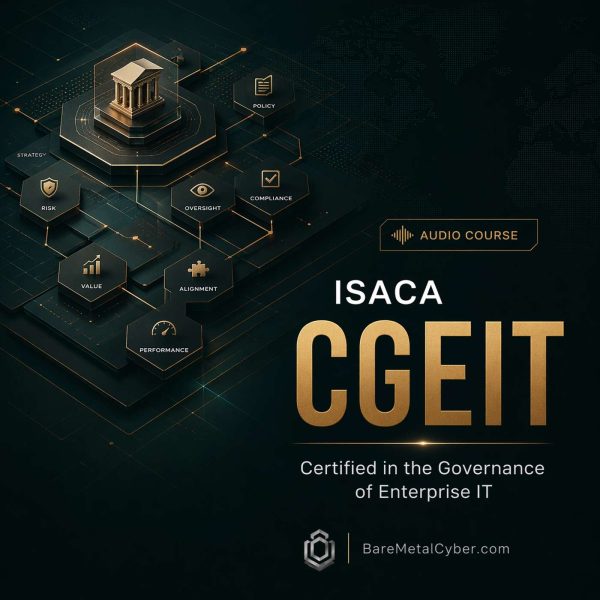
Certified: The ISACA CGEIT Audio Course
- Folgen
- 91
- Format
- Serie – von Anfang an hören
- Letzte Folge
- 15. Feb. 2026
Über den Podcast
Welcome to Certified: The ISACA CGEIT Audio Course. A focused, audio-first path through enterprise governance of IT, built for people who have responsibilities, deadlines, and real stakeholders. Here’s what you can expect: clear explanations that assume you’re capable, but don’t assume you have unlimited study time or a quiet desk. We’ll connect governance concepts to practical decisions—how organizations choose priorities, how they measure value, how they control risk, and how they manage resources across a portfolio. The tone stays professional and direct, because CGEIT rewards disciplined thinking and precise language. By the end, you should recognize what ISACA is really asking, and you should feel comfortable explaining these topics in your own words. To get the most from this course, listen in short, repeatable loops. Pick a steady pace, replay any segment that feels fuzzy, and pay attention to the “why” behind each concept, not just the definition. If you already work in governance, use the episodes to tighten your mental model and sharpen how you justify decisions; if you’re new to it, use them to build a reliable foundation before you worry about edge cases. Try listening once for understanding, then again for exam pattern recognition, especially around benefits, risk, and resourcing tradeoffs. If this approach fits your schedule, follow the show so new episodes land automatically and your study routine stays simple.
Folgen 91
Welcome to the ISACA CGEIT Audio Course
If you’re responsible for how technology supports business outcomes, you already know the hard part is not choosing tools, it’s governing decisions. **Certified: The ISACA CGEIT Audio Course** is built for IT …
Shownotes
If you’re responsible for how technology supports business outcomes, you already know the hard part is not choosing tools, it’s governing decisions. **Certified: The ISACA CGEIT Audio Course** is built for IT leaders, security leaders, program managers, auditors, and governance professionals who need a practical path to the CGEIT credential. You might be stepping into an enterprise role for the first time, rebuilding a governance program after growth or mergers, or trying to align risk and spending with executive expectations. This course assumes you have real work to do and limited time to study, so it focuses on the decision points the exam tests and the conversations leaders actually have. Along the way, you’ll learn to translate governance language into clear actions, artifacts, and accountabilities that hold up under scrutiny.
You’ll move through the core CGEIT themes in a way that feels like guided coaching rather than textbook recitation. The lessons focus on governance frameworks and structures, benefits realization, risk optimization, and resource optimization, with plain-language definitions and exam-relevant nuance. Because it’s audio-first, you can study while commuting, walking, or handling admin work, and you’ll still get a clear mental model of how the pieces fit together. Each segment reinforces what matters most: how to frame governance decisions, how to connect them to business goals, and how to recognize the “best answer” patterns that show up on ISACA-style questions. You’ll also hear common pitfalls, like confusing management activities with governance oversight, or treating risk as a technical issue instead of an enterprise decision.
- What makes this course different is that it treats CGEIT as a job skill, not a vocabulary test. You’ll practice thinking in outcomes, evidence, and accountability, so you can explain why a governance choice is defensible, measurable, and aligned. The content is structured to reduce re-listening and wasted effort, using consistent terminology, crisp examples, and simple checkpoints that keep you oriented without relying on visuals. Success here means more than passing; it means you can walk into a steering committee, an audit discussion, or a portfolio review and speak with calm authority. When you finish, you should feel prepared to answer exam questions quickly and to apply the same logic to real governance work the next day.
Episode 90 — Essential Terms: Plain-Language CGEIT Glossary for Fast Executive Recall (Glossary)
This is the last episode. This episode delivers a plain-language glossary of essential CGEIT terms so you can recall definitions quickly and apply them to executive-level scenario questions without getting …
Shownotes
This is the last episode. This episode delivers a plain-language glossary of essential CGEIT terms so you can recall definitions quickly and apply them to executive-level scenario questions without getting stuck in academic wording. You’ll reinforce core governance vocabulary such as decision rights, accountability, value delivery, benefits realization, portfolio management, risk appetite, tolerance, exceptions, and assurance, with an emphasis on how each term is used to justify choices and evaluate outcomes. We’ll also connect terms to real-world governance behaviors, like what evidence proves a decision was made correctly, what metrics show governance is working, and how language influences stakeholder alignment during tradeoffs. The goal is fast, accurate recall that supports “best answer” reasoning under time pressure, so your responses reflect governance intent, measurable outcomes, and defensible oversight. Produced by BareMetalCyber.com, where you’ll find more cyber audio courses, books, and information to strengthen your educational path. Also, if you want to stay up to date with the latest news, visit DailyCyber.News for a newsletter you can use, and a daily podcast you can commute with.
Episode 89 — Exam Acronyms: High-Yield Audio Reference for CGEIT Domains and Tasks (Glossary)
This episode provides a high-yield acronym reference designed for fast recognition and accurate interpretation during scenario questions, where missing a single term can change what the “best answer” looks …
Shownotes
This episode provides a high-yield acronym reference designed for fast recognition and accurate interpretation during scenario questions, where missing a single term can change what the “best answer” looks like. You’ll review the most common governance, risk, and resource acronyms you are likely to encounter in CGEIT study materials and workplace usage, with clear explanations of what each one means in governance terms and how it influences decisions, evidence, and accountability. We’ll focus on how acronyms map to responsibilities and outcomes, such as how they shape decision rights, portfolio reporting, risk escalation, compliance evidence, and architecture standards enforcement. You’ll also learn how to avoid acronym confusion by anchoring each term to its practical role in GEIT, so you can interpret questions quickly without drifting into unrelated technical detail. Produced by BareMetalCyber.com, where you’ll find more cyber audio courses, books, and information to strengthen your educational path. Also, if you want to stay up to date with the latest news, visit DailyCyber.News for a newsletter you can use, and a daily podcast you can commute with.
Episode 88 — Exam-day tactics: calm two-pass questions and “best answer” governance logic (Exam)
This episode gives you exam-day tactics tailored to CGEIT-style scenario questions, where multiple answers sound plausible and the goal is to choose the one that best reflects governance logic, accountability …
Shownotes
This episode gives you exam-day tactics tailored to CGEIT-style scenario questions, where multiple answers sound plausible and the goal is to choose the one that best reflects governance logic, accountability, and evidence. You’ll learn a calm two-pass approach: first pass to secure confident points quickly, and second pass to handle ambiguous scenarios by identifying the decision being tested, the governance objective at stake, and the action that most strengthens clarity, oversight, and repeatable outcomes. We’ll cover how to avoid common traps like choosing overly tactical fixes, selecting the most conservative control when the scenario calls for alignment and decision rights, or ignoring stakeholder and escalation realities. You’ll also practice how to eliminate distractors by asking which option creates measurable accountability, improves decision structure, and aligns to risk appetite and enterprise objectives. Produced by BareMetalCyber.com, where you’ll find more cyber audio courses, books, and information to strengthen your educational path. Also, if you want to stay up to date with the latest news, visit DailyCyber.News for a newsletter you can use, and a daily podcast you can commute with.
Episode 87 — Align data governance to analytics and AI needs without losing control (1C1)
This episode explains how to align data governance to analytics and AI needs so the enterprise can increase insight and automation without losing control over privacy, quality, lineage, and accountability …
Shownotes
This episode explains how to align data governance to analytics and AI needs so the enterprise can increase insight and automation without losing control over privacy, quality, lineage, and accountability. You’ll learn how analytics and AI expand risk surfaces through broader data access, more data copies, new derived datasets, and model-driven decisions that can amplify data quality problems, bias, or misuse. We’ll cover governance requirements that enable safe scale, including clear data ownership and stewardship, classification and purpose limits, access approvals tied to least privilege, lineage and metadata expectations, and retention and disposal rules that apply to training and analytical artifacts. Real-world scenarios include analytics environments becoming data dumping grounds, teams training models on data without documented consent or provenance, and leaders making decisions from dashboards that lack reliable definitions and quality controls. For CGEIT scenarios, the best answers usually strengthen governance by embedding data controls into analytics workflows, requiring traceable evidence, and balancing innovation with enforceable standards that keep risk visible and manageable. Produced by BareMetalCyber.com, where you’ll find more cyber audio courses, books, and information to strengthen your educational path. Also, if you want to stay up to date with the latest news, visit DailyCyber.News for a newsletter you can use, and a daily podcast you can commute with.
Episode 86 — Prevent architecture drift by governing standards, patterns, and waivers consistently (1B5)
This episode focuses on preventing architecture drift, meaning the slow spread of inconsistent platforms, integration methods, and design choices that increase cost and risk over time. You’ll learn how …
Shownotes
This episode focuses on preventing architecture drift, meaning the slow spread of inconsistent platforms, integration methods, and design choices that increase cost and risk over time. You’ll learn how governance keeps architecture coherent by maintaining clear standards and approved patterns, embedding architecture reviews into decision checkpoints, and running a waiver process that is evidence-based, time-bounded, and monitored for trends. We’ll cover why drift happens in practice, including mergers, rapid delivery pressure, vendor-driven decisions, and inconsistent enforcement across regions, and how to detect it through signals like increasing tool diversity, rising integration complexity, and repeated exceptions in the same areas. Real-world scenarios include teams choosing different identity solutions, duplicated data platforms that fragment reporting, and “temporary” deviations that become permanent because no retirement plan exists. On the CGEIT exam, strong answers typically strengthen architecture governance by improving clarity, speed, and accountability, ensuring standards are usable, waivers are controlled, and the enterprise actively manages technical debt and platform rationalization. Produced by BareMetalCyber.com, where you’ll find more cyber audio courses, books, and information to strengthen your educational path. Also, if you want to stay up to date with the latest news, visit DailyCyber.News for a newsletter you can use, and a daily podcast you can commute with.
Episode 85 — Handle “shadow IT” using governance, incentives, and service improvements (1B6)
This episode teaches you how to handle shadow IT using governance that addresses root causes, because simply banning unsanctioned tools often drives the behavior underground instead of reducing risk. You’ll …
Shownotes
This episode teaches you how to handle shadow IT using governance that addresses root causes, because simply banning unsanctioned tools often drives the behavior underground instead of reducing risk. You’ll learn how shadow IT emerges from unmet needs like speed, usability, missing capabilities, cost friction, or slow approvals, and how governance should respond by improving sanctioned services while enforcing clear boundaries for data handling, vendor usage, and risk acceptance. We’ll cover practical steps such as defining what must be approved, providing fast-path patterns for low-risk needs, improving service catalogs, and using monitoring signals like spend patterns and data flows to detect unsanctioned adoption early. Real-world scenarios include business units adopting SaaS without contract safeguards, teams storing sensitive data in consumer tools, and local analytics efforts creating uncontrolled copies of regulated data. For CGEIT, you’ll practice selecting answers that combine clarity, accountability, incentives, and improved service delivery so the enterprise reduces shadow IT through better options and enforceable governance rather than relying on ineffective policy statements alone. Produced by BareMetalCyber.com, where you’ll find more cyber audio courses, books, and information to strengthen your educational path. Also, if you want to stay up to date with the latest news, visit DailyCyber.News for a newsletter you can use, and a daily podcast you can commute with.
Episode 84 — Manage exceptions and deviations without undermining governance credibility (1A1)
This episode explains how to manage exceptions and deviations in a way that preserves governance credibility, because uncontrolled exceptions are how standards quietly collapse while leaders still believe …
Shownotes
This episode explains how to manage exceptions and deviations in a way that preserves governance credibility, because uncontrolled exceptions are how standards quietly collapse while leaders still believe controls exist. You’ll learn how a governance-grade exception process defines eligibility criteria, required evidence, approval authority, compensating controls, expiration dates, and review cadence, so exceptions are temporary risk decisions rather than permanent loopholes. We’ll cover how to prevent exception abuse, including “emergency” labels used for convenience, repeated renewals without remediation plans, and approvals made outside defined forums that cannot be defended later. Real-world scenarios include architecture waivers that fragment platforms, security control deviations that increase exposure, and compliance exceptions that create audit findings because rationale and compensating controls were never documented. On the CGEIT exam, strong answers usually strengthen the exception process itself by enforcing accountability, traceability, and time-bounded remediation, ensuring deviations are governed decisions aligned to risk appetite rather than informal shortcuts. Produced by BareMetalCyber.com, where you’ll find more cyber audio courses, books, and information to strengthen your educational path. Also, if you want to stay up to date with the latest news, visit DailyCyber.News for a newsletter you can use, and a daily podcast you can commute with.
Episode 83 — Develop and communicate risk policies and standards people can follow (Task 38)
This episode focuses on developing and communicating risk policies and standards that people can actually follow, because governance fails when requirements are unclear, unrealistic, or disconnected from …
Shownotes
This episode focuses on developing and communicating risk policies and standards that people can actually follow, because governance fails when requirements are unclear, unrealistic, or disconnected from day-to-day workflows. You’ll learn how to write policy intent in outcome terms, then support it with standards that define what “compliant” looks like using testable requirements, approved patterns, and role-based expectations. We’ll cover how communication should be targeted to audiences who execute the work, including delivery teams, operations, procurement, and business owners, and how to provide practical guidance that reduces decision fatigue and accelerates compliant delivery. Real-world troubleshooting includes standards that are too complex to apply under time pressure, conflicting requirements across departments, and awareness programs that teach definitions but never change behavior. For CGEIT scenarios, the best answers typically emphasize clarity, usability, accountability, and measurable adherence monitoring so policies and standards shape decisions consistently instead of being treated as optional paperwork. Produced by BareMetalCyber.com, where you’ll find more cyber audio courses, books, and information to strengthen your educational path. Also, if you want to stay up to date with the latest news, visit DailyCyber.News for a newsletter you can use, and a daily podcast you can commute with.
Episode 82 — Align IT and information risk management with the enterprise ERM framework (Task 37)
This episode teaches you how to align IT and information risk management with the enterprise ERM framework so risk decisions are comparable across the business and escalation paths actually work when tradeoffs …
Shownotes
This episode teaches you how to align IT and information risk management with the enterprise ERM framework so risk decisions are comparable across the business and escalation paths actually work when tradeoffs get difficult. You’ll learn how alignment requires shared risk language, consistent categorization, compatible scoring methods, and a governance cadence that connects IT risk signals to enterprise forums without losing the technical detail needed for effective control. We’ll cover typical misalignment problems, including duplicate assessments, conflicting ownership between IT, security, and business leaders, and reporting that is too technical to drive enterprise decisions or too abstract to drive remediation. Real-world scenarios include cyber risks presented as vulnerability lists instead of business exposure, third-party risks split across procurement and IT with no single accountable owner, and risk acceptance happening informally outside ERM thresholds. On the CGEIT exam, strong answers usually strengthen alignment by harmonizing methods and reporting, clarifying decision rights, and ensuring risk treatment and acceptance are traceable to ERM appetite and tolerance. Produced by BareMetalCyber.com, where you’ll find more cyber audio courses, books, and information to strengthen your educational path. Also, if you want to stay up to date with the latest news, visit DailyCyber.News for a newsletter you can use, and a daily podcast you can commute with.
Episode 81 — Align IT processes with legal and regulatory compliance objectives every time (Task 36)
This episode explains how to align IT processes with legal and regulatory compliance objectives so compliance is predictable and repeatable, not dependent on individual memory or last-minute reviews. You’ll …
Shownotes
This episode explains how to align IT processes with legal and regulatory compliance objectives so compliance is predictable and repeatable, not dependent on individual memory or last-minute reviews. You’ll learn how to translate obligations into process requirements by embedding controls and evidence expectations into the way work is requested, designed, approved, changed, and operated, including procurement, access management, change management, incident response, and data handling. We’ll cover how to prevent common breakdowns such as controls that exist only in policy, process steps that are skipped under urgency, and evidence that cannot be produced when auditors ask because it was never captured at the point of execution. Real-world scenarios include regulated data flowing through noncompliant integrations, vendors onboarded without required clauses, and changes implemented without the approvals and testing needed for defensible compliance. For CGEIT, you’ll practice selecting governance actions that standardize compliance alignment through clear criteria, accountable ownership, and monitoring that detects drift early. Produced by BareMetalCyber.com, where you’ll find more cyber audio courses, books, and information to strengthen your educational path. Also, if you want to stay up to date with the latest news, visit DailyCyber.News for a newsletter you can use, and a daily podcast you can commute with.
Episode 80 — Monitor and report adherence to risk policies and standards continuously (Task 35)
This episode explains how to monitor and report adherence to risk policies and standards continuously, because governance only works when it can detect drift early and drive corrective action before risk …
Shownotes
This episode explains how to monitor and report adherence to risk policies and standards continuously, because governance only works when it can detect drift early and drive corrective action before risk accumulates into an incident or compliance failure. You’ll learn how continuous adherence monitoring relies on clear, testable standards, measurable indicators, and defined ownership for responding when adherence declines. We’ll cover practical monitoring approaches such as control performance metrics, exception trend analysis, audit and assurance sampling, automated compliance checks where appropriate, and service-level reporting that ties adherence to business impact. Real-world scenarios include policies that are too vague to measure, teams relying on annual audits as the only detection method, and reporting that lists issues without clear accountability or remediation follow-through. On the CGEIT exam, strong answers typically emphasize continuous monitoring designs that connect adherence evidence to escalation triggers, decision forums, and sustained remediation, making compliance a living governance function rather than a periodic scramble. Produced by BareMetalCyber.com, where you’ll find more cyber audio courses, books, and information to strengthen your educational path. Also, if you want to stay up to date with the latest news, visit DailyCyber.News for a newsletter you can use, and a daily podcast you can commute with.
Episode 79 — Establish comprehensive IT and information risk management programs enterprise-wide (Task 34)
This episode focuses on establishing comprehensive IT and information risk management programs that operate enterprise-wide, meaning they are consistent across business units while still adaptable to different …
Shownotes
This episode focuses on establishing comprehensive IT and information risk management programs that operate enterprise-wide, meaning they are consistent across business units while still adaptable to different risk profiles and regulatory demands. You’ll learn what “comprehensive” implies for governance: clear program scope, defined roles and decision rights, standardized methods for assessment and treatment, integrated reporting, and evidence that controls and monitoring are working in practice. We’ll cover how to build program components such as risk registers, control catalogs, assessment cadence, exception handling, third-party risk integration, and escalation paths that connect to ERM and executive decision forums. Real-world scenarios include fragmented risk processes across regions, duplicate assessments that waste capacity, and risk programs that focus on documentation but fail to influence investment and architecture decisions. For CGEIT, you’ll practice selecting answers that strengthen enterprise-wide consistency, accountability, and actionable reporting so risk management becomes an operating capability, not a periodic compliance exercise. Produced by BareMetalCyber.com, where you’ll find more cyber audio courses, books, and information to strengthen your educational path. Also, if you want to stay up to date with the latest news, visit DailyCyber.News for a newsletter you can use, and a daily podcast you can commute with.
Episode 78 — Apply practical risk assessment methods that support real decisions (4B4)
This episode teaches you how to apply practical risk assessment methods that support real decisions, rather than producing reports that look rigorous but don’t change outcomes. You’ll learn how to select …
Shownotes
This episode teaches you how to apply practical risk assessment methods that support real decisions, rather than producing reports that look rigorous but don’t change outcomes. You’ll learn how to select assessment approaches based on decision needs, such as qualitative methods for fast triage, semi-quantitative scoring for portfolio comparisons, and more detailed analysis when high-impact exposures require deeper justification. We’ll cover how to define scope and assumptions, evaluate likelihood and impact in business terms, assess existing control strength, and document uncertainty so leaders understand confidence levels and tradeoffs. Real-world scenarios include assessments that use inconsistent scales across teams, scoring that is manipulated to secure funding, and risk ratings that ignore dependency concentration or third-party exposure. On the CGEIT exam, the best answers typically emphasize consistency, transparency, and decision usefulness, including using assessments to drive treatment choices, funding decisions, and monitoring priorities with traceable rationale. Produced by BareMetalCyber.com, where you’ll find more cyber audio courses, books, and information to strengthen your educational path. Also, if you want to stay up to date with the latest news, visit DailyCyber.News for a newsletter you can use, and a daily podcast you can commute with.
Episode 77 — Run the risk management lifecycle from identification to monitoring and response (4B3)
This episode explains the risk management lifecycle as a repeatable governance loop that moves from identification to assessment, treatment decisions, implementation, monitoring, and response, with documented …
Shownotes
This episode explains the risk management lifecycle as a repeatable governance loop that moves from identification to assessment, treatment decisions, implementation, monitoring, and response, with documented accountability at each stage. You’ll learn how to prevent lifecycle breakdowns such as risks identified but never assessed, assessments completed but never acted on, or controls implemented but never monitored for effectiveness. We’ll discuss how treatment choices should be governed, including mitigation, transfer, avoidance, or acceptance, and how those choices must align with risk appetite and be supported by evidence and ownership. Real-world scenarios include accepted risks with no expiration or review, mitigation plans that fail due to lack of funding or capacity, and monitoring that focuses on activity rather than indicators that reveal drift. For CGEIT scenario questions, strong answers typically restore lifecycle discipline by clarifying ownership, establishing decision checkpoints, and creating monitoring and escalation mechanisms that keep risk management active over time. Produced by BareMetalCyber.com, where you’ll find more cyber audio courses, books, and information to strengthen your educational path. Also, if you want to stay up to date with the latest news, visit DailyCyber.News for a newsletter you can use, and a daily podcast you can commute with.
Episode 76 — Identify business risk, exposures, and threats with clarity and shared language (4B2)
This episode teaches you how to identify business risk, exposures, and threats using clear, shared language that enables executives and technical teams to align quickly on what matters and what to do next …
Shownotes
This episode teaches you how to identify business risk, exposures, and threats using clear, shared language that enables executives and technical teams to align quickly on what matters and what to do next. You’ll learn to translate technical conditions into business exposure, such as how a weak access model becomes fraud risk, how inconsistent data handling becomes regulatory exposure, or how fragile integrations become service continuity risk. We’ll cover how to define exposures in terms of impacted objectives, affected processes, affected stakeholders, and plausible threat events, then prioritize what to address based on likelihood, impact, and control strength. Real-world scenarios include risk registers filled with vague entries, threat descriptions that lack business context, and teams that disagree because they are describing different layers of the same issue. For CGEIT, you’ll practice choosing answers that improve clarity through common definitions, consistent categorization, and evidence-backed descriptions that make governance decisions faster and more defensible. Produced by BareMetalCyber.com, where you’ll find more cyber audio courses, books, and information to strengthen your educational path. Also, if you want to stay up to date with the latest news, visit DailyCyber.News for a newsletter you can use, and a daily podcast you can commute with.
Episode 75 — Govern risk across IT-enabled capabilities, processes, and services end-to-end (4B1)
This episode focuses on governing risk end-to-end across IT-enabled capabilities, processes, and services, because risk does not respect org charts and often emerges in handoffs, integrations, and shared …
Shownotes
This episode focuses on governing risk end-to-end across IT-enabled capabilities, processes, and services, because risk does not respect org charts and often emerges in handoffs, integrations, and shared dependencies. You’ll learn how end-to-end risk governance connects strategy, architecture, delivery, operations, vendors, and information assets into a single view of exposure that leaders can act on. We’ll cover how to identify risk owners at the service and capability level, how to map dependencies that create concentrated risk, and how to ensure controls are consistent across the full lifecycle from design through operation and change. Real-world scenarios include a secure application sitting on weak identity controls, critical processes depending on a vendor service with unclear incident responsibilities, and shared platforms where one team’s configuration change creates enterprise-wide exposure. On the CGEIT exam, the best answers often reflect end-to-end thinking by addressing ownership, dependency visibility, and integrated controls instead of treating risk as a siloed checklist. Produced by BareMetalCyber.com, where you’ll find more cyber audio courses, books, and information to strengthen your educational path. Also, if you want to stay up to date with the latest news, visit DailyCyber.News for a newsletter you can use, and a daily podcast you can commute with.
Episode 74 — Set risk appetite and tolerance that leaders will enforce consistently (4A3)
This episode teaches you how to set risk appetite and tolerance in a way leaders can enforce consistently, which is critical because many governance failures come from appetite statements that are too vague to …
Shownotes
This episode teaches you how to set risk appetite and tolerance in a way leaders can enforce consistently, which is critical because many governance failures come from appetite statements that are too vague to guide decisions. You’ll learn to express appetite in outcome terms, such as acceptable downtime, data exposure thresholds, compliance deviation boundaries, or financial loss limits, and to connect tolerance to specific decision checkpoints where approvals and escalations occur. We’ll discuss how to make appetite real by assigning ownership, defining measurement methods, and embedding it into portfolio prioritization, architecture standards, vendor approvals, and exception handling. Real-world scenarios include business units claiming “risk appetite is high” to bypass controls, leadership approving conflicting risk positions across similar services, and teams unable to decide because tolerance bands were never defined. For CGEIT questions, strong answers typically improve enforceability by turning appetite into measurable thresholds, aligning it to governance forums, and ensuring decisions are documented with evidence and accountability. Produced by BareMetalCyber.com, where you’ll find more cyber audio courses, books, and information to strengthen your educational path. Also, if you want to stay up to date with the latest news, visit DailyCyber.News for a newsletter you can use, and a daily podcast you can commute with.
Episode 73 — Integrate IT risk governance into enterprise risk management without friction (4A2)
This episode explains how to integrate IT risk governance into enterprise risk management so risk is evaluated consistently, escalations work smoothly, and leadership can compare tradeoffs across the enterprise …
Shownotes
This episode explains how to integrate IT risk governance into enterprise risk management so risk is evaluated consistently, escalations work smoothly, and leadership can compare tradeoffs across the enterprise without translation problems. You’ll learn how integration depends on shared language, common risk categories, aligned reporting cadence, and clear boundaries for what IT risk governance owns versus what ERM owns. We’ll cover how to avoid friction points like duplicate assessments, mismatched scoring scales, conflicting risk ownership, and reporting that is too technical for enterprise risk forums to act on. Real-world scenarios include cybersecurity risks that are reported as technical vulnerabilities instead of business exposure, third-party risks split across procurement and IT with no single accountable owner, and portfolios where risk acceptance happens informally outside ERM thresholds. On the CGEIT exam, the best responses typically align IT risk governance processes, metrics, and escalation paths to ERM expectations while preserving the detail needed for effective operational control. Produced by BareMetalCyber.com, where you’ll find more cyber audio courses, books, and information to strengthen your educational path. Also, if you want to stay up to date with the latest news, visit DailyCyber.News for a newsletter you can use, and a daily podcast you can commute with.
Episode 72 — Select risk frameworks and standards that fit enterprise complexity and maturity (4A1)
This episode teaches you how to select risk frameworks and standards that fit the enterprise’s complexity, regulatory reality, and governance maturity, because choosing an ill-fitting approach creates …
Shownotes
This episode teaches you how to select risk frameworks and standards that fit the enterprise’s complexity, regulatory reality, and governance maturity, because choosing an ill-fitting approach creates bureaucracy, confusion, or gaps that the exam expects you to notice. You’ll learn how to evaluate fit by asking what decisions the framework must support, what evidence must be produced, how risk appetite is defined and enforced, and whether the organization has the capacity to execute the framework consistently. We’ll discuss common selection pitfalls, such as adopting a framework for brand credibility without adapting it to the operating model, or selecting overly detailed standards that teams cannot follow under real delivery pressures. You’ll walk through scenarios like multi-region enterprises needing consistent reporting, highly regulated environments requiring traceable evidence, and rapidly changing portfolios where lightweight but disciplined practices may be more effective. For CGEIT, you’ll practice choosing answers that emphasize fit, scalability, and consistent execution over “most comprehensive on paper” approaches. Produced by BareMetalCyber.com, where you’ll find more cyber audio courses, books, and information to strengthen your educational path. Also, if you want to stay up to date with the latest news, visit DailyCyber.News for a newsletter you can use, and a daily podcast you can commute with.
Episode 71 — Define risk optimization as informed tradeoffs, not risk avoidance (4 Risk Optimization)
This episode defines risk optimization as the disciplined practice of making informed tradeoffs that protect enterprise objectives while still enabling delivery, innovation, and measurable value. You’ll …
Shownotes
This episode defines risk optimization as the disciplined practice of making informed tradeoffs that protect enterprise objectives while still enabling delivery, innovation, and measurable value. You’ll distinguish optimization from avoidance by focusing on decisions that balance likelihood, impact, cost, and opportunity, rather than trying to eliminate risk in ways that stall the business. We’ll connect risk optimization to governance decisions leaders face every day, such as accepting time-to-market pressure, choosing between resilience and cost, or approving exceptions with clear boundaries and evidence. You’ll also explore how risk optimization shows up in CGEIT exam scenarios, where the best answer typically strengthens decision structure, transparency, and accountability rather than selecting the most conservative control. By the end, you’ll be able to explain risk optimization in plain language, apply it to IT-enabled outcomes, and recognize when a scenario requires better tradeoff governance instead of more rules. Produced by BareMetalCyber.com, where you’ll find more cyber audio courses, books, and information to strengthen your educational path. Also, if you want to stay up to date with the latest news, visit DailyCyber.News for a newsletter you can use, and a daily podcast you can commute with.
Episode 70 — Base improvement initiatives on performance results, not politics or anecdotes (Task 33)
This episode explains how to base improvement initiatives on performance results so governance drives meaningful change instead of chasing politics, personal preferences, or one-off anecdotes. You’ll learn how …
Shownotes
This episode explains how to base improvement initiatives on performance results so governance drives meaningful change instead of chasing politics, personal preferences, or one-off anecdotes. You’ll learn how to interpret performance data, trend indicators, exception patterns, audit findings, and stakeholder feedback as inputs to improvement prioritization, then translate those inputs into initiatives with clear scope, owners, and success measures. We’ll cover how to avoid improvement traps such as adding controls without addressing root causes, reorganizing to “fix” problems that are actually process failures, and launching too many initiatives without capacity, causing quality to drop further. Real-world scenarios include repeated change failures that indicate weak release discipline, chronic backlog that indicates portfolio overload, and governance forums that demand new reporting instead of correcting the underlying decision criteria. On the CGEIT exam, strong answers typically show disciplined continuous improvement driven by evidence, with accountability and monitoring to ensure improvements stick and measurably improve outcomes over time. Produced by BareMetalCyber.com, where you’ll find more cyber audio courses, books, and information to strengthen your educational path. Also, if you want to stay up to date with the latest news, visit DailyCyber.News for a newsletter you can use, and a daily podcast you can commute with.
Episode 69 — Establish performance management across investments, processes, and services consistently (Task 32)
This episode teaches you how to establish performance management consistently across investments, processes, and services so governance can see enterprise-wide performance, spot drift early, and enforce …
Shownotes
This episode teaches you how to establish performance management consistently across investments, processes, and services so governance can see enterprise-wide performance, spot drift early, and enforce accountability at the right level. You’ll learn how to build a coherent performance model that connects strategy to portfolio outcomes, operational service performance, risk and compliance indicators, and process effectiveness, using measures that are comparable across business units. We’ll cover how to set targets, thresholds, and escalation rules so performance issues trigger decisions and remediation, not endless discussion, and how to ensure metrics are supported by reliable data and clear ownership. Real-world scenarios include different groups using different definitions for the same KPI, dashboards that cannot be trusted, and governance reporting that focuses on activity while risks and outcomes worsen. For CGEIT scenarios, the best answers usually emphasize consistency, traceability, and evidence-backed measurement that drives action across the enterprise rather than siloed metrics that hide systemic problems. Produced by BareMetalCyber.com, where you’ll find more cyber audio courses, books, and information to strengthen your educational path. Also, if you want to stay up to date with the latest news, visit DailyCyber.News for a newsletter you can use, and a daily podcast you can commute with.
Episode 68 — Evaluate benefits realization across investments, processes, and services for truth (Task 31)
This episode focuses on evaluating benefits realization across investments, processes, and services to ensure governance gets the truth about value, not optimistic narratives or isolated success stories. You’ll …
Shownotes
This episode focuses on evaluating benefits realization across investments, processes, and services to ensure governance gets the truth about value, not optimistic narratives or isolated success stories. You’ll learn how benefits realization must be consistent across the portfolio, using common definitions, baselines, measurement windows, and evidence standards, so executives can compare outcomes and make rational decisions. We’ll cover how to validate benefits that come from process changes, service improvements, risk reduction, and customer experience gains, including how to handle attribution when multiple initiatives contribute to the same outcome. Real-world scenarios include teams reporting benefits without evidence, benefits shifting between programs during reorganizations, and service changes that improve one metric while degrading another. On the CGEIT exam, strong answers typically emphasize governance methods that standardize benefits measurement, require evidence, assign accountable owners, and use results to drive corrective action or portfolio rebalancing. Produced by BareMetalCyber.com, where you’ll find more cyber audio courses, books, and information to strengthen your educational path. Also, if you want to stay up to date with the latest news, visit DailyCyber.News for a newsletter you can use, and a daily podcast you can commute with.
Episode 67 — Align IT investment management with enterprise investment governance practices (Task 30)
This episode explains how to align IT investment management with enterprise investment governance so IT is not treated as a special case that escapes the discipline applied to other capital and strategic …
Shownotes
This episode explains how to align IT investment management with enterprise investment governance so IT is not treated as a special case that escapes the discipline applied to other capital and strategic investments. You’ll learn how enterprise governance expectations—such as standardized business case requirements, risk-based approval thresholds, portfolio reporting, and benefits accountability—should apply to IT-enabled initiatives in a consistent way. We’ll cover how alignment improves decision-making by enabling comparable investment tradeoffs across functions, clarifying funding rules, and ensuring oversight forums have the evidence needed to rebalance portfolios when priorities shift. Real-world scenarios include IT projects approved outside enterprise capital processes, inconsistent financial treatment of cloud spend, and benefits reporting that cannot be compared across business programs. For CGEIT scenario questions, the best answers typically emphasize harmonizing governance cadence, criteria, and reporting so IT investments are managed with the same rigor, transparency, and accountability as enterprise-wide investment decisions. Produced by BareMetalCyber.com, where you’ll find more cyber audio courses, books, and information to strengthen your educational path. Also, if you want to stay up to date with the latest news, visit DailyCyber.News for a newsletter you can use, and a daily podcast you can commute with.
Episode 66 — Assign ownership and accountability so every investment has a responsible leader (Task 29)
This episode teaches you how to assign ownership and accountability so every investment has a responsible leader who can answer for value delivery, risk decisions, and ongoing performance. You’ll clarify what …
Shownotes
This episode teaches you how to assign ownership and accountability so every investment has a responsible leader who can answer for value delivery, risk decisions, and ongoing performance. You’ll clarify what accountability means in governance terms: decision rights, evidence responsibility, and authority to drive corrective action when outcomes drift. We’ll cover practical approaches such as naming an accountable business owner for benefits, defining IT ownership for delivery and operational performance, and establishing shared accountability boundaries for risk and compliance obligations. Real-world scenarios include investments with unclear sponsorship, project managers blamed for benefits they cannot control, and services with no owner for renewals, incident patterns, or technical debt accumulation. On the CGEIT exam, strong answers usually emphasize establishing explicit accountable ownership with documented decision rights, measurable expectations, and governance reporting that makes it obvious who must act when performance or benefits fall short. Produced by BareMetalCyber.com, where you’ll find more cyber audio courses, books, and information to strengthen your educational path. Also, if you want to stay up to date with the latest news, visit DailyCyber.News for a newsletter you can use, and a daily podcast you can commute with.
Episode 65 — Manage IT-enabled investments through their full economic lifecycle end-to-end (Task 28)
This episode focuses on managing IT-enabled investments across their full economic lifecycle, from initial concept and approval through delivery, operation, optimization, and retirement, because governance …
Shownotes
This episode focuses on managing IT-enabled investments across their full economic lifecycle, from initial concept and approval through delivery, operation, optimization, and retirement, because governance requires accountability beyond launch day. You’ll learn how lifecycle management includes funding governance, benefits tracking, risk monitoring, operational performance management, and periodic reassessment of whether the investment still aligns to enterprise objectives. We’ll cover how economic lifecycle thinking forces clarity on total cost of ownership, recurring operating costs, vendor renewal decisions, technical debt, and retirement planning, so value is sustained instead of eroding quietly over time. Real-world scenarios include platforms that grow expensive without measurable benefit, services kept alive after business need fades, and renewal decisions made automatically without performance evidence. For the CGEIT exam, the best answers typically strengthen lifecycle governance by defining ownership, requiring periodic value reviews, and ensuring investments are actively managed until they are intentionally retired with risks and data handled correctly. Produced by BareMetalCyber.com, where you’ll find more cyber audio courses, books, and information to strengthen your educational path. Also, if you want to stay up to date with the latest news, visit DailyCyber.News for a newsletter you can use, and a daily podcast you can commute with.
Episode 64 — Evaluate benefits using methods that capture realized value, not just delivery (3B4)
This episode explains how to evaluate benefits using methods that capture realized value, not just whether a project delivered its outputs on time. You’ll learn the difference between outputs, outcomes, and …
Shownotes
This episode explains how to evaluate benefits using methods that capture realized value, not just whether a project delivered its outputs on time. You’ll learn the difference between outputs, outcomes, and benefits, and how governance validates benefits by establishing baselines, defining measurement periods, and assigning accountable owners who can confirm whether change actually happened in operations. We’ll cover evaluation methods such as KPI tracking, cost avoidance and cost reduction validation, productivity and cycle-time measurement, quality and risk reduction indicators, and customer experience measures, along with the limitations and assumptions that must be documented. Real-world scenarios include programs that “go live” but never change business processes, benefits that depend on adoption that was not managed, and savings claims that ignore new operational costs. On the CGEIT exam, strong answers typically emphasize disciplined benefits measurement with traceable evidence and governance follow-through, rather than accepting success claims based on delivery completion alone. Produced by BareMetalCyber.com, where you’ll find more cyber audio courses, books, and information to strengthen your educational path. Also, if you want to stay up to date with the latest news, visit DailyCyber.News for a newsletter you can use, and a daily podcast you can commute with.
Episode 63 — Choose performance metrics that drive the right behavior and accountability (3B3)
This episode teaches you how to choose performance metrics that drive the right behavior and accountability, because poorly chosen metrics create gaming, misalignment, and false confidence in governance …
Shownotes
This episode teaches you how to choose performance metrics that drive the right behavior and accountability, because poorly chosen metrics create gaming, misalignment, and false confidence in governance outcomes. You’ll learn to select measures that reflect enterprise value, risk control, and operational performance, such as benefits realization, service reliability, change success, cost-to-serve, control effectiveness, and customer experience indicators that are meaningful to business leaders. We’ll discuss how to define owners, thresholds, and escalation triggers so metrics lead to decisions, not dashboards, and how to combine leading and lagging indicators to detect drift early. Real-world scenarios include teams optimizing for speed while quality collapses, projects hitting delivery milestones while benefits are never realized, and governance forums drowning in data that doesn’t support action. For CGEIT scenario questions, the best answers typically reinforce outcome-based measurement, clear accountability, and evidence-backed reporting that discourages metric manipulation. Produced by BareMetalCyber.com, where you’ll find more cyber audio courses, books, and information to strengthen your educational path. Also, if you want to stay up to date with the latest news, visit DailyCyber.News for a newsletter you can use, and a daily podcast you can commute with.
Episode 62 — Manage and report IT investments like a portfolio, not isolated projects (3B2)
This episode focuses on managing and reporting IT investments as a portfolio, which means governance looks at the combined performance, risk, and resource demand across initiatives rather than optimizing each …
Shownotes
This episode focuses on managing and reporting IT investments as a portfolio, which means governance looks at the combined performance, risk, and resource demand across initiatives rather than optimizing each project in isolation. You’ll learn how portfolio thinking enables tradeoffs that protect enterprise outcomes, such as rebalancing funding, stopping low-value work, sequencing dependencies, and reserving capacity for mandatory risk and compliance work. We’ll cover how governance reporting should present portfolio health through alignment, benefits progress, risk exposure, delivery confidence, and capacity constraints, so leaders can decide quickly with the right context. Real-world scenarios include organizations funding too many initiatives at once, duplicating capabilities across business units, and hiding poor outcomes because reporting is fragmented by project teams. On the CGEIT exam, strong answers typically emphasize portfolio-level governance mechanisms that provide transparency and enforce prioritization, rather than treating each investment as a standalone decision with no enterprise tradeoffs. Produced by BareMetalCyber.com, where you’ll find more cyber audio courses, books, and information to strengthen your educational path. Also, if you want to stay up to date with the latest news, visit DailyCyber.News for a newsletter you can use, and a daily podcast you can commute with.
Hier stehen die neuesten 60 von 91 Folgen. Ältere Folgen findest du im Feed des Podcasts.
Empfohlen von Certified: The ISACA CGEIT Audio Course



Ähnliche Podcasts
Mehr Bildung-Podcasts







Ist das dein Podcast?
Bestätige es mit einem Eintrag in deinem Feed: Du bekommst hier einen Code, trägst ihn als podcast:txt in den Kanal deines Feeds ein, und wir prüfen ihn. Danach steht dein Podcast als „verifiziert“ bei SoundNode.