

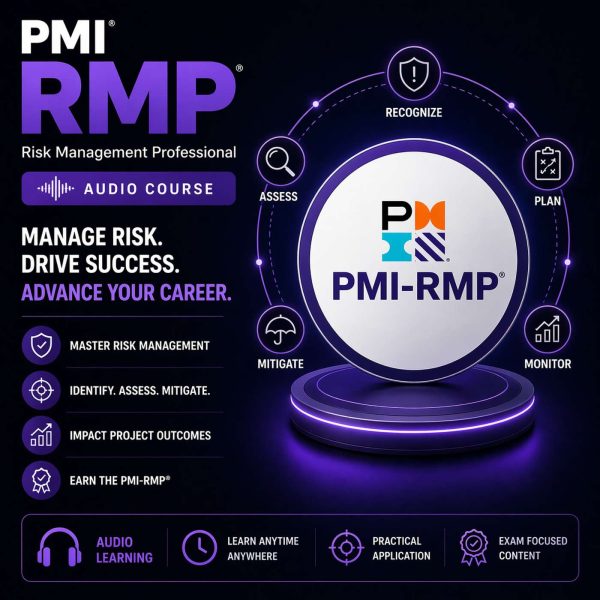
Certified: The PMI-RMP Audio Course
- Folgen
- 84
- Format
- Serie – von Anfang an hören
- Letzte Folge
- 11. Nov. 2025
Über den Podcast
The PMI-RMP Audio Course is your complete audio companion for mastering risk management—designed for professionals who need both exam confidence and real-world fluency. Across 80+ focused episodes, you’ll learn how to think like a risk leader: shaping strategy, identifying threats and opportunities, analyzing exposure, and crafting responses that stand up to scrutiny. Each episode blends clear explanations with relatable project scenarios, helping you connect every domain of the Project Management Institute – Risk Management Professional (PMI-RMP) blueprint to practical evidence, decision flow, and stakeholder impact. Designed for busy learners, this course transforms downtime into productive study time. Whether you’re commuting, walking, or between meetings, you’ll absorb the logic, vocabulary, and cadence of professional risk management—without slides or jargon. By the end, you’ll understand not just what to do on the exam, but how risk thinking transforms project outcomes. Develop the calm confidence of a strategist who anticipates uncertainty and proves control when it matters most. Produced by BareMetalCyber.com, where cybersecurity and project excellence converge in every course.
Folgen 84
Episode 83 — Crisis Communication and Stakeholder Trust
When risk becomes reality, communication determines whether stakeholders remain confident or the project loses support. This episode teaches crisis communication as a disciplined extension of risk governance …
Shownotes
When risk becomes reality, communication determines whether stakeholders remain confident or the project loses support. This episode teaches crisis communication as a disciplined extension of risk governance: speak early, state facts, name owners, explain actions, and set the next update time. You will learn to align messages to thresholds and triggers already agreed in the plan so escalation feels expected, not improvised. We distinguish audiences—team, executives, customers, regulators—and explain how to tailor narrative, detail, and cadence without drifting from a single source of truth. The PMI-RMP exam often rewards choices that are transparent, time-bound, and evidence-backed over attempts to minimize or delay.
We provide actionable patterns: a one-page incident brief (what happened, impact to objectives, drivers, responses underway, decisions needed), a spokesperson model to avoid mixed messages, and a decision log entry that links communications to actions and outcomes. Best practices include rehearsed contact chains, preapproved holding statements, and visual dashboards that show trend direction rather than static status. Troubleshooting covers optimism bias that undercuts credibility, information vacuums that fuel rumors, and post-incident silence that wastes the learning window. Effective crisis communication preserves trust by pairing honesty with momentum: clear story, visible progress, documented closure. Produced by BareMetalCyber.com, where you’ll find more cyber audio courses, books, and information to strengthen your educational path. Also, if you want to stay up to date with the latest news, visit DailyCyber.News for a newsletter you can use, and a daily podcast you can commute with.
Episode 82 — Hybrid Risk: Guardrails and Touchpoints
Hybrid delivery mixes gated planning with iterative build, which multiplies handoffs—and risk—unless you design clear guardrails. This episode defines those guardrails as explicit policies on what must be …
Shownotes
Hybrid delivery mixes gated planning with iterative build, which multiplies handoffs—and risk—unless you design clear guardrails. This episode defines those guardrails as explicit policies on what must be decided at stage gates, what can evolve within sprints, and how information flows between the two. We link appetite, tolerance, and thresholds to both layers so the program board, change control, and team ceremonies share the same triggers and definitions. You will learn how to architect touchpoints: risk review syncs aligned to releases, backlog readiness checks before gates, and lightweight impact notes attached to change requests. On the PMI-RMP exam, hybrid scenarios frequently hide failure modes in the seams; strong answers establish synchronized cadence and artifact traceability rather than favoring one approach over the other.
We offer examples of working hybrids: a regulatory milestone locked by a gate while technical discovery continues under sprint spikes; shared indicators where a rising integration-defect trend auto-schedules a cross-team decision forum; and pre-authorized contingency that teams can draw within limits without waiting for the board. Best practices include dual-view registers (executive and team), RACI clarity for escalation, and explicit conversion rules for when sprint-level risks become program-level items. Troubleshooting covers duplicated registers, conflicting definitions of “done,” and schedule buffers silently consumed by unsignaled changes. Effective hybrid risk practice turns potential friction into a resilient system with clear lanes and consistent signals—exactly the competence the exam seeks to verify. Produced by BareMetalCyber.com, where you’ll find more cyber audio courses, books, and information to strengthen your educational path. Also, if you want to stay up to date with the latest news, visit DailyCyber.News for a newsletter you can use, and a daily podcast you can commute with.
Episode 81 — Agile Risk: Backlogs, Sprints, and Reviews
Agile does not eliminate risk; it changes its rhythm. This episode explains how uncertainty flows through product backlogs, sprint planning, daily scrums, reviews, and retrospectives so you can manage exposure …
Shownotes
Agile does not eliminate risk; it changes its rhythm. This episode explains how uncertainty flows through product backlogs, sprint planning, daily scrums, reviews, and retrospectives so you can manage exposure without breaking agility. We show how to translate classic risk concepts into Agile terms: the backlog becomes a risk radar when items carry risk flags and acceptance criteria; sprint goals define near-term thresholds; and definition-of-ready/definition-of-done act as built-in controls. You will learn how to treat spikes as deliberate risk responses, how to use time-boxed experiments to reduce uncertainty, and how to align risk ownership with Product Owner, Scrum Master, and team roles. The PMI-RMP exam often tests whether you can choose approach-consistent actions—lightweight, evidence-driven, and tied to ceremonies—rather than imposing predictive artifacts that slow delivery.
We expand with concrete patterns: integrate leading indicators (defect escape rate, carryover, cycle time variance) into dashboards; map dependencies across teams using a simple risk board; and maintain a trigger watchlist reviewed at standups for rapid escalation. Best practices include making risk hypotheses explicit on user stories, reserving capacity for mitigation work each sprint, and treating retrospective insights as new risks or opportunities with owners and dates. Troubleshooting covers “water-Scrum-fall” governance gaps, invisible architectural risk hidden behind velocity, and backlog bloat that obscures urgent exposure. Agile risk management favors short feedback loops, measurable learning, and traceable decisions—the same logic the exam rewards. Produced by BareMetalCyber.com, where you’ll find more cyber audio courses, books, and information to strengthen your educational path. Also, if you want to stay up to date with the latest news, visit DailyCyber.News for a newsletter you can use, and a daily podcast you can commute with.
Episode 80 — Portfolio and Program Risk vs. Project Risk
Not all risks live at the project level. This episode differentiates portfolio, program, and project risks—each with distinct horizons and governance layers. Portfolio risks affect strategic objectives and …
Shownotes
Not all risks live at the project level. This episode differentiates portfolio, program, and project risks—each with distinct horizons and governance layers. Portfolio risks affect strategic objectives and resource allocation across multiple initiatives; program risks arise from interdependencies among related projects; project risks stay within a single delivery scope. The PMI-RMP exam tests your ability to identify escalation paths and ownership boundaries when a local issue threatens higher-level outcomes. You will learn how aggregation and correlation shape portfolio exposure, and how consistent categorization ensures visibility across tiers.
We extend with practice scenarios: a shared vendor delay affecting several projects (program risk) or budget cuts that alter organizational appetite (portfolio risk). Best practices include upward reporting of systemic drivers, common scale calibration, and integrated dashboards that roll up exposure without double counting. Troubleshooting guidance covers fragmented registers, conflicting tolerances across layers, and missed feedback loops that prevent portfolio decisions from informing projects. Mastering vertical integration of risk management demonstrates strategic awareness—the difference between tactical control and enterprise contribution that the exam seeks to confirm. Produced by BareMetalCyber.com, where you’ll find more cyber audio courses, books, and information to strengthen your educational path. Also, if you want to stay up to date with the latest news, visit DailyCyber.News for a newsletter you can use, and a daily podcast you can commute with.
Episode 79 — Operational Readiness and Transition Risk
A project’s finish line is not delivery—it is sustained operation. This episode examines operational readiness and transition risk: whether people, processes, and systems can absorb the new capability without …
Shownotes
A project’s finish line is not delivery—it is sustained operation. This episode examines operational readiness and transition risk: whether people, processes, and systems can absorb the new capability without disruption. The PMI-RMP exam often frames scenarios where technical success hides readiness gaps, expecting you to propose proactive verification steps. You will learn to define acceptance criteria for training, support, documentation, and continuity, then monitor them as risk indicators. The transition plan becomes your response tool, mapping dependencies between project and operational teams to ensure accountability.
Examples include incomplete user training delaying adoption, missing spare parts for new equipment, or unclear ownership of post-go-live incidents. Best practices include rehearsal events, staged cutovers, and integrated checklists reviewed at each gate. Troubleshooting guidance covers misaligned service-level agreements, unsupported legacy systems, and last-minute handovers that erode trust. On the exam, the correct option maintains service continuity through documented readiness verification—a hallmark of mature, end-to-end risk thinking. Produced by BareMetalCyber.com, where you’ll find more cyber audio courses, books, and information to strengthen your educational path. Also, if you want to stay up to date with the latest news, visit DailyCyber.News for a newsletter you can use, and a daily podcast you can commute with.
Episode 78 — Cyber and Information Security Risk for PMs
Digital assets and data flows create vulnerabilities every project manager must understand. This episode outlines how to identify and treat cyber and information security risks within project scope, even when a …
Shownotes
Digital assets and data flows create vulnerabilities every project manager must understand. This episode outlines how to identify and treat cyber and information security risks within project scope, even when a dedicated security team exists. We define common exposures—data breach, unauthorized access, loss of confidentiality or availability—and link them to project objectives, contracts, and compliance requirements. The PMI-RMP exam increasingly includes security-related stems, testing your ability to integrate protective controls and escalation paths into standard risk governance.
We discuss practical techniques: performing simple threat modeling for sensitive data, confirming encryption and access controls in vendor deliverables, and ensuring security sign-offs appear as milestones. Best practices include assigning a security liaison as a risk owner, tracking vulnerabilities through the same register, and recording patch or audit evidence as verification artifacts. Troubleshooting guidance covers schedule pressure that bypasses reviews, unclear data-handling roles, and inadequate incident communication channels. The strongest answers link security actions to measurable reductions in exposure, proving that modern risk professionals guard information as diligently as cost or schedule. Produced by BareMetalCyber.com, where you’ll find more cyber audio courses, books, and information to strengthen your educational path. Also, if you want to stay up to date with the latest news, visit DailyCyber.News for a newsletter you can use, and a daily podcast you can commute with.
Episode 77 — Financial and Currency Exposure in Projects
Exchange rates, inflation, and interest fluctuations can quietly shift project economics. This episode teaches you to identify, quantify, and respond to financial and currency risks through the same structured …
Shownotes
Exchange rates, inflation, and interest fluctuations can quietly shift project economics. This episode teaches you to identify, quantify, and respond to financial and currency risks through the same structured framework used for technical exposures. The PMI-RMP exam often tests whether you recognize hidden volatility—for example, multi-currency procurement or long lead-time funding—as a risk requiring contingency and monitoring. You will learn common responses: hedging, index-linked pricing, early conversions, and reserve adjustments. We explain how to express exposure in measurable terms like value-at-risk or expected variance within tolerance bands, connecting financial logic to project thresholds.
Examples include delayed payments in foreign currency, inflation affecting labor contracts, and rate hikes altering financing costs. Best practices include involving finance specialists in risk reviews, setting trigger rates for escalation, and updating cost baselines when currency movements exceed predefined margins. Troubleshooting guidance covers mismatched hedge maturities, overreliance on spot conversions, and ignoring macroeconomic indicators that signal trend change. The exam rewards candidates who apply disciplined governance—traceable thresholds, documented actions, and timely review—to financial uncertainty just as rigorously as to technical risks. Produced by BareMetalCyber.com, where you’ll find more cyber audio courses, books, and information to strengthen your educational path. Also, if you want to stay up to date with the latest news, visit DailyCyber.News for a newsletter you can use, and a daily podcast you can commute with.
Episode 76 — Quality Risk and Fitness-for-Use
Quality risk concerns whether deliverables will meet functional expectations and stakeholder satisfaction, not just specifications. This episode clarifies how to express “fitness-for-use” as an exposure …
Shownotes
Quality risk concerns whether deliverables will meet functional expectations and stakeholder satisfaction, not just specifications. This episode clarifies how to express “fitness-for-use” as an exposure: performance shortfalls, missed acceptance criteria, or defects that erode trust. The PMI-RMP exam frequently embeds quality cues inside scenario stems, requiring you to connect test results, process stability, and defect trends back to risk management logic. You will learn to link quality indicators—defect density, rework rates, customer complaints—to probability and impact scales so analysis becomes evidence-driven rather than subjective. We also distinguish prevention-oriented actions, like process audits and peer reviews, from detection-oriented controls, such as inspections and acceptance testing.
We illustrate practice through diverse examples: in construction, tolerance deviations that delay approvals; in software, instability that inflates support costs; in services, inconsistent documentation that reduces client confidence. Best practices include recording quality metrics in the same register as other risks, assigning owners who can act early, and integrating thresholds into test plans. Troubleshooting guidance covers over-inspection waste, inconsistent defect classification, and unverified supplier quality data. The exam rewards approaches that embed quality assurance into risk governance—detect early, act on evidence, and close exposure through verified results, not paperwork. Produced by BareMetalCyber.com, where you’ll find more cyber audio courses, books, and information to strengthen your educational path. Also, if you want to stay up to date with the latest news, visit DailyCyber.News for a newsletter you can use, and a daily podcast you can commute with.
Episode 75 — Safety, Environmental, and Social Risk
Projects operate within communities and ecosystems, making safety, environmental, and social risk both ethical imperatives and governance requirements. This episode frames these domains as objectives alongside …
Shownotes
Projects operate within communities and ecosystems, making safety, environmental, and social risk both ethical imperatives and governance requirements. This episode frames these domains as objectives alongside cost and schedule, not as afterthoughts. You will learn to translate hazards, emissions, and community impacts into explicit risks with indicators, thresholds, and response owners. The PMI-RMP exam may present scenarios where protective measures compete with delivery pressure; strong choices uphold documented tolerances and escalation rules, demonstrating that safety and social license are non-negotiable boundaries rather than tradeable preferences.
We provide grounded practice examples: job hazard analyses tied to leading injury indicators, environmental monitoring with trigger limits and contingency remediation plans, and stakeholder engagement steps that reduce protest or permit delays. Best practices include integrating safety briefings into cadence, documenting near-miss learning, and maintaining incident command roles for rapid response. Troubleshooting guidance covers conflicting contractor standards, supply materials with uncertain provenance, and inadequate community communication that escalates reputational risk. Treating these areas with the same rigor as technical risks protects people, preserves timelines, and aligns with exam scenarios that reward principled, evidence-backed decisions. Produced by BareMetalCyber.com, where you’ll find more cyber audio courses, books, and information to strengthen your educational path. Also, if you want to stay up to date with the latest news, visit DailyCyber.News for a newsletter you can use, and a daily podcast you can commute with.
Episode 74 — Compliance, Legal, and Regulatory Risk
Compliance, legal, and regulatory exposures introduce hard constraints and nonnegotiable timelines. This episode clarifies how to convert obligations—privacy rules, safety codes, licensing, export controls, and …
Shownotes
Compliance, legal, and regulatory exposures introduce hard constraints and nonnegotiable timelines. This episode clarifies how to convert obligations—privacy rules, safety codes, licensing, export controls, and sector standards—into concrete risk statements, indicators, and triggers. The PMI-RMP exam often embeds a new or changed rule inside a scenario, expecting you to reassess thresholds, adjust plans, and escalate through governance rather than treating the change as mere information. You will learn to distinguish advisory guidance from mandatory requirements, to align evidence artifacts with auditor expectations, and to budget schedule and cost for validation steps like assessments and certifications.
We then discuss implementation patterns. Integrate compliance checkpoints into the schedule, assign clear owners for each requirement, and maintain a traceable matrix that links obligations to tests and proof. Best practices include early legal review for contractual alignment, vendor clauses that mirror your obligations, and change control entries whenever regulatory timelines shift. Troubleshooting guidance covers ambiguous jurisdictional scope, conflicting requirements across geographies, and late discovery that forces rework. On the exam, correct answers tie compliance moves to measurable outcomes—documented approvals, passed checkpoints, risk reductions—rather than generic assurances that “we will comply.” Produced by BareMetalCyber.com, where you’ll find more cyber audio courses, books, and information to strengthen your educational path. Also, if you want to stay up to date with the latest news, visit DailyCyber.News for a newsletter you can use, and a daily podcast you can commute with.
Episode 73 — Vendor and Supply Chain Risk Fundamentals
Vendor and supply chain risks compound because they cross organizational boundaries. This episode outlines fundamentals the exam expects you to apply: segmentation of suppliers by criticality, mapping of …
Shownotes
Vendor and supply chain risks compound because they cross organizational boundaries. This episode outlines fundamentals the exam expects you to apply: segmentation of suppliers by criticality, mapping of dependencies and single points of failure, and alignment of contract obligations with monitoring cadence. You will learn how to translate due diligence into practical indicators—on-time performance, quality escapes, financial health, cybersecurity posture, and capacity signals—that feed your trigger watchlist. We emphasize that third-party risk is not a procurement-only concern; it is a project exposure requiring owners, thresholds, and scenarios for disruption, substitution, and recovery.
We continue with practices that keep exposure visible. Build tiered oversight so critical suppliers receive frequent reviews and contingency rehearsals, while lower tiers follow lighter checks. Use dual-sourcing or buffer stocks where feasible, and document rapid-switch criteria to avoid last-minute negotiation risk. Troubleshooting guidance includes opaque sub-tier suppliers, contractual blind spots around data rights or IP, and geographic concentration that ties lead times to regional events. On the PMI-RMP exam, the stronger answer usually establishes measurable oversight and preauthorized responses, not vague “increase communication” gestures. Treat the supply chain as an extended project system with its own indicators, triggers, and owners. Produced by BareMetalCyber.com, where you’ll find more cyber audio courses, books, and information to strengthen your educational path. Also, if you want to stay up to date with the latest news, visit DailyCyber.News for a newsletter you can use, and a daily podcast you can commute with.
Episode 72 — Procurement and Contract Risk (T&M, FP, CP)
Procurement shifts portions of risk to or from suppliers, and contract type determines how exposure is shared. This episode compares time-and-materials (T&M), fixed-price (FP), and cost-plus (CP) arrangements …
Shownotes
Procurement shifts portions of risk to or from suppliers, and contract type determines how exposure is shared. This episode compares time-and-materials (T&M), fixed-price (FP), and cost-plus (CP) arrangements through a risk lens the PMI-RMP exam frequently leverages. T&M places variability on the buyer unless guardrails cap hours or rates; FP transfers performance and cost risk to the seller but may introduce quality shortcuts or change rigidity; CP reimburses allowable costs with a fee, retaining more risk with the buyer while incentivizing transparency and flexibility. You will learn how clauses—milestones, acceptance criteria, incentives, penalties, and termination rights—become triggers and indicators in your register, shaping proximity, urgency, and response choices.
We expand with application and troubleshooting. For T&M, best practices include not-to-exceed ceilings, burn-up visibility, and preapproved skills matrices. For FP, define crystal-clear deliverables, verification steps, and change procedures to avoid dispute risk. For CP, install audit-ready cost tracking, fee structures aligned to outcomes, and risk-sharing gain/pain elements where appropriate. We also cover flow-down requirements, subcontractor dependencies, and lead-time volatility. Exam scenarios reward the option that matches contract structure to uncertainty and governance maturity, then ties that choice to measurable controls rather than hoping for vendor heroics. Produced by BareMetalCyber.com, where you’ll find more cyber audio courses, books, and information to strengthen your educational path. Also, if you want to stay up to date with the latest news, visit DailyCyber.News for a newsletter you can use, and a daily podcast you can commute with.
Episode 71 — Integrated Change Control and Risk
Integrated change control is where risk management meets governance in real time. This episode explains how proposed changes—scope adjustments, schedule shifts, cost reallocations, or quality criteria …
Shownotes
Integrated change control is where risk management meets governance in real time. This episode explains how proposed changes—scope adjustments, schedule shifts, cost reallocations, or quality criteria updates—intersect with the risk strategy, register, and reserves. You will learn to assess whether a requested change creates new risks, alters probability/impact of existing entries, or consumes contingency and management reserve. The PMI-RMP exam often frames scenarios around change boards, approval thresholds, and sequencing, testing whether you update risk artifacts before, not after, the decision. We emphasize evidence: each change should reference affected risk IDs, revised triggers, and updated exposure narratives so reviewers can see exactly how uncertainty moves when the baseline moves.
We then translate this into day-to-day practice. Strong responses include preparing a concise risk impact note for the change request, showing before/after exposure, and stating whether reserves remain adequate. Best practices include linking mitigation tasks to the schedule as part of the change, documenting residual and secondary implications, and ensuring owners accept any new obligations created by the decision. Troubleshooting guidance covers “silent scope creep” labeled as mitigation, duplicated approvals across teams, and emergency changes that bypass risk review and later erode trust. On the exam, the best choice preserves traceability, respects authority, and ties the change to clear risk outcomes rather than cosmetic documentation. Produced by BareMetalCyber.com, where you’ll find more cyber audio courses, books, and information to strengthen your educational path. Also, if you want to stay up to date with the latest news, visit DailyCyber.News for a newsletter you can use, and a daily podcast you can commute with.
Episode 70 — Issue vs. Risk: Boundaries and Hand-Offs
Understanding where a risk ends and an issue begins is vital to governance control. This episode clarifies that a risk is an uncertain event that may occur, while an issue is a realized event already affecting …
Shownotes
Understanding where a risk ends and an issue begins is vital to governance control. This episode clarifies that a risk is an uncertain event that may occur, while an issue is a realized event already affecting objectives. The PMI-RMP exam tests your ability to decide when to escalate a risk into an issue and update the appropriate logs. You will learn to establish clear hand-offs between risk management and issue management, ensuring continuity of evidence, ownership, and lessons learned. Each transition must preserve history: the original trigger, decision records, and response outcomes.
We illustrate the boundary with examples—an approaching vendor delay remains a risk until the delivery date passes unmet, at which point it becomes an issue requiring corrective action. Best practices include documenting the transition, reassigning ownership if necessary, and linking financial or schedule impact back to residual exposure. Troubleshooting guidance covers premature escalation that bypasses contingency steps, ignored risks that evolve into unmanaged issues, and loss of traceability between the two lists. Maintaining clean boundaries reinforces accountability, sharpens governance, and reflects the judgment PMI-RMP practitioners are certified to demonstrate. Produced by BareMetalCyber.com, where you’ll find more cyber audio courses, books, and information to strengthen your educational path. Also, if you want to stay up to date with the latest news, visit DailyCyber.News for a newsletter you can use, and a daily podcast you can commute with.
Episode 69 — Executive Dashboards as Narratives
Dashboards tell stories, and this episode explains how to design risk dashboards that inform decisions instead of simply displaying colors. We shift the mindset from reporting metrics to narrating change: what …
Shownotes
Dashboards tell stories, and this episode explains how to design risk dashboards that inform decisions instead of simply displaying colors. We shift the mindset from reporting metrics to narrating change: what has improved, what remains critical, and what action is needed. You will learn how to balance visuals with concise commentary so executives grasp meaning in seconds. The PMI-RMP exam often favors the answer that communicates upward effectively—transparent, factual, and aligned with thresholds—over technical perfection hidden in detail.
We provide guidance on structure: start with key drivers and trend arrows, add concise explanations tied to thresholds, and finish with requested decisions or approvals. Best practices include using consistent time intervals, displaying both threats and opportunities, and limiting color codes to avoid confusion for color-impaired viewers. Troubleshooting topics include overcrowded dashboards, inconsistent data sources, and visuals that lack context or direction. A well-constructed dashboard transforms static information into a management narrative—risk exposure becomes a living story executives can steer. Produced by BareMetalCyber.com, where you’ll find more cyber audio courses, books, and information to strengthen your educational path. Also, if you want to stay up to date with the latest news, visit DailyCyber.News for a newsletter you can use, and a daily podcast you can commute with.
Episode 68 — Reporting Overall Risk Exposure
Beyond individual entries, leaders need to understand overall project risk—the integrated effect of all uncertainties on objectives. This episode explains how to synthesize exposure into narratives that show …
Shownotes
Beyond individual entries, leaders need to understand overall project risk—the integrated effect of all uncertainties on objectives. This episode explains how to synthesize exposure into narratives that show whether the project is trending safer, riskier, or stable. The PMI-RMP exam often tests this skill through questions about aggregation and communication. You will learn to group risks by category or driver, roll up scores or confidence ranges, and present exposure relative to thresholds defined in the risk strategy. The goal is clarity: a concise picture of total exposure that guides action, not overwhelm.
Examples show how to express overall exposure as the probability of meeting finish date or budget within tolerance, or as a qualitative trend—improving, stable, worsening—supported by indicator data. Best practices include using consistent visuals, annotating trends with key events, and linking exposure shifts to decisions taken. Troubleshooting guidance covers double counting correlated items, omitting opportunities, and oversimplifying by averaging rather than analyzing drivers. Summarizing overall risk exposure demonstrates system thinking and communication precision—the kind of integrated reasoning both executives and the exam value highly. Produced by BareMetalCyber.com, where you’ll find more cyber audio courses, books, and information to strengthen your educational path. Also, if you want to stay up to date with the latest news, visit DailyCyber.News for a newsletter you can use, and a daily podcast you can commute with.
Episode 67 — Close Criteria and Administrative Closure
Knowing when a risk is truly closed is just as important as identifying it in the first place. This episode defines closure criteria: the trigger window has passed without occurrence, residual exposure is …
Shownotes
Knowing when a risk is truly closed is just as important as identifying it in the first place. This episode defines closure criteria: the trigger window has passed without occurrence, residual exposure is within tolerance, all responses are complete and verified, and required documentation is signed off. The PMI-RMP exam frequently tests this concept by offering options that close risks prematurely or without evidence. You will learn how to set closure criteria during planning so debate is minimal later, ensuring consistency and auditability.
We illustrate with examples such as retiring a procurement risk once all deliveries are accepted and warranties logged, or closing a regulatory risk only after official confirmation is received. Best practices include updating closure status in the register, attaching evidence like sign-offs or reports, and moving retired items to an archive rather than deleting them. Troubleshooting guidance covers premature closure under schedule pressure, missing artifacts, and inconsistent definitions of “tolerance met.” Administrative closure signals maturity—each risk’s story ends with proof, not assumption—exactly what Domain V measures and the exam rewards. Produced by BareMetalCyber.com, where you’ll find more cyber audio courses, books, and information to strengthen your educational path. Also, if you want to stay up to date with the latest news, visit DailyCyber.News for a newsletter you can use, and a daily podcast you can commute with.
Episode 66 — Updating Registers, Plans, and Baselines
Risk information is perishable, so this episode explains how to keep your registers, management plans, and baselines synchronized as the project evolves. You will learn how to treat updates as controlled …
Shownotes
Risk information is perishable, so this episode explains how to keep your registers, management plans, and baselines synchronized as the project evolves. You will learn how to treat updates as controlled changes rather than casual edits, preserving audit trails that show who made a decision, when, and why. The PMI-RMP exam often tests this governance awareness—selecting the answer that records updates properly under change control instead of bypassing formal review. We cover what must be updated: risk data fields, response status, residual ratings, contingency drawdowns, and lessons that shift thresholds or appetite.
Examples demonstrate proper sequencing: a response completes, residuals are rescored, cost and schedule baselines are adjusted, and the management plan reflects the new monitoring cadence. Best practices include version numbering for registers, date-stamping each closed item, and cross-referencing decisions in change logs. Troubleshooting guidance addresses uncontrolled spreadsheet copies, unapproved baseline shifts, and stale entries that contradict current performance data. Maintaining synchronized documentation proves professional discipline and ensures that future audits and lessons learned rely on accurate evidence—a behavior both the exam and real governance bodies expect. Produced by BareMetalCyber.com, where you’ll find more cyber audio courses, books, and information to strengthen your educational path. Also, if you want to stay up to date with the latest news, visit DailyCyber.News for a newsletter you can use, and a daily podcast you can commute with.
Episode 65 — Trigger Watchlists and Early Warning
A trigger watchlist is the practical bridge between indicators and action. This episode shows how to build and operate one: list each trigger with its threshold, the associated risk ID, the owner to notify, the …
Shownotes
A trigger watchlist is the practical bridge between indicators and action. This episode shows how to build and operate one: list each trigger with its threshold, the associated risk ID, the owner to notify, the decision forum to convene, and the time limit for response. You will learn to integrate the watchlist into daily or weekly rhythms so it is reviewed briefly but consistently, and to automate notifications where possible. The exam often rewards choices that activate documented triggers rather than improvising—your goal is predictable, auditable behavior when conditions cross agreed lines.
We expand with examples across delivery approaches: in Agile, a spike in escaped defects triggers a targeted root-cause review before the next sprint; in predictive programs, a vendor late-status trigger calls a contract performance meeting within two business days. Best practices include differentiating advisory thresholds from hard triggers, pruning triggers that generate noise, and logging each activation with time stamps and outcomes for lessons learned. Troubleshooting guidance addresses false positives from poorly calibrated metrics, confusion over who has authority to act, and watchlists that balloon until no one pays attention. A lean, accurate trigger watchlist turns monitoring into decisive movement, closing the loop from detection to action that Domain V seeks to institutionalize. Produced by BareMetalCyber.com, where you’ll find more cyber audio courses, books, and information to strengthen your educational path. Also, if you want to stay up to date with the latest news, visit DailyCyber.News for a newsletter you can use, and a daily podcast you can commute with.
Episode 64 — Monitoring Residuals and Secondaries
After responses deploy, the job is not over—residual and secondary risks must be tracked with the same rigor as original entries. This episode explains how to reassess exposure once mitigations are in place …
Shownotes
After responses deploy, the job is not over—residual and secondary risks must be tracked with the same rigor as original entries. This episode explains how to reassess exposure once mitigations are in place, confirm whether residuals fall within tolerance, and determine if secondary risks merit their own responses or can be accepted. We emphasize lineage: each residual or secondary item should reference its parent, inherit relevant indicators, and carry its own trigger and owner. The exam frequently tests whether candidates notice these follow-on exposures and choose the next action that preserves traceability rather than closing prematurely.
Practical examples show how to monitor residual performance risk after redundancy implementation or a secondary integration risk introduced by a new middleware layer. Best practices include setting post-implementation review dates, running abbreviated qualitative assessments to re-rank items, and using concise “residual dashboards” to maintain executive focus without rehashing the entire register. Troubleshooting guidance covers orphaned secondaries that nobody owns, residuals that quietly grow due to context shifts, and dashboards that present residuals as closed simply because mitigations finished. Mature monitoring proves control of the full risk lifecycle and earns credit on the exam for disciplined follow-through. Produced by BareMetalCyber.com, where you’ll find more cyber audio courses, books, and information to strengthen your educational path. Also, if you want to stay up to date with the latest news, visit DailyCyber.News for a newsletter you can use, and a daily podcast you can commute with.
Episode 63 — Risk Reviews vs. Retrospectives
Risk reviews and retrospectives both look back, but they serve different purposes and happen on different cadences. This episode defines a risk review as a governance forum focused on current exposure, decision …
Shownotes
Risk reviews and retrospectives both look back, but they serve different purposes and happen on different cadences. This episode defines a risk review as a governance forum focused on current exposure, decision readiness, and the effectiveness of responses; a retrospective reflects on how the team worked, extracting process improvements. On the exam, stems often confuse these meetings to test your judgment about where to take an issue. You will learn how risk reviews prioritize indicators, trigger status, and open decisions, while retrospectives synthesize lessons that feed the next iteration’s working agreements. We connect each to artifacts: the review updates the register and decision log; the retrospective updates team norms and action items that may later become risks or mitigations.
We illustrate how to orchestrate both without redundancy. A monthly program-level risk review might confirm residuals, authorize contingency draws, or retire closed items, while a sprint retrospective notes misestimated stories or unstable environments that should appear as new risks with owners. Best practices include keeping agendas short, distributing pre-reads, and capturing outcomes as actionable entries rather than vague insights. Troubleshooting guidance covers meetings that devolve into status theater, reviews that relitigate analysis instead of deciding, and retrospectives that surface the same issues repeatedly because no owner is assigned. Clear separation of purpose raises signal-to-noise, speeds decisions, and aligns with the exam’s preference for targeted, evidence-backed action. Produced by BareMetalCyber.com, where you’ll find more cyber audio courses, books, and information to strengthen your educational path. Also, if you want to stay up to date with the latest news, visit DailyCyber.News for a newsletter you can use, and a daily podcast you can commute with.
Episode 62 — Tracking Indicators, Variance, and Trends
Effective monitoring begins with meaningful measures. This episode clarifies how to select indicators that align with causes and objectives, how to distinguish variance from noise, and how to communicate trends …
Shownotes
Effective monitoring begins with meaningful measures. This episode clarifies how to select indicators that align with causes and objectives, how to distinguish variance from noise, and how to communicate trends that drive decisions. We separate leading indicators (precursors you can influence) from lagging indicators (outcomes you can only record), then explain sampling frequency, control limits, and the dangers of overreacting to single points. You will learn to pair each indicator with a threshold, an owner, and a pre-agreed action, which turns monitoring into a living control instead of a report. The exam often embeds subtle cues that the correct step is to validate data quality or recalibrate thresholds before escalating.
We give concrete examples: supplier quote-to-order cycle time as an early signal of capacity risk, defect discovery rates as a predictor of stabilization effort, or change request counts as a proxy for scope volatility. Best practices include visualizing trends with simple, consistent scales, annotating charts with the decisions they informed, and logging rationale when thresholds are adjusted. Troubleshooting guidance covers metric drift after process changes, “vanity indicators” that look impressive but don’t influence actions, and mixed time horizons that confuse executives. Done well, indicator tracking turns Domain V into a steady heartbeat—quiet when exposure is controlled, insistent when decisions are due—exactly the behavior the exam seeks to validate. Produced by BareMetalCyber.com, where you’ll find more cyber audio courses, books, and information to strengthen your educational path. Also, if you want to stay up to date with the latest news, visit DailyCyber.News for a newsletter you can use, and a daily podcast you can commute with.
Episode 61 — Domain V Overview: Monitor and Close
Domain V unifies everything you have built so far into a disciplined loop of observation, decision, and closure. The exam expects you to demonstrate how risks are monitored against indicators and triggers, how …
Shownotes
Domain V unifies everything you have built so far into a disciplined loop of observation, decision, and closure. The exam expects you to demonstrate how risks are monitored against indicators and triggers, how results are communicated, and how items are formally closed with evidence. We define the core activities: tracking leading and lagging indicators, reassessing exposure after responses, validating residual and secondary risks, and updating registers, plans, and baselines as facts change. You will learn how cadence, ownership, and thresholds converge here; Domain V rewards candidates who can sustain momentum without creating reporting theater. The emphasis is on traceable learning—turning data into action and action into organizational memory. That means clear criteria for closure, a decision record that shows who decided and when, and lessons captured in a way that actually informs the next project rather than disappearing into archives.
We extend these ideas with practical scenarios that mirror exam stems: a trigger fires but the indicator trend is noisy; a response completes yet residual risk remains above tolerance; a new regulation shifts thresholds mid-release. Best practices include maintaining a concise “driver board” of top indicators, running short risk reviews focused on decisions rather than status, and pairing each open item with a near-term question to resolve. Troubleshooting guidance addresses stale registers, dashboards that show color but not direction, and closure that lacks evidence or sign-off. In Domain V, the best answer usually preserves governance discipline while adapting swiftly to reality—close what is truly done, escalate what crosses thresholds, and record the reasoning so future teams start stronger. Produced by BareMetalCyber.com, where you’ll find more cyber audio courses, books, and information to strengthen your educational path. Also, if you want to stay up to date with the latest news, visit DailyCyber.News for a newsletter you can use, and a daily podcast you can commute with.
Episode 60 — Implementing Responses with Governance
Implementation discipline ensures responses become real actions, not promises. This episode ties execution to governance structures: approvals, documentation, reporting cadence, and closure criteria. You will …
Shownotes
Implementation discipline ensures responses become real actions, not promises. This episode ties execution to governance structures: approvals, documentation, reporting cadence, and closure criteria. You will learn how to align each response with change control, verify funding sources, and confirm authority before work begins. The PMI-RMP exam frequently tests this coordination—whether an option respects governance or bypasses it for speed. The right answer balances urgency with documented oversight, demonstrating professional control.
We explore examples like submitting formal change requests for risk-driven design alterations or documenting temporary deviations under approved variance records. Best practices include integrating response tracking into existing project tools, updating stakeholders through regular risk reviews, and validating closure when evidence meets predefined criteria. Troubleshooting guidance covers unapproved scope creep labeled as mitigation, outdated approval chains, and missing audit documentation. Effective implementation under governance converts plans into verifiable progress, completing the loop from identification to control—a principle that defines Domain IV mastery. Produced by BareMetalCyber.com, where you’ll find more cyber audio courses, books, and information to strengthen your educational path. Also, if you want to stay up to date with the latest news, visit DailyCyber.News for a newsletter you can use, and a daily podcast you can commute with.
Episode 59 — Leading Indicators and Trend Watching
Leading indicators offer early warning of emerging exposure before triggers are hit. This episode explains how to identify, monitor, and interpret these signals as part of continuous risk control. We define …
Shownotes
Leading indicators offer early warning of emerging exposure before triggers are hit. This episode explains how to identify, monitor, and interpret these signals as part of continuous risk control. We define leading indicators as measurable factors that change ahead of outcomes—like defect discovery rates predicting test failure, or supplier response times forecasting delivery issues. The PMI-RMP exam often embeds subtle hints toward leading indicators in scenario questions, rewarding candidates who recognize early evidence rather than waiting for lagging data.
We demonstrate setup: selecting indicators linked to causes, setting sampling frequency, and pairing each with an owner and escalation rule. Best practices include automating data capture where possible, visualizing trends to distinguish noise from drift, and recalibrating thresholds after lessons learned. Troubleshooting topics include false positives, neglected data streams, and overreliance on single metrics that fail to show compound trends. Leading indicators convert risk monitoring into proactive management, proving that anticipation—not reaction—is the hallmark of a certified professional. Produced by BareMetalCyber.com, where you’ll find more cyber audio courses, books, and information to strengthen your educational path. Also, if you want to stay up to date with the latest news, visit DailyCyber.News for a newsletter you can use, and a daily podcast you can commute with.
Episode 58 — Communicating Response Effectiveness
Response actions must be measured and communicated so stakeholders see progress and remaining exposure. This episode outlines how to evaluate effectiveness through indicators like probability reduction, impact …
Shownotes
Response actions must be measured and communicated so stakeholders see progress and remaining exposure. This episode outlines how to evaluate effectiveness through indicators like probability reduction, impact change, trigger frequency, and response timeliness. You will learn to differentiate between completion and effectiveness—a completed mitigation that fails to reduce exposure is still inadequate. The PMI-RMP exam often rewards answers that involve evidence-based communication rather than generic updates.
We share examples such as showing defect rate reduction after process training or proving lead-time stability through supplier data. Best practices include using before-and-after metrics, linking performance to thresholds, and reporting both residual and secondary outcomes transparently. Troubleshooting guidance covers missing baselines, inconsistent metrics across teams, and dashboards that celebrate activity rather than results. Communicating effectiveness transforms risk management from documentation into trust-building—leaders fund what they can see working, a truth valid for both real projects and exam reasoning. Produced by BareMetalCyber.com, where you’ll find more cyber audio courses, books, and information to strengthen your educational path. Also, if you want to stay up to date with the latest news, visit DailyCyber.News for a newsletter you can use, and a daily podcast you can commute with.
Episode 57 — Integrating Responses into Schedule and Budget
Responses gain credibility only when embedded in the project’s schedule and budget, not left in isolation. This episode explains how to translate response actions into scheduled tasks with durations …
Shownotes
Responses gain credibility only when embedded in the project’s schedule and budget, not left in isolation. This episode explains how to translate response actions into scheduled tasks with durations, dependencies, and cost allocations. The PMI-RMP exam expects you to understand this linkage: a risk response without time or cost integration is incomplete. You will learn to coordinate with planning teams to include mitigation tasks in baselines, create contingency lines tied to specific triggers, and update earned value forecasts accordingly.
We extend with examples—adding supplier qualification activities to mitigate quality risk, or budgeting extra testing cycles to confirm fixes. Best practices include tracking each response’s percent complete, recording actual costs against contingency use, and preserving audit trails that link register entries to schedule IDs or cost accounts. Troubleshooting guidance covers forgotten resource assignments, misaligned baselines after scope change, and management reserve misuse. Integrated responses demonstrate practical maturity by aligning risk management with delivery mechanics, which both executives and exam graders expect. Produced by BareMetalCyber.com, where you’ll find more cyber audio courses, books, and information to strengthen your educational path. Also, if you want to stay up to date with the latest news, visit DailyCyber.News for a newsletter you can use, and a daily podcast you can commute with.
Episode 56 — Assigning Risk Owners and Action Owners
Clear ownership is the backbone of effective risk management. This episode distinguishes between a risk owner—the person accountable for monitoring and deciding future actions—and an action owner—the individual …
Shownotes
Clear ownership is the backbone of effective risk management. This episode distinguishes between a risk owner—the person accountable for monitoring and deciding future actions—and an action owner—the individual or team responsible for executing a specific response. The PMI-RMP exam frequently tests this difference, embedding clues about accountability and authority within scenarios. You will learn how to assign ownership logically based on influence, expertise, and decision rights, not simply organizational hierarchy. Proper ownership ensures that when triggers fire, action occurs quickly with no ambiguity.
We explore examples such as assigning a vendor manager as the risk owner for supply delays, with procurement staff as action owners for contract modifications. Best practices include documenting ownership in the register, confirming understanding during governance meetings, and reviewing assignments at phase gates to reflect personnel changes. Troubleshooting coverage includes owners without authority to act, shared ownership that diffuses accountability, and outdated contact information that slows escalation. Strong governance ties every open risk to a living name, ensuring accountability is real—a habit that aligns perfectly with the PMI-RMP exam’s emphasis on traceable responsibility. Produced by BareMetalCyber.com, where you’ll find more cyber audio courses, books, and information to strengthen your educational path. Also, if you want to stay up to date with the latest news, visit DailyCyber.News for a newsletter you can use, and a daily podcast you can commute with.
Episode 55 — Residual and Secondary Risks
Every response leaves behind residual risk and may create new secondary risks. This episode defines both and explains how to record, analyze, and monitor them to preserve traceability. Residual risk remains …
Shownotes
Every response leaves behind residual risk and may create new secondary risks. This episode defines both and explains how to record, analyze, and monitor them to preserve traceability. Residual risk remains after a response is implemented; secondary risk emerges as a direct consequence of that response. The PMI-RMP exam expects you to recognize when to accept, further treat, or transfer these follow-on exposures. You will learn to document them with unique identifiers, update scores, and link them back to parent entries so reviewers can see lineage.
Examples include residual performance risk after hardware redundancy, or secondary integration risk created by adding new middleware. Best practices include reassessing exposure once responses take effect, verifying that monitoring cadence covers both residual and secondary entries, and revising thresholds if context changes. Troubleshooting advice addresses missing handoffs, confusion between new independent risks and secondary effects, and failure to retire residuals after closure. Effective management of these categories demonstrates mature control and foresight—the kind of reasoning that earns points on both the exam and in practice. Produced by BareMetalCyber.com, where you’ll find more cyber audio courses, books, and information to strengthen your educational path. Also, if you want to stay up to date with the latest news, visit DailyCyber.News for a newsletter you can use, and a daily podcast you can commute with.
Hier stehen die neuesten 60 von 84 Folgen. Ältere Folgen findest du im Feed des Podcasts.
Empfohlen von Certified: The PMI-RMP Audio Course

Ähnliche Podcasts
Mehr Bildung-Podcasts





Ist das dein Podcast?
Bestätige es mit einem Eintrag in deinem Feed: Du bekommst hier einen Code, trägst ihn als podcast:txt in den Kanal deines Feeds ein, und wir prüfen ihn. Danach steht dein Podcast als „verifiziert“ bei SoundNode.