

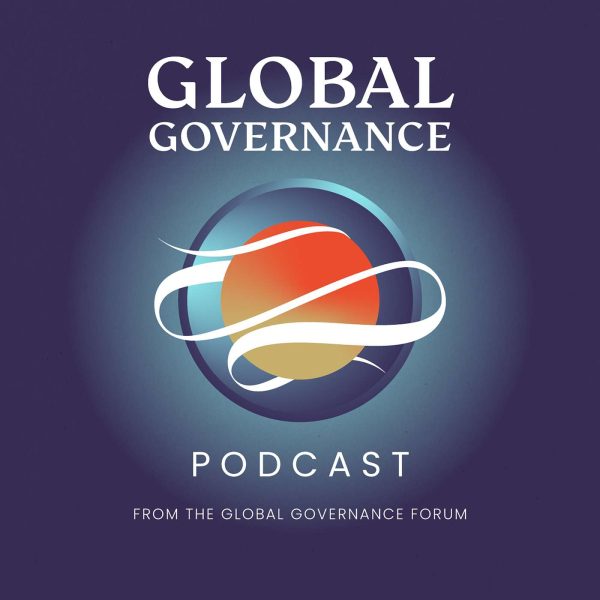
Global Governance Podcast
- Folgen
- 61
- Erscheint
- unregelmäßig
- Letzte Folge
- 13. Okt. 2026
Über den Podcast
Welcome to the Global Governance Podcast with Augusto Lopez-Claros, where we explore the future of governance. Each episode will look at a different global issue and how governance plays a key role in its solution. From climate change to gender equality, from corruption to peace and security, we invite experts to explore a thought-provoking game of “what if?” and “why not?”, positing a world in much closer international cooperation. To learn more visit GlobalGovernanceForum.org.
Folgen 61
Oona Hathaway on International Law and the Future of the United Nations
At a time of mounting pressure on the post-1945 international legal order, Professor Oona Hathaway explores the resilience of the prohibition on the use of force, the challenge of great-power non-compliance …
Shownotes
At a time of mounting pressure on the post-1945 international legal order, Professor Oona Hathaway explores the resilience of the prohibition on the use of force, the challenge of great-power non-compliance, and the possibilities for meaningful UN reform.
Learn more on GlobalGovernanceForum.org
Michael Mandelbaum on America's Foreign Policy and the Future of the International Order
Michael Mandelbaum reflects on American foreign policy, mounting nuclear dangers, geopolitical fragmentation, and whether today's international institutions can adapt before another global crisis compels …
Shownotes
Michael Mandelbaum reflects on American foreign policy, mounting nuclear dangers, geopolitical fragmentation, and whether today's international institutions can adapt before another global crisis compels reform.
Learn more on GlobalGovernanceForum.org
Juan González-Barba on Europe's Future: Values, Unity, and Leadership in a Fragmented World
As geopolitical fragmentation deepens, Ambassador Juan González-Barba reflects on Europe's future, the power of shared values, and how principled cooperation can help shape a more stable international …
Shownotes
As geopolitical fragmentation deepens, Ambassador Juan González-Barba reflects on Europe's future, the power of shared values, and how principled cooperation can help shape a more stable international order.
Learn more on GlobalGovernanceForum.org
Allan Rock on Fighting Grand Corruption and Renewing Global Governance
As grand corruption erodes democracy, security, and public trust, Allan Rock explores the case for an International Anti-Corruption Court, the future of UN reform, and the stronger global institutions needed to …
Shownotes
As grand corruption erodes democracy, security, and public trust, Allan Rock explores the case for an International Anti-Corruption Court, the future of UN reform, and the stronger global institutions needed to uphold the rule of law.
Learn more on GlobalGovernanceForum.org
Adam Lupel on Reforming Global Security, Reviving Multilateralism, and the Future of the UN
In a recent podcast conversation with Adam Lupel, we explored the growing mismatch between today’s global risks and the United Nations’ capacity to respond effectively. Our discussion ranged from Security …
Shownotes
In a recent podcast conversation with Adam Lupel, we explored the growing mismatch between today’s global risks and the United Nations’ capacity to respond effectively. Our discussion ranged from Security Council paralysis and the corrosive effects of veto use, to the UN’s limited ability to address contemporary threats such as civil conflict, state fragility, and transnational risks. We also examined why disarmament and prevention—once central to the UN’s mission—have weakened, and what it would take to restore them as credible pillars of collective security. Importantly, we considered forward-looking ideas, including the role of an Earth System Council in addressing planetary instability as a security issue, and the need to deepen civil society participation to strengthen legitimacy. These questions go to the heart of a broader challenge: how to modernize global governance so the UN can evolve into a more effective, problem-solving institution at the center of international cooperation. We invite you to listen to the full conversation and engage with these critical issues.
Learn more on GlobalGovernanceForum.org
Jojo Mehta on Making Ecocide a Crime: Rewriting the Rules for Planetary Protection
In this episode, Jojo Mehta, CEO of Stop Ecocide International, explores the growing global movement to recognize ecocide as an international crime. Building on the vision she developed with the late Polly …
Shownotes
In this episode, Jojo Mehta, CEO of Stop Ecocide International, explores the growing global movement to recognize ecocide as an international crime. Building on the vision she developed with the late Polly Higgins, Mehta explains why criminal law—alongside regulation—is essential to closing accountability gaps in a fragmented world. She reflects on the milestones that have moved ecocide from the margins to mainstream legal and diplomatic debate, and what its adoption could mean in practice for governments, corporations, and investors confronting the climate crisis. Looking ahead, she outlines practical steps for action and a credible pathway toward systemic change. This is a thoughtful and persuasive conversation that makes a powerful case for why ecocide law could reshape global incentives—well worth a listen.
Learn more on GlobalGovernanceForum.org
Julia Haas on Safeguarding Media Freedom and Democratic Integrity in the AI Era
Artificial intelligence is transforming the global information ecosystem at breathtaking speed. In this timely conversation, Julia Haas, Head of the OSCE Representative on Freedom of the Media’s AI & Freedom of …
Shownotes
Artificial intelligence is transforming the global information ecosystem at breathtaking speed. In this timely conversation, Julia Haas, Head of the OSCE Representative on Freedom of the Media’s AI & Freedom of Expression project, examines what this means for journalism, democratic governance, and human rights.
We discuss the rise of deepfakes and AI-driven disinformation, the concentration of power in big tech platforms, and the economic vulnerabilities of modern newsrooms. How do we preserve information integrity without enabling censorship? How can regulation enhance accountability without strengthening state control? And as media organizations increasingly adopt AI tools, how can trust be protected?
Julia argues that safeguarding media freedom in the age of AI is not merely a technological challenge—it is a democratic test. Multilateral cooperation, principled regulation, and stronger public-interest infrastructure will be essential if innovation is to reinforce, rather than erode, open societies.
Learn more on GlobalGovernanceForum.org
Peter J. Hoffman on Rethinking the UN at a Constitutional Moment
In this wide-ranging discussion, Professor Peter J. Hoffman argues that the United Nations’ current paralysis reflects a deeper crisis of legitimacy rather than a temporary political impasse. He examines why …
Shownotes
In this wide-ranging discussion, Professor Peter J. Hoffman argues that the United Nations’ current paralysis reflects a deeper crisis of legitimacy rather than a temporary political impasse. He examines why incremental reform is no longer sufficient, probing core questions of Security Council authority, democratic representation beyond states, the governance of planetary risk, and the constitutional status of human rights. Drawing on historical experience with institutional change, Hoffman situates the Second UN Charter between realism and ambition, contending that transformative reform often appears unrealistic until conditions make its necessity undeniable. As he concludes, what is dismissed today as idealism may, with the passage of time, come to be seen as the most realistic response to a system no longer fit for purpose.
Learn more on GlobalGovernanceForum.org
Reimagining Global Governance: Augusto Lopez-Claros on the Movement for a Second UN Charter
In this excerpt from CBC Ideas, Augusto López-Claros reflects on a rapidly changing world and the civic movements demanding that the UN evolve with it. From the failures of the current system to the rising …
Shownotes
In this excerpt from CBC Ideas, Augusto López-Claros reflects on a rapidly changing world and the civic movements demanding that the UN evolve with it. From the failures of the current system to the rising pressure from civil society, he outlines why the UN Charter’s original architects left behind a little-known pathway — Article 109 — designed to ensure periodic review. Nearly 80 years later, that review has never happened. This episode explores why now may be the moment to invoke it, and how a global coalition is working to modernize multilateralism for the 21st century.
Learn more on GlobalGovernanceForum.org
Martin Kreutner on the Perils of Strongman Diplomacy
Martin Kreutner, Dean Emeritus of the International Anti-Corruption Academy and a distinguished former member of the Austrian Federal Appeals Tribunal traces the historical roots of our present global order and …
Shownotes
Martin Kreutner, Dean Emeritus of the International Anti-Corruption Academy and a distinguished former member of the Austrian Federal Appeals Tribunal traces the historical roots of our present global order and compellingly argues that the shift to various forms of strongman diplomacy currently under way, in the spirit of the 1945 Yalta conference that established the key political parameters of the United Nations, is likely to be costly for human well-being. Much better to build a more inclusive system, that gives voice to people everywhere and recognizes that we live in a different world in which economic and political power is more diffuse and confronting myriad global challenges which require stronger international cooperation.
Learn more on GlobalGovernanceForum.org
Guy Sinclair on why the UN needs to adapt to 21st century realities
Professor Guy Sinclair explains how the UN has, over time, diverged from its original Charter, adapting in response to global shifts—sometimes enhancing its relevance, but at other times straining its …
Shownotes
Professor Guy Sinclair explains how the UN has, over time, diverged from its original Charter, adapting in response to global shifts—sometimes enhancing its relevance, but at other times straining its legitimacy. Sinclair outlines four key factors driving institutional change: external shocks, internal dynamics, legal mechanisms, and shared narratives. As new technologies like AI and autonomous weapons reshape global threats, he anticipates further evolution in how international organizations operate. We also discuss the strain on the UN’s development agenda—especially the Sustainable Development Goals—as geopolitical shocks and donor fatigue undercut progress. Sinclair addresses concerns about the UN’s diminished authority in peace and security, citing the growing irrelevance of Security Council authorization. He warns that the increasing role of private and state donors may skew UN priorities, challenging its legitimacy. Finally, we explore whether collective security remains a viable goal and whether reform should be gradual or transformative. Through it all, Sinclair urges a critical but hopeful approach, recognizing the UN’s enduring potential amid deep systemic challenges.
Learn more on GlobalGovernanceForum.org
Cecelia Lynch on the Links between Inclusion, Peace and Prosperity
Cecelia Lynch, a Professor of Political Science at the University of California, is a leading thinker on the importance of inclusion as a catalyst for promoting sustainable, peaceful, social transformations …
Shownotes
Cecelia Lynch, a Professor of Political Science at the University of California, is a leading thinker on the importance of inclusion as a catalyst for promoting sustainable, peaceful, social transformations. The idea is that inclusion should not just be limited to nation states but should from the outset involve those directly impacted by conflicts, so that they play a leading role in the resolution process. Radical inclusion broadens participation to include marginalized groups like local communities, women, and non-state actors. It also involves local communities and their unique forms of knowledge in the stewardship of environmental protection, peace building initiatives and conflict resolution, and the design of strategies aimed at improving the livelihoods of marginalized groups around the world. A peace and prosperous world are an impossible achievement if it does not include the voices of the voiceless.
Learn more on GlobalGovernanceForum.org
Sundeep Waslekar on Our Civilizational Crises
Sundeep Waslekar eloquently explains why current nationalisms and our obsession with the primacy of the nation state are not able to deliver practical solutions to the problems that threaten our future as a …
Shownotes
Sundeep Waslekar eloquently explains why current nationalisms and our obsession with the primacy of the nation state are not able to deliver practical solutions to the problems that threaten our future as a human family. In addition to reforms to our current UN-based global governance architecture we also need a new philosophical and ethical framework that is consistent with the idea that we are one human family, inhabiting one planet and that our survival as a human species is inextricably linked to the recognition of our common humanity. Without this anchoring based on enlightened human values, we risk being overwhelmed by multiple crises and the resulting human suffering. We must imagine a better future and take the concrete steps to get there.
Learn more on GlobalGovernanceForum.org
Sonia Sanchez Diaz on the Crisis in the Middle East
Professor Sonia Sanchez Diaz is a highly regarded analyst of the crisis in the Middle East, widely respected for her objectivity, impartiality and incisive analysis, which builds on a deep understanding of the …
Shownotes
Professor Sonia Sanchez Diaz is a highly regarded analyst of the crisis in the Middle East, widely respected for her objectivity, impartiality and incisive analysis, which builds on a deep understanding of the region´s troubled history, its institutions, and peoples. In this podcast she examines developments over the past couple of years and what it means for regional stability and security. Her perceptive analysis casts light on many of the underlying factors underpinning the conflict and she makes a strong case that empowering its women will be an important part of the solution.
Learn more on GlobalGovernanceForum.org
Ambassador Gerardo Bugallo on our Post-Cold War World
Gerardo Bugallo was Spain's Ambassador in Ukraine during the critical years 2013-17, a crucial period that spanned from the Euromaidan to the first years after the annexation of Crimea. In this podcast …
Shownotes
Gerardo Bugallo was Spain's Ambassador in Ukraine during the critical years 2013-17, a crucial period that spanned from the Euromaidan to the first years after the annexation of Crimea. In this podcast interview he shares fascinating insights on the end of the Cold War, the origins of the current conflict, the possibilities of a fair settlement that would permit Ukraine to develop as a sovereign nation enjoying peace and security and stronger ties with the EU, consistent with the principles of non-violence embedded in the UN Charter. He also discusses China's emergence as a global geopolitical actor and the role it could play in the current environment of international big-power tensions. A thoughtful diplomat ably navigating our labyrinthine geopolitical realities.
Learn more on GlobalGovernanceForum.org
Michael Mandelbaum on Titans of the Twentieth Century
Michael Mandelbaum has written a fascinating book examining the role of major political leaders in shaping our recent history, for better or for worse. He is a highly regarded author with an insightful …
Shownotes
Michael Mandelbaum has written a fascinating book examining the role of major political leaders in shaping our recent history, for better or for worse. He is a highly regarded author with an insightful understanding of the factors that have shaped conflict and progress over the past century. Some of the titans featured in this podcast based on his book operated within democratic settings and left democracy stronger than they had found it, while others, tyrants with diseased minds, tended towards coercion rather than persuasion when exercising power and contributed to making the 20th century a blood-soaked century, without parallel in terms of human suffering. In an age of rising authoritarianism, this podcast delivers important warnings for our collective future.
You can find Michael Mandelbaum's new book on Amazon or your local bookstore.
Learn more on GlobalGovernanceForum.org
Wendy Broadgate: Deep into Danger Zone on Climate Change
Wendy Broadgate is a distinguished scientist who has worked in Earth system science and the science-policy interface for two decades. She is therefore singularly well-qualified to address the question of the …
Shownotes
Wendy Broadgate is a distinguished scientist who has worked in Earth system science and the science-policy interface for two decades. She is therefore singularly well-qualified to address the question of the dangers we face because of inadequate action to set our climate system within safe and just boundaries. Public support for more robust action to put the Earth on a more sustainable path is broad-based; what is lacking is political will and a better understanding of our collective intergenerational responsibilities. The costs of inaction will be orders of magnitude larger than acting now, including by rethinking the economic growth imperative of our current economic paradigm. Action is needed now; there is no shortage of knowledge. It needs to be complemented by enlightened political leadership.
Learn more on GlobalGovernanceForum.org
Anthony Annett on The Elements of a More Just Economy
Anthony Annett is an economist who spent two decades at the International Monetary Fund, including as speechwriter to the Managing Director. In an insightful podcast based on his book Cathonomics: How Catholic …
Shownotes
Anthony Annett is an economist who spent two decades at the International Monetary Fund, including as speechwriter to the Managing Director. In an insightful podcast based on his book Cathonomics: How Catholic Tradition Can Create a More Just Economy he argues that we need to take a fresh look at the policies, priorities, and institutions that underpin our current economic system. These are no longer working for the common good. Inequality is corroding the foundations of our societies and beginning to have harmful consequences for our social and political order. On many fronts, our economic systems are on an unsustainable path, and this is in part due to the absence of moral principles and an ethic of solidarity that might be guiding lights when designing policies and approaches to economics aiming for the common good.
Learn more on GlobalGovernanceForum.org
Soumya Swaminathan on Why we Need Stronger Global Health Governance
As the most recent Chief Scientist at the World Health Organization Soumya Swaminathan was on the forefront of the international response to the COVID-19 pandemic. Because of her distinguished background in …
Shownotes
As the most recent Chief Scientist at the World Health Organization Soumya Swaminathan was on the forefront of the international response to the COVID-19 pandemic. Because of her distinguished background in policymaking spanning more than 30 years of experience bringing science and evidence into the formulation of effective actions to address fundamental issues of public health, Dr Swaminathan brings a wealth of insights into a conversation about the lessons learned from the pandemic and how to prepare for the next one. Viruses against which we have no natural immunity will continue to be a major risk factor in coming years and, against the huge human and economic costs of COVID-19, we need to internalize those lessons and come together as one whole human family, preparing responses that will be science-based but that will also leave no one behind because we live in an interconnected world in which our health and the health of others are fully interdependent.
Learn more on GlobalGovernanceForum.org
Daniel Perell on Why We Need to Rethink our Global Governance Architecture
Daniel Perell currently serves as a co-chair of the Steering Group of the Coalition for the UN We Need, an umbrella group of civil society organizations that are collaborating to modernize the UN system, to …
Shownotes
Daniel Perell currently serves as a co-chair of the Steering Group of the Coalition for the UN We Need, an umbrella group of civil society organizations that are collaborating to modernize the UN system, to better adapt it to the needs of the 21st century. He is thus extremely well-qualified to share insights into the forthcoming UN Summit of the Future and the extent to which it might become a catalyst for future transformational innovations, desperately needed in a world increasingly destabilized by climate change, entrenched nationalisms, persistent poverty and inequality and other such global challenges. In this wide-ranging podcast, he shares keen insights on the way forward and how to make the transition from reaffirming important principles embedded in the UN Charter to implementing a broader and more ambitious vision of reforms that will deliver actual solutions to the problems we face.
Learn more on GlobalGovernanceForum.org
Sandrine Dixson-Declève on The Need for a New Economic Paradigm
As co-president of the Club of Rome Sandrine Dixson-Declève is singularly well-qualified to speak to the major challenges we confront today and on which, in the search for solutions, we need much stronger …
Shownotes
As co-president of the Club of Rome Sandrine Dixson-Declève is singularly well-qualified to speak to the major challenges we confront today and on which, in the search for solutions, we need much stronger levels of international cooperation. Widening income disparities have started to undermine social and political stability, the needs of the extremely poor are not being met, and we are failing to stem the worst consequences of climate change. There is no shortage of solutions, from better use of the tax system to lower income inequality, to the phasing out of wasteful energy and other subsidies, to the use of innovative instruments to finance the transition to a green economy. What is lacking is enlightened leadership, more in tune with the needs of the many, a greater focus on longer-term solutions not driven by short-term profit considerations, and the recognition that the economic and political empowerment of women is vital for the creation of a more secure and stable world.
Learn more on GlobalGovernanceForum.org
Sundeep Waslekar on A World Without War
Sundeep Waslekar is a distinguished social scientist who has thought a great deal about the causes and the instruments of war and the risks they pose to the future of humankind. He is the recent author of A …
Shownotes
Sundeep Waslekar is a distinguished social scientist who has thought a great deal about the causes and the instruments of war and the risks they pose to the future of humankind. He is the recent author of A World Without War, a book published by HarperCollins in which he argues that while the risks of nuclear holocaust have perhaps never been higher, we can reverse course and not commit collective suicide. We need to abandon narrow-minded nationalisms and develop dual loyalties to our nation and the world, where the problems we face required a renewed unity of purpose. In this podcast he convincingly makes the case that “It is possible to turn death into life. It is possible to convert violence into peace. It is possible to transform darkness into light. It is possible to change despair into hope. It is possible to end wars and unite the world.”
Learn more on GlobalGovernanceForum.org
Arunabha Ghosh on Mapping our Path to a Green Future
Arunabha Ghosh, an internationally recognized public policy expert, author and columnist is the founder-CEO of the Council on Energy, Environment and Water (CEEW), one of Asia's top climate think-tanks. In …
Shownotes
Arunabha Ghosh, an internationally recognized public policy expert, author and columnist is the founder-CEO of the Council on Energy, Environment and Water (CEEW), one of Asia's top climate think-tanks. In numerous reports, articles and speeches, Dr. Ghosh has convincingly argued that confronting the challenges of climate change will require better policies at the national level and massive levels of cooperation between government and businesses and between nation states across international borders. We will need to address the linkages between the growth of renewable energy and our changing geopolitical landscapes, the role of investment and finance in creating a green future, and persuade ourselves that pessimism at the lack of progress in reducing emissions is not an option. A green future is not an end in itself, but rather the means to an end: a more prosperous and secure future for all. The time to act is now.
Learn more on GlobalGovernanceForum.org
Rebecca Shoot on Global Solutions to Global Problems
Rebecca Shoot, Executive Director of Citizens for Global Solutions, a US-based organization closely aligned with the ideals of the world federalist movement, is an international lawyer and democracy and …
Shownotes
Rebecca Shoot, Executive Director of Citizens for Global Solutions, a US-based organization closely aligned with the ideals of the world federalist movement, is an international lawyer and democracy and governance practitioner with extensive experience supporting human rights, democratic processes, and the rule of law on five continents. In a wide ranging interview, she discusses our climate emergency, the need to give the United Nations a greater role in advancing disarmament, the role of the International Court of Justice in the peaceful settlement of international disputes and how to boost the role of women in global security initiatives. The role of youth in helping us bring about a more hopeful future is also an important core message.
Learn more on GlobalGovernanceForum.org
Andrew Strauss on the Desirability of a Global Parliament
Andrew Strauss, Dean and Professor of Law at the University of Dayton School of Law, and a graduate of Princeton University’s School of Public and International Affairs discusses why setting up a global …
Shownotes
Andrew Strauss, Dean and Professor of Law at the University of Dayton School of Law, and a graduate of Princeton University’s School of Public and International Affairs discusses why setting up a global parliament, perhaps initially by a core group of 20-30 countries, would significantly strengthen the democratic legitimacy of the system that underpins our mechanisms of international cooperation. It could be a powerful antidote to the world-wide spread of ethno-nationalist-authoritarianism and be a catalyst for strengthening a “holistic planetary consciousness, sensitive to the practical urgency of human unity.”
Learn more on GlobalGovernanceForum.org
Michael Mandelbaum on Our Brittle Global Security Landscape
Michael Mandelbaum, a distinguished author with seminal contributions to a better understanding of some of the world´s most intractable problems, discusses why we are failing in our efforts to protect the …
Shownotes
Michael Mandelbaum, a distinguished author with seminal contributions to a better understanding of some of the world´s most intractable problems, discusses why we are failing in our efforts to protect the planet from the calamities of climate change and what to do about it. He also analyzes our unsettled global security situation and the risks for an acceleration of nuclear proliferation and the implications of this for world peace. He comments on the role that the United Nations can play in reconciling national interests with those of the international community, at a time of growing interdependence and interconnectedness. In this interview professor Mandelbaum is articulate and cogent, helping us better understand the background and origins of the great challenges of our age, as an important step to help us frame durable solutions.
Find Michael's latest book The Four Ages of American Foreign Policy on Amazon.
Learn more on GlobalGovernanceForum.org
Steven Phelps on the Interconnectedness of Science and Religion
Steven Phelps is an American physicist, philosopher and translator holding a Ph.D. in Physics, with a specialization in cosmology, from Princeton University. For over a decade he held a research position in the …
Shownotes
Steven Phelps is an American physicist, philosopher and translator holding a Ph.D. in Physics, with a specialization in cosmology, from Princeton University. For over a decade he held a research position in the Physics Department at Technion University in Israel and published original research on the masses of nearby galaxies. He is thus singularly well qualified to explain why science and religion are deeply interconnected aspects of a single reality and how can a better understanding of such connections help unlock human potential and point the way to improved systems of global governance, better aligned with humanity’s spiritual and material progress.
Learn more on GlobalGovernanceForum.org
Fernando Iglesias on the Fight Against Organized Crime in Latin America
Fernando Iglesias is a member of Parliament in Argentina and the Director of the Campaign for a Latin American and Caribbean Criminal Court Against Transnational Organized Crime (COPLA). Pervasive organized …
Shownotes
Fernando Iglesias is a member of Parliament in Argentina and the Director of the Campaign for a Latin American and Caribbean Criminal Court Against Transnational Organized Crime (COPLA). Pervasive organized crime in the region is a huge drag on social and economic development, has led to sky-high levels of violent crime, as the mafias that fuel drug trafficking, money laundering and bribery operate in many countries with impunity in a context of weak states and scant respect for the rule of law. COPLA could be an instrument to enforce the United Nations Convention Against Transnational Organized Crime, also called the Palermo Convention. Iglesias discusses why COPLA is needed, the challenges of establishing a court in a region where free and powerful mafias have often captured the politicians and other public institutions. What is at stake in a region that, over the past 2 decades, has had one of the weakest economic growth performances in the world and what role has organized crime played in this outcome?
Learn more on GlobalGovernanceForum.org
Cedric Ryngaert on Why the World Needs an International Anti-Corruption Court
Cedric Ryngaert is the Chairman of the Department of International and European Law at Utrecht University and the Editor-in-Chief of the Netherlands International Law Review. In this podcast he explores the …
Shownotes
Cedric Ryngaert is the Chairman of the Department of International and European Law at Utrecht University and the Editor-in-Chief of the Netherlands International Law Review. In this podcast he explores the role of an International Anti-Corruption Court (IACC) as a potentially powerful innovation to our global governance architecture. The IACC would be an enforcement mechanism for laws which are already in existence, but which often are ignored by kleptocrats who control the judges, the prosecutors, and the police. How would the IACC operate and under what principles? Would the court have asset recovery powers, to seize stolen assets and return them to the people who are the victims of grand corruption? Could the IACC act even in cases of countries no subject to its jurisdiction? Is sustainable development, as envisaged in the United Nations Sustainable Development Goals, possible without the eradication of kleptocratic abuse?
Learn more on GlobalGovernanceForum.org
Michael Penn on Human Rights and the Development of Human Capabilities
Michael Penn, a professor of psychology and a trained clinical psychologist, explores the evolution of the concept of human rights over the past century and discusses why the unfoldment of a culture of respect …
Shownotes
Michael Penn, a professor of psychology and a trained clinical psychologist, explores the evolution of the concept of human rights over the past century and discusses why the unfoldment of a culture of respect for the dignity of the individual is essential to catalyse the creation of conditions in societies that will contribute to human development. Why should the primary role of government be linked to the creation of those conditions that will facilitate the development of people’s latent capacities? Why should we include in our educational systems the concept of altruism and why is authenticity in human relationships at the basis of human progress? How can people avoid becoming stuck in hopelessness and instead feel that they are contributing to building up a sustainable future that will not sap people´s zest for life?
Learn more on GlobalGovernanceForum.org
Hier stehen die neuesten 40 von 61 Folgen. Ältere Folgen findest du im Feed des Podcasts.
Ähnliche Podcasts
Mehr Regierung-Podcasts



Ist das dein Podcast?
Bestätige es mit einem Eintrag in deinem Feed: Du bekommst hier einen Code, trägst ihn als podcast:txt in den Kanal deines Feeds ein, und wir prüfen ihn. Danach steht dein Podcast als „verifiziert“ bei SoundNode.