

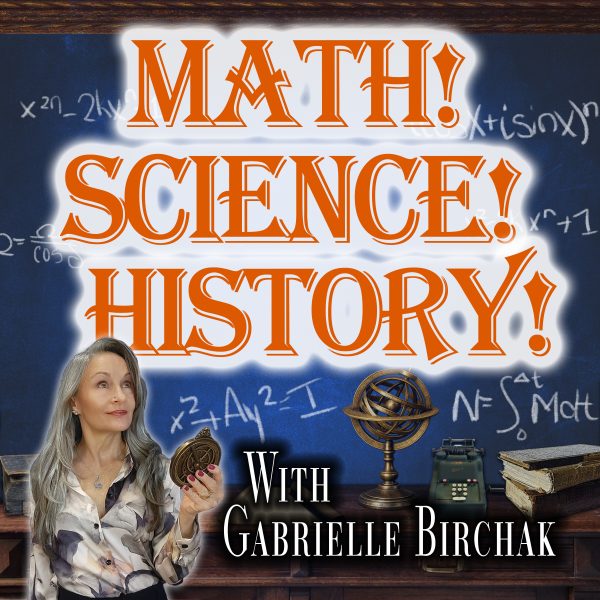
Math! Science! History!
- Folgen
- 235
- Erscheint
- wöchentlich
- Letzte Folge
- 30. Sep. 2026
Über den Podcast
Why do some scientific breakthroughs look different up close than they do in our textbooks? How did math quietly shape the modern world? Math! Science! History! explores the human side of discovery, including the rivalries, the failed attempts, the bold ideas, and the marginalized voices behind the equations and experiments that changed science, technology, and everyday life. Hosted by Gabrielle Birchak, who holds degrees in mathematics and journalism, the show connects codebreaking, astronomy, probability, physics, and innovation to the world we live in today. If you enjoy science stories, historical investigations, and clear math grounded in context, clarity, and research, this show is for you. New episodes twice weekly. Visit www.MathScienceHistory.com for more information.
Folgen 235
The Library of Alexandria: What Really Happened?
After nearly seven years and more than 200 episodes, this is where I say goodbye to Math! Science! History!. The podcast began with my book Hypatia: The Sum of Her Life and grew into something far beyond what I …
Shownotes
After nearly seven years and more than 200 episodes, this is where I say goodbye to Math! Science! History!. The podcast began with my book Hypatia: The Sum of Her Life and grew into something far beyond what I imagined. Thank you for listening, for following me through all of these stories, and for giving me the opportunity to explore the history behind mathematics, science, and the people and ideas that changed our understanding of the world. The podcast may be ending, but the archive, the research, and the stories will remain here for you to explore.
And perhaps it's fitting that our final story is about the Library of Alexandria. The Library didn't survive as an institution, but its ideas survived because people copied them, studied them, translated them, and passed them on. I hope Math! Science! History! can do something similar. As I move into whatever comes next, I'll leave you with the original meaning of carpe diem: to pluck the day, to savor what is ripe and ready, and then use that harvest to plant the seeds for the next season. Thank you for seven incredible years. Carpe diem, my friends.
3 Things You'll Learn
1. The Library of Alexandria was not necessarily destroyed by Caesar. Caesar's fire in 48 BCE certainly destroyed books, but the ancient evidence does not establish that it destroyed the entire Library. Alexandria's scholarly institutions and collections continued afterward.
2. The Library disappeared through a much longer and more complicated process. The Royal Library, Mouseion, Serapeum, and other collections existed in different forms and at different times. Political instability, changing patronage, violence, destruction, and institutional decline all played roles in the gradual disappearance of Alexandria's great scholarly institutions.
3. Knowledge can survive even when institutions disappear. The books of Alexandria did not remain together as one intact collection, but ideas survived through copying, translation, and transmission. Centuries later, scholars working across the Byzantine, Syriac, Persian, and Islamic worlds helped preserve and transmit Greek knowledge into Arabic and beyond.
🔗 Explore more on our website: mathsciencehistory.com 📚 To buy my book Hypatia: The Sum of Her Life on Amazon, visit https://a.co/d/g3OuP9h
🌍 Let's Connect!Bluesky: https://bsky.app/profile/mathsciencehistory.bsky.social Instagram: https://www.instagram.com/math.science.history LinkedIn: https://www.linkedin.com/company/math-science-history/ YouTube: Math! Science! History! - YouTube
🎧 Enjoying the Podcast?
☕ Support the Show: Coffee!! PayPal
Leave a review! It helps more people discover the show! Share this episode with friends & fellow history buffs! Subscribe on your favorite podcast platform
Check out our merch: https://www.mathsciencehistory.com/the-store
Music: All music is public domain and has no Copyright and no rights reserved. Selections from The Little Prince by Lloyd Rodgers
Until next time, carpe diem!
Descartes' Secret Notebook: The Hidden Math Behind Topology
René Descartes is famous for Cogito, ergo sum and his revolutionary approach to philosophy and mathematics. But he also left behind a mysterious 16-page manuscript written in code. In this episode, we uncover …
Shownotes
René Descartes is famous for Cogito, ergo sum and his revolutionary approach to philosophy and mathematics. But he also left behind a mysterious 16-page manuscript written in code.
In this episode, we uncover the story of Descartes' hidden notebook, the waterlogged manuscripts that nearly disappeared, and Gottfried Wilhelm Leibniz's dramatic attempt to decipher the coded pages.
At the center of the mystery is a mathematical relationship involving the vertices, edges, and faces of three-dimensional shapes. Today expressed as V − E + F = 2, this relationship became associated with Leonhard Euler and is closely connected to the development of topology.
We'll explore why this mathematics mattered in the seventeenth century, why Descartes may have feared revealing his ideas, and how the mathematics of shapes and connectivity eventually became relevant to our modern digital world.
3 Things You'll Learn
1. Why Descartes wrote in code The story behind Cogitata Privata, Descartes' "I proceed masked" philosophy, and the secret manuscript that disappeared after Leibniz examined it.
2. How V − E + F = 2 works Using cubes and pyramids, we'll see how vertices, edges, and faces combine to produce a remarkably consistent mathematical relationship.
3. Why this old mathematics still matters The episode connects the history of polyhedra to topology and modern applications such as 3D computer graphics and digital modeling.
Sources
Amir D. Aczel, Descartes's Secret Notebook: A True Tale of Mathematics, Mysticism, and the Quest to Understand the Universe
David S. Richeson, Euler's Gem: The Polyhedron Formula and the Birth of Topology
Peter J. Federico, Descartes on Polyhedra: A Study of the "De solidorum elementis"
Matthew L. Jones, The Good Life in the Scientific Revolution
Frances A. Yates, The Rosicrucian Enlightenment
Johannes Kepler, The Harmony of the World
René Descartes, Discourse on the Method
Full source list appears in the episode transcript at https://www.MathScienceHistory.com
📚 To buy my book Hypatia: The Sum of Her Life on Amazon, visit https://a.co/d/g3OuP9h
🌍 Let's Connect!Bluesky: https://bsky.app/profile/mathsciencehistory.bsky.social Instagram: https://www.instagram.com/math.science.history
LinkedIn: Gabrielle Birchak | LinkedIn YouTube: Math! Science! History! - YouTube 🎧 Enjoying the Podcast?
☕ Support the Show: Coffee!! https://www.paypal.com/ncp/payment/PR7F7ST49GDNA
Leave a review! It helps more people discover the show! Share this episode with friends & fellow history buffs! Subscribe on your favorite podcast platform
Check out our merch: https://www.mathsciencehistory.com/the-store
Music: All music is public domain and has no Copyright and no rights reserved. Selections from The Little Prince by Lloyd Rodgers - From Page to Practice by Brian Teoh - all other music is public domain from Pixabay
Until next time, carpe diem!!
SCIENCE NEWS TUESDAY: A New Species is Discovered
Scientists have officially identified a new wild cat species in Bolivia and a new snake species from New Guinea—and one of them is named after Guns N' Roses guitarist Slash. But these discoveries are about much …
Shownotes
Scientists have officially identified a new wild cat species in Bolivia and a new snake species from New Guinea—and one of them is named after Guns N' Roses guitarist Slash. But these discoveries are about much more than a cute cat and a rock-star snake.
In this episode of How Did We Get Here? Science News Tuesday, we look at how scientists identify new species, why some animals can remain hidden in plain sight for centuries, and how modern genetics and genomics are changing our understanding of the tree of life.
From Carl Linnaeus and the origins of scientific classification to DNA analysis and museum specimens, we explore how scientists went from naming what they could see to uncovering evolutionary relationships that aren't visible to the naked eye.
And there's a bigger question: How many species are still out there waiting to be recognized—and could some disappear before we even know they exist?
Three Things You'll Learn
1. How a "new" species can hide in plain sight.
2. Why a snake was named after Slash, and how Slash rocks out for animals!
3. How DNA changed the way we classify life
4. Why discovering species matters for conservation
Welcome to the jungle: newly-discovered snake named after Slash from Guns N' Roses - Field Museum
🔗 Explore more on our website: mathsciencehistory.com 📚 To buy my book Hypatia: The Sum of Her Life on Amazon, visit https://a.co/d/g3OuP9h
🌍 Let's Connect!YouTube: Math! Science! History! - YouTube Instagram: https://www.instagram.com/math.science.history LinkedIn: https://www.linkedin.com/company/math-science-history/
🎧 Enjoying the Podcast?
☕ Support the Show: Coffee!! PayPal
Leave a review! It helps more people discover the show! Share this episode with friends & fellow history buffs! Subscribe on your favorite podcast platform
Check out our merch: https://www.mathsciencehistory.com/the-store
Music: All music is public domain and has no Copyright and no rights reserved. Selections from The Black Book by Lloyd Rodgers
Until next time, carpe diem!
GH Hardy, Ramanujan, The Search For Proof And The Discovery Of Truth
GH Hardy was a character. He had qualities that were odd, yet endearing. He was a rigorous mathematician. Yet, when he received a letter from Srinivasa Ramanujan, he changed. He learned a new way of equating …
Shownotes
GH Hardy was a character. He had qualities that were odd, yet endearing. He was a rigorous mathematician. Yet, when he received a letter from Srinivasa Ramanujan, he changed. He learned a new way of equating mathematics, and developed a deep and loving respect for an individual who was never formally educated in math.
This is the story of a man who had the ability to see genius in another person, even when that person couldn't see it in themselves.
🔗 Explore more on our website: mathsciencehistory.com 📚 To buy my book Hypatia: The Sum of Her Life on Amazon, visit https://a.co/d/g3OuP9h
🌍 Let's Connect!YouTube: Math! Science! History! - YouTube Bluesky: https://bsky.app/profile/mathsciencehistory.bsky.social Instagram: https://www.instagram.com/math.science.history Facebook: https://www.facebook.com/mathsciencehistory LinkedIn: https://www.linkedin.com/company/math-science-history/
🎧 Enjoying the Podcast?
☕ Support the Show: Coffee!! PayPal
Leave a review! It helps more people discover the show! Share this episode with friends & fellow history buffs! Subscribe on your favorite podcast platform
Check out our merch: https://www.mathsciencehistory.com/the-store
Music: All music is public domain and has no Copyright and no rights reserved. Selections from The Little Prince by Lloyd Rodgers
Wondrous Waters from Pixabay
Nature Documentary by James Carter from Pixabay
Until next time, carpe diem!
REPOST The Resilience of Subrahmanyan Chandrasekhar
In this episode of Math, Science, History, host Gabrielle Birchak does a repost about Subrahmanyan Chandrasekhar, a 19-year-old prodigy whose curiosity during a two-week sea voyage in 1930 led to a …
Shownotes
In this episode of Math, Science, History, host Gabrielle Birchak does a repost about Subrahmanyan Chandrasekhar, a 19-year-old prodigy whose curiosity during a two-week sea voyage in 1930 led to a groundbreaking discovery. While sailing from India to England, Chandrasekhar, armed only with a notebook and the vast expanse of the ocean, began questioning the fate of stars after they exhausted their fuel.
Explore more on our website: mathsciencehistory.com To buy my book Hypatia: The Sum of Her Life on Amazon, visit https://a.co/d/g3OuP9h
Enjoying the Podcast?
If you love Math, Science, History, here's how you can help: Leave a review – It helps more people discover the show! Share this episode with friends & fellow history buffs! Subscribe on your favorite podcast platform
☕ Support the Show! We are sponsored by Coffee!! https://shorturl.at/bHIsc
Checking out our merch: https://www.mathsciencehistory.com/the-store
Music: All music is public domain and has no Copyright and no rights reserved. On Matters of Consequence from The Little Prince by Lloyd Rodgers
Until next time, carpe diem!
REPOST: When Women Gather
What happens when women gather? Throughout the eighteenth century, women across Europe began creating intellectual communities where they could discuss science, mathematics, philosophy, politics, literature …
Shownotes
What happens when women gather?
Throughout the eighteenth century, women across Europe began creating intellectual communities where they could discuss science, mathematics, philosophy, politics, literature, and medicine. During the Enlightenment, these gatherings helped women challenge the idea that intellectual discovery belonged exclusively to men.
Women such as Laura Bassi, Maria Gaetana Agnesi, Émilie du Châtelet, Catharine Macaulay, Caroline Herschel, and many others built on one another's work and created a path for future generations of women in science.
And that path matters far beyond science. When women gather, exchange knowledge, encourage one another, and make room for the next woman, they can change science, politics, education, and society.
Resources
• Read the original "When Women Gather" article • Download my list of eighteenth-century women in science • Laura Bassi, University of Bologna • Émilie du Châtelet's translation of Newton's Principia, Bibliothèque nationale de France • A Vindication of the Rights of Woman, Library of Congress • Caroline Herschel, Royal Astronomical Society
🔗 Explore more on our website: mathsciencehistory.com 📚 To buy my book Hypatia: The Sum of Her Life on Amazon, visit https://a.co/d/g3OuP9h
🌍 Let's Connect!Bluesky: https://bsky.app/profile/mathsciencehistory.bsky.social
YouTube: Math! Science! History! - YouTube
Instagram: https://www.Instagram.com/GabrielleBirchak
🎧 Enjoying the Podcast?
☕ Support the Show: Coffee!! PayPal
Leave a review! It helps more people discover the show! Share this episode with friends & fellow history buffs! Subscribe on your favorite podcast platform
Check out our merch: https://www.mathsciencehistory.com/the-store
Music: All music is public domain and has no Copyright and no rights reserved. Selections from The Little Prince by Lloyd Rodgers
Until 2027, carpe diem!
FLASHCARDS! Three Lessons from a Tobacco Engineer on Curiosity and Identity
Your job is what you do, not who you are - and that distinction could change your life. Gabrielle Birchak spotlights the astonishing story of Paul Tannery, a daytime engineer in the French tobacco …
Shownotes
Your job is what you do, not who you are - and that distinction could change your life. Gabrielle Birchak spotlights the astonishing story of Paul Tannery, a daytime engineer in the French tobacco administration whose after-hours curiosity helped reshape the history of mathematics and science.If you've ever felt like your work has started to define your entire identity, this episode offers a powerful reset. Gabrielle makes the case for building a second life around curiosity, hobby, and learning - not as a luxury, but as a source of well-being, purpose, and even legacy.You'll discover:
· Why meaningful interests outside work are linked to lower stress and higher life satisfaction
· How hobbies and non-work activities can strengthen mental health across cultures
· Why curiosity matters even when it never becomes "productive"
· The surprising power of sharing what you learn with other people
· A simple 20-minute weekly practice to become more than your job title
Gabrielle connects Tannery's life to modern research, including findings on psychological detachment from work and global studies on hobby engagement and mental well-being. The result is a short episode with a big message: the things you pursue for joy may end up shaping your life more than the work that pays the bills. Perfect for anyone feeling stuck in their role, hungry for a fuller identity, or looking for permission to follow their curiosity again. If you need a reminder that learning for its own sake still matters, this one will leave you thinking differently about your time, your talents, and your future.
Notable Quotes· "Your job is what you do, but it does not have to be who you are."
· "Curiosity is not a distraction from life. It is one of the things that makes life richer."
· "Knowledge grows when it is shared."
🔗 Explore more on our website: mathsciencehistory.com 📚 To buy my book Hypatia: The Sum of Her Life on Amazon, visit https://a.co/d/g3OuP9h
🎧 Enjoying the Podcast? 🔗 Explore more on our website: mathsciencehistory.com
☕ Support the Show: Coffee!! PayPal
Subscribe on your favorite podcast platform
Check out our merch: https://www.mathsciencehistory.com/the-store
Music: All music is public domain and has no Copyright and no rights reserved. Selection is from The Little Prince by Lloyd Rodgers Subscribe on your favorite podcast platform
Leave a review! It helps more people discover the show! Share this episode with friends & fellow history buffs!
Until next time, carpe diem!
Paul Tannery: The Tobacco Engineer Who Changed the History of Math
Paul Tannery didn't begin his career intending to become one of the most influential historians of mathematics. He trained as an engineer at the École Polytechnique and spent much of his professional life …
Shownotes
Paul Tannery didn't begin his career intending to become one of the most influential historians of mathematics. He trained as an engineer at the École Polytechnique and spent much of his professional life working in France's state tobacco administration. But after work, Tannery pursued a very different passion: ancient mathematics, astronomy, philosophy, and the history of science.
What began as an intellectual interest became a lifetime of scholarship.
3 TAKEAWAYS:1. How Paul Tannery transformed a personal passion into groundbreaking scholarship 2. Why Tannery believed historical claims needed evidence, not repetition 3. Why your "side interest" may matter more than you realize
RESOURCES:
Paul Tannery — MacTutor History of Mathematics Archive
René Taton, "Paul Tannery (1843–1904) Palatine Library - Complesso Monumentale della Pilotta
🔗 Explore more on our website: mathsciencehistory.com 📚 To buy my book Hypatia: The Sum of Her Life on Amazon, visit https://a.co/d/g3OuP9h
🎧 Enjoying the Podcast?
☕ Support the Show: Coffee!! PayPal
Leave a review! It helps more people discover the show! Share this episode with friends & fellow history buffs! Subscribe on your favorite podcast platform
Check out our merch: https://www.mathsciencehistory.com/the-store
Music: All music is public domain and has no Copyright and no rights reserved. Selections from The Little Prince by Lloyd Rodgers
Waiting for You by Pawel Feszczuk – from Free Music Archive – CC 4.0
Train by Sergey Cheremisinov -from Free Music Archive – CC 4.0
Serene Sonnet by Oleskii Holubiev from Pixabay – CC 0.0
Until next time, carpe diem!
MOMENTUM! Solve Your Relationship Equations
In this episode of Momentum Monday, I cover how the ancient mathematician Diophantus, who revolutionized problem-solving by focusing on relationships between numbers, can inspire us to rethink our own …
Shownotes
In this episode of Momentum Monday, I cover how the ancient mathematician Diophantus, who revolutionized problem-solving by focusing on relationships between numbers, can inspire us to rethink our own relationships. Instead of fixating on fixing others, I challenge you to observe, question, and experiment with your connections, just like solving an equation. Whether it's a coworker, family member, or friend, I share how curiosity, pattern recognition, and small changes can shift the momentum in your favor. Plus, I reference research from Albert Bandura, Daniel Kahneman, and B.F. Skinner to ground these ideas in psychology.
🔗 Sources & Further Reading:
- Diophantus and the Birth of Algebra
- Albert Bandura's Social Learning Theory
- Daniel Kahneman's Thinking, Fast and Slow
- B.F. Skinner Science and Human Behavior
3 Things You'll Learn
- How to observe relationships like a mathematician, identify patterns, not just problems.
- Why questioning your assumptions (e.g., "Are they ignoring me or overwhelmed?") prevents misunderstandings.
- How to experiment with small changes to shift the dynamic in any relationship.
🔗 Explore more on our website: mathsciencehistory.com 📚 To buy my book Hypatia: The Sum of Her Life on Amazon, visit https://a.co/d/g3OuP9h
🎧 Enjoying the Podcast? 🔗 Explore more on our website: mathsciencehistory.com
☕ Support the Show: Coffee!! PayPal
Leave a review! It helps more people discover the show! Share this episode with friends & fellow history buffs! Subscribe on your favorite podcast platform
Check out our merch: https://www.mathsciencehistory.com/the-store
Music: All music is Public Domain Mark 1.0 Universal and has no Copyright and no rights reserved. Selections from Violin Machine: A Deconstruction of the Bach Concerto by Lloyd Rodgers Until next time, carpe diem!
Diophantus, AI, and the Lost Art of Thinking
AI may verify proofs, but it can't replace curiosity. In this episode, I travel back nearly 1,800 years to meet Diophantus of Alexandria and explore how his approach to mathematics still shapes modern …
Shownotes
AI may verify proofs, but it can't replace curiosity. In this episode, I travel back nearly 1,800 years to meet Diophantus of Alexandria and explore how his approach to mathematics still shapes modern problem-solving, from Fermat's Last Theorem to today's AI-assisted research. Along the way, we discover why the real value of mathematics isn't finding answers. it's learning how to think.
🌐 Website: https://www.MathScienceHistory.com
☕Support the show: https://paypal.com/ncp/payment/PR7F7ST49GDNA
• Discover why Diophantus is considered one of history's most influential mathematicians. • Learn how his work inspired Fermat's Last Theorem centuries later. • Explore whether AI is changing mathematics. or simply giving mathematicians better tools.
Follow the show, subscribe wherever you listen, and leave a review to help others discover Math! Science! History!
Music: All music is public domain and has no Copyright and no rights reserved. Selections from The Little Prince by Lloyd Rodgers Valorium – by It's Trigi – No Copyright and no rights reserved Documentary Background – by MiroMax Music – No Copyright and no rights reserved Blackbook 7/1/01 from On The Sensations of Tone – by Lloyd Rodgers – No Copyright and no rights reserved Galliard á3 in g by Orlando Gibbons - recorded, mixed, and mastered by Dr. Phillip W. Serna - licensed under the Creative Commons Attribution-Share Alike 4.0 International license Cute loop [c major] [93bpm] by deadrobotmusic -- https://freesound.org/s/555708/ -- License: Creative Commons 0
Subscribe on your favorite podcast platform Leave a review! It helps more people discover the show! Share this episode with friends & fellow history buffs! Until next time, carpe diem! - Gabrielle
REPOST: From Ancient Greece to AI: Can Mathematics Really Be Patented?
Can mathematics be patented? In this episode, I explore one of the most fascinating questions in mathematics, intellectual property, and computer science by tracing the history of patents from the ancient world …
Shownotes
Can mathematics be patented? In this episode, I explore one of the most fascinating questions in mathematics, intellectual property, and computer science by tracing the history of patents from the ancient world to today's software and AI algorithms. Along the way, we'll discover why mathematical ideas themselves remain unpatentable while the innovative ways we apply them can change technology, and the future.
🌐 Website: https://www.MathScienceHistory.com ☕Support the show: https://paypal.com/ncp/payment/PR7F7ST49GDNA
You'll learn:
• Why mathematics itself cannot be patented but mathematical applications sometimes can. • How ancient patent and copyright ideas evolved into modern intellectual property law. • How the MP3, Fourier Series, FFT, and the Alice v. CLS Bank case shaped today's software patents.
Follow the show, subscribe on your favorite podcast platform, and leave a review to help more people discover Math! Science! History! Music: All music is public domain and has no Copyright and no rights reserved. Selections from The Little Prince by Lloyd Rodgers
Subscribe on your favorite podcast platform! Leave a review! It helps more people discover the show! Share this episode with friends & fellow history buffs!
Until next time, carpe diem!
FLASHCARDS! Think Like John Dalton: 3 Scientific Habits You Already Use
You don't have to be a famous chemist to think like one. This week, I share three "flashcards" inspired by John Dalton that reveal how you're already using the same habits of observation, organization, and …
Shownotes
You don't have to be a famous chemist to think like one. This week, I share three "flashcards" inspired by John Dalton that reveal how you're already using the same habits of observation, organization, and intellectual curiosity that have fueled scientific discovery for centuries.
🌐 Website: https://www.MathScienceHistory.com ☕Support the show: https://paypal.com/ncp/payment/PR7F7ST49GDNA
You'll learn: • Why noticing everyday patterns is the first step of scientific thinking. • How organizing information is one of the most powerful skills of mathematicians and scientists. • Why changing your mind when new evidence appears is a sign of wisdom—not weakness.
Follow the podcast, subscribe on your favorite platform, and leave a review to help more people discover Math, Science, and History.
Flashcard Music: Gift of the Stars from The Little Prince by Lloyd Rodgers. All music is public domain and has no Copyright and no rights reserved. Subscribe on your favorite podcast platform Leave a review! It helps more people discover the show! Share this episode with friends & fellow history buffs!
Until next time, carpe diem!
MOMENTUM! 3 Success Lessons from John Dalton That Will Change Your Week
Success doesn't begin with talent, it begins with the habits you practice when no one is watching. This week, I share three powerful life lessons from chemist John Dalton that can help you build momentum …
Shownotes
Success doesn't begin with talent, it begins with the habits you practice when no one is watching. This week, I share three powerful life lessons from chemist John Dalton that can help you build momentum, overcome obstacles, and develop the kind of character that earns lasting respect.
🌐 Website: https://www.MathScienceHistory.com☕Support the show: https://paypal.com/ncp/payment/PR7F7ST49GDNA
You'll learn: • How to move forward even when opportunities seem out of reach. • Why consistent daily habits create extraordinary results over time. • How humility and genuine relationships build a legacy that lasts.
Follow the podcast, subscribe on your favorite platform, and leave a review to help more people discover Math, Science, and History.
Momentum Music: All music is Public Domain Mark 1.0 Universal and has no Copyright and no rights reserved. Selections from Violin Machine: A Deconstruction of the Bach Concerto by Lloyd Rodgers
Subscribe on your favorite podcast platform Leave a review! It helps more people discover the show! Share this episode with friends & fellow history buffs!
Until next time, carpe diem!
REPOST: How John Dalton's Atomic Theory Changed Science Forever
I'm revisiting one of my first episodes: the story of John Dalton, the self-taught Quaker schoolteacher who never attended university yet gave modern atomic theory its first real momentum. Barred from English …
Shownotes
I'm revisiting one of my first episodes: the story of John Dalton, the self-taught Quaker schoolteacher who never attended university yet gave modern atomic theory its first real momentum. Barred from English universities for his faith, Dalton turned stubborn curiosity into world-changing science, mapping colorblindness before anyone understood it and sketching the first table of elements in a notebook. This is how one weaver's son carried science from a Cumberland village to the Large Hadron Collider.
You'll learn:
• How a Quaker weaver's son barred from university built the foundation of atomic theory
• The stockings mix-up that led Dalton to discover, and later name, colorblindness
• Why his five-element notebook sketch from 1803 still echoes inside the Large Hadron Collider
🌐 Website: https://www.MathScienceHistory.com
☕Support the show: https://paypal.com/ncp/payment/PR7F7ST49GDNA
Follow or subscribe so you never miss an episode. Please leave a review, it helps more curious minds find the show!
Music & Closing CreditsMusic: All music is public domain and has no Copyright and no rights reserved.
Selections from The Little Prince by Lloyd Rodgers
Subscribe on your favorite podcast platform
Leave a review! It helps more people discover the show!
Share this episode with friends & fellow history buffs!
Until next time, carpe diem! - Gabrielle
FLASHCARDS! Francis Bacon, Margaret Mead, and Paul Erdős on the Science of Everyday Thinking
Your instinct to question evidence, challenge "the way things are," and fall in love with a hard problem isn't a personality quirk; it's the exact thinking that built modern science, anthropology, and …
Shownotes
Your instinct to question evidence, challenge "the way things are," and fall in love with a hard problem isn't a personality quirk; it's the exact thinking that built modern science, anthropology, and mathematics. In this Flashcards Friday episode, I break down three quick "cards" inspired by Sir Francis Bacon, Margaret Mead, and Paul Erdős, and show how their most famous breakthroughs mirror instincts you already have. This one's a companion to last Wednesday's Pride Month special, but it stands entirely on its own.
🌐 Website: https://www.MathScienceHistory.com ☕Support the show: https://paypal.com/ncp/payment/PR7F7ST49GDNA
Three Things You'll Learn· How Francis Bacon's inductive reasoning became the foundation of the entire scientific method, and the personal risk he took living as a gay man in Elizabethan England
· Why Margaret Mead's research in Samoa proved that "normal" is often just "what we decided and forgot we decided"
· How Paul Erdős treated unsolved math problems like lifelong relationships, and why that's the key to real mathematical thinking
Subscribe so you never miss a Flashcards Friday, and if this one hit home, leave a review—it helps more curious minds find the show!
Flashcard Music: Gift of the Stars from The Little Prince by Lloyd Rodgers. All music is in the public domain and has no Copyright and no rights reserved.
IMAGES:
Bacon, Francis (1561-1626) -- Portraits Portraits Appartient à l'ensemble documentaire - By Bibliothèque nationale de France, Public Domain, https://commons.wikimedia.org/w/index.php?curid=161117399
Margaret Mead - By Los Angeles Daily News - https://digital.library.ucla.edu/catalog/ark:/21198/zz0002pz57, CC BY 4.0, https://commons.wikimedia.org/w/index.php?curid=117411558
Coming of Age cover (1928) – Public Domain - Coming of Age in Samoa: margaret mead : Free Download, Borrow, and Streaming : Internet Archive
Paul Erdos - By Kmhkmh - Own work, CC BY 3.0, https://commons.wikimedia.org/w/index.php?curid=123828932
Subscribe on your favorite podcast platform. Leave a review! It helps more people discover the show! Share this episode with friends & fellow history buffs! Until next time, carpe diem!
MOMENTUM! Paul Erdős's Secret to Beating Burnout and Staying Focused
The fastest way to solve your toughest problem isn't to grind harder on it, it's to rotate your focus across a few problems at once, the way legendary mathematician Paul Erdős juggled hundreds of unsolved …
Shownotes
The fastest way to solve your toughest problem isn't to grind harder on it, it's to rotate your focus across a few problems at once, the way legendary mathematician Paul Erdős juggled hundreds of unsolved problems at a time. In this episode, I break down the neuroscience of why this "interleaving" beats multitasking, and I hand you seven simple tools to build this Erdős Method into your work week and your home life. By the end, you'll have a system for turning stuck, vague problems into ones your brain quietly keeps solving in the background. 🌐 Website: https://www.MathScienceHistory.com ☕Support the show: https://paypal.com/ncp/payment/PR7F7ST49GDNA Three Things Listeners Will Learn
- Why interleaving deep, undivided focus on one problem at a time, rotated across several, outperforms multitasking
- How to build a personal "Erdős List" and use the 45/15 focus block to make steady progress on several problems each week
- How small habits like the Wall Log, the Thinking Walk, and an End-of-Day Briefing turn your brain's background processing into visible progress
Subscribe to Math! Science! History! on your favorite podcast app and leave a review! It really does help more people find the show!
Momentum Music: All music is Public Domain Mark 1.0 Universal and has no Copyright and no rights reserved. Selections from Violin Machine: A Deconstruction of the Bach Concerto by Lloyd Rodgers
Subscribe on your favorite podcast platform Leave a review! It helps more people discover the show! Share this episode with friends & fellow history buffs! Until next time, carpe diem! - Gabrielle
The Alphabet of Brilliance: 8 LGBTQ+ Scientists Who Changed History | Pride Month Special
For Pride Month, I profile eight scientists across eight identities in the 2SLGBTQI+ community. From the equations underpinning modern physics to the brain cells once dismissed as filler tissue, these …
Shownotes
For Pride Month, I profile eight scientists across eight identities in the 2SLGBTQI+ community. From the equations underpinning modern physics to the brain cells once dismissed as filler tissue, these researchers shaped the world we live in, often while hiding, fighting for, or paying dearly for who they were. Today I trace the lives of Sofia Kovalevskaya, Alan Turing, Margaret Mead, Ben Barres, Christopher Strachey, Magnus Hirschfeld, Paul Erdős, and Lozen, eight stories of brilliance that history tried, and failed, to erase.
3 Things You'll Learn in This Episode- How a forged marriage opened the door to modern physics. Sofia Kovalevskaya couldn't attend university as a woman in Russia, so she found another way in, and ended up proving foundational theorems that every engineer and physicist still relies on today.
- Why the man who helped win WWII was punished by the country he saved. Alan Turing's codebreaking work is credited with shortening the war by years and saving millions of lives. Decades later, that same government prosecuted him for being gay, then put him on its currency.
- How "supporting" brain cells turned out to be running the show. Ben Barres's research overturned decades of neuroscience consensus about glial cells, and his own experience transitioning gave him a firsthand look at gender bias in science that became one of the most cited accounts of its kind.
Sofia Kovalevskaya (1850–1891), Mathematician
- Cooke, R. (1984). The Mathematics of Sonya Kovalevskaya. Springer-Verlag.
- Koblitz, A. H. (1983). A Convergence of Lives: Sofia Kovalevskaia, Scientist, Writer, Revolutionary. Birkhäuser.
- MacTutor History of Mathematics Archive
Alan Turing (1912–1954), Mathematician & Computer Scientist
- Hodges, A. (1983). Alan Turing: The Enigma. Burnett Books.
- Turing, A. M. (1950). "Computing Machinery and Intelligence." Mind, 59(236), 433–460.
- The Alan Turing Institute
- Bank of England: Alan Turing £50 note
- Wellcome Sanger Institute Blog: "LGBTQ+ scientists who shaped history"
Margaret Mead (1901–1978), Anthropologist
- Mead, M. (1928). Coming of Age in Samoa. William Morrow & Company.
- Mead, M. (1975). "Bisexuality: A New Awareness." Redbook Magazine.
- Banner, L. W. (2003). Intertwined Lives: Margaret Mead, Ruth Benedict, and Their Circle. Knopf.
- QueerBio.com: Margaret Mead
- Legacy Project Chicago: Margaret Mead
Ben Barres (1954–2017), Neurobiologist
- Barres, B. A. (2018). The Autobiography of a Transgender Scientist. MIT Press.
- Barres, B. A. (2006). "Does gender matter?" Nature, 442, 133–136.
- Allen, N. J., & Barres, B. A. (2005). "Signaling between glia and neurons: focus on synaptic plasticity." Current Opinion in Neurobiology, 15(5), 542–548.
- Wellcome Sanger Institute Blog: "LGBTQ+ scientists who shaped history"
Christopher Strachey (1916–1975), Computer Scientist
- Campbell-Kelly, M. (1985). "Christopher Strachey, 1916–1975: A Biographical Note." IEEE Annals of the History of Computing, 7(1), 19–42.
- Strachey, C. (1967). "Fundamental Concepts in Programming Languages." Published posthumously in Higher-Order and Symbolic Computation, 13 (2000), 11–49.
- Computer History Museum: Christopher Strachey
Magnus Hirschfeld (1868–1935), Physician & Sexologist
- Hirschfeld, M. (1910). Die Transvestiten. Alfred Pulvermacher.
- Wolff, C. (1986). Magnus Hirschfeld: A Portrait of a Pioneer in Sexology. Quartet Books.
- Encyclopædia Britannica: Magnus Hirschfeld
- US Holocaust Memorial Museum: Magnus Hirschfeld
- Science Museum Blog: "Magnus Hirschfeld and the Institute for Sexual Science"
Paul Erdős (1913–1996), Mathematician
- Hoffman, P. (1998). The Man Who Loved Only Numbers: The Story of Paul Erdős and the Search for Mathematical Truth. Hyperion.
- Schechter, B. (1998). My Brain Is Open: The Mathematical Journeys of Paul Erdős. Simon & Schuster.
- ASBMB: "LGBTQ+ scientists in history"
- The Erdős Number Project, Oakland University
Lozen (c. 1840–1889), Medicine Woman & Warrior
- Ball, E. (1970). In the Days of Victorio: Recollections of a Warm Springs Apache. University of Arizona Press.
- Aleshire, P. (1998). Warrior Woman: The Story of Lozen, Apache Warrior and Shaman. St. Martin's Press.
- Multnomah County Library: "Notable Two-Spirit Figures in History"
- Legends of America: "Lozen: Apache War Woman & Prophet"
- New Mexico Historic Women Marker Program: "Little Sister Lozen"
🔗 Explore more on our website: mathsciencehistory.com 📚 To buy my book Hypatia: The Sum of Her Life on Amazon, visit https://a.co/d/g3OuP9h
🌍 Let's Connect!Instagram: https://www.instagram.com/math.science.history LinkedIn: https://www.linkedin.com/company/math-science-history/ YouTube: Math! Science! History! - YouTube 🎧 Enjoying the Podcast? ☕ Support the Show: Coffee!! PayPal
Leave a review! It helps more people discover the show! Share this episode with friends & fellow history buffs! Subscribe on your favorite podcast platform
Check out our merch: https://www.mathsciencehistory.com/the-store
Music: All music is public domain and has no Copyright and no rights reserved. Selections from The Little Prince by Lloyd RodgersSkylight by Aidan Pinset is from Pixabay and has no copyrightDocumentary by Nikita Kondrashev is from Pixabay and has no copyrightNature Documentary by Alisia Beats is from Pixabay and has no copyrightModular Ambient by S Scheidl is from Pixabay and has no copyrightFrom Page to Practice by Brian Teoh and has no copyright Old Tolchaco by Southwest Native American Indian Flute is from Pixabay and has no copyright
Until next time, carpe diem!
FLASHCARDS! You Are a Game Theorist!
What if the negotiation strategies, workplace rhythms, and relationship instincts you've relied on your whole life already had names in mathematics? In today's FLASHCARDS! episode of Math! Science! History!, I …
Shownotes
What if the negotiation strategies, workplace rhythms, and relationship instincts you've relied on your whole life already had names in mathematics? In today's FLASHCARDS! episode of Math! Science! History!, I break down three foundational concepts from game theory: dominant strategy, tit for tat, and Nash equilibrium, and connect each one to the everyday decisions, compromises, and unspoken social contracts you navigate all the time. Whether you're a math enthusiast or someone who swore they "weren't a math person," this episode reveals that you've been doing game theory your entire life without even knowing it.
🃏 In This Episode, You Will Learn:- What a dominant strategy is and how to recognize when you're already using one, from sending that follow-up email to ordering your favorite dish at a restaurant.
- The fascinating history of tit for tat, the surprisingly simple strategy that beat out complex algorithms in Robert Axelrod's famous 1980s tournament, and how it mirrors the unspoken rules of your closest relationships.
- How a Nash equilibrium shows up in everyday conflict, and why the moment you and someone else silently agree to "stop pushing" is actually a mathematically stable outcome.
📚 Sources
- Von Neumann's 1928 minimax theorem is widely considered the founding document of modern game theory. https://en.wikipedia.org/wiki/Minimax_theorem
- John Nash received the Nobel Prize in Economic Sciences in 1994 for his pioneering analysis of equilibria in the theory of non-cooperative games. https://www.nobelprize.org/prizes/economic-sciences/1994/nash/facts
- Robert Axelrod's landmark book The Evolution of Cooperation (1984) explored how cooperation can emerge among self-interested agents, using his famous computer tournament in which tit for tat won. https://en.wikipedia.org/wiki/The_Evolution_of_Cooperation
Subscribe & Review: If today's episode made you see your everyday decisions in a whole new light, please subscribe to Math! Science! History! and leave a review wherever you listen. It helps more curious minds find the show!
Share This Episode: Know someone who loves psychology, strategy, or really nails the follow-up email? Send them this episode; they're already game theorists and don't know it yet.
Keep Learning: Catch up on last week's full episode on the birth of game theory and Monday's episode on using these strategies in the workplace!
🔗 Explore more on our website: mathsciencehistory.com 📚 To buy my book Hypatia: The Sum of Her Life on Amazon, visit https://a.co/d/g3OuP9h
🎧 Enjoying the Podcast? 🔗 Explore more on our website: mathsciencehistory.com
☕ Support the Show: Coffee!! PayPal
Leave a review! It helps more people discover the show! Share this episode with friends & fellow history buffs! Subscribe on your favorite podcast platform.
Check out our merch: https://www.mathsciencehistory.com/the-store
Music: All music is public domain and has no Copyright and no rights reserved. Selections from The Little Prince by Lloyd Rodgers
Until next time, carpe diem!
MOMENTUM! 3 Game Theory Power-Ups to Hack Your Daily Routine
In this episode of Momentum Monday, I cover the unexpected power of game theory, not just for economists or chess players, but as a practical toolkit for smarter decisions in work, relationships, and personal …
Shownotes
In this episode of Momentum Monday, I cover the unexpected power of game theory, not just for economists or chess players, but as a practical toolkit for smarter decisions in work, relationships, and personal habits. I break down three game-changing strategies: 1) Know Your "Game" (mapping players, rules, and payoffs) 2) Build Your BATNA (your secret weapon for negotiation leverage) 3) Tilt the Game in Your Favor (shaping interactions for win-win outcomes)
Whether you're negotiating a raise, handling a tough conversation, or just trying to stick to your gym routine, these tactics will help you design your environment for success. Learn more about game theory's real-world applications here and how to apply BATNA in negotiations here.
What You'll Learn:
- How to map your interactions like a game, identifying players, rules, and payoffs to make smarter decisions. (Source: Stanford Encyclopedia of Philosophy)
- Why BATNA (Best Alternative To a Negotiated Agreement) is your negotiation superpower, and how to build one. (Source: Harvard PON)
- How to shape your environment and incentives to tilt outcomes in your favor, even in everyday situations.
Call to Action:🔹 Try it this week: Pick one interaction where you'll apply one of these power-ups. Notice how it changes your approach, and your results!🔹 Share your win: Tag me on social media @Math.Science.History with #MomentumMonday and tell me which strategy worked for you!🔹 Subscribe & Review: Help more people discover Momentum Monday by leaving a review on Apple Podcasts or Spotify. Every review fuels the momentum!
🔗 Explore more on our website: mathsciencehistory.com 📚 To buy my book Hypatia: The Sum of Her Life on Amazon, visit https://a.co/d/g3OuP9h
☕ Support the Show: Coffee!! PayPal
Leave a review! It helps more people discover the show! Share this episode with friends & fellow history buffs! Subscribe on your favorite podcast platform
Check out our merch: https://www.mathsciencehistory.com/the-store
Music: All music is Public Domain Mark 1.0 Universal and has no Copyright and no rights reserved. Selections from Violin Machine: A Deconstruction of the Bach Concerto by Lloyd Rodgers Until next time, carpe diem!
Game Theory Explained: The History, Math, and Masterminds Behind It
In this episode, I'm covering the fascinating origin story of game theory, the mathematical framework that explains how we make decisions when our choices depend on what others do. From the chess board to the …
Shownotes
In this episode, I'm covering the fascinating origin story of game theory, the mathematical framework that explains how we make decisions when our choices depend on what others do. From the chess board to the Cold War, from traffic jams to Nobel Prizes, game theory is hiding everywhere in plain sight. I explore the brilliant, sometimes tortured minds of John von Neumann and John Nash, walk you through the elegant math of the minimax theorem and Nash equilibrium, and show you how these ideas have shaped economics, artificial intelligence, biology, and even nuclear diplomacy. Whether you're a math lover or just someone who's ever wondered why traffic jams form out of nowhere, this episode will completely change the way you see strategy, competition, and cooperation in everyday life.
What You'll Learn· The historical and mathematical context of the early 20th century that made game theory possible
· What a "game" actually means in the mathematical sense, and why it's about far more than chess or poker
· Who John von Neumann was and how his 1928 minimax theorem became the cornerstone of game theory
· How John Nash, a young Princeton doctoral student, revolutionized the field with the Nash equilibrium
· Why the Prisoner's Dilemma shows that rational individuals can end up with collectively bad outcomes
Quote from the Episode"As far as I can see, there could be no theory of games without that theorem … I thought there was nothing worth publishing until the Minimax Theorem was proved." - John von Neumann
Episode Resources· von Neumann, John. "Zur Theorie der Gesellschaftsspiele" [On the Theory of Games of Strategy]. Mathematische Annalen 100 (1928): 295–320.
· Nash, John F. "Equilibrium Points in N-Person Games." Proceedings of the National Academy of Sciences 36 (1950): 48–49.
· Nasar, Sylvia. A Beautiful Mind: The Life of Mathematical Genius and Nobel Laureate John Nash. Simon & Schuster, 1998.
· The Nobel Prize, 1994 Economics Prize Press Release: https://www.nobelprize.org/prizes/economic-sciences/1994/press-release/
· Google DeepMind, AlphaGo at 10: https://deepmind.google/blog/10-years-of-alphago/
· Springer Nature, Quantum Game Theory Review (2025): https://link.springer.com/article/10.1007/s11128-025-04913-4
· Stanford Encyclopedia of Philosophy, Evolutionary Game Theory: https://plato.stanford.edu/entries/game-evolutionary/
· MathWorld, Minimax Theorem: https://archive.lib.msu.edu/crcmath/math/math/m/m254.htm
🔗 Explore more on our website: mathsciencehistory.com 📚 To buy my book Hypatia: The Sum of Her Life on Amazon, visit https://a.co/d/g3OuP9h
🌍 Let's Connect!Bluesky: https://bsky.app/profile/mathsciencehistory.bsky.social Instagram: https://www.instagram.com/math.science.history Facebook: https://www.facebook.com/mathsciencehistory LinkedIn: https://www.linkedin.com/company/math-science-history/ Threads: https://www.threads.com/@math.science.history Mastodon: https://[email protected] YouTube: Math! Science! History! - YouTube Pinterest: https://www.pinterest.com/mathsciencehistory
🎧 Enjoying the Podcast?
☕ Support the Show: Coffee!! PayPal
Leave a review! It helps more people discover the show! Share this episode with friends & fellow history buffs! Subscribe on your favorite podcast platform
Check out our merch: https://www.mathsciencehistory.com/the-store
Music: All music is public domain and has no Copyright and no rights reserved. Selections from The Little Prince by Lloyd Rodgers
I Love Math by Gabrielle Birchak – all rights reserved
The Secret to Growing Up by Lee Rosevere - public domain from Pixabay
Until next time, carpe diem!
FLASHCARDS! How You Can Reduce AI Energy Use
In this Earth Day week special of Flashcards Friday, we explore the growing environmental impact of artificial intelligence and digital technology. While AI is revolutionizing our world, it comes with a hidden …
Shownotes
In this Earth Day week special of Flashcards Friday, we explore the growing environmental impact of artificial intelligence and digital technology. While AI is revolutionizing our world, it comes with a hidden cost, massive energy consumption and increasing strain on our planet. In this episode, you'll learn how data centers contribute to global electricity use, how your everyday digital habits add to the problem, and most importantly, what you can do to help curb energy consumption. From holding tech companies accountable to making smarter personal choices, this episode empowers you to take meaningful action toward a more sustainable digital future.
What You'll Learn in This Episode- How AI and data centers contribute to global energy consumption and carbon emissions
- Simple, practical ways to reduce your personal digital energy footprint
- How to advocate for sustainable technology and hold companies accountable
- Data centers already consume ~1% of global electricity, and demand is rising rapidly
- Everyday actions like sending emails, streaming, and using AI tools all have an energy cost
- Small habit changes can collectively make a significant environmental impact
Consumer pressure and policy advocacy can push tech companies toward sustainability
Call to Action- Audit your digital habits today: Clean out your inbox, reduce unnecessary emails, and limit high-energy digital activities
- Support sustainable companies: Choose tech platforms committed to renewable energy and transparency
- Speak up: Ask companies about their carbon footprint and share awareness on social media
- Subscribe & Share: If you found this episode valuable, share it with a friend and subscribe so you never miss a Flashcards Friday
Ask & Advocate: Demand transparency and support green policies Cut Digital Waste: Reduce unnecessary digital consumption Choose Mindfully: Prioritize energy-efficient habits and technologies
🔗 Explore more on our website: mathsciencehistory.com 📚 To buy my book Hypatia: The Sum of Her Life on Amazon, visit https://a.co/d/g3OuP9h
🎧 Enjoying the Podcast? 🔗 Explore more on our website: mathsciencehistory.com
☕ Support the Show: Coffee!! PayPal
Leave a review! It helps more people discover the show! Share this episode with friends & fellow history buffs! Subscribe on your favorite podcast platform
Check out our merch: https://www.mathsciencehistory.com/the-store
Music: All music is public domain and has no Copyright and no rights reserved. Selections from The Little Prince by Lloyd Rodgers
Until next time, carpe diem!
How AI Quietly Drives Climate Change
In this Earth Day episode, I pull back the curtain on the hidden environmental cost of our digital lives. From streaming videos and sending emails to the explosive growth of artificial intelligence, I explore …
Shownotes
In this Earth Day episode, I pull back the curtain on the hidden environmental cost of our digital lives. From streaming videos and sending emails to the explosive growth of artificial intelligence, I explore how the internet, often perceived as clean and intangible, is powered by massive, energy-hungry infrastructure that relies heavily on fossil fuels. I walk through the surprising math behind data centers, AI energy consumption, and e-waste, while challenging the narrative that tech is inherently sustainable. This episode isn't about guilt, it's about awareness, accountability, and asking better questions about the future we're building.
What You'll Learn- Why the internet produces 2–4% of global carbon emissions, rivaling the aviation industry
- How data centers consume massive amounts of electricity, enough to power millions of homes
- The hidden carbon cost of everyday actions like streaming, emailing, and searching online
- The environmental trade-offs of moving our lives online
- Whether AI is actually helping fight climate change, or making it worse
- What policies and systemic changes could meaningfully reduce tech's environmental impact
- How to think critically about digital consumption without falling into guilt-based thinking
"The invisibility of digital pollution is not a coincidence, it's a product of very deliberate branding."
🔗 Explore more on our website: mathsciencehistory.com 📚 To buy my book Hypatia: The Sum of Her Life on Amazon, visit https://a.co/d/g3OuP9h
🎧 Enjoying the Podcast?
☕ Support the Show: Coffee!! PayPal
Leave a review! It helps more people discover the show! Share this episode with friends & fellow history buffs! Subscribe on your favorite podcast platform
Check out our merch: https://www.mathsciencehistory.com/the-store
Music: All music from Pixabay is public domain and has no Copyright and no rights reserved. Selections from The Little Prince by Lloyd Rodgers
Until next time, carpe diem!
MOMENTUM! Earth Day and Common Ground
In this Earth Day Week episode, I explore how momentum, whether in social movements, politics, or personal relationships, starts with communication, not agreement. Drawing from the origins of the first Earth …
Shownotes
In this Earth Day Week episode, I explore how momentum, whether in social movements, politics, or personal relationships, starts with communication, not agreement. Drawing from the origins of the first Earth Day, I highlight how bipartisan collaboration sparked a movement that engaged 20 million Americans. You'll learn how structured dialogue reduces polarization, why understanding values is the real bridge to empathy, and how consistent communication builds trust and momentum over time. This episode reveals the math of common ground and how two perspectives together solve complex problems better than one alone.
3 Things You'll Learn
- Why communication across disagreement is a proven strategy to reduce hostility and increase empathy.
- How finding common ground works like solving simultaneous equations in math, revealing shared solutions.
- The importance of consistent, repeated dialogue in building trust and sustaining momentum for change.
Resources
- Earth Day history and 20 million participants: Earth Day History
- APA on healing political divides: Healing the Political Divide (APA)
- Stanford on empathy and polarization: Stanford Research on Empathy and Respect
- University of Rochester megastudy on reducing partisan animosity: Research-backed Ways to Bridge America's Political Divide
- UC Berkeley on limits of brief dialogue: Can Conversations Reduce Political Conflict?\u00A0
🔗 Explore more on our website: mathsciencehistory.com 📚 To buy my book Hypatia: The Sum of Her Life on Amazon, visit https://a.co/d/g3OuP9h
🎧 Enjoying the Podcast? 🔗 Explore more on our website: mathsciencehistory.com
☕ Support the Show: Coffee!! PayPal
Leave a review! It helps more people discover the show! Share this episode with friends & fellow history buffs! Subscribe on your favorite podcast platform
Check out our merch: https://www.mathsciencehistory.com/the-store
Music: All music is Public Domain Mark 1.0 Universal and has no Copyright and no rights reserved. Selections from Violin Machine: A Deconstruction of the Bach Concerto by Lloyd Rodgers
Until next time, carpe diem!
FLASHCARDS! How to Leave a Legacy
Today's episode explores how you can intentionally build a meaningful legacy by learning from Rosalind Franklin, the scientist whose meticulous work uncovered the DNA double helix. Listeners will discover why …
Shownotes
Today's episode explores how you can intentionally build a meaningful legacy by learning from Rosalind Franklin, the scientist whose meticulous work uncovered the DNA double helix. Listeners will discover why precision and patience are essential in creating lasting impact, how to stay motivated when recognition is delayed, and how legacy is less about immediate fame and more about what you enable others to achieve. Tune in to gain practical insights on crafting a legacy that endures beyond your lifetime. Three Takeaways!
- Why Precision and Patience Matter: How careful, thoughtful work creates a foundation for lasting influence.
- Staying Motivated When Recognition Is Delayed: Understanding that value isn't always immediately visible.
- Legacy as What You Make Possible for Others: How your actions today can ripple forward and empower future generations.
🔗 Explore more on our website: mathsciencehistory.com 📚 To buy my book Hypatia: The Sum of Her Life on Amazon, visit https://a.co/d/g3OuP9h
🎧 Enjoying the Podcast? 🔗 Explore more on our website: mathsciencehistory.com
☕ Support the Show: Coffee!! PayPal
Leave a review! It helps more people discover the show! Share this episode with friends & fellow history buffs! Subscribe on your favorite podcast platform
Check out our merch: https://www.mathsciencehistory.com/the-store
Music: All music is public domain and has no Copyright and no rights reserved. On Matters of Consequence from The Little Prince by Lloyd Rodgers Until next time, carpe diem!
Rosalind Franklin: The Half-Life of Recognition
What happens when the person who does the most essential work never gets the credit? In this episode of Math, Science, History, I tell the story of Rosalind Franklin, the brilliant, exacting chemist whose X-ray …
Shownotes
What happens when the person who does the most essential work never gets the credit? In this episode of Math, Science, History, I tell the story of Rosalind Franklin, the brilliant, exacting chemist whose X-ray diffraction image, Photo 51, revealed the double helix structure of DNA. From the basement of King's College London to the Nobel Prize ceremony she never attended, this episode traces how recognition fades, gets redistributed, and sometimes takes seventy years to settle. It's a story about science, yes, but also about who gets to be remembered, and why the quiet ones doing the actual work so often disappear from history before history knows it has a debt to pay.
What You'll Learn· How Rosalind Franklin used X-ray crystallography to capture Photo 51, and what she derived from that single image
· How Watson and Crick accessed Franklin's data without her knowledge, and what it meant for the published record
· Why Franklin never shared in the 1962 Nobel Prize, and the ongoing debate about what would have happened had she lived
Quote from the Episode"Rosalind Franklin knew the shape of DNA from its shadow. We know the shape of this problem from its data. The question this podcast really asks is whether knowing is enough.", Gabrielle Birchak
Episode Resources
- Dr. Rosalind Franklin, Rosalind Franklin University
- The Story Behind Photograph 51, King's College London
- From the Archive: Rosalind Franklin's Famous Photo 51, UKRI
- Women Are Credited Less in Science Than Men, Nature
- Natalie Portman to Star as Rosalind Franklin in Photograph 51
- Science Museum of Virginia, Rosalind Franklin
🔗 Explore more on our website: mathsciencehistory.com 📚 To buy my book Hypatia: The Sum of Her Life on Amazon, visit https://a.co/d/g3OuP9h
🎧 Enjoying the Podcast? ☕ Support the Show: Coffee!! PayPal
Leave a review! It helps more people discover the show! Share this episode with friends & fellow history buffs! Subscribe on your favorite podcast platform
Check out our merch: https://www.mathsciencehistory.com/the-store
Music: All music is public domain and has no Copyright and no rights reserved. Selections from The Little Prince by Lloyd Rodgers
Until next time, carpe diem!
MOMENTUM! How to Stop Paying the Hidden Brain Tax
In this episode of Monday Momentum, I tackle the silent force that stalls your week before it even starts: overthinking. Drawing on groundbreaking cognitive research, including a Princeton study that found …
Shownotes
In this episode of Monday Momentum, I tackle the silent force that stalls your week before it even starts: overthinking. Drawing on groundbreaking cognitive research, including a Princeton study that found financial stress can drop mental performance by the equivalent of a 13-point IQ loss, and Bluma Zeigarnik's landmark 1927 findings on unfinished tasks, I reveal why mental drag is the hidden tax on your time, focus, and forward motion. More importantly, I shows you exactly how to break the loop: because momentum doesn't begin with perfect clarity, it begins with initiation. Even five minutes of action can be enough to shift your entire week.
🎓 THREE THINGS YOU'LL LEARN- The neuroscience of overthinking, why financial stress and mental loops can drain your brain as much as losing an entire night of sleep, and what research says about the cognitive cost of worry.
- The Zeigarnik and Ovsiankina effects, how unfinished tasks hijack your mental bandwidth, and why starting,even for just five minutes,is the most powerful thing you can do to build momentum.
- Three practical steps to stop the loop this week, how to name your thought spiral, convert worry into one visible action, and use the five-minute launch to break through avoidance and build unstoppable forward motion.
🔗 Explore more on our website: mathsciencehistory.com 📚 To buy my book Hypatia: The Sum of Her Life on Amazon, visit https://a.co/d/g3OuP9h
🎧 Enjoying the Podcast? 🔗 Explore more on our website: mathsciencehistory.com
☕ Support the Show: Coffee!! PayPal
Leave a review! It helps more people discover the show! Share this episode with friends & fellow history buffs! Subscribe on your favorite podcast platform
Check out our merch: https://www.mathsciencehistory.com/the-store
Music: All music is Public Domain Mark 1.0 Universal and has no Copyright and no rights reserved. Selections from Violin Machine: A Deconstruction of the Bach Concerto by Lloyd Rodgers Until next time, carpe diem!
FLASHCARDS! Beat Tax Anxiety: Cognitive Tips to Reduce Stress
Tax season can feel overwhelming, even for people who enjoy working with numbers. In this Flashcards Friday episode, Gabrielle breaks down the science behind why taxes trigger stress and offers three practical …
Shownotes
Tax season can feel overwhelming, even for people who enjoy working with numbers. In this Flashcards Friday episode, Gabrielle breaks down the science behind why taxes trigger stress and offers three practical, math-inspired strategies to make the process more manageable. By understanding how your brain processes complexity and anxiety, you can approach taxes with clarity, structure, and a stronger sense of control.
What You'll Learn- How working memory overload contributes to tax season overwhelm, and how to reduce it
- A simple Bayesian-style approach to managing financial anxiety with real evidence
- How reframing taxes as part of a larger historical and personal narrative can reduce stress and increase motivation
- Subscribe to Math! Science! History! so you never miss a Flashcards Friday
- Share this episode with someone who is feeling overwhelmed this tax season
- Leave a review on your favorite podcast platform to help others discover the show
- Visit your website for more math-meets-life insights and episode resources
🔗 Explore more on our website: mathsciencehistory.com 📚 To buy my book Hypatia: The Sum of Her Life on Amazon, visit https://a.co/d/g3OuP9h
🎧 Enjoying the Podcast? 🔗 Explore more on our website: mathsciencehistory.com
☕ Support the Show: Coffee!! PayPal
Leave a review! It helps more people discover the show! Share this episode with friends & fellow history buffs! Subscribe on your favorite podcast platform
Check out our merch: https://www.mathsciencehistory.com/the-store
Music: All music is public domain and has no Copyright and no rights reserved. Selections from The Little Prince by Lloyd Rodgers
Until next time, carpe diem!
The History of Taxes: From Ancient Civilizations to Modern Income Tax
Taxes feel like a modern invention, tied to governments, elections, and April deadlines, but their story stretches back over five thousand years. In this episode of Math! Science! History!, Gabrielle traces the …
Shownotes
Taxes feel like a modern invention, tied to governments, elections, and April deadlines, but their story stretches back over five thousand years. In this episode of Math! Science! History!, Gabrielle traces the origins of taxation from ancient Mesopotamian clay tablets and Egyptian grain levies to Roman tax farmers, medieval tithes, and the birth of the modern income tax. Along the way, she explores how taxation has always been more than economics, it is a reflection of power, fairness, and the cost of belonging to a society.
What You'll Learn- How taxation began in ancient Mesopotamia as a system tied to temples and survival
- Why ancient Egypt created one of the first structured tax systems
- How Athens and Rome approached taxation very differently, and what that reveals about politics
- The role of feudalism and the church in shaping medieval taxation
- Why the Magna Carta transformed the idea of taxation and consent
- How and why the modern income tax was introduced in Britain and the United States
- The origin of tax withholding and why it changed everything
- What "top marginal tax rate" actually means (and why it matters)
- How war, especially mass conscription, drove some of the highest tax rates in history
- Why debates about "fair share" have remained unchanged for thousands of years
"Who decides what you owe, and what does it cost to belong to a society?"
Episode Resources
- History of Taxation (Britannica): https://www.britannica.com/topic/taxation/History-of-taxation
- Brief History of the IRS: IRS history timeline | Internal Revenue Service
- The 16th Amendment (U.S. National Archives): https://www.archives.gov/milestone-documents/16th-amendment
- UK Parliament: History of Income Tax: https://www.parliament.uk/about/living-heritage/transformingsociety/private-lives/taxation/overview/incometax/
- Historical Income Tax Rates and Brackets, 1862-2025
- Magna Carta Overview: Magna Carta - Summary, Facts & Rights | HISTORY
🔗 Explore more on our website: mathsciencehistory.com 📚 To buy my book Hypatia: The Sum of Her Life on Amazon, visit https://a.co/d/g3OuP9h
🎧 Enjoying the Podcast?
☕ Support the Show: Coffee!! PayPal
Leave a review! It helps more people discover the show! Share this episode with friends & fellow history buffs! Subscribe on your favorite podcast platform
Check out our merch: https://www.mathsciencehistory.com/the-store
Music: All music is public domain and has no Copyright and no rights reserved. Selections from The Little Prince by Lloyd RodgersDulcimer Dance by Arizona Guide from Pixabay Beata – Dark Pagan by Claude Houde from Pixabay All the Things by Abydos_Music from Pixabay Apathias-dark-ambient by Vlad Bakutov from Pixabay
SFX – Horse Galloping – coconut shells by alanmcki on Freesound
Until next time, carpe diem!
MOMENTUM! Move Forward with Mentorship!
In this week's Monday Momentum, I explore how mentorship creates forward motion in both your career and your life. Inspired by the Maria Gaetana Agnesi episode, I discuss how seeking guidance and giving …
Shownotes
In this week's Monday Momentum, I explore how mentorship creates forward motion in both your career and your life. Inspired by the Maria Gaetana Agnesi episode, I discuss how seeking guidance and giving guidance in parallel acts like a flywheel, building momentum that carries projects, learning, and personal growth forward. I share actionable tips for finding a mentor, mentoring others, and observing the momentum that emerges when support flows in both directions.
Resources & Research:
- Less than half of professionals report having a mentor, yet those with mentors are much more likely to advance and feel engaged at work (Gallup)
- Mentored employees are promoted up to five times more often, and mentors themselves can see promotions up to six times more often (Mentorloop)
- Mentorship improves job satisfaction and organizational commitment
- Organizations with mentoring programs experience higher engagement and retention (Chronus)
- Long-term mentoring correlates with higher lifetime earnings, educational attainment, and leadership development (After School Alliance)
🔗 Explore more on our website: mathsciencehistory.com 📚 To buy my book Hypatia: The Sum of Her Life on Amazon, visit https://a.co/d/g3OuP9h
🎧 Enjoying the Podcast? 🔗 Explore more on our website: mathsciencehistory.com
☕ Support the Show: Coffee!! PayPal
Leave a review! It helps more people discover the show! Share this episode with friends & fellow history buffs! Subscribe on your favorite podcast platform
Check out our merch: https://www.mathsciencehistory.com/the-store
Music: All music is public domain and has no Copyright and no rights reserved. Selections from Violin Machine by Lloyd Rodgers
Until next time, carpe diem!
FLASHCARDS! Six Gates of Access: Why Resources Exist But Women Can't Reach Them
In this episode of Flashcards Friday, I break down a powerful diagnostic framework, the Six Gates of Access, that reveals why resources like healthcare, education, legal help, and business funding can exist on …
Shownotes
In this episode of Flashcards Friday, I break down a powerful diagnostic framework, the Six Gates of Access, that reveals why resources like healthcare, education, legal help, and business funding can exist on paper while remaining completely out of reach for millions of women. Moving far beyond the question of whether help exists, I map each gate, Awareness, Eligibility, Friction, Capacity, Continuity, and Safety, across four real-world scenarios: maternal health, advanced education, entrepreneurship, and workplace discrimination, giving listeners a practical tool to identify exactly which barrier is blocking progress and what to do about it.
Learn about:
- The Six Gates of Access framework, a diagnostic model that explains why "a resource exists" and "a resource is reachable" are two very different things, and how any single failing gate can make an entire system inaccessible.
- How the gates show up differently depending on whether you're seeking prenatal care, a college degree, a small business loan, or legal help for workplace discrimination, same model, entirely different doorways.
- Actionable gate-opening strategies, specific, real-world workarounds for each gate so you can stop asking "what's wrong with me?" and start asking "which gate is this, and how do I push through it?"
🔗 Explore more on our website: mathsciencehistory.com 📚 To buy my book Hypatia: The Sum of Her Life on Amazon, visit https://a.co/d/g3OuP9h
🎧 Enjoying the Podcast? 🔗 Explore more on our website: mathsciencehistory.com
☕ Support the Show: Coffee!! PayPal
Leave a review! It helps more people discover the show! Share this episode with friends & fellow history buffs! Subscribe on your favorite podcast platform
Check out my merch: https://www.mathsciencehistory.com/the-store
Music: All music is public domain and has no Copyright and no rights reserved. On Matters of Consequence from The Little Prince by Lloyd Rodgers
Until next time, carpe diem! - Gabrielle
Hier stehen die neuesten 40 von 235 Folgen. Ältere Folgen findest du im Feed des Podcasts.
Ähnliche Podcasts
Mehr Geschichte-Podcasts

Ist das dein Podcast?
Bestätige es mit einem Eintrag in deinem Feed: Du bekommst hier einen Code, trägst ihn als podcast:txt in den Kanal deines Feeds ein, und wir prüfen ihn. Danach steht dein Podcast als „verifiziert“ bei SoundNode.