

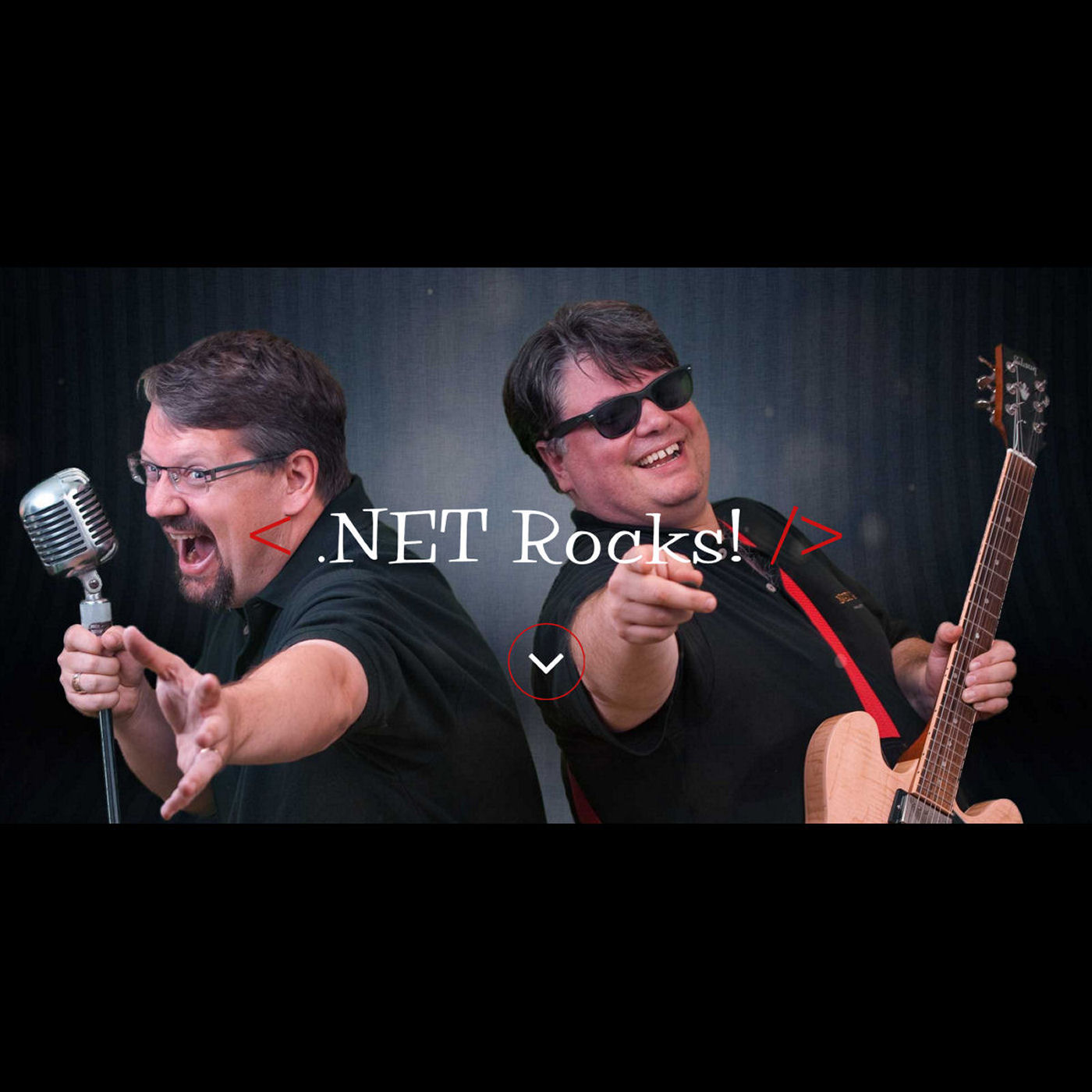
.NET Rocks!
- Folgen
- 2.022
- Erscheint
- wöchentlich
- Letzte Folge
- 12. Nov. 2026
Über den Podcast
.NET Rocks! is an Internet Audio Talk Show for Microsoft .NET Developers.
Folgen 2.022
Modern Mentorship with Ethan Winer
What is mentorship like today? Carl and Richard talk to Ethan Winer about his experiences helping people grow in their careers. Ethan talks about growing Crescent Software back in the QuickBasic and Visual …
Shownotes
What is mentorship like today? Carl and Richard talk to Ethan Winer about his experiences helping people grow in their careers. Ethan talks about growing Crescent Software back in the QuickBasic and Visual Basic days - including mentoring Carl! The conversation ranges over how mentorship for learning has changed with the ready availability of YouTube videos, and even more so with large language models. Is mentorship worthwhile? That's up to you, and the mentor or mentee! Finding folks who want to collaborate with you can be challenging, but ultimately rewarding. There's more than one way to help!The Future We Were Promised Geek Out
Whatever happened to the future we were promised? Time for a Geek Out! To celebrate the end of the opening history bits, Richard pulls together all the most popular topics of "things we were supposed to get in …
Shownotes
Whatever happened to the future we were promised? Time for a Geek Out! To celebrate the end of the opening history bits, Richard pulls together all the most popular topics of "things we were supposed to get in the future." From flying and self-driving cars to fusion power, personal jetpacks, Star Trek replicators, space tourism, and more! While some things are coming true, in a form different from what was expected, other things continue to be very difficult - and there is no sign of when that future will come. The future is here, just not exactly the one we thought it would be!Building System Tray Windows Apps with Joe Finney
It's Tray-Tober! Carl and Richard talk to Joe Finney about his latest project - building small, useful Windows apps that live in the system tray. Joe talks about his original project inspiration, Radio Tray - a …
Shownotes
It's Tray-Tober! Carl and Richard talk to Joe Finney about his latest project - building small, useful Windows apps that live in the system tray. Joe talks about his original project inspiration, Radio Tray - a way to have internet radio playing on his PC without creating a whole browser instance, because he needs that memory for AI! The conversation digs into how code is no longer the barrier to building; it's all about good ideas. What could the system tray do for you? Tray-Tober is about finding out - check out Tray Land on GitHub!XAML.io with Giovanni Albani
OpenSilver evolves! Carl and Richard talk to Giovanni Albani about how OpenSilver continues to help folks migrate Silverlight apps into a sustainable model not dependent on the plug-in - but now the focus is on …
Shownotes
OpenSilver evolves! Carl and Richard talk to Giovanni Albani about how OpenSilver continues to help folks migrate Silverlight apps into a sustainable model not dependent on the plug-in - but now the focus is on WPF! Giovanni talks about XAML.io and its ability to turn WPF applications into WebAssembly apps that run in the browser with no plug-ins and no HTML or JavaScript coding required. The conversation also explores the role of AI in software development and the tooling XAML.io is developing to help senior developers add guardrails and tooling around domain experts using these tools to build secure, reliable software.AI in Live Broadcast with Tim Huckaby
Can AI tech work in live television broadcasts? Carl and Richard talk to Tim Huckaby about his work building Duff Foreman, an AI-powered avatar for live golf programs. Tim talks about using AI to build AI …
Shownotes
Can AI tech work in live television broadcasts? Carl and Richard talk to Tim Huckaby about his work building Duff Foreman, an AI-powered avatar for live golf programs. Tim talks about using AI to build AI, using M365 Copilot to architect and ultimately implement the AI avatar, pulling from golf statistics to provide a digital commentator for the sport. The conversation explores the stack of tools needed to build Duff, some of which Tim selected and some that were already in play for the project. And then there was that first live broadcast - Duff "sitting" with two human presenters during a minor PGA event. Lots of great stories and questions about the future of this tech!Critter Stack Update with Jeremy Miller
The Critter Stack is growing! Carl and Richard talk with Jeremy Miller about the latest Critter Stack updates, including Marten, Wolverine, and more! First up is the stack's expansion with Polecat and Fisher …
Shownotes
The Critter Stack is growing! Carl and Richard talk with Jeremy Miller about the latest Critter Stack updates, including Marten, Wolverine, and more! First up is the stack's expansion with Polecat and Fisher, versions of Marten built for SQL Server 2025 and SQLite, respectively. Jeremy also talks about the evolution of event sourcing and how the framework continues to advance to take advantage of new approaches to managing fast, timely data flows. The conversation also digs into how AI is impacting frameworks, including the continued need for reliable frameworks so you can focus on providing value to your customer. But also in the AI vein is the AI Skills for the Critter Stack - so your AI development tools can work as effectively as possible, and get your application built!Controlling your Digital Legacy with Mattias Karlsson
What happens to your digital assets after you pass away? Carl and Richard talk with Mattias Karlsson about his experience navigating the challenges of losing a friend and having to reorganize their digital …
Shownotes
What happens to your digital assets after you pass away? Carl and Richard talk with Mattias Karlsson about his experience navigating the challenges of losing a friend and having to reorganize their digital assets. There are the immediate issues around access to email, authenticators, and the like, but also the long-term items like GitHub maintainer roles. Mattias talks about looking through your projects and deciding what is actually just for you and can pass with you, as opposed to what others need and value, and what needs a good succession plan. Many products (including GitHub) have successor systems - check them out and make a plan.RockBot with Rocky Lhotka
How about a cloud-native AI assistant? That's RockBot! Carl and Richard talk with Rocky Lhotka about RockBot, Rocky's own variant of the OpenClaw/Hermes type personal assistant. Rocky talks about being …
Shownotes
How about a cloud-native AI assistant? That's RockBot! Carl and Richard talk with Rocky Lhotka about RockBot, Rocky's own variant of the OpenClaw/Hermes type personal assistant. Rocky talks about being uncomfortable with the security approaches the other agents have taken, so he went full enterprise architect on the problem and built RockBot as a set of containers behind the Kubernetes orchestrator. Cloud architecture without the requirement of the cloud! The conversation dives into how to give RockBot controlled access to services like calendar, email, etc. And it's all .NET and open source, so if you want to make changes or contribute, go for it!Post-Quantum Crypto with Michael Howard
Whether quantum computers are around the corner or not, the message is clear: the time for post-quantum cryptography is coming fast. Carl and Richard talk to Michael Howard about Microsoft's efforts to make …
Shownotes
Whether quantum computers are around the corner or not, the message is clear: the time for post-quantum cryptography is coming fast. Carl and Richard talk to Michael Howard about Microsoft's efforts to make post-quantum cryptography available to everyone by 2029. Howard discusses the quantum computing and cryptography issue, specifically the ability of quantum computers to run Shor's algorithm quickly enough to break RSA encryption. While it isn't possible just yet, the harvest-and-decrypt-later concerns are real. And the solution is pretty straightforward- move to TLS 1.3, and be prepared for a wave of changing encryption algorithms as they roll out and are found wanting. A crazy time is coming soon!Numerics.NET with Jeffrey Sax
So what can numerics do for you? Carl and Richard talk to Jeffrey Sax about his work building Numerics.NET, a collection of general-purpose mathematical and statistical classes built for .NET. Jeffrey explains …
Shownotes
So what can numerics do for you? Carl and Richard talk to Jeffrey Sax about his work building Numerics.NET, a collection of general-purpose mathematical and statistical classes built for .NET. Jeffrey explains that numbers in a computer differ from real numbers in the world; for storage and computational efficiency, typical variable types in any programming language have limits on precision and size. How those variables are used can affect the outcome, with potentially disastrous consequences. Numerics.net provides exacting control of precision, as well as complex mathematical functions. It's far from free - but if you need it, you need it!Constraining Agents for Software Development with Don Demcsak
How can constraints make software development assistants more efficient? Carl and Richard talk to Don Demcsak about his work on getting LLMs to build higher-quality software with fewer resources. Don talks …
Shownotes
How can constraints make software development assistants more efficient? Carl and Richard talk to Don Demcsak about his work on getting LLMs to build higher-quality software with fewer resources. Don talks about how domain-driven language techniques help to define and constrain language around a given application problem space, but that largely hasn't been applied to coding agents so far. And as powerful as domain-driven is, it has challenges when it comes to building applications - and, more importantly, testing them. That's where behavior-driven approaches have advantages, which can also be applied to agents. Applying techniques of the past to tools of the future can accelerate development even further!Arguing about AI with Billy Hollis
Ready for a rant? Carl and Richard talk to Billy Hollis about the impact of artificial intelligence on software development. The conversation starts with a listener comment about going all-in on AI to speed up …
Shownotes
Ready for a rant? Carl and Richard talk to Billy Hollis about the impact of artificial intelligence on software development. The conversation starts with a listener comment about going all-in on AI to speed up development radically, which raises the question of how much AI is the right amount. What's safe and what is reckless? And how will that position change over time? Are the problems we're having today just growing pains of the tools, or are they systemic to the technology? Lots to debate!Beside, Inside, and Outside AI with Chad Michel
What's the best way to interact with an LLM in applications? Carl and Richard talk to Chad Michel about the evolving user interface to large language models. Chad recalls Build 2023, where Technical Fellow …
Shownotes
What's the best way to interact with an LLM in applications? Carl and Richard talk to Chad Michel about the evolving user interface to large language models. Chad recalls Build 2023, where Technical Fellow Steven Batiche talked about LLMs starting out beside your application (like Copilot), but eventually moving inside, like Claude Cowork. Then Steven suggested that the ultimate destination is outside - a separate interface that then orchestrates across applications. The conversation dives into how development has evolved with these tools, and what other applications could look like in the future.OpenClaw with David Guttman
What can OpenClaw do for you? Carl and Richard talk to David Guttman about his work on OpenClaw, and helping others be successful with it.OpenClaw was one of the first personal agents released and has continued …
Shownotes
What can OpenClaw do for you? Carl and Richard talk to David Guttman about his work on OpenClaw, and helping others be successful with it.OpenClaw was one of the first personal agents released and has continued to evolve with the industry. David talks about controlling access to OpenClaw, and controlling what OpenClaw has access to. The challenge is managing prompt injection, and the agent can be manipulated by others to share information inappropriately. But it can also be a time saver for routine and annoying tasks - it takes time to set up properly, but that time is paid back quickly when it gets to work!Catching Up with Shawn Wildermuth
What's Shawn been up to lately? Carl and Richard chat with Shawn Wildermuth about his work in the Netherlands. Shawn talks about his last show on being a senior developer - and how much that has changed in the …
Shownotes
What's Shawn been up to lately? Carl and Richard chat with Shawn Wildermuth about his work in the Netherlands. Shawn talks about his last show on being a senior developer - and how much that has changed in the past two years. The role of large language models in software development has changed careers, but they're still fun. The conversation also dives into the role of Aspire to utilize the best of cloud architecture and how LLMs make that easier as well - and enable developers to take on more architectural roles without getting stuck in the details of implementation.Identity is Hard with Michele Bustamante
Identity is hard, and getting harder! Carl and Richard talk to Michele Bustamante about the evolution of authentication and authorization in the current landscape. Michele talks about finding apps at clients …
Shownotes
Identity is hard, and getting harder! Carl and Richard talk to Michele Bustamante about the evolution of authentication and authorization in the current landscape. Michele talks about finding apps at clients that are still using older authentication strategies that are no longer secure - or are implemented incorrectly, so they were never secure! The conversation covers the array of tools available today for security, so you don't need to roll your own, and includes support so you can do it right. The role of the LLMs is important - old significant vulnerabilities are being found and fixed that can impact your apps, so it's important to review your identity solutions today!Commercial Open Source Update with Jimmy Bogard
Last year Jimmy Bogard released commercial licensed versions of AutoMapper and Mediatr - how's it going? Carl and Richard chat with Jimmy about the decision to go commercial and what he's learned after a year …
Shownotes
Last year Jimmy Bogard released commercial licensed versions of AutoMapper and Mediatr - how's it going? Carl and Richard chat with Jimmy about the decision to go commercial and what he's learned after a year. Making customer transactions is part of the process for sure, as is a new array of issues and ideas. But for the most part, Jimmy says it was the right decision and has been a good experience. Another great story of sustainable open source!The Role of AI in Testing with Debbie O'Brien
How has testing changed in the era of AI? Carl and Richard talk to Debbie O'Brien in her new role at Zephyr about using LLMs to help build and validate tests - and much more. Debbie talks about joining Zephyr …
Shownotes
How has testing changed in the era of AI? Carl and Richard talk to Debbie O'Brien in her new role at Zephyr about using LLMs to help build and validate tests - and much more. Debbie talks about joining Zephyr and using testing tools like Playwright to validate application workflows and generate documentation. This leads to a discussion about documentation being more important than ever, since LLMs will actually read it! Maintaining quality is a challenge with LLM-generated code and tests, so there's always a role for a critical eye in the process.Open Source Maintenance Fee Update with Rob Mensching
The Open Source Maintenance Fee is more than a year old now - how are things going? Carl and Richard catch up with Rob Mensching to discuss the OSMF and its success in supporting Rob's WiX Toolset project. Rob …
Shownotes
The Open Source Maintenance Fee is more than a year old now - how are things going? Carl and Richard catch up with Rob Mensching to discuss the OSMF and its success in supporting Rob's WiX Toolset project. Rob talks about the key aspect of the OSMF - making it part of the licensing, so that it isn't optional. Of course, you can download the source from GitHub and compile it yourself without violating any license terms, but if you're that engaged, you can contribute too. The goal with OSMF is to have folks who want to use the product have a reason and method to pay - check it out!Azure Container Apps with Paul Yuknewicz and Jan Kalis
Have you checked out Azure Container Apps lately? Carl and Richard talk to Paul Yuknewicz and Jan Kalis about how they have sped up startup time with Container Apps using a feature called Express, and then on …
Shownotes
Have you checked out Azure Container Apps lately? Carl and Richard talk to Paul Yuknewicz and Jan Kalis about how they have sped up startup time with Container Apps using a feature called Express, and then on to the big news - Sandboxes. Sandboxes let you experiment with Azure Container Apps with managed identity to access Azure Connectors to all sorts of resources, both within Azure and outside it - Salesforce, SAP, etc. It's an effective and secure strategy for building applications, but also for experimenting with agents - at no point does the agent actually have control of any credentials. If you haven't looked at ACA lately, you need to check out these latest features!DNSimple CLI with Anthony Eden
DNSimple has a CLI! Carl and Richard talk to DNSimple CEO Anthony Eden about the evolution of the DNSimple CLI in today's software market. DNSimple provides DNS, domain registrar, and certificate services - so …
Shownotes
DNSimple has a CLI! Carl and Richard talk to DNSimple CEO Anthony Eden about the evolution of the DNSimple CLI in today's software market. DNSimple provides DNS, domain registrar, and certificate services - so why does it need a CLI? Anthony talks about earlier experiments with CLIs for folks who didn't want to use the web interface. But today, large language models change the game and work best with a CLI - those specific commands mean more accurate results from LLMs, which make for a powerful natural language interface experience. The conversation covers the new tooling around LLMs, how the registrar market has evolved, changes to certificates, and ICANN's recent announcement of new gTLDs. DNSimple continues to evolve with the times! Check the show notes for a link for ten dollars off anything at DNSimple!Data Centers in Space Geek Out
Do data centers in space make any sense? Time for a rare summer-time Geek Out! Richard chats with Carl about all the hype surrounding building orbital data centers for AI workloads. Richard points out that …
Shownotes
Do data centers in space make any sense? Time for a rare summer-time Geek Out! Richard chats with Carl about all the hype surrounding building orbital data centers for AI workloads. Richard points out that enthusiasm for this idea surged in the fall of 2025, when the backlash against ground data centers peaked. But could you actually make the orbital data centers work? The conversation works through a reasonable satellite design, covering off the details of power, cooling, communications, and satellite management. But how many satellites would be enough? This leads to an exploration of Kessler Syndrome, where orbital debris gets out of control - and what we can reasonably do about it. Which leads to another idea - how do we make ground-based data centers not suck?Event Sourcing using Cratis with Einar Ingebrigsten
Can tooling make event sourcing implementations easier? Carl and Richard talk to Einar Ingebrigsten about his work on cratis.io - a set of open-source tools for implementing event sourcing in your application …
Shownotes
Can tooling make event sourcing implementations easier? Carl and Richard talk to Einar Ingebrigsten about his work on cratis.io - a set of open-source tools for implementing event sourcing in your application. Einar discusses the foundational elements of event sourcing and the common implementation patterns he developed at Cratis. With extensive support for .NET, Cratis provides tooling for data storage, event response, replay management, and much more. Also in development is Cratis Studio for collaborating visually on an event model - and generating the code in the process.Daemonic AI with Emmz Rendle
Is it time to build your own agent harness? Carl and Richard talk to Emmz Rendle about her work on Daemonic AI, which gives you more control over which models and tooling you use to build software with agents …
Shownotes
Is it time to build your own agent harness? Carl and Richard talk to Emmz Rendle about her work on Daemonic AI, which gives you more control over which models and tooling you use to build software with agents. Emmz talks about the upcoming rug pull in AI software development tools, where prices are rising, and services are being restricted. Having enough control to choose when to run locally becomes key to being productive at a reasonable price. Being able to pick-and-choose what agents and configurations to use for each of the agent roles you want to implement is super powerful - check out the GitHub project and take it for a spin!Ten Things Scott Sauber Does On Every .NET App
What settings, configurations, and workflows do you use for every .NET app? Carl and Richard talk to Scott Sauber about his list - from organizing folders by feature, to logging, security, and testing. Scott …
Shownotes
What settings, configurations, and workflows do you use for every .NET app? Carl and Richard talk to Scott Sauber about his list - from organizing folders by feature, to logging, security, and testing. Scott talks about enforcing rules like treating warnings as errors so you won't ignore important warnings, and validation in the build, to make applications more reliable. Each of these items represents some work, but in the end, your application will be higher quality and more reliable. Which ones are you already doing?Using AI to Measure Quality of AI with Vishwas Lele
Large Language Models can generate a lot of text - but is it any good? Carl and Richard talk to Vishwas Lele about his ongoing efforts at pWin.ai to build tools for responding to government RFPs. Vishwas …
Shownotes
Large Language Models can generate a lot of text - but is it any good? Carl and Richard talk to Vishwas Lele about his ongoing efforts at pWin.ai to build tools for responding to government RFPs. Vishwas focuses on the quality problem - both the quality of the incoming RFP and the quality of the responding proposal. How do you determine the key requirements of an RFP reliably? And when it comes to the response, how do you provide measurable results for a response? The conversation digs into a change in workflow that benefits the RFP process regardless of tooling - and gives hints to the patterns of success with LLMs!Use What Works with Dylan Beattie
Use What Works! Carl and Richard talk to Dylan Beattie about the Use What Works movement, encouraging developers to use well-maintained open-source projects available today rather than rolling their own. Dylan …
Shownotes
Use What Works! Carl and Richard talk to Dylan Beattie about the Use What Works movement, encouraging developers to use well-maintained open-source projects available today rather than rolling their own. Dylan explains how folks go down a path of believing a library is simple until they learn enough to realize that every bit of software is more complicated than they realize. And the less code you own, the happier and more productive you are. Adding AI to the mix only makes it clearer: you need some stability in development. If you're changing every layer of code, you'll spend even more time and frustration chasing problems. Make getting results easier - use what works!.NET Nanoframework with José Simões
Ready to go nano? Carl and Richard talk to José Simões about the open source .NET nanoFramework - a community-driven project to provide .NET for embedded systems. José talks about the evolution from the .NET …
Shownotes
Ready to go nano? Carl and Richard talk to José Simões about the open source .NET nanoFramework - a community-driven project to provide .NET for embedded systems. José talks about the evolution from the .NET microFramework, to something even smaller, while at the same time, microcontrollers have gotten much more powerful. The conversation looks beyond the hobbyist and educational uses of these systems into commercial IoT applications. The development cycle is one you'll recognize, working in Visual Studio (or Visual Studio Code) and executing against an emulator, or to the actual controller via USB. And yes, you can set breakpoint in the controller!Episode 2000!
Recorded live at the Tavern Hall in Bellevue during the Party with Palermo for the MVP Summit, it's episode 2000! Carl and Richard take questions from the audience and play clips from past guests and listeners …
Shownotes
Recorded live at the Tavern Hall in Bellevue during the Party with Palermo for the MVP Summit, it's episode 2000! Carl and Richard take questions from the audience and play clips from past guests and listeners about their experiences with .NET, and the role that .NET Rocks has played in their careers. After two thousand shows, there are lots of stories, and plenty to celebrate. Thanks for listening!How We Beat the Y2K Bug
The Y2K bug turned out to be a non-event on January 1, 2000. How did that happen? Carl and Richard bring together a number of stories from folks who were there, fixing the software and updating systems, so …
Shownotes
The Y2K bug turned out to be a non-event on January 1, 2000. How did that happen? Carl and Richard bring together a number of stories from folks who were there, fixing the software and updating systems, so effectively that, ultimately, nothing much happened when the clocks rolled over. It was common practice with early software to only store two digits worth of year - back then, storage space was at a premium. For years, there had been warnings about fixing these problems, but by 1999, it was essential. These are the stories of how some folks did those fixes so effectively that when Jan 1 2000, came around, nothing bad happened.
Hier stehen die neuesten 40 von 2.022 Folgen. Ältere Folgen findest du im Feed des Podcasts.
Ähnliche Podcasts
Mehr Technologie-Podcasts

Ist das dein Podcast?
Bestätige es mit einem Eintrag in deinem Feed: Du bekommst hier einen Code, trägst ihn als podcast:txt in den Kanal deines Feeds ein, und wir prüfen ihn. Danach steht dein Podcast als „verifiziert“ bei SoundNode.