

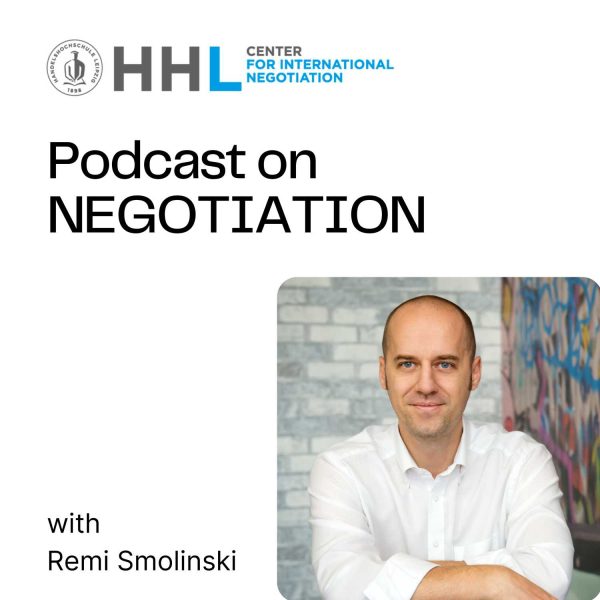
Podcast on Negotiation
- Folgen
- 59
- Erscheint
- monatlich
- Letzte Folge
- 3. Juni 2026
Über den Podcast
As a negotiation professor, I've spent my academic career trying to answer a question what it means to negotiate well and helping my students and executives achieve better negotiation results. In the Podcast on Negotiation, I invite negotiation scholars and professionals to discuss the most recent research findings, analyze ongoing negotiations, and review negotiation strategies and tactics that really work!
Lizenz: Remi Smolinski 2025
Folgen 59
On Impact Negotiation Toolkit with Nuno Delicado
In this episode, we welcome Nuno Delicado, negotiation expert, founding partner of Pluris, and author of Impact Negotiations Toolkit. With experience advising, training, and supporting negotiators across …
Shownotes
In this episode, we welcome Nuno Delicado, negotiation expert, founding partner of Pluris, and author of Impact Negotiations Toolkit. With experience advising, training, and supporting negotiators across countries, sectors, and complex situations, Nuno brings a practical and deeply human perspective on what it means to negotiate well.
Together, we explore why he wrote Impact Negotiations Toolkit and why the word “impact” is at the heart of his approach. Rather than seeing negotiation only as a way to win, close a deal, or secure an immediate outcome, Nuno invites us to think about negotiation through its lasting effects: on relationships, organizations, communities, and the wider world.
The conversation looks at how impactful negotiation differs from traditional frameworks, what negotiators can do before, during, and after a conversation, and why reflection is essential for learning and long-term success. Nuno shares insights into the main components of his toolkit, including preparation, connection, creativity, decision-making, and continuous improvement.
We also discuss what separates negotiators who consistently create meaningful results from those who do not, how to navigate strong power imbalances, and whether there are universal principles of negotiation across cultures and sectors. Nuno challenges common myths about negotiation and reflects on how hybrid work, artificial intelligence, and cross-cultural collaboration are reshaping the way we negotiate today.
This episode is for anyone who wants to move beyond short-term wins and learn how negotiation can become a tool for better decisions, stronger relationships, and positive change. We close with Nuno’s view on what makes someone a truly great negotiator and the one idea he hopes every listener takes away from Impact Negotiations Toolkit.
More free tools from Nuno's great book can be found at: https://www.impactnegotiations.org/.
On why we avoid negotiating with David Hunsaker, Hong Zhang, and Alice Lee
In this episode, we talk with David A. Hunsaker, Hong Zhang, and Alice J. Lee, authors of the paper “Beyond Propensity: Thresholds, Costs, and Interventions in Negotiation Avoidance,” about why people often …
Shownotes
In this episode, we talk with David A. Hunsaker, Hong Zhang, and Alice J. Lee, authors of the paper “Beyond Propensity: Thresholds, Costs, and Interventions in Negotiation Avoidance,” about why people often choose not to negotiate, even when negotiation could benefit them.
The conversation begins with the origins of their research project on negotiation avoidance, a phenomenon that is both common and surprisingly underexamined. Starting from a relatable observation that even negotiation scholars sometimes avoid negotiating, we ask why people decide not to negotiate at all, before they ever reach the bargaining table.
We discuss the paper’s finding that negotiation avoidance is widespread: more than 95% of participants reported avoiding negotiation in at least some situations, and people avoided negotiation up to 51% of the time. The episode explores why studying the decision to initiate negotiation is just as important as studying what happens once people are already engaged in the negotiation itself.
The authors introduce two key concepts from the paper. The first is Threshold for Negotiation Initiation, which refers to the point at which a person decides that negotiation is “worth it.” We examine how people make that decision, including the role of percentage-based thinking: the same dollar savings may feel more or less worthwhile depending on the total price of the item.
The second concept is Willingness to Pay to Avoid Negotiation. We explore the striking finding that nearly half of participants were willing to pay extra to avoid negotiating, and consider what people may really be trying to avoid: time, discomfort, conflict, embarrassment, or the fear of seeming inappropriate.
The episode also looks at the tension revealed in the car-buying scenario: many people preferred having the possibility of negotiation, yet later said they would pay to avoid actually doing it. This opens a broader discussion of the cognitive, emotional, and social barriers that keep people from initiating negotiations.
Finally, we discuss the interventions tested in the paper. A financial comparison showing that negotiation could be worth more per hour than a person’s usual wage did not significantly increase negotiation initiation, while a social norm intervention, showing that negotiation is common, did. The conversation considers why financial logic may not be enough, why social permission matters, and what practical advice the authors would give to consumers, employees, managers, and negotiation educators.
We close by asking what future research should explore next in understanding when, why, and how people decide to negotiate.
On body language secrets with Greg Williams
In this episode, we sit down with Dr. Greg Williams, a leading expert in negotiation, body language, emotional intelligence, and microexpressions, to explore what is really happening beneath the surface of …
Shownotes
In this episode, we sit down with Dr. Greg Williams, a leading expert in negotiation, body language, emotional intelligence, and microexpressions, to explore what is really happening beneath the surface of every negotiation.
Most people focus on the words being spoken in a negotiation. But tone, posture, facial expressions, eye movement, gestures, silence, and subtle behavioral shifts often reveal just as much as the conversation itself. Dr. Williams has spent decades studying how these nonverbal signals influence trust, tension, confidence, power, and decision-making.
Drawing from his book, Body Language Secrets To Win More Negotiations, Greg explains why body language is not about guessing what someone is thinking, but about becoming a more careful observer of patterns, context, and emotional change. We discuss what nonverbal cues can reveal, what they cannot reliably tell us, and why misreading body language can damage trust if negotiators jump to conclusions too quickly.
Throughout the conversation, Greg shares practical insights on how to recognize important signals at the negotiation table, including microexpressions, subtle shifts in behavior, emotional triggers.
We also explore how negotiators can manage their own body language to project confidence, openness, and control without appearing artificial, aggressive, or manipulative. Greg offers guidance for anyone who wants to become a better listener, a sharper observer, and a more emotionally intelligent communicator.
The conversation begins with Greg reflecting on what first drew him to the nonverbal side of negotiation and how his decades of work shaped the central message of Body Language Secrets To Win More Negotiations. From there, we examine what body language can and cannot reveal, the first signals negotiators should watch for when entering a conversation, and the microexpressions or behavioral cues that are often missed when people focus too heavily on words alone.
Greg also discusses why context is essential when interpreting body language, including the influence of culture, personality, stress, power dynamics, and high-stakes pressure. We look at the most common mistakes people make when trying to read others, how to respond when someone’s words and body language do not seem to align, and how to avoid making assumptions that could weaken trust.
Later in the episode, Greg explains why some people seem naturally better at reading body language, whether this skill can be learned, and how negotiators can become more aware of the signals they are sending themselves. He also shares a practical exercise listeners can begin using immediately to become sharper observers in everyday conversations.
Whether you negotiate in business, leadership, sales, law, conflict resolution, relationships, or everyday life, this episode will help you better understand the signals people send before they ever say a word.
On negotiation stories on the path to peace with Joshua Weiss
In this episode of the Podcast on Negotiation On Negotiation Stories on the Path to Peace, we speak with Joshua Weiss about the human stories that shape negotiation, conflict resolution, and peacebuilding. Josh …
Shownotes
In this episode of the Podcast on Negotiation On Negotiation Stories on the Path to Peace, we speak with Joshua Weiss about the human stories that shape negotiation, conflict resolution, and peacebuilding. Josh reflects on his own path into the field, what first drew him to negotiation and mediation, and how his work has evolved through scholarship, practice, and teaching.
We also revisit his recent work on failure in negotiation, exploring what failure can teach us and why it remains such an important and often overlooked part of learning. From there, the conversation turns to the power of stories: why they matter so deeply in negotiation, what they reveal that courses and workshops alone sometimes cannot, and how personal experience can open new ways of understanding conflict, connection, and change.
A major focus of the episode is Josh’s new project, a community-based database of negotiation stories. He shares what inspired the initiative, how he hopes people will use it, and what makes it different from more traditional negotiation clearinghouses such as those at PON and DRRC. We also explore the kinds of stories that stay with us and what makes a negotiation story especially meaningful.
In the second part of the episode, we turn to the Abraham Path Initiative. Josh introduces the vision behind this work and reflects on what drew him personally to it. Together, we discuss how encounter across cultures and communities can create new possibilities for understanding and peacebuilding, and how movement, listening, and shared human experience can become part of a larger path toward peace.
Throughout the episode, we explore Josh’s personal journey into negotiation, mediation, and conflict resolution, the lessons from his work on failure in negotiation, the role of stories in negotiation and peacebuilding, and the promise of his new database of negotiation stories from the community. We also discuss how this project differs from traditional negotiation case collections, the vision and significance of the Abraham Path Initiative, the way encounter across cultures can open space for peace, and the deeper connection between stories, understanding, and hope.
On real estate negotiations with Robin Kencel
In this episode, we host Robin Kencel, a leading real estate broker in the U.S. Robin has been recognized on The Wall Street Journal's RealTrends rankings (including The Thousand/America’s Best lists), placing …
Shownotes
In this episode, we host Robin Kencel, a leading real estate broker in the U.S. Robin has been recognized on The Wall Street Journal's RealTrends rankings (including The Thousand/America’s Best lists), placing her team among the top performers nationally and in the top 1-1.5% across the U.S., with repeated state-level top-100 distinctions.
Together with Robin, we unpack how real estate negotiations really work, who holds leverage at different stages and how to align agents, principals, lenders, and lawyers. We look at pricing and anchoring in volatile markets, from comps and cap rates to when ignoring the “asking” price is the smartest move. Robin shows how to use structure as a bargaining tool, from contingencies and seller financing to creative concessions that unlock value, and how disciplined diligence, zoning, environmental risk, tenant rolls, can legitimately reopen terms without undermining trust. We talk BATNAs that truly matter, time pressure, managing multiple offers ethically, and the fine line between tactics and relationships: reading signals, countering nibbling, and keeping counterparties on-side to reach closing. You’ll hear where residential and commercial playbooks overlap (and where they don’t), plus two vivid case stories, a bidding war flipped into collaboration, and a near-miss rescued by reframing interests. We wrap with practical takeaways you can use immediately: questions to ask before the first call, a concession matrix for inspection findings, and a closing checklist, lessons that apply well beyond property, from leases for founders to any negotiation requiring speed, diligence, and structured creativity.
This episod is especially interesting to: buyers, sellers, founders negotiating leases, asset managers, and anyone who wants sharper due-diligence and deal-structuring skills.
On SMART Negotiator(s) with Keld Jensen
In this episode, we sit down with Keld Jensen, a world-renowned negotiation expert, to discuss his groundbreaking new book Smart Negotiator. With decades of experience in teaching, researching, and advising …
Shownotes
In this episode, we sit down with Keld Jensen, a world-renowned negotiation expert, to discuss his groundbreaking new book Smart Negotiator. With decades of experience in teaching, researching, and advising negotiators across the globe, Keld brings a fresh perspective to a field that is often thought to be already saturated. So why Smart Negotiator now? Because the negotiation landscape is evolving rapidly, and today’s challenges from AI integration to shifting trust dynamics, demand new tools and mindsets.
Together, we explore how the world of negotiation has changed in recent years and what new pressures negotiators must navigate. Keld introduces us to the concept of NegoEconomics, his framework for uncovering hidden value in deals, and explains why trust remains at the heart of every successful outcome. We dive into the fascinating interplay between human insight and artificial intelligence, including real-world examples where AI surfaced breakthroughs that human intuition alone might have missed.
The conversation also covers practical guidance: how to measure and rebuild trust mid-deal, how to design contracts in the age of AI, and how to avoid the most common mistakes, even those made by seasoned professionals. Keld explains the mindset and signals needed to build a true SMARTnership, a collaborative paradigm that transcends zero-sum tactics, and offers tactics for uncovering the “hidden surplus” present in every negotiation.
We also look at cutting-edge topics such as using AI for real-time negotiation feedback, countering authority bias when dealing with powerful counterparts, and the evolving role of contracts as tools for long-term alignment rather than just legal safeguards.
Finally, Keld reflects on where the journey of Smart Negotiator might lead next and how the integration of AI will continue to reshape the way we negotiate in the years to come.
On AI in peacebuilding with Shane Ray Martin
Shane Ray Martin is a venture capitalist at B Ventures Group, where his mission is to back founders whose solutions deliver both profit and peace. He’s also a negotiation advisor, author, and trusted voice at …
Shownotes
Shane Ray Martin is a venture capitalist at B Ventures Group, where his mission is to back founders whose solutions deliver both profit and peace. He’s also a negotiation advisor, author, and trusted voice at the intersection of technology and conflict resolution.
In this episode, we explore how artificial intelligence is reshaping the field of peacebuilding. We discuss how AI is being used in early warning systems that anticipate conflict, and how AI-mediated diplomacy is emerging as a tool in negotiations. We also unpack the deep ethical dilemmas that come with deploying AI into real conflict zones, where the stakes are high and mistakes can have life-or-death consequences.
Shane walks us through his path into venture capital via B Ventures, a “peace VC” fund that supports tech founders who pursue both social impact and financial returns. He talks candidly about the hurdles these founders face when pitching peace-tech ideas to investors, who often prioritize clearer profit models.
We also turn our attention to negotiation and mediation, and examine concrete ways AI can strengthen those practices. Shane offers practical advice for anyone interested in fusing technology, public policy, or peace work to achieve meaningful change.
If you’re curious about where AI, diplomacy, and conflict resolution converge, this episode is made for you.
On Mediation with Leonardo D'Urso
In this episode, we sit down with Leonardo D’Urso, one of Europe’s pioneers in mediation and conflict resolution and the CEO of ADR Center. We begin by exploring his personal journey, what first drew him into …
Shownotes
In this episode, we sit down with Leonardo D’Urso, one of Europe’s pioneers in mediation and conflict resolution and the CEO of ADR Center. We begin by exploring his personal journey, what first drew him into the field, and move on to the heart of his work: explaining what mediation really is, and who can (and cannot) become an effective mediator.
Leonardo takes us inside his new book, SOLVE: Mastering Conflict Resolution with the SOLVE Mediation Matrix, and introduces listeners to a structured framework that guides parties from conflict to resolution. He explains the five stages of the SOLVE Matrix: Set the Stage, Open the Process, Listen & Understand, Validate Options, and Enable Resolution, and illustrates how these work in practice with examples from commercial, community, and even victim-offender mediations.
We also discuss why the book goes beyond process steps to include targets, strategies, activities, keys, and skills, and what this level of detail contributes to real-world dispute resolution. Leonardo shares memorable mediation stories, insights into what people often misunderstand about mediation compared to litigation, and surprising lessons from applying the same approach across such diverse contexts.
Looking ahead, Leonardo reflects on the future of mediation and its role in addressing today’s global conflicts. He also offers practical advice for listeners: how anyone, whether or not they’ve ever been in a mediation room, can start adopting a mediator’s mindset in everyday life.
Finally, we ask him to capture the essence of his book, and to reflect on who he considers truly great in the world of negotiation and mediation.
On lobbying with Michael Koplovsky
Lobbying is often portrayed as a mysterious arena where influence meets policy. But at its heart, lobbying is built on negotiation, balancing interests, crafting agreements, and building trust under pressure.In …
Shownotes
Lobbying is often portrayed as a mysterious arena where influence meets policy. But at its heart, lobbying is built on negotiation, balancing interests, crafting agreements, and building trust under pressure.
In our next episode, we sit down with Michael Koplovsky, a multilingual EU lobbyist, former senior diplomat, and professor whose career spans five continents and some of the most complex political and crisis environments in the world. From forging civil-military cooperation in war zones to advancing public-private partnerships in Europe’s political institutions, Michael has seen lobbying and negotiation at their most intense.
In this wide-ranging conversation, Michael takes us through his unique career journey, explaining how his path from diplomacy to academia and ultimately into lobbying unfolded and why negotiation has always been the common thread linking them together. He sheds light on what lobbyists really do beyond the usual stereotypes, and why their work is so often misunderstood. We explore the surprising similarities between lobbying and negotiation, as well as the subtle differences that shape how each plays out in practice.
Michael shares vivid stories from the “war rooms” where advocacy campaigns are mapped out, and from the high-level tables where policy shifts are decided. He speaks candidly about both successes and failures in lobbying, highlighting the lessons negotiators can draw from each. We discuss the challenge of negotiating when multiple stakeholders with competing interests are at the table, and how to strike the right balance between quiet relationship-building behind the scenes and formal deal-making in the spotlight.
The conversation also touches on the ethical responsibilities lobbyists carry when shaping policy outcomes, and how much of their work depends on integrity and trust. Michael reflects on how lobbying has changed in recent years, shaped by technology, social media, and even the rise of AI, and what this means for the future of influence and negotiation. Looking back across his career, he distills the single most important negotiation lesson he has learned and shares who comes to his mind when he thinks about true greatness in negotiation.
With advanced degrees in National Security, Strategic Studies, and International Relations, and years of teaching negotiation, leadership, and communication, Michael bridges theory and practice like few others can. His vivid anecdotes from political capitals and crisis zones alike offer insights you won’t find in textbooks.
Whether you are a negotiation professional, a student, or simply curious about how influence is really shaped in the political world, this episode pulls back the curtain on lobbying as negotiation in action.
On AI in negotiation with Yadvinder Rana
AI is entering the negotiation room, not as a silent observer, but as a highly effective tool shaping how we prepare, communicate, and reach agreements. From guiding our preparation to AI-driven coaching, from …
Shownotes
AI is entering the negotiation room, not as a silent observer, but as a highly effective tool shaping how we prepare, communicate, and reach agreements.
From guiding our preparation to AI-driven coaching, from real-time performance feedback to agent-based simulations, artificial intelligence is beginning to revolutionize the way we approach negotiations in business, diplomacy, and beyond.
To explore this exciting frontier, I’m joined by Yadvinder S. Rana, a negotiation expert who bridges research, practice, and AI innovation. With a background in cross-cultural negotiations and B2B dealmaking, Yadvinder has spent his career investigating how professionals can consistently achieve optimal outcomes, even in environments marked by uncertainty, limited trust, or overwhelming complexity.
His recent work explores how AI can support human negotiation, responsibly and effectively. His empirical research shows that AI-augmented support can lead to 48% better individual outcomes and up to 84% more joint value when both parties use structured AI tools. To put these findings into practice, he developed the ALIGN Framework, a methodology that provides 24/7 expert-quality negotiation assistance powered by AI, no steep learning curve required.
Yadvinder works with procurement and sales leaders navigating complex B2B negotiations, helping them adopt AI tools that drive superior preparation and value creation. He also partners with consulting and training firms to integrate AI-enhanced negotiation into their services.
In our conversation, we explore what AI can, and crucially, cannot do in the context of negotiation, examining both its practical capabilities and its current limitations. We discuss how AI is already being used in negotiation training and education, from intelligent simulations to personalized feedback systems. We also dive into the ethical and relational dilemmas that arise when AI tools are introduced into real-time negotiations, including questions of trust, transparency, and agency. A key part of our discussion focuses on whether machines can truly grasp complex human dynamics like power, trust, and cultural nuance. Finally, we reflect on how negotiation professionals can best prepare for an AI-augmented future and what skills will remain essential in an increasingly automated world.
On negotiating with Aristotle with Rudolf Schüssler
Following our earlier episode on Immanuel Kant and the role of truth and lies in negotiation, we return to the world of philosophy, this time with a thinker who approached ethics from a different angle …
Shownotes
Following our earlier episode on Immanuel Kant and the role of truth and lies in negotiation, we return to the world of philosophy, this time with a thinker who approached ethics from a different angle: Aristotle. What would Aristotle say if he were advising a modern-day negotiator? In this episode, we’re joined by Rudolf Schüssler, a distinguished philosophy professor from the University of Bayreuth, to explore how Aristotle’s timeless ideas can shed light on negotiation. …On trust in intercultural negotiation with Mariusz Sikorski
In this episode, we disucss one of the most essential and most elusive elements of successful negotiation: trust. What exactly is trust, and why does it matter so much at the negotiating table? Our guest …
Shownotes
In this episode, we disucss one of the most essential and most elusive elements of successful negotiation: trust. What exactly is trust, and why does it matter so much at the negotiating table? Our guest, Mariusz Sikorski, who is a practitioner and researcher specializing in intercultural negotiation, walks us through the foundations of trust, unpacking its definition and exploring the many ways it influences negotiation outcomes, often before a single word is spoken. …On negotiating sustainable future with Rajiv Vaid Basaiawmoit
In this episode we host Rajiv Vaid Basaiawmoit, an innovation educator, sustainability advocate, and Head of Sci-tech Innovation & Entrepreneurship at Aarhus University. Rajiv is also the co-founder of …
Shownotes
In this episode we host Rajiv Vaid Basaiawmoit, an innovation educator, sustainability advocate, and Head of Sci-tech Innovation & Entrepreneurship at Aarhus University. Rajiv is also the co-founder of Biosymfonix EduGames, where he develops innovative educational tools that bridge science, sustainability, and real-world problem-solving. …On questions in negotiation with Linda Swindling
What if the key to unlocking better deals, stronger relationships, and greater confidence in negotiations was simply... asking better questions? In this episode, we’re joined by Linda Swindling, internationally …
Shownotes
What if the key to unlocking better deals, stronger relationships, and greater confidence in negotiations was simply... asking better questions? In this episode, we’re joined by Linda Swindling, internationally recognized negotiation expert and author of Ask Outrageously! The Secret to Getting What You Really Want. Linda brings a rare combination of legal insight, executive coaching experience, and practical negotiation wisdom to the table. …On first offers and impasses with Martin Schweinsberg
In this episode, we focus on first offers and negotiation impasses with Martin Schweinsberg, Associate Professor of Organizational Behavior at ESMT Berlin. Drawing from his cutting-edge research, Martin reveals …
Shownotes
In this episode, we focus on first offers and negotiation impasses with Martin Schweinsberg, Associate Professor of Organizational Behavior at ESMT Berlin. Drawing from his cutting-edge research, Martin reveals the science behind why first offers set the tone for negotiations, how they shape expectations, and whether making the first move truly gives you an advantage. But what happens when negotiations hit a deadlock? …On the art and science of convincing with Adele Gambardella and Chip Massey
In our latest episode, we focus on persuasion and high-stakes negotiation with two exceptional experts: Adele Gambardella and Chip Massey. They share insights from their new book, "Convince Me: High-Stakes …
Shownotes
In our latest episode, we focus on persuasion and high-stakes negotiation with two exceptional experts: Adele Gambardella and Chip Massey. They share insights from their new book, "Convince Me: High-Stakes Negotiation Tactics to Get Results in Any Business Situation", offering listeners practical strategies to enhance their convincing abilities in both professional and personal contexts. …On failure in negotiation with Joshua Weiss
Joshua Weiss is a negotiation and conflict resolution expert, Senior Fellow at the Harvard Negotiation Project and the co-founder of the Global Negotiation Initiative at Harvard University. He is also the …
Shownotes
Joshua Weiss is a negotiation and conflict resolution expert, Senior Fellow at the Harvard Negotiation Project and the co-founder of the Global Negotiation Initiative at Harvard University. He is also the Director of the MS in Leadership and Negotiation at Bay Path University. …On sustainability and negotiation with Brian Ganson
In this episode, we explore how negotiation can serve as a powerful tool for advancing sustainability goals across various contexts, from environmental and social to economic issues. We discuss the evolving …
Shownotes
In this episode, we explore how negotiation can serve as a powerful tool for advancing sustainability goals across various contexts, from environmental and social to economic issues. We discuss the evolving role of negotiation theory, emphasizing the need for socially responsible approaches that include long-term impacts and the interests of all stakeholders, even those not directly involved in the negotiation. …On AI negotiations with Shane Ray Martin
Shane Ray Martin is on a mission to create a new generation of peaceful and tech-savvy negotiators. As an investor at B Ventures, the first-ever PeaceTech venture capital fund, Shane is driving innovation at …
Shownotes
Shane Ray Martin is on a mission to create a new generation of peaceful and tech-savvy negotiators. As an investor at B Ventures, the first-ever PeaceTech venture capital fund, Shane is driving innovation at the intersection of technology and negotiation. With a passion for empowering others, he is currently writing a book on 'AI Negotiations' aimed at inspiring the next wave of negotiation experts. …On Negotiation, Identity and Justice with Daniel Druckman
Dr. Daniel Druckman, a distinguished scholar and practitioner in the fields of negotiation, conflict resolution, and international relations. Dan has an extensive and impactful body of work, having published …
Shownotes
Dr. Daniel Druckman, a distinguished scholar and practitioner in the fields of negotiation, conflict resolution, and international relations. Dan has an extensive and impactful body of work, having published widely on topics such as negotiating behavior, nationalism and group identity, human performance, peacekeeping, political stability, nonverbal communication, and research methodology. …On the Elements of Negotiation with Keld Jensen
Keld Jensen is a distinguished expert in negotiation, renowned globally for his expertise. With more than thirty years of experience in international management and negotiation, he is a highly sought-after …
Shownotes
Keld Jensen is a distinguished expert in negotiation, renowned globally for his expertise. With more than thirty years of experience in international management and negotiation, he is a highly sought-after guest lecturer in fields such as negotiation, trust-building, behavioral economics, and impression management at top Executive MBA institutions worldwide. Keld has written and published 24 books in 36 countries. …On building business relationships with Vladimir Bushin
Vladimir Bushin is a renowned negotiation, influence, and business relationships coach, whose expertise has shaped the way professionals interact and build trust in the corporate world and beyond. As the author …
Shownotes
Vladimir Bushin is a renowned negotiation, influence, and business relationships coach, whose expertise has shaped the way professionals interact and build trust in the corporate world and beyond. As the author of the acclaimed rapport-building course, "7 Levels of Nurturing", and a Founding Member of the prestigious Cialdini Institute, Vladimir brings a wealth of knowledge and insight to our discussion. …On a woman's guide to negotiation with Beth Fisher-Yoshida
Beth Fisher-Yoshida is a Professor of Professional Practice at Columbia University School of Professional Studies. She is also a Program Director of the Master in Negotiation and Conflict Resolution and …
Shownotes
Beth Fisher-Yoshida is a Professor of Professional Practice at Columbia University School of Professional Studies. She is also a Program Director of the Master in Negotiation and Conflict Resolution and Co-Executive Director of the Advanced Consortium on Cooperation, Conflict and Complexity and Director of the Youth, Peace, and Society program, both hosted by the Climate School / Earth Institute at Columbia University. …On Star Wars and conflict resultion with Jen Reynolds and Noam Ebner
Have you ever realized that at the core of Star Wars lies an eternal conflict? It's a clash as old as time itself: Jedi Knights pitted against Sith Lords, rebels challenging the might of the empire, and the …
Shownotes
Have you ever realized that at the core of Star Wars lies an eternal conflict? It's a clash as old as time itself: Jedi Knights pitted against Sith Lords, rebels challenging the might of the empire, and the eternal struggle between dark and light, good and evil. But beyond the mesmerizing visual spectacle, Star Wars serves as a mirror to our own existence, reflecting how we struggle with opposing interests, gravitating towards one side or the other, and wrestling with the consequences of our…On experience in negotiation with Mike Inman
In this episode, we are privileged to be joined by negotiation expert Mike Inman. With a wealth of experience accumulated over more than a decade, Mike has trained the managers many of the world's leading …
Shownotes
In this episode, we are privileged to be joined by negotiation expert Mike Inman. With a wealth of experience accumulated over more than a decade, Mike has trained the managers many of the world's leading Fortune 500 companies. His tenure as a negotiation trainer spans six continents, during which he has equipped over 7,000 B2B negotiators with the tools and strategies needed to thrive in competitive business environments. …On ransomware negotiations with Pim Takkenberg
Ransomware negotiations constitute the complex and often ethically challenging process of communication and compromise between targeted entities and cybercriminals seeking financial gain through extortion. In …
Shownotes
Ransomware negotiations constitute the complex and often ethically challenging process of communication and compromise between targeted entities and cybercriminals seeking financial gain through extortion. In the aftermath of a ransomware attack, negotiators, typically representing the victimized organizations, engage in dialogue with hackers to navigate the terms of payment, decryption keys, and the potential release of sensitive information. …On how to negotiate our salary with Michael Philips
Michael W Phillips is the founder and head of Phillips Consulting, a niche management consulting firm specializing in commercial negotiations for public and private sector companies. For almost 30 years he has …
Shownotes
Michael W Phillips is the founder and head of Phillips Consulting, a niche management consulting firm specializing in commercial negotiations for public and private sector companies. For almost 30 years he has led negotiations for organisations as diverse as the NHS, local councils and global manufacturing corporations. He's negotiated contracts for everything from nursing home placements to cinema screens, orthopaedic implants to sewage pumps, liquid helium to truck leases. …On applying FBI tactics in business negotiations with Andreas Winheller
Andreas Winheller is an experienced professional with a diverse academic background and extensive expertise in the fields of negotiation, mediation, and cognitive neuroscience. In addition to his academic …
Shownotes
Andreas Winheller is an experienced professional with a diverse academic background and extensive expertise in the fields of negotiation, mediation, and cognitive neuroscience. In addition to his academic achievements, Andreas has successfully completed an Executive Scholarship Program for "Management and Leadership" at the Northwestern University - Kellogg School of Management. …On how to get what we want in difficult negotiations with Gary Noesner
Gary Noesner looks back at a 30-year career in the FBI, serving as an investigator, instructor, and negotiator. His focus included investigating Middle East hijackings victimizing American citizens. Noesner …
Shownotes
Gary Noesner looks back at a 30-year career in the FBI, serving as an investigator, instructor, and negotiator. His focus included investigating Middle East hijackings victimizing American citizens. Noesner spent 23 years as an FBI hostage negotiator, culminating in his role as the Chief of the FBI’s Crisis Negotiation Unit. Throughout his tenure, he handled diverse crises, ranging from prison riots and militia standoffs to religious zealot sieges, terrorist embassy takeovers, airplane hijackings, and over 120 overseas kidnapping cases involving Americans.
Gary continues to consult independently and speaks at global law enforcement conferences and corporate events. His expertise has been featured in numerous television documentaries and major publications, and he authored the book "Stalling for Time: My Life as an FBI Hostage Negotiator," published by Penguin Random House in 2010. The book served as the basis for a six-part mini-series on Waco, airing on the Paramount Network on January 24, 2018.
During this episode, we discuss how to effectively influence our negotiation partners and get what we want even in the most difficult negotiations. Gary recalls the main challenges he faced in his career, highlighting the importance of effective negotiation in crisis situations. He shares insights from impactful negotiations, emphasizing that crisis negotiation methods, like the Behavioral Change Stairway Model (BCSM), have proven efficacy and are applicable also in other situations. We discuss BCSM, a method Gary developed during his active service at the FBI. We explore the learnability of active listening and the challenge of developing empathy and building rapport. We talk about the prerequisites for BCSM's effectiveness and its applicability to different personality types. We stress the general assumption that influencing behavior is easier if the other party likes us. At the end, Gary shares his advice for aspiring negotiators, emphasizing key skills and qualities. The interview concludes with a question about individuals who exemplify greatness in negotiation.
On how to win deals and influence stakeholders with Mark Raffan
Mark Raffan, an acclaimed negotiation trainer, speaker, podcast host, and renowned entrepreneur, hails from a family of entrepreneurs. His affinity for sales, negotiation, and conflict management has been a …
Shownotes
Mark Raffan, an acclaimed negotiation trainer, speaker, podcast host, and renowned entrepreneur, hails from a family of entrepreneurs. His affinity for sales, negotiation, and conflict management has been a constant throughout his life. Before founding Negotiations Ninja, one of the best negotiation podcasts in the world, Mark climbed the corporate ladder through sales and procurement roles, gaining exposure to diverse industries. …
Hier stehen die neuesten 40 von 59 Folgen. Ältere Folgen findest du im Feed des Podcasts.
Ähnliche Podcasts
Mehr Bildung-Podcasts






Ist das dein Podcast?
Bestätige es mit einem Eintrag in deinem Feed: Du bekommst hier einen Code, trägst ihn als podcast:txt in den Kanal deines Feeds ein, und wir prüfen ihn. Danach steht dein Podcast als „verifiziert“ bei SoundNode.