

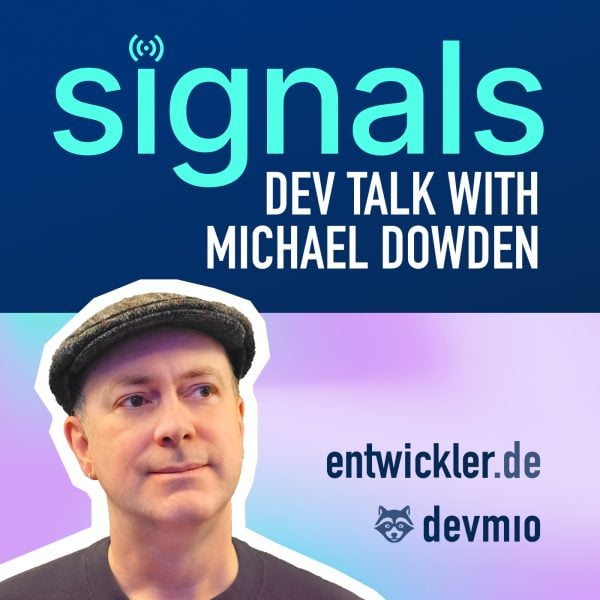
Signals: DevTalk with Michael Dowden
- Folgen
- 21
- Erscheint
- alle zwei Wochen
- Letzte Folge
- 25. Nov. 2026
Über den Podcast
Welcome to Signals, the podcast where we step back from the hype to really look at what's shaping technology and the industries around it. In each episode, we talk with industry experts to surface real trends, question our assumptions, and unpack why things work the way they do today. We're not just focused on what's new, but on the decisions, defaults, and debates that got us here, and what they might mean in the long run.
Folgen 21
What is Domain-Driven Architecture?
In this episode, Michael Dowden sits down with Stefan Priebsch to explore how domain-driven architecture can connect software more closely to business processes, why numbers and observability belong in …
Shownotes
In this episode, Michael Dowden sits down with Stefan Priebsch to explore how domain-driven architecture can connect software more closely to business processes, why numbers and observability belong in architectural decisions, and how teams can use those insights to decide what is worth automating. The conversation also looks at what happens when AI removes development bottlenecks: new constraints appear, and teams need to understand what actually matters to the business. Stefan argues for simpler systems, incremental change, and architecture that can evolve as the business changes. Human judgment and communication remain central, particularly when deciding what to build and what not to build.From Automation to Delegation: Learning to Work with AI Agents
From automated bug fixes to everyday errands: how to delegate clearly, verify results, and set boundaries on cost and autonomy. What does it take to manage AI agents rather than just ask them questions? Debbie …
Shownotes
From automated bug fixes to everyday errands: how to delegate clearly, verify results, and set boundaries on cost and autonomy. What does it take to manage AI agents rather than just ask them questions? Debbie O'Brien shares examples from her development work and personal automation experiments. Topics covered: - Delegating to agents like new team members: clear instructions, small tasks, and increasing responsibility as trust develops. - Automating bug discovery, reproduction, fixes, and verification, with screenshots and video for human review. - Starting locally before moving automated checks into CI. - Keeping research in Markdown documents to provide context for planning and execution. - Managing token costs by adjusting routine frequency, reviewing expensive tasks, and clearing unnecessary context. - Setting boundaries around purchases, email, and travel tasks—and recognizing when agents act on incomplete information. - Checking information across multiple sources rather than relying on a single model or document. - Why Debbie believes junior developers still have an important place on engineering teams. Find Debbie's videos, blog posts, and social profiles at debbie.co.Kapitel (10)
Building Trust in AI-Powered Software with Jeff Watkins
Beyond faster code: evaluations, human oversight and the ethical choices behind useful, inclusive products. What does trustworthy AI look like when its behavior isn't deterministic? This conversation connects …
Shownotes
Beyond faster code: evaluations, human oversight and the ethical choices behind useful, inclusive products. What does trustworthy AI look like when its behavior isn't deterministic? This conversation connects practical software delivery decisions with their wider impact on users and society. Topics include: - Bridging AI's trust gap through evaluations, guardrails, monitoring and clear routes to human intervention. - Planning for mistakes with reversible actions and compensating transactions. - Why faster code generation can shift bottlenecks to problem framing, testing, release and maintenance. - Managing token costs and communication overhead in agentic workflows. - Protecting user experience through research and testing rather than treating more features as more value. - Digital sovereignty, AI regulation and the case for collaboration and federated infrastructure. - Digital inclusion across connectivity, age and socioeconomic circumstances. Jeff's closing takeaway: engineers should take more interest in the humanities to better understand the people and societies their systems affect.Kapitel (10)
Don't Trust, Verify Heavily
In this episode, host Michael Dowden sits down with Venkat Subramaniam to discuss the real strengths and limitations of AI in software engineering. Rather than treating AI as true "artificial intelligence," …
Shownotes
In this episode, host Michael Dowden sits down with Venkat Subramaniam to discuss the real strengths and limitations of AI in software engineering. Rather than treating AI as true "artificial intelligence," Venkat describes it as a fast "accelerated inference engine" that amplifies human capability rather than replacing it. Developers can delegate code generation to AI, but not their responsibility or accountability for the final product. Navigating this shift requires moving from a mindset of "trust but verify" to "don't trust, verify heavily" through rigorous CI/CD pipelines, unit testing, and continuous human oversight. Instead of eliminating developers, AI will reshape their role, removing tedious boilerplate work and elevating the focus toward critical thinking, software architecture, verification, and long-term production stability.What Is a Sovereign Engineer and Why Do You Need to Become One?
In this episode, host Michael Dowden sits down with platform engineer and author Russell Miles to explore how software engineering is fundamentally changing in the era of artificial intelligence. Drawing from …
Shownotes
In this episode, host Michael Dowden sits down with platform engineer and author Russell Miles to explore how software engineering is fundamentally changing in the era of artificial intelligence. Drawing from the concepts in his book, The Sovereign Engineer, Russell offers a practical vision for developers facing rapid technological shifts. Rather than viewing AI as a replacement for software practitioners, the conversation explores how engineers can adapt their practices, preserve their authority, and construct better environments to thrive.Rewriting the Rules of Intuitive AI Design
In this episode, host Michael Dowden sits down with user experience expert Christian Kuhn to explore the evolving relationship between UX and AI design, drawing parallels to the early smartphone revolution …
Shownotes
In this episode, host Michael Dowden sits down with user experience expert Christian Kuhn to explore the evolving relationship between UX and AI design, drawing parallels to the early smartphone revolution. They examine the limitations of prompt-based interfaces and advocate for more intuitive, prompt-free experiences that reduce cognitive load. Kuhn also addresses ethical concerns around addictive design, synthetic empathy, and user trust, introducing the Human AI Experiences (HAX) framework as a guide for responsible AI design. Ultimately, both Dowden and Kuhn argue that as AI development matures, user research and human-centered UX will once again become essential to building meaningful products.Engineering Agentic UI: Standards, Safety, and the Future of Angular
In this episode, host Michael Dowden speaks with Angular expert Manfred Steyer about integrating artificial intelligence into large-scale enterprise applications. Moving beyond text-heavy chats, the discussion …
Shownotes
In this episode, host Michael Dowden speaks with Angular expert Manfred Steyer about integrating artificial intelligence into large-scale enterprise applications. Moving beyond text-heavy chats, the discussion covers core takeaways on building Agentic User Interfaces (UIs) that can stream dynamic components, dashboards, and co-created workflows on demand. To keep non-deterministic AI applications reliable and secure, developers must implement robust engineering frameworks—including standardized protocols like AG-UI and A2UI to avoid backend technology lock-in, deterministic safety harnesses, advanced human-in-the-loop patterns, and modern component-level blackbox testing using Vitest.30 Years of PHP: Guarding the Core Infrastructure
In this episode, host Michael Dowden sits down with Sebastian Bergmann, the creator of PHPUnit, to discuss the evolving landscape of open-source software development. Bergmann shares details on upcoming …
Shownotes
In this episode, host Michael Dowden sits down with Sebastian Bergmann, the creator of PHPUnit, to discuss the evolving landscape of open-source software development. Bergmann shares details on upcoming features in PHPUnit 13.3 designed to tackle flaky tests. The conversation delves deeply into modern supply chain security, highlighting recent changes in Composer's dependency handling and the necessity of automated dependency hygiene. Bergmann also addresses the dual-edged sword of AI in engineering—explaining how AI tools are driving an onslaught of security reports while warning against the dangers of developer "de-skilling." Finally, they examine the long-term financial sustainability of open-source projects and call on businesses to support the shared digital infrastructure they rely on.The Agentic Enterprise: Bridging the Gap Between API Management and AI Innovation
In this episode, host Michael Dowen sits down with API strategy expert Dr. Matthias Biehl to discuss how the Model Context Protocol (MCP) serves as the missing link connecting generic Large Language Models …
Shownotes
In this episode, host Michael Dowen sits down with API strategy expert Dr. Matthias Biehl to discuss how the Model Context Protocol (MCP) serves as the missing link connecting generic Large Language Models (LLMs) to real-time, proprietary enterprise data and systems. The discussion explores the architectural shift from passive LLMs to active, real-time AI agents that are capable of interacting with their environments and collaborating via Agent-to-Agent (A2A) protocols. Dr. Biehl outlines how enterprises can seamlessly upgrade their existing REST API investments—specifically process and context APIs—into MCP interfaces without massive technical reengineering. Crucially, the episode highlights how organizations can overcome data safety concerns and build operational trust not by hardcoding agent limitations, but by utilizing proven API gateways and governance methodologies to enforce guardrails at scale.Balancing LLMs, Computer Vision, and Engineering Trade-offs
In this live podcast episode, host Michael Dowden sits down with Pieter Buteneers, CTO of the legal tech workspace Emma, and Martin Stypinski, founder of the computer vision consulting firm VMG. The …
Shownotes
In this live podcast episode, host Michael Dowden sits down with Pieter Buteneers, CTO of the legal tech workspace Emma, and Martin Stypinski, founder of the computer vision consulting firm VMG. The conversation bridges two distinct areas of artificial intelligence: highly deterministic, traditional computer vision applications and the rapidly evolving world of Large Language Models (LLMs). Together, they argue that AI is an accelerator rather than a solution in itself. The true value of any technology company lies in a deep understanding of the customer's problem and the user experience built around solving it.The Shift from Kubernetes and DevOps to Platform Engineering
In this episode, Michael Dowden sits down with Google Developer Advocate Abdellfetah Sghiouar to explore the current state and history of Kubernetes, tracing its 11-year evolution from a Google open-source …
Shownotes
In this episode, Michael Dowden sits down with Google Developer Advocate Abdellfetah Sghiouar to explore the current state and history of Kubernetes, tracing its 11-year evolution from a Google open-source project to a mature industry standard. The discussion delves into the rise of platform engineering and internal development platforms (IDPs), which aim to provide developers with higher-level abstractions that hide underlying infrastructure complexities. Looking ahead, they analyze emerging trends such as the swing between cloud and on-premise infrastructure, the growth of edge computing, and the integration of AI into development workflows.Not My Job/No Need to Know
In this episode, host Michael Dowden sits down with Alistair Cockburn, co-author of The Agile Manifesto, to discuss modern software design and its evolution alongside Large Language Models (LLMs). Cockburn …
Shownotes
In this episode, host Michael Dowden sits down with Alistair Cockburn, co-author of The Agile Manifesto, to discuss modern software design and its evolution alongside Large Language Models (LLMs). Cockburn explains that applying the "genius" of human bureaucracies, specifically the concepts of "not my job" and "no need to know," is the most effective way to define software responsibilities and manage the rapid, often messy, code generation of AI agents. By framing software components as specialized entities in a bureaucracy, developers can establish a clear gradient to judge design quality and detect design drift as systems evolve.AIOps: Smarter Systems or Bigger Risks?
In this live podcast episode, host Michael Dowden sits down with Christian Schneider and Torsten Köster to explore the impact of artificial intelligence on software operations. They distinguish between AI for …
Shownotes
In this live podcast episode, host Michael Dowden sits down with Christian Schneider and Torsten Köster to explore the impact of artificial intelligence on software operations. They distinguish between AI for Ops (using AI to enhance day-to-day analytics) and Ops for AI (the specialized observability required to monitor non-deterministic AI applications). The conversation also covers the architectural principles, observability requirements, and security controls needed to safely deploy AI at scale, along with the growing role of AI in software development and the future of IT operations.The Human Core of Engineering in the Age of AI
In this episode, our experts address a deceptively complex question: What is AI actually doing to the software industry? Not as a tool or a trend, but as an accelerant. They dig into why agility seems strangely …
Shownotes
In this episode, our experts address a deceptively complex question: What is AI actually doing to the software industry? Not as a tool or a trend, but as an accelerant. They dig into why agility seems strangely quiet, whether the software crisis was ever really solved, and what all these rapid changes mean for the way we build and think about software.Making Accessibility the New Standard in an AI-Driven World
In this episode, host Michael Dowden sits down with Jemima Abu, a senior product engineer, to explore how web accessibility is not just an optional business requirement but a fundamental responsibility to build …
Shownotes
In this episode, host Michael Dowden sits down with Jemima Abu, a senior product engineer, to explore how web accessibility is not just an optional business requirement but a fundamental responsibility to build useful products for all users. They unpack the dual role of AI, illustrating how it can inherit human biases to produce flawed code while also serving as a powerful tool for accelerating essential tasks such as alt-text generation and transcript proofreading. Ultimately, the episode calls for a mindset shift toward intentionality, urging developers to leverage new technologies to create more inclusive digital experiences that can stand the test of time.Node.js: Moving Too Fast for Corporations, but Too Slow for Developers
The episode focuses on the operational and security landscape of Node.js. Marco and Rafael explain that Node.js development is driven by volunteers rather than a formal product roadmap, with significant time …
Shownotes
The episode focuses on the operational and security landscape of Node.js. Marco and Rafael explain that Node.js development is driven by volunteers rather than a formal product roadmap, with significant time dedicated to security releases and triaging reports from platforms like HackerOne. A major theme is the rise of "AI slop"—low-quality, AI-generated bug reports that consume valuable maintainer time. To combat this, the team has implemented stricter reporter reputation requirements. The episode also discusses the project's evolution toward including more built-in modules to improve user experience, the recent stabilization of native TypeScript support, and ongoing debates regarding the frequency of major release cycles.How AI is Redrawing the Battle Lines of Cybersecurity
In this episode, Michael Dowden sits down with Andrew Roden to explore the dual nature of artificial intelligence in the security industry, highlighting its power to both automate defense and supercharge …
Shownotes
In this episode, Michael Dowden sits down with Andrew Roden to explore the dual nature of artificial intelligence in the security industry, highlighting its power to both automate defense and supercharge sophisticated attacks. While AI agents are now capable of discovering and exploiting software vulnerabilities autonomously, the human element, through social engineering and the patient manipulation of open-source trust, remains the most critical vulnerability in the modern supply chain. Ultimately, Andrew emphasizes that human instinct remains the best defense in an AI-driven world, as engineering mastery is required to filter out low-quality "AI slop" and secure critical infrastructure.Trust is the New Currency in AI Design
In this episode, Michael Dowden sits down with UX designer Konrad Piercey to discuss how AI is reshaping user experience (UX) and product design. Piercey emphasizes that successful AI integration is not merely …
Shownotes
In this episode, Michael Dowden sits down with UX designer Konrad Piercey to discuss how AI is reshaping user experience (UX) and product design. Piercey emphasizes that successful AI integration is not merely a technical challenge but a human one rooted in trust and transparency. He also explores key challenges brought by AI, including team alignment and the inevitability of bias in intelligent systems.The Governance Revolution: Scaling Trust Through Platform Engineering
This episode explores the evolving definition of platform engineering, framing it as the essential "governance fabric" required for modern digital businesses. Mark Boyd, Director at Platformable, discusses the …
Shownotes
This episode explores the evolving definition of platform engineering, framing it as the essential "governance fabric" required for modern digital businesses. Mark Boyd, Director at Platformable, discusses the shift from traditional DevOps toward a product-centric approach that prioritizes consistency, security, and the removal of development friction.The End of Coding as We Know It
https://entwickler.de/reader/player/the-future-of-frontend-engineering
Vibe Coding Beyond the Hype
In this episode, host Michael Dowden sits down with John Davies, CTO of Incept 5, to unpack what he calls the “utterly crazy” pace of AI innovation. They explore the rise of vibe coding, where developers shift …
Shownotes
In this episode, host Michael Dowden sits down with John Davies, CTO of Incept 5, to unpack what he calls the “utterly crazy” pace of AI innovation. They explore the rise of vibe coding, where developers shift from writing code to orchestrating AI bots, and where fully functional apps can be built in days instead of months. But with this acceleration comes new responsibility: privacy risks, private vs. …
Ähnliche Podcasts
Mehr Nachrichten-Podcasts




Ist das dein Podcast?
Bestätige es mit einem Eintrag in deinem Feed: Du bekommst hier einen Code, trägst ihn als podcast:txt in den Kanal deines Feeds ein, und wir prüfen ihn. Danach steht dein Podcast als „verifiziert“ bei SoundNode.