

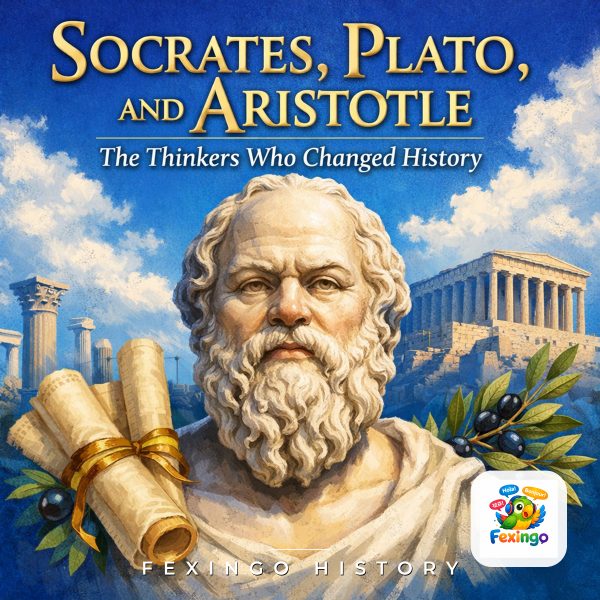
Socrates, Plato, and Aristotle: The Thinkers Who Changed History — Fexingo History
- Folgen
- 295
- Erscheint
- täglich
- Letzte Folge
- 23. Nov. 2026
Über den Podcast
In the sunlit agoras of Athens and the shaded groves of the Academy, three figures laid the foundations of Western thought. Socrates, the gadfly who questioned everything, left no writings—yet his method of relentless inquiry shaped philosophy forever. His student Plato, fleeing the trauma of Socrates' execution, built a metaphysical system of Forms and penned the Republic, a utopian blueprint that still haunts political theory. And Aristotle, Plato's most brilliant pupil, rejected the ethereal for the empirical, cataloguing ethics, biology, and logic with a systematic mind that would define science for two millennia. This show, hosted by Lucas and Luna, traces the thread from Socrates' trial in 399 BCE, through Plato's Academy and Aristotle's Lyceum, to the enduring influence of their ideas on Christianity, the Enlightenment, and modern democracy. We'll explore the Peloponnesian War's chaos, Plato's disastrous Sicilian ventures, Aristotle's tutelage of Alexander the Great, and the Hellenistic world that scattered their texts across the Mediterranean. Why does a Socratic dialogue still provoke, and why do we still debate Plato's ideal state? Join us as we argue with the dead. #Socrates #Plato #Aristotle #AncientGreece #ClassicalPhilosophy #Athens #PeloponnesianWar #AlexanderTheGreat #TheRepublic #NicomacheanEthics #SocraticMethod #Lyceum #Academy #HellenisticWorld #WesternPhilosophy #History #WorldHistory #FexingoHistory Keep every episode free: buymeacoffee.com/fexingo
Mitwirkende
- LucasModeration
- LunaCo-Moderation
Folgen 295
The Unseen Rivals: Socrates, Plato, and Aristotle
We often remember the triumvirate of Socrates, Plato, and Aristotle as a seamless lineage of wisdom, but their actual relationship was far more complicated, competitive, and human. In this episode, we peel back …
Shownotes
We often remember the triumvirate of Socrates, Plato, and Aristotle as a seamless lineage of wisdom, but their actual relationship was far more complicated, competitive, and human. In this episode, we peel back the myth of the passive student to reveal a trio defined by sharp intellectual rivalries and personal betrayals. We explore how Plato’s Academy and Aristotle’s Lyceum were not just schools, but rival institutions competing for students, funding, and political influence in post-war Athens. You will hear about the tension between the Elenchus method and Aristotelian logic, the role of Xenophon in shaping Socrates’ public image against Plato’s philosophical ideal, and the surprising financial and social networks that kept these thinkers alive. We also look at the lesser-known figures like Antisthenes and Euclid of Megara, whose Cynic and Megarian schools offered alternative paths to virtue that challenged the dominance of the big three. This is a story about mentorship, jealousy, and the messy reality of building an intellectual legacy in a city that eventually executed your teacher.
#Socrates #Plato #Aristotle #Akademeia #Lykeion #Stagira #Elenchus #NicomacheanEthics #Antisthenes #EuclidOfMegara #Cynicism #MegarianSchool #Xenophon #Asebeia #Arete #AncientAthens #History #FexingoHistory #Philosophy
The Fourth Teacher: Aristoxenus and Ancient Music Theory
While Socrates, Plato, and Aristotle laid the groundwork for Western thought, a lesser-known student of Aristotle named Aristoxenus changed how we understand sound itself. In this episode, Lucas and Luna …
Shownotes
While Socrates, Plato, and Aristotle laid the groundwork for Western thought, a lesser-known student of Aristotle named Aristoxenus changed how we understand sound itself. In this episode, Lucas and Luna explore the life of Aristoxenus of Tarentum, the man who shifted music from abstract mathematics to empirical observation. We discuss his groundbreaking work in harmonics, his rejection of Pythagorean ratios in favor of auditory experience, and how he documented the scales of ancient Greek music. From his early days as a musician in his father’s troupe to his studies at the Lykeion, Aristoxenus offers a unique perspective on how philosophy intersects with art. You will learn about the tetradic system, the distinction between rhythmos and harmonia, and why his Treatise on Harmony remains a critical text for understanding ancient acoustics. This is not just about notes; it is about how one thinker challenged the mathematical orthodoxy of his time to create a science of listening.
#Aristoxenus #AncientGreekMusic #MusicTheoryHistory #Harmonics #Lykeion #Tarentum #PythagoreanRatios #AristotleStudent #AncientAcoustics #GreekPhilosophy #Ethos #ScalesAndModes #ClassicalAntiquity #MediterraneanHistory #EmpiricalScience #FexingoHistory #HistoryPodcast #Humanities
The Lost Teachers of Alexandria
We often think of Socrates, Plato, and Aristotle as isolated giants in a void, but their intellectual lineage was actually sustained by a vast, interconnected network of teachers, students, and rival schools …
Shownotes
We often think of Socrates, Plato, and Aristotle as isolated giants in a void, but their intellectual lineage was actually sustained by a vast, interconnected network of teachers, students, and rival schools across the ancient Mediterranean. In this episode, we trace the hidden connections between these three thinkers, focusing on how their ideas were preserved, distorted, and transmitted through figures like Antisthenes, Euclid of Megara, and the later Peripatetic scholars who carried Aristotle’s library to Rome. We explore the tension between the Academy’s mathematical mysticism and the Lyceum’s empirical rigor, examining how personal relationships—like Plato’s fraught time in Sicily with Dionysius II, or Aristotle’s brief marriage to Pythias—shaped their philosophical outputs. By looking at the ‘silent students’ and the political contexts of Athens during its decline, we reveal that the ‘unseen rivals’ mentioned in previous episodes were not just abstract concepts but living people navigating war, slavery, and exile. This conversation moves beyond the famous busts to show the messy, human reality of how philosophy survived the fall of democratic Athens and traveled east to influence Islamic scholars like Ibn Rushd and Avicenna, proving that these thinkers were never truly alone.
#Socrates #Plato #Aristotle #Akademeia #Lykeion #Stagira #Elenchus #NicomacheanEthics #IbnRushd #Avicenna #Antisthenes #EuclidOfMegara #Cynicism #Peripatetic #Asebeia #Arete #History #FexingoHistory
The Silent Students of Socrates
While Plato and Aristotle dominate the history books, their circle included figures who quietly shaped the intellectual landscape of ancient Athens. This episode explores the lives of Antisthenes, the founder …
Shownotes
While Plato and Aristotle dominate the history books, their circle included figures who quietly shaped the intellectual landscape of ancient Athens. This episode explores the lives of Antisthenes, the founder of Cynicism, and Euclid of Megara, whose school bridged logic and ethics. We examine how these lesser-known thinkers challenged mainstream ideals, particularly through Antisthenes’ radical rejection of material wealth and his famous encounter with Alexander the Great. The conversation also delves into the philosophical tensions between the Academy and rival schools, highlighting how dissenting voices contributed to the richness of Greek thought. By focusing on the margins of the great triad, we uncover a more nuanced picture of intellectual life in the fourth century BCE.
#Antisthenes #EuclidOfMegara #Cynicism #Socrates #Plato #Aristotle #AncientAthens #Philosophy #AlexanderTheGreat #Akademeia #Lykeion #HellenisticPeriod #IntellectualHistory #GreekThought #Ethics #Logic #FexingoHistory #History
The Lost Teachers of Alexandria: Hypatia's Tragic End
In this episode, we turn away from the lecture halls of Athens and look toward the great Library of Alexandria in the fourth century CE. We explore the life of Hypatia of Alexandria, a Neoplatonist philosopher …
Shownotes
In this episode, we turn away from the lecture halls of Athens and look toward the great Library of Alexandria in the fourth century CE. We explore the life of Hypatia of Alexandria, a Neoplatonist philosopher, mathematician, and astronomer who taught one of the most vibrant intellectual circles in the ancient world. Unlike Socrates or Aristotle, whose legacies were secured by their students' writings, Hypatia’s voice survives only through fragments and the accounts of those who admired her—or feared her. We examine how she navigated the volatile political landscape of Roman Egypt, balancing her role as a public intellectual with the rising tensions between Christian bishops and pagan traditionalists. The conversation delves into her contributions to mathematics, particularly her commentary on Diophantus’s Arithmetica and Apollonius’s Conics, and asks why a woman of her stature was targeted during the power struggles that followed the death of Theophilus, the Bishop of Alexandria. This is not just a story about violence, but about the fragility of knowledge when it becomes entangled with dogma.
#Hypatia #Alexandria #Neoplatonism #AncientMathematics #RomanEgypt #BishopTheophilus #Orestes #Synesius #Patriarch Cyril #LibraryOfAlexandria #WomenInHistory #Diophantus #Apollonius #Conics #Arithmetica #LateAntiquity #FexingoHistory #History
The Three Teachers: Socrates Plato Aristotle Legacy
This episode explores the unique pedagogical bond between Socrates, Plato, and Aristotle, often called the 'Three Teachers' of Western philosophy. While previous episodes have covered their political theories …
Shownotes
This episode explores the unique pedagogical bond between Socrates, Plato, and Aristotle, often called the 'Three Teachers' of Western philosophy. While previous episodes have covered their political theories and ethical works, we focus on the classroom dynamic that defined antiquity. Lucas and Luna discuss how Socrates’ refusal to write transformed him into a living method, how Plato institutionalized this at the Akademeia with its rigorous mathematical curriculum, and how Aristotle took these tools to Stagira and beyond. We examine the specific teaching styles of each man, from Socratic elenchus to Aristotelian empiricism, and how their relationship shaped the transmission of knowledge through centuries, including the preservation efforts by Andronicus of Rhodes and later Islamic scholars like Ibn Rushd. The conversation highlights not just what they thought, but how they taught, creating a lineage of inquiry that outlasted the fall of Athens itself.
#Socrates #Plato #Aristotle #ThreeTeachers #Akademeia #Lykeion #Stagira #Elenchus #WesternPhilosophy #AncientGreece #Pedagogy #PhilosophyHistory #FexingoHistory #History #Classics #MediterraneanHistory #GreekThought #IntellectualLineage
The Third Teacher: How Aristotle’s Wife Pythias Shaped His Legacy
We often remember Socrates for his death, Plato for his forms, and Aristotle for his logic. But behind the Stagirite’s monumental works lies a quieter, more complex figure: Pythias of Stagira, his wife and …
Shownotes
We often remember Socrates for his death, Plato for his forms, and Aristotle for his logic. But behind the Stagirite’s monumental works lies a quieter, more complex figure: Pythias of Stagira, his wife and first cousin. This episode moves past the grand theories of the Lykeion to explore the domestic and political realities that shaped Aristotle’s life after he left Athens. We look at his time in Assos and Mytilene, where he wasn’t just writing ethics but navigating family disputes, managing estates, and dealing with the grief of losing his young son Nicomachus. By examining the fragments of his letters and the biographical accounts from Diogenes Laërtius, we uncover how Pythias influenced his practical approach to law and household management. It is a story about the man behind the philosopher king, showing how personal loss and marital partnership informed his later writings on friendship and politics.
#Aristotle #Pythias #AncientGreece #Stagira #Lykeion #PhilosophyHistory #GreekWomen #NicomacheanEthics #Assos #Mytilene #HellenisticEra #ClassicalAthens #MarriageInAntiquity #DiogenesLaertius #Nicomachus #HistoryPodcast #FexingoHistory #MediterraneanHistory #IntellectualHistory
The Cynic Jar: Diogenes Challenging Ancient Athens
While Plato and Aristotle built vast systems of logic and ethics in their academies, a radical alternative was taking shape on the streets of Corinth and Athens. This episode explores the life of Diogenes of …
Shownotes
While Plato and Aristotle built vast systems of logic and ethics in their academies, a radical alternative was taking shape on the streets of Corinth and Athens. This episode explores the life of Diogenes of Sinope, the founder of Cynicism, who rejected social convention to live in absolute accordance with nature. We examine his famous encounter with Alexander the Great at Corinth, where Diogenes demanded only that the king step out of his sunlight, revealing a profound critique of power and status. Through his provocative acts—eating in the marketplace, carrying a lamp in daylight searching for an honest man, and living in a large ceramic jar (pithos)—Diogenes forced his contemporaries to question the value of wealth, fame, and political ambition. Unlike the refined debates of the Lyceum or the Academy, Cynicism was a philosophy of action, demanding self-sufficiency and freedom from desire. We also look at how his student Crates of Thebes continued this legacy, rejecting his own fortune to join the movement, and how Diogenes’ sharp wit influenced later Stoic thinkers like Zeno. This is not just about eccentricity; it is about a rigorous, uncomfortable demand for authenticity in a world obsessed with appearance.
#DiogenesOfSinope #Cynicism #AncientGreekPhilosophy #AlexanderTheGreat #Corinth #Pithos #CratesOfThebes #ZenoOfCitium #Stoicism #Aristippus #SocraticTradition #HappinessEudaimonia #NatureVsConvention #AncientAthens #PhilosophicalEccentricity #FreedomAutarkeia #HistoryPodcast #FexingoHistory
Diogenes the Cynic: The Philosopher Who Lived in a Jar
While Plato and Aristotle built grand systems of logic and statecraft, Diogenes of Sinope offered a radically different path through ancient Greece. In this episode, we explore the life of the man who chose to …
Shownotes
While Plato and Aristotle built grand systems of logic and statecraft, Diogenes of Sinope offered a radically different path through ancient Greece. In this episode, we explore the life of the man who chose to live in a ceramic tub, owned nothing but a cloak and a staff, and famously mocked Alexander the Great. We trace his journey from a wealthy exile to the streets of Athens, where he practiced Cynicism not as a theory, but as a daily performance. We look at his interactions with contemporaries like Plato and Alexander, examining how his radical asceticism challenged the very foundations of social convention and political power. From his famous lantern search for an honest man to his final, humorous request to be thrown back into the earth, Diogenes remains one of history’s most enduring symbols of intellectual freedom and anti-materialism.
#DiogenesOfSinope #Cynicism #AncientGreekPhilosophy #AlexanderTheGreat #Plato #Aristotle #AthensHistory #HellenisticPeriod #PhilosophicalLives #Antisthenes #Kynikos #AncientMediterranean #GreekHistory #PhilosophyPodcast #FexingoHistory #History #Classics #IntellectualFreedom
The Greek Slave Trade and Aristotle’s Paradox
We often remember Aristotle as the father of logic and biology, but he also wrote one of the most explicit defenses of slavery in Western history. In this episode, we pull back the curtain on his economic …
Shownotes
We often remember Aristotle as the father of logic and biology, but he also wrote one of the most explicit defenses of slavery in Western history. In this episode, we pull back the curtain on his economic treatise, the Politika, to examine how he justified human ownership through the lens of oikonomia, or household management. We explore the chilling distinction he drew between natural slaves and those enslaved by war, and how this philosophical framework was used to rationalize the brutal realities of the Laurion silver mines and the slave markets of Delos. This isn't just about ancient ethics; it is about how intellectual giants can construct complex moral architectures that ignore basic humanity when convenient. We look at the specific arguments he made regarding efficiency, nature, and power, and why even his contemporaries found some of his logic deeply troubling. Join us as we dissect the uncomfortable intersection of high philosophy and the gritty economics of the ancient Mediterranean.
#Aristotle #AncientSlavery #GreekPhilosophy #Politika #Oikonomia #NaturalSlave #AthensHistory #LaurionSilver #DelosMarket #AncientEconomics #MediterraneanHistory #EthicsOfOwnership #Stagira #Peripatetic #ClassicalAntiquity #HistoryPodcast #FexingoHistory #PhilosophyAndPower #AncientWorld
The Lost Letters of Aristotle’s Wife
While Plato’s Academy and Socrates’ dialogues dominate the historical record, the personal life of Aristotle’s wife, Pythias, remains largely obscured by silence. This episode explores what little evidence we …
Shownotes
While Plato’s Academy and Socrates’ dialogues dominate the historical record, the personal life of Aristotle’s wife, Pythias, remains largely obscured by silence. This episode explores what little evidence we have of her role in the Lykeion and her influence on Aristotle’s later work, including the Politics and his biological studies. We examine the social expectations for women in Stagira and Athens during the fourth century BCE, contrasting the public philosophical legacy with the private domestic realities. Through fragments of letters, references in Xenophon, and the context of Aristotelian biology, we reconstruct a picture of a woman who managed household oikonomia while her husband mapped the natural world. The conversation also touches on their daughter, Pythias II, and how family lineage intersected with intellectual inheritance in the Peripatetic school. By looking at the material culture of the era—pottery, domestic architecture, and legal documents—we find subtle hints of female agency that standard histories often miss, offering a more complete view of the thinkers who changed history.
#Aristotle #Pythias #Lykeion #AncientGreece #Stagira #WomenInHistory #Peripatetic #ClassicalPhilosophy #Oikonomia #HellenisticEra #AncientBiology #Plato #Socrates #GreekHistory #FemaleAgency #DomesticLife #FexingoHistory #History
The Lost Scrolls of Alexandria: Burning Knowledge
While the burning of the Library of Alexandria is one of history’s most famous tragedies, the reality is far more complex and gradual than a single catastrophic fire. This episode explores the long decline of …
Shownotes
While the burning of the Library of Alexandria is one of history’s most famous tragedies, the reality is far more complex and gradual than a single catastrophic fire. This episode explores the long decline of the Mouseion, from the scholarly peak under Eratosthenes and Callimachus to the political upheavals that eroded its funding and status. We examine how Roman generals like Julius Caesar, Emperor Aurelian, and later Christian authorities contributed to the library's fragmentation over centuries. By looking at the specific mechanisms of book loss—replication limits, political purges, and shifting intellectual priorities—we uncover how the collective knowledge of the ancient world was slowly scattered rather than instantly destroyed. Join us as we trace the fate of the Codex Seraphinianus of antiquity and the scholars who tried to preserve it against the rising tides of war and ideology.
#LibraryOfAlexandria #Mouseion #Eratosthenes #Callimachus #JuliusCaesar #Aurelian #Hypatia #AncientHistory #Mediterranean #Egypt #GreekScholars #BookLoss #IntellectualHistory #PtolemaicDynasty #RomanEmpire #FexingoHistory #HistoryPodcast #AncientAlexandria
The Hidden Cost of Greek Philosophy
We often romanticize the intellectual golden age of Athens, imagining Socrates debating in the agora and Plato teaching in shaded gardens. But this episode peels back that idealized veneer to reveal the brutal …
Shownotes
We often romanticize the intellectual golden age of Athens, imagining Socrates debating in the agora and Plato teaching in shaded gardens. But this episode peels back that idealized veneer to reveal the brutal economic machinery that made such leisure possible. We examine how the Athenian economy relied on silver mines worked by enslaved populations, specifically at Laurion, and how this wealth funded the civic life of free citizens. You will hear about the tension between the philosophical pursuit of virtue and the reality of ownership, including Aristotle’s own conflicted writings on slavery in his work Politika. We also look at the role of Aspasia, a metic woman whose intellect challenged Athenian law, and explore the concept of oikonomia as it applied to household management versus market exchange. This is not just a story about great thinkers; it is a story about the human cost of their ideas.
#AncientAthens #Socrates #Plato #Aristotle #LaurionMines #SlaveryInAntiquity #GreekPhilosophy #Oikonomia #Chrematistike #AspasiaOfMiletus #Helots #NicomacheanEthics #Politika #MediterraneanHistory #ClassicalGreece #HistoryPodcast #FexingoHistory #Hetaerae #Elenchus
Socrates Plato Aristotle: The Thinkers Who Changed History
Most histories of Greek philosophy focus on the grand theories of Socrates, Plato, and Aristotle, but this episode explores their daily realities. We look at how these thinkers navigated the practicalities of …
Shownotes
Most histories of Greek philosophy focus on the grand theories of Socrates, Plato, and Aristotle, but this episode explores their daily realities. We look at how these thinkers navigated the practicalities of life in ancient Athens and beyond, from the financial struggles of the Academy to the political dangers that led to Socrates' execution. Lucas and Luna discuss the role of students like Speusippus and Xenophon, the influence of women like Aspasia, and the hidden curriculum of mathematics and myth that shaped their minds. We also examine the personal rivalries and alliances that defined their intellectual legacy, including the complex relationship between Aristotle and his former teacher Plato. Through specific anecdotes and lesser-known facts, we uncover the human side of these iconic figures.
#Socrates #Plato #Aristotle #AncientAthens #GreekPhilosophy #Academy #Lyceum #Xenophon #Aspasia #Speusippus #HermiasOfAtarneus #DionysiusII #Elenchus #NicomacheanEthics #MediterraneanHistory #ClassicalGreece #FexingoHistory #History
Socrates Plato Aristotle: The Unseen Rivals
While the triad of Socrates, Plato, and Aristotle is often taught as a seamless lineage of truth-seeking, their actual relationships were fraught with tension, rivalry, and profound disagreement. This episode …
Shownotes
While the triad of Socrates, Plato, and Aristotle is often taught as a seamless lineage of truth-seeking, their actual relationships were fraught with tension, rivalry, and profound disagreement. This episode peels back the layers of the Akademeia and the Lykeion to reveal how these thinkers competed not just for students, but for the very definition of philosophy itself. We explore the friction between Plato’s ideal forms and Aristotle’s empirical observation, the influence of lesser-known rivals like the Megarians and Cynics, and the personal dynamics that shaped Western thought. Through specific anecdotes and direct contrasts in their methodologies, we uncover how their debates on ethics, politics, and metaphysics laid the groundwork for centuries of intellectual conflict.
#Socrates #Plato #Aristotle #Akademeia #Lykeion #MegarianSchool #Cynicism #AncientAthens #GreekPhilosophy #Elenchus #NicomacheanEthics #Stagira #Xenophon #Antisthenes #EuclidesOfMegara #WesternThought #HistoryPodcast #FexingoHistory
The Lost Playbook of Alexander the Great
While Socrates, Plato, and Aristotle are remembered as abstract thinkers, their ideas shaped one of history’s most brutal conquerors. This episode explores how Aristotle personally tutored the young Alexander …
Shownotes
While Socrates, Plato, and Aristotle are remembered as abstract thinkers, their ideas shaped one of history’s most brutal conquerors. This episode explores how Aristotle personally tutored the young Alexander of Macedon, transforming him from a restless prince into a strategic genius who mapped the known world. We look beyond the battles to examine the intellectual exchange that occurred in the private study at Pella, where the future emperor learned Greek philosophy not just for prestige, but for governance. The conversation details specific moments: the gift of Homeric texts bound with gold, the treatment of captured cities like Persepolis, and the philosophical justification for empire. We also investigate the controversial role of Callisthenes, Aristotle’s nephew, who became the court historian and eventually fell out of favor by refusing to endorse Alexander’s growing desire for divine honors. By tracing the lineage from the Lyceion to the courts of Persia, we uncover how ancient ethical frameworks were tested against the realities of absolute power.
#AlexanderTheGreat #Aristotle #Plato #Socrates #AncientMacedon #Pella #Callisthenes #HellenisticPeriod #Persepolis #NicomacheanEthics #PhilipII #HomericLiterature #GreekPhilosophy #ConquestHistory #AncientGreece #ImperialPolitics #FexingoHistory #History
The Lost Diaries of Ancient Athens
We often think of ancient history as a series of grand battles and political treaties, but the real texture of life in Classical Athens is found in the margins. This episode explores the daily rhythms of the …
Shownotes
We often think of ancient history as a series of grand battles and political treaties, but the real texture of life in Classical Athens is found in the margins. This episode explores the daily rhythms of the city’s intellectual elite through the lens of private correspondence, dining habits, and the complex social web that connected philosophers to politicians. We look at how Socrates navigated the shadow of the Thirty Tyrants, how Plato’s Academy functioned as both a school and a salon, and how Aristotle’s scientific curiosity extended into the mundane details of biology and household management. By examining sources like Xenophon’s Memoirs and fragments of personal letters, we uncover a side of these thinkers that is far more human than the marble statues suggest. From the taste of wine at a symposium to the legal anxieties of owning slaves, we reconstruct the intimate realities behind their public philosophies.
#Socrates #Plato #Aristotle #ClassicalAthens #AncientGreece #Xenophon #Symposium #Akademeia #Lykeion #AthenianLaw #Hetaerae #Elenchus #NicomacheanEthics #ThirtyTyrants #PeloponnesianWar #FexingoHistory #History #Philosophy #DailyLife
How Socrates’ Wife Xanthippe Shaped His Legacy
For anyone coming with us through these conversations about the Mediterranean, we usually focus on the grand halls of the Akademeia or the dusty streets where Socrates walked. But today, we are stepping into …
Shownotes
For anyone coming with us through these conversations about the Mediterranean, we usually focus on the grand halls of the Akademeia or the dusty streets where Socrates walked. But today, we are stepping into the domestic sphere to look at a figure often dismissed as a punchline: Xanthippe. We know her primarily from later comic poets and Xenophon as the archetypal shrew who drove Socrates to drink water in a bowl rather than eat dinner. Yet recent scholarship suggests this caricature might be a deliberate inversion designed to highlight Socrates' legendary self-control. We will explore how Plato subtly references her influence in the Apology and Phaedo, arguing that her fiery temperament was actually the crucible that forged his philosophical calm. We also examine the legal realities of Athenian marriage, where women had limited rights but significant social leverage within the household. By looking at the archaeological evidence of ordinary Athenian homes and the specific laws governing marital disputes, we can reconstruct a more nuanced picture of their partnership. This episode moves beyond the joke to ask whether Xanthippe was a victim of historical slander or an active participant in one of antiquity’s most famous intellectual marriages.
#Socrates #Xanthippe #AncientAthens #Plato #Aristotle #GreekPhilosophy #ClassicalAntiquity #HellenisticHistory #WomenInAncientGreece #MarriageInAthens #Xenophon #Apology #Phaedo #AthenianLaw #DomesticLife #GenderRoles #FexingoHistory #History
The Philosopher Kings Who Never Ruled
We often think of Plato and Aristotle as abstract thinkers locked in ivory towers, but their ideas were deeply entangled with the messy reality of power. This episode explores the failed political experiments …
Shownotes
We often think of Plato and Aristotle as abstract thinkers locked in ivory towers, but their ideas were deeply entangled with the messy reality of power. This episode explores the failed political experiments that shaped their theories: Plato’s disastrous attempt to impose his 'Philosopher King' ideal on the tyrant Dionysius II of Syracuse, and Aristotle’s practical, albeit flawed, guidance for the Greek colony of Rhegium. We look at how these real-world failures forced the philosophers to refine their definitions of justice, law, and human nature. From the bloody coups in Sicily to the constitutional reforms in Magna Graecia, we trace how the friction between theory and practice forged Western political thought.
#Socrates #Plato #Aristotle #DionysiusII #Syracuse #Rhegium #PhilosopherKing #AncientGreece #PoliticalPhilosophy #MagnaGraecia #Republic #PoliticsAristotle #ThirdSicilianWar #Hermias #Timoleon #Constitutionalism #HistoryPodcast #FexingoHistory
How Greek Philosophers Navigated War and Slavery
While we often celebrate the intellectual triumphs of Socrates, Plato, and Aristotle, their lives were inextricably bound to the brutal realities of fifth- and fourth-century Athens. In this episode, we explore …
Shownotes
While we often celebrate the intellectual triumphs of Socrates, Plato, and Aristotle, their lives were inextricably bound to the brutal realities of fifth- and fourth-century Athens. In this episode, we explore how these thinkers reconciled their high-minded ideals with a society built on conquest and exploitation. We examine Plato’s controversial proposals in The Laws regarding the treatment of war captives, which included the possibility of enslaving defeated enemies from non-Greek cultures. We then look at Aristotle’s defense of natural slavery in Politics, arguing that some individuals are suited only for labor, a view deeply influenced by his observations of Persian and Scythian societies. Through the lens of Xenophon’s economic writings, we also uncover the practical side of Athenian wealth, derived from Laurion silver mines worked by enslaved helots. This conversation peels back the marble facade of philosophy to reveal the complex, often uncomfortable ethical frameworks these men used to justify the inequalities of their time.
#AncientAthens #Plato #Aristotle #Socrates #GreekPhilosophy #NaturalSlavery #WarCaptives #Xenophon #LaurionSilverMines #Helots #NicomacheanEthics #Politics #TheLaws #Oikonomia #PersianEmpire #Scythians #ClassicalGreece #History #FexingoHistory
The Academy's Hidden Curriculum: Mathematics and Myth
While Plato’s Republic is famous for its political theory, the Akademeia was also a rigorous center for mathematics and astronomy. This episode explores how Eudoxus of Cnidus developed the method of exhaustion …
Shownotes
While Plato’s Republic is famous for its political theory, the Akademeia was also a rigorous center for mathematics and astronomy. This episode explores how Eudoxus of Cnidus developed the method of exhaustion to calculate areas and volumes, laying groundwork for calculus. We examine the story of Hippasus, the Pythagorean accused of revealing the existence of irrational numbers, and how this mathematical crisis reshaped Greek thought. From the geometric proofs of Euclid to the celestial models that influenced later astronomers, we trace how abstract numbers became the language of the cosmos.
#EudoxusOfCnidus #MethodOfExhaustion #Akademeia #Plato #Hippasus #IrrationalNumbers #PythagoreanTheorem #AncientGreekMathematics #Euclid #Geometry #AstronomyHistory #Socrates #Aristotle #MediterraneanHistory #ClassicalAthens #MathematicsPhilosophy #FexingoHistory #History
The School That Outlived Athens: Aristotle's Library
When the Macedonian army sacked Athens in 322 BCE, the city’s political freedom collapsed, but its intellectual legacy found a new home. This episode traces the perilous journey of Aristotle’s personal library …
Shownotes
When the Macedonian army sacked Athens in 322 BCE, the city’s political freedom collapsed, but its intellectual legacy found a new home. This episode traces the perilous journey of Aristotle’s personal library and his original manuscripts from Stagira to Rome. We explore how Andronicus of Rhodes, centuries later, painstakingly reconstructed the Peripatetic corpus from scattered scrolls, creating the first systematic edition of Aristotle’s works. The conversation examines the physical reality of these texts—how they were copied by hand, preserved in private collections, and eventually lost to fire and time, only to be recovered through the meticulous work of Byzantine scribes and Islamic scholars who translated them into Arabic before returning to Europe. We also look at the controversial inclusion of the pseudo-Aristotelian works that became standard curriculum for nearly two thousand years, shaping medieval theology and early modern science in ways Aristotle himself never intended.
#Aristotle #PeripateticSchool #AndronicusOfRhodes #Stagira #AncientGreekLibrary #ByzantineScribes #IslamicGoldenAge #MedievalPhilosophy #HellenisticPeriod #ManuscriptPreservation #LostTexts #NicomacheanEthics #Organon #Alexandria #Baghdad #Toledo #History #FexingoHistory #ClassicalAntiquity
The Secret Diaries of Ancient Athens
We usually think of ancient Greek history as a series of grand battles and philosophical treatises, but the private lives of its thinkers were just as dramatic. This episode explores the personal relationships …
Shownotes
We usually think of ancient Greek history as a series of grand battles and philosophical treatises, but the private lives of its thinkers were just as dramatic. This episode explores the personal relationships between Socrates, Plato, and Aristotle, focusing on their students, lovers, and rivals. We look at how these connections influenced their work, from Plato's love for Aspasia to Aristotle's complex relationship with his pupil Callisthenes. Join us as we uncover the human side of these legendary figures, revealing that behind the logic and ethics was a network of friendship, betrayal, and ambition.
#Socrates #Plato #Aristotle #AncientAthens #GreekPhilosophy #Aspasia #Callisthenes #Xenophon #Alcibiades #NicomacheanEthics #Academy #Lyceum #HellenisticPeriod #HistoryPodcast #FexingoHistory #ClassicalGreece #PrivateLife #IntellectualNetworks
Aristotle's Lost Slave Treatise and the Ethics of Ownership
While we have extensively covered the philosophical schools of Plato’s Academy and Aristotle’s Lykeion, one corner of Aristotle’s vast output remains largely absent from modern discourse: his direct engagement …
Shownotes
While we have extensively covered the philosophical schools of Plato’s Academy and Aristotle’s Lykeion, one corner of Aristotle’s vast output remains largely absent from modern discourse: his direct engagement with slavery. In this episode, Lucas and Luna unpack Aristotle’s controversial defense of natural slavery in Politics Book One. We examine how he distinguished between the Spartan helot system and Athenian chattel slavery, arguing that some men were 'living tools' by nature. The conversation traces the historical context of these views during the height of Athens’ imperial power, exploring the economic realities of the ancient Mediterranean world. We also look at the rare but significant exceptions to this rule, such as the freedman Philemon and the scholar Aristoxenus, whose lived experiences challenged Aristotle’s rigid classifications. By stepping into the workshop and the marketplace of fourth-century BCE Greece, we confront the uncomfortable tension between Aristotle’s monumental contributions to logic and ethics and his complicity in a brutal social hierarchy. This is not just about history; it is about how even the greatest minds can be blind to the humanity of those they dominate.
#Aristotle #AncientSlavery #GreekPhilosophy #PoliticsBookOne #NaturalSlavery #ClassicalAthens #HellenisticWorld #SocialHistory #MediterraneanHistory #EthicsAndPower #SpartanHelots #ChattelSlavery #AncientEconomics #Philemon #Aristoxenus #FexingoHistory #HistoryPodcast #HumanRightsHistory
The Socratic Method in Practice: Athens' Courtroom Drama
We often think of Socrates, Plato, and Aristotle as distant figures in busts or textbook diagrams, but their ideas were forged in the heat of immediate human conflict. In this episode, we leave the quiet halls …
Shownotes
We often think of Socrates, Plato, and Aristotle as distant figures in busts or textbook diagrams, but their ideas were forged in the heat of immediate human conflict. In this episode, we leave the quiet halls of the Academy and Lyceum to step into the chaotic, noisy streets of Classical Athens. We focus on a specific, under-examined aspect of their legacy: the practical application of philosophical inquiry during the Peloponnesian War and its aftermath. While previous episodes covered the trial itself, we look at the social ecosystem that made such trials possible—the role of the jury courts, the pressure from the Thirty Tyrants, and how ordinary citizens engaged with radical new ideas about justice. We explore the tension between democratic participation and intellectual elite, examining how figures like Alcibiades and Xenophon navigated a world where questioning authority could cost you your life. This is not just about philosophy; it is about the survival of thought in a society that values consensus over truth.
#Socrates #Plato #Aristotle #ClassicalAthens #PeloponnesianWar #ThirtyTyrants #AthenianDemocracy #Asebeia #Elenchus #Alcibiades #Xenophon #GreekPhilosophy #AncientHistory #MediterraneanHistory #JusticeInAntiquity #SocraticMethod #FexingoHistory #History
The Greek Slave Trade and the Cost of Freedom
While we often celebrate the intellectual triumphs of Socrates, Plato, and Aristotle, their world was built on a foundation of human bondage that modern audiences rarely confront. This episode pulls back the …
Shownotes
While we often celebrate the intellectual triumphs of Socrates, Plato, and Aristotle, their world was built on a foundation of human bondage that modern audiences rarely confront. This episode pulls back the curtain on the economic engine of Classical Athens: the slave trade. We explore how prisoners of war, debtors, and kidnapped children from Anatolia fueled the silver mines of Laurion and the domestic lives of the elite. Through the lens of specific cases like Ariston’s daughter and the harpists of Syracuse, we examine the legal mechanisms of enslavement, the brutal reality of the market at Delos, and the complex social mobility—however narrow—that existed within slavery. Lucas and Luna discuss the psychological toll on the enslaved, the role of manumission, and how the fear of revolt shaped Athenian democracy. By understanding the scale of this trade, which brought hundreds of thousands into Greece annually, we gain a clearer picture of why these philosophers wrote as they did, and what they chose to ignore.
#AncientAthens #SlaveTrade #Socrates #Plato #Aristotle #LaurionSilverMines #DelosMarket #ClassicalGreece #HellenisticWorld #Manumission #EnslavedWomen #AthenianLaw #Herodotus #Xenophon #Oikonomia #HistoryPodcast #FexingoHistory #AncientEconomy
The Socratic Method: How Questioning Changed Truth
We often think of Socrates, Plato, and Aristotle as builders of systems, but their most radical innovation was a way of speaking. In this episode, we step away from the grand architecture of the Academy and …
Shownotes
We often think of Socrates, Plato, and Aristotle as builders of systems, but their most radical innovation was a way of speaking. In this episode, we step away from the grand architecture of the Academy and Lykeion to examine the street-level practice of elenchus. This is the rigorous, often uncomfortable art of cross-examination that Socrates turned into a public sport in the Athenian agora. We look at how this method stripped away unexamined opinions to reveal contradictions, forcing interlocutors to confront the gaps in their own logic. By tracing specific dialogues like the Euthyphro and examining the reactions of contemporaries like Anytus, we see how this intellectual violence laid the groundwork for Western critical thinking. It wasn't about winning arguments; it was about clearing the mental debris so truth could finally breathe.
#Socrates #Plato #Aristotle #Elenchus #AthenianAgora #PhilosophyHistory #CriticalThinking #AncientGreece #ClassicalAthens #WesternThought #IntellectualHistory #SocraticMethod #GreekPhilosophy #Epistemology #FexingoHistory #HistoryPodcast #TruthSeeking #MediterraneanHistory
The Daily Life of Athenian Philosophers
We often imagine Socrates, Plato, and Aristotle as disembodied minds debating abstract forms in empty halls. But these men lived in the gritty, sensory reality of Classical Athens, surrounded by the smell of …
Shownotes
We often imagine Socrates, Plato, and Aristotle as disembodied minds debating abstract forms in empty halls. But these men lived in the gritty, sensory reality of Classical Athens, surrounded by the smell of olive oil, the noise of the Agora, and the rigid social structures that both constrained and defined them. In this episode, we strip away the marble busts to reveal the daily rhythms of their existence: the physical toll of Socrates’ barefoot wanderings through the dust, the lavish symposia where Plato’s circle drank spiced wine and debated until dawn, and the rigorous athletic requirements of Aristotle’s Lyceum. We explore how their diet, clothing, gender dynamics, and even their sleep habits shaped their thinking. From the specific ingredients of a philosopher’s dinner to the legal restrictions on women in their homes, this conversation grounds high theory in human flesh, showing how the environment of the Mediterranean basin actively molded the birth of Western philosophy.
#Socrates #Plato #Aristotle #AncientAthens #ClassicalGreece #GreekPhilosophy #DailyLife #Agora #Symposium #Lykeion #Akademeia #Hetaerae #AtticDiet #Peripatetic #Xenophon #AgesilausII #Pnyx #History #FexingoHistory
The Unseen Rivals of Socrates Plato and Aristotle
We often hear about the holy trinity of Greek philosophy, but their intellectual world was crowded with fierce competitors who shaped the course of Western thought. In this episode, we explore the Megarian …
Shownotes
We often hear about the holy trinity of Greek philosophy, but their intellectual world was crowded with fierce competitors who shaped the course of Western thought. In this episode, we explore the Megarian school founded by Euclides of Megara, whose paradoxes challenged logic itself, and Antisthenes, the founder of Cynicism who rejected conventional morality entirely. We also look at how Eubulides, a student of Euclides, crafted riddles that still stump logicians today. While Plato and Aristotle built grand systems, these lesser-known figures questioned the very foundations of language, truth, and virtue. Their debates in the agoras of Athens and the halls of the Academy reveal a much more chaotic, vibrant, and contested intellectual landscape than the tidy lineage usually presented. Discover how the 'Socratic' tradition splintered into dozens of schools, each claiming to be the true heir to Socrates' legacy.
#EuclidesOfMegara #Antisthenes #Eubulides #MegarianSchool #Cynicism #AncientGreekPhilosophy #Socrates #Plato #Aristotle #LogicalParadoxes #ClassicalAthens #HellenisticThought #PreSocratic #History #FexingoHistory #PhilosophyPodcast #IntellectualHistory #GreekMythology
The Three Philosophers: A Family Feud
While history remembers Socrates, Plato, and Aristotle as a unified lineage of Western thought, their actual relationships were fraught with tension, rivalry, and deep personal friction. This episode moves …
Shownotes
While history remembers Socrates, Plato, and Aristotle as a unified lineage of Western thought, their actual relationships were fraught with tension, rivalry, and deep personal friction. This episode moves beyond the textbook narrative of mentorship to explore the human dynamics that shaped their work. We examine the bitter estrangement between Plato and Aristotle, who clashed over fundamental metaphysical principles at the Academy in Athens. We also look at the complex dynamic between Socrates and his most famous student, Alcibiades, whose political ambitions directly contributed to Socrates' eventual trial. Through letters, biographical fragments, and historical accounts from Xenophon and Plutarch, we reconstruct a picture of three brilliant minds who respected each other’s intellect but often rejected each other’s conclusions. From the olive groves of the Lykeion to the shadows of the Acropolis, this is the story of how intellectual disagreement fueled some of history’s greatest ideas.
#Socrates #Plato #Aristotle #AncientGreece #AcademyAthens #Lykeion #Alcibiades #Xenophon #Plutarch #Metaphysics #FormsTheory #Peripatetic #SocraticMethod #GreekPhilosophy #ClassicalAthens #IntellectualHistory #PhilosopherKing #FexingoHistory
Hier stehen die neuesten 40 von 295 Folgen. Ältere Folgen findest du im Feed des Podcasts.
Ähnliche Podcasts
Mehr Bildung-Podcasts







Ist das dein Podcast?
Bestätige es mit einem Eintrag in deinem Feed: Du bekommst hier einen Code, trägst ihn als podcast:txt in den Kanal deines Feeds ein, und wir prüfen ihn. Danach steht dein Podcast als „verifiziert“ bei SoundNode.