

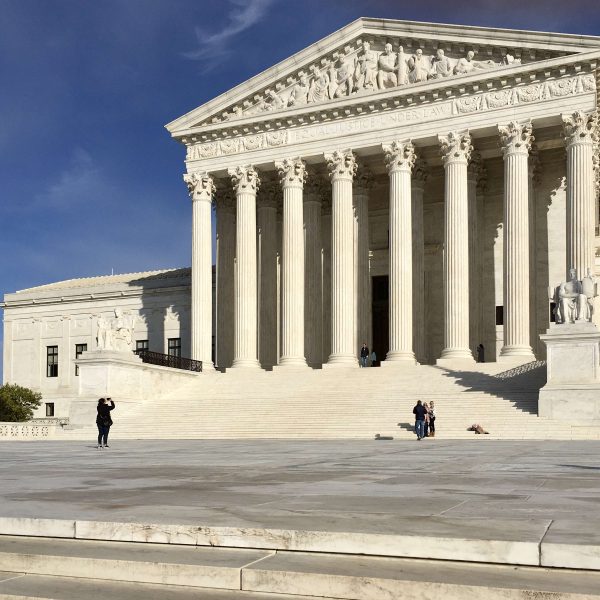
Supreme Court Decision Syllabus (SCOTUS Podcast)
- Folgen
- 583
- Erscheint
- mehrmals pro Woche
- Ort
- United States
- Letzte Folge
- 11. Nov. 2026
Über den Podcast
We Read The Supreme Court's own Syllabus or Per Curium word for word, then maybe say hin then shut the microphone back off.
We are the Antidote to Mainstream News and Entertainment-Hype Style coverage of the Supreme Court...What they do in the words of the RJD (Recorder of Judicial Decisions) Read by RJ Dieken and friends
Visit Montana's famous Loki Esq Law @ LokiEsq.Law (website) A Criminal Defense and Mediation Lawfirm Operating Statewide.
Be Kind to one another, say hi someday.
RoadsScholar80@gmai
*Note this podcast is for informational and educational purposes only.
Mitwirkende
Folgen 583
MULLIN v. FRIENDS OF THE RUIDOSA CHURCH (Big Bend Border Wall/Government Authority))
Send us Fan MailSCOTUS halts the injunction that is preventing the border wall from being built in the Big Bend Area of Texas.Also listen for my post roll...Thanks for being with me since my trucking days well …
Shownotes
SCOTUS halts the injunction that is preventing the border wall from being built in the Big Bend Area of Texas.
Also listen for my post roll...Thanks for being with me since my trucking days well before law school and through law school and three years of public defense. The Criminal system is so broken...
Reach out at the same email as always or send a letter:
RJ Dieken,
Loki Esq Law PLLC, Montana
1600 Lake Blaine Rd #BKalispell, MT 59901
FEDERAL COMMUNICATIONS COMMISSION v. SHERROD BROWN, ET AL.
Send us Fan Mail4th Circuit's Writ of Mandamus to force the FCC to decide an issue out of time, and in 48 hours is stayed.LokiEsq.LawSupport the show
DEPARTMENT OF HOMELAND SECURITY v. LEAGUE OF WOMEN VOTERS (Removes injunction below)
Send us Fan MailThe Court here removed the District Court's Stay. The Court held that the plaintiffs seeking a prohibition of the Governments use of the SAVE program to help states check voter rolls is …
Shownotes
The Court here removed the District Court's Stay. The Court held that the plaintiffs seeking a prohibition of the Governments use of the SAVE program to help states check voter rolls is overturned. The Court will decide in another case if the States are able to clean voter rolls within 90 days of an election).
People Not Politicians v. Onder (Elections & the Purcell Principle)
Send us Fan Mail In People Not Politicians v. Onder, the Supreme Court stayed federal-court orders that would have forced Missouri to use its 2025 congressional map instead of the 2022 map. Under state law, the …
Shownotes
In People Not Politicians v. Onder, the Supreme Court stayed federal-court orders that would have forced Missouri to use its 2025 congressional map instead of the 2022 map. Under state law, the 2025 map cannot take effect unless voters approve it in a referendum. Relying on Purcell v. Gonzalez, the Court held that federal courts should not change a state's election rules on the eve of an election, especially here, where ballots on the 2022 map had already been printed and mailed and voting had begun. It also rejected the Eighth Circuit's view that the Missouri Supreme Court caused the late change, noting that the state court had flagged the referendum requirement months before the primary.
NATIONAL REPUBLICAN CONGRESSIONAL COMMITTEE, ET AL. v. SHERROD BROWN, ET AL. (Ripeness, Admin Law, Media Discounts for people running for public office).
Send us Fan MailThe Court did not seem to think the 4th Circuit should have made a ruling on an appeal from the 4th Circuit, therefore they grant a stay of the 4th's Stay.Support the show
DONALD J. TRUMP, PRESIDENT OF THE UNITED STATES, ET AL. v. CALIFORNIA, ET AL. (Federal Election rules and Article III Standing)
Send us Fan MailSupport the show
NATIONAL PARK SERVICE, ET AL. v. NATIONAL TRUST FOR HISTORIC PRESERVATION IN THE UNITED STATES (WHITE HOUSE CONSTRUCTION, ARTICLE III STANDING)
Send us Fan MailThe Supreme Court Thinks the National Trust for Historic Preservation in The United States Does not have Article III Standing. (Simplified)Construction on the White House East Wing can resume …
Shownotes
The Supreme Court Thinks the National Trust for Historic Preservation in The United States Does not have Article III Standing. (Simplified)
Construction on the White House East Wing can resume (Simplified)
WEST VIRGINIA v. B. P. J. (Transgender Athletes, Title IX)
Send us Fan Mail 1. Title IX allows schools to provide separate women’s and men’s sports teams defined by biological sex, and West Virginia has permissibly maintained female sports for biological females …
Shownotes
1. Title IX allows schools to provide separate women’s and men’s sports teams defined by biological sex, and West Virginia has permissibly maintained female sports for biological females consistent with Title IX.
Trump v. Barbara (Birthright citizenship) JB recording.
Send us Fan MailIn Trump v. Barbara, the Supreme Court held that children born in the U.S. to parents unlawfully or temporarily present are citizens at birth under the Fourteenth Amendment, striking down …
Shownotes
In Trump v. Barbara, the Supreme Court held that children born in the U.S. to parents unlawfully or temporarily present are citizens at birth under the Fourteenth Amendment, striking down Trump's executive order limiting birthright citizenship. The Court relied on the common law rule of jus soli and its precedent in Wong Kim Ark, rejecting the Government's domicile-based theory. Chief Justice Roberts wrote for the Court; Kavanaugh concurred in part and dissented in part, while Thomas, Alito, and Gorsuch each dissented.
National Republican Senatorial Committee (NRSC) v. Federal Election Commission (FEC) (Campaign Finance/Election Law)
Send us Fan MailIn NRSC v. FEC the Supreme Court granted Certiorari to the United States Court of Appeals for the Sixth Circuit to answer the question of whether the limits imposed by the Federal Election …
Shownotes
In NRSC v. FEC the Supreme Court granted Certiorari to the United States Court of Appeals for the Sixth Circuit to answer the question of whether the limits imposed by the Federal Election Campaign Act (FECA) on how much political parties can spend in direct coordination with their federal candidates violate the First Amendment.
Held: FECA’s political party coordinated expenditure limits violate the First Amendment. Justice Kavanaugh delivered the opinion of the Court, in which Roberts, C.J., and Thomas, Alito, Gorsuch, and Barrett, JJ., joined. Kagan, J. Filed a dissenting opinion in which Sotomayor and Jackson, JJ., joined.
Read by Jake A. Leahy.
TRUMP v. BARBARA (BIRTHRIGHT CITIZENSHIP) RJD Recoding
Send us Fan Mail Children born in the United States to parents unlawfully or temporarily present are “subject to the jurisdiction” of the United States and are citizens at birth under the Fourteenth Amendment’s …
Shownotes
Children born in the United States to parents unlawfully or temporarily present are “subject to the jurisdiction” of the United States and are citizens at birth under the Fourteenth Amendment’s Citizenship Clause.
CHATRIE v. UNITED STATES (4a and Geofence Warrant for Google Location history)
Send us Fan Mail Police officers conducted a Fourth Amendment search when they acquired Chatrie’s location data from Google because an individual has a reasonable expectation of privacy in his cell-phone …
Shownotes
Police officers conducted a Fourth Amendment search when they acquired Chatrie’s location data from Google because an individual has a reasonable expectation of privacy in his cell-phone location information.
WATSON v. REPUBLICAN NATIONAL COMMITTEE (Absentee ballots and Election day statutes)
Send us Fan Mail The federal election-day statutes do not prevent Mississippi from counting absentee ballots postmarked by election day but received up to five days thereafter; nothing in the federal …
Shownotes
The federal election-day statutes do not prevent Mississippi from counting absentee ballots postmarked by election day but received up to five days thereafter; nothing in the federal election-day statutes requires ballots to be received by election day.
Trump v. Slaughter (For cause removal protection (non-Federal Reserve))
Send us Fan MailIn Trump v. Slaughter, the Supreme Court held that the FTC's for-cause removal protection for its Commissioners violates the separation of powers, overruling Humphrey's Executor v …
Shownotes
In Trump v. Slaughter, the Supreme Court held that the FTC's for-cause removal protection for its Commissioners violates the separation of powers, overruling Humphrey's Executor v. United States (1935) to the extent it survived. The Court reasoned that the Constitution vests executive power solely in the President, who must be able to remove at will any officer—like an FTC Commissioner—who exercises that power, a principle confirmed by the First Congress's "Decision of 1789" and by Myers v. United States (1926). It concluded that Humphrey's rested on an outdated and unworkable view of the FTC as merely "quasi-legislative" and "quasi-judicial," when in fact the agency promulgates binding rules, adjudicates enforcement actions, and sues in federal court—all executive functions. The Court reversed the lower courts and reinstated President Trump's removal of Commissioner Rebecca Slaughter, with Justice Gorsuch concurring and Justice Sotomayor dissenting, joined by Justices Kagan and Jackson.
Trump v. Cook (For Cause Removal (Federal Reserve))
Send us Fan MailIn Trump v. Cook, the Supreme Court denied the Government's application to stay an injunction reinstating Federal Reserve Governor Lisa Cook, whom President Trump had fired over alleged …
Shownotes
In Trump v. Cook, the Supreme Court denied the Government's application to stay an injunction reinstating Federal Reserve Governor Lisa Cook, whom President Trump had fired over alleged mortgage fraud predating her appointment. The Court held that the Federal Reserve Act's "for cause" removal standard is judicially reviewable, that "cause" requires a substantial showing reflecting the Fed's unique independence, and—resolving the case on this narrow ground—that the President failed to give Cook the notice and opportunity to respond that the statute requires before removal. The Court also held that equity permits courts to reinstate an officer during litigation over a disputed removal. Chief Justice Roberts wrote for the Court, joined by Justices Sotomayor, Kagan, Kavanaugh, and Jackson, with Kavanaugh and Jackson concurring separately and Thomas, Alito (joined by Gorsuch), and Barrett each dissenting.
Monsanto v. Durnell (Federal Preemption)
Send us Fan MailIn Monsanto Co. v. Durnell, the Supreme Court held that FIFRA expressly preempts a state-law failure-to-warn claim demanding a cancer warning on Roundup's label, since the EPA had approved …
Shownotes
In Monsanto Co. v. Durnell, the Supreme Court held that FIFRA expressly preempts a state-law failure-to-warn claim demanding a cancer warning on Roundup's label, since the EPA had approved the label without one and federal law requires using the approved label. The Court (per Justice Kavanaugh) reversed a $1 million Missouri verdict; Justice Thomas concurred; Justice Jackson, joined by Justice Gorsuch, dissented.
MULLIN v. DOE (TPS/Immigration/Admin Law)
Send us Fan MailThe TPS statute bars judicial review of non-constitutional claims.Support the show
Blanche v. Lau (Immigration and Nationality Act)
Send us Fan MailIn Blanche v. Lau, the Supreme Court held that the Immigration and Nationality Act does not require a border officer to have clear and convincing evidence that a lawful permanent resident has …
Shownotes
In Blanche v. Lau, the Supreme Court held that the Immigration and Nationality Act does not require a border officer to have clear and convincing evidence that a lawful permanent resident has committed a crime involving moral turpitude before treating that resident as an applicant for admission. Lau, a lawful permanent resident, was charged with trademark counterfeiting, briefly traveled abroad, and on his return was paroled rather than admitted because of the pending charge; after he pleaded guilty, the Government initiated removal proceedings charging him as inadmissible. The Second Circuit vacated the removal order, holding that the officer needed clear and convincing evidence of the crime at the time of reentry to deny him already-admitted status. Reversing, the Court explained that removing a permanent resident on inadmissibility grounds involves two steps—commission of the crime suffices to treat him as seeking admission, while conviction is required to find him inadmissible—and that nothing in the statute imposes a clear-and-convincing-evidence burden on border officers; the Board's evidentiary standard applies only at the removal hearing, where Lau's guilty plea easily satisfied it. The Court rejected Lau's argument that conviction must precede being treated as seeking admission, since the statute incorporates only the listed crimes and not their conviction requirement, and it remanded without deciding whether Lau's offense actually involved moral turpitude.
Mullin v. Al Otro Lado (INA & Arriving in the United States)
Send us Fan MailIn Mullin v. Al Otro Lado, the Supreme Court held that an alien standing in Mexico does not "arrive in the United States" within the meaning of the Immigration and Nationality Act by attempting …
Shownotes
In Mullin v. Al Otro Lado, the Supreme Court held that an alien standing in Mexico does not "arrive in the United States" within the meaning of the Immigration and Nationality Act by attempting and failing to set foot in the country; arrival occurs only when the alien crosses the border. The case arose from the Government's 2016 "metering" policy, under which border officials stood on the U.S. side and limited the number of asylum seekers allowed to enter and be processed each day; asylum seekers and the group Al Otro Lado challenged the policy, and the District Court and a divided Ninth Circuit panel held that an alien arrives—and thus must be inspected and may apply for asylum—upon encountering a U.S. official at the border, even while still on the Mexican side. Reversing, the Court reasoned that "arrives in" carries its ordinary meaning of physically entering a place, that surrounding INA provisions distinguishing actual from attempted entry confirm this reading, and that the presumption against extraterritoriality cuts against applying the asylum provisions to aliens still outside the country. The Court found the respondents' anti-surplusage argument insufficient to overcome the text, rejected their treaty-based argument as foreclosed by precedent, and dismissed their policy concerns as overstated and tied to a hypothetical rather than the rescinded metering policy actually at issue. The Court first held the case was not moot, since the declaratory judgment still barred the Government from resuming metering. The decision reversed and remanded, drawing a concurrence from Justice Thomas and dissents from Justices Sotomayor and Jackson.
EXXON MOBIL CORP. v. CORPORACIÓN CIMEX, S. A. (CUBA & Helms-Burton Act lawsuits)
Send us Fan Mail The Helms-Burton Act itself abrogates the sovereign immunity of Cuban agencies and instrumentalities Support the show
WOLFORD v. LOPEZ (2nd Amendment and Hawaii)
Send us Fan MailHawaii's rules about not allowing people to concealed carry on private property unless the owner posts consent is unconstitutional.Support the show
PUNG v. ISABELLA COUNTY (Tax Sale/Gvmt Forclosure/Takings)
Send us Fan MailThe proper baseline for measuring “just compensation” following a tax sale is the auction sale price, not the property’s hypothetical fair market value, at least when the sale is fairly …
Shownotes
The proper baseline for measuring “just compensation” following a tax sale is the auction sale price, not the property’s hypothetical fair market value, at least when the sale is fairly conducted in light of the country’s history of tax sales. Pp. 4–11.
LANDOR v. LOUISIANA DEPT. OF CORRECTIONS AND PUBLIC SAFETY (Spending Clause authority, RULIPA)
Send us Fan Mail Individuals may not be held liable in their personal capacities under a Spending Clause statute unless those individuals have voluntarily and knowingly consented to answer lawsuits under the …
Shownotes
Individuals may not be held liable in their personal capacities under a Spending Clause statute unless those individuals have voluntarily and knowingly consented to answer lawsuits under the statute; because the individual defendants in this case did not voluntarily and knowingly consent to face RLUIPA liability in an agreement with the federal government, Mr. Landor’s case cannot proceed against them.
Cisco v. Doe (Alien Tort Statute & Torture Victim Protection Act)
Send us Fan Mail The Supreme Court held that federal courts may no longer create new causes of action for violations of international law under the Alien Tort Statute, effectively closing the narrow door that …
Shownotes
The Supreme Court held that federal courts may no longer create new causes of action for violations of international law under the Alien Tort Statute, effectively closing the narrow door that Sosa v. Alvarez-Machain had left open in 2004. Reasoning that judicial authority under Sosa's framework was narrow from the start and that the power to create causes of action belongs to Congress—particularly where the Constitution expressly assigns Congress the job of defining offenses against the law of nations—the Court concluded that ATS suits always implicate foreign policy in ways that supply a sound reason to defer to the political branches. The supposed narrow class of permissible ATS actions, the Court said, is in truth a null set, so there can be no ATS liability for aiding and abetting violations of international law. Separately, the Court held that the Torture Victim Protection Act, which creates liability for one who "subjects" another to torture, does not reach aiding-and-abetting conduct: drawing on Central Bank of Denver, the Court reasoned that the statute's silence on aiding and abetting settles the question, and that "subjects" implies a direct causal link between torturer and victim rather than the broader, more attenuated assistance that aiding-and-abetting liability would capture. The practical upshot is that the plaintiffs—who alleged that Cisco built surveillance technology enabling China to identify and persecute them—cannot hold the company or its executives liable under either statute.
McCarthy v. Hernandez (Habeas and Miranda)
Send us Fan MailIn a per curiam decision, the Supreme Court summarily reversed the Second Circuit’s grant of federal habeas relief to Pedro Hernandez, who was convicted of kidnapping and felony murder in the …
Shownotes
In a per curiam decision, the Supreme Court summarily reversed the Second Circuit’s grant of federal habeas relief to Pedro Hernandez, who was convicted of kidnapping and felony murder in the 1979 disappearance and death of Etan Patz. The Second Circuit had concluded that the state trial judge should have told the jury about the rule from Missouri v. Seibert governing when a confession obtained after a delayed Miranda warning may be tainted by an earlier unwarned confession. Because the judge instead answered the jury’s question with a simple “no,” the Second Circuit found that the state courts had unreasonably applied clearly established federal law. The Supreme Court disagreed, explaining that Seibert concerns a judge’s decision whether to suppress a confession and says nothing about what juries must be instructed to consider. Because no Supreme Court precedent required the jury instruction the Second Circuit demanded, and because federal habeas courts may not overturn state convictions by extending existing precedents into new contexts, the Court held that AEDPA barred relief and reinstated Hernandez’s conviction.
T. M. v. University of Md. Medical System Corporation (RookerFeldman Doctrine)
Send us Fan MailWe speak today to say...nothing has changed...Support the show
Hunter v. United States (Criminal law appeal waiver enforceability)
Send us Fan MailBecause a criminal law appeal waiver must be both knowingly and voluntary a waiver of ineffective assistance of counsel is not really possible.Support the show
United States v. Hemani (Second Amendment)
Send us Fan MailThe Supreme Court held that the government's prosecution of Ali Hemani under 18 U.S.C. §922(g)(3)'s prohibition on firearm possession by unlawful users of controlled substances …
Shownotes
The Supreme Court held that the government's prosecution of Ali Hemani under 18 U.S.C. §922(g)(3)'s prohibition on firearm possession by unlawful users of controlled substances violated the Second Amendment as applied to him. Justice Gorsuch, writing for seven Justices, concluded that the government failed to identify a historical tradition of firearm regulation analogous to its interpretation of §922(g)(3), which automatically disarms anyone who regularly uses a controlled substance regardless of whether the person is dangerous, intoxicated, or incapable of managing his affairs. The Court rejected the government's reliance on historical laws regulating "habitual drunkards," finding that those laws targeted individuals whose intoxication rendered them incapacitated, served different purposes, and generally required individualized proceedings before liberty could be restricted. Because Hemani was prosecuted solely for possessing a firearm while being an admitted marijuana user, and because the government failed to show that such a broad prohibition is consistent with the Nation's historical tradition of firearm regulation, the Court held the prosecution unconstitutional. The Court emphasized the narrowness of its ruling, leaving open the validity of laws targeting addicts, intoxicated persons, or individuals shown through individualized evidence to be dangerous because of their drug use.
Justice Alito, joined by Justice Kagan, concurred in the judgment.
FS Credit Opportunities Corp. v. Saba Capital Master Fund, Ltd. (Implied Rights of Action)
Send us Fan MailIn a 6–3 decision, the Supreme Court held that Section 47(b) of the Investment Company Act does not create an implied private right of action allowing investors or other private parties to sue …
Shownotes
In a 6–3 decision, the Supreme Court held that Section 47(b) of the Investment Company Act does not create an implied private right of action allowing investors or other private parties to sue for rescission of contracts that allegedly violate the Act. The case arose when activist investor Saba Capital challenged voting-right restrictions adopted by several closed-end mutual funds and sought rescission under Section 47(b). Writing for the Court, Justice Barrett explained that Congress, not the courts, determines who may enforce federal statutes, and Section 47(b)’s language is directed at courts’ remedial authority once parties are already before them rather than at creating enforceable rights for a particular class of individuals. The Court emphasized that the ICA establishes a comprehensive enforcement scheme centered on the Securities and Exchange Commission and expressly authorizes private suits in only limited circumstances, making it unlikely that Congress intended an additional implied cause of action. The Court also rejected reliance on Transamerica Mortgage Advisors v. Lewis, noting that Congress amended Section 47(b) in 1980 to remove the “shall be void” language that supported an implied remedy in that case. Accordingly, the Court reversed the Second Circuit and held that Saba could not use Section 47(b) as a standalone basis to seek rescission of contracts allegedly violating the ICA.
Keathley v. Buddy Ayers Construction, Inc. (judicial estoppel
Send us Fan MailIn a unanimous opinion by Justice Jackson, the Supreme Court vacated a Fifth Circuit decision that had barred Thomas Keathley’s personal-injury lawsuit under the doctrine of judicial estoppel …
Shownotes
In a unanimous opinion by Justice Jackson, the Supreme Court vacated a Fifth Circuit decision that had barred Thomas Keathley’s personal-injury lawsuit under the doctrine of judicial estoppel after he failed to disclose the claim during his ongoing Chapter 13 bankruptcy. The Court held that when determining whether a debtor’s omission of a legal claim was inadvertent or mistaken, courts must consider the totality of the circumstances rather than applying the Fifth Circuit’s rigid rule that focused almost exclusively on whether the debtor knew of the claim and had a potential motive to conceal it. Emphasizing that judicial estoppel is an equitable doctrine requiring flexibility and case-specific analysis, the Court explained that the Fifth Circuit’s approach was both too narrow and too broad because knowledge of a claim and a theoretical incentive to conceal it are present in nearly every nondisclosure case. Without deciding whether judicial estoppel should apply in the bankruptcy context at all, or whether inadvertence is always an exception, the Court concluded that lower courts must evaluate all relevant evidence bearing on whether the omission was truly an honest mistake, and remanded for further proceedings.
Hier stehen die neuesten 40 von 583 Folgen. Ältere Folgen findest du im Feed des Podcasts.
Ähnliche Podcasts
Mehr Bildung-Podcasts



Ist das dein Podcast?
Bestätige es mit einem Eintrag in deinem Feed: Du bekommst hier einen Code, trägst ihn als podcast:txt in den Kanal deines Feeds ein, und wir prüfen ihn. Danach steht dein Podcast als „verifiziert“ bei SoundNode.