

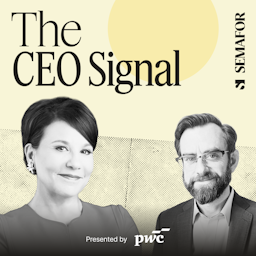
The CEO Signal
- Folgen
- 17
- Erscheint
- alle zwei Wochen
- Letzte Folge
- 19. Nov. 2026
Über den Podcast
When the business world moves, these are the leaders making the decisions that shape it. The CEO Signal is a new show hosted by Penny Pritzker — investor, business builder, and former U.S. Secretary of Commerce — and Andrew Edgecliffe-Johnson, Semafor’s CEO Editor. Episodes are released every two weeks. Building on The CEO Signal newsletter, read by the world’s top chief executives, the show brings that perspective to candid conversations with the leaders running the world’s biggest companies. The CEO Signal is presented by PwC.
Folgen 17
Land O'Lakes CEO Beth Ford: If You Eat, You Should Care About Farmers
“There's no distance,” says Land O'Lakes CEO Beth Ford of her relationship with the farmers who own the $16 billion cooperative. She knows their families, visits their farms and sees their successes and …
Shownotes
“There's no distance,” says Land O'Lakes CEO Beth Ford of her relationship with the farmers who own the $16 billion cooperative. She knows their families, visits their farms and sees their successes and hardships firsthand.
In this episode of The CEO Signal, Ford tells Penny Pritzker and Andrew Edgecliffe-Johnson what makes leading a farmer-owned business different. During the inflation surge of 2022, she chose to absorb a loss rather than lower the price paid to dairy farmers for their milk. The decision protected farmers' immediate earnings but would ultimately affect their equity in the cooperative. Not everyone agreed.
Ford also describes the pressures reshaping American agriculture, from rising land prices to trade and immigration, and why she believes food security deserves the same attention as national security.
McDonald's CEO Chris Kempczinski on why being the biggest isn't enough
Even the world's largest restaurant chain has to rethink how it competes. In this episode of The CEO Signal, McDonald's CEO Chris Kempczinski tells Penny Pritzker and Andrew Edgecliffe-Johnson why changing …
Shownotes
Even the world's largest restaurant chain has to rethink how it competes.
In this episode of The CEO Signal, McDonald's CEO Chris Kempczinski tells Penny Pritzker and Andrew Edgecliffe-Johnson why changing consumer habits and new competitors are prompting him to push for faster decisions and a greater appetite for risk. But McDonald's success was built on consistency and careful execution, and changing how it operates is no small task.
Kempczinski also faces the challenge of persuading thousands of independent franchisees to invest in his plans. He's clear about the direction, but pragmatic about the details: “We reserve the right to get smarter.”
The CEO Signal is presented by PwC. Visit here to learn more.
Airbnb CEO Brian Chesky on the founder’s role and bridging Silicon Valley’s AI divide
“What if design just ran the boardroom?” In this episode of The CEO Signal with Penny Pritzker and Andrew Edgecliffe-Johnson, Airbnb CEO Brian Chesky explains how his training as an industrial designer shapes …
Shownotes
“What if design just ran the boardroom?”
In this episode of The CEO Signal with Penny Pritzker and Andrew Edgecliffe-Johnson, Airbnb CEO Brian Chesky explains how his training as an industrial designer shapes his unconventional approach to running the company. He describes Airbnb as a three-dimensional model in his head and explains why he remains so personally involved in recruiting and organizational decisions.
“The founder is the keeper of the dream,” he says.
On artificial intelligence, Chesky warns that Silicon Valley is losing touch with the people whose lives its technologies will transform. “Society feels like AI is happening to them, not for them,” he says. Chesky believes the industry needs bridge builders to reconnect with people beyond the Silicon Valley bubble. And he thinks he could help.
Inside the Breakup of an American Industrial Giant
After nearly four decades at Honeywell, Vimal Kapur reached the top — and then took on the task of breaking the 140-year-old industrial conglomerate into three companies. Kapur tells Penny Pritzker and Andrew …
Shownotes
After nearly four decades at Honeywell, Vimal Kapur reached the top — and then took on the task of breaking the 140-year-old industrial conglomerate into three companies.
Kapur tells Penny Pritzker and Andrew Edgecliffe-Johnson how he managed that separation while simultaneously building Honeywell Technologies into a focused automation company, reshaping its portfolio and deciding where the new business should compete. The challenge, he says, is capturing the advantages of focus without giving up the benefits of scale.
A big part of that judgment comes from staying close to customers. Kapur explains why he tries to spend roughly a third of his time with them, how those conversations help test major strategic decisions, and why he believes “the CEO should have a founder’s mindset” when it comes to products, innovation and the future of the business.
Motorola Solutions CEO Greg Brown on the “Relief or Regret” Rule
“Relief or regret?” That is the question Motorola Solutions Chairman and CEO Greg Brown uses to test consequential decisions. In a candid conversation with Penny Pritzker and Andrew Edgecliffe-Johnson, Brown …
Shownotes
“Relief or regret?” That is the question Motorola Solutions Chairman and CEO Greg Brown uses to test consequential decisions.
In a candid conversation with Penny Pritzker and Andrew Edgecliffe-Johnson, Brown explains how nearly two decades of reinvention, activist pressure and private-equity involvement changed the way he leads. Working with activists made him more accountable and pushed him, he says, from thinking “like a manager” to thinking “like an owner.”
He is equally open about the moments when that judgment was tested. When Motorola Solutions’ board considered selling the company, Brown told directors: “This is bullshit. And if you want to fire me, go ahead and fire me.” He later apologized for the delivery, but not the substance, then ran the process the board had asked for. No buyer emerged, but the process ultimately led to Silver Lake investing in Motorola.
Brown also explains how he decides what Motorola should build, buy or partner on, and how he keeps the company moving through successive reinventions without losing sight of what should remain core.
United Airlines CEO Scott Kirby on calculated bets and building a US flag carrier
United Airlines CEO Scott Kirby wants to build what he calls the “undisputed flag carrier of the United States.” He argues that airlines are not commodities and that greater scale could benefit customers, but …
Shownotes
United Airlines CEO Scott Kirby wants to build what he calls the “undisputed flag carrier of the United States.” He argues that airlines are not commodities and that greater scale could benefit customers, but acknowledges a fundamental obstacle to consolidation: “We can’t get it done without a willing partner, and we don’t have one.”
In this episode of The CEO Signal, Kirby discusses the decade-long push to transform United and how he thinks about the bets required to do it. A former card counter who says senior executives should play high-stakes poker with their own money, Kirby warns against assuming the answer is in the spreadsheet. “The important thing,” he says, is to understand and question the assumptions.
Hosted by Penny Pritzker and Andrew Edgecliffe-Johnson, the conversation also looks back at United’s aircraft strategy during Covid. As competitors retired widebody aircraft and shrank their fleets, United moved in the opposite direction. Kirby believed the risk-reward had shifted: “We don’t actually have to be totally right,” he told the board. “We just have to not be totally wrong.” Kirby also explains why building employee pride means eliminating the things employees have to apologize for, and why a CEO’s job is “not to work hard. It’s to think hard.”
The CEO Signal is Semafor's interview platform for conversations with the global CEOs whose decisions are shaping the future of the new world economy. Hosted by Penny Pritzker and Andrew Edgecliffe-Johnson, the show explores the moments of judgment that define leadership.
Penny Pritzker is the founder and chairman of PSP Partners and served as U.S. Secretary of Commerce from 2013 to 2017.
Andrew Edgecliffe-Johnson is CEO Editor at Semafor and a former Financial Times journalist who has spent decades covering global companies and corporate leadership.
Jon Gray, President and COO, Blackstone on AI, Private Credit and Big Bets
Jon Gray, chief operating officer of the $1.3 trillion asset manager Blackstone, says one of the firm’s distinguishing habits is to “go big” when it finds a theme it believes in. But he also says successful …
Shownotes
Jon Gray, chief operating officer of the $1.3 trillion asset manager Blackstone, says one of the firm’s distinguishing habits is to “go big” when it finds a theme it believes in. But he also says successful convictions need to be challenged, particularly as Blackstone invests heavily around artificial intelligence. “You keep pressing against what you’re doing to confirm that you haven’t just sort of fallen in love,” he says.
In this episode of The CEO Signal, Gray describes investing as “pattern recognition”: finding “good neighborhoods,” and connecting the dots before others do. Hosted by Penny Pritzker and Andrew Edgecliffe-Johnson, the conversation also explores how Blackstone makes investment decisions at scale and why Gray worries strong systems can “stamp out the entrepreneurial spirit.”
Gray also addresses the current debate around private credit. He says lower returns as rates fall and spreads tighten would be a “totally reasonable criticism,” while rejecting claims that the asset class is creating systemic risk or heading for collapse as “not very logical.”
The CEO Signal is Semafor's interview platform for conversations with the global CEOs whose decisions are shaping the future of the new world economy. Hosted by Penny Pritzker and Andrew Edgecliffe-Johnson, the show explores the moments of judgment that define leadership.
Penny Pritzker is the founder and chairman of PSP Partners and served as U.S. Secretary of Commerce from 2013 to 2017.
Andrew Edgecliffe-Johnson is CEO Editor at Semafor and a former Financial Times journalist who has spent decades covering global companies and corporate leadership.
Reed Hastings on life after Netflix and the next wave of AI
Netflix co-founder and former CEO Reed Hastings says AI could unleash a new wave of “creative destruction” as companies use rapidly improving technology not just to cut costs, but to challenge competitors and …
Shownotes
Netflix co-founder and former CEO Reed Hastings says AI could unleash a new wave of “creative destruction” as companies use rapidly improving technology not just to cut costs, but to challenge competitors and build new businesses.
In this episode of The CEO Signal, Hastings notes that AI has been getting “roughly twice as good every year” and says CEOs should think of it as the equivalent of doubling their workforce. He also explains why it’s not the paranoid who survive “it’s really the people who have judgment” — leaders who can distinguish the threats and opportunities that truly matter.
Hosted by Penny Pritzker and Andrew Edgecliffe-Johnson, the conversation also explores the culture Hastings built at Netflix, why he's taken on the "really hard" challenge of turning around a Utah ski resort, and how he knew when it was time to step away and let Ted Sarandos and Greg Peters lead without him.
The CEO Signal is Semafor's interview platform for conversations with the global CEOs whose decisions are shaping the future of the new world economy. Hosted by Penny Pritzker and Andrew Edgecliffe-Johnson, the show explores the moments of judgment that define leadership.Penny Pritzker is the founder and chairman of PSP Partners and served as U.S. Secretary of Commerce from 2013 to 2017.
Andrew Edgecliffe-Johnson is CEO Editor at Semafor and a former Financial Times journalist who has spent decades covering global companies and corporate leadership.
Max Levchin on why Affirm wants to be your smarter older sister
Affirm founder and CEO Max Levchin built his company to behave like your “smarter older sister”: helping customers make better decisions rather than profiting from their mistakes. In this episode of The CEO …
Shownotes
Affirm founder and CEO Max Levchin built his company to behave like your “smarter older sister”: helping customers make better decisions rather than profiting from their mistakes.
In this episode of The CEO Signal, he explains how that philosophy shaped Affirm and why it may become even more important as AI transforms consumer finance.
Hosted by Penny Pritzker and Andrew Edgecliffe-Johnson, the conversation explores how Levchin has translated that philosophy into Affirm’s products, culture and decision-making as the company has grown. He also explains how his identity as an “immigrant engineer” shapes his leadership, and why he studies dystopian science fiction to help prevent the AI future he is “working very hard to prevent.”
The CEO Signal is Semafor's interview platform for conversations with the global CEOs whose decisions are shaping the future of the new world economy. Hosted by Penny Pritzker and Andrew Edgecliffe-Johnson, the show explores the moments of judgment that define leadership.
Penny Pritzker is the founder and chairman of PSP Partners and served as U.S. Secretary of Commerce from 2013 to 2017.
Andrew Edgecliffe-Johnson is CEO Editor at Semafor and a former Financial Times journalist who has spent decades covering global companies and corporate leadership.
Ralph Lauren CEO Patrice Louvet on magic, logic, and saying no
Patrice Louvet says Ralph Lauren left about $1 billion in revenue on the table as it pulled back from places where, “frankly, we weren’t proud of being.” When he became CEO in 2017, the company had stretched …
Shownotes
Patrice Louvet says Ralph Lauren left about $1 billion in revenue on the table as it pulled back from places where, “frankly, we weren’t proud of being.” When he became CEO in 2017, the company had stretched its brand too far. His challenge was to restore the brand without compromising the creative “magic” that made Ralph Lauren distinctive.
After nearly three decades at Procter & Gamble, Louvet came from a world of data, structure and business logic. At Ralph Lauren, he had to learn when the numbers should lead and when they should follow the magic. Defining the company as being in the “dreams business” became the foundation for deciding where the brand belonged, what it should stop doing and how it could grow without losing what made it special.
Today, Ralph Lauren has no shortage of opportunities to expand — including into hotels, Louvet says. The challenge is no longer finding new avenues for growth, but knowing which ones to pursue without repeating the gradual dilution that weakened the brand before.
For Louvet, that comes down to a deceptively simple principle: knowing what you can do is not the same as knowing what you should do.
About the Show
The CEO Signal is Semafor's interview platform for conversations with the global CEOs whose decisions are shaping the future of the new world economy. Hosted by Penny Pritzker and Andrew Edgecliffe-Johnson, the show explores the moments of judgment that define leadership.
Penny Pritzker is the founder and chairman of PSP Partners and served as U.S. Secretary of Commerce from 2013 to 2017.
Andrew Edgecliffe-Johnson is CEO Editor at Semafor and a former Financial Times journalist who has spent decades covering global companies and corporate leadership.
Cisco CEO Chuck Robbins on AI transformation, hard decisions, and leading at speed
In this episode of The CEO Signal, Chuck Robbins talks about the people decisions behind a transformation as sweeping as Cisco's repositioning for the age of AI. He says executives need to “disagree and …
Shownotes
In this episode of The CEO Signal, Chuck Robbins talks about the people decisions behind a transformation as sweeping as Cisco's repositioning for the age of AI. He says executives need to “disagree and commit,” but warns that CEOs shouldn't tolerate people who aren't on board with the strategy. “The one thing that is like death in an organization is passive aggressive behavior,” he says. …Allstate CEO Tom Wilson on trust, purpose and why CEOs should speak up
"There should be more voices" in the corporate world speaking up on societal issues, Allstate CEO Tom Wilson says in this episode of The CEO Signal. “CEOs need to stand up and decide what’s important to them …
Shownotes
"There should be more voices" in the corporate world speaking up on societal issues, Allstate CEO Tom Wilson says in this episode of The CEO Signal. “CEOs need to stand up and decide what’s important to them, what’s important to their customers — and take a stand.” Wilson has led Allstate for nearly two decades, running a business built on trust at a time when trust in America is under pressure. …Dan Schulman, Verizon CEO, on AI, layoffs and punching back
“If somebody’s going to punch me, I’m going to punch back,” Verizon CEO Dan Schulman says in this episode of The CEO Signal. Schulman, who came out of retirement six months ago to lead the $200 billion telecoms …
Shownotes
“If somebody’s going to punch me, I’m going to punch back,” Verizon CEO Dan Schulman says in this episode of The CEO Signal. Schulman, who came out of retirement six months ago to lead the $200 billion telecoms company, reveals that he initially turned the job down — twice. But his mandate is blunt: stop losing customers to its rivals, regain Verizon’s “swagger,” and move it from a defensive posture to one that is “playing to win.” That reset has come with hard choices. …Arvind Krishna, IBM CEO, on Big Bets, AI, and Quantum
What does it take to make big bets inside a public company? In this episode of The CEO Signal, IBM Chairman and CEO Arvind Krishna discusses how he thinks about major strategic decisions at a moment of rapid …
Shownotes
What does it take to make big bets inside a public company? In this episode of The CEO Signal, IBM Chairman and CEO Arvind Krishna discusses how he thinks about major strategic decisions at a moment of rapid technological change — from hybrid cloud to AI and quantum. At the center of the conversation is IBM’s acquisition of Red Hat — a decision Krishna helped drive before becoming CEO, and one that reveals how he thinks about conviction, resistance, and making a consequential call before the…Emma Walmsley on Leading and Leaving GSK
What does it take to hand over a company after years at the helm? Dame Emma Walmsley reflects on her tenure as CEO of GSK at the moment she was preparing to hand over to her successor, Luke Miels. It’s a rare …
Shownotes
What does it take to hand over a company after years at the helm? Dame Emma Walmsley reflects on her tenure as CEO of GSK at the moment she was preparing to hand over to her successor, Luke Miels. It’s a rare chance to hear a CEO reflect on the full arc of their tenure, from stepping into the role to shaping their own succession. …Starbucks CEO Brian Niccol on Leading Through Turnarounds
Why do some CEOs run toward the hardest challenges in business? In the first episode of The CEO Signal, Starbucks CEO Brian Niccol joins hosts Penny Pritzker and Andrew Edgecliffe-Johnson to discuss the …
Shownotes
Why do some CEOs run toward the hardest challenges in business? In the first episode of The CEO Signal, Starbucks CEO Brian Niccol joins hosts Penny Pritzker and Andrew Edgecliffe-Johnson to discuss the leadership mindset behind one of the most closely watched turnaround stories in global business. Niccol has built a reputation for stepping into difficult situations. …Introducing: The CEO Signal
When the business world moves, these are the people turning the wheel. Introducing The CEO Signal, a new show hosted by Penny Pritzker and Andrew Edgecliffe-Johnson. Episodes are released every two weeks …
Shownotes
When the business world moves, these are the people turning the wheel. Introducing The CEO Signal, a new show hosted by Penny Pritzker and Andrew Edgecliffe-Johnson. Episodes are released every two weeks. Building on The CEO Signal newsletter, the essential briefing read by the world’s top chief executives, the show brings that perspective to revealing conversations with the people steering the world’s biggest companies.
Ähnliche Podcasts
Mehr Wirtschaft-Podcasts


Ist das dein Podcast?
Bestätige es mit einem Eintrag in deinem Feed: Du bekommst hier einen Code, trägst ihn als podcast:txt in den Kanal deines Feeds ein, und wir prüfen ihn. Danach steht dein Podcast als „verifiziert“ bei SoundNode.