

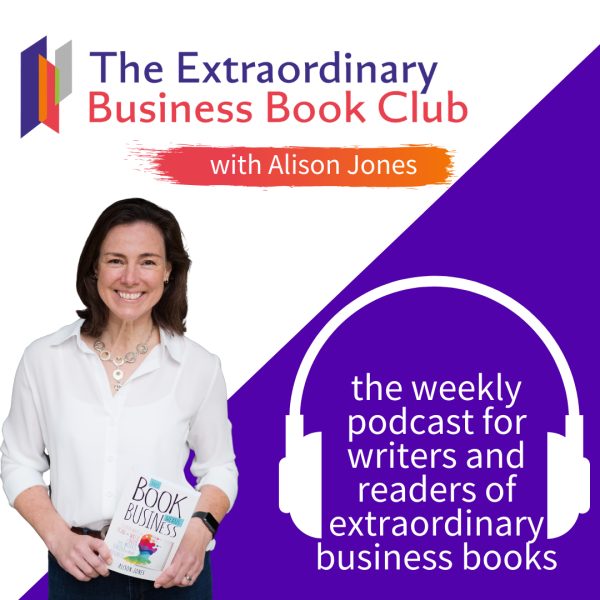
The Extraordinary Business Book Club
- Folgen
- 399
- Erscheint
- wöchentlich
- Letzte Folge
- 9. Nov. 2026
Über den Podcast
Alison Jones, publisher and book coach, explores business books from both a writer's and a reader's perspective. Interviews with authors, publishers, business leaders, entrepreneurs, tech wizards, social media strategists, PR and marketing experts and others involved in helping businesses tell their story effectively.
Folgen 399
Episode 510 - Turning ideas into books
'I don't write what I know, I write what I want to know.' Having an idea for a book? That's the easy bit. The real work begins when you try to translate that shiny, beautiful, slightly vague idea into a clearly …
Shownotes
'I don't write what I know, I write what I want to know.'
Having an idea for a book? That's the easy bit. The real work begins when you try to translate that shiny, beautiful, slightly vague idea into a clearly articulated concept that can support tens of thousands of useful, readable words.
This Best Bits episode explores the full range of that process, from capturing ideas and developing structure to making complex thinking accessible to time-poor readers.
Hear from:
Nir Eyal on how curiosity can pull you through the long process of writing a book;
Alex Merry on starting small and writing for one real person;
Claire Handby on noticing and capturing ideas as a daily habit;
Dougal Shaw on breaking The Book down into something manageable, and carving out time for it;
Melissa Swift on overcoming perfectionism and learning the craft of writing;
Michelle Gielan on turning two-minute news stories into long-form writing;
Caroline Webb on structural thinking and reader-focused design.
That might sound linear: it's not. Writing a book isn't simply about capturing an idea on paper. The process of writing exposes the gaps, sharpens the argument, develops our thinking.
You work on the writing, and the writing works on you.
Episode 509 - Fail Smarter with Dougal Shaw
' Probably 90% of the journey is about dealing with failure and the prospect of failure hanging over you.' Very often when we hear about failure it's from successful leaders looking at it in the rear-view …
Shownotes
' Probably 90% of the journey is about dealing with failure and the prospect of failure hanging over you.'
Very often when we hear about failure it's from successful leaders looking at it in the rear-view mirror, a moment of drama on their way to eventual triumph. But what if failure deserves a story of its own, even if there's no happy ending?
Dougal Shaw has spent more than a decade interviewing entrepreneurs as a business journalist, first at the BBC, where he created the CEO Secrets series, and now at Business Leader. His new book, Fail Smarter, draws on those conversations to explore what really happens when things go wrong, how looking at failure with more courage and curiosity can transform it into fuel for success, and how the best leaders create cultures in which mistakes are owned and explored.
We also talk about Dougal's approach to writing, what's helpful and what's not about a background in journalism as preparation for publishing a book, and the very different interpretations of 'editing' in the industry.
Episode 508 - Leadership Intelligence with Caroline Webb
'Good structure makes it a lot easier to wrap your head around complex ideas.' How do you take a vast body of knowledge and experience and turn it into something that readers can actually remember and apply …
Shownotes
'Good structure makes it a lot easier to wrap your head around complex ideas.'
How do you take a vast body of knowledge and experience and turn it into something that readers can actually remember and apply when they're in the thick of a difficult situation?
That's the challenge Caroline Webb set herself with her latest book, Leadership Intelligence. Drawing on more than 25 years of leadership coaching and the latest behavioural science, she created a practical playbook organized around three distinctively human strengths: wisdom, inspiration and resilience.
In this conversation we explore the extraordinary amount of work involved in making complex ideas simple without oversimplifying them. Caroline shares how she developed that structure (hello, Post-its!), and wove into it the memorable models and real-life stories that make a book both usable and memorable.
We also talk about the role of business books in an age of AI age and her power move - combining a print book with an evolving digital companion.
It's a masterclass in writing with the reader in mind.
Episode 507 - Finding your voice with Dr Claire Handby
'Get started. Accept that you need to write and get something out of you. That's the feeling to notice and then respond to it however it shows up.' Dr Claire Handby is a business leader, executive coach and …
Shownotes
'Get started. Accept that you need to write and get something out of you. That's the feeling to notice and then respond to it however it shows up.'
Dr Claire Handby is a business leader, executive coach and author who's driven by the impulse to 'make the invisible visible'. Her first book, Uptick, draws on her own experience of career reinvention; her forthcoming book, Zip It, deals with the under-explored experience of professional silencing and how to find your voice again after a difficult career transition.
In this conversation we explore how books can transform lived experience into something that helps others make sense of their own lives, and how writing itself helps us process those experiences and find a way forward. We also talk about finding your voice, literally as well as metaphorically - it's a rare joy to hear a Northern woman narrate her own business book.
Claire also shares how she deliberately turned her unhelpful doomscrolling habit into a writing practice: simply noticing things, capturing thoughts, and gradually building up the body of work that would become her books.
It's a reminder, if you needed one, that writing a book starts with simply noticing that you have something to say.
Episode 506 – The Frankfurt Book Fair debrief
'Now that we have AI to give us all the answers, who needs books, right?' It's a question that everyone who writes, publishes or sells nonfiction books has to face up to in 2026. The decline of reading and the …
Shownotes
'Now that we have AI to give us all the answers, who needs books, right?'
It's a question that everyone who writes, publishes or sells nonfiction books has to face up to in 2026. The decline of reading and the threat posed by AI are unarguable, yet there are also signs of resilience and reasons for hope, alongside some useful lessons for anyone writing or publishing business or self-development books.
Practical Inspiration's fabulous sales and marketing assistant Lauren Moseley became a roving reporter between meetings at this year's Frankfurt Book Fair, capturing five perspectives from across the industry.
Hear from:
NielsenIQ Book Data's Belle Edelman on nonfiction trends, how readers discover books, and the value of writers' work in an AI world
Durnell Marketing's Siobhan Humphries and Paula Moreno on how authors can support book sales, and why credibility and human connection matter
Rights experts Clare Hodder and Kris Kliemann on international opportunities, shorter books, and offering something readers can't get from an AI query
Liverpool University Press's Anna Champion on streamlining publishing work while preserving the relationships at its heart
The Independent Publishers Guild's Tom Holman on copyright challenges, opportunities for smaller publishers, and taking a thoughtful approach to AI adoption.
If you couldn't make it to Frankfurt, here's a taste of the conversations shaping the future of books - and what they might mean for yours.
Episode 505 - Speaking success with Alex Merry
' Reps can help you improve your ability to speak, and you can be the person creating those reps.' If you're seeking success as a speaker, what does that mean to you? Perfectly polished delivery, Big, flashy …
Shownotes
' Reps can help you improve your ability to speak, and you can be the person creating those reps.'
If you're seeking success as a speaker, what does that mean to you? Perfectly polished delivery, Big, flashy stages?
Alex Merry sees his job as helping founders unlock the true potential of their ideas, and as part of that he brings speakers at all stages of the journey into community in MicDrop. He has a more intentional, strategic approach to defining success as a speaker. In fact, turns out some of the most commercially powerful speaking opportunities happen in very ordinary rooms, with a relatively small number of exactly the right people.
We talk about the beautiful overlap between books and speaking, why the two work together so synergistically, and how being in community with the right people can supercharge success in both. We also talk about the importance of doing all of this in public, testing your ideas, learning to communicate the same message in a million different ways.
A practical and energising conversation about speaking, writing, business development, community, and why success might be different to - and so much achievable than - your assumptions.
Episode 504 - Resilient Optimism with Michelle Gielan
' You can continually be choosing optimistic behavior even when you're not feeling optimistic.' Michelle Gielan is a positive psychology researcher married to a happiness researcher - wouldn't you love to be at …
Shownotes
' You can continually be choosing optimistic behavior even when you're not feeling optimistic.'
Michelle Gielan is a positive psychology researcher married to a happiness researcher - wouldn't you love to be at that dinner table?
In her latest book Resilient Optimism: The science of sustaining a positive mindset in tough times, she explores why optimism that lasts when reality hits is not based on an emotion, but on behaviour, and more particularly on the belief that our behaviour matters.
She also discovered that your behaviour matters way beyond your own mood and your own outcomes. Becoming a 'positive deviant' - actively expressing optimism, celebrating progress, spreading 'positive gossip' - can transform the outcomes of everyone around you.
We also talk about writing as sense-making, experimenting with 'power leads', and how to think of a book as a collection of beautifully connected two-minute stories.
A hopeful, practical conversation about agency, courage, writing, and resilience.
Episode 503 - What book awards do to and for authors
'You can be both disappointed for yourself and delighted for other people at the same time.' Book awards are great for visibility and credibility. But there's another side to them too. Entering for an award …
Shownotes
'You can be both disappointed for yourself and delighted for other people at the same time.'
Book awards are great for visibility and credibility. But there's another side to them too.
Entering for an award means putting the product of months or years of private work into the public gaze to be judged. And however highly evolved you are, there's a good chance that fear, hope, self-doubt, and even a sulk can all be part of the process that follows.
In this episode, authors representing every dimension of the experience reflect honestly and helpfully on their experience and what they've learned.
Hear from:
- Sarah Robb on the difference between the award and the real reward
- Tom Pullen on awards as a way through the 'post-publication valley of death'
- Helen Beedham on the surprising questions that success raised about her identity as an author
- Susan Ni Chriodain on why there's nothing wrong with wanting something enough to be disappointed
- Martin Farrell on what awards revealed about his own need for recognition
- Virginia Cinquemani on managing expectations and breathing through the nerves
- Angela Rixon on the very real value of shortlisting
- Ian Pettigrew on the need to take care around the meaning we attach to an outcome
- Alice Sheldon on treating an award result as data rather than a verdict
- Trevor Merriden on why awards judges understand more than authors might realise about what's at stake.
Episode 502 - Beyond Belief with Nir Eyal
'I don't write what I know, I write what I want to know.' You know Nir Eyal. He's an authority on behaviour change and human potential, a respected academic and the bestselling author of Hooked and …
Shownotes
'I don't write what I know, I write what I want to know.'
You know Nir Eyal. He's an authority on behaviour change and human potential, a respected academic and the bestselling author of Hooked and Indistractable. His latest book is called Beyond Belief: The science-backed way to stop limiting yourself and achieve breakthrough results.
But did you know that he's not writing for you, dear reader - he's writing for himself, to satisfy his curiosity about a topic that's caught his attention? Or that when he sits down to write, it immediately triggers an anxiety response: 'Why is this so difficult? It's boring. What if nobody likes my book? What if I don't make my deadline? What am I even doing?'
In this fascinating conversation, we explore what beliefs mean for life and work and, most relevantly for this podcast, writing. You'll discover how he replaced those anxious questions with a more liberating belief, which I guarantee will work for you too (I know because it worked for me).
And - of course - we talk about AI: where it's helpful for writing and where it becomes a dirty thief if you let it.
Episode 501 - Effective with Melissa Swift
'It's just this kind of ordinary zone of getting done the things you need to get done and making sure your work has the impact it's supposed to have.' There's a lot of talk about high performance in leadership …
Shownotes
'It's just this kind of ordinary zone of getting done the things you need to get done and making sure your work has the impact it's supposed to have.'
There's a lot of talk about high performance in leadership literature. But perhaps a more realistic goal, and the one with the potential to transform an organization root to branch, is effectiveness, argues Melissa Swift.
Her new book Effective: How to do great work in a fast-changing world, explores what it really means to be effective at work - not crushing it, not hustling, just consistently doing the right work well in a world where nobody is ever really 'done'.
In this conversation, she talks about why we need to become our own personal organizational consultants: stepping back from the inundation of work to understand what our job actually is, where the friction points are, and what boundaries we need to keep doing good work sustainably.
She also talks about the craft of writing business books, including what business book writers can learn from journalists and how to get the balance right between informing and entertaining.
A thoughtful, practical conversation about work, writing, resources and realistic goals.
Episode 500 - The quincentenary episode
'Books are made by humans, for humans, in conversation with other humans, and they are still the best vehicle we have for sustained thought.' It's episode 500 of The Extraordinary Business Book Club. I KNOW!!! …
Shownotes
'Books are made by humans, for humans, in conversation with other humans, and they are still the best vehicle we have for sustained thought.'
It's episode 500 of The Extraordinary Business Book Club. I KNOW!!!
To mark the milestone, I handed the mic over to YOU, the listeners, to reflect on what the show has meant to you over the years.
There are reflections on discovering what to read next, finding community among people with big ideas, and hearing authors speak honestly about the intractably hard work of writing. (Public service announcement: writing a book is difficult not because you're doing it wrong, but because turning an idea into something useful takes real work.)
And in the age of AI, we explore what remains distinctively human about books, and why they matter more than ever.
A celebratory landmark episode about writing, reading, thinking together — and the extraordinary alchemy of books.
Episode 499 - Personal branding with Chris Ducker
'The publishing of the book actually is not the finish line, it's the start line.' Chris Ducker is a serial entrepreneur, three-times bestselling author, keynote speaker and founder of Youpreneur, where he …
Shownotes
'The publishing of the book actually is not the finish line, it's the start line.'
Chris Ducker is a serial entrepreneur, three-times bestselling author, keynote speaker and founder of Youpreneur, where he helps entrepreneurs and industry leaders and experts launch and market their books and grow their authority and their businesses.
In other words, the perfect Extraordinary Business Book Club guest.
And he's here to tell you that too many business book authors treat publication day as the end of the project: box ticked, job done. When actually that's the moment the next phase of work begins.
Your book sits at the heart of your reputation-building ecosystem. Why spend months or years creating a brilliant body of content and then not use it properly? It's going to keep on giving as a source of ideas, stories, frameworks and prompts for marketing, speaking and client conversations if you let it.
We also talk about what personal brand really means (and how to build one), and the two most fundamental questions every business book author should ask themselves: what transformation do I want for my reader, and what do I want this book to do for my business?
Episode 498 - Contagious Confidence with Julie Smith
'Confidence can fuel good performance, doubt can sap performance.' Julie Smith's first book, Coach Yourself Confident, focused on the individual experience of confidence: closing the gap between how capable we …
Shownotes
'Confidence can fuel good performance, doubt can sap performance.'
Julie Smith's first book, Coach Yourself Confident, focused on the individual experience of confidence: closing the gap between how capable we are and how capable we believe ourselves to be. It won quite a few awards.
Her new book, Contagious Confidence, explores confidence as a performance variable: a powerful way for leaders to help teams do their best work.
But the funny thing about writing about confidence - even second time around, and even with awards in the bag - is that much of the time you don't feel very, well, confident. Julie talks about perfectionism, inner critics (hers is called Nigel) and the 'difficult second album', but also the surprising joy of giving yourself permission to write a shitty first draft and that sensation of freewheeling when it's all working perfectly.
It's a conversation about confidence, leadership, writing, community - and sprouts.
Episode 497 - Going faster still with Ben Hunt-Davis & Harriet Beveridge
'We worked really hard to create "me too" moments rather than "so what" moments.' Will It Make The Boat Go Faster? is a phrase that has entered the business lexicon, not just as a book title and the name of a …
Shownotes
'We worked really hard to create "me too" moments rather than "so what" moments.'
Will It Make The Boat Go Faster? is a phrase that has entered the business lexicon, not just as a book title and the name of a company but as a leadership philosophy. Ben Hunt-Davis and Harriet Beveridge self-published the first edition 15 years ago - Ben telling the inspiring story of how he and the British men's rowing Eight underwent radical transformation to win Gold at Sydney in 2000, and performance coach Harriet Beveridge highlighting the transferable strategies everyone can take from it.
Now Penguin are releasing an updated third edition. The principles remain the same, but the strategies are even sharper and the stories brought right up to date, to equip a new generation of individuals and leaders with tried-and-tested strategies for everyday success.
In this conversation, we talk about what it means to develop and refine one powerful idea over time, rather than chasing the next shiny thing, how the book and the business work together, and what it takes to sustain a creative partnership over many years and several editions. And there's some candid insight into the real work of writing a book, which begins after you've actual written the book...
Episode 496 - Likeable Badass with Alison Fragale
'The art of building your own status with your audience is to convey to as many people as you can, as often as you can, hey, I really care about people. And I'm also really capable.' Status is a funny thing. We …
Shownotes
'The art of building your own status with your audience is to convey to as many people as you can, as often as you can, hey, I really care about people. And I'm also really capable.'
Status is a funny thing. We want it, but because it's what other people think of us, we assume we can't control it. And we're pretty sure that we shouldn't be caring so much what other people think of us, anyway.
But Alison Fragale, organizational psychologist, professor and author of Likeable Badass, is clear not only that status is a fundamental human need, but that you can influence it, once you understand how it works.
She's also clear-eyed about the realities of writing a successful book: the importance of a well-thought-through proposal, the ruthlessness required to cut material that you as the author love but that doesn't serve the reader, and the unavoidable truth that nobody will ever sell more of your book than you will.
A masterclass in making ideas accessible, embedding a book in a business, and sustaining the book promo for the long term.
Episode 495 - The streak effect
'Today is day one of whatever streak you choose to commit to.' Something a little bit different this week, as I celebrate an unusual milestone: eight years of running every single day. But this isn't really …
Shownotes
'Today is day one of whatever streak you choose to commit to.'
Something a little bit different this week, as I celebrate an unusual milestone: eight years of running every single day.
But this isn't really about running, it's about streaking (no, not that kind of streaking, do grow up) and why committing to one tiny daily action can be such a powerful way of moving yourself towards the person you want to be.
Don't just take my word for it: writing productivity expert Bec Evans and daily blogger Seth Godin also share their thoughts on why consistency matters more than brilliance, why the practice matters more than the output, and why this might be exactly what you need to get your book written.
One day every streak will end, and that's a tough thought to comptemplate. But today? Today, you get to choose.
Episode 494 - Incorruptible with Eric Ries
'The more successful an organization is, the more valuable it is as a target. So the more golden the goose, the more the temptation to butcher it. We actually create the conditions for our own failure by …
Shownotes
'The more successful an organization is, the more valuable it is as a target. So the more golden the goose, the more the temptation to butcher it. We actually create the conditions for our own failure by blindly pursuing success.'
Eric Ries wrote the bible for many entrepreneurs: The Lean Startup. But in recent years, he's turned his attention to what happens to startups as they mature - having showed us how to create something worth protecting, he's now focusing on how we protect it once it's built. Why do so many founders who had such a positive vision for their new company, and who achieved such success with that approach, find themselves sidelined or overruled as it slides into mediocrity or even malignancy?
The result of his quest to understand this seemingly inevitable, faceless force is a new book, Incorruptible: Why good companies go bad and how great companies stay great.
As one of the leading thinkers and activists of our day, Eric discovered the surprisingly simple way to create the infrastructure necessary to reimagine value by founding the Long Term Stock Exchange. And as a tech entrepreneur himself, he has great advice on how to use AI effectively and ethically in the writing process.
One of Eric's most fundamental lessons is that trust is the most valuable asset of all, and that applies to your book just as much as your business. NOT an episode to miss - trust me on this.
Episode 493 - The natural advantage
'Really paying attention to nature seems to shift something more fundamental... writing can begin to feel a little less effortful and a little more joyful.' You might think that being in nature and writing …
Shownotes
'Really paying attention to nature seems to shift something more fundamental... writing can begin to feel a little less effortful and a little more joyful.'
You might think that being in nature and writing business books are two entirely unconnected activities. But the annual Write it Wild retreat keeps showing that the first benefits the second in more ways than even I had realised when I first came up with the idea.
In this episode I talk to this year's participants about what they're noticing - the dynamic interplay between attention and perspective, between focus and freedom, between structure and flow, between solitude and community, and how all of that is impacting their writing and their state.
You don't need to go off into the woods and examine a daisy through a magnifying glass or make fire with flint and steel every time you want to write a decent paragraph, but if you're feeling a bit stuck or a bit joyless, spending a little purposeful time in nature might just make all the difference. And writing that's easier and more joyful for you to write tends to be easier and more joyful for others to read, too.
Episode 492 - Writing is resistance
'Unlike the washing up, which I'm perfectly happy to delegate to a machine... I don't WANT to delegate my writing, because that's how I think.' Technology is great at making life easier. But sometimes, easy …
Shownotes
'Unlike the washing up, which I'm perfectly happy to delegate to a machine... I don't WANT to delegate my writing, because that's how I think.'
Technology is great at making life easier. But sometimes, easy isn't what we really need.
It's hard to resist the siren call of AI as you stare at a blank document: 'Let me write that email/post/book, I can do it really quick and it'll sound super professional.' Or, as it's more likely to put it: 'It's not cheating. It's optimizing for efficiency.'
In this episode, I make the case for engaging with the mental heavy lifting of writing in a world determined to lift it for us. Doing the hard things builds capacity and it also, weirdly, makes us happier.
Resistance is NOT futile. But it's going to take a bit of work.
Episode 491 - Future-Fit Innovation with Barbara Salopek
' Being creative means having a deep knowledge about anything that you do, because this helps you then to connect those things into new things.' Innovation. You can't sit through a corporate meeting without …
Shownotes
' Being creative means having a deep knowledge about anything that you do, because this helps you then to connect those things into new things.'
Innovation. You can't sit through a corporate meeting without hearing the word. Everyone thinks they know what they mean by it, and most people are confident that it's someone else's responsibility. There's a department for that, right? In fact, Barbara Salopek argues, innovation is a responsibility for every employee, whether they like it or not, because the deep knowledge required is distributed throughout the business; the 'innovation muscle' has to be built both top down and bottom up throughout all three levels – individuals, teams and the entire organization.
She also makes the case that innovation is far broader than most people think: not just shiny new product development (expensive) but also incremental internal process improvements (efficient). Building that kind of innovation culture takes long-term commitment, and it also demands that leaders pay attention to building psychological safety, not just brainstorming.
And if you're grappling with your own business book, you need to hear about Barbara's structured approach to conquering what can seem like an insurmountable task.
Episode 490 - Asking the wrong questions
'...The very human tendency to focus on the thing that we think is the problem but isn't actually the thing that needs our attention.' In writing, as in life and work, we often focus on the question that looks …
Shownotes
'...The very human tendency to focus on the thing that we think is the problem but isn't actually the thing that needs our attention.'
In writing, as in life and work, we often focus on the question that looks obvious: How do I write this quickly? How do I find the time? How do I tell my story? How do I get feedback?
But very often, there's a better question behind the one we're asking.
In this Best Bits episode I look at some of the most common wrong-question traps that authors fall into, and explore the deeper, more useful questions behind them that can transform not just the book, but the author too.
Hear from:
- Kevin Anderson on why AI is a terrible answer to the 'how can I write my book quickly' question
- Chris Lovett on 'finding' [sic] time to write
- Amy Cantin on writing to make readers feel capable, not impressed
- Ian Pettigrew on telling your story without making it the point of your book
- Paolo Gaudiano on starting with what your reader cares about (rather than what you want to tell them)
- Helen Beedham on testing your argument rather than simply strengthening it
- Becky Westwood on what to do with feedback once you have it
- Alison Jones on why, for business book authors, it's not just about the book.
Luckily, writing is itself a great way to find better questions...
Episode 489 - Books and learning with Amy Cantin
'Readers don't finish books that make them feel impressed by someone with a lot of experience or success. They finish books that make them feel capable.' Does the book still have a place in next-generation …
Shownotes
'Readers don't finish books that make them feel impressed by someone with a lot of experience or success. They finish books that make them feel capable.'
Does the book still have a place in next-generation corporate learning platforms? You bet.
Amy Cantin of Skillsoft talks me through the evolution of organizational learning, and the ways in which business books underpin the various summaries, webinars, AI simulations and social learning opportunities they offer their corporate clients to ensure not only that every employee keeps learning, but that they are able to learn in the way that suits them best.
There are great tips here on how to write a book that's truly transformational for professional development, and a reminder that while the learning landscape has evolved, books remain the fullest expression of the ideas that shape work-life, and authors are still central to the learner's experience.
Episode 488 - The 10th birthday podcast party
'If there's one thing that this podcast has reinforced for me over the last 10 years, it is that books and the people who write them matter.' It's almost a decade to the day since I first pressed 'record' and …
Shownotes
'If there's one thing that this podcast has reinforced for me over the last 10 years, it is that books and the people who write them matter.'
It's almost a decade to the day since I first pressed 'record' and launched this podcast into the world (and you might be amused to find out the real reason behind it). In this 10th birthday episode I'm taking a moment to look back on the ambition and anxiety behind that moment, and reflect on how much has changed, and what hasn't, for writers and readers of business books.
I've also put together 10 super-practical lessons I've learned over that time, for anyone grappling with their own ambition and anxiety in the face of starting something new. I welcome back my very first guest and have a moment with 2016 Alison, as we look forward to whatever the next 10 years will bring.
Whether you've been listening since that first episode or just discovered The Extraordinary Business Book Club, you're part of something really special, and a way of being and thinking that's taken on existential meaning for us over the last decade - as individuals and as a society.
Episode 487 - Measuring Inclusion with Paolo Gaudiano
'Inclusion is what you do and diversity is what you get.' Paolo Gaudiano's expertise ranges from rocket science through computational neuroscience to the really tough work: diversity, equity and inclusion in …
Shownotes
'Inclusion is what you do and diversity is what you get.'
Paolo Gaudiano's expertise ranges from rocket science through computational neuroscience to the really tough work: diversity, equity and inclusion in organizations.
It's not got any easier over the last couple of years, but it's not got any less important, either. Paolo simply points to the evidence: focusing on improving workplace experiences for all employees leads not only to happier people but also to better business outcomes. His book - Measuring Inclusion: Higher profits and happier people, without guesswork or backlash - was named International Business Book of the Year at the Business Book Awards in 2025.
We also talk about the power and perils of language, the concept of 'gateway words', and the importance of recognizing that the words that work for you might not work for others...
Episode 486 - Going All In at the London Book Fair
'If you're into it, read into it.' Fresh (sic) from the London Book Fair, this week's episode brings together perspectives from across the industry on the National Year of Reading campaign. Does reading even …
Shownotes
'If you're into it, read into it.'
Fresh (sic) from the London Book Fair, this week's episode brings together perspectives from across the industry on the National Year of Reading campaign.
Does reading even still matter? [Spoiler alert: it matters more than ever!] And how can we - as an industry and as individuals - encourage people to do more of it, given all the competing demands on their attention?
As well as finding out what's happening in the industry, learn how you can join the movement to make reading a more intentional, joyful part of your everyday life, and I'm not just talking about business books. Your attention is under siege like never before - reading is a radical act of resistance, as well as a practice of self-development, a powerful way of supporting your wellbeing and the best route to becoming a better writer.
Episode 485 - People Glue with Helen Beedham
'If you love somebody, set them free,' advised Sting back in 1985. Little did he know he was setting out a core principle of leadership for the 21st century. It's the big idea behind award-winning author Helen …
Shownotes
'If you love somebody, set them free,' advised Sting back in 1985. Little did he know he was setting out a core principle of leadership for the 21st century.
It's the big idea behind award-winning author Helen Beedham's second book People Glue: Hold on to your best people by setting them free, which leans into that paradox with rather more by way of helpful detail than the Police front man ever provided. Through rigorous research and conversations with top CEOs she has identified four key freedoms that top talent most values, and also the anti-freedom forces that most frequently prompt them to walk out of the organizational door.
We also talk about what it means to write a second book – why WOULD you put yourself through that again? And what might you do differently second time around?
Episode 484 - Hope is a Strategy with Ian Pettigrew
'We don't understand much about hope, and yet people are crying out for it from leaders.' If you ever hear someone dismissively say 'hope is not a strategy', be sure to introduce them to Ian Pettigrew, author …
Shownotes
'We don't understand much about hope, and yet people are crying out for it from leaders.'
If you ever hear someone dismissively say 'hope is not a strategy', be sure to introduce them to Ian Pettigrew, author of Hope is a Strategy. He will disabuse them of the idea that hope is simply wishful thinking and introduce them to a more muscular, active concept: hope that can be – MUST be – wielded with rigour and realism.
In Ian's book (quite literally), hope isn't rainbows and unicorns; if it is, you don't get away with that twice. Neither is it about ignoring reality until something good happens. Strategic hope is gritty and demanding, but it's also the most powerful force in the world for both personal and organizational transformation.
We also talk about the practicalities of applying this theory of hope to the business of writing a book, both the inner game and the getting of the words onto the page. So if you're feeling a bit hopeless about your own project, this is for you.
Episode 483 - Relentless with Chris Lovett
'O nce you know that you can't do it all, it becomes a little bit easier.' Why do so many of us feel like we're drowning in endless demands and to-do lists, at work and at home? Why, when we have so many smart …
Shownotes
'O nce you know that you can't do it all, it becomes a little bit easier.'
Why do so many of us feel like we're drowning in endless demands and to-do lists, at work and at home? Why, when we have so many smart productivity tools, is it so damn hard to get the important things done?
If you relate, I'd like to introduce you to Chris Lovett. Because HE can introduce you to the genius idea of 'strategic laziness', and also explain how an author with no time can write a book perfectly designed to be read by people with no time.
If you're looking for the antidote to hustle culture, if you're ready to face the fact that you will NEVER get to the bottom of your to-do list and if you fancy embracing tiny acts of rebellion to stem the relentlessness, this is for you.
Episode 482 - Giving writers a voice with Kevin Anderson
'The crux of our whole business is just really finding talented people to help others do what they can't do themselves as well.' Kevin Anderson never planned to become CEO of one of the biggest editorial …
Shownotes
'The crux of our whole business is just really finding talented people to help others do what they can't do themselves as well.'
Kevin Anderson never planned to become CEO of one of the biggest editorial agencies in the world, but that's where his knack for seeing opportunities in a fast-changing industry together with the guts to take them has landed him.
In this episode, we talk about how publishing professionals can support authors at every stage – from clarifying the concept through writing the manuscript to securing the right deal (and we note that 'the right deal' means different things to different authors.)
From the impact of AI on writing and piracy to top tips for writing business books, the enduring appeal of long-form nonfiction to the plethora of publishing options open to authors today, it's packed with insights and advice for aspiring authors.
Don't wait until you've written your manuscript to listen to this!
Episode 481 - Social anxiety at work with Becky Westwood
"Love feedback, hate feedback, feel sort of somewhere in the middle, it still creates this sense of anxiety for everyone around." Organizational psychologist Becky Westwood is an expert in social anxiety at …
Shownotes
"Love feedback, hate feedback, feel sort of somewhere in the middle, it still creates this sense of anxiety for everyone around."
Organizational psychologist Becky Westwood is an expert in social anxiety at work. And that gives her a unique persepctive on the situation guaranteed to created anxiety in ALL of us: giving and receiving feedback.
In her book Can I Offer You Something? Expert Ways to Overcome the Horrors of Organizational Feedback, she invites us to reject the grim reality of most workplace feedback processes and return to the original sense of the word: nourishment. It's refreshingly human, and might just save you some lost sleep, not to mention relationships.
This book was named Short Business Book of the Year, and we talk about what length is the right length for a book, and how the answers come as you write, not before you start.
So start.
Hier stehen die neuesten 40 von 399 Folgen. Ältere Folgen findest du im Feed des Podcasts.
Ähnliche Podcasts
Mehr Kunst-Podcasts

Ist das dein Podcast?
Bestätige es mit einem Eintrag in deinem Feed: Du bekommst hier einen Code, trägst ihn als podcast:txt in den Kanal deines Feeds ein, und wir prüfen ihn. Danach steht dein Podcast als „verifiziert“ bei SoundNode.