

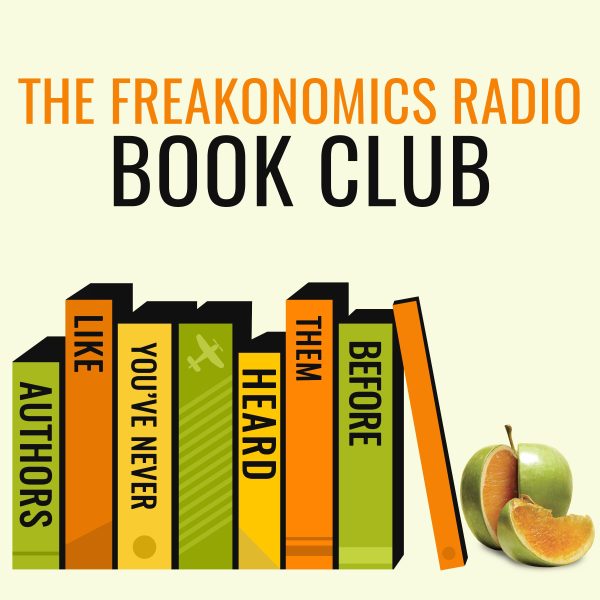
The Freakonomics Radio Book Club
- Folgen
- 35
- Erscheint
- unregelmäßig
- Letzte Folge
- 16. Okt. 2026
Über den Podcast
From the podcast that explores the hidden side of everything, hear authors like you’ve never heard them before. Stephen Dubner and a stable of Freakonomics friends talk with the writers of mind-bending books, and we hear the best excerpts as well. You’ll learn about skill versus chance, the American discomfort with death, the secret life of dogs, and much more. To get every show in the Freakonomics Radio Network without ads and a monthly bonus episode of Freakonomics Radio, start a free trial for SiriusXM Podcasts+ on Apple Podcasts or by visiting siriusxm.com/podcastsplus.
Folgen 35
33. Is This What a “Good Billionaire” Looks Like?
David Rubenstein, a product of the old bipartisan D.C., made his fortune in private equity. He’s been spending it on “patriotic philanthropy” and institutions like the Kennedy Center, where Trump fired him as …
Shownotes
David Rubenstein, a product of the old bipartisan D.C., made his fortune in private equity. He’s been spending it on “patriotic philanthropy” and institutions like the Kennedy Center, where Trump fired him as chairman. Now he wonders if the center can hold.
- SOURCES:
- David Rubenstein, co-founder and co-chairman of the Carlyle Group, principal owner of the Baltimore Orioles.
- RESOURCES:
- Inside the Owner's Box: Conversations on Power and Leadership in Sports, by David M. Rubenstein (2026).
- The American Experiment: Dialogues on a Dream, by David M. Rubenstein (2021).
- The American Story: Conversations With Master Historians, by David M. Rubenstein (2019).
- Moneyball: The Art of Winning an Unfair Game, by Michael Lewis (2003).
- EXTRAS:
- "The Merger You Never Knew You Wanted," by Freakonomics Radio (2025).
- "The Secret Life of a C.E.O.," series by Freakonomics Radio (2018).
- "Extra: David Rubenstein Full Interview," by Freakonomics Radio (2018).
- "The Longest Long Shot," by Freakonomics Radio (2016).
Hosted by Simplecast, an AdsWizz company. See pcm.adswizz.com for information about our collection and use of personal data for advertising.
- SOURCES:
32. Why Has There Been So Little Progress on Alzheimer’s Disease?
One possibility: a leading hypothesis pursued by researchers (and funders) was built on science that now appears to be fraudulent. Stephen Dubner speaks with the scientist and the journalist who blew the …
Shownotes
One possibility: a leading hypothesis pursued by researchers (and funders) was built on science that now appears to be fraudulent. Stephen Dubner speaks with the scientist and the journalist who blew the whistle.
- SOURCES:
- Charles Piller, investigative journalist for Science, author of Doctored.
- Matthew Schrag, associate professor of neurology at Vanderbilt University Medical Center.
- RESOURCES:
- Doctored: Fraud, Arrogance, and Tragedy in the Quest to Cure Alzheimer's, by Charles Piller (2025).
- "The brain makes a lot of waste. Now scientists think they know where it goes," by Jon Hamilton (NPR, 2024).
- "The history of Alzheimer’s disease," by Lisa Kiani and Richard Hodson (Nature, 2024).
- EXTRAS:
- "Can Marty Makary Fix the F.D.A.?" by Freakonomics Radio (2026).
- "Are You Ready for the Elder Swell?" by Freakonomics Radio (2025).
Hosted by Simplecast, an AdsWizz company. See pcm.adswizz.com for information about our collection and use of personal data for advertising.
- SOURCES:
The Most Powerful People You’ve Never Heard Of (Update)
Just beneath the surface of the global economy, there is a hidden layer of dealmakers for whom war, chaos, and sanctions can be a great business opportunity. In this updated episode from 2025, journalists …
Shownotes
Just beneath the surface of the global economy, there is a hidden layer of dealmakers for whom war, chaos, and sanctions can be a great business opportunity. In this updated episode from 2025, journalists Javier Blas and Jack Farchy help us shine a light on the shadowy realm of commodity traders.
- SOURCES:
- Javier Blas, opinion columnist at Bloomberg News.
- Jack Farchy, energy and commodities senior reporter at Bloomberg News.
- RESOURCES:
- The World For Sale: Money, Power, and the Traders Who Barter the Earth's Resources, by Javier Blas and Jack Farchy (2021)
- The King of Oil: The Secret Lives of Marc Rich, by Daniel Ammann (2010).
- EXTRAS:
- "How the Supermarket Helped America Win the Cold War (Update)" by Freakonomics Radio (2024).
- "The First Great American Industry," by Freakonomics Radio (2023).
Hosted by Simplecast, an AdsWizz company. See pcm.adswizz.com for information about our collection and use of personal data for advertising.
- SOURCES:
31. Werner Herzog Isn’t Afraid ...
... of bad reviews, meager financing, or artificial intelligence. But he is worried that the world is full of sloppy thinkers who mistake facts for the truth. SOURCES: Werner Herzog, writer, filmmaker, and …
Shownotes
... of bad reviews, meager financing, or artificial intelligence. But he is worried that the world is full of sloppy thinkers who mistake facts for the truth.
- SOURCES:
- Werner Herzog, writer, filmmaker, and actor.
- RESOURCES:
- The Future of Truth, by Werner Herzog (2025).
- Every Man for Himself and God Against All: A Memoir, by Werner Herzog (2023).
- EXTRAS:
- "When Did We All Start Watching Documentaries?" by Freakonomics Radio (2025).
- "Werner Herzog Thinks His Films Are a Distraction," by People I (Mostly) Admire (2023).
Hosted by Simplecast, an AdsWizz company. See pcm.adswizz.com for information about our collection and use of personal data for advertising.
- SOURCES:
30. Can A.I. Save Your Life?
For 50 years, the healthcare industry has been trying (and failing) to harness the power of artificial intelligence. It may finally be ready for prime time. What will this mean for human doctors — and the rest …
Shownotes
For 50 years, the healthcare industry has been trying (and failing) to harness the power of artificial intelligence. It may finally be ready for prime time. What will this mean for human doctors — and the rest of us? (Part four of “The Freakonomics Radio Guide to Getting Better.”)
- SOURCES:
- Bob Wachter, professor, chair of the department of medicine at the University of California, San Francisco.
- Pierre Elias, cardiologist, assistant professor of biomedical informatics at Columbia University, medical director for artificial intelligence at NewYork-Presbyterian Hospital.
- RESOURCES:
- A Giant Leap: How AI Is Transforming Healthcare and What That Means for Our Future, by Bob Wachter (2026).
- "Epic Systems (MyChart)," by Acquired (2025).
- "Detecting structural heart disease from electrocardiograms using AI," by Pierre Elias and Timothy Poterucha (Nature, 2025).
- "What Are the Risks of Sharing Medical Records With ChatGPT?" by Maggie Astor (New York Times, 2025).
- "Will Generative Artificial Intelligence Deliver on Its Promise in Health Care?" by Bob Wachter and Erik Brynjolfsson (JAMA, 2023).
- The Digital Doctor: Hope, Hype, and Harm at the Dawn of Medicine’s Computer Age, by Bob Wachter (2015).
- EXTRAS:
- "The Doctor Won’t See You Now," by Freakonomics Radio (2025).
- "How to Stop Worrying and Love the Robot Apocalypse (Update)," by Freakonomics Radio (2024).
Hosted by Simplecast, an AdsWizz company. See pcm.adswizz.com for information about our collection and use of personal data for advertising.
- SOURCES:
29. The Wellness Industry Is Gigantic — and Mostly Wrong
Zeke Emanuel (a physician, medical ethicist, and policy wonk) has some different ideas for how to lead a healthy and meaningful life. It starts with ice cream. (Part three of “The Freakonomics Radio Guide to …
Shownotes
Zeke Emanuel (a physician, medical ethicist, and policy wonk) has some different ideas for how to lead a healthy and meaningful life. It starts with ice cream. (Part three of “The Freakonomics Radio Guide to Getting Better.”)
- SOURCES:
- Zeke Emanuel, oncologist, bioethicist, professor at the University of Pennsylvania.
- RESOURCES:
- Eat Your Ice Cream: Six Simple Rules for a Long and Healthy Life, by Zeke Emanuel (2026).
- "Nutrition Science’s Most Preposterous Result," by David Merritt Johns (The Atlantic, 2023).
- EXTRAS:
- "Is Ozempic as Magical as It Sounds?" by Freakonomics Radio (2024).
- "The Suddenly Diplomatic Rahm Emanuel," by Freakonomics Radio (2023).
- "Ari Emanuel Is Never Indifferent," by Freakonomics Radio (2023).
- "What’s the “Best” Exercise?" by Freakonomics Radio (2014).
Hosted by Simplecast, an AdsWizz company. See pcm.adswizz.com for information about our collection and use of personal data for advertising.
- SOURCES:
28. China Is Run by Engineers. America Is Run by Lawyers.
In his new book “Breakneck,” Dan Wang argues that the U.S. has a lot to learn from China. He also says that “no two peoples are more alike.” We have questions. SOURCES:Dan Wang, research fellow at the Hoover …
Shownotes
In his new book “Breakneck,” Dan Wang argues that the U.S. has a lot to learn from China. He also says that “no two peoples are more alike.” We have questions.
- SOURCES:
- Dan Wang, research fellow at the Hoover Institution at Stanford University, author of Breakneck: China's Quest to Engineer the Future.
- RESOURCES:
- Breakneck: China's Quest to Engineer the Future, by Dan Wang (2025).
- The Anaconda in the Chandelier: Writings on China, by Perry Link (2025).
- "Is the U.S. Ready for the Next War?" by Dexter Filkins (The New Yorker, 2025).
- "How smartphones made Shenzhen China’s innovation capital," by Dan Wang (2016).
- How China Escaped the Poverty Trap, by Yuen Yuen Ang (2016).
- The Art of Not Being Governed, by Jame Scott (2009).
- EXTRAS:
- "The Engineering State and the Lawyerly Society: Dan Wang on his new book 'Breakneck,'" by the Sinica Podcast (2025).
- "Is the U.S. Really Less Corrupt Than China?" by Freakonomics Radio (2021).
Hosted by Simplecast, an AdsWizz company. See pcm.adswizz.com for information about our collection and use of personal data for advertising.
- SOURCES:
27. The Most Powerful People You’ve Never Heard Of
Just beneath the surface of the global economy, there is a hidden layer of dealmakers for whom war, chaos, and sanctions can be a great business opportunity. Javier Blas and Jack Farchy, the authors of The …
Shownotes
Just beneath the surface of the global economy, there is a hidden layer of dealmakers for whom war, chaos, and sanctions can be a great business opportunity. Javier Blas and Jack Farchy, the authors of The World for Sale, help us shine a light on the shadowy realm of commodity traders.
- SOURCES:
- Javier Blas, opinion columnist at Bloomberg News.
- Jack Farchy, energy and commodities senior reporter at Bloomberg News.
- RESOURCES:
- The World For Sale: Money, Power, and the Traders Who Barter the Earth's Resources, by Javier Blas and Jack Farchy (2021)
- The King of Oil: The Secret Lives of Marc Rich, by Daniel Ammann (2010).
- EXTRAS:
- "How the Supermarket Helped America Win the Cold War (Update)" by Freakonomics Radio (2024).
- "The First Great American Industry," by Freakonomics Radio (2023).
Hosted by Simplecast, an AdsWizz company. See pcm.adswizz.com for information about our collection and use of personal data for advertising.
- SOURCES:
26. Is Professional Licensing a Racket?
Licensing began with medicine and law; now it extends to 20 percent of the U.S. workforce, including hair stylists and auctioneers. In a new book, the legal scholar Rebecca Allensworth calls licensing boards “a …
Shownotes
Licensing began with medicine and law; now it extends to 20 percent of the U.S. workforce, including hair stylists and auctioneers. In a new book, the legal scholar Rebecca Allensworth calls licensing boards “a thicket of self-dealing and ineptitude” and says they keep bad workers in their jobs and good ones out — while failing to protect the public.
- SOURCES:
- Rebecca Allensworth, professor of law at Vanderbilt University.
- RESOURCES:
- "The Licensing Racket: How We Decide Who Is Allowed to Work, and Why It Goes Wrong" by Rebecca Allensworth (2025).
- "Licensed to Pill," by Rebecca Allensworth (The New York Review of Books, 2020).
- "Licensing Occupations: Ensuring Quality or Restricting Competition?" by Morris Kleiner (W.E. Upjohn Institute for Employment Research, 2006).
- "How Much of Barrier to Entry is Occupational Licensing?" by Peter Blair and Bobby Chung (British Journal of Industrial Relations, 2019).
- EXTRAS:
- "Is Ozempic as Magical as It Sounds?" by Freakonomics Radio (2024).
Hosted by Simplecast, an AdsWizz company. See pcm.adswizz.com for information about our collection and use of personal data for advertising.
- SOURCES:
25. How to Make Something from Nothing
Adam Moss was the best magazine editor of his generation. When he retired, he took up painting. But he wasn’t very good, and that made him sad. So he wrote a book about how creative people work— and, in the …
Shownotes
Adam Moss was the best magazine editor of his generation. When he retired, he took up painting. But he wasn’t very good, and that made him sad. So he wrote a book about how creative people work— and, in the process, he made himself happy again.
- SOURCE:
- Adam Moss, magazine editor and author.
- RESOURCES:
- The Work of Art: How Something Comes from Nothing, by Adam Moss (2024).
- "Goodbye, New York. Adam Moss Is Leaving the Magazine He Has Edited for 15 Years," by Michael M. Grynbaum (The New York Times, 2019).
- Salt, Fat, Acid, Heat: Mastering the Elements of Good Cooking, by Samin Nosrat (2017).
- EXTRAS:
- "David Simon Is On Strike. Here’s Why," by People I (Mostly) Admire (2023).
- "Samin Nosrat Always Wanted to Be Famous," by Freakonomics Radio (2023).
- "What’s Wrong with Being a One-Hit Wonder?" by Freakonomics Radio (2023).
Hosted by Simplecast, an AdsWizz company. See pcm.adswizz.com for information about our collection and use of personal data for advertising.
- SOURCE:
24. Is the U.S. Sleeping on Threats from Russia and China?
John J. Sullivan, a former State Department official and U.S. ambassador, says yes: “Our politicians aren’t leading — Republicans or Democrats.” He gives a firsthand account of a fateful Biden-Putin encounter …
Shownotes
John J. Sullivan, a former State Department official and U.S. ambassador, says yes: “Our politicians aren’t leading — Republicans or Democrats.” He gives a firsthand account of a fateful Biden-Putin encounter, talks about his new book Midnight in Moscow, and predicts what a second Trump term means for Russia, Ukraine, China — and the U.S.
- SOURCES:
- John Sullivan, former U.S. Deputy Secretary of State and former U.S. Ambassador to Russia.
- RESOURCES:
- Midnight in Moscow: A Memoir from the Front Lines of Russia's War Against the West, by John Sullivan (2024).
- "The ‘Deathonomics’ Powering Russia’s War Machine," by Georgi Kantchev and Matthew Luxmoore (The Wall Street Journal, 2024).
- War, by Bob Woodward (2024).
- "On the Record: The U.S. Administration’s Actions on Russia," by Alina Polyakova and Filippos Letsas (Brookings, 2019).
- "Why Economic Sanctions Still Do Not Work," by Robert A. Pape (International Security, 1998).
- EXTRAS:
- "The Suddenly Diplomatic Rahm Emanuel," by Freakonomics Radio (2023).
Hosted by Simplecast, an AdsWizz company. See pcm.adswizz.com for information about our collection and use of personal data for advertising.
- SOURCES:
23. Confessions of a Black Conservative
The economist and social critic Glenn Loury has led a remarkably turbulent life, both professionally and personally. In a new memoir, he has chosen to reveal just about everything. Why? SOURCE:Glenn Loury …
Shownotes
The economist and social critic Glenn Loury has led a remarkably turbulent life, both professionally and personally. In a new memoir, he has chosen to reveal just about everything. Why?
- SOURCE:
- Glenn Loury, professor of economics at Brown University and host of The Glenn Show.
- RESOURCES:
- Late Admissions: Confessions of a Black Conservative, by Glenn Loury (2024).
- "Amy Wax – The DEI Witch Hunt at Penn Law," by Glenn Loury (The Glenn Show, 2024).
- "The Conservative Line on Race," by Glenn Loury (The Atlantic, 1997).
- "Will Affirmative-Action Policies Eliminate Negative Stereotypes?" by Stephen Coate and Glenn Loury (The American Economic Review, 1993).
- EXTRAS:
- "Roland Fryer Refuses to Lie to Black America," by Freakonomics Radio (2022).
- "How Much Does Discrimination Hurt the Economy?" by Freakonomics Radio (2021).
- "The Pros and Cons of Reparations," by Freakonomics Radio (2020).
Hosted by Simplecast, an AdsWizz company. See pcm.adswizz.com for information about our collection and use of personal data for advertising.
- SOURCE:
22. How Does the Lost World of Vienna Still Shape Our Lives?
From politics and economics to psychology and the arts, many of the modern ideas we take for granted emerged a century ago from a single European capital. In this episode of the Freakonomics Radio Book Club …
Shownotes
From politics and economics to psychology and the arts, many of the modern ideas we take for granted emerged a century ago from a single European capital. In this episode of the Freakonomics Radio Book Club, the historian Richard Cockett explores all those ideas — and how the arrival of fascism can ruin in a few years what took generations to build.
- SOURCE:
- Richard Cockett, author and senior editor at The Economist.
- RESOURCES:
- Vienna: How the City of Ideas Created the Modern World, by Richard Cockett (2023).
- "Birth, Death and Shopping," (The Economist, 2007).
- The Hidden Persuaders, by Vance Packard (1957).
- "An Economist's View of 'Planning,'" by Henry Hazlitt (The New York Times, 1944).
- The World of Yesterday: Memoires of a European, by Stefan Zweig (1942).
- EXTRA:
- "Arnold Schwarzenegger Has Some Advice for You," by People I (Mostly) Admire (2024).
Hosted by Simplecast, an AdsWizz company. See pcm.adswizz.com for information about our collection and use of personal data for advertising.
- SOURCE:
EXTRA: Remembering Daniel Kahneman
Nobel laureate, bestselling author, and groundbreaking psychologist Daniel Kahneman died in March. In 2021 he talked with Steve Levitt — his friend and former business partner — about his book Noise: A Flaw in …
Shownotes
Nobel laureate, bestselling author, and groundbreaking psychologist Daniel Kahneman died in March. In 2021 he talked with Steve Levitt — his friend and former business partner — about his book Noise: A Flaw in Human Judgment (cowritten with Olivier Sibony and Cass Sunstein) and much more.
- SOURCES:
- Daniel Kahneman, professor emeritus of psychology and public affairs at Princeton University.
- RESOURCES:
- Noise: A Flaw in Human Judgment, by Olivier Sibony, Daniel Kahneman, and Cass R. Sunstein (2021).
- Thinking, Fast and Slow, by Daniel Kahneman (2011).
- EXTRAS:
- "What’s the Secret to Making a Great Prediction?" by No Stupid Questions (2021).
- "The Men Who Started a Thinking Revolution," by Freakonomics Radio (2017).
- "How to Be Less Terrible at Predicting the Future," by Freakonomics Radio (2016).
Hosted by Simplecast, an AdsWizz company. See pcm.adswizz.com for information about our collection and use of personal data for advertising.
- SOURCES:
21. Are We Living Through the Most Revolutionary Period in History?
Fareed Zakaria says yes. But it’s not just political revolution — it’s economic, technological, even emotional. He doesn’t offer easy solutions but he does offer some hope. SOURCES:Fareed Zakaria, journalist …
Shownotes
Fareed Zakaria says yes. But it’s not just political revolution — it’s economic, technological, even emotional. He doesn’t offer easy solutions but he does offer some hope.
- SOURCES:
- Fareed Zakaria, journalist and author.
- RESOURCES:
- Age of Revolutions: Progress and Backlash from 1600 to the Present, by Fareed Zakaria (2024).
- "The Ultimate Election Year: All the Elections Around the World in 2024," by Koh Ewe (TIME, 2023).
- "The Tea Party and the Remaking of Republican Conservatism," by Vanessa Williamson, Theda Skocpol, and John Coggin (Perspectives on Politics, 2011).
- The Post-American World, by Fareed Zakaria (2008).
- The Future of Freedom: Illiberal Democracy at Home and Abroad, by Fareed Zakaria (2003).
- EXTRAS:
- "Is the U.S. Really Less Corrupt Than China?" by Freakonomics Radio (2021).
Hosted by Simplecast, an AdsWizz company. See pcm.adswizz.com for information about our collection and use of personal data for advertising.
- SOURCES:
20. Why Are People So Mad at Michael Lewis?
Lewis got incredible access to Sam Bankman-Fried, the billionaire behind the spectacular FTX fraud. His book is a bestseller, but some critics say he went too easy on S.B.F. Lewis tells us why the critics are …
Shownotes
Lewis got incredible access to Sam Bankman-Fried, the billionaire behind the spectacular FTX fraud. His book is a bestseller, but some critics say he went too easy on S.B.F. Lewis tells us why the critics are wrong — and what it’s like to watch your book get turned into a courtroom drama.
- SOURCES:
- Michael Lewis, author.
- RESOURCES:
- Going Infinite: The Rise and Fall of a New Tycoon, by Michael Lewis (2023).
- "Column: In Michael Lewis, Sam Bankman-Fried Found His Last and Most Willing Victim," by Michael Hiltzik (Los Angeles Times, 2023).
- "Even Michael Lewis Can’t Make a Hero Out of Sam Bankman-Fried," by Jennifer Szalai (The New York Times, 2023).
- "Michael Lewis Goes Close on Sam Bankman-Fried — Maybe Too Close," by James Ledbetter (The Washington Post, 2023).
- "What You Won’t Learn From Michael Lewis’ Book on FTX Could Fill Another Book," by Julia M. Klein (Los Angeles Times, 2023).
- "Michael Lewis’s Big Contrarian Bet," by Gideon Lewis-Kraus (The New Yorker, 2023).
- "He-Said, They-Said," by John Lanchester (London Review of Books, 2023).
- "Downfall of the Crypto King," by Jesse Armstrong (The Times Literary Supplement, 2023).
- "FTX Debtors vs. Joseph Bankman and Barbara Fried," in the United States Bankruptcy Court for the District of Delaware (2023).
- Federal Prosecution of Election Offenses: Eighth Edition, by Richard C. Pilger (2017).
- "Pay Candidates to Drop Out? That Should Be Legal," by Stephen L. Carter (Bloomberg, 2016).
- "The History of the Term 'Effective Altruism,'" by William MacAskill (Effective Altruism Forum, 2014).
- EXTRAS:
- "Is This 'The Worst Job in Corporate America' — or Maybe the Best?" by Freakonomics Radio (2023).
- "A Million-Year View on Morality," by People I (Mostly) Admire (2022).
- “Did Michael Lewis Just Get Lucky with 'Moneyball'?” by Freakonomics Radio (2022).
Hosted by Simplecast, an AdsWizz company. See pcm.adswizz.com for information about our collection and use of personal data for advertising.
- SOURCES:
19. The Facts Are In: Two Parents Are Better Than One
In her new book The Two-Parent Privilege, the economist Melissa Kearney says it’s time for liberals to face the facts: U.S. marriage rates have plummeted but the babies keep coming, and the U.S. now leads the …
Shownotes
In her new book The Two-Parent Privilege, the economist Melissa Kearney says it’s time for liberals to face the facts: U.S. marriage rates have plummeted but the babies keep coming, and the U.S. now leads the world in single-parent households. Plus: our friends at Atlas Obscura explore just how many parents a kid can have.
Hosted by Simplecast, an AdsWizz company. See pcm.adswizz.com for information about our collection and use of personal data for advertising.
18. “Insurance Is Sexy.” Discuss.
The economist Amy Finkelstein explains why insurance markets are broken and how to fix them. Also: why can’t you buy divorce insurance? Hosted by Simplecast, an AdsWizz company. See pcm.adswizz.com for …
Shownotes
The economist Amy Finkelstein explains why insurance markets are broken and how to fix them. Also: why can’t you buy divorce insurance?
Hosted by Simplecast, an AdsWizz company. See pcm.adswizz.com for information about our collection and use of personal data for advertising.
17. Samin Nosrat Always Wanted to Be Famous
And with her book "Salt, Fat, Acid, Heat," she succeeded. Now she's not so sure how to feel about all the attention. Hosted by Simplecast, an AdsWizz company. See pcm.adswizz.com for information about our …
Shownotes
And with her book "Salt, Fat, Acid, Heat," she succeeded. Now she's not so sure how to feel about all the attention.
Hosted by Simplecast, an AdsWizz company. See pcm.adswizz.com for information about our collection and use of personal data for advertising.
16. Did Michael Lewis Just Get Lucky with “Moneyball”?
No — but he does have a knack for stumbling into the perfect moment, including the recent FTX debacle. In this installment of the Freakonomics Radio Book Club, we revisit the book that launched the analytics …
Shownotes
No — but he does have a knack for stumbling into the perfect moment, including the recent FTX debacle. In this installment of the Freakonomics Radio Book Club, we revisit the book that launched the analytics revolution.
Hosted by Simplecast, an AdsWizz company. See pcm.adswizz.com for information about our collection and use of personal data for advertising.
15. Does Philosophy Still Matter?
It used to be at the center of our conversations about politics and society. Scott Hershovitz is the author of Nasty, Brutish, and Short, in which he argues that philosophy still has a lot to say about work …
Shownotes
It used to be at the center of our conversations about politics and society. Scott Hershovitz is the author of Nasty, Brutish, and Short, in which he argues that philosophy still has a lot to say about work, justice, and parenthood.
Hosted by Simplecast, an AdsWizz company. See pcm.adswizz.com for information about our collection and use of personal data for advertising.
14. Why Do Most Ideas Fail to Scale?
In a new book called The Voltage Effect, the economist John List — who has already revolutionized how his profession does research — is trying to start a scaling revolution. In this installment of the …
Shownotes
In a new book called The Voltage Effect, the economist John List — who has already revolutionized how his profession does research — is trying to start a scaling revolution. In this installment of the Freakonomics Radio Book Club, List teaches us how to avoid false positives, how to know whether a given success is due to the chef or the ingredients, and how to practice “optimal quitting.”
Hosted by Simplecast, an AdsWizz company. See pcm.adswizz.com for information about our collection and use of personal data for advertising.
13. What’s Wrong With Shortcuts?
You know the saying: “There are no shortcuts in life.” What if that saying is just wrong? In his new book Thinking Better: The Art of the Shortcut in Math and Life, the mathematician Marcus du Sautoy argues …
Shownotes
You know the saying: “There are no shortcuts in life.” What if that saying is just wrong? In his new book Thinking Better: The Art of the Shortcut in Math and Life, the mathematician Marcus du Sautoy argues that shortcuts can be applied to practically anything: music, psychotherapy, even politics. Our latest installment of the Freakonomics Radio Book Club.
Hosted by Simplecast, an AdsWizz company. See pcm.adswizz.com for information about our collection and use of personal data for advertising.
12. “This Didn't End the Way It’s Supposed to End.”
The N.B.A. superstar Chris Bosh was still competing at the highest level when a blood clot abruptly ended his career. In his new book, Letters to a Young Athlete, Bosh covers the highlights and the struggles …
Shownotes
The N.B.A. superstar Chris Bosh was still competing at the highest level when a blood clot abruptly ended his career. In his new book, Letters to a Young Athlete, Bosh covers the highlights and the struggles. In this installment of the Freakonomics Radio Book Club, he talks with guest host Angela Duckworth.
Hosted by Simplecast, an AdsWizz company. See pcm.adswizz.com for information about our collection and use of personal data for advertising.
11. The Mom Who Stole the Blueprints for the Atomic Bomb
To her neighbors in the English countryside, the woman known as Mrs. Burton was a cake-baking mother of three. To the Soviet Union, she was an invaluable Cold War operative. Ben Macintyre, author of Agent …
Shownotes
To her neighbors in the English countryside, the woman known as Mrs. Burton was a cake-baking mother of three. To the Soviet Union, she was an invaluable Cold War operative. Ben Macintyre, author of Agent Sonya: Moscow’s Most Daring Wartime Spy, explains how the woman who fed America’s atomic secrets to the Russians also struggled to balance her family and her cause. Hosted by Sarah Lyall.
Hosted by Simplecast, an AdsWizz company. See pcm.adswizz.com for information about our collection and use of personal data for advertising.
10. Check the Data: It’s a Man’s World
Do you think public bathrooms are too small, smartphones are too big, and public transit just wasn’t made for you? Then you’re probably a woman. In her book Invisible Women: Data Bias in a World Designed for …
Shownotes
Do you think public bathrooms are too small, smartphones are too big, and public transit just wasn’t made for you? Then you’re probably a woman. In her book Invisible Women: Data Bias in a World Designed for Men, Caroline Criado Perez argues that products and processes — from medications to snowplow routes — have historically been tailored for the “standard male.” Hosted by Maria Konnikova.
Hosted by Simplecast, an AdsWizz company. See pcm.adswizz.com for information about our collection and use of personal data for advertising.
9. All You Need Is Nudge
When Richard Thaler published Nudge in 2008 (with co-author Cass Sunstein), the world was just starting to believe in his brand of behavioral economics. How did nudge theory hold up in the face of a global …
Shownotes
When Richard Thaler published Nudge in 2008 (with co-author Cass Sunstein), the world was just starting to believe in his brand of behavioral economics. How did nudge theory hold up in the face of a global financial meltdown, a pandemic, and other existential crises? With the publication of a new, radically updated edition, Thaler tries to persuade Stephen Dubner that nudging is more relevant today than ever.
Hosted by Simplecast, an AdsWizz company. See pcm.adswizz.com for information about our collection and use of personal data for advertising.
8. Is the Future of Farming in the Ocean?
Bren Smith, who grew up fishing and fighting, is now part of a movement that seeks to feed the planet while putting less environmental stress on it. He makes his argument in a book called Eat Like a Fish; his …
Shownotes
Bren Smith, who grew up fishing and fighting, is now part of a movement that seeks to feed the planet while putting less environmental stress on it. He makes his argument in a book called Eat Like a Fish; his secret ingredient: kelp. But don’t worry, you won’t have to eat it (not much, at least). Hosted by Stephen Dubner.
Hosted by Simplecast, an AdsWizz company. See pcm.adswizz.com for information about our collection and use of personal data for advertising.
7. How to Get Anyone to Do Anything
The social psychologist Robert Cialdini is a pioneer in the science of persuasion. His 1984 book Influence is a classic, and he has just published an expanded and revised edition. In this episode, he gives a …
Shownotes
The social psychologist Robert Cialdini is a pioneer in the science of persuasion. His 1984 book Influence is a classic, and he has just published an expanded and revised edition. In this episode, he gives a master class in the seven psychological levers that bewitch our rational minds and lead us to buy, behave, or believe without a second thought. Hosted by Stephen Dubner.
Hosted by Simplecast, an AdsWizz company. See pcm.adswizz.com for information about our collection and use of personal data for advertising.
6. How Does New York City Keep Reinventing Itself?
In a word: networks. Once it embraced information as its main currency, New York was able to climb out of a deep fiscal (and psychic) pit. Will that magic trick still work after Covid? In this episode, hear …
Shownotes
In a word: networks. Once it embraced information as its main currency, New York was able to climb out of a deep fiscal (and psychic) pit. Will that magic trick still work after Covid? In this episode, hear Thomas Dyja, author of New York, New York, New York: Four Decades of Success, Excess and Transformation, tell us about the past and future of the Big Apple. Hosted by Kurt Andersen.
Hosted by Simplecast, an AdsWizz company. See pcm.adswizz.com for information about our collection and use of personal data for advertising.
Ähnliche Podcasts
Mehr Gesellschaft und Kultur-Podcasts




Ist das dein Podcast?
Bestätige es mit einem Eintrag in deinem Feed: Du bekommst hier einen Code, trägst ihn als podcast:txt in den Kanal deines Feeds ein, und wir prüfen ihn. Danach steht dein Podcast als „verifiziert“ bei SoundNode.