

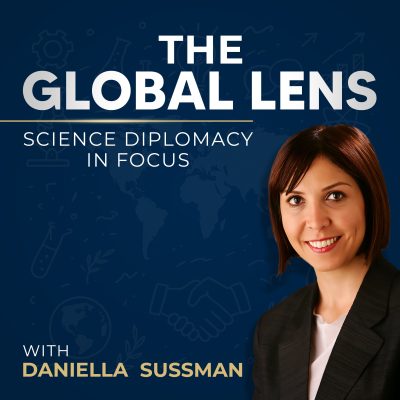
EP9 Inspiring Talk Series with Ugo Amaldi
Shownotes
OVERVIEW
In this episode of The Global Lens, host Daniella Sussman speaks with Professor Ugo Amaldi about science diplomacy and international scientific collaboration through the lens of CERN and global research cooperation. Drawing on decades of leadership in large-scale experiments, Amaldi reflects on how sustained partnerships shape the future of research, from quantum technologies to medical innovation. The conversation highlights how collaborative science advances discovery while building trust across geopolitical boundaries.
EPISODE SUMMARY
From Cold War collaborations with Soviet scientists to pioneering CERN experiments and advancing cancer therapy with hadron beams, this episode traces the evolution of global scientific cooperation. Amaldi shares lessons learned from managing large international teams, translating fundamental physics into life-saving treatments, and establishing durable networks across nations. The conversation also examines disparities in research investment within Europe and advocates for sustained, long-term commitment to science as a foundation for diplomacy and progress. Throughout, collaboration is presented not just as an ideal, but as a practical necessity for advancing knowledge and fostering peace.
In this episode, we discuss:
01:41 – Introduction to the importance of international scientific collaboration
03:30 – Cold War era science and cross-cultural cooperation with Soviet physicists
04:10 – Building large-scale international collaborations at CERN
05:54 – Balancing innovation and stability in complex experiments
09:08 – Transition from work in particle physics to pioneering cancer therapy
18:20 – European disparities in research funding and investment
21:35 – Advice to future scientists: curiosity, optimism, and collaboration
ABOUT THE GUEST
Ugo Amaldi is a particle physicist and pioneer in hadron therapy. A CERN Scientist Emeritus, he co-discovered the rising proton-proton cross section in 1973, founded and led the 500-member DELPHI collaboration at LEP, and proposed the cyc-linac accelerator for cancer treatment. In 1992 he created the TERA Foundation, leading to Italy’s CNAO center and influencing facilities worldwide. As Scientific Director of the Tera-Care Foundation, he now advances clinical helium facilities with CERN. Author of more than 600 papers (h-index 83), accelerator physics textbooks, and popular science books including Particle Accelerators: From Big Bang Physics to Hadron Therapy (Springer). Co-author of ~40 physics textbooks used by millions of students globally.
MENTIONED IN THE EPISODE:
⚉ (Reference) European Organization for Nuclear Research (CERN) - https://home.cern/
⚉ (Studies or Research) DELPHI experiment - https://home.cern/science/experiments/delphi
⚉ (Reference) National Center for Oncological Hadrontherapy (CNAO) - https://fondazionecnao.it/en/
⚉ (Reference) European Network for Hadron Therapy (ENLIGHT) - https://enlight.web.cern.ch/
CONNECT WITH UGO AMALDI:
⚉ Inspire HEP: https://inspirehep.net/
CONNECT WITH DANIELLA:
⚉ Podcast Website: https://glsd.ai/
⚉ LinkedIn: https://www.linkedin.com/in/daniellasussman/
⚉ Instagram: https://www.instagram.com/daniellasussmanglobal/
Alle Folgen von The Global Lens – Science Diplomacy in Focus